


SweetloreEncyclopedia of World Sweets (834)

Bratislavský rožok
Bratislavský rožok
The filling decides the shape, and an egg film bakes into a marbled pattern
Baked Sweets / Bratislava, Slovakia

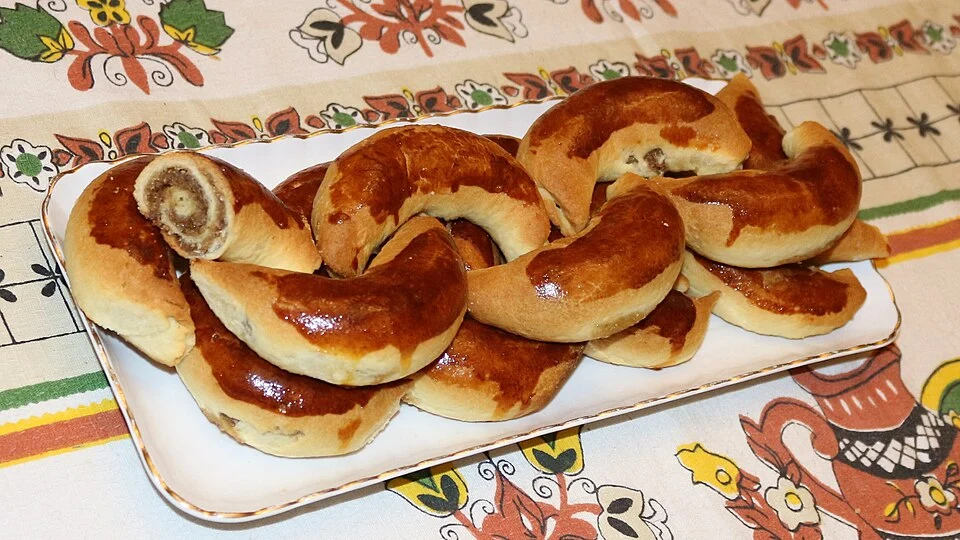
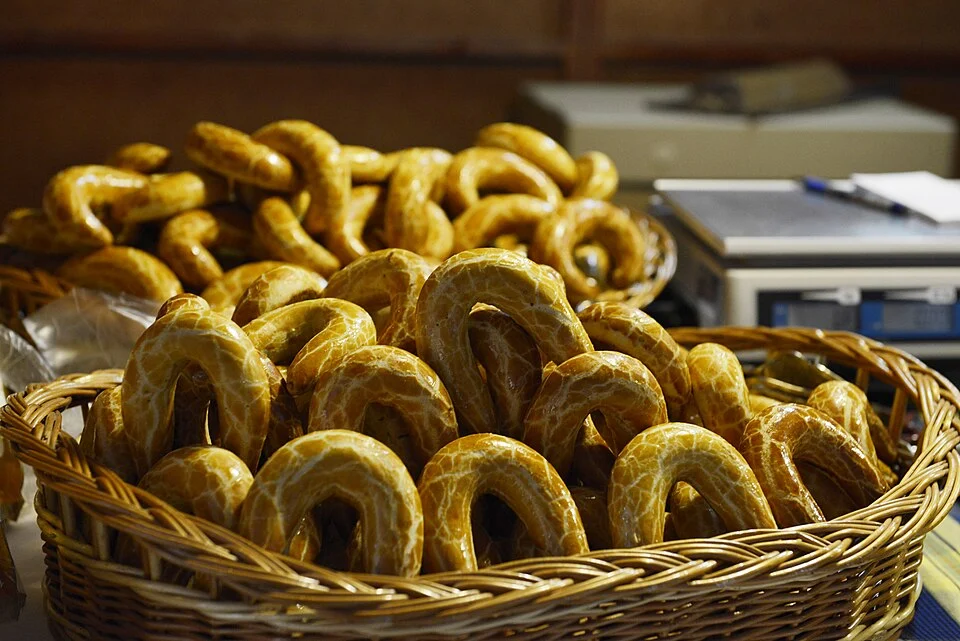
Break one of these baked crescents partway along its arc, and you will find a dense filling inside a glossy brown crust. Bratislavský rožok is a pastry named for Bratislava, Slovakia, and filled with either poppy seed or walnut. The poppy seed version is a horseshoe that tapers toward both ends, while the walnut version is shaped like a letter C with its opening left wide. The color of the cut face and the outline bent by hand before baking show which filling is inside. The pale streaks on the surface of both shapes appear in a film of egg that is brushed on and dried before baking.
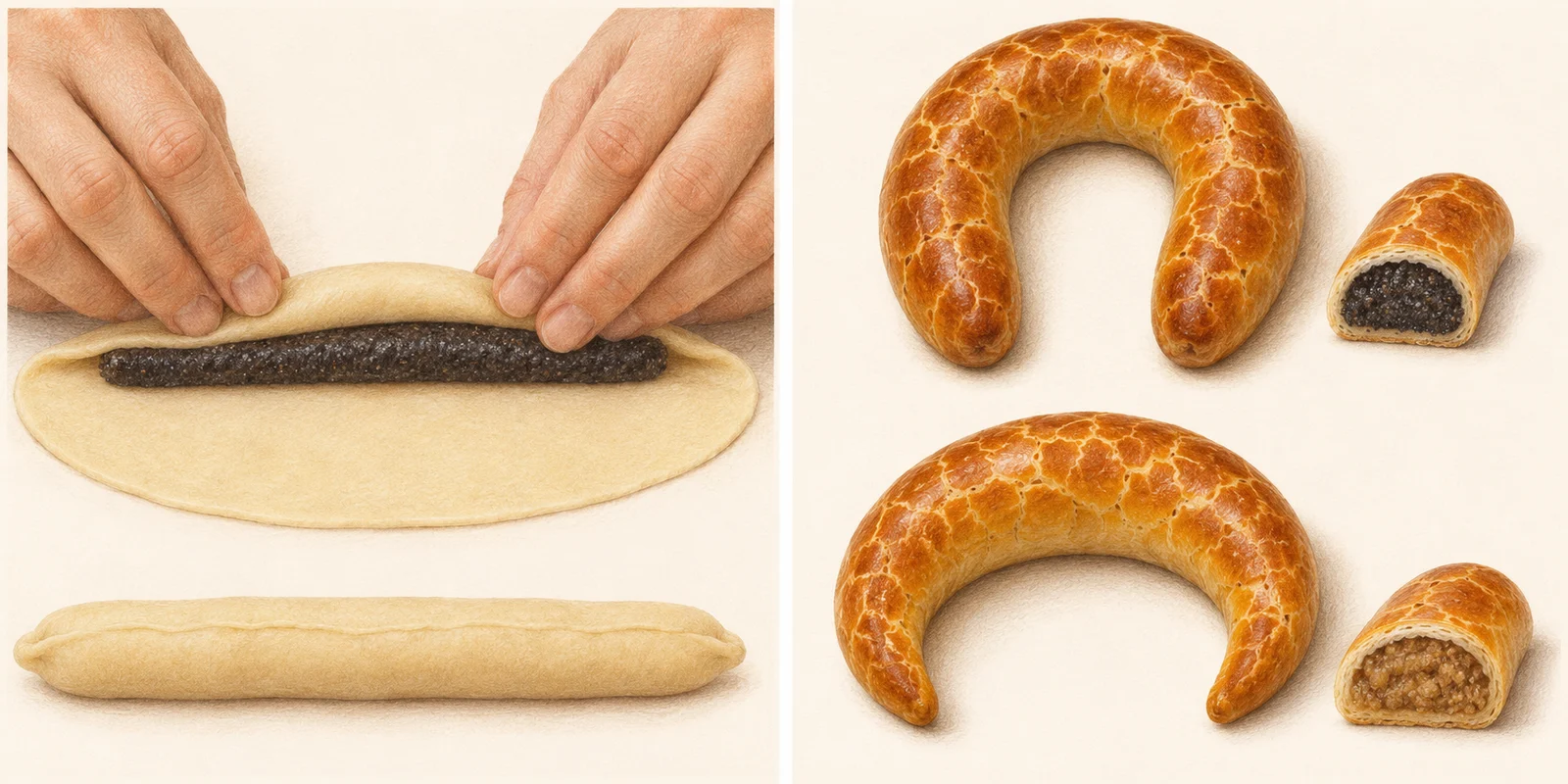
Rolling the Thin Dough Wide Enough to Enclose the Filling
According to the specification published in the Official Journal of the European Union in 2019, a baked piece normally weighs 40 to 70 grams, and the filling makes up at least 40% of the weight of the whole product. The crust is a few millimeters thick, firm yet crumbly when broken. The poppy seed filling that appears inside is dark gray to black, and the walnut filling is brown. The proportion of filling is measured not by the weights of the kneaded dough and filling when they are weighed out separately, but by the weight of one finished piece, crust included. The specification estimates the weight lost in baking at about 10%, depending on the weight of the piece and the firmness of the filling.
The thinly rolled dough is made with wheat flour, yeast, sugar, salt and fat, and the fat is set at no less than 30% of the weight of the flour. This proportion is measured against the weight of the flour, not the weight of the whole baked piece. The specification gives butter, lard and margarine as examples of the fat, and it also permits a method in which the fat is first mixed into the flour before the remaining ingredients are added. The Bratislava Tourist Board’s example uses 300 grams each of two flours of different grind and 180 grams of butter. The example from the Slovak public broadcaster STVR uses 320 grams of flour in total and 165 grams of butter. In both, the dough containing the fat is kneaded and left to ferment.
The working times in the specification are as follows. The dough is first left to ferment for 30 to 40 minutes. Once it has visibly risen, it is lightly kneaded again, cut into portions for single pieces and rounded. After resting for 15 to 20 minutes, each round is rolled into an oval 12 to 15 centimeters long and 2 to 3 millimeters thick. A rod of filling lies along the long side, and the thin dough wraps once around it. After wrapping, the thickness is adjusted toward both ends, the seam is closed evenly, and the piece is set seam side down on a baking sheet. On the sheet, poppy seed pieces are bent into a horseshoe and walnut pieces into a C. Because the filling is hidden before the pastry is finished, the way it is bent serves as a clue before one reads a bag or a label.
Poppy Seed Is Cooked; Walnut Is Bound with a Hot Liquid
In the Official Journal’s poppy seed filling, ground seeds are combined with melted, heated sugar. Poppy seeds mixed with ingredients such as milk powder, sweet breadcrumbs and raisins are added little by little to a liquid in which sugar has been dissolved, then stirred and cooked until a thick paste forms. Honey may be used instead of sugar. When the heat is turned off and the mixture cools, the filling firms up, and grated lemon zest or lemon paste is added, along with cinnamon or vanilla sugar as needed. The filling is brought from a state of loose, fine grains to a firmness at which it can be shaped by hand into a thin rod.
In the walnut example, ground nuts are combined with sugar or honey, raisins, milk powder, vanilla sugar or vanillin sugar, cinnamon and similar ingredients, and bound with boiling water. Hot milk is also given among the example ingredients. Unlike the poppy seed filling, it does not go through a stage of cooking down in a pot, and it is adjusted to a firmness that can be shaped once it has cooled. The specification allows up to one tenth of the weight of the poppy seeds or walnuts to be replaced with sweet breadcrumbs, and it also mentions using plum or apricot jam and raisins for flavor. The firmness that lets the rod hold its shape when wrapped is common to both fillings, whose grains differ in color.
Actual recipes differ in the liquid that goes on the heat and in the flavorings. In the public broadcaster’s example, milk is brought to a boil with sugar and vanillin sugar, ground poppy seeds are added and briefly cooked, and then butter, lemon zest and cinnamon are mixed in. The tourist board’s example binds the poppy seeds with boiling water and uses hot milk and rum for the walnuts. Poppy seed and walnut can be told apart by color, but whether the liquid that loosens a given poppy seed filling is water or milk can be learned only from the method.
According to the specification, the guideline for the liquid used when poppy seeds are first boiled or scalded with boiling water is 35 to 40% of the quantity of poppy seeds. This is neither a standard that determines the color of the filling that appears on the cut face nor the proportion of filling in the finished product as a whole. It is a guideline for passing hot liquid through the grains before the sugar is melted and heated. The mixture is then cooked and, once cool, flavored, and only then does it become a filling that can be wrapped by hand.
Forming the Egg Film Before Baking
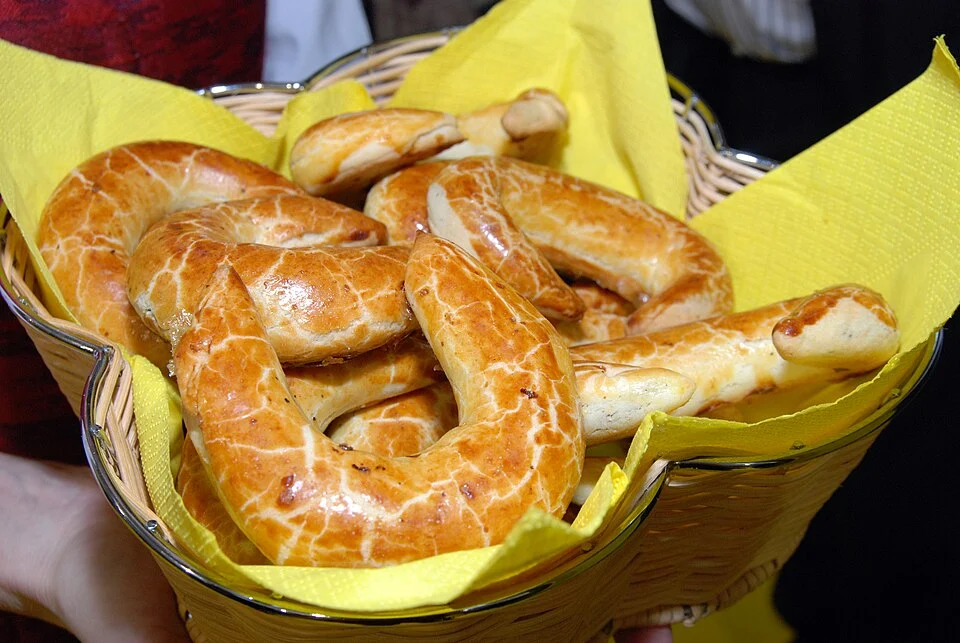
Whole egg or egg yolk is brushed onto the dough on the baking sheet, which is then left in a cool, airy place. When the egg on top has dried a little and the dough has risen slightly, the egg is brushed on again. After the film has dried once more, the pieces go on to the final proof, and the risen dough is baked without steam. As the inside of the dough expands, fine cracks form in the dried film. This is why delicate pale lines run across the glossy brown crust. In a basket of the pastries, each piece keeps its own branching, net-like pattern of lines on its upper crust.
In the public broadcaster’s example, egg yolk thinned with water is brushed on first, the dough is left for at least 15 minutes to dry and proof, and egg yolk is brushed on once more. In the tourist board’s example, egg yolk is thinned with a little milk and dried in an airy place for about 30 minutes, and the pieces are then moved to a warm place. In both, the egg on the surface is dried before the next step. The specification gives a baking range of 170 to 220°C: 10 to 12 minutes for pieces weighing 40 to 50 grams, and 15 to 20 minutes for pieces of 50 to 70 grams. The public broadcaster suggests 15 to 20 minutes at 200°C and finishes the golden-brown pieces by brushing them with melted butter. The egg film is formed before baking, while the butter is fat added to the hot pastry after it comes out of the oven.
A Shop That Sold Both Fillings, and the Town’s Old Name
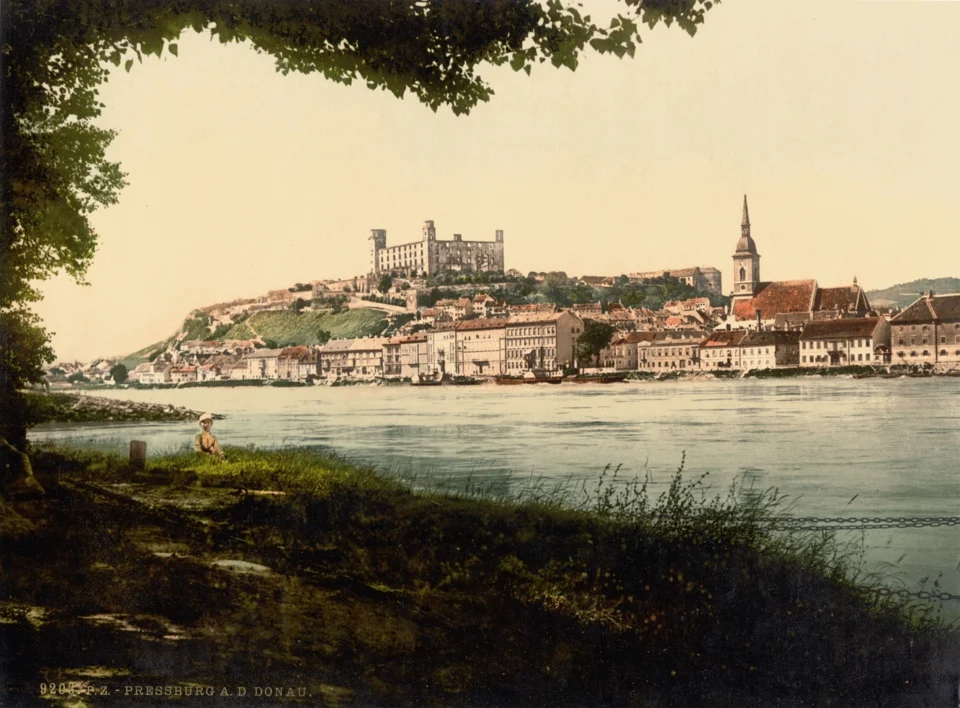
Records of both fillings being sold together can be traced to the second half of the 19th century. In the 1863 Pressburger Wegweiser, which the specification cites, Anton Pressberger’s shop advertised Beugel with poppy seed and with walnut. In Tivadar Ortvay’s 1905 history of the town’s streets, Rauda, who took over Scheuermann’s shop, is said to have made horseshoe-shaped pastries with poppy seed and walnut and to have raised the town’s reputation. The old records of the two fillings on sale and today’s specification that gives the walnut pastry a C shape come from sources of different periods.
For still older records, the tourist board cites a 1599 rule of the bakers’ guild that required pretzel bakers also to make Beigel. The specification cites a book by Vladimír Tomčík that mentions an inn’s ledger of 1590. Both offer leads for searching for old records of a pastry. Neither account says that the two fillings were given today’s outlines or that patterns were made with egg.
The specification takes from a book published in 1992 the story that Scheuermann set out a new filled pastry in his shop window on St. Nicholas Day in 1785. The city’s tourist board and a regional cultural organization, on the other hand, give 1836 as the year Scheuermann’s shop opened, and according to the regional cultural organization, the original address of the shop also differs from the one traditionally cited. The year 1785 is the date of an anecdote about origins. It can be read separately from records, such as 19th-century advertisements and street histories, that allow one to check what was sold at which shop.
The specification gives 1834 as the year Schwappach’s shop opened and records that horseshoes with poppy seed and walnut were also sold there. In addition to the succession of the shop from Scheuermann to Rauda, the names of the baker Johann Korče, his son Hans, and Emil Kastner also appear. Alongside the story of a single shop window where the pastry was first sold, records remain of several shops baking pastries with the same two fillings.
Beyond the town, there was a service that wrapped and shipped pastries from the shop, and there were newspapers that spread the method. Gustáv Wendler’s shop on Štefánikova Street handled mail orders, and the tourist board reports shipments to Budapest, Trnava, Esztergom and other places. The specification also records that the Vienna newspaper Neue Freie Presse published a recipe for "Pressburger Kipfel" on 16 April 1938. After the Second World War, it was also taken up in vocational education in baking and confectionery in the former Czechoslovakia. The place name survived not only in goods bought at shops in the town but also in mail, newspapers and the settings where craftsmen were trained.
One Name in Three Languages, and the Shared Shape
The Slovak name Bratislavský rožok spread after the First World War, around the time the town came to be called Bratislava. The German name for the town, Pressburg, survives in Pressburger Kipfel, and the Hungarian name, Pozsony, in Pozsonyi kifli. Kifli broadly refers to horned or crescent-shaped breads and pastries, and with Pozsonyi added, it refers to the filled type described here. The name Pozsonyi kifli, which is also made in Hungary, contains an old name for present-day Bratislava.
In 2012, on Slovakia’s application, the EU entered the names in three languages in its register of Traditional Specialities Guaranteed (TSG). The revised specification published in 2019 lists Bratislavský rožok and Pozsonyi kifli as registered names. What the TSG sets out are traditional characteristics such as the proportion of filling and the method of brushing with egg. That pastries of the same family have been made in Slovakia and Hungary, and that a pastry name containing a place name is protected in connection with its method of production, are compatible.
The specification describes the pastry as sold by the piece in producers’ shops, confectioners, cafés and similar outlets. When it is sold unpackaged, the TSG mark may be placed on a price tag or information board near the product name. The product is made by hand and baked to order, not par-baked, frozen and thawed for finishing. After baking it is cooled and prepared for shipping or sale, and its shelf life at room temperature is given as 3 to 10 days, depending on the amount of yeast used. The mark seen beside the name at the time of purchase and the shape seen when one picks up a piece are different parts of the same specification.
Before EU registration, the technique of enclosing the two fillings was already shown in competitions. In 1999 and 2005, a Slovak bakers’ cooperative took it to baking competitions in Paris, and in 2007, nine teams from three countries took part in the Danubius Gastro exhibition in Bratislava. Even when the product’s name is passed down in a different language, the distinction between horseshoe and C, the lines on the crust and the filling revealed when it is broken all give clues, so that the quality of a piece can be judged both from the outside and from the inside.
Glossary
- Beugel
- A word that appears as an old name for the pastry of Bratislava. Local-language sources also give spellings such as bajgel.
- Pozsony
- The Hungarian name of Bratislava. The first part of Pozsonyi kifli comes from this place name.
- Kifli
- A Hungarian word for horned or crescent-shaped breads and baked goods. It is also used for types without a sweet filling.
- Recipe (ルセット)
- The proportions of ingredients and the method of preparation.
- Traditional Specialities Guaranteed (TSG)
- An EU scheme that protects names associated with traditional raw materials, composition or methods of production.


