


SweetloreEncyclopedia of World Sweets (834)

Khaliat al-Nahl
Khaliat al nahl
Small cheese-filled buns baked like a honeycomb
Fermented Pastries / Yemen and the Arabian Peninsula

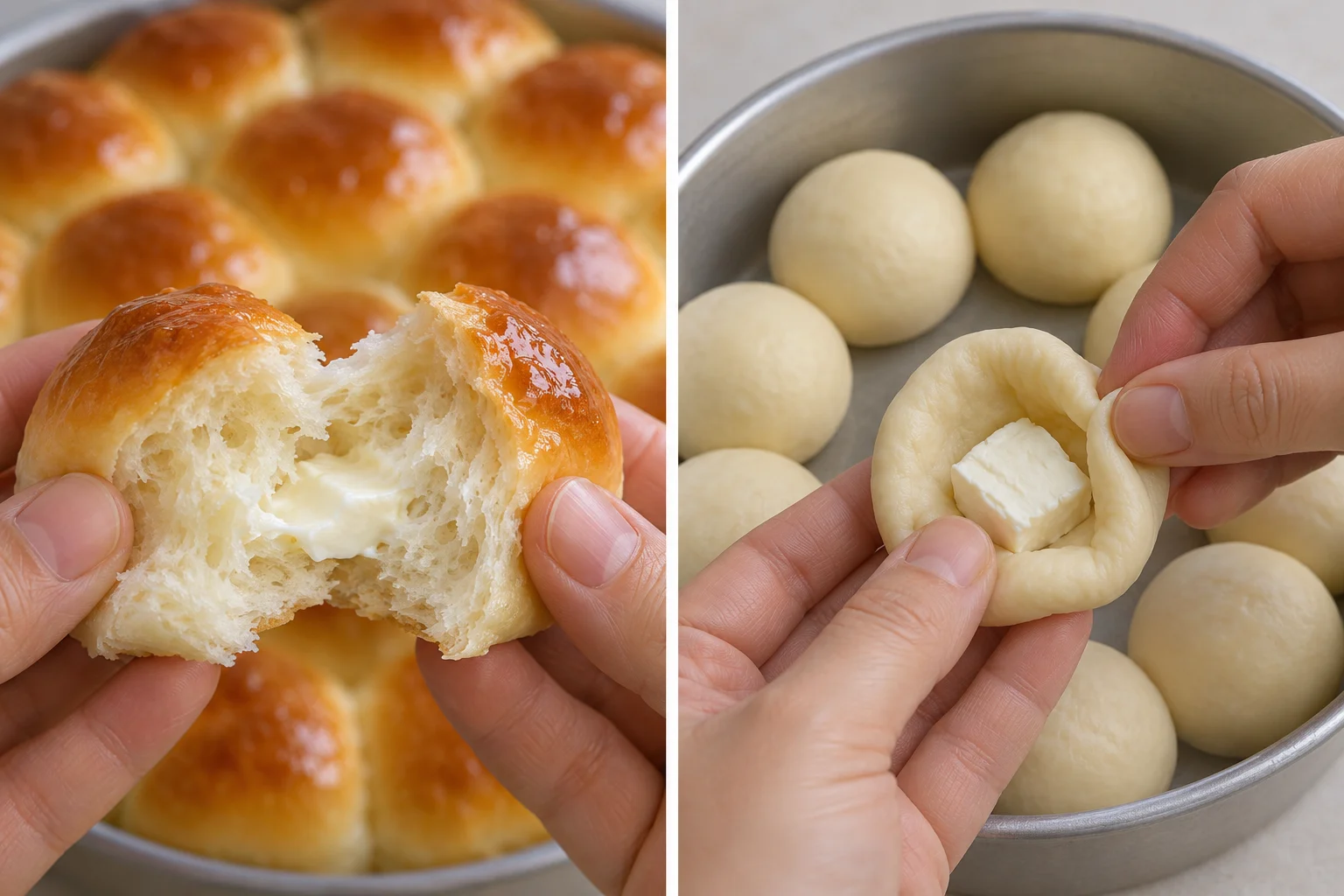
Tear one bun from the round pan and, beneath the brown crust on top, you find the white side that pressed against its neighbor. Bite to the center and there is cheese, while the top crust carries the sweetness of honey or sugar syrup. Khaliat al-Nahl (خلية النحل) is a pastry of small yeasted buns baked packed together. Its Arabic name means "beehive." It comes from the way each round bun, wrapped around its cheese, swells in the pan and presses against the others, forming a pattern like honeycomb.
Set the Balls Apart and Wait Until They Touch
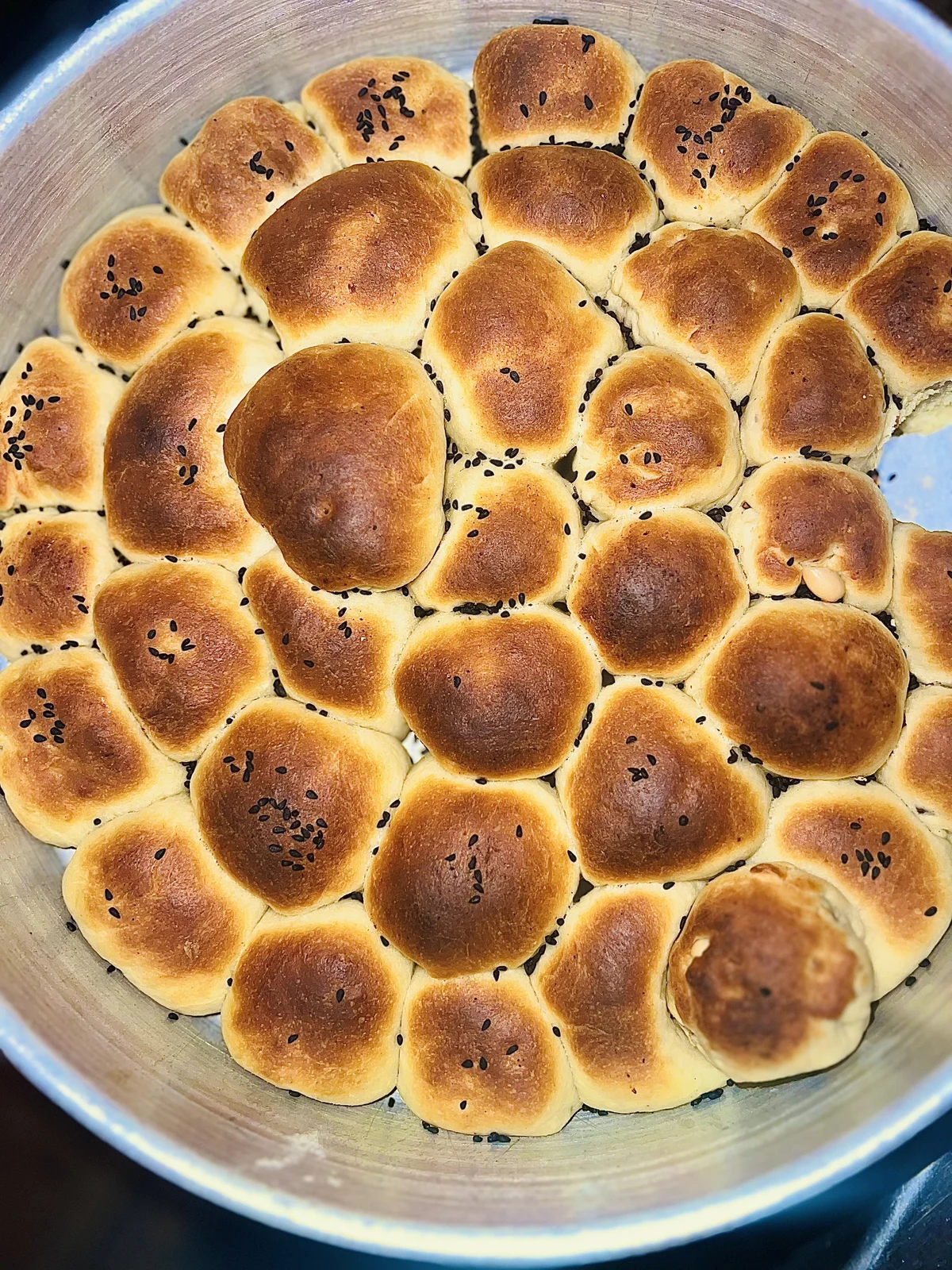
Look at a single ball. In the middle of the pan it is surrounded by other balls, while at the edge one side faces the rim of the pan. Even if the dough is divided and rolled to the same size, the number of faces that touch a neighbor after proofing depends on where the ball sits. In photographs of the baked bread, the tops stay rounded, while the boundaries between balls become nearly straight. At the edge the balls follow the curve of the pan, so they do not all look like regular hexagons. The shape seen from above is determined by the size of the balls and by the spacing at which each one is placed in the pan before baking.
In Reem Assil’s cookbook Arabiyya, the first rise takes about 1 hour. The dough is divided into 6 pieces, and each of those into 6 more, making 36 balls of about 21 g each. After rolling and resting them for 10 minutes, press each ball with your fingers into a circle about 5 cm across. Place 1 teaspoon of mascarpone in the center of each and gather the edges to close. Set the balls seam side down about 1.3 cm apart in concentric circles, offsetting their positions from ring to ring. Leave them for 1 to 1½ hours, and begin baking when the balls have puffed up and just touch their neighbors. The recipe fills two 9-inch round pans or one 16-inch pan.
Allison Albakri, who learned the bread from a neighbor from Saudi Arabia, makes walnut-sized balls, each enclosing ½ to 1 teaspoon of cream cheese, and arranges them without overcrowding the pan. Zahra Muhammad Barrak, who contributed a recipe to Al-Kawthar in Karbala, Iraq, also leaves narrow gaps so that the balls almost touch, and lets them rise further. Both arrangements allow room for the balls to swell later. Even without the rim of a round pan, small breads can be arranged so that they touch one another.
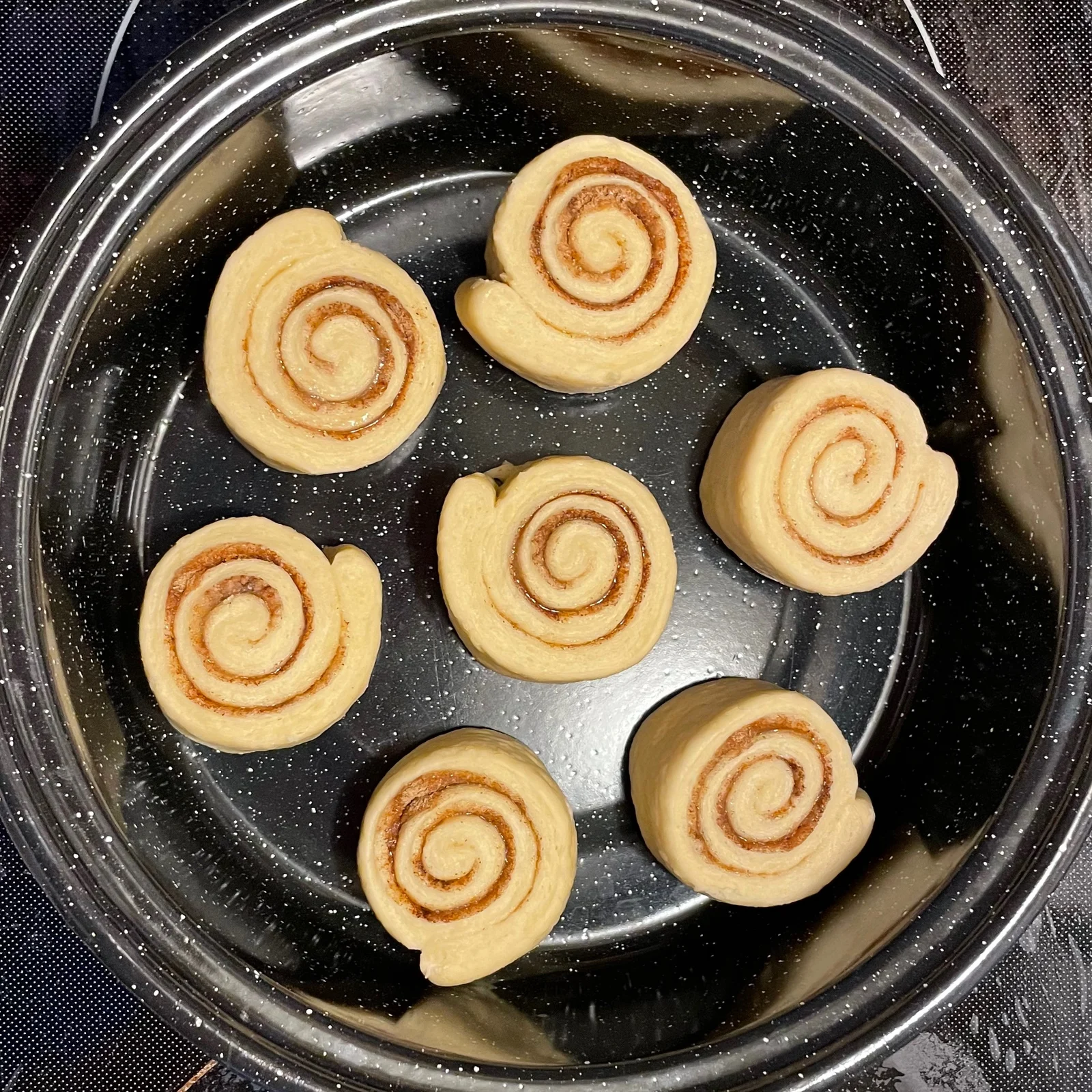
The maker behind Sheba Yemeni Food, which presents Yemeni cooking, first divides the dough into three, then repeatedly cuts the pieces in half to obtain 48. Kiri cheese is prepared in the same number: 12 portions, each cut into four. The balls are set about 1.3 cm apart in a 14-inch round pan and left for 1 to 1½ hours, until they roughly double in size. Using two smaller pans is also an option. How many balls fit in one pan depends not only on how large each ball is made, but also on the size of the pan and how far apart the balls are placed before baking.
Cheese Wrapped One Ball at a Time, and the Milk in the Dough
Assil’s dough contains milk, eggs, butter, and yogurt or labneh. Albakri adds milk, yogurt, and olive oil, and uses both baker’s yeast and baking powder. The Karbala magazine page also uses yeast and baking powder, measures water and powdered milk separately, and puts no egg in the dough. Some doughs measure the milk solids and water of powdered milk separately, and others include the tang of yogurt, so the breads already differ in flavor before any syrup is poured over them.
Hakim Sulaimani, who runs Yaffa Cafe in Brooklyn, divides chilled cream cheese into 24 portions of about 1 teaspoon each, and rolls and chills each portion in advance. He uses oil on his hands and the work surface to handle the soft dough, divides it into 24 equal pieces, and wraps one portion of cheese in each. The balls go seam side down in a pan about 20 cm square. Dividing the cheese before wrapping keeps the amount in each ball even. Where the cheese is placed on the flattened circle of dough, and where the edges are gathered and closed, determines the thickness of the dough at the center and at the seam. Assil, who arranges 36 balls in a round pan, and Sulaimani, who fits 24 into a square pan, both produce pieces in which every serving has its own core of cheese.
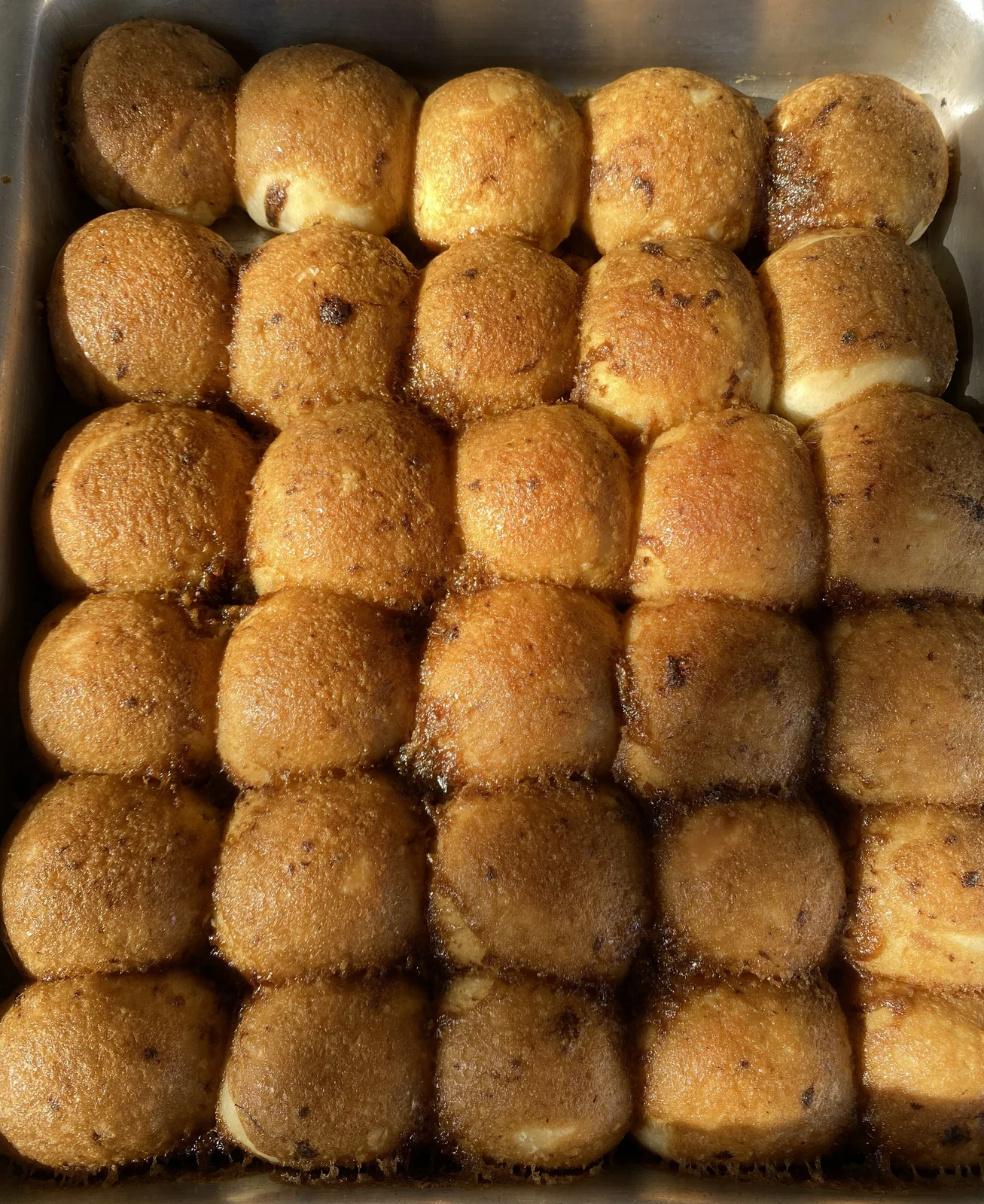
The cheese is not limited to cream cheese. Assil’s recipe offers a choice of mascarpone or cream cheese. The Karbala magazine page names Kiri and Rumi cheese for savory fillings and nuts for sweet ones. The impression of each bite also changes depending on whether the first part to touch the mouth is the top crust, glossy with honey, or the white side of a torn bun. The filling and the sweetness on the outside are added separately, so that milk and the saltiness of cheese come through after the bite into the soft bread. Assil herself lets the bread cool slightly after baking, cuts it into wedges, and serves it with tea or coffee. Besides tearing along the seams, you can also cut a whole portion from the pan.
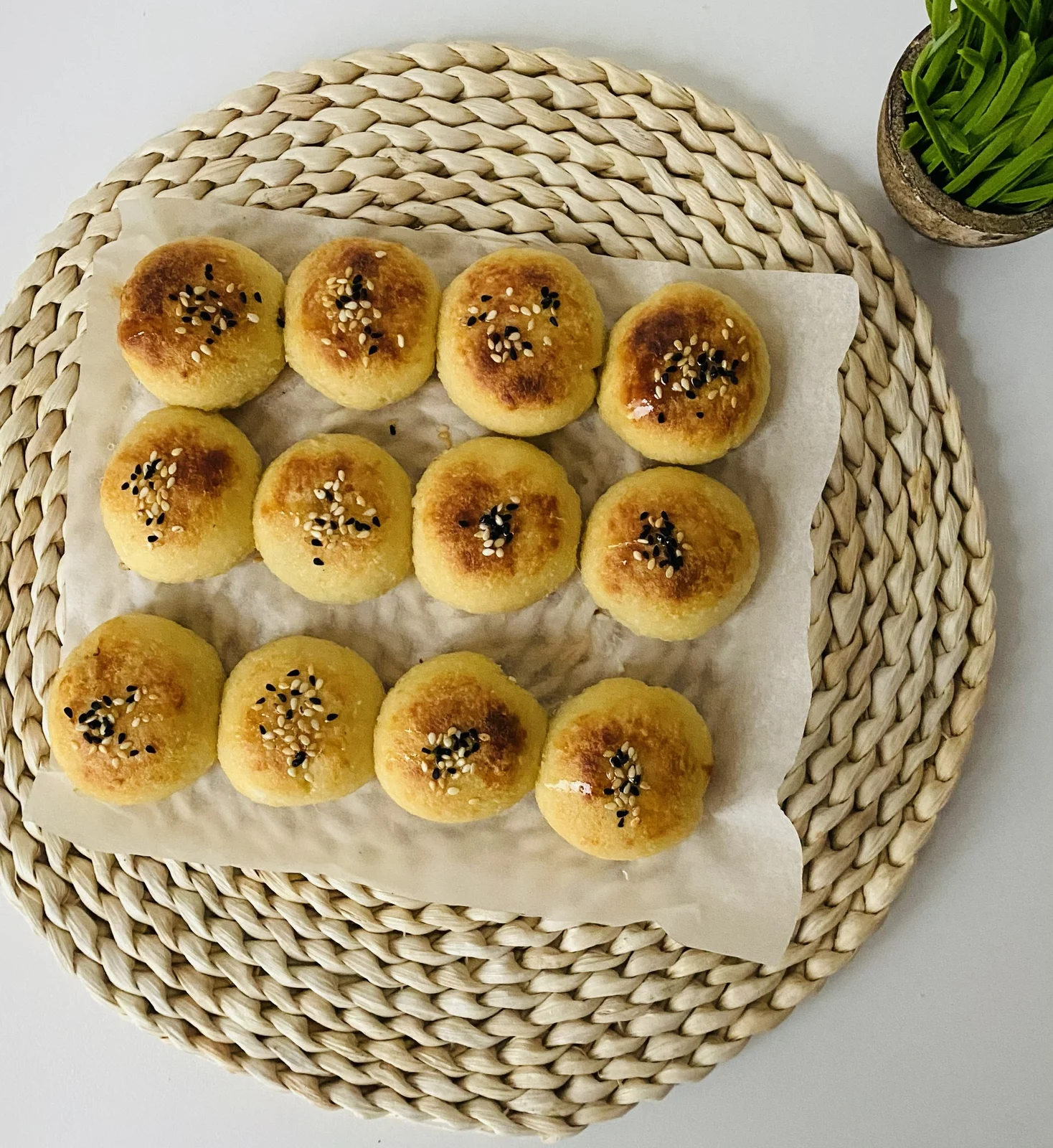
The proofing times also differ. In the Karbala magazine page, the kneaded dough rests for at least 30 minutes and rests again briefly after the balls are arranged. Sulaimani leaves the soft dough for about 1 to 1½ hours, until doubled, then arranges the 24 rolled balls so that they touch one another and bakes them. In Assil’s version the balls are about 1.3 cm apart when placed in the pan, so the steps leading to similar seams differ. Whether the balls are set against their neighbors before baking, or are left to move together in the pan, also changes the time allowed between shaping and baking.
Where the Honey Runs and Where the Seeds Stay
The syrup Sulaimani uses is clover honey in which crushed green cardamom pods have steeped for about a week. When he is in a hurry, he stirs in ground cardamom. After the buns are baked to a pale golden brown, he pours the warmed honey over them and scatters white sesame and black nigella seeds on top. The fragrance passes into the honey and spreads over the crust, and the seeds add their aroma and texture as you bite. Assil warms honey and water until the honey dissolves, adds orange blossom water, rose water, and lemon juice, and lets it cool. Pouring the cooled liquid over the hot bread just out of the oven is her way of finishing it.
The Sheba Yemeni Food recipe, which boils sugar and water, also uses honey. After 2 cups of sugar and 1 cup of water are boiled for 5 to 10 minutes, 1 tablespoon each of honey and orange blossom water is added. At Yaffa, spices are steeped in honey, and that honey itself is used on top. Honey appears in both, but in one it is part of a boiled sugar syrup, and in the other it is the liquid that covers the surface. In some versions the dough is brushed with milk and topped with seeds before baking, and in others the seeds are scattered after the honey is poured. The difference is whether the seeds touch the unbaked dough or the warm honey.
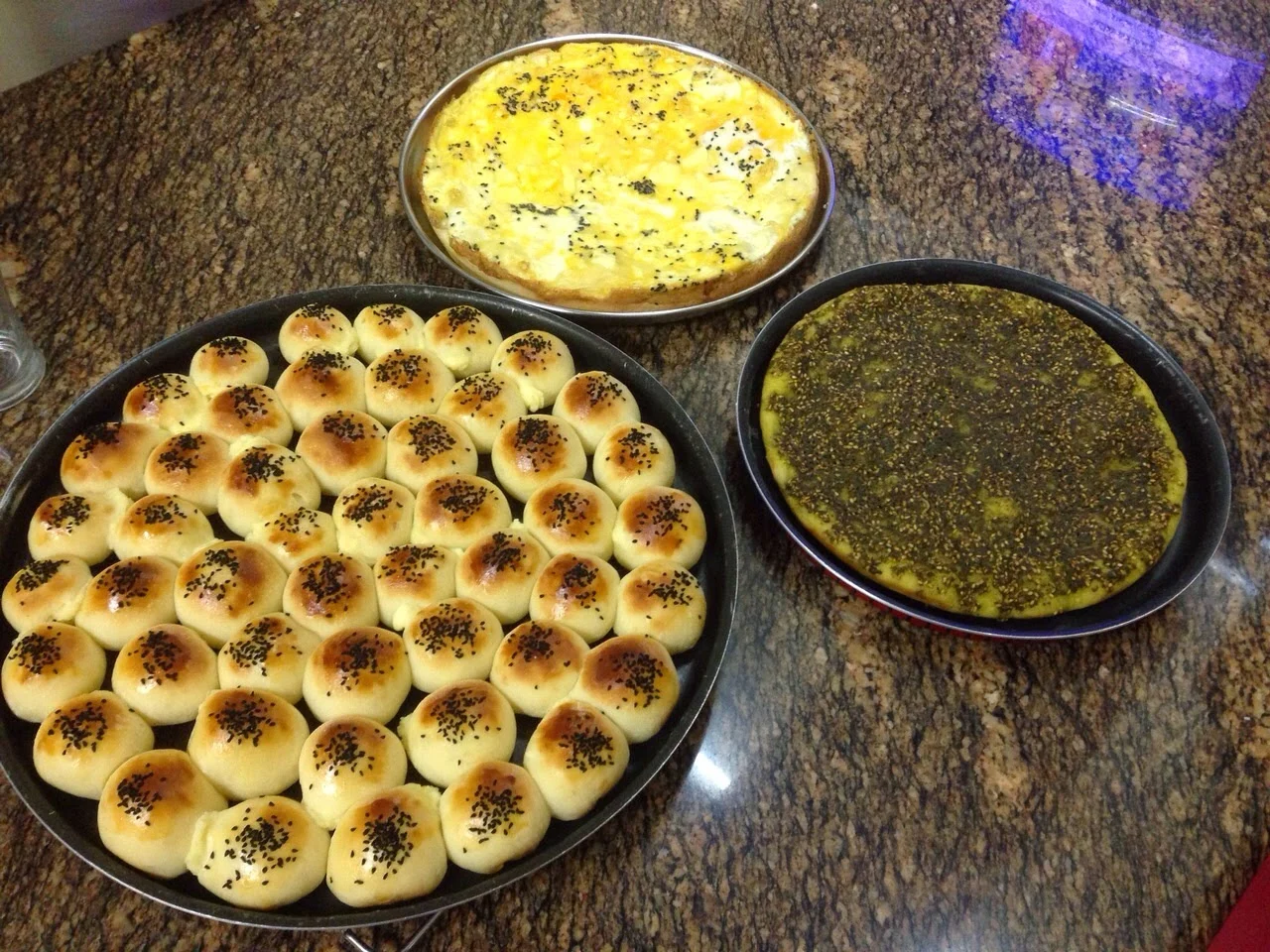
In a home recipe that Umm Abdullah of Yemen published in 2020, the dough rises for 1 hour, is wrapped around cheese, and is arranged on a round baking tray. Egg yolk mixed with vinegar is brushed over the tops, sesame and nigella seeds are sprinkled on, and the bread is baked at 180°C. The sweetness poured on from outside is sweetened milk or condensed milk, applied after baking. A clear honey or syrup and a finish containing milk differ in color, but both flow along the curve of each ball and settle into the grooves at the edges where the tops meet. The visible honeycomb is made by the pan, while the sweetness and gloss are added after baking.
In the Karbala recipe, milk is brushed on before baking, and sesame and nigella seeds are sprinkled on for the savory version. For the sweet version, a sugar syrup is poured on after baking. Sweet fillings are also an option inside. The magazine names nuts specifically, and there is another example that uses chocolate as the sweet filling. Aparna Balasubramanian made a lightly sweetened chocolate version with half the dough, and Sai Geetha Pai writes about a sweet version filled with dates and nuts and a savory example baked on another day. Some combinations give the honey outside and the milk inside different flavors, while other recipes put sweetness inside as well. Breads with different fillings and finishes can also share the same honeycomb-like arrangement.
A Festival in Oman, Taken from the Tray One Bun at a Time
The cook Dina Macki writes in Bahari about Karankasho, celebrated on the 14th day of Ramadan, mainly on the northern coast of Oman. After prayers, children visit friends, relatives, and neighbors and receive sweets and small gifts. Her aunt Nasra would bring out the bread on its tray and wait for the children, who ran up and tore off one bun each to take away. Even as an adult, Macki recalls, she still craves cheese-filled bread during Ramadan, though she knows what is inside.
Macki’s recipe for 20 buns wraps both mozzarella and a soft processed cheese in a single dough. After the balls are arranged in the pan, they proof for 30 to 45 minutes. A syrup made with honey, orange juice, and crushed cardamom is cooled and poured over the hot bread. The amount can be adjusted by pouring it on or brushing it on, and the bread is served warm after about 10 minutes. It is baked at 200°C, or 180°C with a fan, for 20 to 25 minutes. The dough is brushed with milk and topped with sesame before baking, and crushed sea salt is also sprinkled on after the syrup. The bread is served when the syrup has soaked into the crust, but not cooled for long, so that the cheese at the center can be eaten while still melted. Set beside the home recipe from Yemen that pours sweetened milk over the bread, it shows that home cooks place the sweetness on the outside while choosing for themselves the aroma and the use of milk.
From Homes Shared over Tea to Cafés Across the Sea
The Yemeni home post carries a Ramadan tag. The post does not say at which meal the bread is served. Albakri learned the recipe from her Saudi neighbor after the two began drinking tea together almost every week. Because the neighbor measured ingredients with coffee cups, teacups, and table spoons, the amounts that the writer converted into standard measures cover a range. The numbers used to convey a single household batch also differ between a recipe learned over tea and one standardized in grams and counts for publication.
The place where Assil encountered the bread was Qahwa House in Dearborn, Michigan. On the walls were photographs of the owner’s family growing coffee beans in Yemen, and on the counter were pastries fragrant with honey. She writes that the coffee was served not only in modern pots but also in long-handled copper vessels kept warm over candle flames. Sulaimani named Yaffa Cafe in Brooklyn as the place where he offers the bread alongside strong Yemeni coffee. In shops in different towns, these are cases in which the bread and the drink traveled together.
A cookbook bearing Yemen’s name, a neighbor from Saudi Arabia, a magazine from Iraq, and a festival in Oman do not settle the city or the era in which the bread originated. Still, the account of taking one bun at a time from a tray in Oman conveys well what was given the honeycomb shape. When the cheese is wrapped it is an independent ball, when baked it is one large sheet joined to its neighbors, and when served it is again a single bun. The size handled by hand changes at each stage, so the form made in the kitchen can also be passed to people at the table.
Glossary
- Khaliat al-Nahl (خلية النحل)
- Arabic for "beehive." Spellings such as Khaliat al Nahl and Khaliat Nahal are also seen in Latin script.
- Nigella
- a small black seed used as a spice. Here it is used on the surface of the bread together with white sesame.
- Cardamom
- a strongly aromatic spice. Sulaimani infuses honey with its fragrance.
- Sweetened milk
- a dairy product with sugar added. In home recipes, it is poured over the baked bread as a finish.


