DRUG

パレード伏見洋菓子店

SweetloreEncyclopedia of World Sweets (834)

SWEETS&CAKES

Kheer Kadam

Kheer kadam

A Bengali sweet that treats milk in two ways

Sugar Confections / Bengal region, India

Kheer Kadam: one whole pale yellow ball with a granular surface beside a halved one, its yellow outer layer surrounding a round white core.

Cut open a ball coated with granules, and the white outer dough surrounds a small round core. Bengal’s Kheer Kadam (ক্ষীর কদম) wraps a bite-sized, syrup-soaked rasgulla in sweet concentrated milk. Both the outside and the inside are made from milk, but the outer milk is reduced in a pan, while the inner milk is curdled with acid and then cooked in sugar syrup. Sweets with the same structure are made in Malda, West Bengal, where they are called Ras Kadam, and in Meherpur, Bangladesh, where they are called Roshkodombo.

Halve one and you can see where the core sits and how thick the outer layer is. When you bite in, the surface granules and the dense milk dough break down first, then the teeth meet the springy core and the syrup is released. The finishing granules change from shop to shop and from home to home: poppy seeds, sugar, or grated milk solids. Whatever the granules, the interviews and recipes agree on one point: the inner ball and the shell that wraps it are prepared separately.
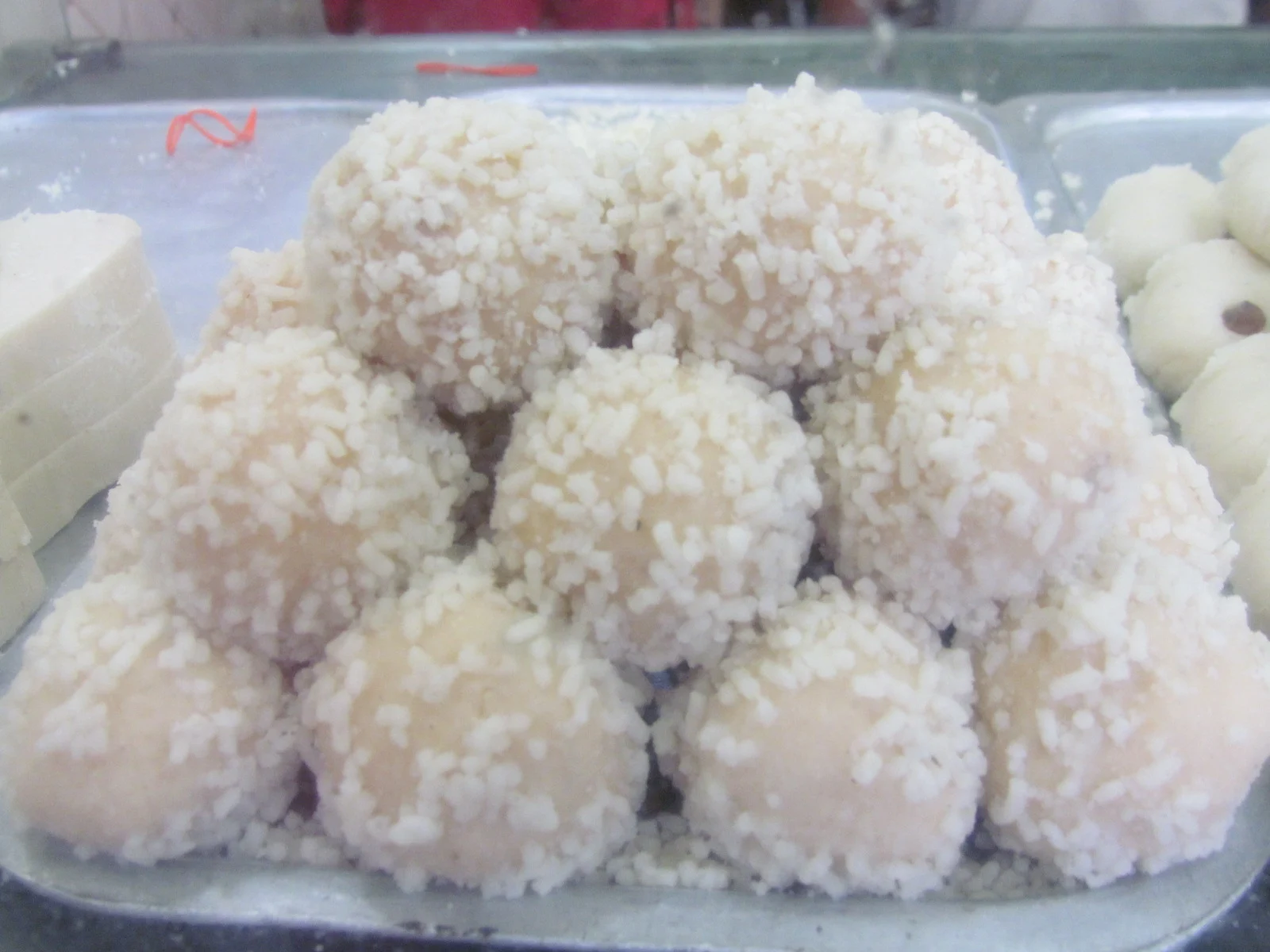
Kheer Kadam coated in coarse white granules, piled on a plate
Kheer Kadam photographed in Karda, West Bengal. The photograph does not reveal what the surface granules are made of. Satadaldas1966, Wikimedia Commons, CC BY-SA 4.0.

Curdling the Milk for the Rasgulla, Reducing the Milk for the Shell

To make the core, an acid such as lemon juice is added to hot milk. The curds that separate from the whey are lifted out in a cloth, giving soft chhena. The chhena is drained, kneaded by hand until the grains are no longer noticeable, and rolled into small balls. These are cooked in sugar syrup to make syrup-soaked rasgulla cores. The balls do not simply finish cooking in the whey. The milk solids are first taken out and rolled, and only then do they meet the sugar and water boiled in a separate pot.

In the Zayka Ka Tadka recipe, the rolled chhena goes into the syrup for about seven to eight minutes, then is moved to a cloth to cool. The recipe moves through the pot where acid is added to boiling milk, the cloth that removes the whey, and the pot of syrup in which the round cores are cooked. The shell is not closed around the core while it is still hot; the cores are set out on a plate, ready for the next step. Even after the core pot is put away, two jobs remain: kneading the khoa and preparing the surface granules.
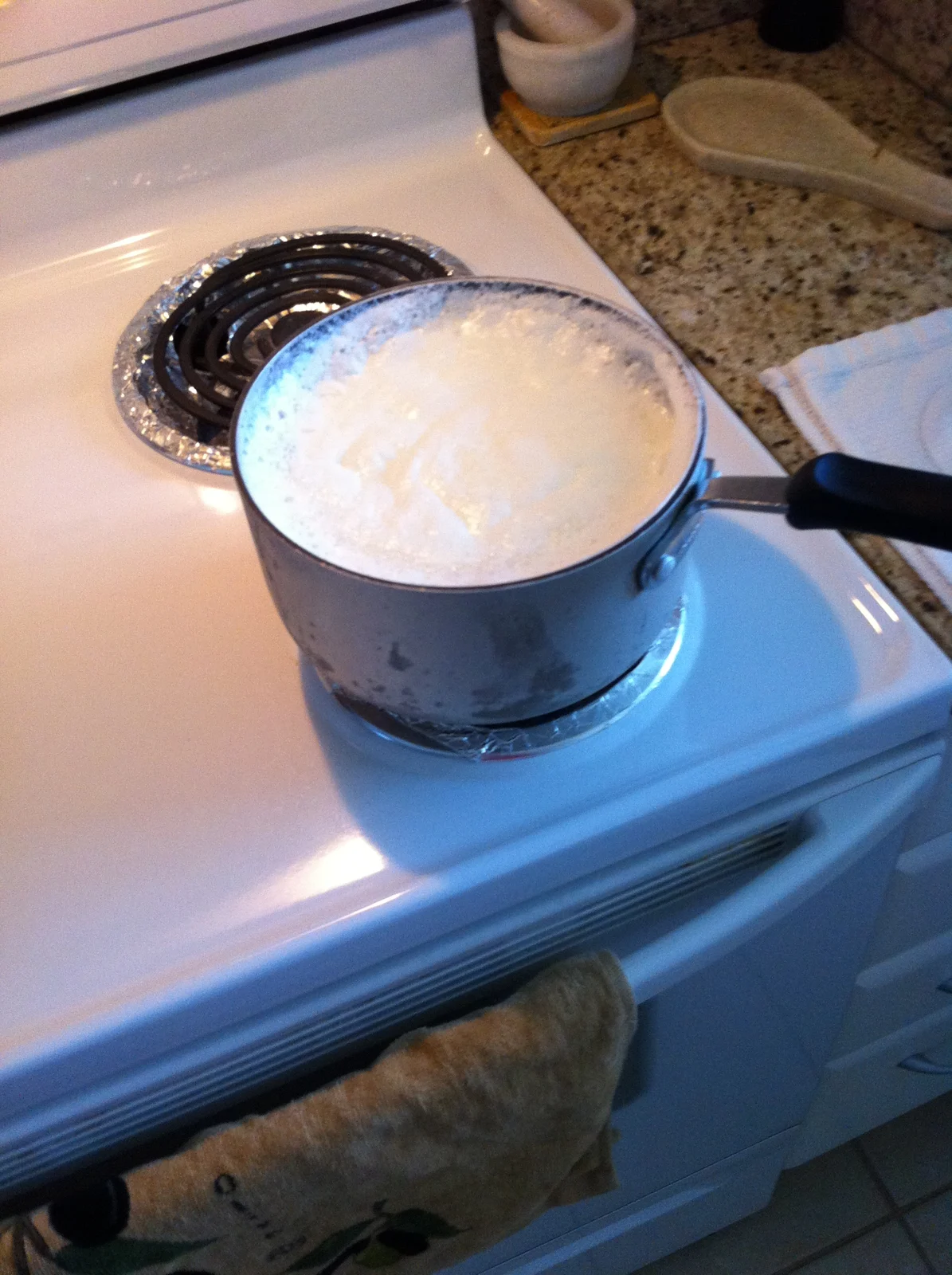
Milk being heated in a pot on a stove to make paneer
A reference photograph showing the heating of milk before the solids are taken out. The pot shown is one used to make paneer. Ian Brown, Wikimedia Commons, CC BY 2.0.

The khoa used for the outer dough is also called mawa. This milk is heated in a pan so that the water evaporates and the milk thickens. The way water is removed differs from the acid-set core, and the aroma of long-heated milk remains. A Parsi Dairy Farm product is described as small rasgullas wrapped in sweet mawa, and its ingredients list khoa and sweetened condensed milk. Both are milk-based doughs, but once the core is wrapped, the shell does not need to copy its springiness. It is made into a dense dough that can be smoothed over finger marks and shaped into a ball.

The outer kheer of this sweet needs a different firmness from the kheer made by simmering rice in milk and ladling it into a bowl. The core is placed in the center and the edges are gathered, and the dough should hold the wrapped shape in the hand. In BongCook’s home recipe, the concentrated milk is divided into a portion for kneading and a portion to be grated at the end and applied to the ball. The kneaded milk becomes a single skin over the core, and the grated milk is felt grain by grain under the fingers on top of it. The same ingredient builds the thickness seen in cross-section and also roughens the surface.
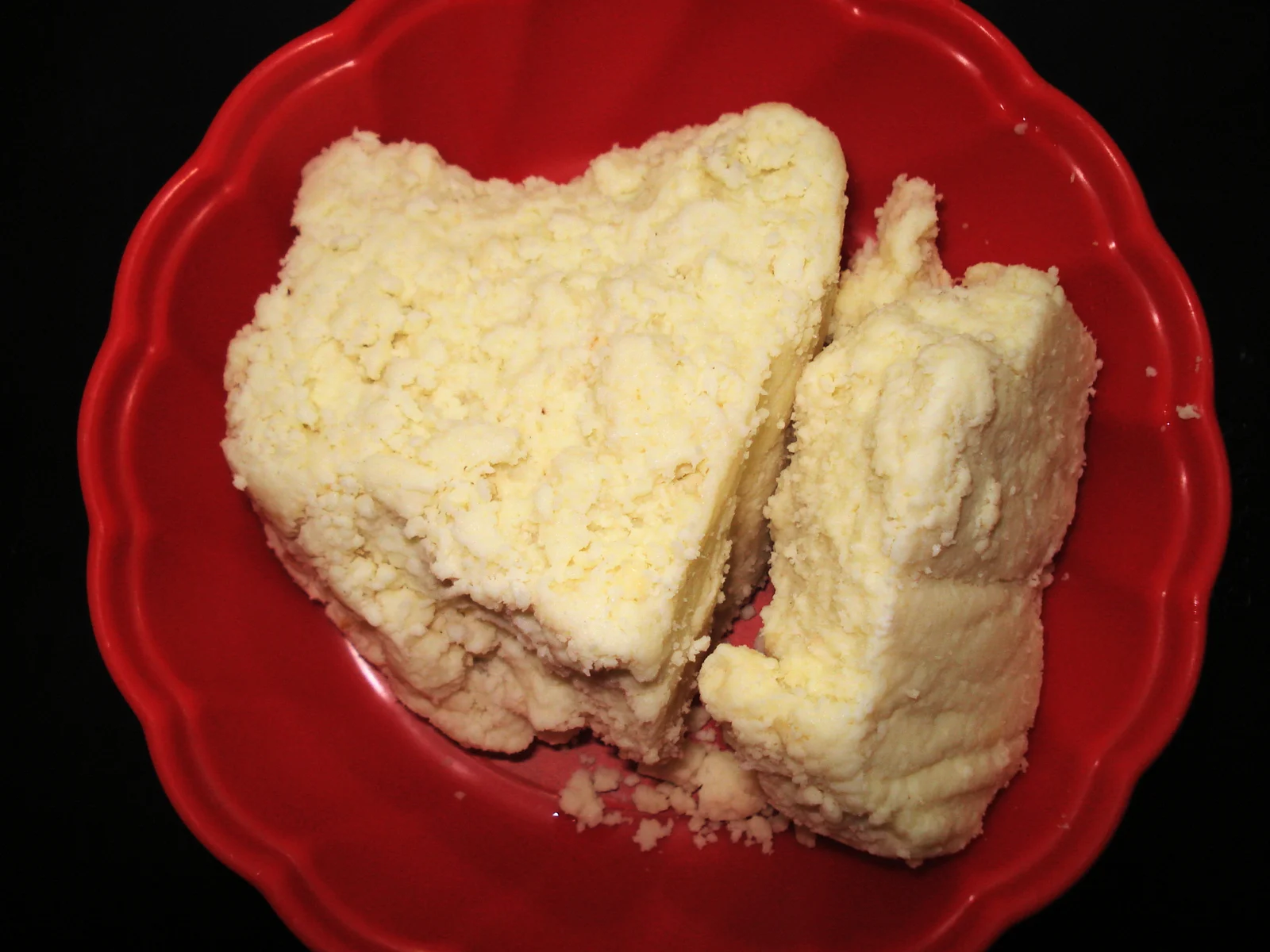
Khoa on a red plate, showing the cut face of a mass of reduced milk
A reference photograph of khoa, as used for the outer dough. A mass of concentrated milk is shown, with grains left along the cut. Miansari66, Wikimedia Commons, released into the public domain by the author.

Draining the Core’s Syrup and Closing the Shell in the Palm

In BongCook’s method, the finished rasgullas are cooked for about five more minutes in undiluted sugar syrup, then left in the thick syrup for about thirty minutes. They are lifted out and the syrup on the surface is drained, and once they have cooled they are wrapped in concentrated milk. The recipe calls the core a "dry rasgulla" in the sense that the dripping syrup has been drained off. Syrup remains inside the core. If the ball is wet with syrup even on the outside, the syrup tends to creep into the seam during wrapping. Just before wrapping, the cook judges where to leave moisture and where to hold it back.

The same recipe prepares 100 g of khoa for the shell for eight cores. Powdered sugar, milk, and rose essence are kneaded into it, and it is divided into eight portions; each portion is flattened on the palm and a core is set on it. The edges are gathered and closed, the seam is smoothed, and the ball is rolled on a plate of 50 g of separately prepared grated khoa. If the grated khoa does not stick, a thin coat of syrup is brushed onto the ball. The core’s syrup is drained first, and the syrup drawn to the outside is added last. Even the same syrup splits into two roles: the moist texture inside and a way of making the granules stick outside.

My Family Recipes’ home method divides 250 g of mawa, enough to wrap eight to ten rasgullas, into the same number of portions as there are cores. It allows for both store-bought mawa and mawa reduced from milk, and for the latter it lists 1.25 liters of whole milk. This is a substitution in the ingredient list, not a specification that reducing milk will always yield that weight of mawa. Almond flour and saffron are also used, and chilled sweets are returned to room temperature before eating. The finished thickness changes with the size of the core to which each portion of khoa is allotted.

In this home formula, a heavy-bottomed pan is used and whole milk is stirred continuously over low heat, driving off water until it comes together. Whether the dough is made from milk or from store-bought mawa, the saffron-mixed dough is cooled first, and then the powdered sugar is added. Excess syrup left on the core is pressed out lightly. The hand-closed balls are rolled in almond flour, so a shell of saffron-flavored milk is overlaid with a plain-colored flour. Even among home methods of applying flower-like granules, some use ingredients other than grated khoa.
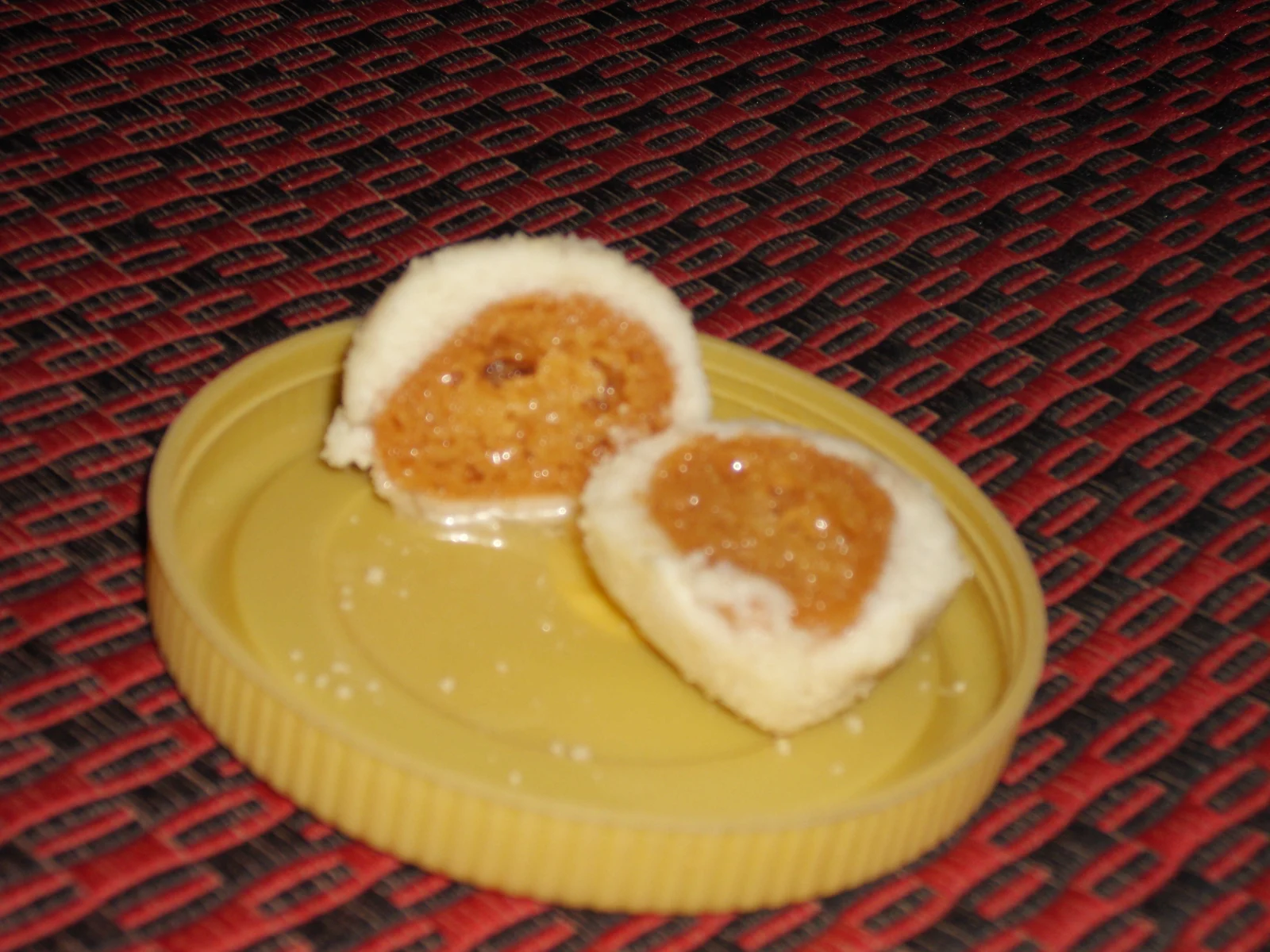
A Kheer Kadam cut in two, showing the boundary between the white exterior and a brown round core
Cross-section of Kheer Kadam. A white dough surrounds a round core of a different color. The photographer’s description does not say what colored the core. Paalappoo, Wikimedia Commons, CC BY-SA 3.0.

There are examples in which the core is colored, and examples in which an uncolored core and shell are told apart by texture. When saffron’s color and aroma are used, the stage at which it is added differs from recipe to recipe. In Zayka Ka Tadka, saffron soaked in milk is mixed into the khoa. A photograph in BongCook’s article shows a yellow core, but the author states clearly that only one was colored for the photograph and the other rasgullas were white. A cross-section shows the position and thickness of the core and shell; the way saffron was used cannot be determined from color alone.

Among home variations is one that wraps a small gulab jamun inside. Rasgulla is rolled chhena cooked in syrup. Gulab jamun is cooked in oil until its surface browns and is then soaked in syrup. Both become a round core holding sweet syrup, but the texture and aroma beyond the white shell differ. Kini’s Kitchen, which presents this version, describes it as its own variation, made by swapping out the rasgulla it normally uses.
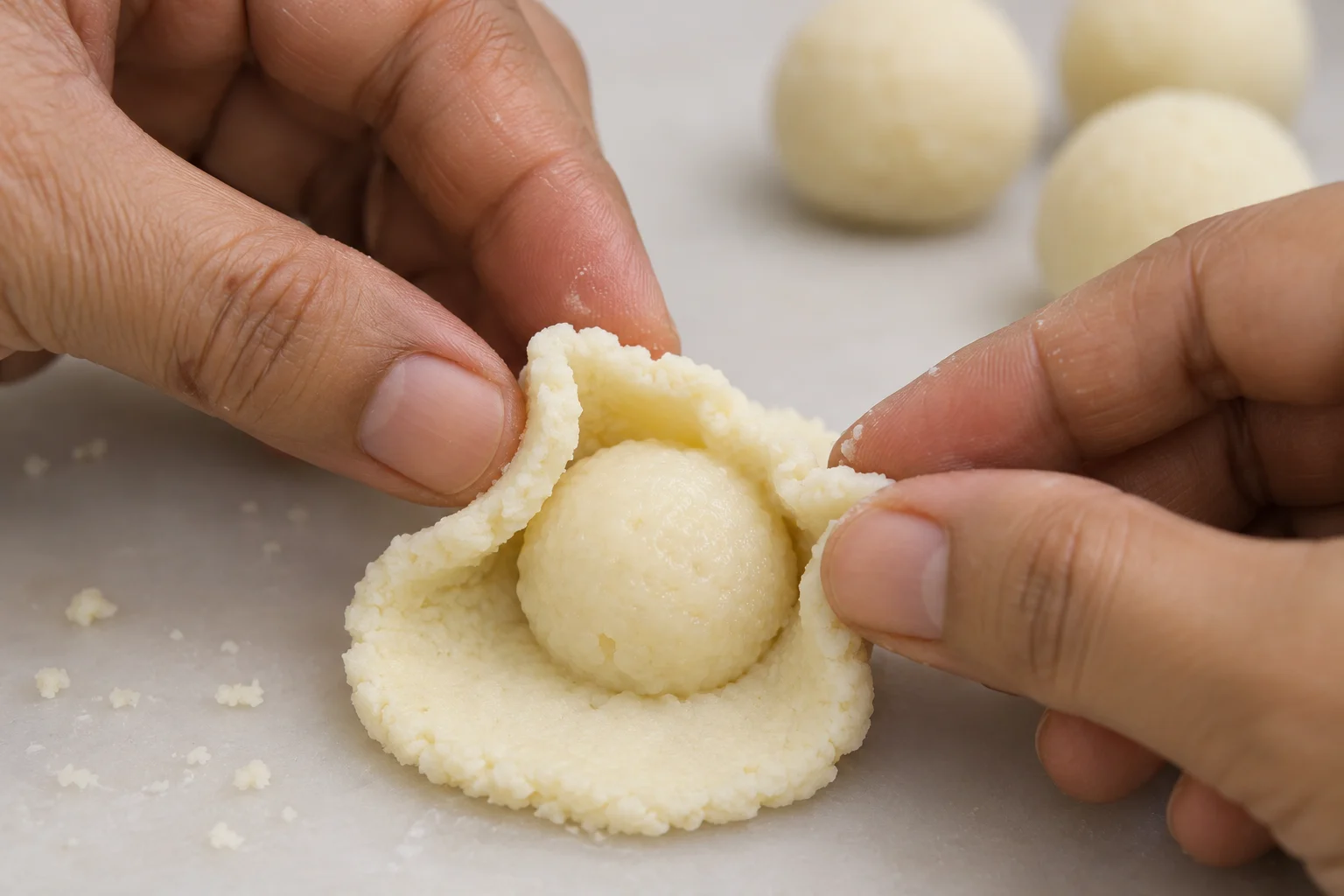
Reconstruction image (AI-generated). Hands wrapping a small rasgulla in a dough of concentrated milk.
Reconstruction image (AI-generated). A small rasgulla with its syrup drained is placed at the center, and a dough of concentrated milk is gathered around it by hand to wrap it. It is based on BongCook, which presents a home recipe.

The Granules That Resemble Flowers Differ from Shop to Shop

In a report from Malda, rasgulla is wrapped in kheer and covered with sugar mixed with poppy seeds. Some makers are said to have switched to white sugar granules because the price of poppy seeds rose. The Meherpur interview also says that sugar or poppy seeds are used on the surface. Seeds that meet the teeth and sugar that melts in the mouth change how the first bite feels. In a home example coated with grated khoa, the first grains one meets are milk as well. In every example the surface is finely raised, so it is hard to tell from the flower-like look which ingredient was used.

Zayka Ka Tadka’s method, apart from the chhena for the core, curdles milk with acid a second time to make paneer. Its water is pressed out with a weight, and the paneer is crumbled and dry-roasted in a frying pan; the golden-red result is cooled and crushed finely. The step of kneading khoa into a shell is also part of this recipe. Acid-set milk is used in two places, the core and the surface, with reduced milk between them. If one assumes that all the surface granules are khoa, the extra effort of curdling milk separately is lost from view.
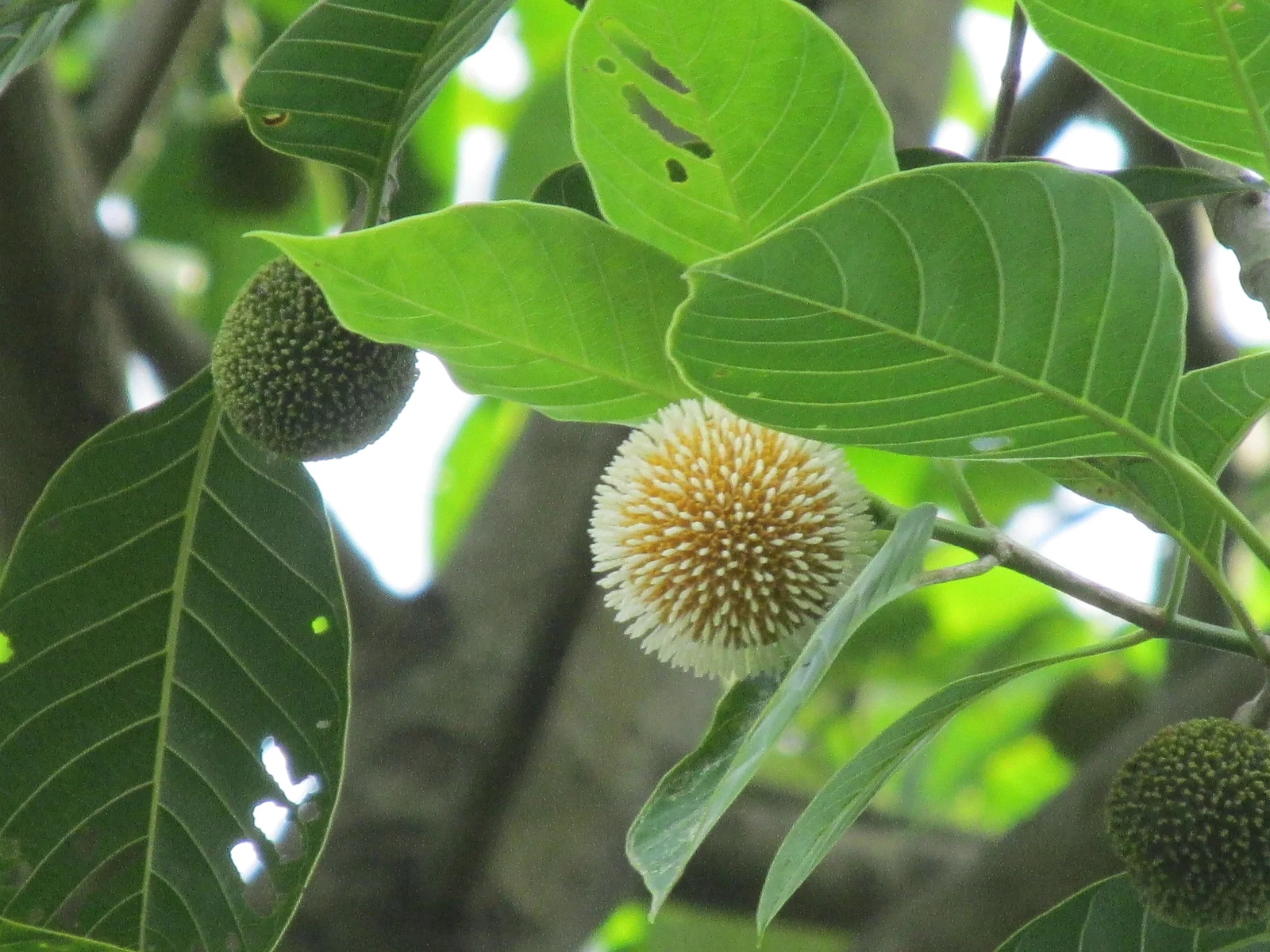
Kadam flowers on a branch. Small florets cluster radially to form a sphere
Kadam flowers photographed in Bangladesh. The spherical cluster of tiny florets is likened to the surface of the sweet. Engr.Raju, Wikimedia Commons, CC BY-SA 4.0.

The way the balls are displayed also supports the flower impression. BongCook’s author writes that as a child they saw many Kheer Kadam neatly piled up in a neighborhood sweet shop. The Karda photograph likewise shows balls stacked on a large platter. What can be seen in the piled form is the outer granules and the size of the balls; to see the color and position of the core, one has to cut them open. Even when sweets are sold under similar names, what is sprinkled on at home and how a shop finishes the appearance can be traced separately.

The Shade of the Kadam Tree in Malda, and the Trade in Meherpur

The Malda story goes back to Gaur, once the capital of Bengal. It is said that the local sweet arose in connection with the religious figure Chaitanya, who came during the reign of Sultan Hussain Shah and guided Rupa and Sanatana in the shade of a kadam tree. It is a tradition that links the spherical blossoms with the shade at Gaur. No historical source describing how sweets were made at that time is cited, so this story alone cannot establish when rasgulla began to be wrapped in concentrated milk.

The family of Basudeb Grand Sons, interviewed in Meherpur, tells when their ancestor opened the shop. According to family tradition, Basudeb Saha set up a shop in 1861 at the gate of the residence of the landowner Surendranath Bose and made sweets to serve to his guests. The business is said to have continued through his son Robindronath into the grandson’s generation. What is told in Malda is the memory of the kadam tree and the religious figure; the Meherpur interview preserves where the shop stood and for whom it made sweets.

The milk sweets the shop handled at the time of the interview were roshkodombo and Sabitri, and it made them only to order. To reduce milk in a large pot, one first has to gather a lot of milk and stock firewood so that the fire can burn for a long time. The needed amount of milk does not always arrive in the same way. Selling on order includes the work, before each piece is wrapped, of assembling the milk and firewood and firing the pot.

Where the boxes go also comes up in the interviews. In Malda, they are brought along when visiting relatives and friends, and given on Jamai Shashthi, when sons-in-law are entertained. Orders pile up around festivals and gatherings. A Meherpur shopkeeper, meanwhile, says that when people working abroad come home, they take back sweets to give to colleagues at their workplaces. Beyond the one piece eaten at the shop, there are people opening the box in relatives’ homes and at distant workplaces.

Names at the Point of Sale, and What Is Registered

Rajshahi also sells roshkodom. In local reports, the long-established Rajshahi Mishtanno Bhandar handles roshkodom and monda. In a separate article, the manager lists chhena, mawa, poppy seeds, sugar, and date-palm jaggery as ingredients used in the shop’s sweets. That explanation covers several of the shop’s sweets, and it does not say which part of the roshkodom uses jaggery or whether there is a rasgulla inside. A name can serve as a clue for tracing a town, but what the sweet looks like when cut has to be checked shop by shop.

A 2022 report from Malda includes testimony from a representative of a local mango traders’ association, who said that an application had been submitted to the central authority for a geographical indication for Ras Kadam. "Banglar Rasogolla," whose registration can be confirmed in India’s geographical indications register, is the geographical indication for the rasgulla itself, which is used as the sweet’s core. The headline of the article reporting Malda’s application and the Rasogolla registration record deal with different names. For the sweet that combines the granule-covered shell and the core, it is worth reading separately the name conveyed in interviews at the place of production and the object of the registration.

How much concentrated milk to make, how much shell to allot to a core whose syrup has been drained, and what to apply on the outside: even when shops use the same name, these are not fixed to a single formula. The flower-like look when the box is opened is made at the very last step of finishing, by rolling the balls by hand. With one bite, the milk shell gives way and the teeth reach the small syrup-soaked ball; the difference between the two pots at the start of the process is still there.

Glossary

Chhena (ছানা)
Soft milk solids obtained by curdling heated milk with acid and removing the whey. It is kneaded and rolled to make the core of rasgulla.
Khoa / Mawa
A dense milk dough obtained by reducing milk. In this sweet, it is used for the shell that covers the rasgulla.
Kadam (কদম)
A tree that bears flowers clustered into spheres. In Malda and Meherpur, the granular appearance of the sweet is likened to the flower.
Jamai Shashthi
A Bengali observance in which sons-in-law are entertained. In Malda, it is presented as one occasion on which Ras Kadam is given among relatives.
TOPKheer Kadam | Cafe & Sweets Parade Kyoto

(FAQ)

All You Need to Know

Do you have gluten-free sweets made without wheat flour?

Yes. We offer sweets made without wheat flour, such as madeleines made with rice flour. However, they are made in the same kitchen as products that use wheat flour. If you have a wheat allergy or need to strictly avoid wheat, please consult our staff before purchasing.

Do you use additives such as preservatives or emulsifiers?

We do not add preservatives or colorings when making our sweets.

Some of our baked goods (such as madeleines and chocolat) use baking powder to help the batter rise. In addition, ingredients we purchase, such as chocolate, may contain additives such as emulsifiers that help maintain their quality.

To see the ingredients we use, please check the ingredients listed on each product page.

When is the Seasonal Citrus and Lemon Curd Cake available?

This cake is sold on an irregular basis.
It is often available on Saturdays, Sundays and public holidays. We post updates on in-store availability as needed in our Instagram Reels, so please check there.

Do you sell fresh cakes on Wednesdays?

We do not currently sell fresh cakes on Wednesdays.
On Wednesdays, we mainly sell baked sweets and drinks.

*Many customers have asked about this, but no decision has been made yet about selling fresh cakes on Wednesdays.

Can I request noshi paper (noshi kakegami) for gifts, presents, and the like?

For gift boxes in sizes M and L, we offer inner noshi (uchi-noshi) only, at 100 yen (tax included) per sheet. Please specify the top inscription and name inscription, and place your request at least 3 days in advance. For same-day requests, please consult the shop.

Do you offer OEM (manufacturing of original products)?

We are currently accepting consultations on OEM requests, depending on their details.
To start, please contact us through the inquiry form with details such as your product concept, desired quantity, and sales purpose.

Where is the shop located?

Cafe & Sweets Parade Kyoto is in Uoya-cho, one street south of the Otesuji Shopping Street, a 4-minute walk from Keihan Fushimi-Momoyama Station and a 5-minute walk from Kintetsu Momoyama-Goryomae Station. Parade stands in an area full of history and charm. Nearby are Torisei, a sake and yakitori restaurant run by a long-established sake brewery; Teradaya, said to be the place where Sakamoto Ryoma was attacked; the Fushimi Jikkokubune, wooden boats that take you along the canal; and many other places.
For the exact location and other details of Cafe & Sweets Parade Kyoto, please check Google Maps↗︎.

What days is the shop open?

We are open every Wednesday through Sunday from 11:00 to 18:00 (last order 17:30). We are regularly closed on Mondays and Tuesdays.
On public holidays, we are open on some days and closed on others.
We may also close temporarily on irregular days, or open on regular closing days. For the latest information, please check Instagram↗︎ or Google Maps↗︎.

How can I place a large order?

Yes, we accept orders through this inquiry form.
Large orders are orders of 21 or more units, or orders with 10 or more delivery addresses.

Can you tell me about allergens in your products?

Whether a product uses egg, wheat flour, peanuts, walnuts, other nuts or dairy products is stated on the allergen list page and on each product’s page.

Peanuts (groundnuts) and walnuts are shown separately from “other nuts” such as almonds.

Points of caution other than the items above, such as sesame, gelatin and honey, are written in the “Notes” section of each product. However, not all allergens are listed. For assortments such as gift boxes, the ingredients of each sweet included are listed under [Ingredients] on the product page.

If you have any questions, please ask our in-store staff or call us (075-644-4118) before purchasing.

Do any of your products contain alcohol?

Yes. We mainly use liquor in the following sweets:

• Canelé de Bordeaux (rum)
• Galette Bretonne (with rum)
• Madeleine au Chocolat (with liqueur: Grand Marnier)

The Galette Bretonne and the Madeleine au Chocolat are also available in “without rum” and “without liqueur” versions, respectively, made without liquor.

▼Gift boxes
• Classic Baked Sweets Gift Box L [9 Varieties, 15 Pieces]: includes 2 Galettes Bretonnes (with rum)
• Classic Baked Sweets Gift Box M [9 Varieties, 9 Pieces]: includes 1 Madeleine au Chocolat (with liqueur)
• Gluten-Free Gift Box [S] and Gift Box [M] with Higuchi Apiary: contain no sweets made with liquor

Even in baked sweets, a small amount of alcohol may remain. Children, pregnant women, people sensitive to alcohol and anyone who will be driving should take care.

For seasonal products, please check the “Notes” section on the allergen list page.

Is there parking?

The shop does not have its own dedicated parking lot. If you are coming by car, please use one of the paid coin-operated parking lots nearby.
If you are coming by train, the shop is about a 4-minute walk from Fushimi-Momoyama Station on the Keihan Main Line and about a 5-minute walk from Momoyama-Goryomae Station on the Kintetsu Line.

Can I eat and drink in the shop?

Yes, you can enjoy your order in our in-store eat-in space. Seating consists of 5 counter seats and 4 terrace seats (2 tables for 2 people each). High-speed Wi-Fi is also available.
Takeout is available as well. Opening hours are 11:00–18:00 (last order 17:30).

Where can I check the day’s cake selection and sold-out items?

The fresh cakes we sell change from day to day. We post updates on in-store availability as needed on Instagram↗︎.
Items may sell out after a post. If you want to be sure to get something, please call us (075-644-4118).

Do the 2 types of lemon cake differ in how they should be stored and how long they keep?

Yes. The lemon cake with icing must be kept refrigerated and keeps until the end of the day of purchase. The lemon cake without icing can be stored at room temperature and keeps for approximately 7 days from the date of manufacture. Please prioritize the date shown on the label of the product you have.

How long do baked-goods gifts keep, and how should I store them?

As a guideline, baked-goods gifts keep for about 2 weeks from the date of manufacture. Please store them in a cool place, away from direct sunlight and high temperature and humidity. The exact date is printed on the back of each individual sweet.

What payment methods can I use in store?

▼In store
• Cash
• Credit cards: Visa, Mastercard, JCB, American Express, Diners Club, Discover
• Transit IC e-money: Suica, PASMO, ICOCA, Kitaca, TOICA, manaca, SUGOCA, nimoca, Hayakaken
• Other e-money: iD, QUICPay+
• Code payments: PayPay, Rakuten Pay, d Barai, au PAY, Merpay, WeChat Pay, Alipay+, and others

Apple Pay and Google Pay can be used if one of the e-money services or cards listed above is registered.

What kind of cream puff is the Oven-Baked Cream Puff?

It is our classic cream puff: a crisp cookie-crust choux generously filled with a rich cream that combines fresh cream with custard made using “Sakura” eggs from a purely Japanese chicken breed.
It must be kept refrigerated; please eat it on the day of purchase. We also offer a caramel-flavored version, the “Oven-Baked Caramel Cream Puff.”
For details, please see the Oven-Baked Cream Puff product page.

What Are Meringue Cookies?

Meringue cookies are sweets made by baking and drying meringue, which is egg white and sugar whipped together. At Parade, we use kibi sugar (Japanese cane sugar) and finish them with a light texture: a crisp first bite, then an airy, fizzy melt in your mouth.

What kind of sweet is a sablé diamant?

True to its name, which means “diamond” in French, this is a sablé coated with sugar that sparkles around the outside. For the sugar coating, we use vanilla sugar that we make by hand in our shop from vanilla bean pods.
It keeps for about 3 weeks. Please store it in a cool place, away from direct sunlight, high temperatures and humidity. It is also included in our baked goods gift boxes.
For details, please see the Sablé Diamant product page.

Is the Galette Bretonne available both with and without rum?

Yes. It is available both with rum and without rum. The individually sold Galette Bretonne contains rum. The rum-free version is included in our gift boxes. Please contact the store to ask whether it can be purchased individually.

What kind of sweet is a Linzer torte?

The Linzer torte is a sweet associated with Linz, Austria, combining a nut pastry with jam. At Parade, we layer a cinnamon-scented pastry, almond batter and our house-made framboise (raspberry) jam, and bake them together.

What baked goods can I choose as a gift (temiyage) from Fushimi?

We offer Gifts M and L, assortments of our classic baked goods; Gift S, with sweets made with rice flour; and a gift that includes honey from Kyoto Higuchi Apiary. You can choose based on the number of pieces, the ingredients, and the recipient’s preferences. As a guideline, the baked goods keep for about 2 weeks from the date of manufacture.

How do the gift boxes differ by type?

They differ in the types and number of sweets they contain.
・Classic Baked Goods Gift Box M [9 types, 9 items]: 2 types of sablé (12 pieces each), Galette Bretonne, 3 types of madeleine, financier, Sésame Matcha, Boule de Neige Chocolat
・Classic Baked Goods Gift Box L [9 types, 15 items]: 2 types of sablé (12 pieces each), Galette Bretonne (2 each without rum and with rum), Honey Madeleine, Madeleine Chocolat (without liqueur), financier, Sésame Matcha, Boule de Neige Chocolat
・[Gluten-Free] Gift Box [S]: 4 Honey Madeleines, 2 Madeleine Chocolat (without liqueur), 2 Sésame Matcha, 2 Boule de Neige Chocolat
・Gift Box [M] with Higuchi Bee Farm: 8 classic baked goods in 7 types, plus Wildflower Honey (160 g) from Kyoto Higuchi Bee Farm
The sweets made with liquor are the Galette Bretonne (with rum) in the L box and the Madeleine Chocolat (with liqueur) in the M box. For full details, please see the list of gift boxes.

What kinds of honey, eggs and chocolate do you use?

The ingredients we use vary by product. Our main ingredients are as follows.
• Honey: Purely Japanese honey from Higuchi Apiary in Fushimi, Kyoto (Honey Madeleine, Caramelized Honey Canelé, etc.)
• Eggs: “Sakura” eggs from purely Japanese-bred hens (Oven-Baked Cream Puff, Canelé de Bordeaux, Honey Madeleine, etc.)
• Chocolate: Chocolate from Valrhona of France (Madeleine Chocolat, etc.)
• Butter: Cultured butter (Brown Butter Financier, Galette Bretonne, etc.)
Please check each product page for that product’s ingredients.

Is there an ideal temperature or way to warm the sweets so they taste their best?

Depending on the product, there are recommended ways to enjoy it.
• Canelé de Bordeaux: Warming it for 3–5 minutes in a toaster oven that has not been preheated makes the caramel on the surface crisp, giving it a texture close to freshly baked.
• Brown Butter Financier: Warming it in a toaster oven for about 1–2 minutes gives it a texture and aroma close to freshly baked.
• Linzer Torte: The ideal serving temperature is 5–20°C.
• Lemon Cake (with icing): We recommend letting it sit at room temperature for a little while to enjoy the fluffy texture of the cake, or, in summer, enjoying it chilled straight from the refrigerator.
Toaster ovens heat differently depending on the model, so please keep an eye on the sweets while warming them to avoid burning.

How many people do Size 4, Size 5 and Size 6 whole cakes serve?

Parade’s “Decoration Cake with Fresh Cream and Seasonal Fruit” serves approximately 3–4 people in Size 4, 4–6 people in Size 5 and 6–7 people in Size 6. Please choose a size based on how much will be eaten and whether it will be served together with other sweets.

How long can I carry a cake? Do I need ice packs or an insulated bag?

Please plan on carrying it for about 1 hour. Conditions vary depending on the temperature, the type of cake and how you travel, so if you are planning a long journey, please consult the shop before purchase.

Can I have a message plate or candles added to a birthday cake?

The “Decoration Cake with Fresh Cream and Seasonal Fruit” comes with an original cookie plate and 1 set of 5 candles. A charge applies to candles from the 2nd set onward.

Are the sweets for sharing at work individually wrapped? How many people can a gift serve?

The Classic Baked Goods Gift is an assortment of sweets packed in individual bags. Note, however, that “9 items” does not mean 9 pieces: some items, such as the sablés, contain several pieces in one bag. Please think separately about how many people you are giving to and how many bags you want to give each person.

What is the difference between a financier and a madeleine?

Generally, a financier is characterized by the flavors of egg whites, almonds, and browned butter, while a madeleine is typically based on a batter made with whole eggs. At Cafe & Sweets Parade Kyoto, we offer the Brown Butter Financier and a madeleine made with rice flour and honey.

Do canelés taste better warmed? How do you recommend eating them?

If you warm Parade’s Canelé de Bordeaux for about 3 to 5 minutes in a toaster oven that has not been preheated, the caramel on the surface becomes crisp, and you can enjoy a texture and aroma close to freshly baked. Because heating varies by model, please keep an eye on it while it warms.

Can cakes and baked goods be frozen?

Because ingredients and finishing differ from product to product, we do not state that all cakes and baked goods can be frozen under the same conditions. Please first check each product’s storage instructions and date label. If you plan to freeze a product, please consult the shop before purchasing and tell us the product name.

What is the difference between sablés, cookies and galettes?

“Cookie” is a name for a wide range of baked goods. “Sablé” is used as a name describing a texture that crumbles softly like sand, and “galette” is used for sweets with a flat shape, among other things. Parade’s Galette Bretonne is a thick-baked cookie made with butter.

Can I get paper bags, small bags for sharing or gift wrapping?

In store, paper bags, plastic bags, bags for baked goods and gift wrapping are available for a fee. Prices vary by type and size. Please let us know how many you need and any wrapping requests before purchase.

News Letter

We send the latest news from Cafe & Sweets Parade Kyoto and money-saving coupons exclusive to our followers. Add us as a friend on LINE. Something good should come your way.

* We usually send notices of sales launches on Sunday mornings.
* Depending on the content, messages may be sent only to certain segments of subscribers.

Thank you for signing up!
We hope you look forward
to our next email.

Access

Cafe & Sweets Parade Kyoto

〒612-8041

Heights Momoyama No. 105, 574 Uoya-cho, Fushimi-ku, Kyoto-shi, Kyoto

* If you are coming by car, please use a nearby parking lot.

VIEW MORE GOOGLE MAP