


SweetloreEncyclopedia of World Sweets (834)

Basler Brunsli
Basler Brunsli
Cut-out sweets from Basel baked with almonds and chocolate
Baked Sweets / Basel, Switzerland

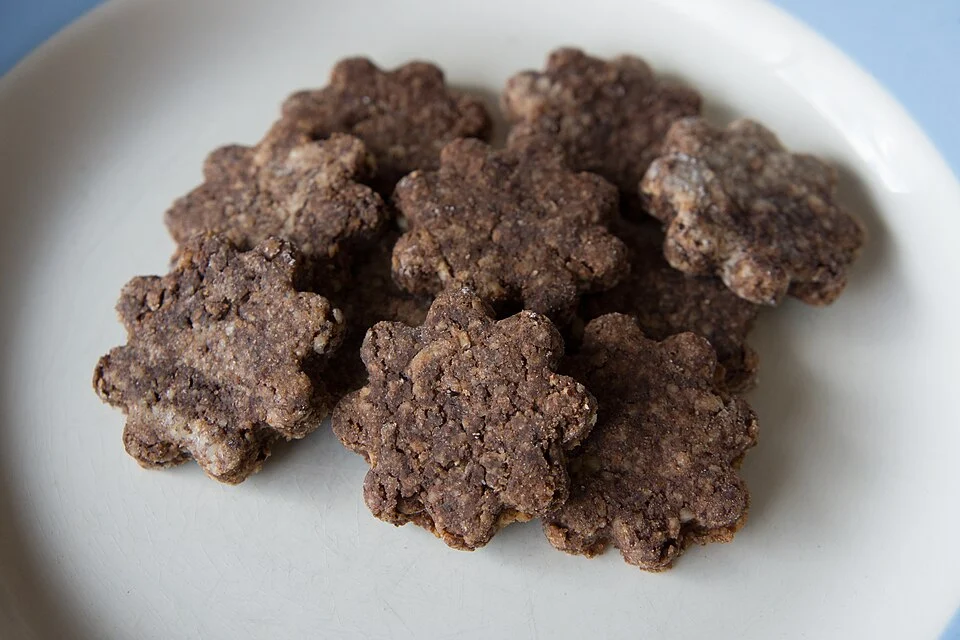
Break one of these small, dark brown flowers and the dry surface cracks first, leaving moist grains of nut inside. Basler Brunsli are Swiss baked sweets made from ground almonds or other nuts combined with sugar, egg white, and chocolate or cocoa. The dough can be cut into stars, hearts, or flowers. Some versions are scented with cinnamon or cloves, and some keep a wooden-mold design or fine grooves on the surface. Once the dough is firm enough to cut with a cutter, the outside is dried and the Brunsli are baked briefly, so the inside stays moist. Although they carry Basel’s name, they appear in Christmas cookie boxes throughout Switzerland.
Binding the Nuts with Egg White and Choosing How to Add the Chocolate
In an almond-based dough, the grains of ground nut can be felt on the tongue. The Culinary Heritage of Switzerland survey also includes examples made with hazelnuts or walnuts. It explains that when farmers in Basel-Landschaft make them with walnuts, the result keeps a rustic, earthy aroma and a coarser texture than the almond version. Changing the nut does not alter the outline cut by the metal cutter, but what one notices when eating is which nut was chosen when the ground nuts were prepared.
The Swiss dairy association Swissmilk mixes ground almonds, sugar, grated dark chocolate, flour, cocoa, cinnamon, and other ingredients. A well is made in the center, and beaten egg white is added, along with kirsch (a cherry spirit) or water if desired, and the mixture is brought together without kneading. The chocolate is reduced to fine shavings and scattered through the other ingredients, and egg white is added so that the nuts and sugar come together. The mixing continues until the moisture of the egg white has spread through the dry ingredients, so that the outline holds when the cutter is pressed in.
In a Betty Bossi recipe, the egg white is whisked until firm and then added to a mixture of sugar, almonds, flour, and cinnamon. The chocolate is softened with hot water, most of the water is poured off, and the chocolate is worked smooth and mixed into the dough. Should the egg white be used as it is or whipped, and should the chocolate be grated or softened? The two recipes make the dough in different ways, and both bring it to a state in which it can be rolled out to about 1 cm.
A confectioner visited by Culinary Heritage of Switzerland warms granulated sugar and egg white over a gas flame, then adds almonds and pure cocoa. The ingredients differ from those of the two home recipes, which use solid chocolate, and the dough is mixed by machine. The chilled dough is cut with a knife in the amount needed, rolled out by machine, sprinkled with granulated sugar, and run under a board that cuts grooves. Because ridges are made across the broad surface of the dough before the pieces are cut out, each piece keeps parallel lines on its surface in addition to its round or heart-shaped outline.
Swissmilk also presents a white Brunsli made with blanched almonds and grated white chocolate. Even without cocoa and cinnamon, the process carries over: the dough is bound with egg white, rolled to about 1 cm, cut out, dried, and baked briefly. The name, which derives from the color brown, remains for the white version too, and when eaten it shares with the brown version the feel of a dough made from ground nuts and the way it is baked.
Cutting the Outline, Pressing the Design, and Drying the Surface First
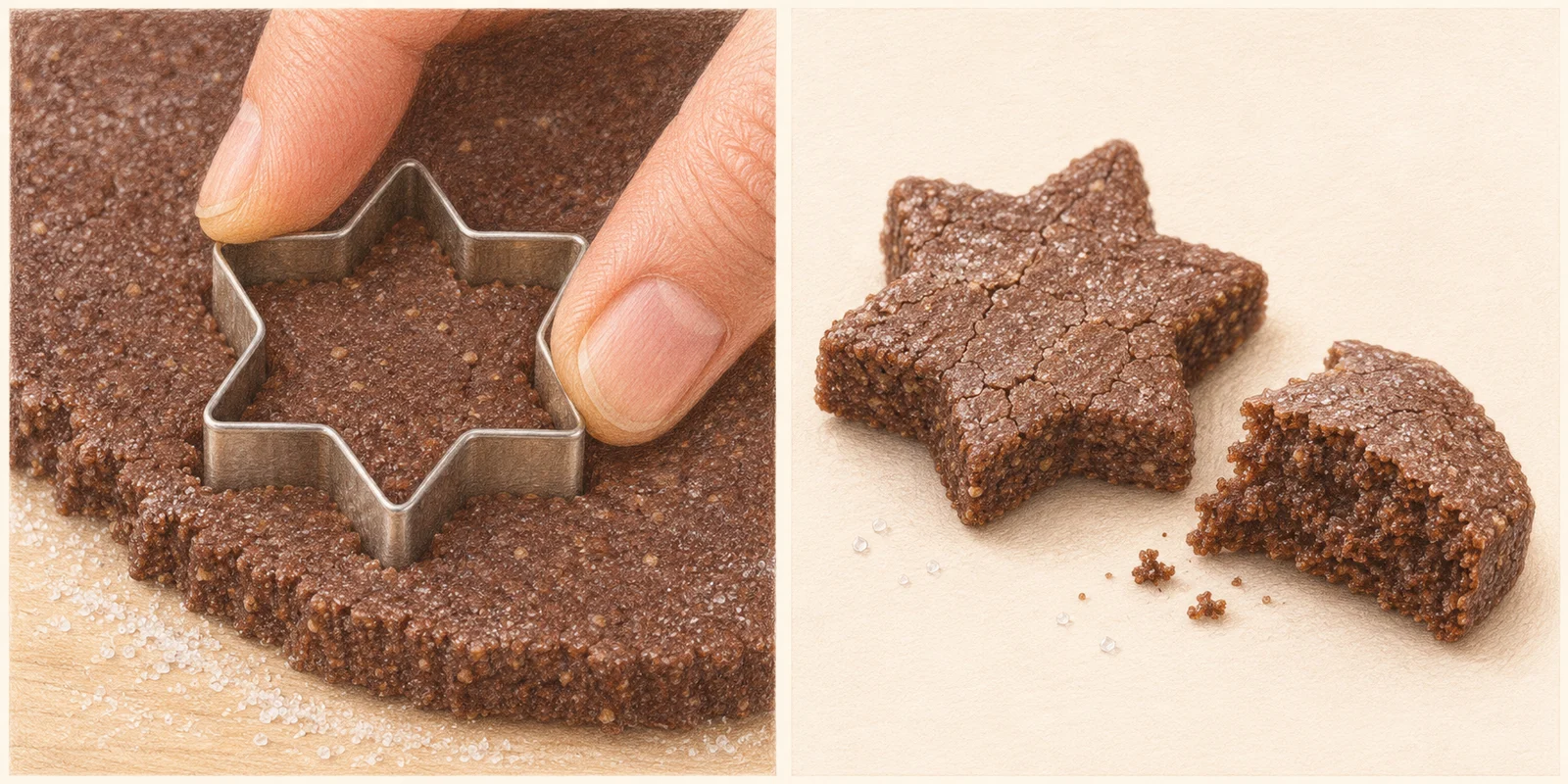
Rolling the dough out on a sugared surface, or between two sheets of baking paper, makes it possible to handle the sticky dough without it clinging to the work surface. Using paper also means no sugar needs to be added to the surface for rolling. In a Betty Bossi recipe, the cutter is dipped in sugar repeatedly before it is pressed in. Besides metal cutters from which the cut dough is removed each time, some workshops use tapered cutters that can cut several pieces in a row. If dough does not collect in the narrow corners, the edges of stars and hearts are easier to keep even from piece to piece.
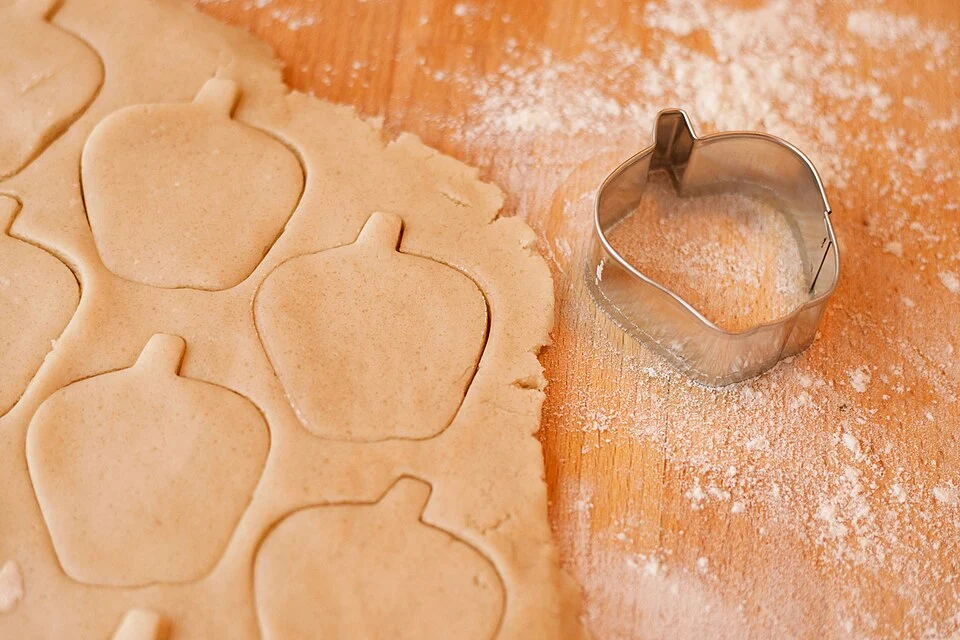
A wooden mold presses not only the edge but also a design on the inside of the piece. Another producer in the survey reproduces deer, swans, houses, violins, human figures, and other motifs with molds that date from his grandfather’s time. Pieces made this way are brushed, just after baking, with a thin glaze of icing sugar and lemon juice to give them a shine. Anna Bosshardt’s two recipes also include a step of applying an egg white icing after baking; one uses cocoa and egg white in the dough, and the other uses chocolate and whole egg. The granulated sugar used to spread the dough and the glaze that covers the surface after baking serve different purposes. Some recipes for today’s home bakers bake the pieces with the cutting sugar left on and omit the glaze.
In the workshop example from Culinary Heritage of Switzerland, the cut pieces are left overnight and baked for about 5 minutes at 210°C. Swissmilk dries them for at least 5 hours or overnight, and Betty Bossi for about 6 hours at room temperature or overnight. Swissmilk bakes at 220°C with a fan oven or 240°C with top and bottom heat for 4 to 6 minutes, and Betty Bossi at 250°C for about 5 minutes. In every example, the surface dries for a long time on the baking sheet, and the time under heat is short. The Brunsli are still soft inside when they come out of the oven, so Swissmilk has them removed with a spatula once they have cooled. Reading thickness, drying, and oven conditions together shows how the method leaves a dry outer layer and a moist interior.
Bio Suisse, the Swiss organic farming association, presents a recipe in which 150 g of chocolate bar with 70% cocoa is melted in a bain-marie and combined with 200 g of ground almonds, 180 g of sugar, and 2 tablespoons of kirsch. Two egg whites, whipped stiff with salt, are folded in, and after about 1 hour in the refrigerator the dough is rolled out to about 1 cm. The chilling comes before the soft dough is handled and cut, and the overnight drying comes after the pieces are removed from the cutter. They go on the middle rack of a 240°C oven for about 4 minutes. Even a bake planned simply for the next day includes a chilling period and a period for drying the outside.
Three Brown Sweets in a 1903 Cookbook
In the dessert chapter of the 1903 edition of Amalie Schneider-Schlöth’s Basler Kochschule (Basel Cooking School), "Braunes," another name for Brunsli, appears as no. 1589. The first recipe calls for 500 g of sugar, 500 g of raw almonds, 90 g of bitter chocolate, 15 g of cinnamon, 2 g of cloves, and the whites of 3 to 4 eggs. The chocolate is grated and mixed with the nuts, sugar, and spices, the egg white is put in the center, and everything is quickly brought together. Sugar is spread on the board instead of flour, the dough is rolled out to the thickness of a little finger, and stars, hearts, crescents, and other shapes are cut out with metal cutters.
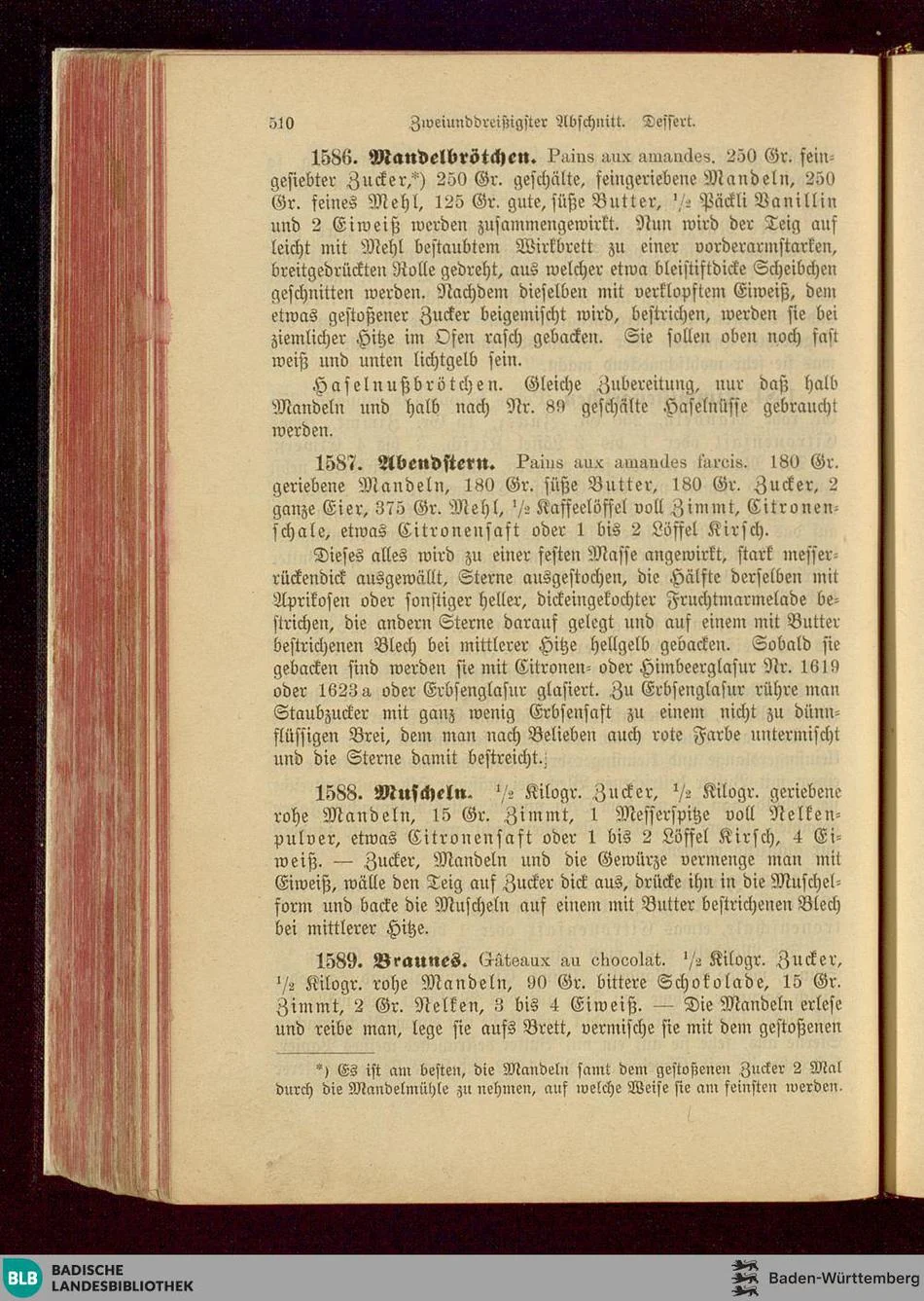
The cut pieces are placed well apart on a buttered baking sheet and heated for a few minutes over a low fire, less to bake them than to dry them through. Recent recipes specify an oven temperature and a time, whereas this book specifies the strength of the fire and the degree of doneness. The book does not give a modern temperature equivalent to "low fire." The same no. 1589 also includes a mixture with more skin-on almonds, 200 g of chocolate, and 4 to 6 egg whites. A cheaper version uses 250 g of raw almonds with 100 g of white bread or flour, finely crushed and sifted, and 60 g of chocolate. Of a 1910 cookbook, Culinary Heritage of Switzerland says that what affected the cost of ingredients was less the difference between bar chocolate and cocoa than how much of the then-expensive almonds was used.
In the very next entry, no. 1590, Schokoladenbrötchen also contain almonds, sugar, chocolate, and cinnamon. The method is close up to the point of rolling out on sugar, cutting, and baking over a low fire, but here the egg white is first beaten stiff. The difference in mixing seen in the modern Swissmilk and Betty Bossi recipes can already be found in the 1903 book, by reading the procedures of these two closely related items side by side.
Christmas Cookie Boxes and Paper Bags Taken Home from Celebrations
Culinary Heritage of Switzerland reports that in April 1725, 5 pounds of Brunsli were prepared for the meal held in Winterthur to welcome the pastor Hans Rudolf Müller. It is a record of a banquet that preserves the name and the quantity, but the recipe is unknown. The same source also notes that a work by Eugen A. Meier presents a recipe from 1750. Among the Basel manuscripts introduced by the local historian Albert Spycher in a baking-trade journal, one by Dorothea Respinger contains a 1794 recipe using chocolate and kirsch, while another manuscript uses unpeeled almonds and whipped egg white and adds milk if the dough is too stiff. Some records give only the name, and others allow later readers to trace the ingredients and even the steps for the molds.
In Basel homes in the late 19th century, Brunsli were made for Christmas together with anise baked goods, cinnamon stars (Zimtsterne), quince sweets, and Läckerli made with honey. At weddings in the early 20th century, guests received a paper bag called a Bhaltis after the meal. Some bags mentioned in local records bore the initials of the bride and groom, and held Brunsli together with almond or hazelnut hearts, anise sweets, macaroons, and more. Besides being a sweet eaten a little at a time at home in winter, a Brunsli was also a piece to carry home from a wedding and savor again as a reminder of the celebration.
Mailänderli, which belong to the same Christmas assortment, are made in the Swissmilk recipe by first mixing 125 g of butter, 125 g of sugar, and lemon zest, then adding whole egg and 250 g of flour to form the dough. Even when cut into stars and other shapes with metal cutters, they are light in color, in contrast to the brown of Brunsli, and brushing them with egg yolk before baking gives them a yellow surface. Culinary Heritage of Switzerland notes that Brunsli are baked at home and also made by specialty shops and large bakeries, and that ready-made dough is sold so that households need only shape and bake them. This is a way of selling that preserves, even for those who have no time to combine nuts and egg white at home, the part of the work in which one chooses a cutter and works with one’s hands in winter.
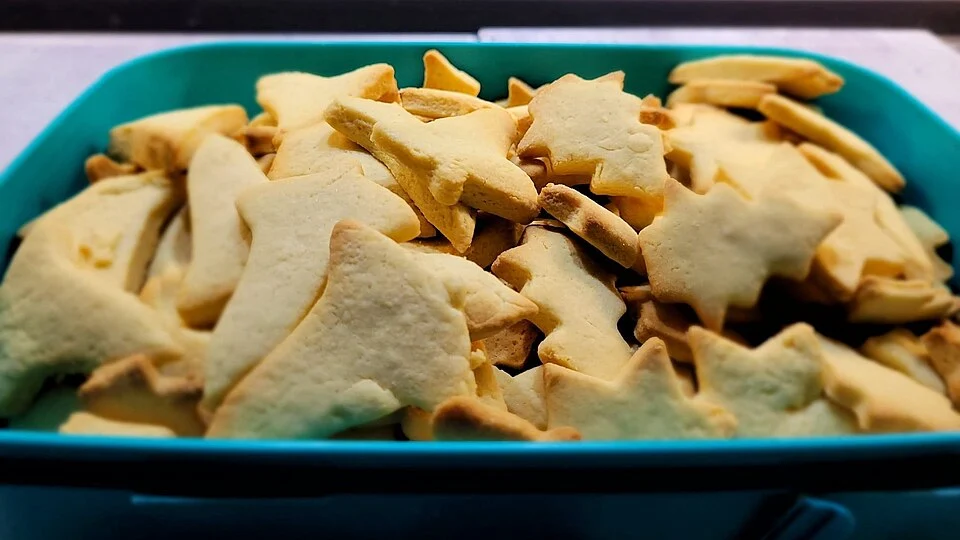
Culinary Heritage of Switzerland reports that shops today still sell bite-size pieces, medium-sized pieces for Christmas, and larger pieces to accompany tea. On a large single piece the design from the wooden mold shows clearly, while small pieces can go into one bag with other baked sweets. According to the same source, Brunsli are moist inside soon after baking and dry out as the days pass. They are served with coffee or tea, and sometimes with red wine. The brown that remains in the name Brunsli also appears in "Braunes" in the old book and in the French "Brun de Bâle." Even if one chooses a piece from a cookie box by the same name, the ground-nut grain, the pattern pressed by the mold, and the moisture that remains beyond the dry outer layer all vary with the maker and the time since baking.
Glossary
- Brunsli
- A Swiss German name for the sweet, derived from the color brown. It is also called Braunes, Basler Brauns, and, in French, Brun de Bâle.
- Kirsch
- A spirit distilled from cherries. Some Brunsli recipes use it to flavor the dough.
- Amalie Schneider-Schlöth
- The author of Basler Kochschule. This article refers to the 1903 edition held by the Baden State Library (Badische Landesbibliothek) in Karlsruhe.
- Bhaltis
- In this article, a paper bag of sweets that guests receive at weddings in Basel.


