


SweetloreEncyclopedia of World Sweets (834)

Magenbrot
Magenbrot
A Swiss fair sweet of spiced dough in a dark sugar glaze
Baked Sweets / Switzerland, including Basel

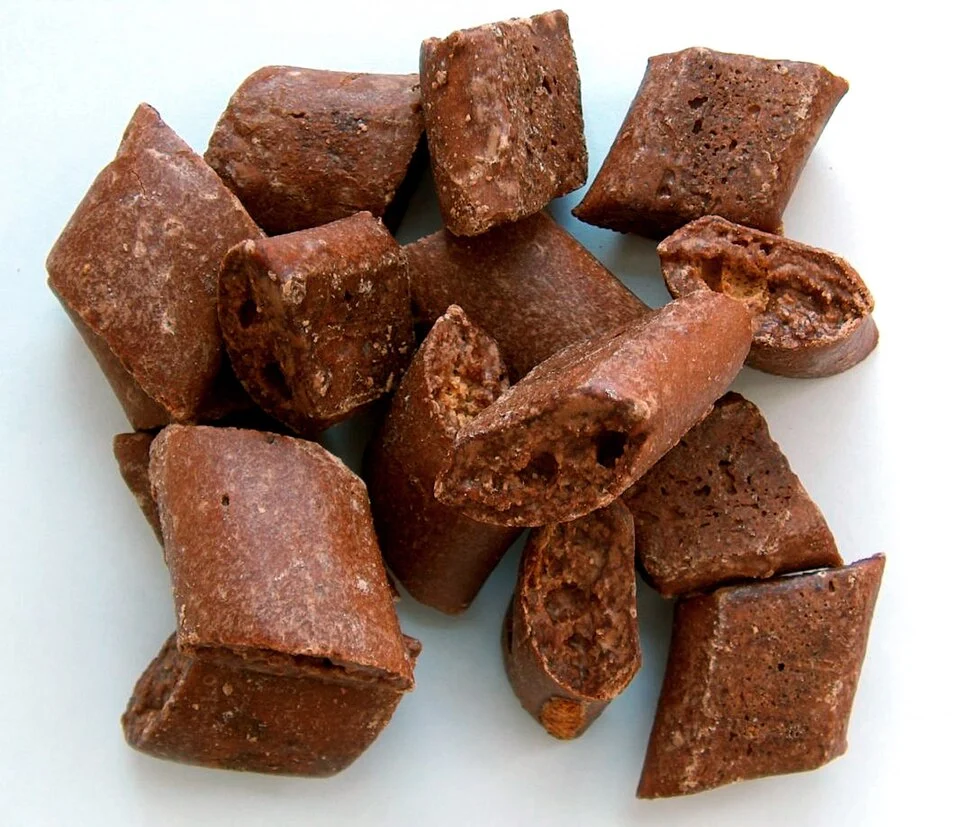
Break a piece of Magenbrot and, just beneath the brown glaze, you will see a crumb with small air bubbles. At autumn fairs in Switzerland, some stalls sell these bite-sized sweets in pink paper bags. Inside is spiced Lebkuchen, baked as a long bar and then cut into short pieces. The deep colour outside is a sugar glaze containing cocoa or chocolate powder. In a single bite, the sugar on the outside touches the tongue first, then you reach a crumb scented with cinnamon and cloves. On the broken surface you can see two separate jobs: baking the bar first, and sweetening the surface of each small piece afterwards.
Mixing in spices and baking as a bar
The workshop featured in the Culinary Heritage of Switzerland survey uses Ruchmehl, a type of wheat flour; a sugar syrup made from sugar, water and an acidulant; a raising agent; and spices. Cinnamon and cloves are central, with aniseed, ginger, coriander, cardamom and others added. The producer Rohner lists cloves, cinnamon, coriander, star anise and others. Which aroma follows the sweet surface when you eat it has less to do with the depth of colour from the cocoa than with which spices were chosen when the flour was mixed.
The workshop interviewed does not put honey in the dough, so that the spices come to the fore. The Culinary Heritage of Switzerland contrasts this with Biber and Basler Läckerli, in which honey is clearly noticeable, and explains that in this sweet the sweetness of sugar matters. Some makers do combine it with honey. Watching a baked block receive a dark brown glaze shows what makes up the outside of Magenbrot, which is not determined simply by the difference in ingredients, whether honey is used or not.
The dough is shaped into a long, thin bar, which in the process described is baked at 220°C for 25 minutes. The bar, now full of small bubbles from the raising agent, is not put into the glaze right away. It is left for a day and then cut into bite-sized pieces. The maker explains that freshly baked dough would soak up too much of the warm syrup. The heat has entered the bar from its surface, and cutting turns what was the inside of the bar outwards as well. If small bubbles remain here and there, the syrup also enters the cut faces, while the centre keeps the character of baked dough. The resting time before cutting is also set with an eye to how far the sugar will penetrate later.
If the bars are of uniform width, pieces cut to similar lengths by machine will also hold similar amounts per bite. The baked outer surface of the bar and the side the knife has passed through differ in condition. If the pieces are moved into the syrup after cutting, sugar can coat both the faces that were turned towards the oven and the cut ends that appeared only when the bar was cut. Compared with records of older sweets made in finger-thick shapes and baked piece by piece, today’s workshop process shows a different approach: bake at length in one go, cut to the size needed, and only then finish the surface.
Tumbling each cut piece in warm glaze
The glaze is made by heating a little water with sugar until dissolved, then adding cocoa or chocolate powder. At the workshop interviewed, the powder is used in small amounts to produce a deep brown. Because overheating the sugar strengthens the caramel flavour, the depth of colour is not achieved by the strength of boiling alone. While it is warm, the syrup flows, so it clings to the surface when the pieces are tumbled in it, rather than being brushed on one piece at a time. There is a difference between a state in which the syrup penetrates slightly, just inside the dark crust, and one in which the whole piece is soaked evenly to the centre.
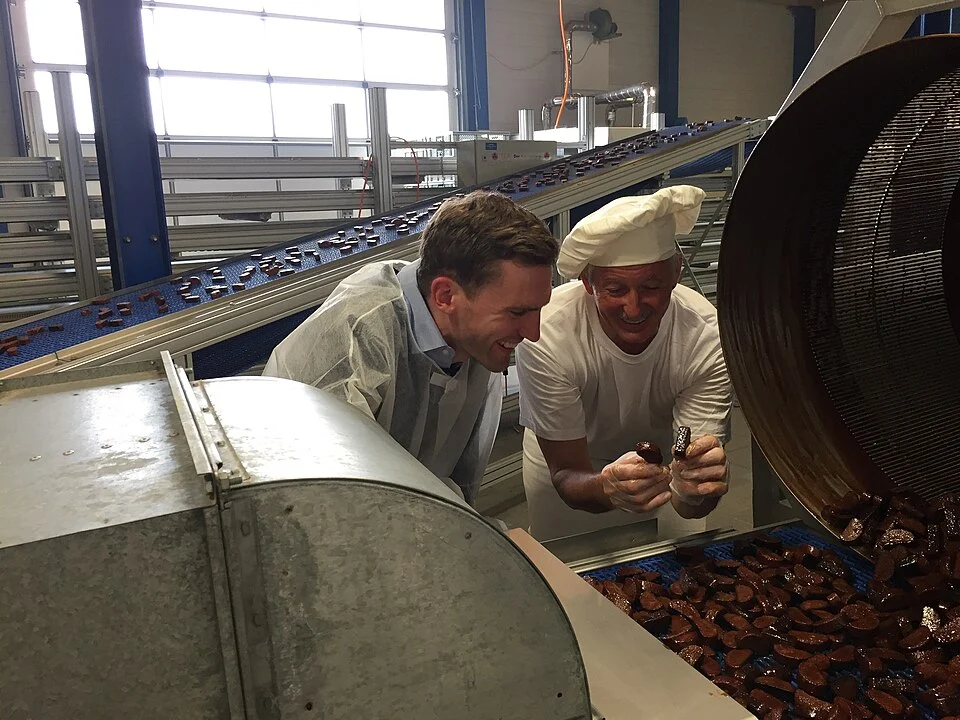
At the workshop visited by the Culinary Heritage of Switzerland, the bars are sent along a belt, cut by a machine, and the pieces drop into a rotating drum. Inside is warmed syrup, and after one turn each piece emerges coated in brown glaze. They cool on the next belt, and it takes about 2 hours before they can go to packaging. At Rohner too, the bars are baked and cooled, cut with a dedicated machine, glazed, dried and then packed into bags and other containers. In the photograph, pieces with wet surfaces are lined up near the drum’s exit. At what stage the baked bar is cut, and where the process is stopped to cool it, shapes the gloss of the piece you buy.
The Culinary Heritage of Switzerland material states that after a few days the glaze and the dough inside blend together. Rohner advises that if its product is left out of the bag for a long time, it loses moisture. In the workshop the warm syrup is spread, then cooled so that each piece keeps its shape; at the stall the pieces are put into bags; and at home they stay in the packaging until eaten. With time, the sugar may blend into the dough, or the pieces may dry out if the bag is left open. The difference between the glaze you taste in the first bite and the crumb your teeth reach next depends on the time that has passed since the sweet left the oven.
A piece fresh out of the drum is still too wet on the surface to pick up by hand and put in a bag. Spread on the next belt, the pieces stay separate from one another until the glaze has set. By contrast, pieces bought at a shop and kept for several days may look dry on the surface, but the dough and sugar have had time to blend. Tracing the time the drum takes to spread the syrup, the time it takes to cool the pieces enough to bag them, and the days they spend blending in the package shows that work continues even after a single round of heating.
A sweet named for the stomach, and the glaze of 1946
Magenbrot literally means “stomach bread.” According to the Culinary Heritage of Switzerland, in volume 5 of the Swiss German dictionary Schweizerisches Idiotikon, published in 1905, Magebrot was a baked sweet of sugar dough regarded as easy to digest. The name can be read as one from an era that believed sugar and spices aided digestion. Nineteenth-century Swiss cookbooks give methods using almonds, sugar, eggs and spices, shaped to the thickness of a finger. The brown glaze that covers today’s wheat dough does not appear in those methods.
In a recollection recorded in the folklore journal Schweizer Volkskunde, a woman from the Appenzell region, born in 1875, says that at the fair there was Magenbrot alongside the carousel and the panorama. She also remembers that she could not afford all the pleasures of the fair. The recollection does not reveal whether what the stall sold was an almond sweet or something closer to the later Lebkuchen. One craftsman interviewed by the Culinary Heritage of Switzerland suggests that it may have begun by soaking leftover bread in syrup, adding flour and spices, and baking it again. This is the maker’s conjecture. Among the processes now made public, there are examples in which fresh flour is weighed out before the dough is made.
The earliest glazed recipe found by the Culinary Heritage of Switzerland survey appears in the 1946 specialist book Lebkuchen. It is called Alpenkräuterbrot, and is a product made by bakers who travel from fair to fair. The book also mentions that dark glaze was thought to hide poor-quality ingredients, and urges those in the trade not to lower the quality of their materials. This year is as far back as a brown-glazed product can be traced in the literature. Further records are needed to say when the small pieces began to be sold at fairs, or what kind of bags they were put in at the stalls.
When comparing items written under the same name, the process of combining almonds and eggs can be read from the cookbooks, and the bustle of peddling in town can be read from the fair recollections. The old recollections say nothing of today’s packaging or surface colour. The brown glaze that appears in the 1946 book added flavour and also became a mark by which a coated piece could be recognised at a fair. In looking for the sweet at a stall, what catches the eye far sooner than the shape of the individual pieces is the colour of the bag.
Finding the pink bag at the autumn fair
The Basler Herbstmesse (Basel autumn fair) traces its origin to 1471, when the city obtained the privilege of holding a regular fair. According to the tourist office’s guide, among its many squares and venues, Petersplatz has stalls selling everyday goods and food, and Magenbrot is one of the pleasures there. The fifteenth-century date concerns the fair itself; the brown sweet of today appears in present-day guides. At OLMA, the agricultural and food fair held in St. Gallen in eastern Switzerland, the 2025 guide also lists stalls selling the sweet.

The Culinary Heritage of Switzerland interview reports that when one seller switched to bags through which the contents could be seen, customers repeatedly asked whether he no longer sold Magenbrot, so he went back to the original pink. The colour, in other words, let people find the sweet without opening a bag. There is also a theory that the colour was matched to that of cotton candy, but who first chose it, and why, is not known. Besides the items packed into large and small bags at its fair stalls, Rohner also offers cups with lids. Whichever container is used, a few pieces can be eaten on the spot and the rest taken home, and since the pieces are already cut into bites, they can be taken out by hand.
According to the Swiss public broadcaster SRF, Rohner of eastern Switzerland began trading at markets in 1956 and later also supplied local retailers. In the canton of Lucerne and in Basel there are small sellers known locally, and among retailers, some stock it in autumn while others buy it year-round. Both occasions remain: buying at a market by looking for the colour, and picking it up from a shelf in a local shop. At either kind of stall, the fact that the sweet is cut small and glazed piece by piece means it can be shared as it is with family and friends.
The Culinary Heritage of Switzerland survey records that several producers support sales at markets and fairs and cooperate with the travelling stall trade. The production volume of the one workshop visited was about 200 tonnes a year in that survey. From the belts that continue beyond the drum, one can see how the batch-by-batch preparation of the flour leads into a system for moving and cooling large quantities of pieces. This is a figure for the workshop interviewed. The form in which the sweet leaves the producer, such as cups or paper bags filled at the venue, varies with the buyer and the shop.
A neighbouring method: soaking in sugar while still warm
A source from the German state of Hesse describes a method in which dough sweetened with honey or sugar is coated with glaze while still warm, so that the glaze soaks through to the inside. This differs in the handling after the oven from the Swiss example, in which the bar is left for a day and the glaze enters only slightly through the bubbles, leaving the centre dry. Both combine baked dough with sugar, but whether the glaze is applied to warm dough or to rested dough changes how far the dark layer shows when the piece is broken. In German markets too, it is sometimes sold alongside other spice sweets and sweet nuts.
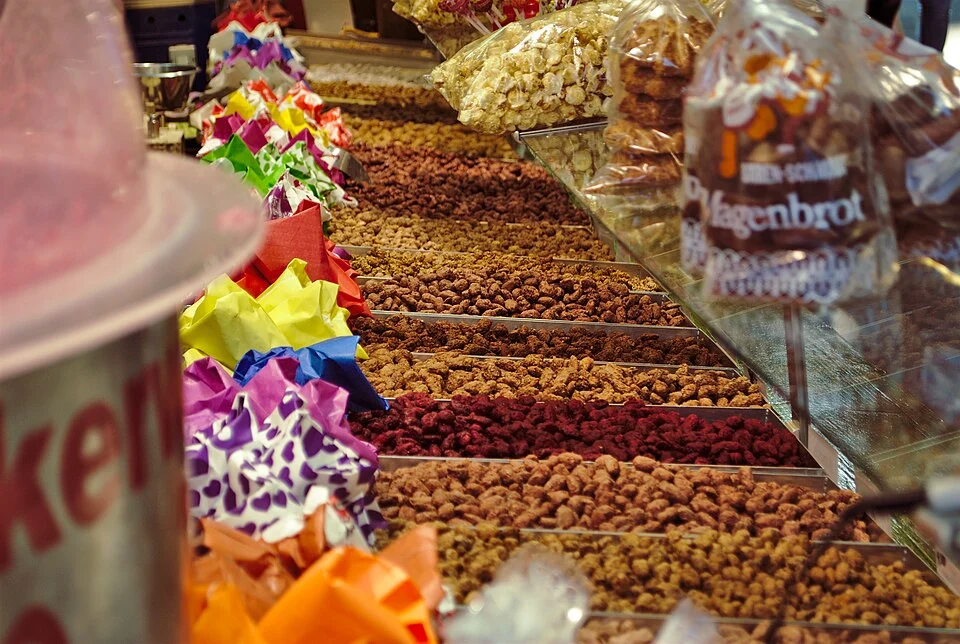
Hesse names as similar sweets the flat Aachener Printen and the round Offenbacher Pfeffernüsse, some of which are finished with a white glaze. Some Printen are patterned with wooden moulds, and with Pfeffernüsse the colour of each rounded piece catches the eye. The piece of Magenbrot you pick up is a cut section of a bar with glaze applied. If you break a piece taken from the bag, you can see a brown exterior and a spice-scented interior, unlike the pictures made by moulds or the round outline.
Glossary
- Lebkuchen
- A group of spiced baked sweets from Central Europe. They differ in the sweetener used in the dough and in the exterior finish.
- Ruchmehl
- A grade of wheat flour used in Switzerland. It includes parts of the grain closer to the outer layers.
- Glaze (糖衣)
- Here, a layer in which a mainly sugar-based liquid coats baked and cut dough and sets on the surface.
- Idiotikon (Schweizerisches Idiotikon)
- A dictionary of Swiss German that records historical word forms and how words were used.
- Basler Herbstmesse
- The autumn fair held in Basel at several squares and the exhibition grounds.
- OLMA
- An agricultural and food fair held in St. Gallen in eastern Switzerland.


