


SweetloreEncyclopedia of World Sweets (834)

Bolo Souza Leão
Bolo Souza Leão
Cassava and coconut milk combined and baked in a water bath
Cakes / Brazil, Pernambuco State

Beneath a lightly browned surface lies a smooth, dense crumb the color of egg yolk. Bolo Souza Leão is a baked sweet from Pernambuco state in northeastern Brazil. A moist cassava dough is combined with coconut milk, egg yolks and a sugar syrup. In the version in which the batter is passed through a fine sieve before baking, the graininess is removed, and the cake is cooked in its pan set in hot water. A sweet, egg-rich baked cake is overlaid with the work of a region long accustomed to handling cassava and sugar.
Cassava Dough Combined with a Syrup That Draws a Thread
Before the egg yolks are mixed in, massa de mandioca is a moist dough made from processed cassava root. In the reconstruction study published in Contextos da Alimentação, the researcher found moist massa de mandioca hard to obtain, so she tried both a batch she prepared herself and massa puba bought at the São Cristóvão market in Rio de Janeiro. It is handled differently from an ingredient such as dry flour, which is simply weighed out. In the trials, both doughs gave similar results when baked, but this was not an experiment that measured moisture content to establish that all cassava products are interchangeable.
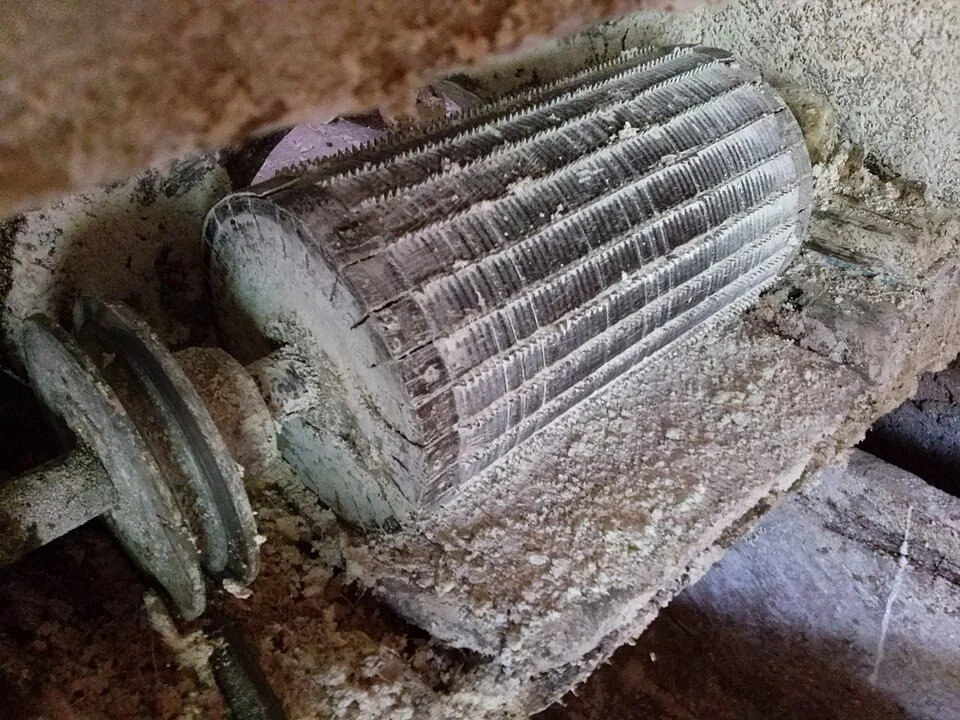
The formulation that the reconstruction study finally adopted combines 500 g of raw massa de mandioca with 400 ml of coconut milk and 8 egg yolks. The yolks and coconut milk are not poured in all at once but added alternately and mixed in. Separately, a syrup is made from 500 g of granulated sugar and 250 ml of water, 100 g of unsalted butter is added, and the syrup is left to cool. This syrup and 5 g of salt are added to the cassava dough. In this formulation, the sugar that sweetens and the milky ingredient that loosens the cassava are prepared in separate steps.
The syrup is boiled down to ponto de fio, the stage at which a small amount lifted up draws a thin thread. In the study’s recipe, the heat is turned off at this point and the butter is added to the still-hot syrup. Butter can be melted in the steaming pan, and because the cooled syrup is what is mixed into the yolk-containing dough, the yolks are not suddenly exposed to heat. Unlike mixing in sugar as dry crystals, here a step of dissolving it and setting its concentration comes first.
Once the dough comes together, it is passed through a fine sieve three times. The researcher then transferred it to a pan 22 cm in diameter. Sieving leaves fewer large particles and poorly loosened portions. Even among sweets that use cassava, the texture on the tongue differs from that of a bake that keeps the fibers of the grated root. The step of loosening the dough with yolks and coconut milk and the step of evening out the particles lead to the smooth cut face of the baked cake.
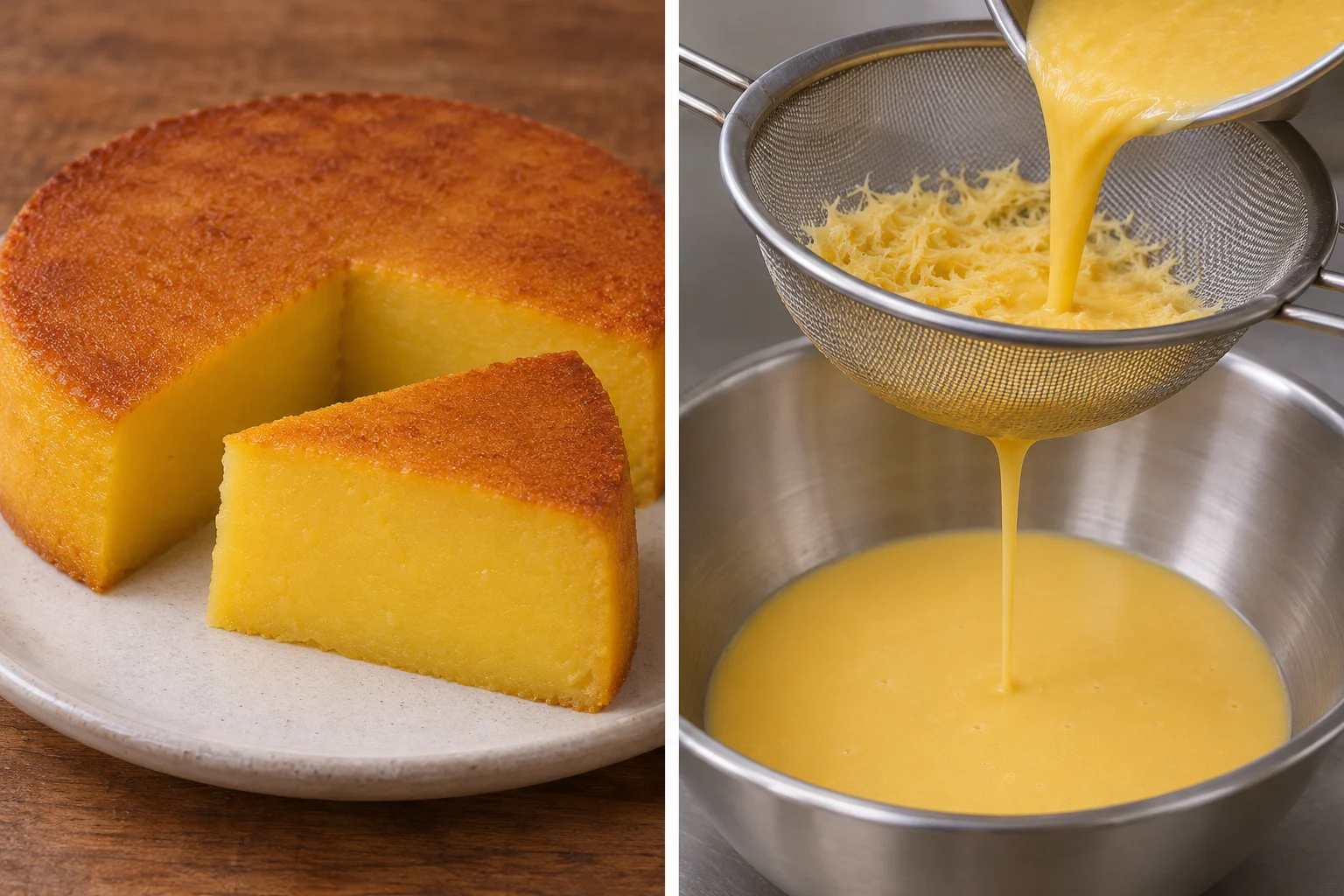
The Sieved Batter Is Baked in a Water Bath
The study’s recipe preheats the oven to 220 °C and heats the pan in a water bath for about 1 hour, until the surface browns.
220 °C is the oven setting, not the temperature of the water around the pan or of the center of the batter. Where the sides and base of the pan touch the water, the temperature rises more gently than where dry oven heat strikes directly. The surface is not submerged, so it takes color from the heat above. This difference in heating is involved in achieving a browned surface and a smooth interior at the same time.
The batter in this recipe has no step of folding in whipped egg whites and none of adding baking powder. A rich batter of egg yolks and cassava is baked until it can hold its shape. After it is taken out of the oven and cooled, it keeps the shape of a slice when cut, and in the mouth the fine-grained batter dissolves. Although it is firm enough to be cut thin, it is not a cake that crumbles like a dry, airy sponge. In the study’s trial, after the cake was removed from the round pan, individual portions for plating were cut with a 6 cm cutter.
Comparing Home and Shop Formulations: Yolk and Milk Quantities Vary
Even for the same sweet, the amounts of egg yolk and milk combined with the cassava differ from maker to maker. The reconstruction study first tried the recipe of Rita de Souza Leão Barreto Coutinho, of the Engenho Morenos line. It appears in Viagem gastronômica através do Brasil (2001) and uses cloves and erva-doce seeds, which have a sweet aroma. Considering the differences from the other recipes it had collected, the study left out these two ingredients from the first trial. The baked result was close to the intended outcome in color, texture and aroma, but the researcher recorded that the butter flavor came through more strongly than the other ingredients.
Next the researcher tried the recipe of Casa dos Frios, a shop in Recife. This is a formulation recorded in Sabor do Brasil (2011). Because it uses less butter than the previous recipe, the trial improved on the prominence of the butter flavor. However, it also uses fewer yolks, and the researcher notes that the color was weak. In the next trial she therefore increased the yolks, adjusting flavor and color. Even when the same cassava, coconut milk, butter, sugar and yolks are used, a change that reduces the fat and a change that reduces the yolks do not act on flavor and color in the same way.
In the home recipe and the shop recipe given in the study’s appendix, the cassava dough is 1 kg in both. The home recipe uses 16 egg yolks and spices and is cooked in a water bath in a deep round pan 27 cm in diameter. The shop recipe uses 12 yolks and, after an ordinary sieve, a conical strainer with still finer holes. The guide cooking time is about 50 minutes in both, but the shop recipe specifies neither a water bath nor a temperature and takes a pudding-like firmness as the sign of doneness. Even when the time is the same, the pan, the heating conditions and the straining method must be read separately.
Gilberto Freyre, who studied sugar culture, collected several Souza Leão formulations for his cookbook Açúcar and stated that they contradict one another. Materials from the Fundação Joaquim Nabuco also note that a recipe appeared in the June 1870 notebook of Erotides Castro de Souza Leão, connected with Engenho Calaúma in Joatã. Such records carry information about which household’s formulation it was and from when. Because the sweet has the same name, a later shop’s formulation cannot simply be read as a formulation from a nineteenth-century notebook.
In the recipe adopted from Açúcar in the reconstruction study, boiling water is added to the grated flesh of two coconuts, which are left covered for a while and then squeezed. Butter that has been melted separately and cooled is mixed into the milk obtained this way. The recipe calls for 12 yolks, 3 cups of cassava dough and 500 grams of sugar. This adopted version does not describe a separate step of boiling a syrup; the mixed batter is passed through a sieve, cashew nuts are then added, and it is baked in a buttered pan. Sieving the cassava is common to the reconstructed recipe, and because the nuts are added afterwards, pieces of varying size remain within the sieve-refined batter.
A paper in Ciência & Trópico on the food culture of Paraíba, the neighboring state to the north, also lists an example with the same name. It uses 800 g of cassava dough, 700 g of sugar, 10 egg yolks and 200 g of butter, along with milk obtained from coconut and cow’s milk. In the final formulation of the Pernambuco reconstruction study, cow’s milk is not an ingredient. The Paraíba example is baked in small molds, and a raisin is placed on each portion after it is unmolded. There are examples in which one large cake is cooled and cut, and examples in which individual portions are made from the start in small molds; even under the same name, the way it is served changes.
The Pernambuco reconstruction study also mentions that some recipes put cashew nuts into the batter. In the study’s plating, the nuts were crushed, lightly roasted and served alongside, separately from the cake batter. When nuts are in the batter, hard fragments appear even in the soft part of the cut face. Served outside, the fragrant pieces can be combined with the cake after one has scooped up only the smooth part. The caramel sauce served with this plating is also part of the dish the researcher composed. It must be read as distinct from the ingredients common to the formulations handed down through the generations.
How Sugar-Producing Households Served the Sweet
In Pernambuco, using processed cassava and coconut, the households of sugar mills (engenhos) preserved their own recipes for the sweet. According to the commentary of the Fundação Joaquim Nabuco, the story is passed down at several engenhos connected with branches of the Souza Leão family, and each household is said to have inherited its own recipe. Having the ingredients available is one thing; having a recipe bearing a family’s name passed on through relatives and shops is another. The coexistence of different formulations is a reason to verify each household’s cooking and transmission.
Souza Leão family tradition includes a story that the sweet was served when Emperor Pedro II of Brazil and Empress Teresa Cristina visited Pernambuco in 1859. According to the testimony of the descendant Eudes de Souza Leão Pinto, cited in the study, the place was Engenho Morenos, and Rita de Cássia, who received the party, was in charge of the cooking. In that account, the idea of replacing wheat flour with cassava and using butter made on the sugar plantation is linked to a special sweet served to guests.
A text in the yearbook of the Museu Imperial mentions a meal at Morenos on 18 December 1859. It asks whether the Emperor ate this sweet, and the author writes as though convinced that he did. No original menu is shown at the relevant passage. Records of the visit and the family tradition that the sweet came to the table differ in strength of evidence. A story told within the family cannot be taken as it stands as the date of invention. The 1870 notebook and the formulations collected later serve as clues, separate from tradition, for investigating what ingredients the sweet was made from.
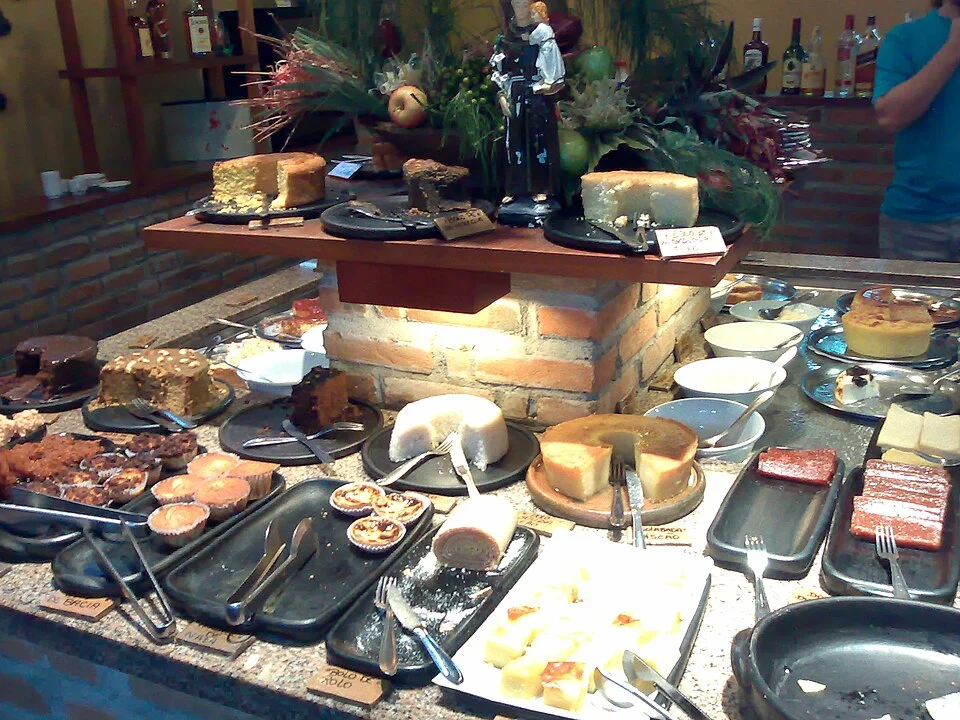
Two Bolos Side by Side in Pernambuco
By State Law No. 13.428 of 16 April 2008, Pernambuco designated bolo Souza Leão as part of the state’s cultural and intangible heritage. The text of the law defines the sweet as heritage and does not specify how many yolks are added or which branch’s method is used. That a single baked cake of strained batter has formulations written down at home, formulations made in shops, and small-scale examples from the neighboring state is compatible with this designation. It cannot be said that the state law brought the formulations into a single one; what can be confirmed is that the sweet came to be treated as regional culture.
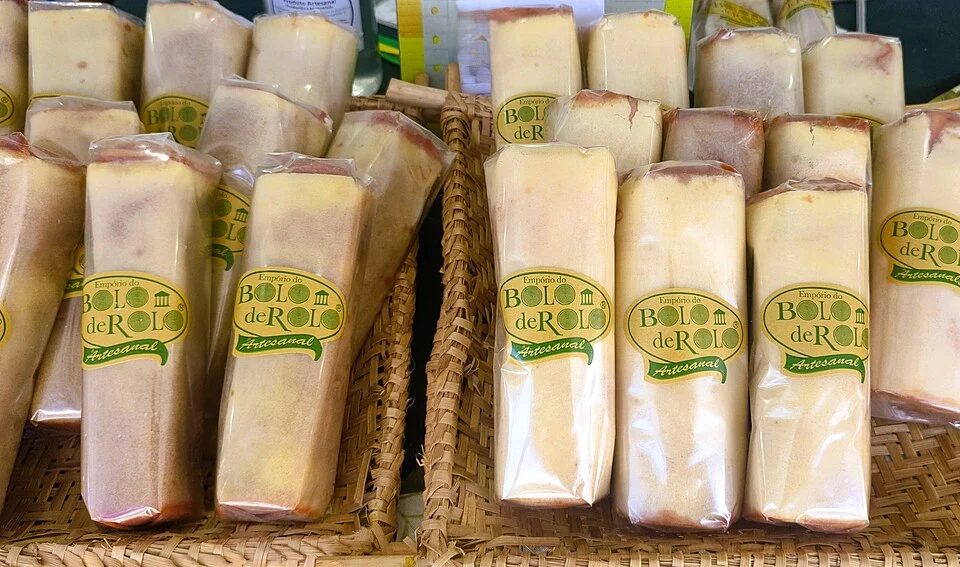
Among the sweets sold in Recife there is also bolo de rolo, listed as a specialty of the same state. A thin baked sheet of batter is spread with guava paste and rolled, making a spiral on the cut face. The Souza Leão trial sets the whole strained batter in the pan, so it does not form a layer of fruit paste on the cut face. The reconstruction study also reports that some people, such as the confectionery students it surveyed in Juiz de Fora outside the state, did not know Souza Leão. Even among sweets that have become state heritage, the structure and the degree to which they are known outside the state are not uniform.
Glossary
- Massa de mandioca
- A moist, dough-like ingredient made from processed cassava. The reconstruction study also compared it with commercially sold massa puba.
- Ponto de fio
- The stage at which a syrup has been boiled down so that it draws a thin thread when lifted. In the recipe described in this article, the butter is added at this point.
- Engenho
- A facility for processing sugarcane and making sugar, or the plantation that owns one. Morenos and Calaúma, mentioned in this article, appear in the traditions and records of the Souza Leão family.
- Gilberto Freyre
- A Brazilian sociologist. In Açúcar he studied the sugar sweets of the Northeast and recorded the differing recipes for Souza Leão.


