


SweetloreEncyclopedia of World Sweets (834)

Buckeye
Buckeye candy
A peanut-and-chocolate piece modeled on the seed of an Ohio tree
Sugar Confections / Ohio, United States

The buckeye (buckeye candy) is a confection from Ohio in the United States, made by mixing peanut butter with powdered sugar and butter, rolling it into balls, and coating them in chocolate. Dipped in melted chocolate with a small area left bare on top, the brown ball shows a pale circle. When the thin, firmly set shell cracks, a soft, peanut-scented filling lies inside. The round spot recalls the seed of the Ohio buckeye, the state tree of Ohio. A state university’s newsletter printed the method, and confectioners in town pack this same round shape into boxes, from game-day boxes to gift boxes.
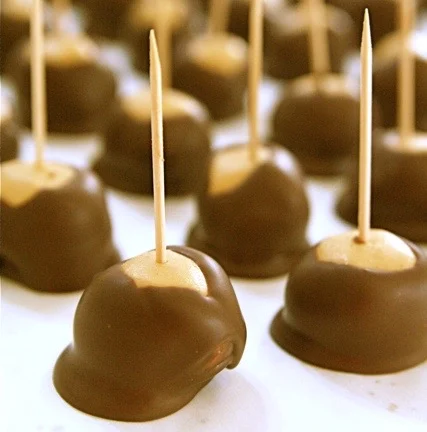
Chilled First, Then Dipped, to Leave a Single Circle
In The Ohio State University’s recipe, smooth peanut butter is mixed with sifted powdered sugar, melted unsalted butter, vanilla, and salt. The home-scale example uses 2 cups of sifted powdered sugar and 3/4 cup of smooth peanut butter. The mixture is made firm enough not to stick to the hands and to change shape when pressed, and is rolled into balls 1 inch (about 2.5 cm) in diameter. It is not a dough baked in an oven to set its shape; fine powdered sugar is worked into the fatty ingredients until the mixture holds together by hand. The rolled centers are frozen for a further 15 to 20 minutes so that they do not collapse when lifted on a pick and can take the melted coating.
Chopped semisweet chocolate and a small amount of vegetable shortening are melted in a double boiler. A thin pick is inserted into the top of each ball, and the ball is dipped to about three-quarters of its depth and lifted out; the pale peanut mixture shows around the pick. The size of the pale circle is set by the depth of the dip, not by decoration added afterward. If the ball is set down the same way up, the exposed part stays directly on top. Even after the pick is removed, peanut filling remains in the round area. If a ball is split vertically after the chocolate has cooled, the pale circle on top connects to the peanut filling inside, and it is clear that the coating covers only the brown part.
The December 1972 staff newsletter The Buckeye, issued by the university, also gives a method using powdered sugar and peanut butter. Butter or margarine is mixed in, the balls are set on paper and refrigerated overnight, and they are coated the next day. The university’s current recipe conveys the finish through the proportion of depth dipped, whereas the 1972 newsletter does so by making the visible circle about the size of a dime. If the balls differ in size, the diameter of the visible circle changes even when they are dipped to the same depth. One is a guide to how far to lower the hand; the other, to how much of a pattern to leave on the confections lined up on the plate.
The outer chocolate cools as many pieces are dipped in succession, so the university’s current recipe instructs reheating it if necessary. The peanut balls, which need to set, stay cold, while the chocolate to be applied is kept fluid. The two are not brought to the same temperature; the technique lies in giving a core that can be handled on a pick a coating that is still fluid, which covers it thinly without losing its shape.
Michelle Young, who has made this confection with her family in Columbus, wrote in 2021 that she adjusts the amount of powdered sugar depending on how warm the kitchen is and the condition of the butter, stopping when the mixture holds together when pressed without crumbling. Freshly coated balls go back on a cold tray. A hole left by the pick on top is also a common sight in home examples, and some people smooth it with a finger. The eye pattern comes from the depth of the chocolate, and the small hole in the center keeps the mark of the hand that held the pick.
How the coating is set also differs by period. In the 1972 newsletter, paraffin is added to the chocolate and the dipped balls are refrigerated. In the confectionery teaching material that Ohio State University uses in Fairfield County, semisweet chocolate is combined with vegetable shortening and left at room temperature to set. The material also lists a comparison of ingredients that make the chocolate easier to apply. Chilling the filling to a firmness that will not fall off the pick is the filling’s job; thinly covering the dipped ball and keeping a smooth brown shell is the coating’s job. Change where the ball is chilled or what is added, and the handling needed to reach the same appearance changes too.
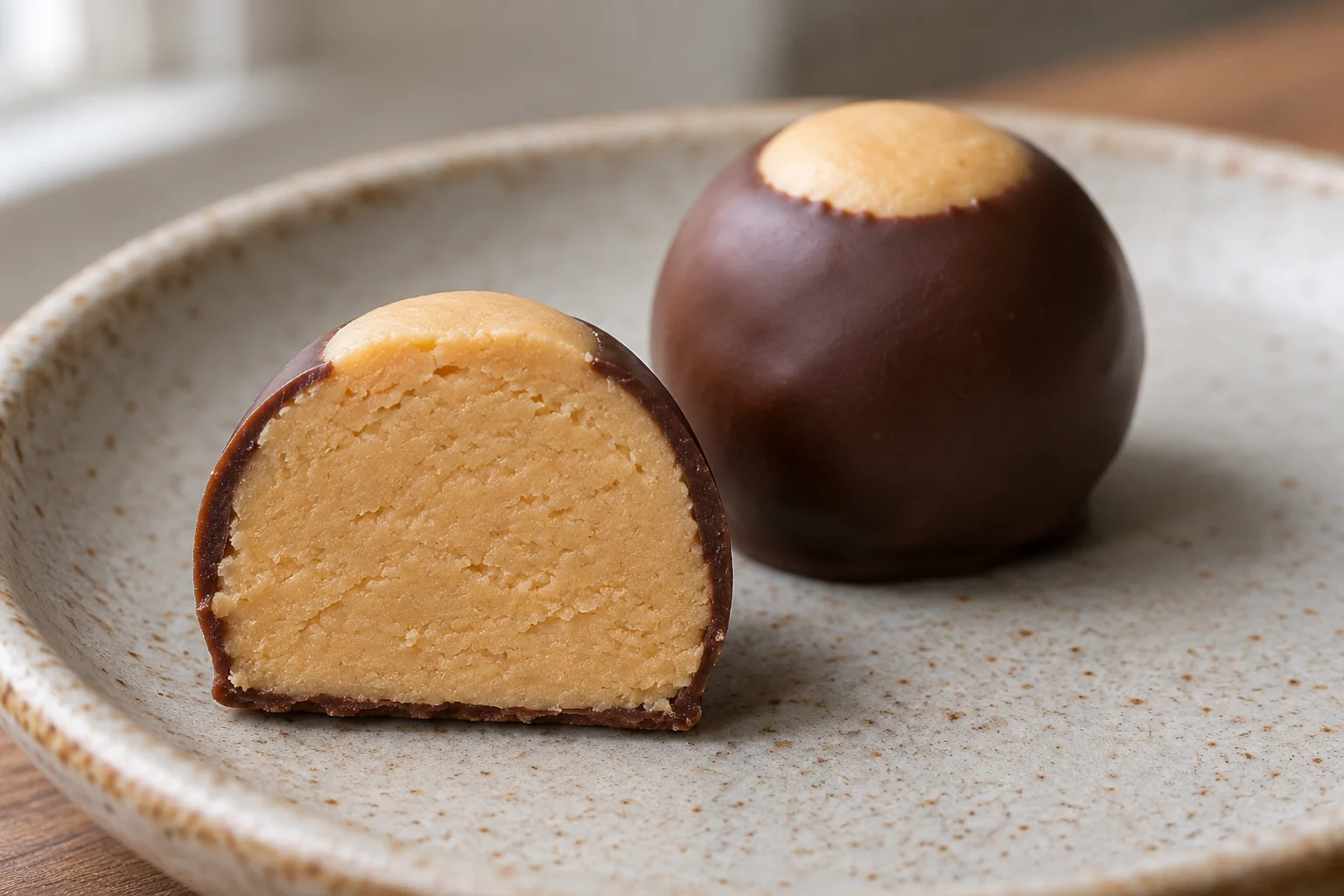
A Tree’s Seed, and the Round Mark Recognized on Game Day
The Ohio buckeye (Aesculus glabra) is a relative of the horse chestnut. Its spiny or warty fruit contains glossy brown seeds. The place where the seed was attached inside the fruit appears pale, which was likened to the eye of a buck, hence the name buckeye. The confection imitates the seed by letting the pale filling show through the brown coating. The seeds are poisonous; the ingredients of the confection are peanut butter and chocolate, and what it borrows from the tree’s seed is its shape and coloring.
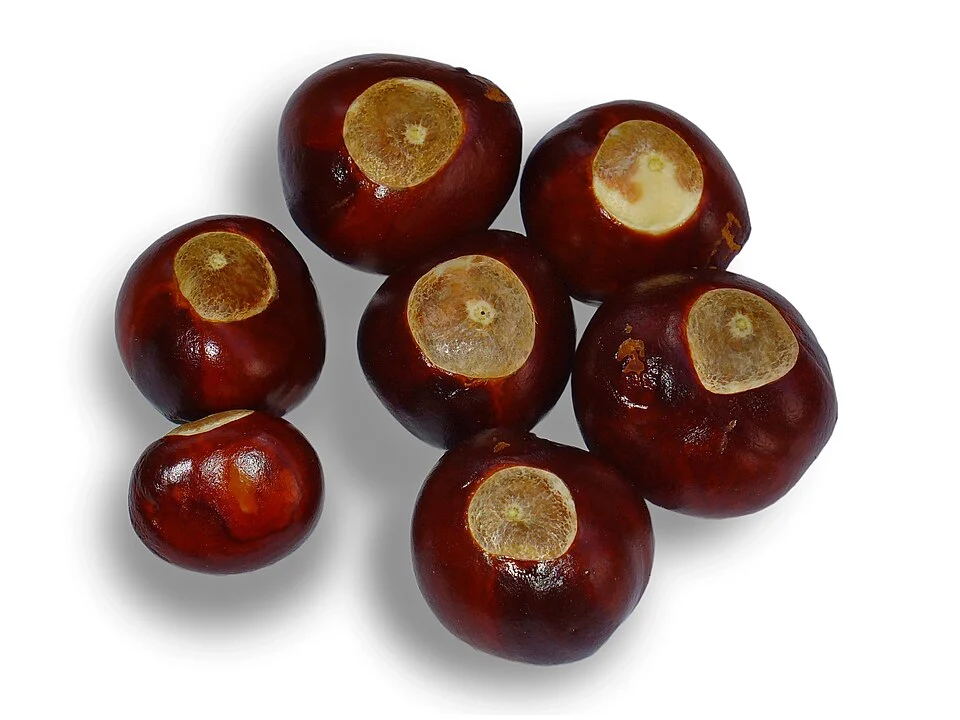
The Museum of Biological Diversity at The Ohio State University explains that it is unclear when the people of the state began to be called Buckeyes. The occasion the museum cites for spreading the name is the 1840 presidential election. Supporters of William Henry Harrison used log cabins and other items made of buckeye wood, and songs calling Ohio the Buckeye State were sung. In 1953, 150 years after statehood, the buckeye was designated the state tree. Behind the way the confection calls Ohio to mind lies a history in which the name of the brown seed had been used for the land and its people before it was used for the confection.
In the university’s athletics, not only the seed but also the leaf became a design. Milt Caniff, an alumnus and cartoonist, stylized the leaf in 1950, and at the October 30, 1965 game against Minnesota, a mascot wearing a ball-like buckeye on its head appeared at Ohio Stadium. This was the mascot later called Brutus Buckeye. The large round head seen at games and the small round spot on a confection on a plate both come from the two colors on the seed.

A Ball Learned at Christmas, Made with Children on College Game Days
In the December 28, 1983 issue of The Arizona Republic, the journalist Gail Tabor wrote about how she came to call them buckeye balls. It began when she liked a confection her mother brought at Christmas and asked how it was made. When she rolled small balls and dipped them in chocolate, the first one left a part where the filling showed, and she thought it resembled the tree’s seed, she said. It is one household’s recollection: her mother’s peanut confection recipe came first, and the name came to her from the shape she saw while dipping.
Friends to whom she gave the confection asked for the method, and Tabor later wrote that she taught it to one acquaintance. When she returned to Columbus after leaving Ohio, it was already known well enough that the method appeared in the local newspaper, but she herself does not remember the year of that return visit. The 1972 university newsletter had already printed the step of leaving a circle, before the 1983 recollection. In the 2004 food magazine Saveur, Sara Bir raises another possibility: that an employee of Gordon Candies in Columbus began it in 1967. That Bir herself learned it from her mother, and that it was eaten at pregame gatherings and at Christmas, is her own experience within the same article. Readers of the newsletter could make the same pattern at home from the instruction to leave a circle about the size of a dime on top of the ball. Set side by side, the story of finding the shape at home, the story that seeks an origin with a shop employee, and the dated newsletter leave two separate questions: when the recipe for the rolled confection first came about, and when it was named for its likeness to the seed.
In the recipe Tabor published in the newspaper, it is 1 pound of butter to 4 pounds of powdered sugar, with at least 6 tablespoons of peanut butter. When her son Guy Lucas published his mother’s article, he added that the 6 tablespoons is a starting point to which one adds to taste. The 1972 university newsletter gives 1 pound of peanut butter to 1.5 pounds of powdered sugar. In the home method there is room to add peanut butter to taste, whereas the newsletter was written from the start so that the amount of peanut butter relative to powdered sugar can be compared. Even for the same confection with a visible pale circle, the sweetness of the sugar and the richness of the peanut differ with the recipe. In Tabor’s household, on the days of Ohio State–University of Michigan football games, she rolled balls and dipped them in chocolate with the children, and kept doing so after moving. What her mother taught her was a Christmas confection, and the day of making many balls with the next generation became a college game day too.
Boxes Handed Out One Piece at a Time, and Balls Chosen for Ceremonies
Anthony-Thomas, a family-owned company in Columbus, was founded in 1952 by Anthony Zanetos, who came to the United States from Greece, and his son Tom, after they ran ice cream and snack shops. The company name combines their two names. According to the company’s history, it moved to a larger factory in 1969, built another factory in 1995, and added packaging and manufacturing equipment again in 2024. This equipment is used for multiple confections and does not represent the volume of buckeyes alone. It shows that, in a town where people made the balls at home, there is a shop that makes the confection continuously and sells it according to the number of people gathering.
The company offers 12-piece packs in both a box with the university’s design and a box with the shop’s traditional design, and for pregame gatherings held in parking lots and elsewhere it offers a 60-piece pack of individually wrapped pieces. The same-size confection is wrapped differently when a box is opened to show the round pattern as a gift and when pieces are handed out one by one before a game. A local chocolate café packs hand-rolled balls in boxes and ships them out of state; in written testimony submitted to the state legislature in 2025, Lisa Boyle of the shop listed them among its most-ordered items. There are also versions that incorporate Oreo or Butterfinger in addition to the traditional ball. As the university’s recipes also include a version without peanuts, the recipe changes to suit the eater and the occasion, and the bite-size shape with a pale circle remains as a clue to the name.
At The Buckeye Lady in Columbus, they make a version in which a peanut mixture surrounds raspberry jam. When broken open, it reveals layers in order: chocolate, peanut, and, deeper in, the jam. The shop prepares assortments for events such as weddings, and also holds classes in which participants roll and coat balls themselves and take them home. A shop that takes small brown balls to gatherings also passes on, in another form, the method that has been handed down through hands-on work in homes.
In 2025, a bill to make the buckeye, a combination of peanut butter fudge and chocolate, the state’s official confection passed the Ohio Senate. According to legislative records as of November 9, 2026, it has been referred to a House committee. What the Chocolate Cafe conveyed in its written support was the work of hand-rolling each piece at its Columbus shop and the business of delivering gifts out of state. The bill’s description states that the confection consists of peanut butter fudge and chocolate, and leaves the depth of the coating and the proportion of powdered sugar to each shop’s and household’s method. Beneath the name that the legislature takes up as a candidate to represent the state lie the memory of a land that saw a tree’s seed and the days spent rolling confections to hand out to family and spectators.
Glossary
- Ohio buckeye
- Scientific name Aesculus glabra. The state tree of Ohio; its glossy brown seed bears a pale mark. The confection reproduces the seed’s shape and coloring.
- Peanut butter
- A paste made by grinding peanuts. Here it is mixed with powdered sugar and butter to form an unbaked center that is rolled into balls.
- Semisweet chocolate
- Chocolate with added sugar and a pronounced cacao flavor. In the university’s recipe it is melted and used to coat the balls.
- Gail Tabor
- A U.S. journalist. In 1983 she wrote in a newspaper her own recollection of making her mother’s confection and naming it buckeye, along with the recipe.


