


SweetloreEncyclopedia of World Sweets (834)

Cajeta de Celaya
Cajeta de Celaya
A Celaya milk sweet of reduced goat's milk that draws a thread from the wooden spatula
Sugar Confections / Celaya, Guanajuato, Mexico

When the wooden spatula is lifted, the brown liquid of reduced goat’s milk draws out in a thread. Cajeta de Celaya is a milk sweet made around Celaya in the state of Guanajuato, Mexico. The milk is simmered in a copper pot and stirred with a wooden spatula, and the maker watches for the point at which to take it off the heat. Tracing how it was scooped from a small wooden box and how it came to be sold packed in glass jars also shows why makers choose the thickness of the milk and the container.
Reducing the milk until it draws a thread from the spatula
The geographical indication declaration published in Mexico’s Diario Oficial in 2022 describes how Celaya makers judge matters from the receipt of the milk to the end point of reduction. A workshop looks at the color and smell of the milk it receives and also checks its temperature, density and acidity. Because the water is reduced over a long time once the milk is in the pot, there is a step of selecting the milk to be reduced before the sweetness is adjusted at the finish. Separate checks are set for the stage of receiving milk and for the stage of inspecting the finished sweet.
The milk is heated in a copper pot with a wide mouth and sloping sides. The declaration’s process table states that the milk is warmed to 93 °C before the sugar is added. Once heating is under way, the milk is stirred and reduced to about one-third of its initial volume. There is a stage in which the heat is lowered, and stirring continues throughout. Because vigorous, fast movement can trap air and change the thickness and appearance, the description of the traditional method says the spatula is moved smoothly and at a steady pace. The pot does not need to be heated in the same way until the milk boils as after the water has been reduced.
According to the declaration, the pine spatula used in the traditional method is about 1.7 meters long. The craftsperson rests the spatula against the side of the pot, holds it level and watches the cajeta running along its surface. Once the milk moves from simply running off to a deepened amber liquid that draws a thread, the way the thread forms becomes the basis for judgment. Checking this repeatedly beside the pot is the work of reading the punto de cajeta, that is, the point at which the mixture is done as cajeta. Even when timing shifts with the size of the batch and the strength of the fire, the spatula can be used to follow changes in the contents of the same pot.
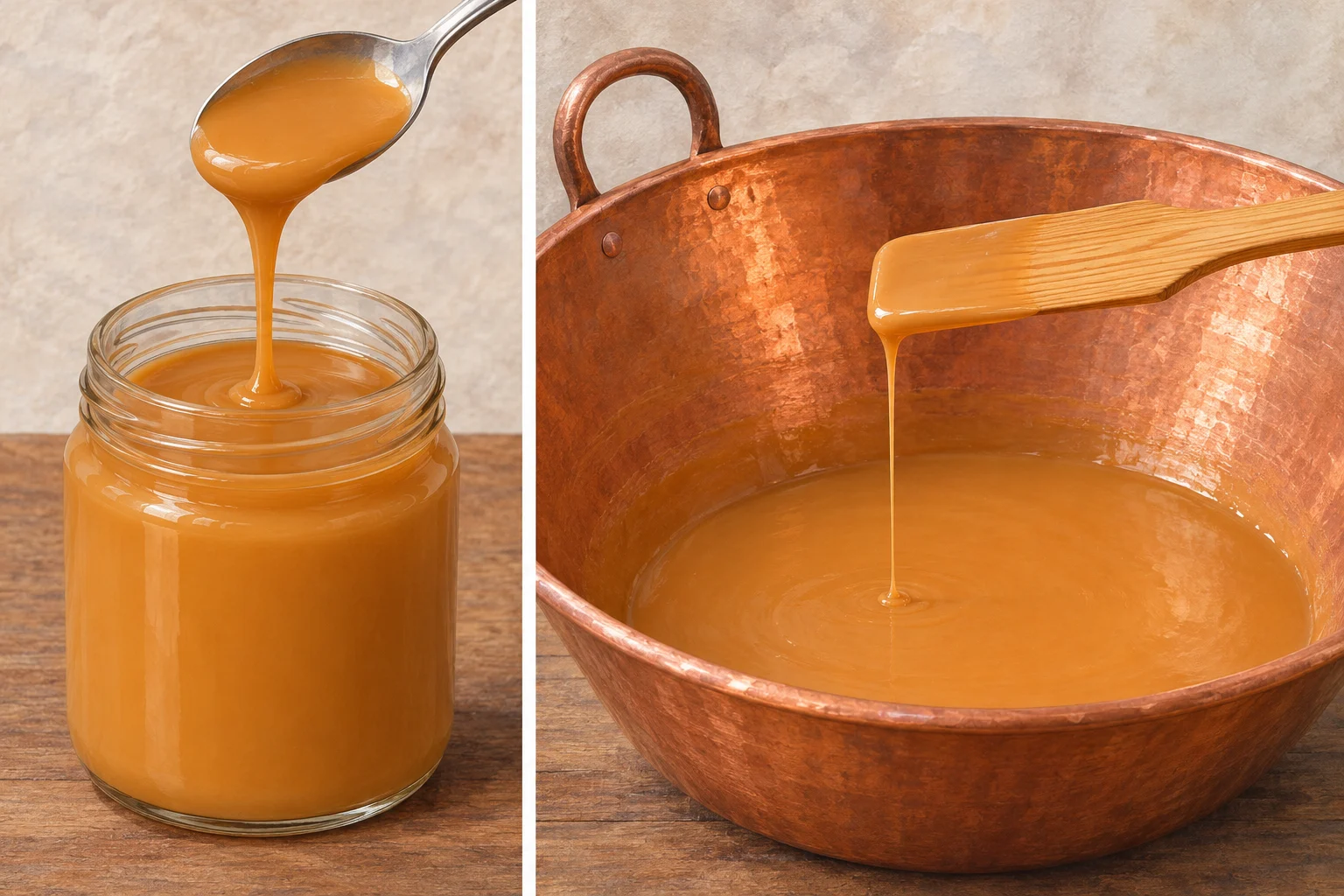
The process table also gives 65–69 °Brix as a guide to the end point. This is a measure of the concentration of soluble solids, obtained from the refractive index. It is affected not only by the weight of sugar added but also by components naturally present in the milk, such as lactose, and by the water that has evaporated. The thread seen on the spatula shows how the cajeta flows, while the refractometer measures the concentration of dissolved components. The declaration’s process table says the reduction can take two to three hours, whereas the passage describing the traditional method gives a range of about an hour and a half to four hours. The time to take the pot off the heat is not fixed uniformly; in each batch, the maker checks whether the mixture has approached the specified concentration.
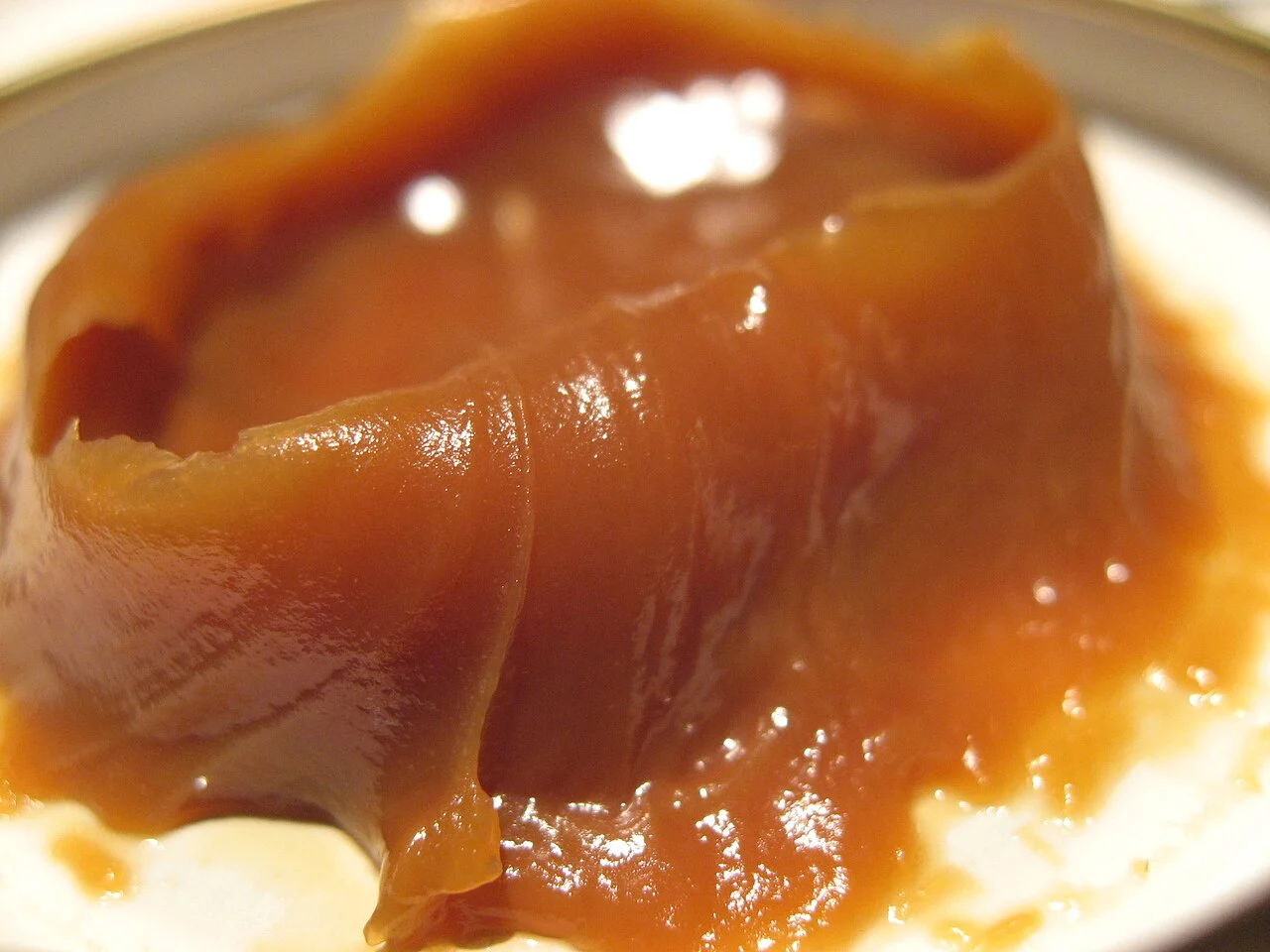
Goat’s milk from nearby farms, and four formulations
The milk supply rests on goat keeping in and around Celaya. The declaration lists dairy goats, mostly Saanen, along with breeds such as Toggenburg, Anglo-Nubian and Alpine. The passages on regional livestock raising mention both the older practice of using scrub such as mesquite and keeping that uses alfalfa and maize. The amount of milk a workshop can process is not decided solely by the confectioner’s circumstances; it also depends on the season in which milk is available and on how the goats are kept. The product categories and the note on the period of low goat’s-milk supply show this relationship concretely.
Cajeta de Celaya is based on goat’s milk, but the geographical indication declaration classifies the products handled under the same name by the formulation of their ingredients. For Premium A, the milk-to-sugar formulation is given as 80 percent goat’s milk and 20 percent sugar. For Premium B, the share of goat’s milk is also 80 percent, and the remainder is 10 percent sugar and 10 percent glucose. These proportions are separate from the share each ingredient makes up of the contents of the jar after reduction.
For both categories, the declaration gives an example in which 4 to 5 liters of milk yield 1 liter of cajeta.
In the declaration’s formulation categories, Típica is half milk and half sugars, and Comercial is 30 percent milk and 70 percent sugars. Examples are given in which 3 to 4 liters of milk yield 2 liters of cajeta for Típica, and 1 liter of milk yields 1 liter of cajeta for Comercial. Premium A and B use goat’s milk, while for the other categories cow’s milk may be combined with it at up to 50 percent in periods when goat’s-milk production is low. The declaration names November and December as the main such months. Even when the same place name appears on the label at the point of sale, the way milk and sugars have been combined differs by category.
Scooped from a wooden container and carried home by rail
The origin story told by Celaya makers says that goat’s milk was tried in making a milk sweet, and it became the sweet of the region. In the tale, a container made with a wooden lid and thin strips of wood was then devised so the sweet could be kept, shared and sold. The container came to be called a cajete, and in time what was put inside it was also called cajeta. This is not a story from which one can confirm when goat’s milk was first used or the moment the name was given, but it conveys that the wooden container and the milk sweet were sold together as a pair.
The local maker La Reyna describes the cajete as a cylindrical container with sides made of thin strips of wood, and says that the lid was used to scoop out the contents. With a sweet cut into individual pieces and wrapped, as caramels are, the eater takes out one piece at a time. Cajeta keeps a stickiness that lets it be moved from the pot into a container, and it is eaten by scooping out a little at a time while it stays in the container. The box and lid were tools for carrying, and could also be used to start eating on the spot. This way of eating lies behind the explanation that the container’s name became the sweet’s name.
The history of the same maker states that the founder, Bernardo Rosas González, helped with work for the Olalde family in 1923, at the age of nine, and learned to care for goats and handle milk. It further says that he learned the method from Octaviano Quintero and later used a tricycle for deliveries. What this record describes is where one maker acquired his skills and how he delivered his product. Rather than settling on the name of an inventor, it shows the route by which the knowledge of judging milk and the work of handling the pot were passed down through households and workshops.
Local accounts also say that railway passengers bought cajeta in Celaya and took it home to other towns, and that this spread its reputation. The date when sales at railway stations began is uncertain. What appears in the makers’ accounts is how this sweet circulated: long-simmered milk was carried in its container, and visitors could take it back to another town. At which station, and in which shop, the wooden boxes were sold is one question; the way the railway has been spoken of as the means of carrying Celaya souvenirs is another.
La Tradicional de Salgado traces the history of its workshop back to 1860. What it offers visitors is production and tastings at its former workshop and shop. The year the shop displays belongs to the company’s own history and does not indicate the year cajeta was first cooked in the Celaya area. Set beside La Reyna’s record of its founder’s apprenticeship from 1923, it shows that the two shops trace the memory of their own production from different eras.
From pot to jar, and into the shop’s confections
The container listed in the Diario Oficial’s process table as the current one is a glass jar with a metal lid. The finished cajeta is strained, and after heating is complete it is left to stand for a short while. The process table gives an example of filling at about 50–55 °C, so that the contents flow and are easy to transfer into the jar.
At the same time, it takes into account that if the jar is capped while too hot, steam condenses into droplets on the inside of the lid. Beyond the judgment of when to take the cajeta off the heat, how easily it flows when filled into the container and how it is handled until it has cooled and been stored are needed after it is finished.
In the Diario Oficial’s description, after the end point of heating is judged, the jars are prepared, and once the filled contents have cooled the labels are applied and the jars are packed into boxes. What the story of the wooden cajete shows is a way of use in which the cajeta is carried and scooped out to eat. The glass-jar process shows handling in which the unit of carriage is standardized and the jars are boxed with their lids closed. The wooden container and the jar are both vessels for holding cajeta, but they differ in how the cajeta reaches the point of sale and in how the contents are handled after purchase.
La Tradicional de Salgado, in central Celaya, divides the cajeta it makes into natural, vanilla, envinada and quemada. Apart from formulation categories of milk and sugars such as the Diario Oficial’s Premium A and Premium B, these are names for choosing flavor at the point of sale. The Spanish edition of Larousse Gastronomique also gives examples of flavoring cajeta with vanilla, cinnamon, rum and other ingredients. Even though the base preparation of milk and sugar is shared, the flavored versions do not all smell alike.
Besides cajeta, the same workshop also makes milk sweets called hamoncillo and chicloso, and a confection with cajeta sandwiched between small obleas. An oblea is a thinly baked wafer, and it makes the cajeta, which is spooned out of the jar in small amounts, into something that can be eaten whole together with the baked wafer. There are also examples in which cajeta is used as the filling of a confection wrapped around fruit. That cajeta keeps a stickiness that lets it be moved from the pot into a container matters not only when it is eaten as it is, but also when it is spread on the surface of other confections or enclosed within them.
The range of La Reyna featured in the state tourism guide includes cajeta flavored with coffee and mezcal, in addition to vanilla and others. Here too there are several jar sizes and flavors, so even among one shop’s products the way of eating and the quantity can be chosen. The workshops the state presents also handle products in wooden containers and small obleas. While the glass-jar process is recorded in the Diario Oficial, forms sandwiched between thin wafers and forms packed in wooden containers can also be seen in the shops’ ranges. The forms in which cajeta is taken home did not settle into a single form with the move to jars.
The protected area of the 2022 geographical indication includes not only the municipality of Celaya but also Apaseo el Grande, Juventino Rosas, Cortazar and Villagrán, in the same state of Guanajuato. Viewing a milk sweet bearing a place name through the history of one town’s shops shows the paths by which individual craftspeople passed on their skills. Viewed across the whole production area, it also brings into view the farms that deliver the milk and how the formulation is handled in the season when milk is scarce. Reduction until the milk draws a thread from the spatula, and a form that can be put in a container and carried elsewhere, are recorded in common for the cajeta made in these several towns.
Glossary
- Cajete
- The wooden container that Celaya makers give as the origin of the name cajeta. In local histories, accounts mention the lid being used in place of a spatula.
- Punto de cajeta
- The end point of reduction. It is judged by how the thread of cajeta falls from the wooden spatula, and by its color and stickiness.
- Soluble solids (°Brix)
- A measure of the concentration of dissolved components, expressed from the refractive index. It is to be distinguished from the weight proportion of sugar added to the cajeta.
- Bernardo Rosas González
- The founder of La Reyna. According to the company’s history, he learned to make cajeta through keeping goats and handling milk.
- Octaviano Quintero
- The person who appears in La Reyna’s history as the one from whom Bernardo Rosas González learned how to make cajeta.
- Oblea
- A thinly baked wafer. There are examples of workshops selling it with cajeta sandwiched between wafers.
- Indicación geográfica (geographical indication)
- A name that protects the link between a product’s characteristics or reputation and a specific region. For Cajeta de Celaya, it sets out the product categories, process and production area.


