


SweetloreEncyclopedia of World Sweets (834)

Bêtises de Cambrai
Bêtises de Cambrai
The stripe in white pulled candy, and the two confectioners of Cambrai
Sugar Confections / Cambrai, France

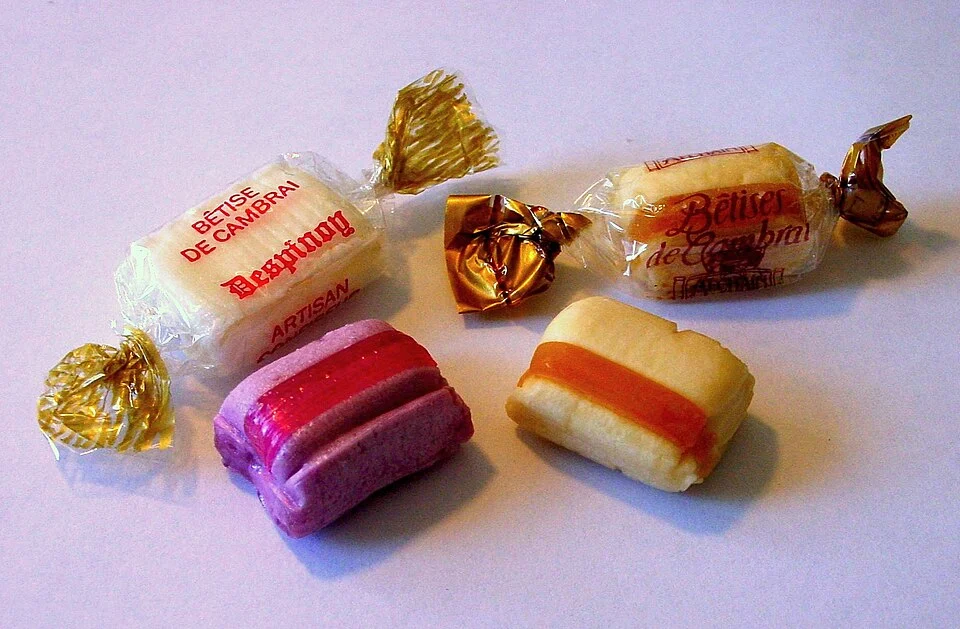
Unwrap one and you find a small white candy swelling like a tiny pillow, crossed by a thin caramel-colored stripe. This is the Bêtises de Cambrai of Cambrai, in northern France, and its traditional flavor is mint. The white part and the stripe start as sugar from the same pan, but only the stripe’s share is taken from the cooled mass; the rest is pulled to work in air before the two are joined. Only when the combined mass is stretched into a rod and cut does it become a piece that is rounded on top and flat underneath.
Dividing One Pan of Sugar into White Body and Stripe
A French living-heritage source states that sugar and glucose are cooked and then cooled on a cooling table until firm enough to handle. The portion to be caramelized is taken at this point. In the Despinoy workshop, a copper kettle is used: the pale yellow sugar, once boiled, is spread on a cold table, and a portion set aside is colored with caramel. The mass is not handled by machine while it is still flowing, as in the kettle, nor after each piece has set hard. It is worked at the intermediate stage, when it has cooled enough for hands and tools, and the part that will later become the stripe is set apart.
A 2020 article describing a visit to the Afchain workshop begins with white sugar dissolved in warm water, glucose syrup added, and the mixture boiled down in a copper kettle. The mass is turned repeatedly on the cooling table, and the portion for the stripe is taken once it can be lifted. The remaining sugar is put on a machine and stretched, which works in small air bubbles and makes the same sugar look white. A regional tourism body likewise explains that the candy whitens as air is incorporated, and Despinoy says that its own sugar turns white during pulling. The two parts, which look different, are made by separate treatments after cooling.
Mint is added to the whitened mass, and the caramel-colored portion is joined to it as the stripe. In the article on the Afchain process, a machine combines the two into a thick rod, which rollers then thin. The white mass is not mixed so thoroughly that it turns brown throughout. The colored surface stays on the side that is stretched, so every cut piece carries a single line. The shape, domed on top and flat on the bottom, comes from the work of shaping the rod by machine and then cutting it piece by piece. Despinoy also has steps of stretching, machine processing, cutting and wrapping, and Afchain names the crisp bite of its boiled and pulled sugar as a distinguishing feature. The exact proportions used by the two companies and the production conditions at each step do not appear in the published sources.
The Afchain visit article continues to the point where the cut pieces are wrapped individually and gathered into bags. The single lump from the cooling table has become a rod by the time it enters the rollers, and only when it is cut and wrapped in separate papers does it take the form of the piece bought in a shop. In the article the cooling table is called the “marbre.” Despinoy’s work is also documented, including the sugar that whitens while being pulled and the wrapping and sorting after cutting. Because it cannot be confirmed that every company uses the same equipment, this sequence of machines and the roller-based shaping belong to the workshop that was visited.
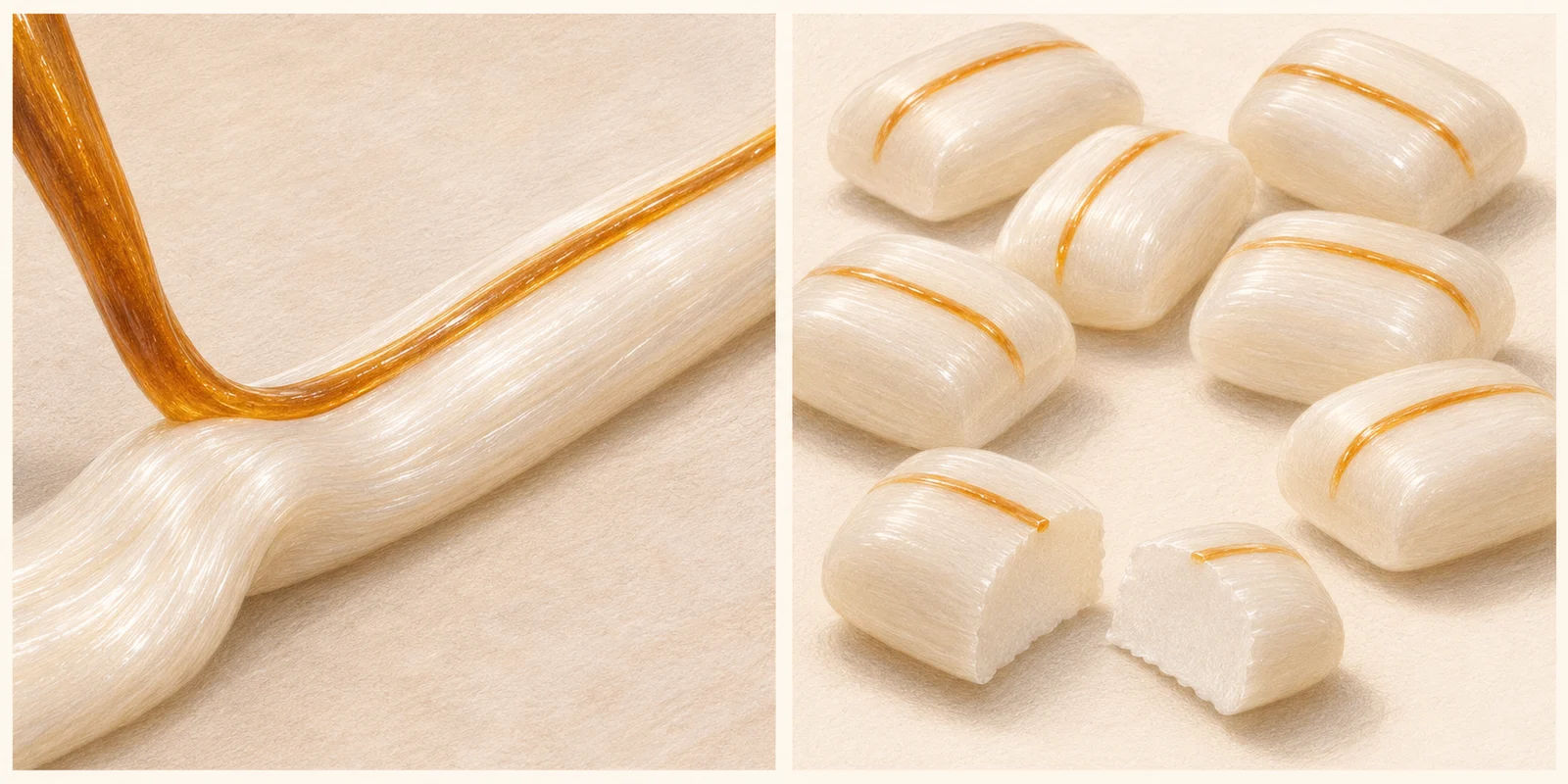
Fresh Mint, and Selling by the Individually Wrapped Piece
In regional heritage sources, mint with a caramel stripe is the basic example. The city of Cambrai presents the candy as an after-meal sweet and notes that fruit and chocolate flavors now exist as well. VPAH’s examples include apple, orange, lemon and violet, and Afchain also offers a mint product and an assortment of fruit flavors. While the stripe stays as a mark of identity, the color and aroma of the piece taken from the wrapper can be chosen. To learn the ingredients and flavor, read the producer’s labeling as well as the color of the piece. The freshness of the mint appears in explanations of the custom of serving it after a meal, and is distinguished from claims about medicinal effects.
An exhibition document made in 2018–2019 by students of food culture and supervised by a specialist in food history cites, for the Afchain example only, the essential oil of Mitcham mint grown in Grasse. The stage at which the mint aroma is added can be read from the working process, and which mint was chosen from the exhibition document that studied one company. The same document says that Afchain has offered its candies individually wrapped since 1947. This is a date that traces how that company sold its product; it gives no grounds for applying the mint’s origin or the date of the switch to individual wrapping to both companies. On heating, the document also describes an example in which sugar and glucose are combined and boiled for about 30 minutes under vacuum, with the aroma added after cooling and pulling. The caramel stripe seen in the candy is a marker and, in the document’s explanation, also part of the flavor that tempers the strong taste of the mint. This too is the explanation of the makers the document took up.
The Name “Mistakes,” and the Claims of Two Confectioners
The French word bêtises means mistakes, pranks, foolish things and the like. Heritage sources link it to an apprentice’s mistake, and also raise the possibility that it derives from another sense of the word, meaning trifles or small trinkets. The sound of the confection’s name alone cannot settle in which shop or what kind of mistake occurred.
The city’s guide gives around 1850 as a rough date of origin. Afchain puts forward a story set in 1830: the apprentice Émile Afchain botched a job and was scolded, but the candy that resulted sold. Despinoy’s nineteenth-century story also features an apprentice, who misjudged the sugar and mint, worked air into the batch, scorched the sugar at the bottom of the kettle and was scolded; here too, the candy was later favored by customers. An essay in the heritage journal In Situ presents the Afchain story and points out that traditions should be handled with caution when explaining how a confection came about. The stories each company preserves show how the origin was later told in the town. The exhibition document traces records of candy-making in the town back to the thirteenth century and explains that in the nineteenth century a large market was held on the 24th of each month. It discusses the possibility that Afchain’s new candy appeared around 1850 in response to the demands of buyers gathering at this market.
A French tourist guide explains that the rivalry between the two families filled the newspapers of the time and went to court in 1889. The terms “inventor” and “creator” that appear in another regional cultural source are also clues for tracing that period. The original nineteenth-century judgment has not been located. By contrast, a 1993 ruling of the French Cour de cassation documents a dispute over “Bêtises de Cambrai” syrup sold in 1991, concerning the relabeling of bottles from the same manufacturer. According to the document, the Cambrai distiller Dinor had bottled the syrup for Despinoy; Afchain’s manager bought it and relabeled the bottles on an open day to promote his own product. What the Cour de cassation rejected on September 29, 1993 was the appeal concerning this relabeling. Here the famous name moves from the candy to a drinking syrup, and which company’s product it is can be told only by the paper stuck on identically shaped bottles.
In a Sugar Town, the Names of the Candy and the Shops Remain
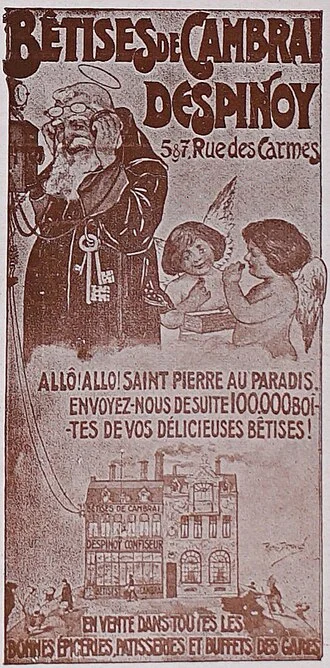
In 1992, Bêtises was entered in the Nord-Pas-de-Calais inventory of culinary heritage, the year it was recorded as one item of the region’s food culture. VPAH’s source presents Despinoy as a confectioner’s shop dating from around 1800, and according to a company profile from a regional government agency, business under that name was interrupted once, in 1966. By Despinoy’s own account, René Campion took it over in 1972 and expanded the business. The factory is said to have stood in the center of Cambrai, to have changed location several times, and to have moved to Fontaine-Notre-Dame, west of the city. What has lasted is the shop’s name; the people and places that make the candy have changed in the meantime. VPAH writes that where Despinoy’s factory stood in the town can be narrowed down by period from the addresses and designs on old tins. In the advertisement photograph, too, the address at Nos. 5 and 7 on Carme street (カルム通り) in Cambrai remains beneath the shop name. Set side by side, an advertisement printing this street address and the records of a workshop that moved to the west of town tie the same shop name to different places. The Afchain workshop listed by VPAH is on Champ de Tir street (シャン・ド・ティール通り) in the city of Cambrai. This official profile also shows that two workshops make candies of the same name and welcome customers through separate doors. It is a source that tells where customers were handed the candy, more than the name alone does.
The confectioners named in the Cambrésis tourist booklet are not only the two companies known today. About fifteen shops once took part in making or selling it, and names such as Lorivier-Delabre, Després and Herlin are listed. The same booklet also mentions the local industry of growing sugar beet and processing the harvest into sugar. It is not a source that traces a single piece on the counter back to the field of its raw material, but it shows that a confection made from boiled and pulled sugar has been eaten in a land with an agriculture that produces sugar.
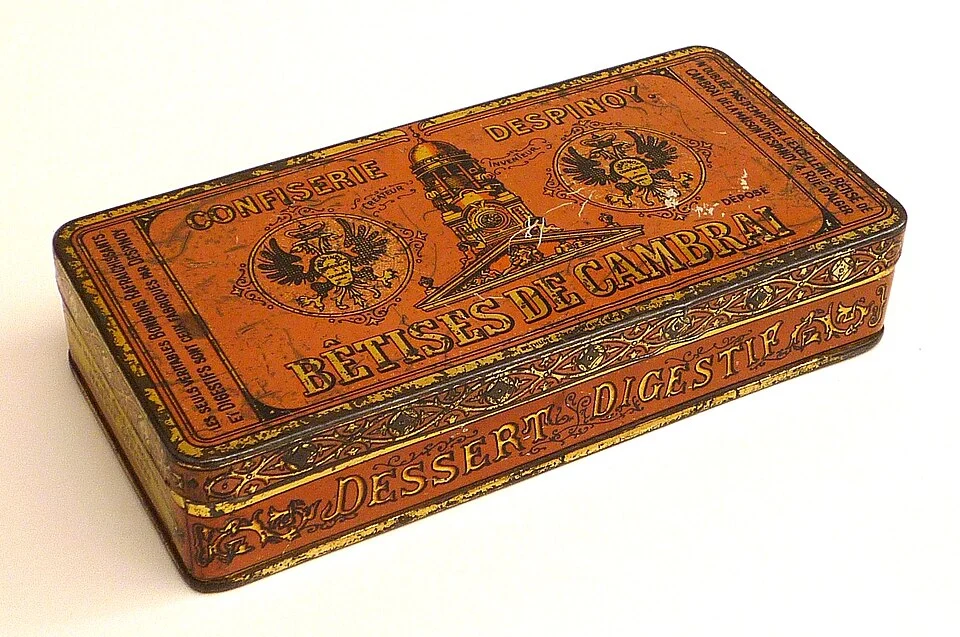
Afchain has a tin depicting the vehicle once used to deliver and sell its candies. Rather than the method of making them, the vehicle design shows which tools the company has kept as memories of its trade. The Catalogue collectif de France also has a record registering Despinoy’s packaging materials. What the catalogue shows is that the materials exist and where they are held; to trace the lettering or dates of old wrappers, one must read the entries for the individual objects. Even from a tin on which the shop name can be read, the design of the container alone does not reveal the recipe by which the candy inside was boiled. On the side of the Despinoy tin in the photograph, words linked to after-meal eating are also printed. The way of selling mint pieces as a close to the meal can be traced through the words on the tin as well as through the aroma of the product.
At Le Labo, a cultural venue in Cambrai, an exhibition on the candy and the town’s history was held from September 20, 2025 to January 4, 2026. Starting from tins collected by the local historians François Tilly and Nicolas Ladrière, they built the exhibition with the city department in charge, and the two companies opened their places of production and lent objects and documents. The year before the exhibition, the two published a book on a local dispute of the late nineteenth century, and the exhibition used the collected tins to show what has been recorded in the town. Afchain and Despinoy each prepared a commemorative tin with the same design and mint flavor to coincide with the exhibition. The venue describes it as the first time that the two rivals have issued tins with the same picture. The commemorative tins keep the mint aroma while placing in that year’s buyers’ hands a relationship different from the days when the shops competed through differences in design. Looking in turn at an advertisement with the shop name in large letters, a tin that states the place of manufacture, and the two companies’ commemorative tins with the same design, one sees that the container holding a single piece has also become a record of the town and its workshops.
Glossary
- Bêtises
- A French word meaning mistakes, pranks and the like. There are several explanations for the origin of the confection’s name.
- Pulled candy
- Candy made by repeatedly stretching a mass of heated sugar to work air into it.
- Caramel
- Sugar heated to give it color and flavor. It is used for the thin stripe of this candy.
- René Campion
- According to Despinoy’s account, the person who took over the company in 1972.


