


SweetloreEncyclopedia of World Sweets (834)

Canistrelli
Canistrelli
A Corsican biscuit that is cut, baked, and dipped in a drink
Baked Sweets / France, Corsica

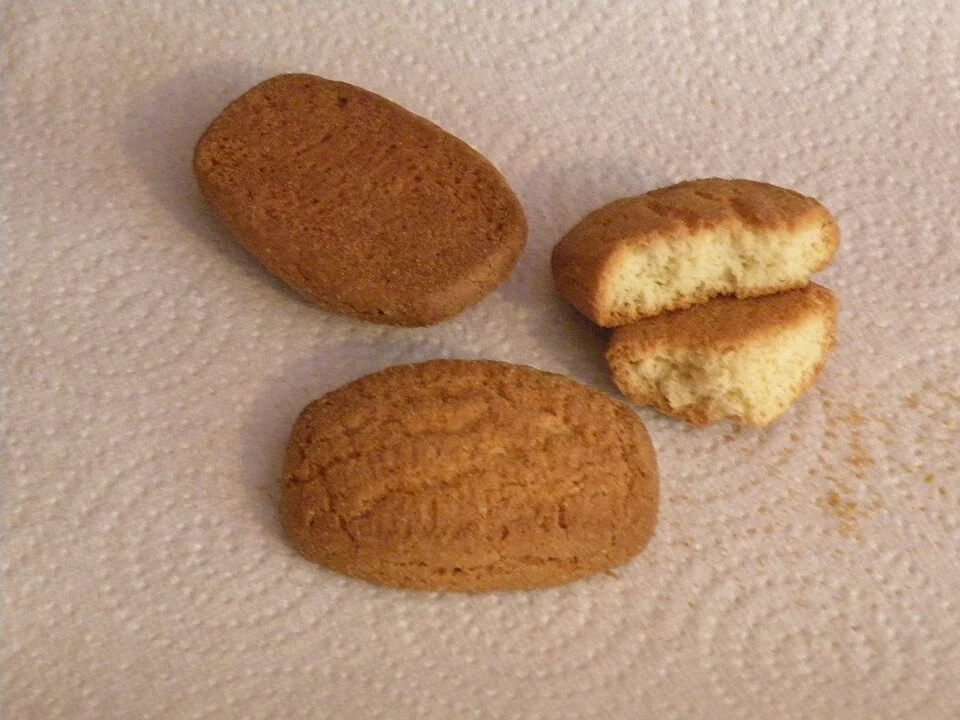
Break a canistrello (plural canistrelli) and just under the lightly colored surface you see a pale, fine-grained crumb. These are dry Corsican biscuits that shed small fragments onto the plate. A rectangle or diamond is easy to bite from a corner, while a rounder piece snaps from its thin edge. The best-known version binds flour and sugar with oil and is flavored with white wine or aniseed. Because nothing is sandwiched in the middle, such as cream or bean paste, what you see at the center depends on the dough. Some break slightly coarsely; others are fine-grained and tight.
Choosing the Liquid, Then Adding the Flour
At Maison Casanova in Olmi-Cappella, in the hills of Balagne in the northwest, the flour is mixed in two stages. The recipe calls for 1 kg of flour, with 450 g each of sugar and peanut oil and 6 eggs. A pinch of salt and 20 g of a leavening agent given in French as levure are also included. First, half of the flour is combined with the other ingredients, and once the mixture is smooth, the remaining flour is added little by little. Water is added only when needed. Even if the baked biscuit is meant to be dry, the dough before cutting needs enough moisture to be rolled out into a single sheet on the work surface. Adding the flour in halves lets the baker judge whether water is needed while checking that the dough holds together well.
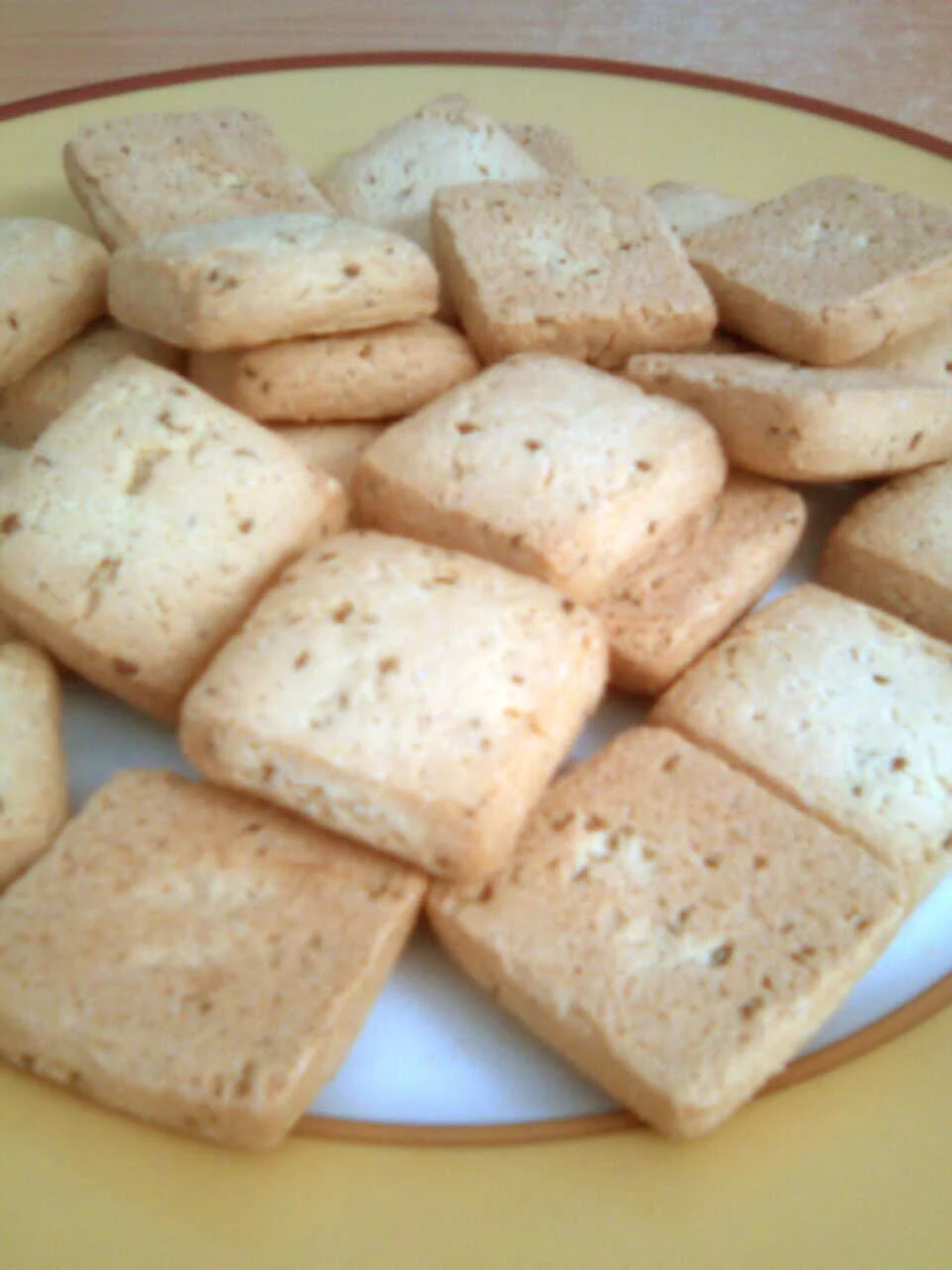
For this quantity, the guideline for wine is 500 mL. White wine and aniseed can be used together, or anisette can replace the seeds. If seeds are mixed in, the aroma comes out where the teeth crush the grains as the biscuit breaks. If white wine or anisette is poured in, the aroma disperses along with the liquid, and the water in that liquid binds the flour. Even with the same anise flavor, there is no reason to use the same amount of water afterward whether you add the seeds or pour in the spirit. Seen from the side, a baked piece may show visible seeds in places and nearly uniform dough color in others. Some aromas become apparent only when you eat the biscuit.
Peanut oil is liquid at room temperature. As the dough is mixed, the oil spreads between the flour particles, so the strong elasticity of a bread dough made by kneading flour and water is less likely to develop. In Casanova’s formula, the moisture in the eggs also wets the flour, and their proteins set when heated. Considering that combination, a crisp bite after baking and a dough that holds together and can be handled before baking can coexist. The local recipe gives no experimental figures measuring texture. Through this one example of a method that uses eggs, we can read how the ingredients work differently from a dough kneaded with oil alone.
Cutting One Sheet of Dough and Baking It to the Edges
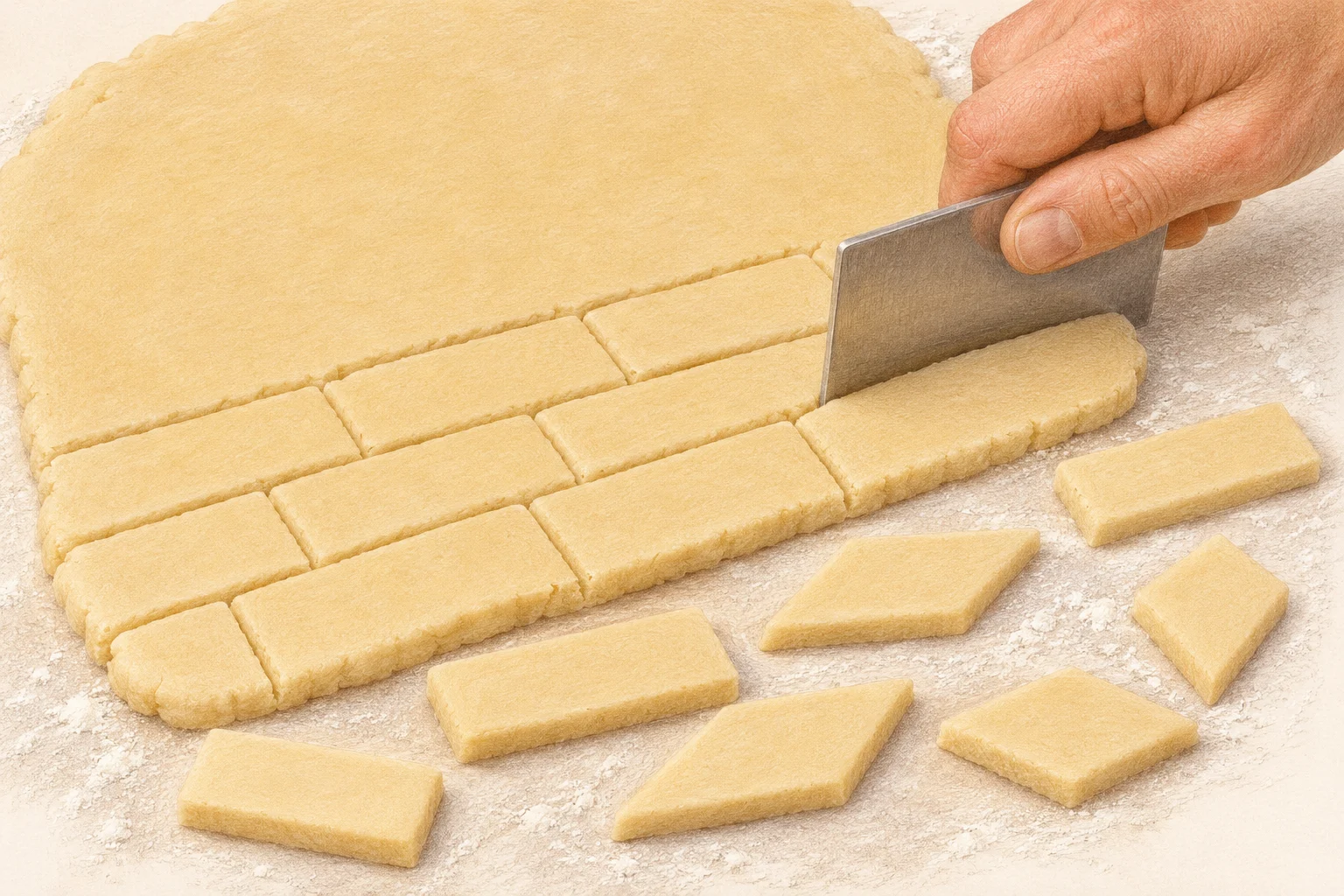
At Casanova, the dough is rolled out to a thickness of 1–2 cm on a floured surface. It is cut into rectangles, squares, or diamonds with a long side of about 6–8 cm, then baked at 180°C for 15–20 minutes. If you make parallel cuts and then cross them with a second set of diagonal cuts, you get diamonds of the same width. Cutting with a round cutter leaves dough between the individual pieces, but with straight cuts adjacent pieces share an edge, so the dough between them is cut up as well. Apart from the ends near the outer edge of the sheet, little dough has to be gathered and rolled out again.
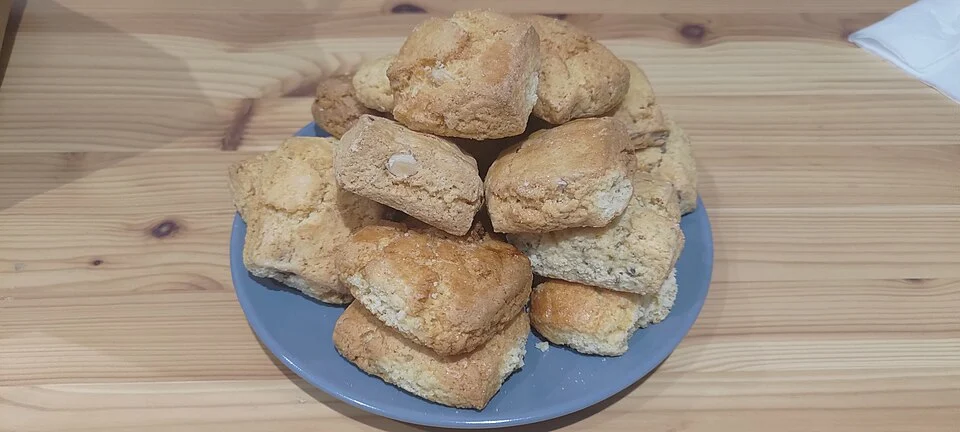
The thinner the corner, the shorter the distance heat has to travel to reach the center. Even at the same thickness, moisture escapes at different speeds from the tip of a diamond and from the middle of a rectangle. Because the dough is cut before baking, every piece has raw-cut edges, and these too are exposed to the heat of the oven. When square biscuits are stacked on their sides, you can see not only the top surface but also the color and thickness of the sides that were cut and then baked. When you break one from a corner, the well-dried thin part snaps first, and then the teeth meet the dough in the center and any almonds mixed into it.
If the rolled-out dough is thicker than planned, the texture of the edges and the center is likely to differ even when baked at the same temperature for the same time. A diamond’s tip may already be colored while its center is still soft. Making the thickness even is not merely a matter of tidy arrangement for the cook. When you break a piece taken from the oven and look at the color of its side and the state of its center, it gives you a basis for comparing baking times. Because Casanova gives the dough thickness in addition to time and temperature, the figures in the example can be read together.
Fats and Leavening That Differ from Workshop to Workshop
Biscuiterie d’Afa, near Ajaccio, lists as its basic ingredients flour, sugar, a leavening agent, a little water, and sunflower oil. If we fixed the island’s formula on the basis of Casanova’s example, which uses eggs and peanut oil, the dough of this workshop on the same island would be lost from view. Afa makes versions such as white wine flavor and almond. Because aromas can be mixed into each thinly cut piece, the same method of gathering the dough on the work surface and baking it can yield biscuits that smell as you bite them or that end with a bite of nuts.
CliqueCorse, which presents Corsican cooking, uses butter, eggs, white wine, and aniseed, and specifies baker’s yeast as the leavening. Dough made with butter tends to firm up when cold, so the stiffness felt in the hands while rolling differs from that of a dough made with an oil that is liquid at room temperature. Casanova’s French recipe writes levure, whereas the tourist board’s German version translates it as baking powder. When reading an example that specifies baker’s yeast, as CliqueCorse does, there is a waiting time for fermentation; when reading it as leavening with baking powder, the process centers on mixing and baking. The leavening in Casanova’s recipe, which is translated in different ways, cannot be pinned down to one or the other from the single French word.
Maison Zamboni in Lucciana says it uses a method dating to 1876, from the great-grandmother Marie-Jeanne Zamboni. The workshop explains that its basic dough, which it preserves, contains no butter or eggs, and that the outside is crisp while the inside is rather soft. What the Zamboni example conveys is less a date of origin for the whole island than a family formula passed down together with the name of the workshop. The fact that the texture inside can be changed while the surface bake is maintained also shows the range that fits within the description "dry biscuit." Fresh from the oven, the biscuit is hot and fragile; as it cools, steam escapes and the fat settles. How much force it takes to snap a corner, and how dense the center is, are easier to grasp by comparing pieces once they have cooled.
Carried Along, Eaten with a Drink
L’OPT, which documents the food culture of Balagne, presents canistrelli as a sweet suited to travel. Besides being eaten as they are, they were also dipped in wine or milk, it says. Bitten undipped, a crack runs out from where the teeth meet the biscuit. If a corner is put into a drink first, liquid enters through the baked, dry edges and cracks, and that part breaks down with little force. Without soaking the whole piece, you can eat from the softened side and enjoy the crispness of the dry side. Baking a dough made with white wine and adding wine when eating are also separate matters; the aroma and moisture of the latter are added just before eating.
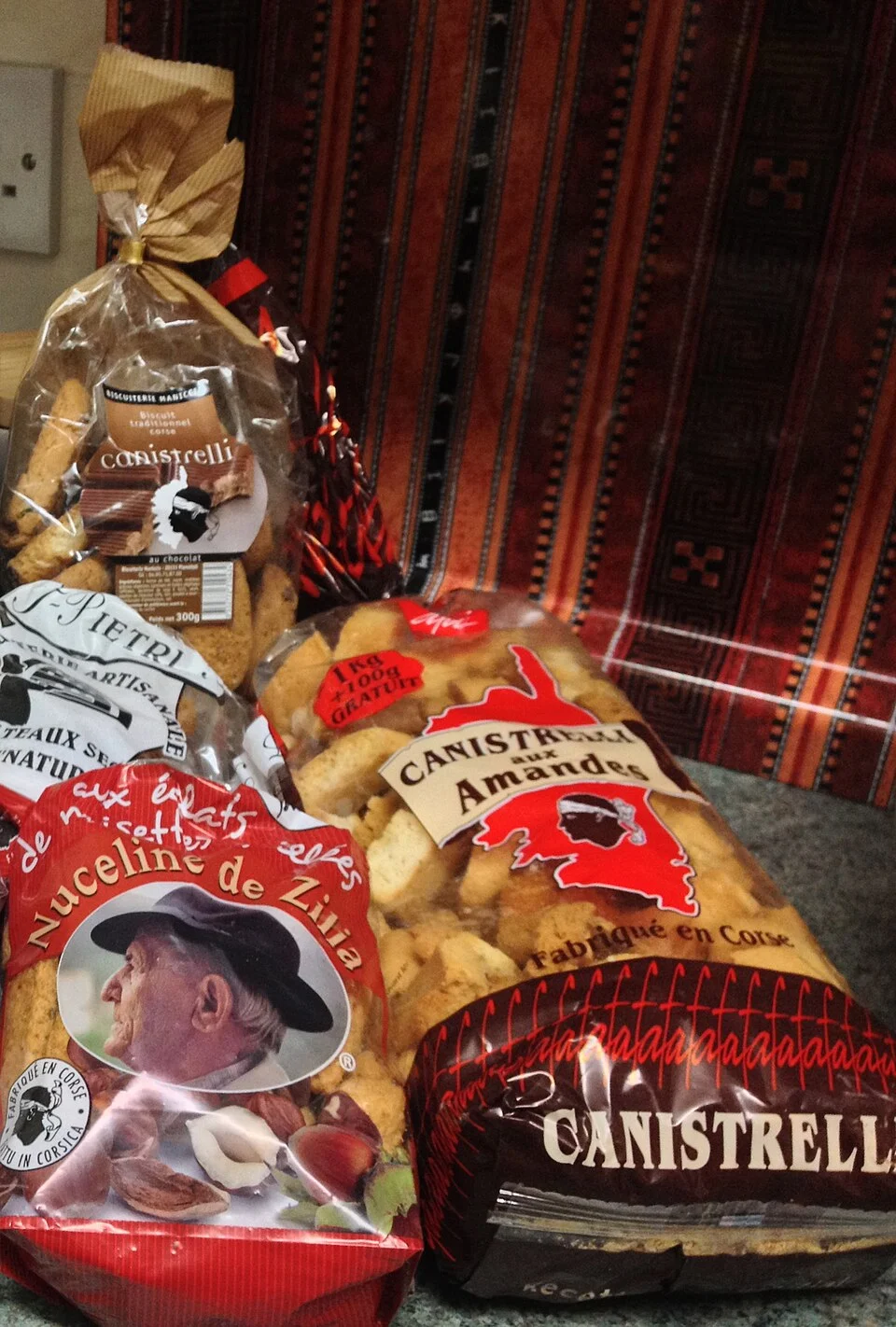
According to the tourist board’s introduction, they are made throughout the year in all parts of the island. Because they are not filled with fresh fruit or cream, you can take them one at a time and carry them along, matching them to whatever drink is at hand at breakfast or as a snack. L’OPT says they are served with coffee or tea and also when welcoming guests. That a baked sweet is dry is a separate matter from the shelf life of each product. If it absorbs moisture, the way the edges break changes, and even among sweets with the same name, the presence of eggs or nuts differs. Someone who chooses a bag for going out and someone who dips a fragrant piece at home can both make use of the same dryness of the dough, each in their own setting.
At a hands-on workshop covered by the tourist board, a dough mixed with candied clementine was rolled to about 1 cm, cut into rectangles, and baked for about 15 minutes. The pieces were packed into bags at the workshop, and participants took them home. The flow is the same even when the flavoring changes: a thinly rolled sheet is cut and, after baking, turned into a form that can be taken home piece by piece. Not only with aniseed or nuts but also with an example scented with finely chopped citrus, the process can be traced concretely up to the baked product before bagging.
Afa’s guide includes an account that shepherds carried them on long working days, and a statement that the company has distributed them through shops since the early 1980s. It is now made in Appietto, and the guide advises closing the bag with a clip or transferring the contents to an airtight container. As a story of a former portable food, as a product carried to the shop, and as a piece kept at home after opening, the dryness has meaning in each setting. When reading the bag’s labeling, look at the ingredients as well as the flavor name, and you can also see the difference between the company’s regular products and the egg-based "Les Historiques."
A Name from Baskets and a Namesake Across the Sea
Among the origin theories L’OPT recorded are one that links the name to canistro, the Corsican word for a basket, and a story that the sweet came from Genoa. A biscuit small enough to fit in a bag is also easy to imagine stacked in a basket. According to the Metropolitan City of Genoa’s introduction, a report of a robbery on a road in the Trebbia valley in 1576 lists a basket containing canestrelli among the stolen goods. The record shows how a person traveling on the opposite shore carried an item of that name. To learn the sweet’s formula and outline, and how it reached Corsica, we would need other records that convey the ingredients and methods of the time.
If you choose the canestrelli of Torriglia in present-day Liguria, you get small flower-shaped pieces with a hole in the center. They use flour, egg yolks, butter, and sugar, sometimes with lemon zest, and are brushed with egg white before baking. In Torriglia the yolks go into the dough and the whites are used on the surface of the petals. In Casanova’s cut pieces, the eggs are not separated into stages but mixed into the dough. In the flower shape, heat also reaches the central hole. In the Corsican cut pieces, the thin tips and the cut sides dry first. Adding the place name conveys what shape each of the two sweets sold under similar names takes and how the ingredients are used differently.
A lemon fragrance alone does not distinguish the island’s formula from that across the sea. A citrus scent is possible in a rounded Corsican piece and in a Torriglia piece with undulations along its petals. When reading the method from appearance, look not only at the outline but also at whether there is a hole in the center and whether round notches are evenly spaced along the edge.
In Calvi, Corsica, there is also a tradition of distributing blessed canistrelli on Holy Thursday before Easter. From a story that links ritual and sweet, we can read a memory of pieces handed out one by one in a setting other than the travel snack. The dryness that lets the biscuit travel is also useful at town events, at tea for guests, and in today’s bagged products. When you pick up a piece with this name, first snap a corner and check the color of the fragments, any aniseed grains, and the bite of the nuts; this gives you a clue for thinking about whose formula it is.
Glossary
- Anisette
- A liqueur flavored with anise. Instead of mixing in the seeds, it adds both aroma and liquid to the dough.
- Balagne
- A region in northwestern Corsica. Calvi and Olmi-Cappella, where Maison Casanova is located, offer clues for thinking about the sweets of this region.
- Holy Thursday (Jeudi saint)
- The Thursday of Holy Week before Easter. It is the day on which sweets are said to have been distributed in Calvi.


