


SweetloreEncyclopedia of World Sweets (834)

Croquignoles de Reims
Croquignoles de Reims
The dry crunch and color that survive in Reims’s egg-white confections
Baked Sweets / Reims, France

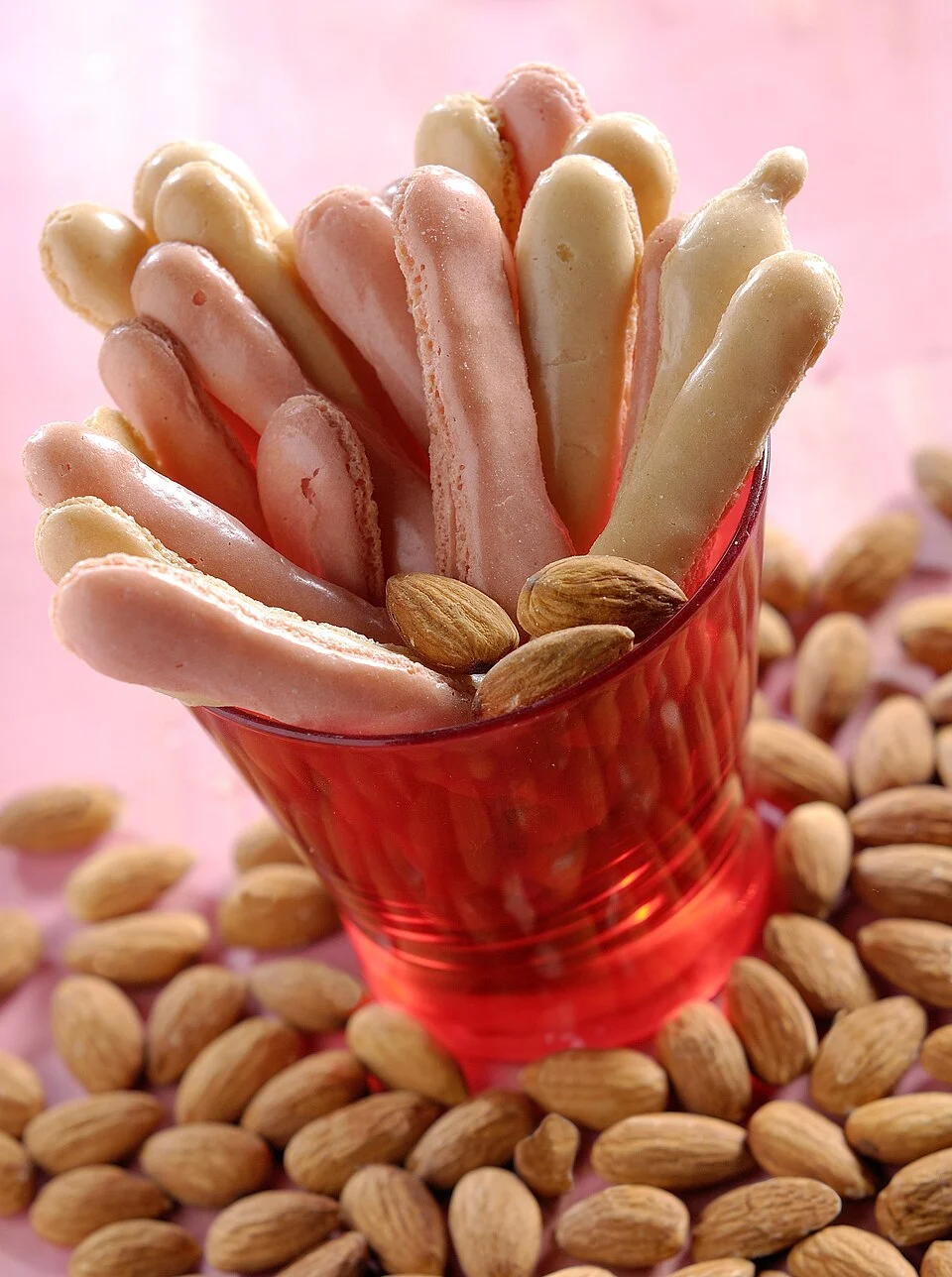
Croquignoles de Reims are small confections from the Champagne region, baked into little sticks or rounds. Their pink or pale colors recall meringue, but when you bite into one, the dry dough snaps hard. Sugar and egg white combined with wheat flour define how they are made. The croquignoles sold by Fossier, a confectioner in Reims, come plain, with almonds, and raspberry-flavored. Whether you pick one from a plate and bite it, or eat it alongside a sorbet or cream, the crunch of the small dry piece remains. Eaten together with something soft from the same plate, the sugar-rich dough is hard, then breaks and crumbles.
Egg White and Flour, Baked Until Dry
The label of Fossier’s plain croquignoles, as recorded in a food database, lists sugar, wheat flour, egg white, flavoring and carmine coloring. According to a retailer’s label, the almond version contains 13% almonds and is a slender stick. The label of the raspberry-flavored version lists natural flavoring and carmine, so its aroma is built differently from products that mix in the fruit itself. A Fossier product description quoted in 2009 lists pink and yellow, and round and slender shapes, while a survey of regional confections lists pink and white. Records of color and shape therefore vary with the period and the product the sources cover.
The food glossary of INRAE and AgroParisTech cites, in addition to the sense of a very dry, hard little confection, a description of a small confection made with sugar or royal icing, flour and egg white. That the Reims product is likened to a kind of meringue owes partly to its bright color and the light look of egg white. A passage from the Larousse gastronomique, cited in the same glossary, includes an example finished after baking with a vanilla glaze on the surface. Because Fossier’s label simply lists the ingredients, the label alone does not settle whether the flavoring is mixed into the dough or applied after baking. Fossier’s 2025 gift catalogue lists croquignoles and meringues as separate products. The plain version’s label includes wheat flour, and eating one gives the feel of biting into a small, low-moisture biscuit from the outside in.
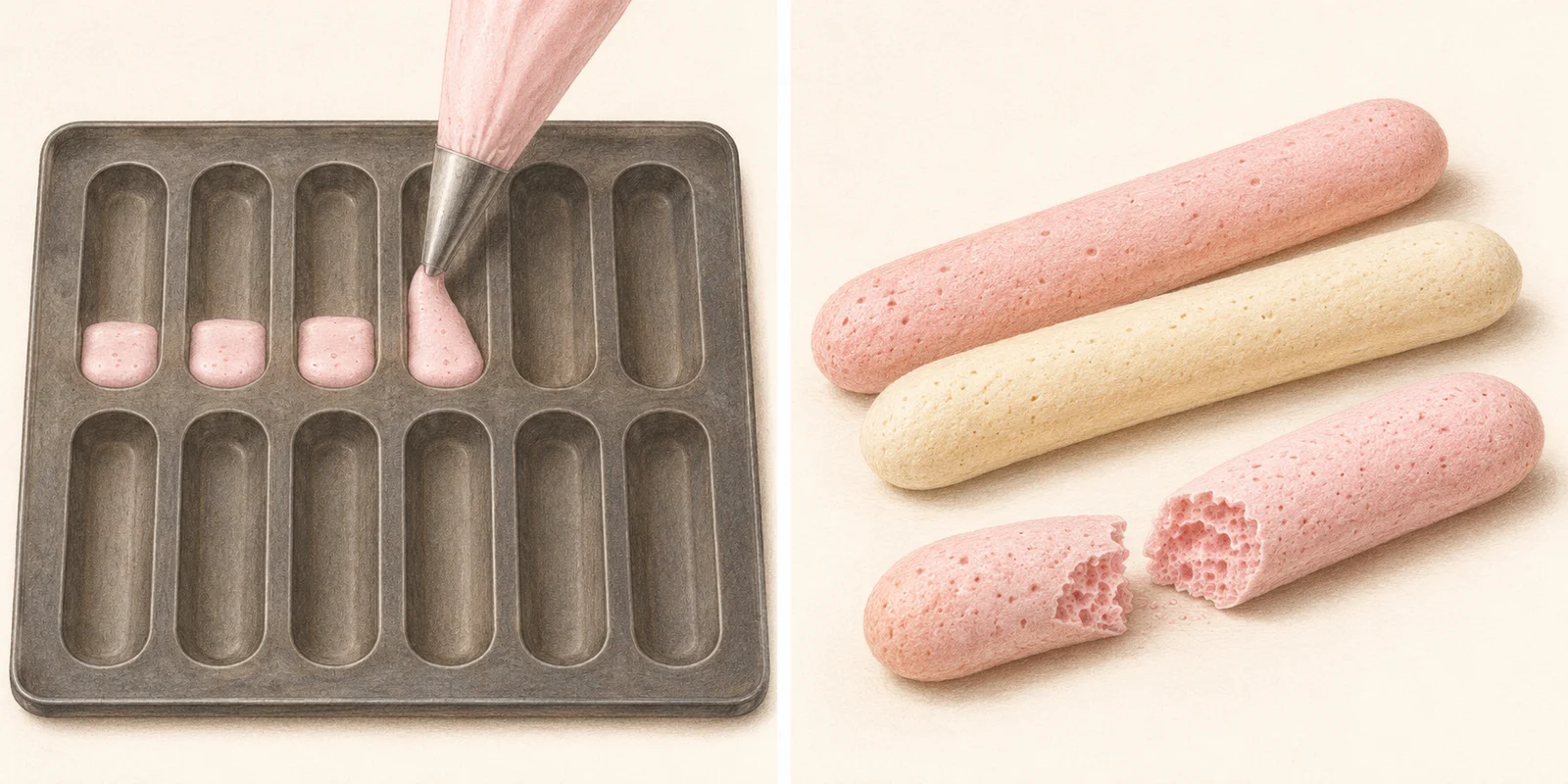
A home recipe published in 2018 uses one egg white, 30 g of flour and 50 g of icing sugar. Part of the icing sugar is added to the egg white and whipped; the rest is sifted together with the flour and folded in. Pressed out in short lengths from a piping bag, the dough makes rounds; drawing the nozzle along makes sticks. They are baked at 120 °C for about an hour and cooled in the oven with the heat turned off. Rather than opening the oven door and taking them straight out, the cooling oven is part of the process, and the aim is a dry crunch that holds once they have cooled, not only just after baking.
The quantity this home recipe gives is ten pieces. The baking sheet is lined with paper, and a spatula is used to mix the sifted flour and sugar into the egg white. Rather than mixing and whipping all three from the start, the sugar is added in two portions and the flour is added afterward to the aerated egg white, so the batter holds together up to the piping. The long baking time after the shapes are formed, and the cooling in the oven, are a home method of producing a texture that stays hard when bitten even though the color remains bright. The published home recipe contains no record that directly compares the conditions of a home oven with Fossier’s production equipment.
A Metal Plate Forming Shapes in Two Rows of Six
The Musée-hôtel Le Vergeur in Reims holds a mold for baking croquignoles. A rectangular metal plate carries slender depressions, six to a row in two rows, so that twelve shapes are laid out at once. The maker is unknown, and the date is said to be possibly the 19th century. The catalogue records its size as 15.5 × 16.5 × 0.6 cm and its weight as 153.3 g. A white label on the back states that Madame Neville donated it in January 2011. For making many slender confections, besides evening out the lengths by the piping hand alone, there was a tool that placed the batter into a fixed number of depressions.
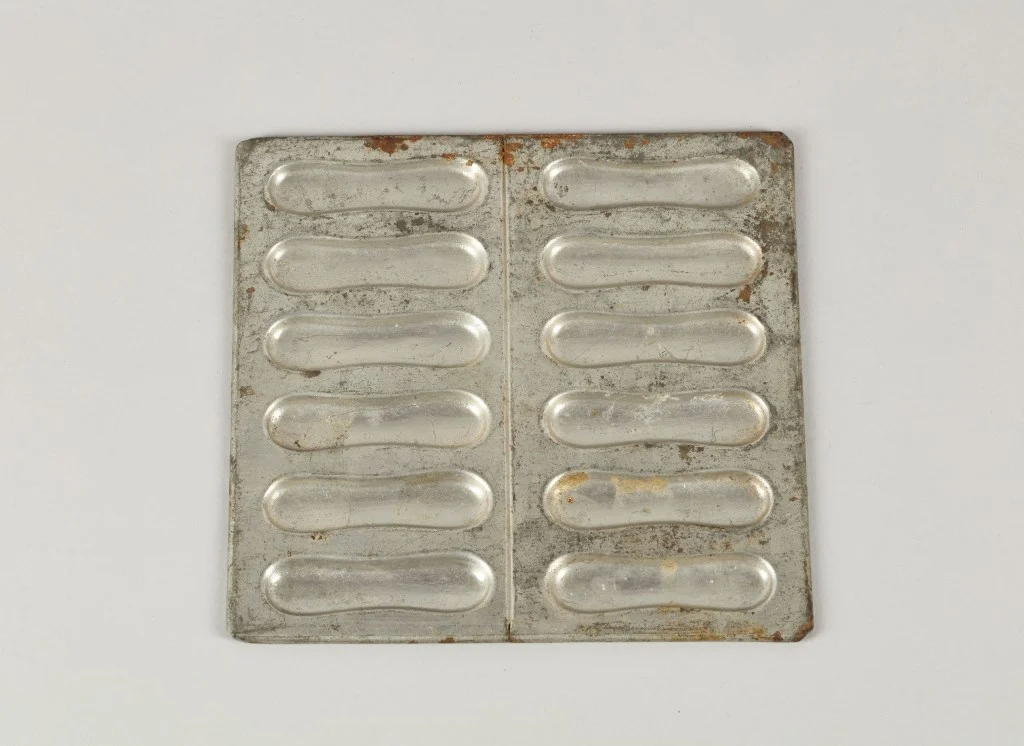
The 1836 cookery dictionary of Brunet includes a recipe in which a stiff dough is passed through a funnel, the dough emerging from the tip is cut with a knife, and the pieces are arranged on a lightly buttered baking sheet. In this method, as cited in glossaries such as INRAE’s, the funnel and blade are the tools that cut out a single piece. The Reims catalogue records a plate that holds twelve, which shows a different way of evening out the shapes before baking. Both give concrete dimensions and handling, but there is no record of the recipe presented in the cookery dictionary having been poured directly into the Reims mold.
The glossary also presents an 1806 entry that takes up Émard, a Parisian confectioner, and an 1896 article that mentions a confection of the same name in Troyes. The metal plate preserved in Reims shows that a tool for shaping slender forms was used in Reims at a time when the term was in use in other towns. Reading together a tool whose form survives under the confection’s name and culinary books that cite dates and towns, one cannot determine the origin in a particular workshop from records of the same name.
Set Beside Biscuit Rose, the Shape and the Bite Differ
Biscuit rose de Reims is a pink rectangle with icing sugar on top. According to Fossier’s history, it began when baked dough was dried a second time using the residual heat of the oven after the bread had been baked. It is also said that because the black specks of vanilla pods showed in the white dough, carmine was used to color it. Dry biscuits roses are eaten dipped in Champagne, and an article introducing them dates that way of eating from the 1920s. Croquignoles also have a dry hardness, and some are pink, but the outline of a thin stick or small round can be told apart when they are laid out on a plate.
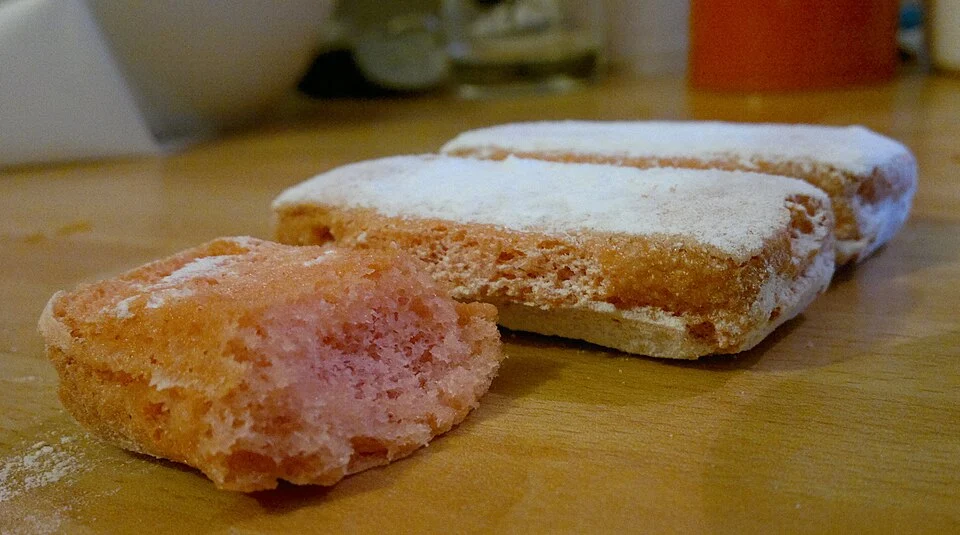
The specification sheet for Fossier’s biscuit rose for distribution lists sugar, wheat flour, whole egg, egg white, carmine, starch, raising agent and vanilla flavoring. Some of these overlap with the label of the plain croquignoles. A tradition that the batter that ran over into the oven when biscuits roses were made became croquignoles also appears in a regional guide. The Fossier description quoted in 2009 presents the two as equally old. The oven story is told as an origin, while the museum’s twelve-cavity plate shows that there was a tool for shaping and baking each piece in the same form.
The regional product survey explains that Fossier’s predecessor, a confectionery workshop, was founded in Reims in 1756, and that in 1845 Fossier, a baker, took it over and gave it his family name. The June–July 2005 issue of the local chamber of commerce bulletin lists, together with biscuit rose, hard croquignoles that can be served at an aperitif, macarons, meringues, and Charles VII, a sablé made with egg. A university library’s guide to Reims also names, under Fossier, croquignoles and biscuit rose, and Charles VII sandwiched with chocolate. The year the shop began, the year it changed its name, and which confections were on the shelves in a given year can be traced in other sources.
While Fossier’s main product is the broad rectangular biscuit rose, it also carries the name croquignoles at the counter that presents its other confections together. The Épernay tourist office’s introduction to the Fossier shop likewise mentions croquignoles, biscuit rose, marzipan and pain d’épices. When looking up Reims sweets by name, being sold in the same shop is no evidence of similar color or baking, but it does show a way of selling in which several dry baked confections can be chosen and boxed together.

Old Dictionaries, Household Tins, and the Same Name Elsewhere
The 1878 dictionary of the Académie française described the croquignole as a dry, very hard little confection. The 1873 Grand dictionnaire de cuisine by Alexandre Dumas and others includes a confection of the same name in which sweet and bitter almonds are moistened with egg white and combined with flour, sugar, butter, salt, lemon zest and eggs. The stiff dough is rolled out and cut into small pieces, arranged on a buttered baking sheet, and baked at high heat until colored. The dictionary also notes that they are used in croquembouche, in which small confections are assembled with caramelized sugar. Fossier’s almond version contains egg white, whereas the dictionary’s recipe also includes whole eggs and butter.
What appears in issue no. 52 of the 1886 household magazine La Mode illustrée is a recipe sent in by a home reader. Equal amounts of flour and sugar, with both sweet and bitter almonds crushed, are combined with whipped egg white. Rolled to about the size of a walnut and placed on a metal baking sheet, the baked pieces are said to keep for several days in a tin box. From the dictionary’s use of stacking confections into a large form to the kitchen’s use of a tin so that they can be eaten over several days, the role of the small dry confection changes.
A recollection from near Pithiviers, in the Loiret department, features children waiting for small confections, like pink or yellow sticks and buttons, to come back from the market. One local method gives a procedure that combines egg white and ground almonds with flour, sugar, salt, lemon zest, butter and whole eggs. A tourist guide for Béarn lists a specialty of the same name at Navarrenx, and the dictionary of the Université de Sherbrooke gives, as a separate sense, fried confections such as braided ones in Quebec, Canada. Even where the slender roundness or the pink color is similar, tracing what kind of egg is mixed into the flour, and whether the confection is baked or fried, shows the shape the confection takes in each place.
The differences also show in what goes into the bag under the same name. What the reader packed into a tin in the 1886 household magazine were baked pieces rolled to walnut size, while the 1873 dictionary has a use of assembling a different shape with caramelized sugar. In the account from near Pithiviers, the children saw slender sticks and small buttons. Between the Quebec dictionary’s confection of braided dough put into oil and the two-row metal mold that survives in Reims, the traces of the process of shaping each piece taken by hand differ.
A Single Hard Piece, Beside an Aperitif or Sorbet
In Fossier’s 2025 gift catalogue, both the plain and the almond croquignoles are combined with biscuit rose and other items. A retailer cites a combination of raspberry and chocolate to go with coffee, and the almond version as an accompaniment to red-fruit sorbet or bitter chocolate cream. A 2013 document of the Champagne-Ardenne Economic, Social and Environmental Council also listed them as a regional dessert, alongside biscuit rose, Reims pain d’épices and galette au sucre. From the aperitif to the cold dish after the meal, having croquignoles alongside gives a dry crunch when a piece is bitten.
Glossary
- Meringue
- A confection or batter made with whipped egg white and sugar. Croquignoles de Reims are likened to meringue in appearance, and flour is added to them as well.
- Carmine (carmin)
- A red coloring. It can be found in Fossier’s product labels for croquignoles and biscuit rose.
- Biscuit rose
- The pink biscuit of Reims. Fossier explains its two bakings and the way of eating it dipped in Champagne.
- Croquembouche
- A confection in which small pastries are assembled with boiled sugar. The dictionary of Dumas and others gives an example that uses croquignoles.


