


SweetloreEncyclopedia of World Sweets (834)

Foi Thong
Foi thong
Egg yolk poured into fine threads, kept long for the celebration bundle
Sugar Confections / Thailand

Lift the golden bundle on the plate with chopsticks, and what looked like short threads unfold and stretch out. Thai foi thong (ฝอยทอง) is a confection made by trickling fine streams of egg yolk into hot syrup. The thickness of each line is set as it falls toward the pan, and when it touches the hot sugar syrup, it sets as a line. If you gently lift the circle drawn over the pan with a long stick and fold it, even a one-bite bundle keeps its long threads. Thong means “gold,” and foi refers to a shape like fine threads. At weddings, the unbroken thread carries wishes for long life and for a married couple’s life together to last.
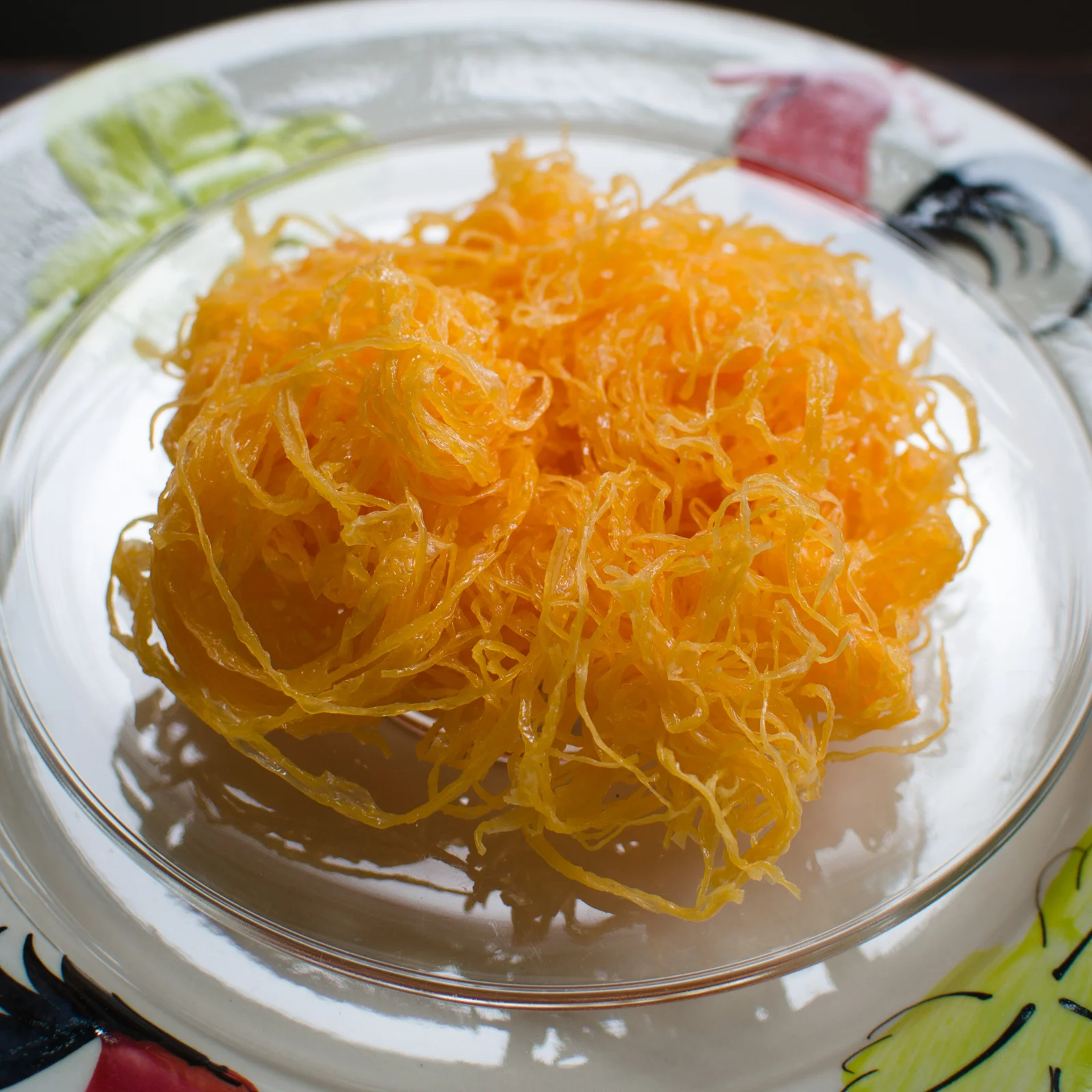
Removing the Egg Membrane So the Liquid Runs Continuously Through the Hole
A teaching document compiled by the culture division of Rajamangala University of Technology Phra Nakhon uses 15 duck eggs and 5 hen’s eggs. The yolks are separated from the whites, and the membrane enclosing each yolk is removed. Separately, three tablespoons of the clear, runny part of the duck egg whites are taken and returned to the yolks. In Thai this is called khai nam khang: the white that is not clumped, like the part left clinging to the inside of the shell after an egg is cracked. Unlike a method that adds a lot of egg white and whips it to a foam, here the yolks, with their membrane removed, are mixed so that they keep passing through the small hole of the funnel. How many duck and hen’s eggs to use, and which part to strain out so that the hole does not clog partway through, are separate decisions.
Another technical document from the same university uses 20 duck egg yolks, 10 hen’s egg yolks and 40 g of thin egg white. The mixed egg is strained through a thin cloth, and in this example 10 g of vegetable oil is added afterward. The cloth should be dry, so that no unintended water gets into the egg mixture and makes the threads brittle. If membrane or clumps remain in the hole, the emerging line breaks or varies in thickness even when the same amount is used. If the line breaks several times at the outlet, strain the mixture again and add thin egg white. The technical document also includes the judgment to use more thin white when the eggs are fresh. The 40 g is an example for that recipe; to keep the egg mixture flowing unbroken over the pan, the amount is adjusted to that day’s eggs and to the outlet.
The foi thong egg mixture is not made to be set first and then cut thin with a knife. The line that leaves the outlet becomes, just as it is, the thickness it has in the pan. Even with a small hole, if the funnel stays in one position for a moment, the mixture pools there. Conversely, if you draw circles quickly while pouring the same amount, the liquid is spread over a longer distance. Three things—the size of the hole, the flow of the egg mixture, and the speed at which the cook moves the funnel—affect the thickness and continuity of the threads. Since a line that has clogged partway cannot be stretched out afterward, the cook prepares early, at the stage of straining through the cloth, with the finished threads in mind.
Circling the Edge of the Pan and Lifting the Cooked Lines Together
The culture division’s document heats 4 cups of water and 5 cups of white sugar with pandan leaves, strains the syrup, and adds jasmine scent. When the syrup is at a light boil over medium heat, the egg mixture is put into a funnel made by rolling a banana leaf into a cone. The cook circles the pan’s edge about twice to draw one layer, simmers it for about 2 minutes, and then pulls it up with a pointed stick and folds it over. The leaf is a tool for making the fine outlet. There is no step of wrapping the egg mixture in the leaf and steaming it; the egg touches the leaf only while flowing into the pan. The pandan scent, obtained by boiling the leaves, and the jasmine scent, added separately, both pass from the syrup into the egg threads. Even if the leaf funnel is replaced with a metal one, the steps that determine the syrup’s aroma can stay the same.
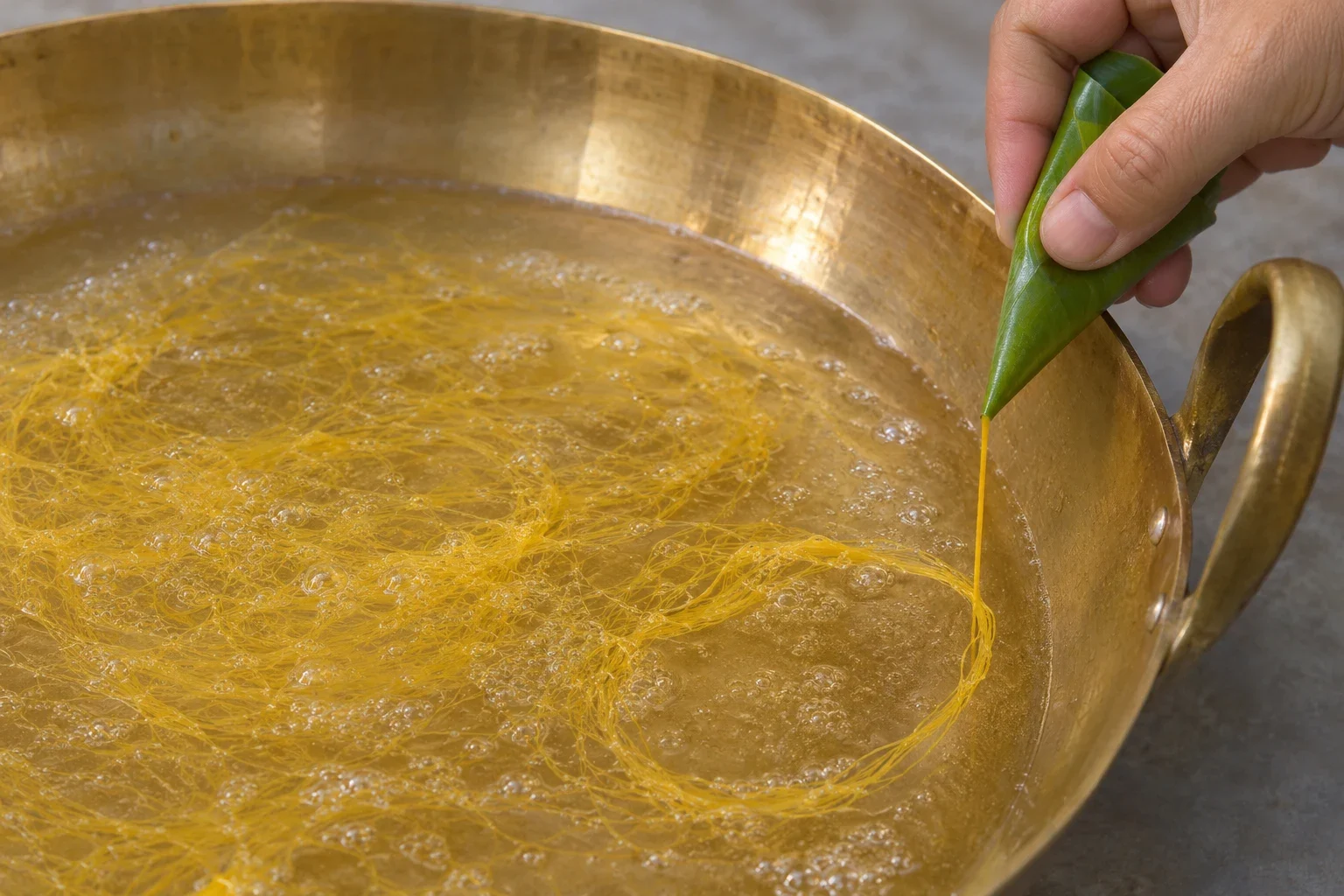
The technical document uses 2,500 g of sugar and 3,000 g of water with jasmine flowers floating in it; of the boiled and strained syrup, half is set aside as a thin syrup. The other half, used for cooking, is reduced separately, skimming off foam, with glossy, coarse bubbles as the guide. This is an example in which a brass funnel draws about 25 circuits starting from the outside of the pan. The number of circuits is adjusted according to how large a bundle is wanted. Two circuits and about 25 circuits are examples given with different tools and quantities. To work out the length of a single thread from the number of circuits, you also need the diameter of the circle drawn and how many circuits the flow continued. In both cases, the funnel is moved so that liquid is not laid again on places where thread has already fallen.
In the technical document, water is sprinkled with a spray bottle over the cooked threads, which are scooped up with a long pointed stick and aligned by shaking them in the syrup. Next they are placed on a rack with a tray beneath it, and the excess syrup is drained off. If the flow runs in one direction when the threads are lifted from the pan, the ends of the bundle can be folded small and fitted to the width of the plate without cutting each thread much. After the threads are removed, the next batch is poured once the syrup has returned to a boil. The water in the syrup evaporates in the meantime, so even if the syrup was measured the same way at the start, differences appear by a certain bundle. The technical document explains that when the syrup becomes too concentrated, the lines break and the surface tends to become coarse. The adjustment of the egg-mixture funnel and the adjustment of the syrup, which changes over the fire, show up in the same thread.
When the egg protein in the pan is set by heat, the fine line can be lifted while keeping its long shape. In a fine thread the center is close to the surface, so the heat of the syrup reaches it in a short time. After the threads are made into a bundle, there are spaces between them. When the bundle is lifted onto the rack and the syrup is drained, excess syrup does not readily pool inside it, and when it is pressed with the tongue, a texture that separates into several strands remains. The sweetness comes from the syrup, while the egg’s flavor and color come from the formulation of the egg mixture. The fineness of the line, which determined whether the thread could be drawn in the pan, also connects to the sensation of it loosening as you eat.
A review in a Thai food research journal lists the syrup concentrations as 55–57 degrees for foi thong, 65–66 for met khanun, 70–72 for thong yip and 72–74 for thong yot. This is an index of density read from the refractive index, and it is separate from the numbers used to read the temperature of the pan. Where needed, it also gives a separate concentration for the thin syrup used to adjust sweetness. That most of the four names contain “gold” and that sugar appears in the ingredients list does not by itself determine how concentrated the syrup is. The reasons the technical document watches the foam on the surface and sprinkles water relate to the fact that what is being cooked is a fine thread.
Side by Side, Three Golden Sweets Show Their Differences in the Pan
Lining up the egg sweets with “gold” in their names, thong yot is a single drop, thong yip a single blossom, and foi thong a single bundle. For thong yot, a batter of egg mixed with flour is dropped from a spoon one drop at a time, and each drop keeps its thickness in the syrup. For thong yip, a round of egg cooked in the syrup is picked up, and its edge is pinched with the fingers while still warm. Foi thong is already a line before it is picked up, and the work at lifting is less to give it a new shape than to align the lines and keep them. There is the stickiness needed to hold a drop in the syrup, the thickness of the disc from which the pleats are formed after it is lifted from the heat, and the fineness of the line flowing continuously from the funnel. Each creates a texture that differs in the thickness felt in the mouth.
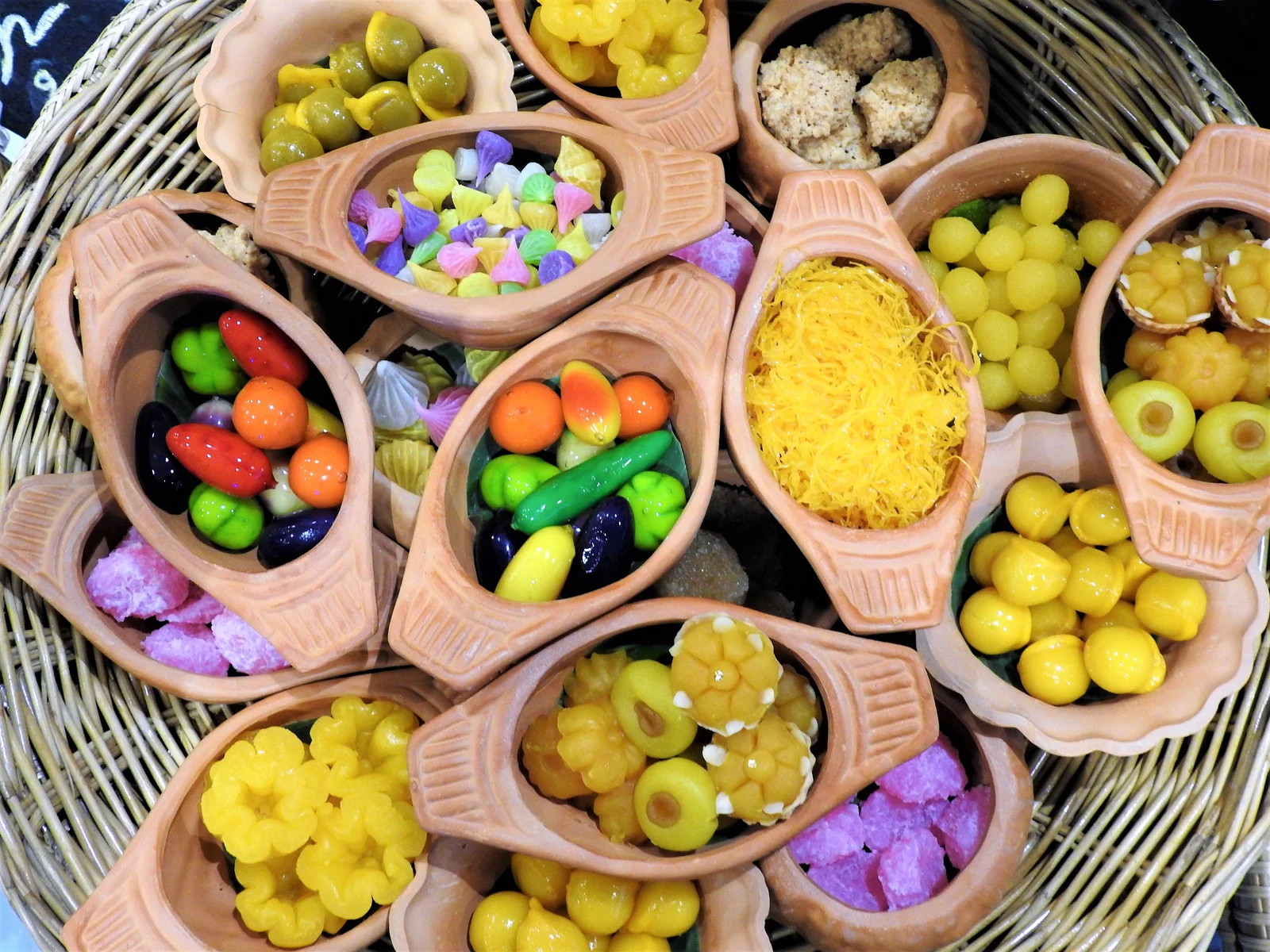
The Thailand Foundation reads in wedding foi thong a wish for the couple’s long life together and for longevity. Even when the folded bundle is reduced to a portion for serving, the length of thread that went around the pan remains. Gold drops are tied to the wish to gain money, and flower-shaped thong yip to the wish to grasp gold in one’s hand. When the three are handed over together, in addition to the shared golden color, you can see the form dropped one drop at a time, the form folded one piece at a time, and the long line taken without being cut partway. The work of straining the egg, watching the syrup and lifting the threads so that they could be made long connects to the meaning explained at that occasion.
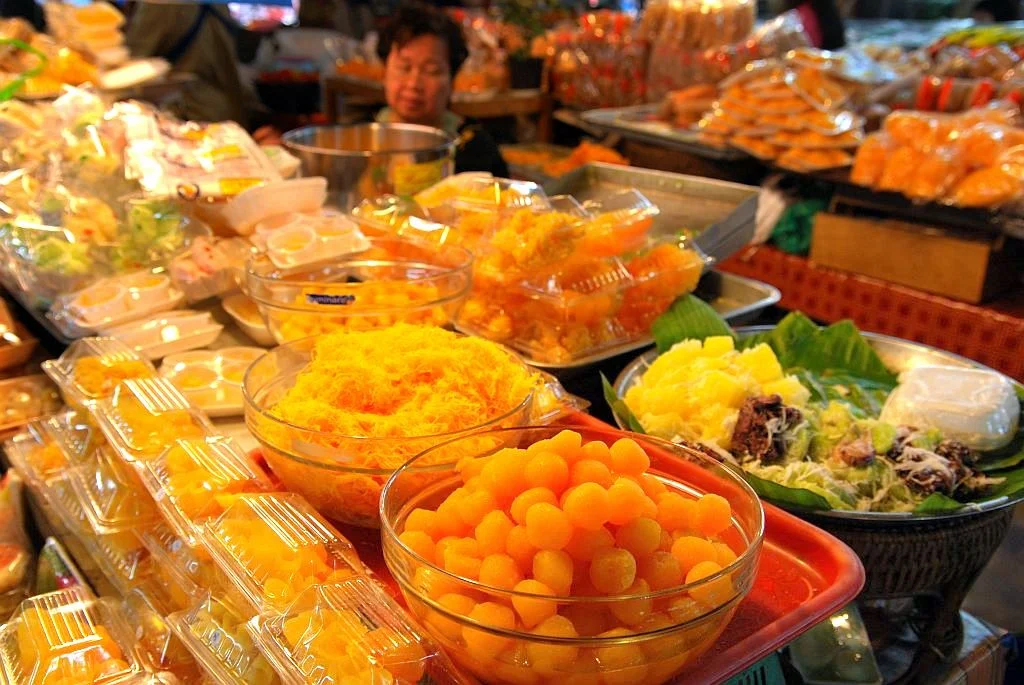
A study of Ban Chin in Ayutthaya Province recorded, through interviews and observation, how ten makers of foi thong, thong yot and met khanun select ingredients, make the sweets and sell them. In the community, people are said to have learned the work at home and passed the processes down across generations. To continue as a business making items prepared for festivals, they are made so that the sugar does not turn grainy and the egg smell is not strong, even when orders increase and the pan is used many times. Passing on a single formulation does not convey the shape of the boiling bubbles or when the flowing egg can be lifted while still long. This is an example of work that has been preserved by learning through handling the same tools, from selecting ingredients to judging the finish.
Egg Turned into Fine Threads in Portugal and Fukuoka Too
A Thai university teaching document includes a story linking Thao Thong Kip Ma and Maria Guyomar de Pinha, who were associated with the court of the Ayutthaya Kingdom, to Portuguese egg-sweet techniques. The method can be compared with that of Portuguese fios de ovos. A recipe collection from APTECE, the Portuguese association for tourism and cuisine, has the egg strained through a mesh and dropped into sugar syrup through a special funnel in a circling motion. The syrup is judged by the point at which it forms fine beads, and this example gives an upper limit of 108°C. This figure is not a value used as a temperature in Thai methods. The Thai teaching documents explain watching the bubbles and how the line breaks, adding thin egg white, and using pandan or jasmine. Even if the techniques of cooking egg through a hole in distant lands resemble each other, the history of an author or a shop alone cannot establish the year in which the method reached the court or the person responsible.
APTECE’s formulation is 12 egg yolks, 2 egg whites, 750 g of sugar and 250 mL of water. The yolks and whites are combined with a fork, not whipped, and passed through a mesh three times. The cooked threads are picked up with a slotted spoon, drained on a tilted tray or rack, and, once cool, separated with hands moistened with water. This method also notes adding water in small amounts during cooking so that the syrup does not become too concentrated. Read together with the Thai example that uses a long stick, the two share the drawing of circles to set the line, while the tool and the timing for aligning the threads after lifting differ.
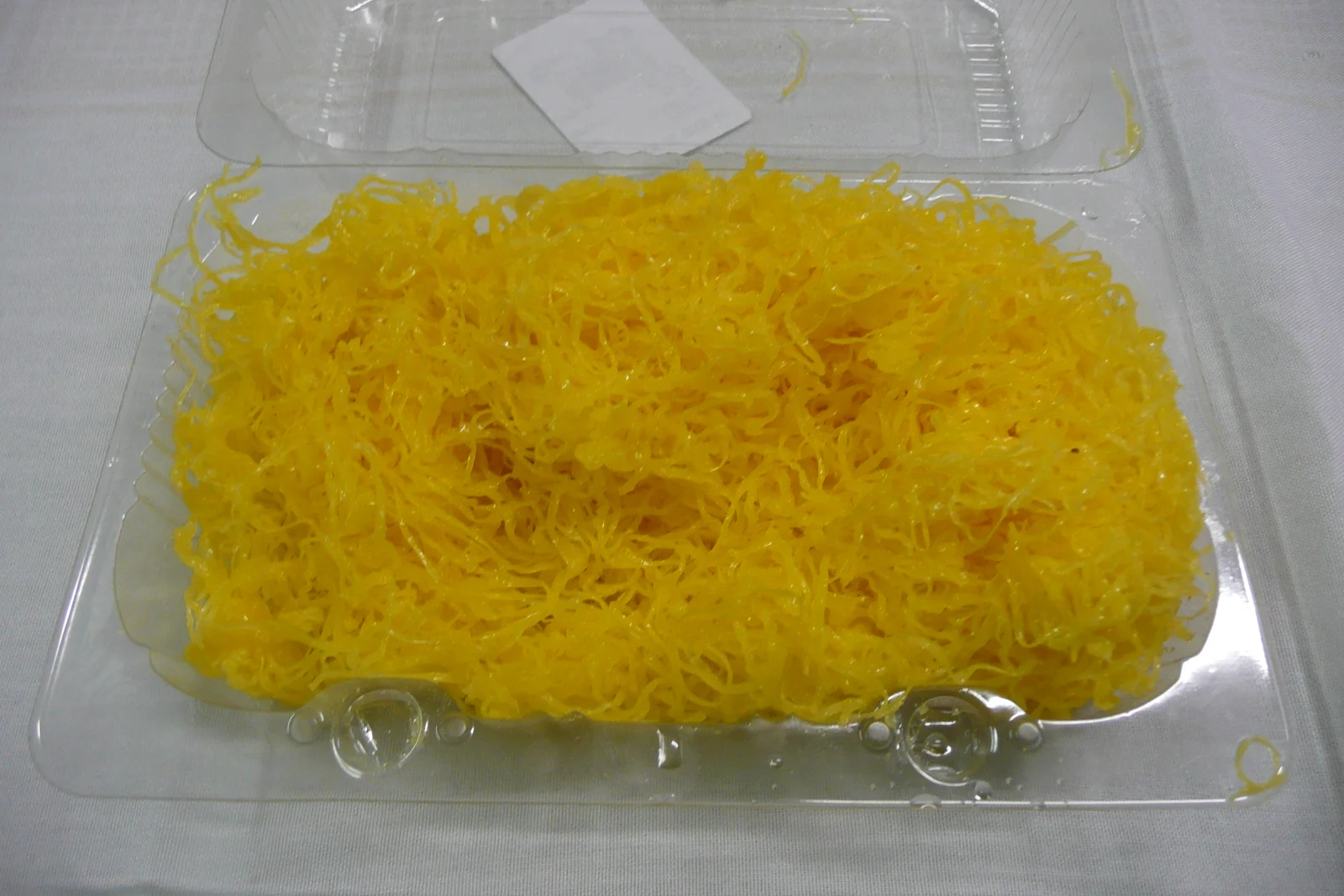
Japan’s keiran somen also has a method of pouring egg yolk in fine streams. In the process of Matsuya in Fukuoka, published by the Japan Society of Cookery Science, the egg mixture is put into a stainless steel cylinder with two holes in the bottom, and circles are drawn from the edge of the pan inward so that the drop positions do not overlap. The Portuguese recipe collection and the Thai brass-funnel example have the same movement of drawing circles over the pan. Matsuya in Fukuoka states that its first-generation owner began manufacturing and selling the sweet in 1673, and Ishimura Manseidō says it has made it since its founding in 1905. The dates of the shops are material for tracing local commerce. The bundle on which a wish is placed at a Thai wedding and the plate served as a famous confection in Hakata each have their own meaning at the table. Following the long threads made from egg yolk, in both you can see work carried out while keeping the flow going over the pan.
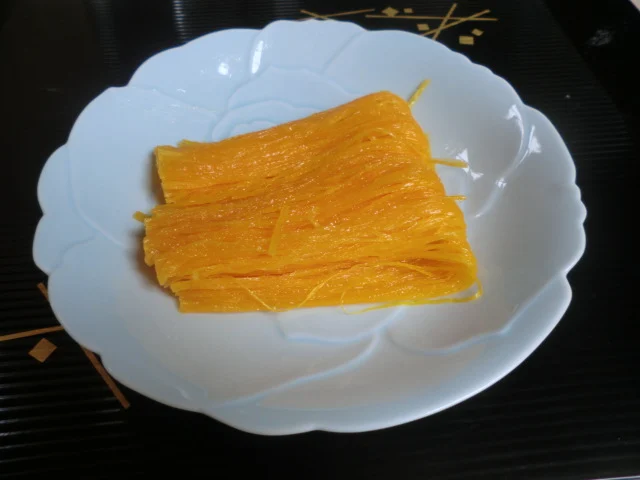
Besides the long form, Matsuya also sells “Tabane,” bite-sized pieces wrapped in ryūhi konbu (kelp). After comparing how the threads are made in the pan, looking at the length into which the threads are divided when eaten shows a way of serving different from the Thai example of folding the threads long for celebrations. The Fukuoka approach of offering both long and short forms and the Thai custom of attaching a wish for continuity to length at weddings both presuppose that the length of the thread carries through to the plate.
Glossary
- Khai nam khang (ไข่น้ำค้าง)
- The thin, clear portion of duck egg white that does not form clumps. For foi thong, it is set aside and mixed into the yolks.
- Thong yot (ทองหยอด)
- A Thai sweet in which a batter of egg yolk and flour is cooked in syrup one drop at a time. It differs from foi thong, which is made into threads, in the shape in which it is dropped into the pan.
- Thong yip (ทองหยิบ)
- A Thai sweet in which egg cooked in syrup is pinched into a flower shape while still warm.
- Fios de ovos
- A Portuguese sweet in which egg is poured from a special funnel into sugar syrup and cooked into threads.


