DRUG

パレード伏見洋菓子店

SweetloreEncyclopedia of World Sweets (834)

SWEETS&CAKES

Fouace de Laguiole

Fouace de Laguiole

Flower and citron fragrance baked into the Laguiole ring

Fermented Pastries / Aveyron, France

Thick golden-brown ring of Fouace de Laguiole with a center hole, four dark spots and pale cracks on top, beside a cut slice with pale yellow crumb.

Cut into a thick ring and the wheat-and-butter dough appears, with orange blossom on the nose. Chew on, and you reach small pieces of candied citron. This is the Fouace de Laguiole baked by Maison Roux in Laguiole, Aubrac, in the Aveyron département of southern France. Cutting a ring into portions is a form widely seen in the fouace of the département. Roux’s product has a dough with a restrained rise; the citrus blossom is in the dough, and the sugar-cooked peel is in it as pieces that can be chewed one by one.

Flower scent and sugar-cooked peel

The orange blossom and the citron that Roux uses sit in different places within a cut slice. The floral scent is present even where there is no peel, while the candied citron gives off its aroma and sweetness where the bite presses on a small piece. If jam is spread on the dough after baking, the fruit spreads across the cut surface. When candied peel is baked in, the pieces inside appear only once the ring is cut, and the way the aroma comes through changes with each bite. The shop’s description lists the aroma of wheat, the aroma of flowers and the taste of thick candied citrus peel.
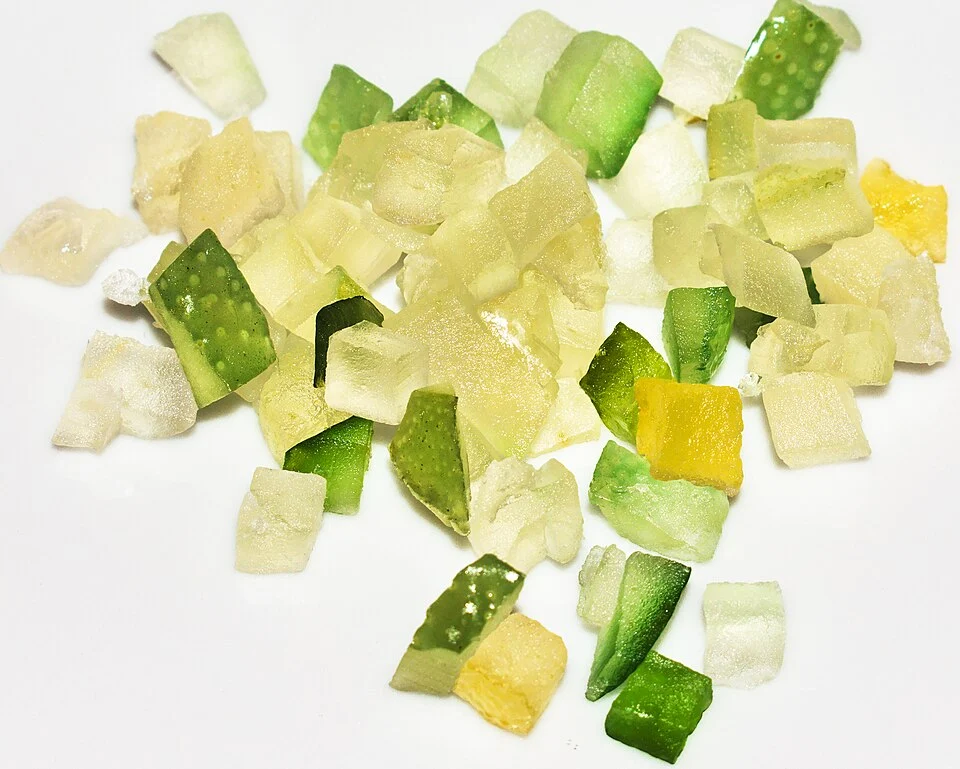
Chopped candied citron in pale yellow and green, arranged on a white surface
A generic example of finely diced candied citron peel. It is a stock photograph that shows the shape of the pieces; it is not a photograph of the pieces Roux uses. Photo: Ich (2018), original, CC BY-SA 4.0.

Roux’s product description lists fine-textured wheat flour, eggs in the shell, butter and natural flavourings. For the round version, it says the dough is fermented with levain and is denser than an ordinary brioche. The ring is baked in the oven with a restrained rise, and fine-crumbed dough remains even inside the puffed ring. The description does not give the temperatures and times before the dough goes into the oven, how long it is kneaded, or at what stage the peel is mixed in. The density the shop conveys as texture, and how the dough ferments in a general home recipe, can be traced through separate examples.

The description of the 500-gram coque also states that levain and butter are used, along with eggs from hens raised with outdoor access. For this product, the shop says it uses no preservatives or artificial flavourings and gives a storage guideline of three weeks at 15–25°C. What can be read from the box label is how to take home a product made at the shop. Besides eating a ring fresh from the oven, a smaller shape can be cut a little at a time or taken to several households.

How a ring is made in Aveyron households

The Aveyron tourist board’s home recipe uses 1 kilogram of flour, 250 grams of butter, 300 grams of sugar, four eggs, one glass of milk, 10 grams of baker’s yeast and orange-blossom flavouring. The yeast is dissolved in lukewarm water, the flour and salt are mixed and a well is made in the centre, and the butter, sugar, milk, eggs and blossom flavouring, combined together, are added. The sugar and butter go into the thick dough before baking, not only as something added after cutting. Even for the same ring, Roux’s version has citron pieces in addition to the floral scent, whereas the ingredient list of this home recipe contains no candied citron.

The dough is kneaded for about 30 minutes, lifting it by hand. When blisters form on the surface and the dough comes away from the hands easily, it is transferred, as a guide, to a large floured bowl and left in a slightly warm place. Depending on the season in the kitchen, this takes about two hours in summer and overnight in winter. Once the dough has risen well, a hand is slipped under it to lift it, and the ring is shaped on a buttered baking sheet. Because about a quarter of an hour is left before moving on to the next step, there is a resting period both between kneading and the first rise, and between shaping the ring and baking.

Unlike the flour and butter, the milk is given as one glass, a household vessel. On the same page, the tourist board’s representative answers that a standard glass holds about 20–25 centilitres. The page also explains that cream is added to taste and, if used, a small amount is added before kneading. In a method that takes time for kneading, ingredients weighed by weight, liquid measured in a container and cream whose addition is left to the maker all become dough at the same worktable. The levain in Roux’s product description and the baker’s yeast in the home recipe point to different kinds of fermentation work.

In the home example, egg yolk is brushed on before baking, and the area near the centre is snipped with scissors to make a hollow. The oven is prepared at about 210°C, then lowered to 180°C, and the ring is baked for about 30 minutes. The representative’s reply on the same page also gives a guideline of 30–45 minutes at 180°C. Baking time also varies with size and with the oven used, so Roux’s workshop temperature cannot be determined from this. The gloss of the egg yolk from the oven and the sweetness of the fine sugar sprinkled after baking remain in separate places. A ring has an edge both outside and inside, and once a slice is cut, one can check from there toward the centre the grain of the dough and where the sugar on the surface touches the mouth.
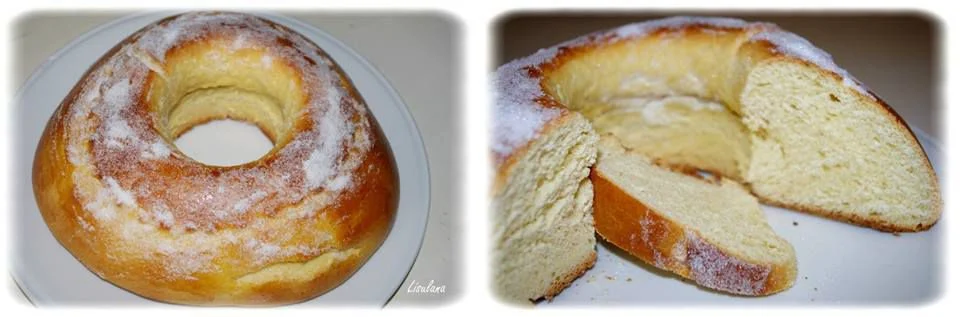
Comparison photograph of a whole Aveyron fouace ring and cut pieces side by side
A generic example of Aveyron fouace. It is a single photograph placing the whole ring beside cut pieces that show the crumb. Neither Roux’s workshop nor citron pieces can be confirmed from the photograph. Photo: Pascal78 (2021), original, CC BY-SA 4.0.

According to the Aveyron regional guide, even with the same ring shape, whether orange blossom is used for scent differs from maker to maker. The shop’s guide to its round version states that in the past the village used a shared oven and baked fouace in the oven after the bread had been baked. Home recipes using baker’s yeast and eggs came to appear, and Roux’s round version today uses levain. The place where the scent is put, the fermentation before the ring is shaped and the heat used in the oven are points that can vary even among products bearing the same name within the département.
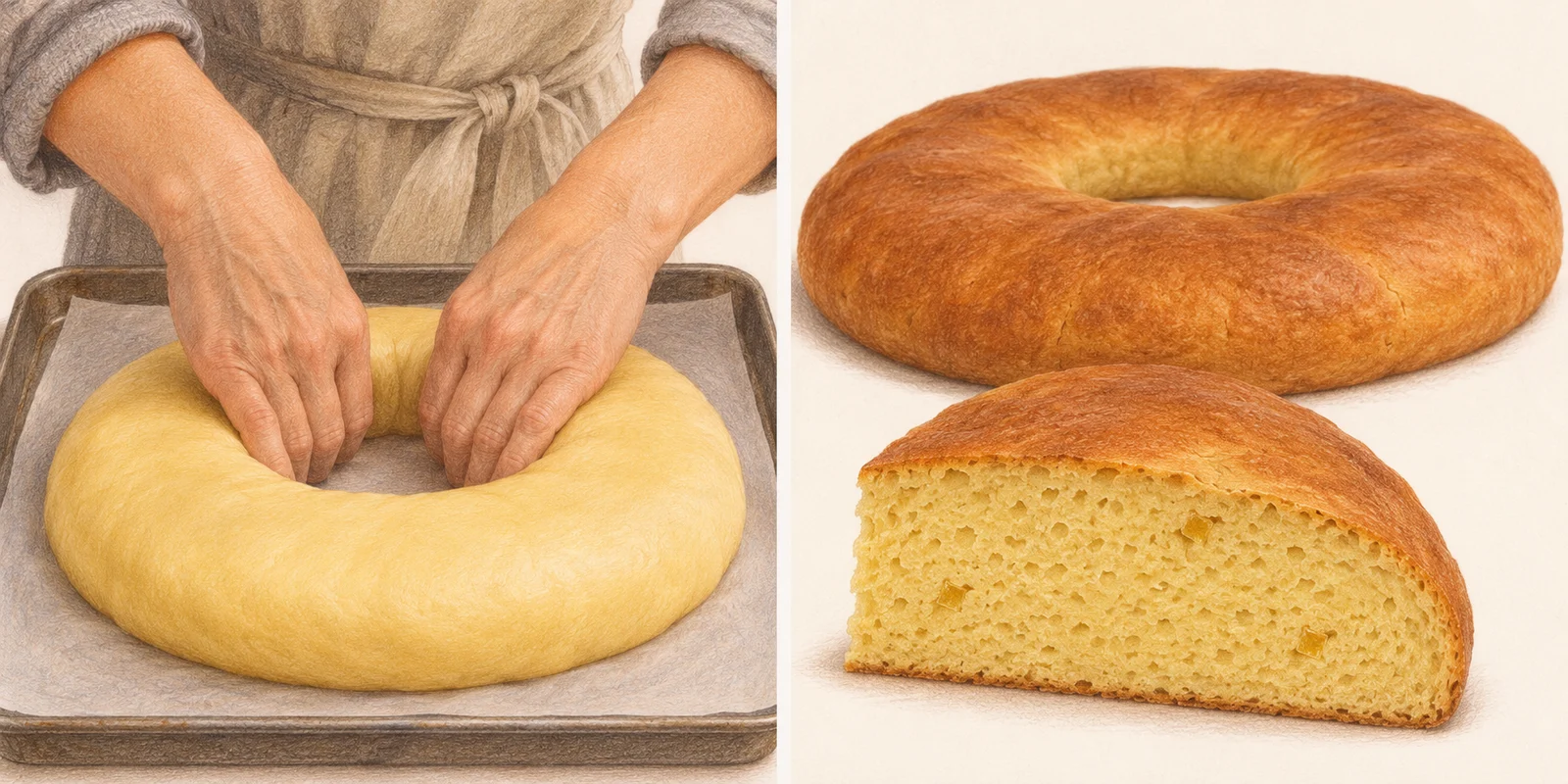
Reconstruction image (AI-generated). On the left, hands widening the hole in the centre of a pale dough; on the right, a pale yellow cross-section showing brown crust and pieces of candied citron
Reconstruction image (AI-generated). A home-recipe example of shaping fouace dough into a ring (left), and a cross-section of Laguiole fouace containing candied citron (right). References: Maison Roux product description and Aveyron tourist board home recipe.

Laguiole in 1858, and fouace in literature

Roux says it has kept its own recipe since 1858. The tourist board’s shop guide likewise presents it as a family business spanning six generations. The shop says the sweet was made in the Haut Rouergue for religious celebrations and family meals, and served as a dessert. If a large single ring is set out before the guests and then cut, it can be divided according to the number of people gathered. 1858 is not the year in which a ring for that use first appeared across the region, but a year tied to one house in Laguiole taking over the recipe.

Hills near Laguiole in Aveyron, with grassland and hedges visible in the mist
A landscape near Laguiole, Aveyron. A reference image conveying the name of the town and the location of Aubrac. Photo: Krzysztof Golik (2020), original, CC BY-SA 4.0.

The word fouace appears in Rabelais’s Gargantua in the 16th century. A shepherd guarding the grapes pays for the fouaces that the sellers of Lerné were carrying to town, and the pairing of freshly baked fouace eaten with grapes in the morning is described. Roux also cites, in the history of its own shop, the passage that describes the use of wheat, egg yolk, butter, saffron and spices. What the tale conveys is the name at that time, the dish and a morning table; the procedure for making at Laguiole a ring scented with flowers and citron is a method conveyed separately by the shop.

In the tale, a quarrel breaks out with the shepherds who tried to buy the fouace, and food becomes the trigger of the dispute. It is not an explanation of a cake taken home, but a scene in which local sellers carry freshly baked goods to another town and meet buyers near the vineyard. When Roux quotes this passage in its shop introduction, the spices in the quotation and the workshop’s present-day pieces of citron are not the same ingredient. The present character of the scent, from flowers and peel, can be read from the workshop’s own description of its ingredients, while linking it to the name in the old tale.

Roux likens the round shape to the sun and also presents an account that traces it to the Gallo-Roman period. In Larousse’s dictionary, the entries listed alongside fouace and the close fougasse include an unleavened flat bake of wheat and a brioche-like sweet scented with orange blossom in southern France, among others. Each of these has its own sources to read: the name appearing in the literature, the locally told image of a form reminiscent of the sun, and the putting of sugar-cooked peel into the Laguiole ring. Even under the same name, whether it is cut as a thick ring or broken from a thin dough form differs.

Dividing the festival ring, slicing it thin at breakfast

The Aveyron introduction notes that fouace was set out at Epiphany, Easter, baptisms and weddings. In Najac, in the west of the département, there is also an event at the festival of Saint Bartholomew at the end of August in which a large fouace is carried through the streets and eaten afterward. Apart from the product of the Laguiole workshop, this is a picture, in another town of the département, of one large ring being made and shared among many people. At such events it is cut according to the number of people gathered, and on a breakfast plate one can take only the thickness one wants. What does not change is that, before cutting, it can be set out as one thick ring.

According to the tourist board’s guide to the west of the département, when the large ring is carried in Najac, musicians, dancers, residents and visitors proceed together along the street. Outside festival days too, fouace is on sale at markets and bakeries in the west. The local guide mentions, besides celebration days, a snack shared at the workplace between tasks, birthdays and a slice eaten on the way somewhere. The festival ring is shown in the street before many people eat it; at the market it is carried home and cut as much as needed. It is a way of handling a ring-shaped sweet: what was bought in the morning can also be shared as a snack.

In Roux’s shop, products called coque, in 500-gram, 750-gram and 1-kilogram sizes, and products called ronde (round), in 1.5-, 2-, 2.5- and 3-kilogram sizes, are listed. When choosing a size, the number of pieces into which the ring is cut also changes. Roux displays product names that contain the shop’s name as registered trademarks. While using the same word as the fouace of the whole département presented by the tourist board, the Laguiole shop’s version is distinguished by its floral scent, the peel inside and its shape before cutting.

For breakfast or a snack, Roux suggests serving it with honey, butter, jam and the like. With tea or coffee, and with hot chocolate, the flavour that remains after the floral scent differs. The tourist board’s home example also serves it with jam. When it is plated with whipped cream or fruit, the cut dough comes into contact with soft cream or juicy fruit. On the other hand, Roux also presents eating it before a meal with Laguiole cheese, Roquefort or foie gras. After a slice has been cut from the large ring, one can choose to spread something sweet on it or to add a savoury bite.

Besides fouace, the shop also sells Croquants de Laguiole, cakes made with candied fruit, prune tarts and other items. In addition to the take-away and delivery options described in the tourist board’s shop guide, the manufacturer’s guide gives an example in which Café Bras, at the Musée Soulages in Rodez, serves a dessert using this fouace. If one buys a ring at the Laguiole shop, one can share it with others and then choose accompaniments as one likes. On the plate in Rodez, the cut piece is used as an ingredient of a single dessert. The way it is cut after leaving the shop leads both to the tables of homes in town and to the dishes of another establishment.

Even when sharing the same ring with someone, looking only at the outside does not tell which slice will contain the small pieces of peel. The dough that encloses the candied fruit and the jam put on just before eating differ in the order in which they touch the mouth, even if the sweetness comes from the same fruit. A dough scented with orange blossom, in which the small chew of peel remains, is what characterizes a piece from Roux. On a festive day when the ring is cut all at once and on a day when it is cut little by little at breakfast, what goes with the same dough also changes.

Glossary

Citron (cédrat)
A citrus fruit with thick peel. Roux’s fouace contains candied peel.
Haut Rouergue
A historical regional name covering northern Aveyron. Roux describes Laguiole fouace as a sweet of this region.
Epiphany (Épiphanie)
A Christian feast day. In Aveyron it was one of the occasions on which fouace was served at the table.
TOPFouace de Laguiole | Cafe & Sweets Parade Kyoto

(FAQ)

All You Need to Know

Do you have gluten-free sweets made without wheat flour?

Yes. We offer sweets made without wheat flour, such as madeleines made with rice flour. However, they are made in the same kitchen as products that use wheat flour. If you have a wheat allergy or need to strictly avoid wheat, please consult our staff before purchasing.

Do you use additives such as preservatives or emulsifiers?

We do not add preservatives or colorings when making our sweets.

Some of our baked goods (such as madeleines and chocolat) use baking powder to help the batter rise. In addition, ingredients we purchase, such as chocolate, may contain additives such as emulsifiers that help maintain their quality.

To see the ingredients we use, please check the ingredients listed on each product page.

When is the Seasonal Citrus and Lemon Curd Cake available?

This cake is sold on an irregular basis.
It is often available on Saturdays, Sundays and public holidays. We post updates on in-store availability as needed in our Instagram Reels, so please check there.

Do you sell fresh cakes on Wednesdays?

We do not currently sell fresh cakes on Wednesdays.
On Wednesdays, we mainly sell baked sweets and drinks.

*Many customers have asked about this, but no decision has been made yet about selling fresh cakes on Wednesdays.

Can I request noshi paper (noshi kakegami) for gifts, presents, and the like?

For gift boxes in sizes M and L, we offer inner noshi (uchi-noshi) only, at 100 yen (tax included) per sheet. Please specify the top inscription and name inscription, and place your request at least 3 days in advance. For same-day requests, please consult the shop.

Do you offer OEM (manufacturing of original products)?

We are currently accepting consultations on OEM requests, depending on their details.
To start, please contact us through the inquiry form with details such as your product concept, desired quantity, and sales purpose.

Where is the shop located?

Cafe & Sweets Parade Kyoto is in Uoya-cho, one street south of the Otesuji Shopping Street, a 4-minute walk from Keihan Fushimi-Momoyama Station and a 5-minute walk from Kintetsu Momoyama-Goryomae Station. Parade stands in an area full of history and charm. Nearby are Torisei, a sake and yakitori restaurant run by a long-established sake brewery; Teradaya, said to be the place where Sakamoto Ryoma was attacked; the Fushimi Jikkokubune, wooden boats that take you along the canal; and many other places.
For the exact location and other details of Cafe & Sweets Parade Kyoto, please check Google Maps↗︎.

What days is the shop open?

We are open every Wednesday through Sunday from 11:00 to 18:00 (last order 17:30). We are regularly closed on Mondays and Tuesdays.
On public holidays, we are open on some days and closed on others.
We may also close temporarily on irregular days, or open on regular closing days. For the latest information, please check Instagram↗︎ or Google Maps↗︎.

How can I place a large order?

Yes, we accept orders through this inquiry form.
Large orders are orders of 21 or more units, or orders with 10 or more delivery addresses.

Can you tell me about allergens in your products?

Whether a product uses egg, wheat flour, peanuts, walnuts, other nuts or dairy products is stated on the allergen list page and on each product’s page.

Peanuts (groundnuts) and walnuts are shown separately from “other nuts” such as almonds.

Points of caution other than the items above, such as sesame, gelatin and honey, are written in the “Notes” section of each product. However, not all allergens are listed. For assortments such as gift boxes, the ingredients of each sweet included are listed under [Ingredients] on the product page.

If you have any questions, please ask our in-store staff or call us (075-644-4118) before purchasing.

Do any of your products contain alcohol?

Yes. We mainly use liquor in the following sweets:

• Canelé de Bordeaux (rum)
• Galette Bretonne (with rum)
• Madeleine au Chocolat (with liqueur: Grand Marnier)

The Galette Bretonne and the Madeleine au Chocolat are also available in “without rum” and “without liqueur” versions, respectively, made without liquor.

▼Gift boxes
• Classic Baked Sweets Gift Box L [9 Varieties, 15 Pieces]: includes 2 Galettes Bretonnes (with rum)
• Classic Baked Sweets Gift Box M [9 Varieties, 9 Pieces]: includes 1 Madeleine au Chocolat (with liqueur)
• Gluten-Free Gift Box [S] and Gift Box [M] with Higuchi Apiary: contain no sweets made with liquor

Even in baked sweets, a small amount of alcohol may remain. Children, pregnant women, people sensitive to alcohol and anyone who will be driving should take care.

For seasonal products, please check the “Notes” section on the allergen list page.

Is there parking?

The shop does not have its own dedicated parking lot. If you are coming by car, please use one of the paid coin-operated parking lots nearby.
If you are coming by train, the shop is about a 4-minute walk from Fushimi-Momoyama Station on the Keihan Main Line and about a 5-minute walk from Momoyama-Goryomae Station on the Kintetsu Line.

Can I eat and drink in the shop?

Yes, you can enjoy your order in our in-store eat-in space. Seating consists of 5 counter seats and 4 terrace seats (2 tables for 2 people each). High-speed Wi-Fi is also available.
Takeout is available as well. Opening hours are 11:00–18:00 (last order 17:30).

Where can I check the day’s cake selection and sold-out items?

The fresh cakes we sell change from day to day. We post updates on in-store availability as needed on Instagram↗︎.
Items may sell out after a post. If you want to be sure to get something, please call us (075-644-4118).

Do the 2 types of lemon cake differ in how they should be stored and how long they keep?

Yes. The lemon cake with icing must be kept refrigerated and keeps until the end of the day of purchase. The lemon cake without icing can be stored at room temperature and keeps for approximately 7 days from the date of manufacture. Please prioritize the date shown on the label of the product you have.

How long do baked-goods gifts keep, and how should I store them?

As a guideline, baked-goods gifts keep for about 2 weeks from the date of manufacture. Please store them in a cool place, away from direct sunlight and high temperature and humidity. The exact date is printed on the back of each individual sweet.

What payment methods can I use in store?

▼In store
• Cash
• Credit cards: Visa, Mastercard, JCB, American Express, Diners Club, Discover
• Transit IC e-money: Suica, PASMO, ICOCA, Kitaca, TOICA, manaca, SUGOCA, nimoca, Hayakaken
• Other e-money: iD, QUICPay+
• Code payments: PayPay, Rakuten Pay, d Barai, au PAY, Merpay, WeChat Pay, Alipay+, and others

Apple Pay and Google Pay can be used if one of the e-money services or cards listed above is registered.

What kind of cream puff is the Oven-Baked Cream Puff?

It is our classic cream puff: a crisp cookie-crust choux generously filled with a rich cream that combines fresh cream with custard made using “Sakura” eggs from a purely Japanese chicken breed.
It must be kept refrigerated; please eat it on the day of purchase. We also offer a caramel-flavored version, the “Oven-Baked Caramel Cream Puff.”
For details, please see the Oven-Baked Cream Puff product page.

What Are Meringue Cookies?

Meringue cookies are sweets made by baking and drying meringue, which is egg white and sugar whipped together. At Parade, we use kibi sugar (Japanese cane sugar) and finish them with a light texture: a crisp first bite, then an airy, fizzy melt in your mouth.

What kind of sweet is a sablé diamant?

True to its name, which means “diamond” in French, this is a sablé coated with sugar that sparkles around the outside. For the sugar coating, we use vanilla sugar that we make by hand in our shop from vanilla bean pods.
It keeps for about 3 weeks. Please store it in a cool place, away from direct sunlight, high temperatures and humidity. It is also included in our baked goods gift boxes.
For details, please see the Sablé Diamant product page.

Is the Galette Bretonne available both with and without rum?

Yes. It is available both with rum and without rum. The individually sold Galette Bretonne contains rum. The rum-free version is included in our gift boxes. Please contact the store to ask whether it can be purchased individually.

What kind of sweet is a Linzer torte?

The Linzer torte is a sweet associated with Linz, Austria, combining a nut pastry with jam. At Parade, we layer a cinnamon-scented pastry, almond batter and our house-made framboise (raspberry) jam, and bake them together.

What baked goods can I choose as a gift (temiyage) from Fushimi?

We offer Gifts M and L, assortments of our classic baked goods; Gift S, with sweets made with rice flour; and a gift that includes honey from Kyoto Higuchi Apiary. You can choose based on the number of pieces, the ingredients, and the recipient’s preferences. As a guideline, the baked goods keep for about 2 weeks from the date of manufacture.

How do the gift boxes differ by type?

They differ in the types and number of sweets they contain.
・Classic Baked Goods Gift Box M [9 types, 9 items]: 2 types of sablé (12 pieces each), Galette Bretonne, 3 types of madeleine, financier, Sésame Matcha, Boule de Neige Chocolat
・Classic Baked Goods Gift Box L [9 types, 15 items]: 2 types of sablé (12 pieces each), Galette Bretonne (2 each without rum and with rum), Honey Madeleine, Madeleine Chocolat (without liqueur), financier, Sésame Matcha, Boule de Neige Chocolat
・[Gluten-Free] Gift Box [S]: 4 Honey Madeleines, 2 Madeleine Chocolat (without liqueur), 2 Sésame Matcha, 2 Boule de Neige Chocolat
・Gift Box [M] with Higuchi Bee Farm: 8 classic baked goods in 7 types, plus Wildflower Honey (160 g) from Kyoto Higuchi Bee Farm
The sweets made with liquor are the Galette Bretonne (with rum) in the L box and the Madeleine Chocolat (with liqueur) in the M box. For full details, please see the list of gift boxes.

What kinds of honey, eggs and chocolate do you use?

The ingredients we use vary by product. Our main ingredients are as follows.
• Honey: Purely Japanese honey from Higuchi Apiary in Fushimi, Kyoto (Honey Madeleine, Caramelized Honey Canelé, etc.)
• Eggs: “Sakura” eggs from purely Japanese-bred hens (Oven-Baked Cream Puff, Canelé de Bordeaux, Honey Madeleine, etc.)
• Chocolate: Chocolate from Valrhona of France (Madeleine Chocolat, etc.)
• Butter: Cultured butter (Brown Butter Financier, Galette Bretonne, etc.)
Please check each product page for that product’s ingredients.

Is there an ideal temperature or way to warm the sweets so they taste their best?

Depending on the product, there are recommended ways to enjoy it.
• Canelé de Bordeaux: Warming it for 3–5 minutes in a toaster oven that has not been preheated makes the caramel on the surface crisp, giving it a texture close to freshly baked.
• Brown Butter Financier: Warming it in a toaster oven for about 1–2 minutes gives it a texture and aroma close to freshly baked.
• Linzer Torte: The ideal serving temperature is 5–20°C.
• Lemon Cake (with icing): We recommend letting it sit at room temperature for a little while to enjoy the fluffy texture of the cake, or, in summer, enjoying it chilled straight from the refrigerator.
Toaster ovens heat differently depending on the model, so please keep an eye on the sweets while warming them to avoid burning.

How many people do Size 4, Size 5 and Size 6 whole cakes serve?

Parade’s “Decoration Cake with Fresh Cream and Seasonal Fruit” serves approximately 3–4 people in Size 4, 4–6 people in Size 5 and 6–7 people in Size 6. Please choose a size based on how much will be eaten and whether it will be served together with other sweets.

How long can I carry a cake? Do I need ice packs or an insulated bag?

Please plan on carrying it for about 1 hour. Conditions vary depending on the temperature, the type of cake and how you travel, so if you are planning a long journey, please consult the shop before purchase.

Can I have a message plate or candles added to a birthday cake?

The “Decoration Cake with Fresh Cream and Seasonal Fruit” comes with an original cookie plate and 1 set of 5 candles. A charge applies to candles from the 2nd set onward.

Are the sweets for sharing at work individually wrapped? How many people can a gift serve?

The Classic Baked Goods Gift is an assortment of sweets packed in individual bags. Note, however, that “9 items” does not mean 9 pieces: some items, such as the sablés, contain several pieces in one bag. Please think separately about how many people you are giving to and how many bags you want to give each person.

What is the difference between a financier and a madeleine?

Generally, a financier is characterized by the flavors of egg whites, almonds, and browned butter, while a madeleine is typically based on a batter made with whole eggs. At Cafe & Sweets Parade Kyoto, we offer the Brown Butter Financier and a madeleine made with rice flour and honey.

Do canelés taste better warmed? How do you recommend eating them?

If you warm Parade’s Canelé de Bordeaux for about 3 to 5 minutes in a toaster oven that has not been preheated, the caramel on the surface becomes crisp, and you can enjoy a texture and aroma close to freshly baked. Because heating varies by model, please keep an eye on it while it warms.

Can cakes and baked goods be frozen?

Because ingredients and finishing differ from product to product, we do not state that all cakes and baked goods can be frozen under the same conditions. Please first check each product’s storage instructions and date label. If you plan to freeze a product, please consult the shop before purchasing and tell us the product name.

What is the difference between sablés, cookies and galettes?

“Cookie” is a name for a wide range of baked goods. “Sablé” is used as a name describing a texture that crumbles softly like sand, and “galette” is used for sweets with a flat shape, among other things. Parade’s Galette Bretonne is a thick-baked cookie made with butter.

Can I get paper bags, small bags for sharing or gift wrapping?

In store, paper bags, plastic bags, bags for baked goods and gift wrapping are available for a fee. Prices vary by type and size. Please let us know how many you need and any wrapping requests before purchase.

News Letter

We send the latest news from Cafe & Sweets Parade Kyoto and money-saving coupons exclusive to our followers. Add us as a friend on LINE. Something good should come your way.

* We usually send notices of sales launches on Sunday mornings.
* Depending on the content, messages may be sent only to certain segments of subscribers.

Thank you for signing up!
We hope you look forward
to our next email.

Access

Cafe & Sweets Parade Kyoto

〒612-8041

Heights Momoyama No. 105, 574 Uoya-cho, Fushimi-ku, Kyoto-shi, Kyoto

* If you are coming by car, please use a nearby parking lot.

VIEW MORE GOOGLE MAP