


SweetloreEncyclopedia of World Sweets (834)

Gâteau de ménage
Gâteau de ménage
Egg and cream baked onto a household yeasted dough
Fermented Pastries / France, Franche-Comté

Lift a slice by its rounded, baked edge and you find bread-like, puffed dough on the outside and a thin layer of baked egg and cream at the center. This is the gâteau de ménage of Franche-Comté in eastern France. In the Doubs department, the topping is called goumeau, among other names, and is spread while still liquid over a yeasted dough pressed with shallow hollows. Eaten, the dough tears softly, with a smooth, lightly browned topping layered over it. Some households serve it with coffee in the afternoon, and there are records of similar galettes served at patron saint festivals and at Epiphany.
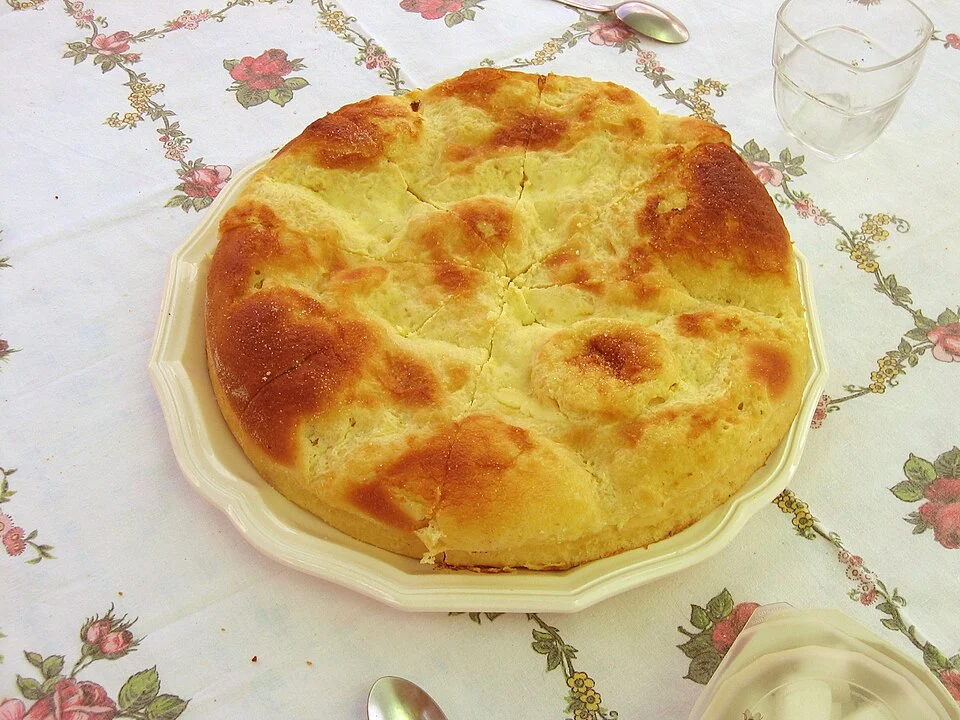
A Fingertip Hollow to Receive the Unbaked Cream
Around Besançon, the base is a yeasted dough made by mixing flour with baker’s yeast, eggs, sugar, milk and butter. The risen, softened dough is rolled out into a round, flat and wide in the center and slightly raised around the edge. Compared with baking the dough heaped up like a thick brioche, here the cream layer is broad, and each slice includes both the bread-like rim and the thin topping at the center. The same dough provides a rim high enough to keep the cream from running out, and room to puff up in the oven.
In the version Mireille provided to the Pays Horloger tourist information, 500 g of flour is combined with dried baker’s yeast; 300 ml of milk is warmed and 40 g of butter melted in it, and the same quantity of oil is used. Eggs go into the flour, and the still-lukewarm liquid is added and kneaded in. The dough first rises, covered, at 25°C for at least one hour, until almost doubled. For a tin 22 cm in diameter, 300 g of dough is taken, divided into balls and rested for 30 minutes. With floured hands it is quickly spread into a circle, and a small hollow is pressed into the center with the fingertips. The explanation is that vigorous reworking partway through rising would cost the dough its lightness; the hollow is where the liquid goumeau is received.
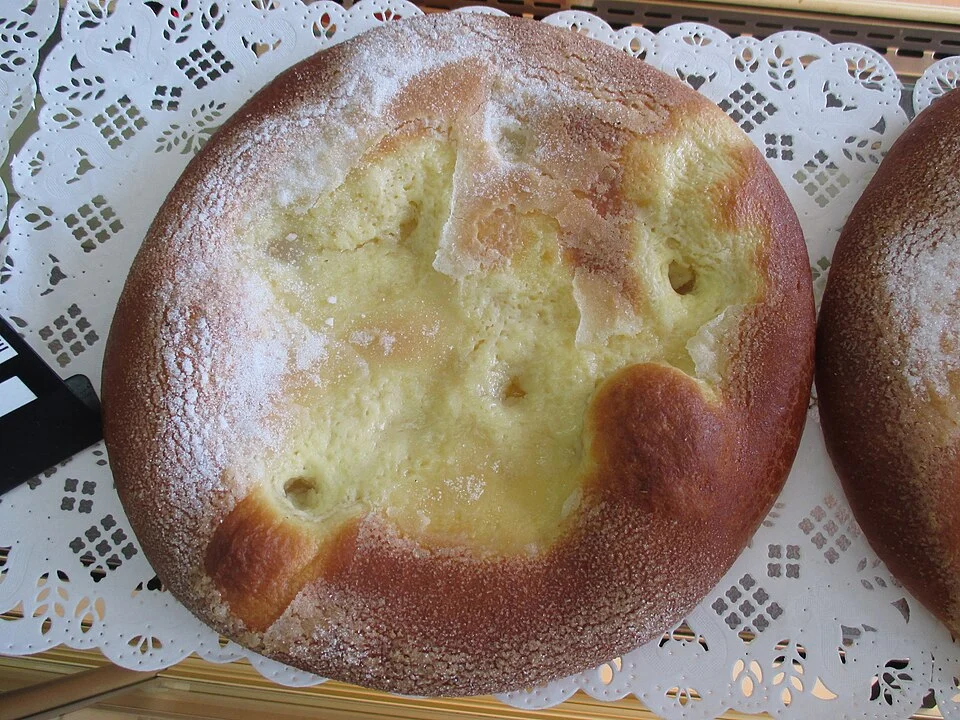
In this version the shaped dough is rested for a further 15 minutes. Meanwhile one egg is beaten, and 40 g of sugar and 125 ml of crème fraîche are added in turn and combined with a whisk. Once spread over the risen dough, it goes without delay into an oven preheated to 210°C. After about 12 to 15 minutes, watch for the topping to take on a light color. The egg sets with the heat, and the liquid that had pooled in the hollow remains inside the puffed rim. Cut after cooling completely on a rack, each slice has dough and cream baked together in the same oven.
Another home version uses 400 g of flour, 2 eggs, 60 g of sugar, 200 ml of milk and 80 g of butter. The topping combines 2 eggs, about 120 ml of liquid cream and a little flour or cornstarch, with oil sometimes added. The dough, spread in the tin, rises for about 2 to 3 hours in a draft-free place at 20–24°C. A small ridge is formed at the edge, the base is pricked with a fork before the topping is poured on, and the cake bakes for about 15 minutes at 200°C in a fan oven. Without a fan, it takes a few minutes longer, and the color should be checked near the oven. Because sugar is sprinkled on after baking in this version, where the sweetness is placed (in the dough, in the topping or on the baked surface) can also be compared with Mireille’s method of mixing sugar into the goumeau beforehand.
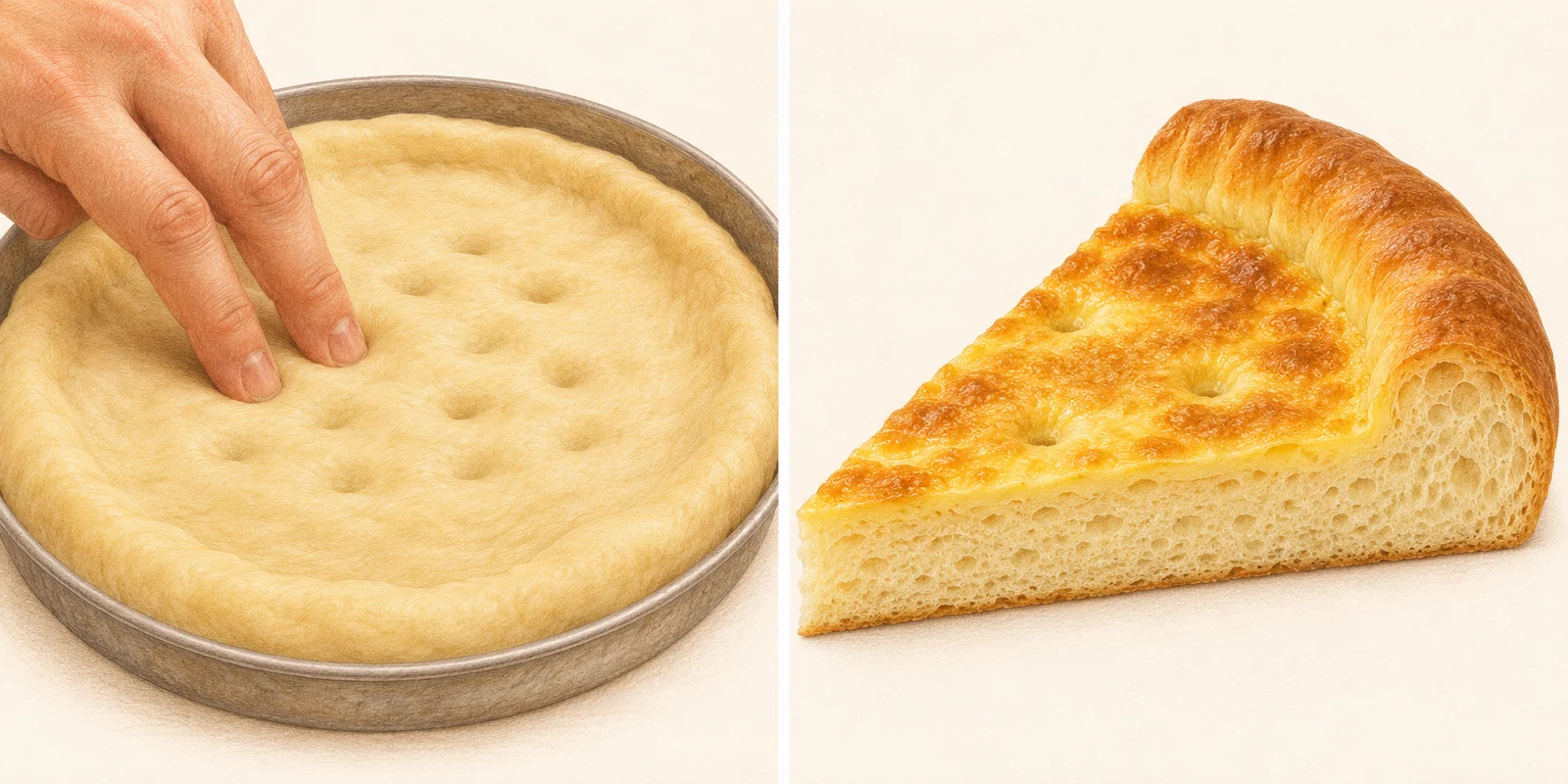
Bread Dough Set Aside at Home, and a Cake Passed to the Neighbors
Besides the topping mixture, goumeau can refer to the whole baked cake. The Jura department has the forms comeau and commeau, and Haute-Saône has gaumeau; the regional dictionary notes that commeau and similar forms are found in nineteenth-century glossaries. The frayure of the Doubs sources is an example of eggs, cream and sugar mixed and brushed on before baking. Tracing the names of the baked cake also shows what was prepared on top of the dough. The regional dictionary also gives an example in which the same word, goumeau, named a flowing batter originally used for fried pastries. In current usage for tarts, beaten egg is combined with fresh cream or butter and made sweet or savory. There are also records of seasonal fruit added in early spring, and of this egg and cream combined with a rhubarb tart; depending on what sits on top of the baked tart, the range of uses of the same word varies.
In the Montbéliard region, on bread-baking days at home, part of the dough was set aside, mixed with butter, and topped with beaten egg and cream to make a cake for celebrations. In a 1976 study of regional food, the topping sometimes has sugar mixed in and sometimes salt. There is also a recollection that brioche dough spread with cream was put into the oven once its heat had settled. In the Pays Horloger, it is said that when bread was baked in the communal oven, each household made one from a portion set aside, which gave the cake the name ménage, meaning "household." Without having to start by preparing fresh flour, a family could make a cake from the bread baked that same day.
In accounts recorded in the Doubs, when a household baked several cakes, they were shared with the neighbors, and those baked next door were received in turn. It was a chance to learn the differences in topping and dough by eating one’s own cake and the neighbor’s. At the open-air museum at Nancray, which gathers the houses of Franche-Comté, an event in 1999 served bread and gâteau de ménage baked on site. The cakes that passed between households also appear where visitors watch and taste the craft of bread-baking.
There are also scenes in which the person preparing the topping and the person rolling out the dough were different. In a Doubs recollection cited by the regional dictionary, thirty or forty cakes might be baked for a festival; egg dough was spread on oiled paper, and the fingers were moved to raise the rim. A girl poured goumeau mixed from sugar, cream and eggs onto each cake in turn, and after small pieces of butter were placed on top, the cakes went into the oven. It shows how the shaping of the rim and the pouring of the liquid, steps that survive in present-day versions, were divided in a kitchen on a day when many cakes were made to be given out.
A January Prize, Summer Festivals, and a Slice at Four in the Afternoon
The culinary heritage inventory of Franche-Comté records that galettes spread with goumeau were served at patron saint festivals and at Epiphany. In January, when Epiphany falls, shops display the usual tarte au goumeau, but there are also cases of people buying a galette with a small fève baked inside. There is also a record that in 1919 four pastry cooks of Besançon fixed a recipe for the galette de goumeau used at festivals. That year marks the point at which the pastry cooks agreed on a recipe; when households began making the cake from bread dough set aside at home is a separate matter to trace.
The gâteau de fête of the Montbéliard region in the Doubs is, as its name says, a cake baked for festivals. In Hérimoncourt there is a recollection of making a cake that was both sweet and salty, once a year, for the festival on 22 August, and in Champagney in Haute-Saône a cake of the same name featured in the meal of the festival on 15 August. The everyday occasion given by the Pays Horloger tourist information is around 4 p.m., with coffee or, in winter, hot chocolate. Around Besançon there are also examples served at breakfast. Beyond flavor and shape, both the time of day when people reach for a slice at home and the day each year when a family gathers around a single cake survive alongside the name.
Farther off, in the Belgian Ardennes, gâteau de ménage is used as another name for gâteau moré. This is a cake of yeasted dough close to brioche, baked in a tall mold with vertical flutes, and the flutes show in its outline. To tell the Doubs method apart, the clues, besides the name, are the cream baked broadly over a flat dough and the rim that holds it.
Across the Border in the Jura, the Cream Turns Tangy
In the totché (also toétché) of Ajoie in the Swiss canton of Jura, a dough of flour, warmed milk, yeast, salt, oil and other ingredients is left to rise, and egg yolks mixed into soured cream are spread over it in a round. It is close to the French galette in baking a layer of milk over a yeasted dough; the Ajoie version makes use of saltiness and the sourness of the milk. In the Franches-Montagnes and Delémont districts of the same canton, a little saffron or flour may be used in the topping, and in Ajoie there are examples with potato mixed into the dough. According to the inventory, adding flour or saffron to the topping was a way of saving eggs. In shaping, the dough is pushed out with the fingers from the center toward the edge to raise the perimeter, which resembles the French side. The Swiss inventory notes that a 1908 ethnography described totché as an old tradition of Ajoie, and says that it is now a specialty of the whole canton of Jura.
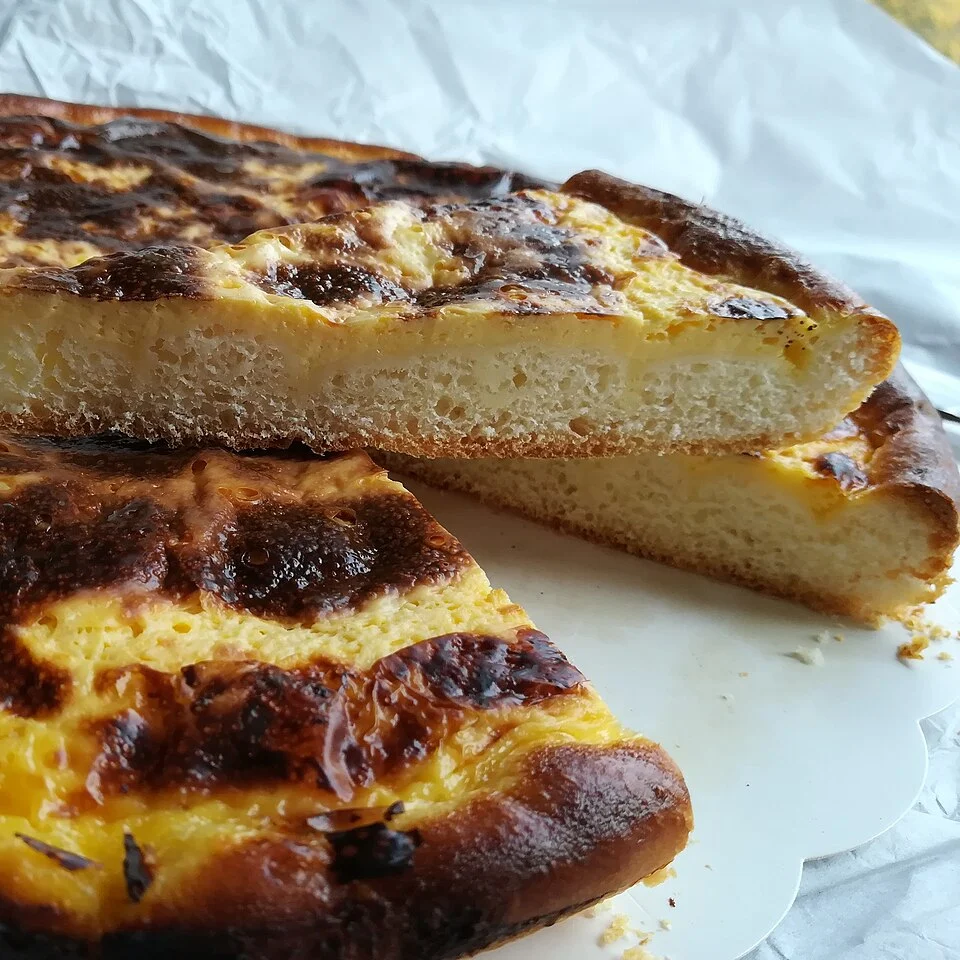
Before refrigerators became common in the 1950s, raw milk left for a few days in a cool place saw its cream rise to the top and turn naturally sour. Even after chilling made the cream easier to keep, totché has continued to use soured cream, and in current production, pasteurized cream is inoculated with selected lactic bacteria and kept at room temperature for 24 hours to develop its tang. In the sweet goumeau of the French side, eggs and sugar are mixed into the cream, but in Ajoie it is the sourness of the cream itself that is wanted. The flavor when the cake is eaten also depends on how the milk was handled before the cream was baked.
According to Swiss federal materials on intangible cultural heritage, totché, which is baked all year round, also appears at the Saint-Martin festival in November. In the Ajoie meal of many courses centered on pork dishes, the savory slice is served at the start of the dessert course. The Dictionnaire du Jura says that it is traditionally eaten cold, but also gives examples of its being served slightly warm as a starter. The day for making a thin potato totché was also the day for baking bread, in a communal or household oven. A little of the dough is taken, mixed with boiled, mashed potato and rolled thin. Using the oven while it was still hot, before the large loaves went in, families turned the thin cake topped with cream into part of their meal. The inventory’s version bakes briefly, about 5 minutes at 250°C, and once it has colored, it is folded in four or rolled and eaten immediately.
On the Swiss side there is also a sweet gâteau à la crème cuite. The Neuchâtel and Jura versions line a round with crisp pâte brisée instead of yeasted dough. In Neuchâtel, eggs, cream and sugar are mixed and baked starting at 210°C, with the heat lowered to 170°C partway through; in the Jura version of the same name, milk, flour, eggs and sugar are first heated in a pan, then butter and lemon juice are added and the mixture is poured onto the base. Is the cream layered over a thin, puffing bread, or heated inside a crisp tart? From the slice you eat, you can trace the fermentation of the base, the taste of the milk, and the point where the heating begins.
Glossary
- goumeau
- A topping made by mixing eggs, cream and other ingredients. In some regions the word also refers to the whole cake baked with this topping.
- frayure
- A Doubs word for a mixture of egg and cream brushed onto dough. There are versions with sugar or salt added.
- fève
- The small prize hidden in an Epiphany galette. Around Besançon, too, it was sometimes put into a galette spread with goumeau.
- totché
- A cake from the Swiss canton of Jura in which tangy cream is baked onto a yeasted dough. Spellings such as toétché also exist.


