


SweetloreEncyclopedia of World Sweets (834)

Monohara
Monohora sweet
A thin, crackling sugar shell around a milk core
Sugar Confections / Janai, West Bengal, India

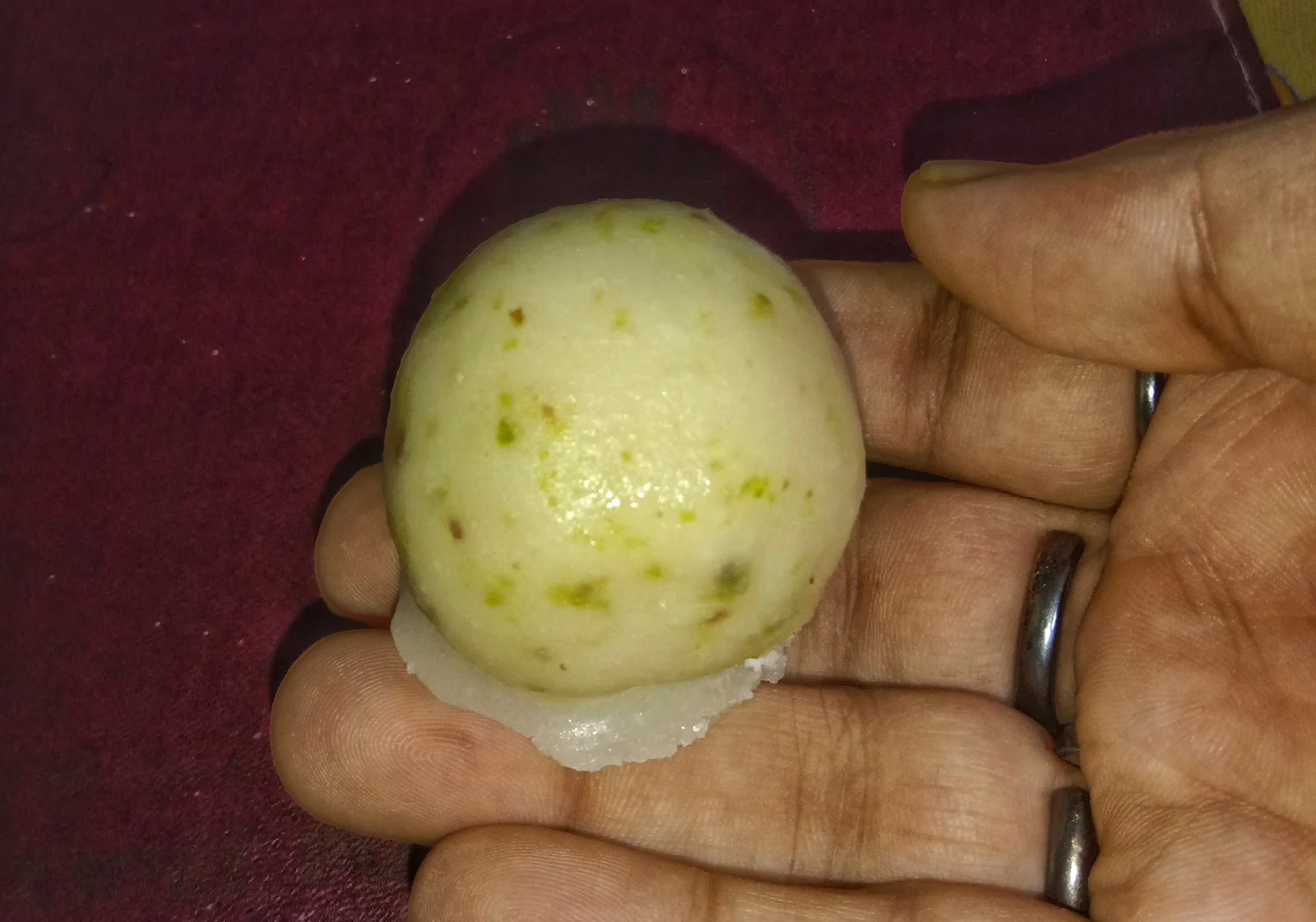
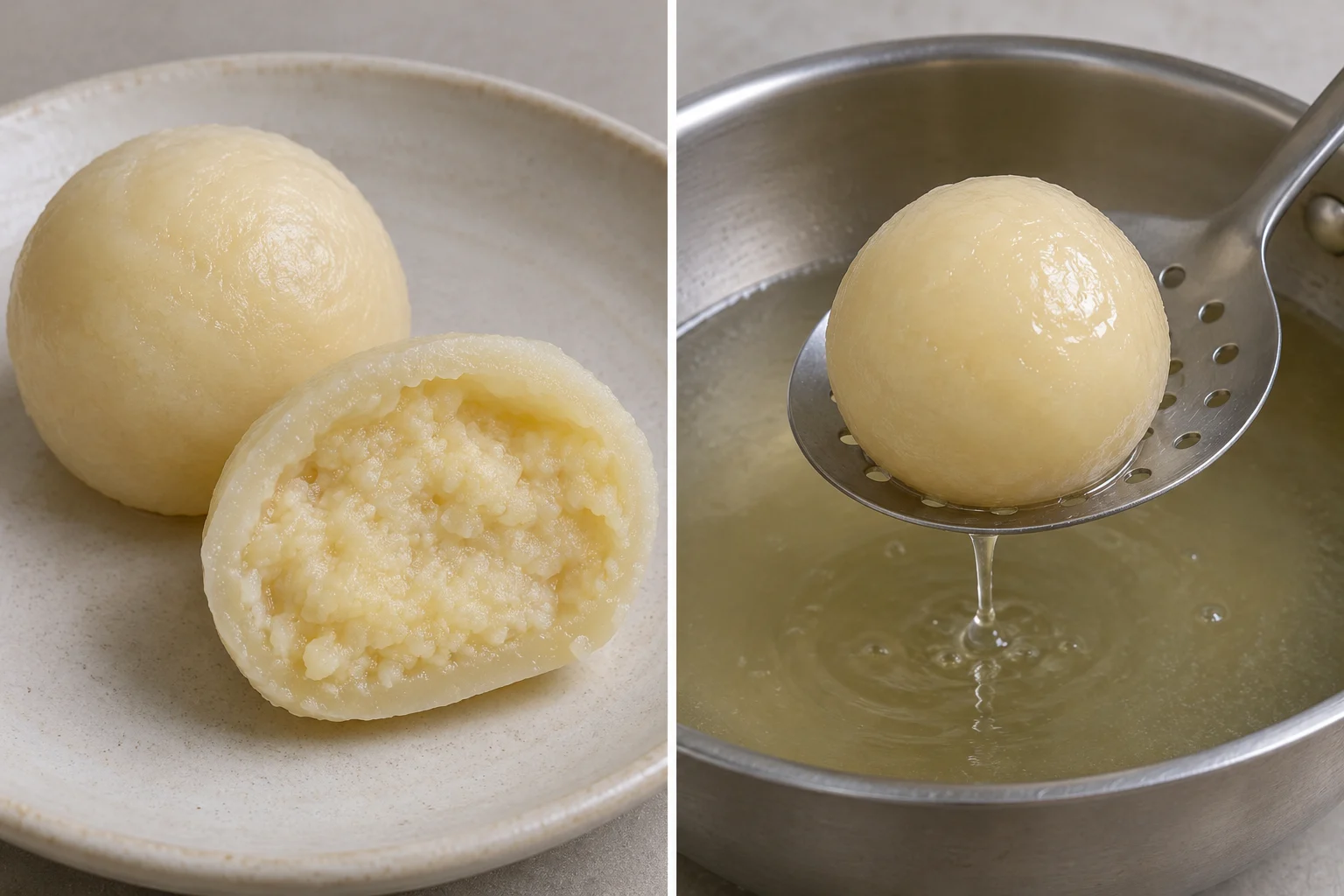
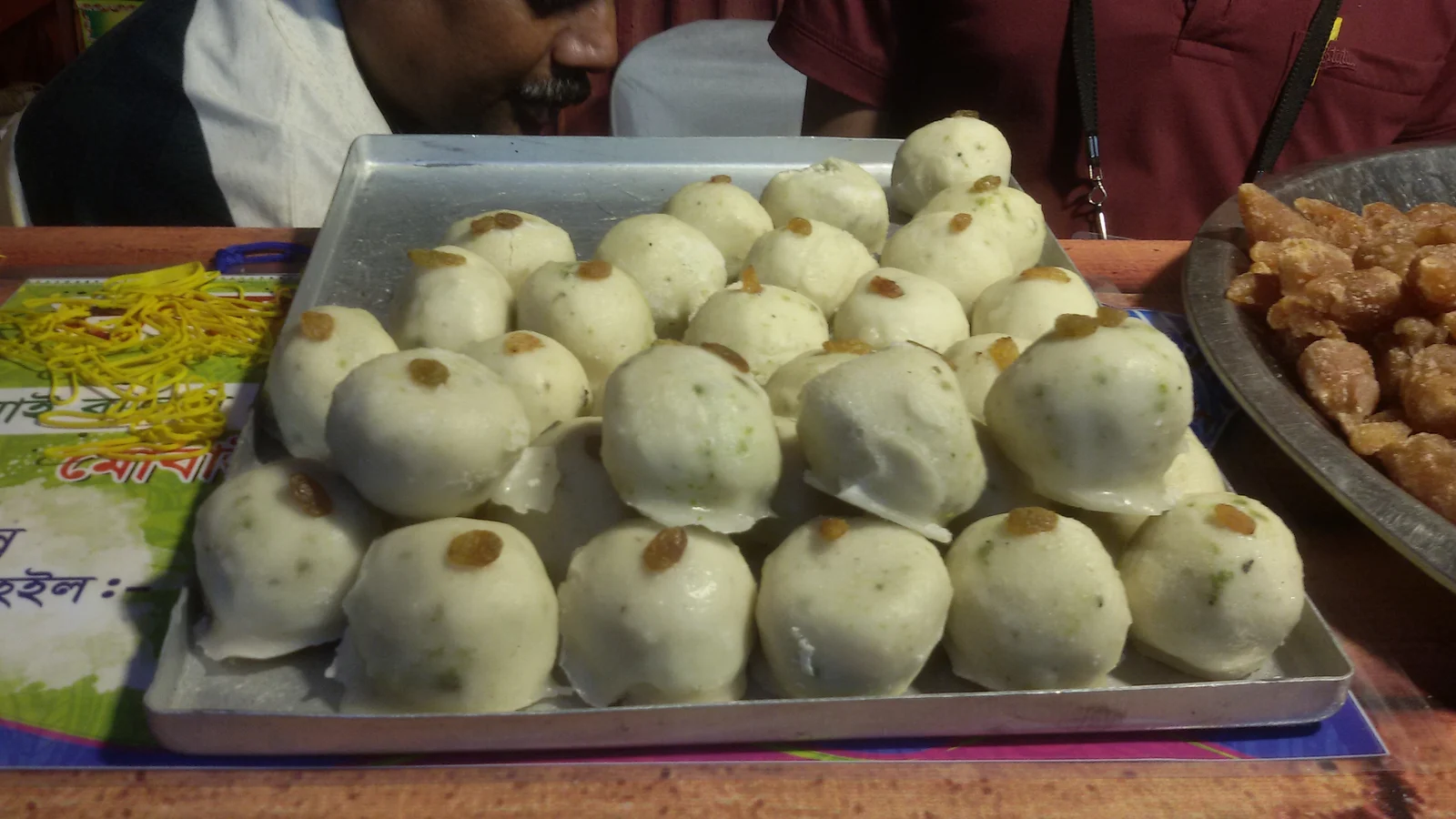
Monohara (মনোহরা, monohara) is a sweet from West Bengal in which a soft milk dough is wrapped in a thin sugar shell. In Janai, in Hooghly district, chhena, milk curdled with acid, is kneaded together with khoya, milk boiled down, then rolled into balls and dipped in sugar syrup. When bitten, the teeth first break through the thin outer film, and beneath it lies a milk core that still retains a slight graininess. Besides the whitish sugar shell, some versions use a sugar made by boiling down date palm sap collected in winter. The Bengali word monohora means "that which captivates the heart," and sweets of the same name are also made in places other than Janai, such as Beldanga in Murshidabad district.
The Milk Core: One Part Curdled, One Part Boiled Down
The core of Janai monohara contains two ingredients taken from the same milk by different methods. Chhena is the milk solid left when warmed milk is curdled with acid and strained through cloth. In the method set out in the Janai producers’ association’s entry in the GI Journal, the milk is held at 85–90 °C and about 50 millilitres of acidic whey is added per litre. Whey is the liquid that separates from the white curds when milk coagulates. Lemon juice is added if needed; once the milk has curdled well, the curds are taken up in cloth and washed to remove the remaining sourness. Because chhena is made by gathering the curdled milk grains in cloth, the grains it leaves on the tongue differ from those of khoya, in which the water is driven off while the milk is still liquid.
After the chhena is strained, a weight of about 8–10 kilograms is placed on it, still in the cloth, and it is pressed for about 20 minutes to remove excess moisture. It is then spread on a board and kneaded by hand for about 20 minutes to break up large lumps and even out the grains. Grated khoya (also called mawa), made by heating milk to reduce its water, is then added. In the process given in the Journal entry, the ratio of khoya to chhena is about 2 to 1. This adds the richness of boiled-down milk and, leaving no large lumps of khoya, brings the whole core to a state in which it can be rolled by hand. Powdered cardamom is mixed into the interior, so when the sugar on the surface is broken, the fragrance comes out together with the milk dough. The Journal entry also mentions rose essence as a flavouring.
The drained and kneaded dough also passes through a stage at which one judges whether it is ready to be heated and rolled. Ghee is melted in a pan, the combined chhena and khoya dough is added, and sugar or a seasonal sugar is put in and stirred over low heat. Ghee is the fat obtained by separating the water and milk solids from butter. In the example given in the Journal entry, ghee is melted at about 40–45 °C and the dough is stirred at about 65–70 °C for 5–6 minutes. The cue to take it off the heat is when the dough begins to pull away from the sides of the pan and comes together in one mass. Rather than fixing the firmness by the first draining alone, the maker also watches how the dough moves in the pan.
The dough taken off the heat is cooled to a temperature at which it can be handled by hand, then rolled. The Journal entry shows a sphere about 2 inches (about 5 cm) in diameter and a flat disc. In the sphere, the core is thicker toward the centre; in the flat piece, the upper and lower shells lie close together even at the centre. When the sweet is eaten in small bites, even if the shell is equally thin, the proportion of milk to sugar in each mouthful varies with the thickness of the core. Smoothing large bumps on the surface with the fingertips lets the thin syrup applied next follow the shape of the core.
Dipped One by One in Syrup Before the Thickness Changes
The sugar added to the core and the sugar that covers the outside are handled in separate pans. In the Janai Journal entry, water and sugar are heated to thicken the syrup, which is cooled slightly before the cores are dipped in it one at a time. As a guide to concentration, the entry gives 80–85 °Bx for sugar syrup and 65–70 °Bx for winter date palm sugar syrup. Brix is a measure of the concentration of a solution and is a different figure from the temperature of the pan. The roughly five minutes of cooling mentioned in the entry is meant to bring the syrup, which is kept warm, to a viscosity at which it leaves a thin coating on the surface of a lifted core.
Just after it is lifted out, the piece has the gloss of the syrup; while it cools at room temperature after being moved to a tray, the sugar crystallises into a shell that breaks under the teeth. The Journal entry likens the thinness of the shell to fish scales. Rather than grains sticking on separately, as when a powder is sprinkled over, it forms a continuous film around the core. A thick sugar coating tends to leave sugar in the mouth even after it is broken, whereas with a thin coating the chhena and khoya dough appears right beneath the broken shell. When pistachios, cashews or raisins are used as decoration, they add another texture to the soft core and the crystalline film.
Nolen gur, used in winter, is a sugar made from date palm sap. In the seasonal method it is used both for the sweetness of the core and for the outer syrup. Compared with a sugar shell, the sap sugar deepens the colour and adds aroma. Even so, the form aimed for is a thin shell that meets the teeth first. The syrup is adjusted to a different concentration from that used in the season of white sugar so that, while the colour and aroma change, the shell still follows the core once it has cooled.
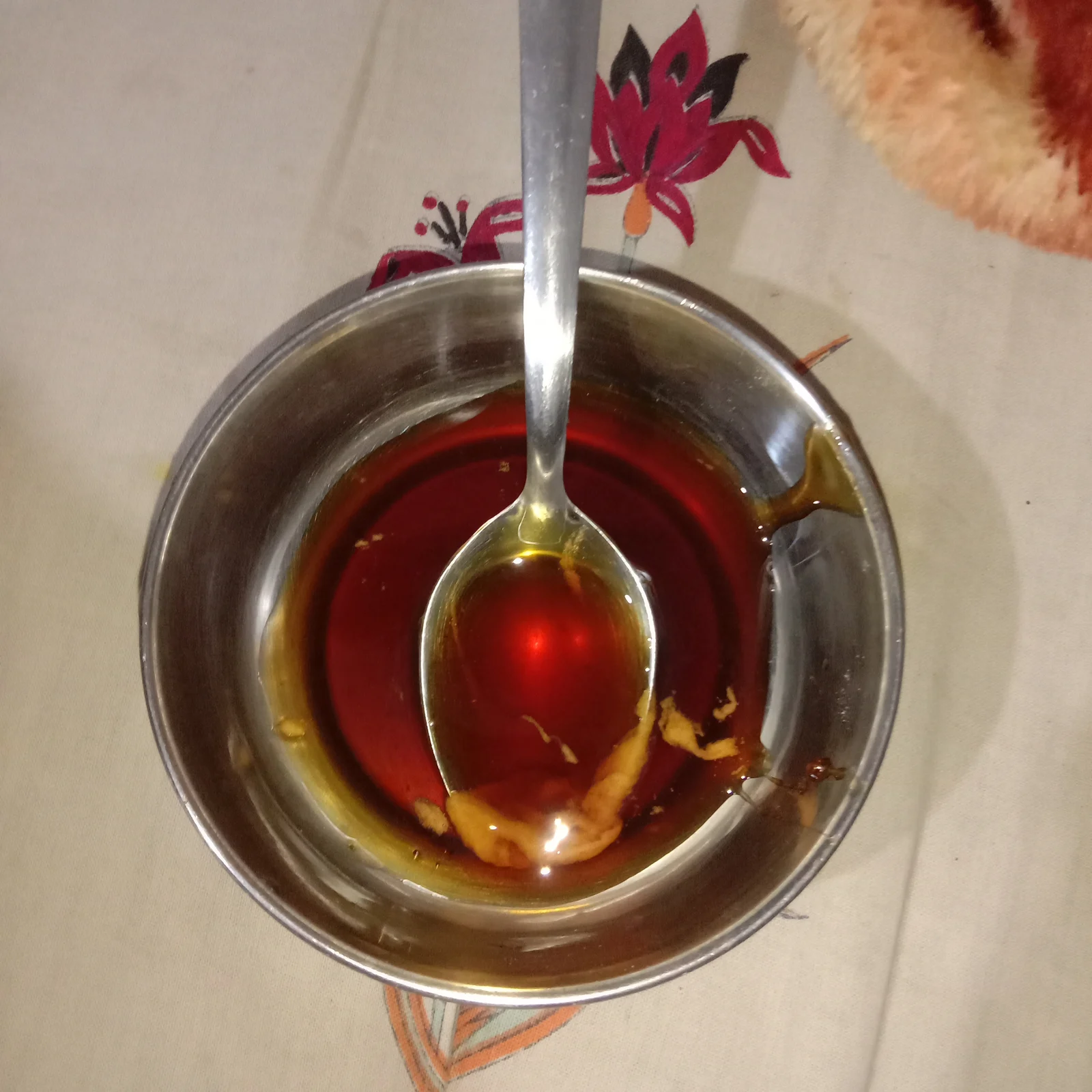
When The Telegraph visited a workshop in Janai in 2026, the maker was coating shaped milk balls with coarsely crushed pistachios and carrying them to the next work room. There stood a pan of syrup thicker than that used to soak rasgulla, and each ball was dipped and immediately lifted out with a small spoon. The balls were set on a paper-lined surface, and a fan was turned on them to harden the surface. As in the Journal entry’s account of cooling on a tray, the rolled core is not left long in the syrup, and the shell is finished after it is lifted out. This workshop’s order, in which the pistachios go on first, differs in perspective from the Journal entry’s description of adding decoration to the finished piece.
While Waiting, While Carrying: Stories About the Sugar Shell
The Janai producers’ association names the moira, the confectioners who make and sell sweets, as the people who have made monohara for generations. The Journal entry also describes the quarter where the moiras live. In the story of a landlord who had an artisan make milk sweets, the patron did not return on schedule, so the artisan coated the finished sweets in thick sugar and waited. When the landlord came back, he said the taste had captivated his heart, and this is said to be the origin of the name.
In the story involving an official of the British period, too, time passes after the milk sweets are made. A visiting official who liked the milk sweets in Janai wanted to take a large quantity home, and the artisan covered the surface with sugar to prepare for the journey. What differs between the two stories is the circumstance: whether the sweets were made to wait for someone at the shop or to be eaten after being carried. When sugar is used in food, part of the water becomes less available to microorganisms. The tales explain why thick sugar was used on milk sweets that were not eaten at once, but they are not records of the storage temperature or number of days required for the sweets sold today.
The Journal entry also gives several names for who began making it. In one account, Paran Chandra Nag opened a shop and refined the sweet through repeated trials; in another, it was the sweet of Lalit Moira in the 1860s; and in a third, it was devised by Paran’s son, Bhim Chandra Nag. The same entry also states that the father, Paran, began trading in Kolkata in 1826. The year a confectionery shop opened, the time when a shell began to be added to existing milk sweets in Janai, and the time when the technique became established each require separate evidence. What the stories now told do show are the people and the place tied to monohara’s origins.
Chhena Delivered in the Evening, and Finishes That Vary by Place
The chhena that Janai’s confectioners roll is also prepared in homes near the market. In villages such as Baksa and Madhabpur, covered by the Bengali newspaper Ei Samay, families collect milk, boil it, curdle it, and deliver it to market shops from evening into night. It is said that in the periods when more people buy sweets for festivals, more chhena is used than usual. For those who make the raw material, however, there is a limit to the amount of milk they can collect even when demand grows. Monohara rests not only on the skill of kneading chhena in the confectioner’s pan but also on the work of neighbours who collect milk in quantity, heat it, curdle it and carry it.
Ei Samay reported at the time of its July 2026 reporting that 21 shops in the market used about 100 kilograms of chhena a day for monohara, and that the amount nearly doubled in the Puja season. The producer interviewed, Sudip Ghosh, supplied about 20–25 kilograms a day. In a system in which a family handles everything from collecting the milk to delivering it to the shops, an increase in orders at the counter does not necessarily mean an immediate increase in milk or chhena in the same proportion. These figures come from one market and one supplier at the time of reporting; they are not a guide to the quantity used in other years.
The Janai producers’ association applied for a geographical indication (GI) in 2022. Application number 990 in the register is shown as registered, and the registration certificate in the document list is dated 27 March 2026. The registered name, "Janai Monohara," includes the place, and the Journal entry records the local milk used, the time spent kneading by hand, and the work of dipping the core in syrup. What can be read from this record is which form and method Janai applied for as characteristics tied to the place. How the same sweet name has been used elsewhere can be traced through the records of each maker.
At a confectionery shop in Beldanga, Murshidabad district, run by three generations of the same family, Chandan Saha describes a method that combines chhena with the skin that forms on the surface of milk. The dough, with nutmeg, mace (the dried aril that surrounds the seed) and cardamom added, is rolled and coated with hot syrup. The pieces are set on banana leaves or oiled sal leaves, and after about 30 minutes of cooling the surface hardens. In the Janai process, each core is dipped one at a time in warm syrup and moved to a tray. Both wrap a milk dough in sugar, but they differ in the milk ingredients and spices mixed into the core, in the way the sugar is applied, and in the surface on which the pieces cool.
In Mahadipur, near the border in Malda district, the local confectioner Raju Ghosh makes a monohara that he says he learned from his father, using boiled-down milk, coconut, sugar, date palm sugar and cardamom. A local newspaper reports residents who bring sweets as a gift when relatives come from the Bangladesh side, or when they themselves visit relatives. In Janai, what travels from nearby villages to the market is chhena for the core, whereas in Mahadipur what is delivered to relatives’ homes is the finished monohara made with milk and coconut. The same sweet name appears in each place, in the daily work of gathering ingredients and in the custom of giving the finished sweets as gifts.
In Bengali sandesh, the chhena dough is shaped, and in rasgulla (rosogolla), rolled chhena balls are cooked in syrup. In Janai monohara, the core mixed with khoya is kneaded first and heated until it can be rolled, and only then dipped in syrup. The syrup stays on the outside and, as it cools, becomes a shell that holds its shape. That the sugar film breaks first when the sweet is bitten, followed by soft grains and the aroma of milk, is because the pan in which the core is made and the pan for the outer covering are separate.
Glossary
- Chhena (ছানা, chhena)
- The milk solid obtained by curdling milk with acid and separating the whey. In Janai it is washed, drained and kneaded by hand before being used as the core of the sweet.
- Khoya (khoya, mawa)
- A milk product made by heating milk to reduce its water until it approaches a solid. In the Janai method it is grated and mixed into the chhena.
- Ghee (ghee)
- A fat obtained by separating the water and milk solids from heated butter.
- Nolen gur (নলেন গুড়, nolen gur)
- A sugar made from date palm sap collected in winter. Here it is a seasonal ingredient used in the core and sugar coating of Janai monohara.
- Moira (ময়রা, Moira)
- A confectioner in Bengal who makes and sells sweets, and also the people who have passed down that trade.
- Mace (mace)
- A spice made by drying the aril that surrounds the nutmeg seed.
- Geographical indication (GI)
- The name of a product whose quality, reputation or other characteristics are tied to a particular place of origin. The registered name is Janai Monohara.


