


SweetloreEncyclopedia of World Sweets (834)

Num Akor
Num akor
Fermented non-glutinous rice batter steamed in small molds
Desserts / Cambodia

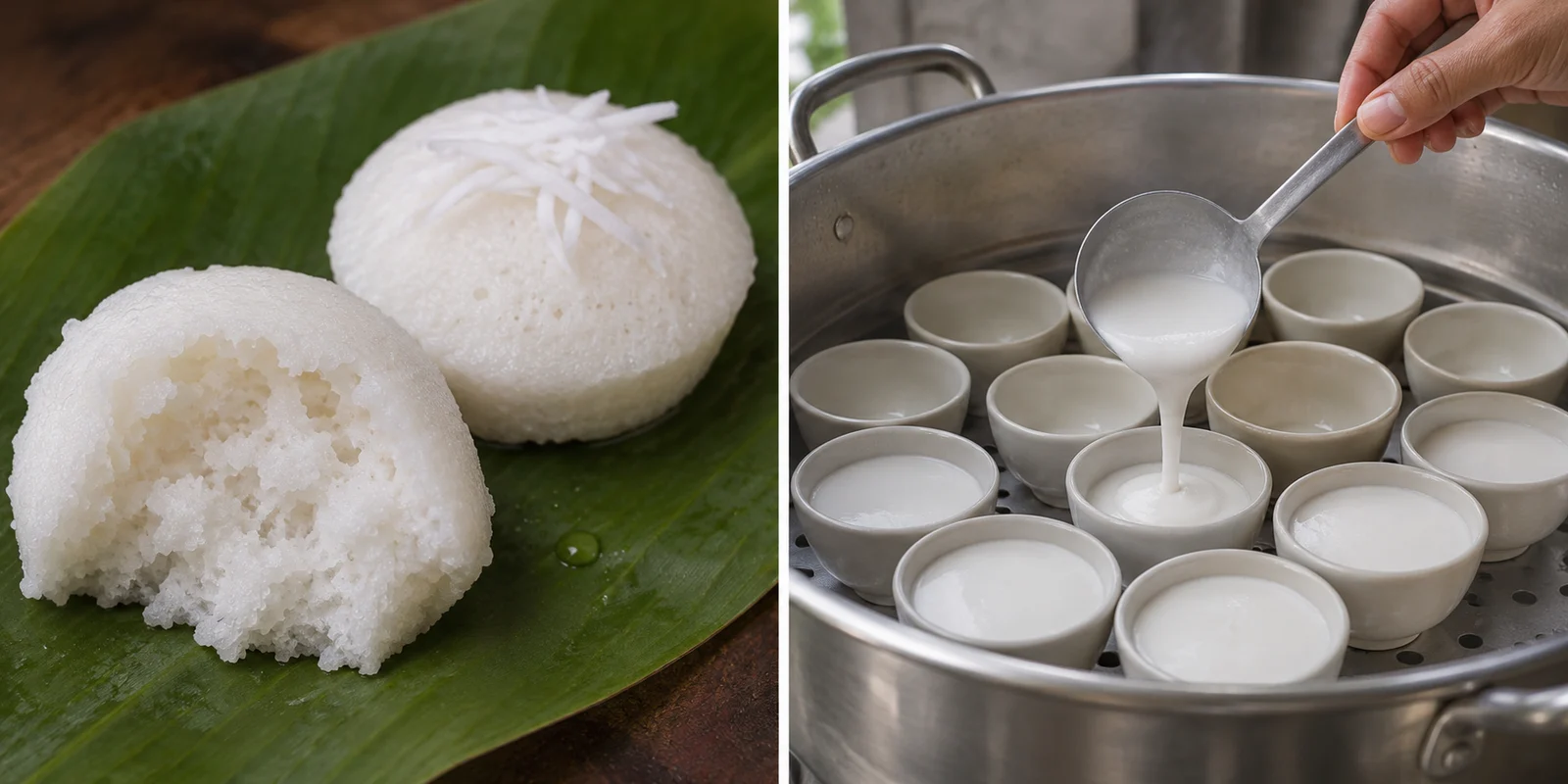
When you break the round white cake in two, fine holes appear inside. If you eat it together with the coconut on top, thin fibers remain after the soft rice batter. Cambodia’s num akor (នំអាកោ, also spelled នំអាកោរ; num akor) is a sweet made by fermenting ground rice batter and steaming it in small portions. Its small, puffed shape does not come from cutting up one large steamed sheet; it comes from batter poured out one portion at a time before steaming. It is sold in boxes in Phnom Penh markets and is also listed among the sweets of Pchum Ben, the season for honoring ancestors.
Soaking the Rice, Draining the Water, Waiting for Fermentation
In 2005, The Cambodia Daily visited Uk Ra, who makes num akor in Phnom Penh. She soaks rice in water for several hours, grinds it, and then presses it to remove excess water. She said she uses about 100 kilograms of rice a day. This is not the amount for one batch of batter but her own description of her work as a whole at the time of the interview. Letting the rice absorb water first makes it easier to grind finely, and draining the ground material makes it possible to adjust the moisture when sugar and coconut are combined next. Measuring dry flour and water from the start and soaking before grinding differ in the stage at which the water going into the batter is adjusted.
In the Khmer-language AMS article introducing festival sweets, the standard type uses non-glutinous rice, white sugar, a fermentation starter, and a little salt. Uk Ra’s formula combines drained ground rice with sugar, coconut, and palm sugar, mixed and left for several hours. The standard type described with white sugar and the mixture used in a market workshop, where white ones are also on sale, cannot be read as the same ingredient list. Dissolving white sugar and adding colored palm sugar may change the color and aroma of the batter. Even once the batter is soft enough to be poured into containers one at a time, it is not heated right away; the mixed batter is left to rest.
Joanes Rivière, a pastry chef in Siem Reap, told the same newspaper that the traditional method relies on natural fermentation, like bread leaven. He also gave an example in which adding a small amount of commercial yeast shortens the time until the batter rises to about one hour. The time spent soaking the rice is separate from the time spent waiting for bubbles after the batter is mixed. Even with the same amount of rice, how much it rises varies with room temperature and the condition of the starter. Bubbles formed before steaming remain as fine holes after heat sets the surrounding batter. A sweet made by pressing rice cooked as whole grains has gaps between the grains, but in akor made from ground rice, the cross section shows traces where the batter rose.
Pouring Into Cups One at a Time, Topping After Steaming
At Uk Ra’s steaming station, two large stainless-steel containers sat over the burners. Hundreds of small cups were placed inside them, and a little batter was put into each. What goes into the large containers is rows of small cups; the article does not specify the material of the small containers themselves. Because the batter is poured one portion at a time before heat is applied, the rim of each small container determines how far the batter spreads during steaming. Even soft batter does not run all the way sideways and rises little by little within the container. When selling to customers as well, no large slab has to be broken; the pieces are removed one by one and packed into boxes.
Heat enters from outside the cup, and with the exposed surface in the steam, the batter keeps its shape while staying soft. A step that uses a browned edge as a marker, as in baked sweets, does not appear in the steaming described in the interview. If coconut was mixed into the batter beforehand, its flavor continues through the inside. When shredded coconut is scattered on top, the fibers and aroma gather at the first place the mouth touches. In Uk Ra’s examples, milk was sometimes added on top before steaming and sometimes not. As things to scatter on top, the article lists chopped nuts, sesame, shredded coconut, and fruit. Even when white coconut is visible on the outside, what went into the batter itself can be known from the maker’s explanation.
At the burner, the work of lining up small cups and the work of putting batter in them continue. After soaking the rice, grinding it, draining it, and leaving the mixed batter for several hours, it is transferred into many cups at once. What the article describes is the ingenuity of one maker handling hundreds of containers; even if the steaming vessel is made larger, the single piece that is eaten need not be larger. If the amount put into each small container is uniform, each shape remains when the box is opened at the stall. The first photograph the reporter saw also showed several round, puffed white pieces in a box, scattered with white fibers.
The reporter wrote that the akor they ate had a sweetness that was not too strong and a fermented flavor, and that it made them want to try pairing it with fruit. If white sugar or palm sugar is mixed into the batter, the sweetness spreads through each piece, while with fruit added afterward, juiciness and aroma overlay the surface. The holes left by steaming ground rice and a topping placed on the surface later each have their own point at which texture is created. Even when the shape taken from the small cup is the same, the flavor of a single bite changes depending on what kind of sweetness the rice has and what remains on top.
Phnom Penh Stalls and the Pchum Ben Plate
The reporter asked about sellers at Toul Tompong Market and found akor in a polystyrene foam box at Orussey Market. The seller said her aunt made it, and that aunt, Uk Ra, was steaming batter at the Central Market. This does not mean the box that was bought had been steamed at the back of that same market. Since the maker said she sold at several markets in the city, the practice of removing pieces from the cups one by one and packing several into a box also suits work handled at other stalls. Uk Ra stressed that her product is a Cambodian sweet and also said she had no competitors.

At the time of that interview, Uk Ra was 47. She said she began making it around the age of 19 to earn income after the fall of the Khmer Rouge regime, and that her mother and grandmother also made akor. She kept making a formula of her own devising and adjusted it as she went. That she worked out the batter for her business on her own, and that the sweet was also known to her mother and grandmother, both appear in the same testimony. Rivière answered that around the same period he often saw this sweet in Siem Reap markets, and that it was also served at a restaurant where he worked. A product that she sells herself in the capital and one seen at markets and shops in another town cannot be treated as the same maker’s formula or business.
The AMS festival article introduces Pchum Ben, when relatives earn merit at the temple and prepare food for monks and ancestors. It says akor has a standard type and a coconut milk type, and that the standard type is commonly used for the event. Even if a box is sold as a single unit at a market, on a festival plate pieces can be taken one at a time as needed. The finishes of milk, fruit, and sesame seen in the interview are not stated to apply to all of the article’s standard type. The article lists non-glutinous rice and white sugar, among others, as ingredients for the standard type, and where shop formulas differ can be understood from what was heard at the market.
The festival article treats together the preparation of a meal at which the family gathers and food for monks taken to the temple. Leaf-wrapped ansom comes in varieties with different fillings such as pork, beans, and banana, and these use glutinous rice. Akor, steamed by pouring fermented batter into cups, is not a dish named for a leaf fold or a type of filling. Because it is ground after the rice is soaked and keeps its bite-size shape until steaming is done, it can be held in the hand and shared among several people. Even sweets used at the same festival are not identical, from the wrapping stage to whether they have browning.
Num bot and num kom, which appear at the same festival, are steamed from glutinous rice flour dough wrapped around a bean or coconut filling. Num treap, made by cooking white or black glutinous rice and adding sugar, is flattened in a tray and cut into pieces. Akor is made by fermenting a ground non-glutinous rice batter and first dividing it into small containers to steam. Even when all appear at the festival as rice sweets, the form you see differs as you eat them: the boundary where a filling is wrapped, the spaces between cooked rice grains, or the holes in fermented batter.
Num T’not, with Palm Sugar and Added Fruit Pulp
Num t’not (នំត្នោត, num t’not) from Takeo is also a rice sweet steamed in small containers. The Cambodian Cookbook gives an example using 150 grams each of sugar made by boiling down palmyra palm sap and strained pulp taken from ripe fruit. The sugar made from the sap brings sweetness and color, while the ripe pulp adds palm aroma and a golden color to the batter. It uses 300 milliliters of coconut milk and is steamed in oiled cups, ramekins, or molds lined with paper. At markets, banana-leaf containers are sometimes used; after steaming and removing from the container, shredded coconut mixed with salt is placed on top.
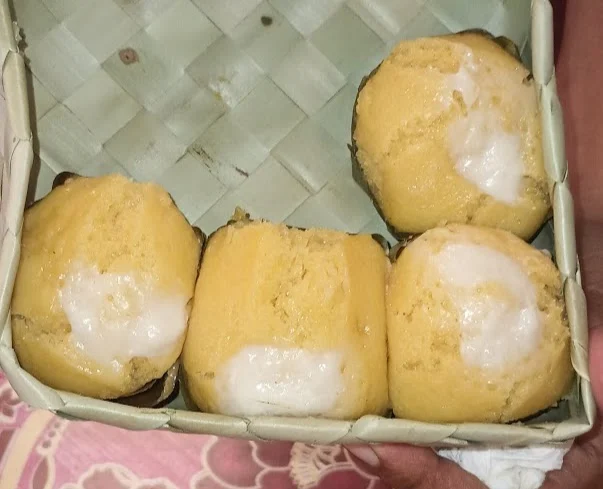
The same num t’not recipe dissolves palm sugar in a little water and, once it has cooled, adds it to the flour. The pulp is strained before being added. The two palm ingredients are not processed in the same pot; the dissolved sugar and the pulp are each made smooth and then combined. The batter is poured to about three-quarters of the container and steamed for roughly 25 to 30 minutes. Wrapping the lid in cloth is said to prevent water droplets on the lid from falling and denting the surface. The cloth and heating time are examples from this home recipe associated with Takeo. They are not matched to the time or quantities used when steaming the standard type of akor at markets.
This num t’not recipe presents baking powder as an option for a lighter result. There is a step of mixing liquid and pulp into the flour and leaving it for 10 minutes, and that wait is explained as letting the flour absorb the liquid. Even if the batter appears to rise, the process of creating bubbles is not necessarily the same as for akor, which is steamed after waiting for fermentation. Because white shredded coconut sits on top, it is the first flavor to touch the mouth. The palm pulp is in the batter itself, so color and aroma remain even when you push the surface aside and break it open.
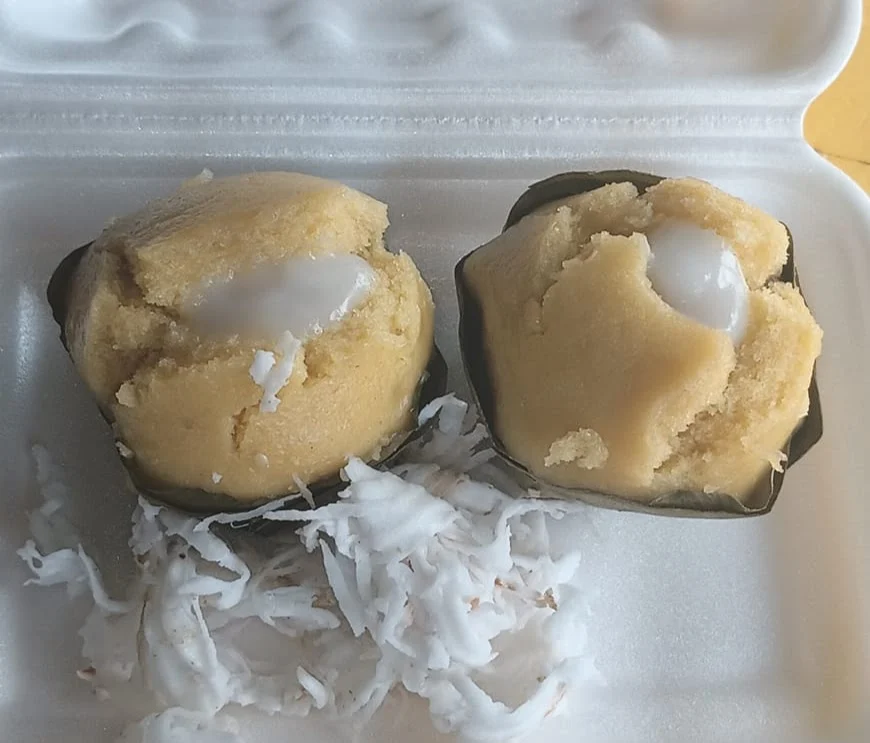
When you eat the standard type of num akor, even if you remove the topping, the fermented rice retains its original flavor and fine holes. With akor made with coconut milk, even if you remove the white fibers, the milk’s flavor is already in the batter. Num t’not shows, from the aroma inside, the difference between a sweet sweetened with sap sugar alone and one that also contains fruit pulp. Though they give a similar round impression, from white to golden, what rice was prepared, how it was made to rise, and at what stage pulp or milk was added can be seen by looking at the inside and the outside separately once broken open.
Glossary
- Fermentation starter (មេ)
- A starter added to make rice batter rise. One of the ingredients of the AMS standard type. A method of shortening the time with commercial yeast is also reported.
- Pchum Ben (ភ្ជុំបិណ្ឌ)
- The Cambodian season of honoring ancestors. Rice sweets including num akor are introduced in local articles.
- Palmyra palm (ត្នោត)
- Boiling down the sap gives palm sugar, and the pulp of the ripe fruit is also used in sweets. The num t’not example uses both.
- Num treap (នំទ្រាប)
- A sweet of cooked glutinous rice combined with sugar, flattened in a tray and cut. It can be distinguished from num akor, which steams fermented ground rice.


