


SweetloreEncyclopedia of World Sweets (834)

Bánh ít lá gai
Bánh ít lá gai
The black skin kneaded with ramie, and a gift wrapped in leaves
Desserts / Bình Định, Vietnam

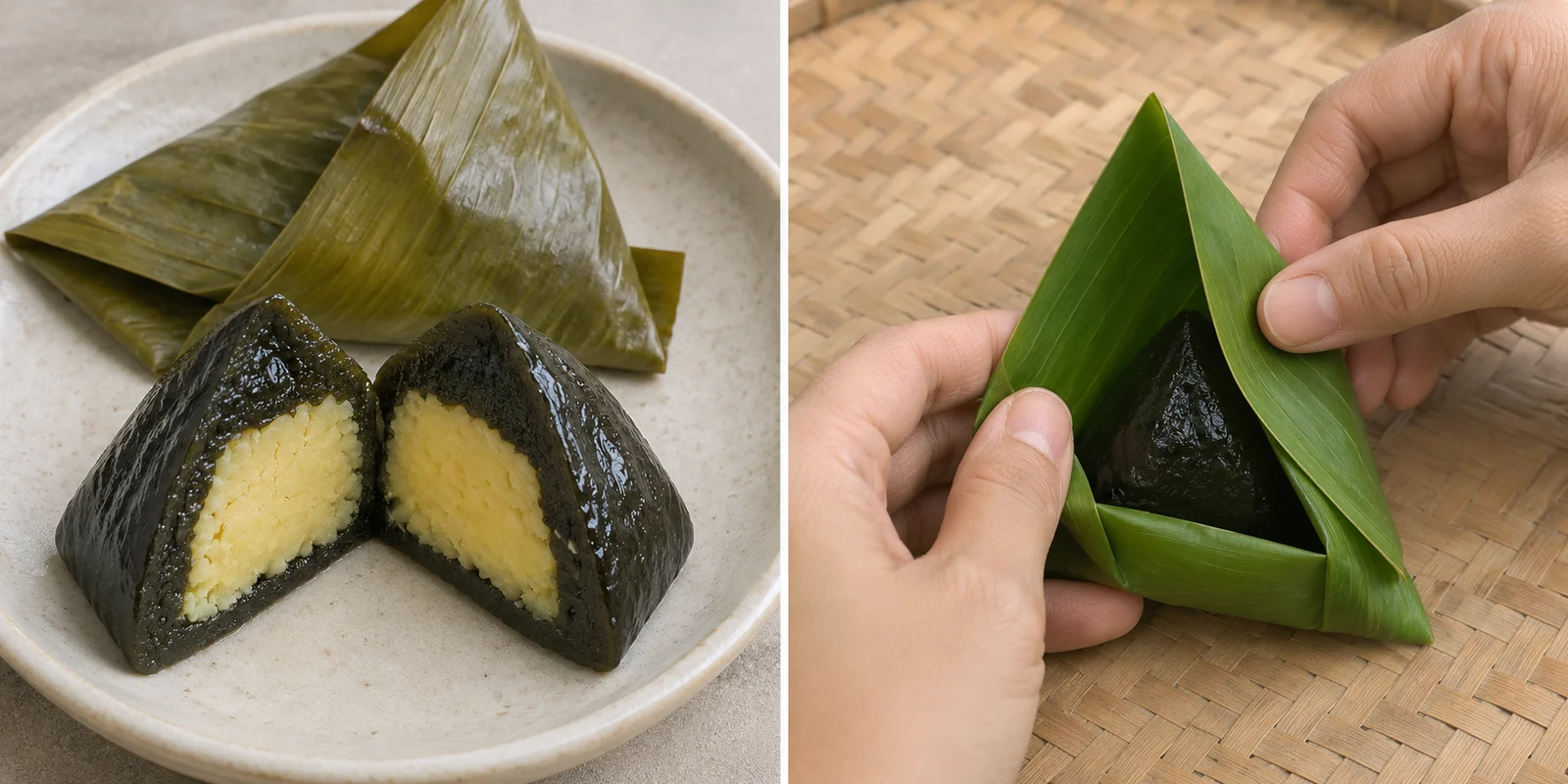
Unfold the pointed wrapper, and inside the banana leaf the glutinous rice skin appears, glossy and nearly black. Peel the leaf away completely and the dark color remains; break the skin and a bright mung bean or coconut filling emerges. Bánh ít lá gai, known in Bình Định in central Vietnam, is a steamed sweet made by kneading ramie leaves together with glutinous rice and enclosing a sweet filling. Two kinds of leaf are used. The leaf called lá gai is finely pounded and mixed into the edible skin, while the banana leaf is shaped around it into a package with a square base and a pointed top.
Removing the Leaf Ribs, Grinding the Rice, and Combining the Two
In the Bình Định method, the stalks and thick veins are removed from the heart-shaped ramie leaves, which are then torn, washed, boiled until soft, and pounded in a mortar. The work turns leaves that still hold their shape when chopped into a mass that leaves no tough fibers when the skin is chewed. The dark dough does not get its color from scorched outer leaves. Because the ramie leaves are boiled, pounded, and mixed through the whole dough, the color and aroma remain in the edible skin even after the package is opened. Leaves alone, however finely processed, do not become sticky enough to enclose a filling, so the glutinous rice is handled separately.
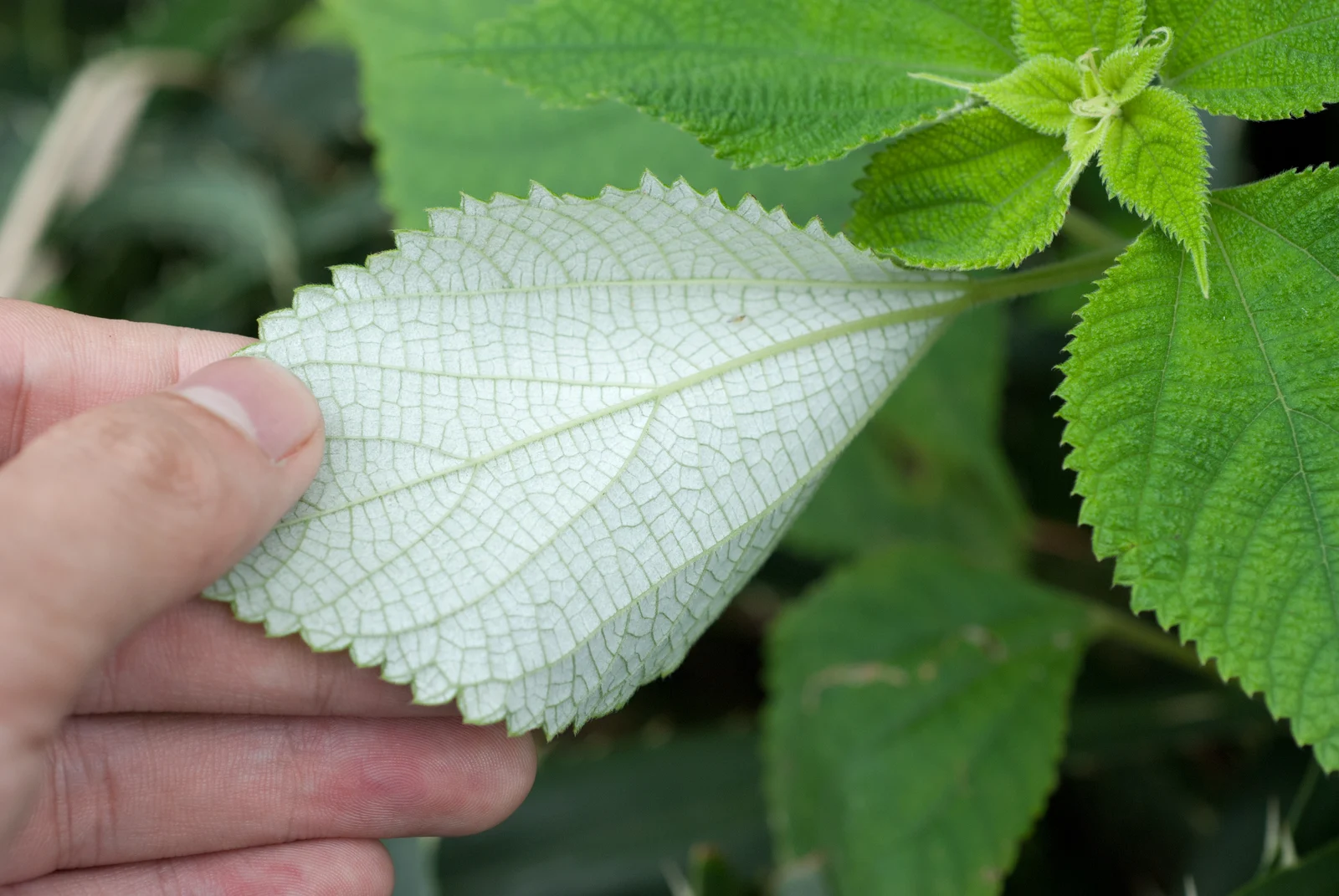
Fresh, fragrant glutinous rice is washed and soaked in water for several hours. It is then ground finely, pressed, and drained of excess water. In an article from the Overseas Vietnamese Committee, the ramie leaves and the glutinous rice are each finely processed, combined with sugar, kneaded repeatedly, and pounded further. A Vietnamese tourism source describes grinding the soaked glutinous rice together with the leaves and draining the mixture in a cloth bag. Whether the two are processed separately first or ground together, the dough needs enough stickiness and moisture to be closed over a filling later. It is pounded so that no streaks or uneven color remain in the rice mass, letting the color of the kneaded leaves show wherever it is cut.
One account also describes draining the ground rice by tying the mouth of a cloth bag and hanging it, or by pressing it down with a stone. If too much moisture remains, the skin stretches before it can be shaped over the filling; if it is squeezed too hard, it cracks and becomes difficult to close around the filling. In the step of kneading after the water is drained, the aim is a firmness suited to pulling the skin. Thinness alone does not decide quality: a slightly thicker part has a layer of glutinous rice and ramie to chew through before reaching the filling. The work of mixing the edible leaf into the dough and the work of folding the outer leaf are separate stages that follow.
In a version recorded by VnExpress, the glutinous rice is soaked in water for 3 to 4 hours and then ground. Once the drained rice, pounded ramie, and boiled-down sugar are in the mortar, the tip of the pestle is coated with peanut oil several times to keep the sticky dough from clinging to it. The oil is not used only after the outer leaf has been wrapped. Here it also helps release the dough, which has begun to turn sticky in the mortar, from the pestle while it continues to be worked. The time spent soaking the rice and the time spent adjusting color and firmness in the mortar serve different purposes, even though both involve the same rice.
Wrapping the Mung Bean or Coconut Filling One at a Time
The Overseas Vietnamese Committee article gives a method in which thinly shaved coconut is combined with sugar and a little ginger and cooked until the moisture is reduced. In the versions that use mung beans, the beans are soaked, boiled, mashed, and worked with sugar and ginger. Coconut and beans are not always combined in a single pot. Mashed beans soften and fall apart in the mouth, while shaved coconut leaves fine fibers when the teeth reach the filling. Tourism sources also mention versions with peanuts or black beans. The ramie mixed into the skin and the ginger in the filling pot appear in different places, even within the same bite.
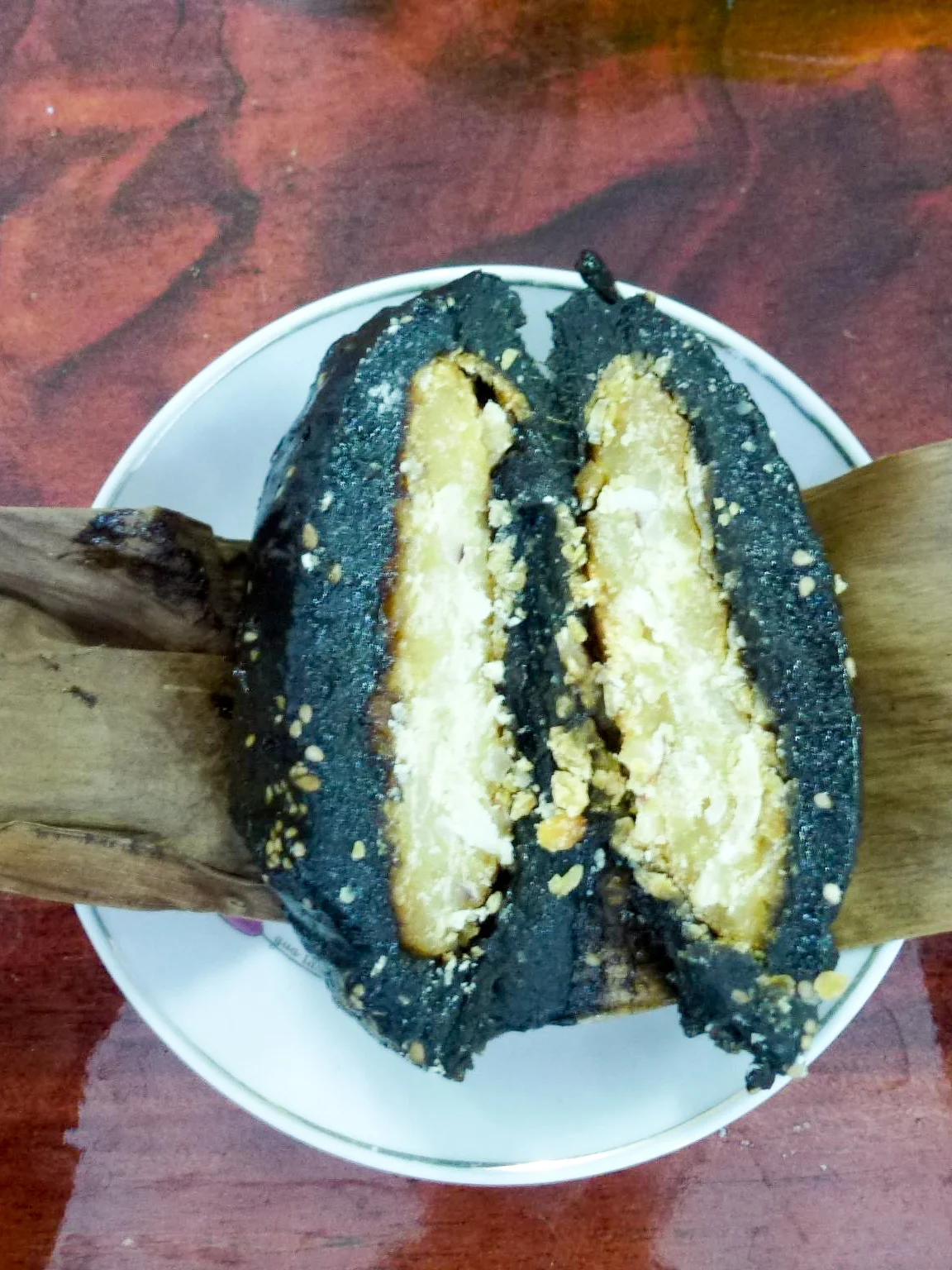
In versions where beans and coconut form a single filling, shaved coconut is first stir-fried with sugar, then combined with cooked mung beans and a little ginger and cooked over low heat until the color deepens. The mashed beans hold the mixture together, and the fine strands of coconut fried beforehand are mixed into the mung beans. Some versions make coconut the main ingredient, some make a separate mung bean filling, and some mix the two; the black skin alone shows none of these differences. When the leaf is removed and a bite is broken open, whitish fibers visible inside the moist bean paste are a clue to what was cooked together.
A portion of glutinous rice dough is flattened, the filling is placed in the middle, and the edges are gathered and closed. If the moisture in the filling has been reduced, it keeps its shape as a single portion, and the bean paste is less likely to push out when the skin is drawn around it. Tourism sources on Bình Định cite a soft stickiness that does not cling to the teeth, the aroma of glutinous rice, and the flavor of beans and ginger as characteristic qualities. Bite into the part near the edge of the opened package and the stickiness of the skin comes first; bite into the center and the flavor of the beans and ginger comes through. Depending on the recipe, a single bite can combine a part where the black skin looks smooth with a part where chopped ingredients remain in the bright filling.
Folding the Banana Leaf and Steaming It in Its Pointed Shape
Tourism sources on Bình Định describe a version in which banana leaves are briefly passed over a flame to make them pliable, then cut into rounds for use. If the leaf splits at a fold, the glutinous rice inside is more likely to come out, or the faces of the package are more likely to collapse. Heating the leaf is meant to give the outer wrapping, which goes into the steamer, surfaces and corners that hold. In versions that use a thin coating of oil, the leaf also comes away more easily from the sticky skin after steaming. With the base squared off and the top closed to a point, the still-soft sweet can be carried one piece at a time, leaf and all.
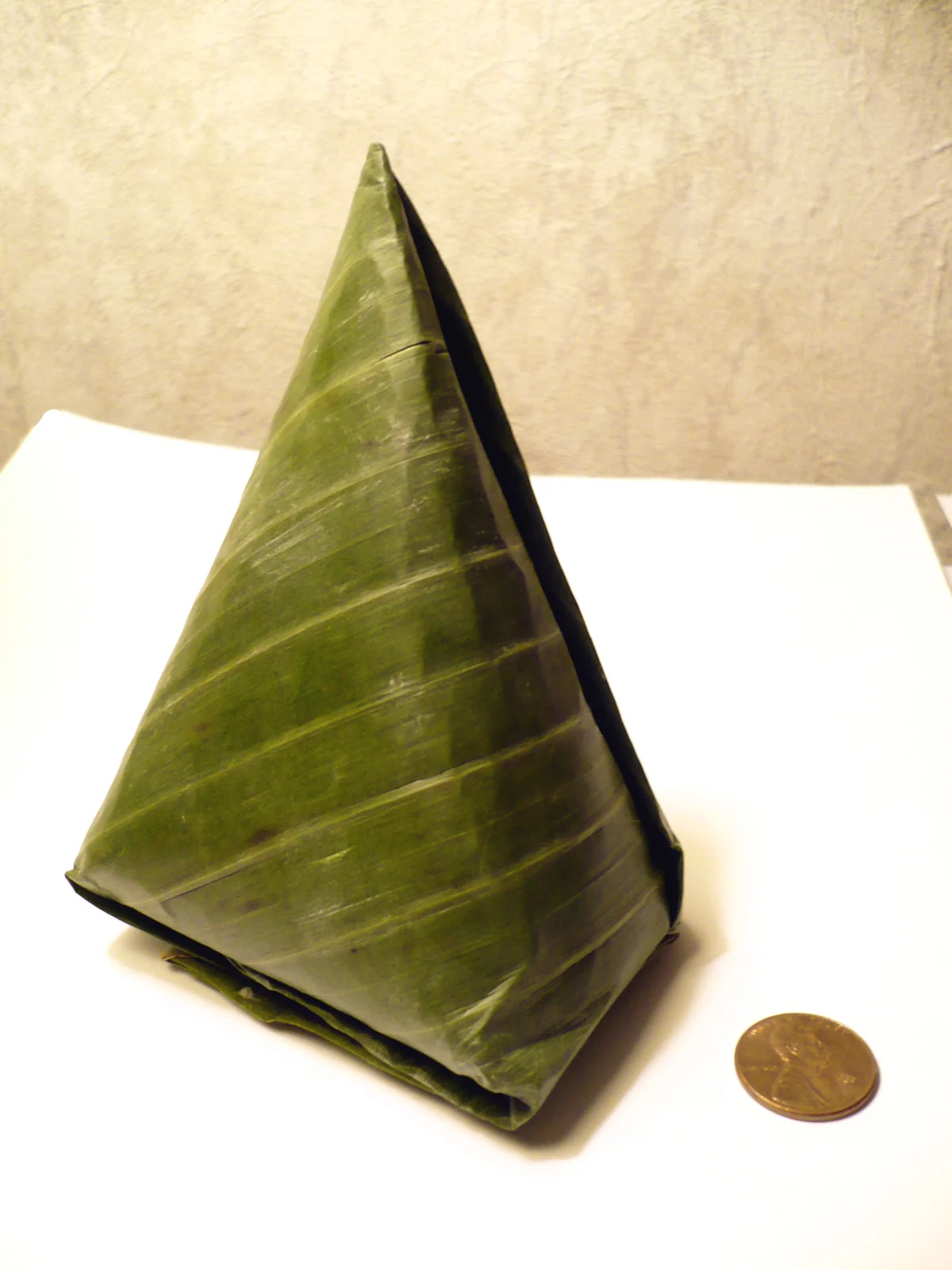
After wrapping, the package is steamed, with the heat passing through the leaf from outside. The edible skin is a glutinous rice dough that has absorbed water, and steaming sets it around the filling. Where oil is used, it is a thin film that helps the leaf release from the skin, not oil in which the whole sweet is submerged and cooked. The dark color inside the package is not the result of browning. Because a soft skin appears once the outer leaf is peeled away, the pointed outline of a gift in the hand and the color and stickiness of the part that is eaten show up as separate aspects of the same sweet.
The outline of a Bình Định package is compared to a small pyramid. The old Cham towers at Tuy Phước are also known locally by the name bánh ít. A tower name laid over the sweet conveys a similar shape, but it is not evidence of when the folding of the sweet began. In a shop, what one sees is the shape of the folded leaf; at the tea table, what appears for the first time is the skin steamed beneath the leaf. Remove one leaf, and the corners that recalled a tower turn out to be something different from the hand-sized portion of dough inside.

Bình Định, Where the Sweet Is Given One Piece at a Time, and Other Leaf Wrappings
Makers gather in the hamlet of Chung Tin near Tuy Phước in Bình Định, and the sweet is also treated as a local specialty in Quy Nhơn and An Nhơn. When visiting close acquaintances or traveling far, people sometimes prepare several dozen pieces, eating some on the way or handing them to the recipient. Because each piece is closed in its own leaf, the needed number can be taken out on arrival, with no need to cut a large cake. On death anniversaries and at Tết, the sweet is first offered to the ancestors and then eaten by everyone with tea. A folk song about marrying into Bình Định and eating this sweet is also cited. What the song conveys is the occasion of getting to know the sweet through weddings and visits, and it can be read separately from any record of the year the sweet was first made.
An article on gifts for a death anniversary tells of a household that did not prepare the sweets alone: neighbors gathered the day before to help with the preparation and wrapping. After the offering, the household sent departing guests home with the sweets in their wrappings. Whether handed to someone drinking tea on the spot or sent along on the way home, each piece can be given because it is closed in its own leaf. A sweet made for a death anniversary need not match the boxes sold in the market; this is an example in which neighbors shape each piece by hand to suit the number of offerings and the people who gather.
In Đại Hào village and in Cam Lộ in Quảng Trị, there are versions in which black glutinous rice dough encloses mung beans and shaved coconut, and the outside is folded into a triangle or a small boat shape. In the season when Tết, death anniversaries, and weddings coincide, the quantity prepared increases, and the sweets can be bought at markets such as the one in Đông Hà. According to a heritage source from Hội An, the skin is filled, thinly coated with peanut oil, wrapped in a folded banana leaf, and steamed on a bamboo rack. The leaf may be shaped like a tower with a square base, or tapered at both ends. Even among skins kneaded with the same ramie, the direction from which a package opens and whether coconut fibers remain on chewing can be compared by looking at the outer shape and the inner formulation.
The writer of the Hội An conservation source recalls being given one when their mother came home from the market, and presents it as a sweet that can be bought on the town’s main streets and at stalls in the shade of trees. The old town’s version is small, while that from the offshore Cham Islands is larger; the source links the abundance of ramie in the island forests to the stronger flavor. Even within Hội An, differences in size and in the appearance of the leaves used can be seen. The leaf-wrapped sweet offered on an ancestor’s death anniversary and the one carried home as a souvenir from a visited town overlap in the same maker’s product.
For the related bánh gai, the example from Tứ Trụ in Thanh Hóa uses a method of pounding ramie and glutinous rice flour with sugarcane molasses. The mung bean filling uses shaved coconut and other ingredients, and sesame seeds are applied to the dough before wrapping. One account records that after steaming, the sweets are cooled, tied one by one once the moisture has dripped off, and bundled in fives. The meeting of black skin and bright bean filling inside the leaf is similar, but the pointed shape of Bình Định and the flat wrapped bundles differ in how they are prepared before gifting and in the order in which they are opened.
Even the Wrapping for Carrying It Home Is a Subject of Research
A research summary on Bình Định published in 2026 by the science and technology department states that traditional ingredients and production methods were studied in Tuy Phước, Hoài Nhơn, Tây Sơn, and An Nhơn, and that modified starch, ingredients of natural origin, and food additives were examined as ways to extend shelf life. The publishing body is now named Gia Lai following administrative reorganization, but the places studied and the sweet are recorded under the name Bình Định. The objectives section sets targets of more than 7 days for the procedure using modified starch and more than 8 days for the procedure using food additives, and the outputs section lists a specialist report on the process exceeding 7 days and results from studying steaming, wrapping, and storage. These are records of procedures and conditions set in the research, and the number of days cannot be applied to every sweet made in shops or homes.
While the steamed sweet is carried from home to another place, what is required is that, when opened, the skin separates from the leaf and can be eaten in its shape around the filling. The research examined wrapping and steaming as well because, whatever the number of days, the process of handling the combination of glutinous rice skin, filling, and outer leaf continues. The recipient first holds the pointed package, opens the leaf and sees the color of the ramie, and on reaching the filling meets the sweetness of mung beans and the aroma of coconut and ginger. The work of using one leaf for boiling and another for folding remains in that order.
Glossary
- Lá gai
- Ramie leaf. The stalks and thick veins are removed, and the leaf is boiled and pounded to give the edible dough its color and aroma.
- Lá chuối (banana leaf)
- The leaf that wraps the outside of the sweet before steaming. In some versions it is passed over a flame to make it easier to fold.
- Bánh gai
- The name of a related Vietnamese sweet that uses ramie. It is used more broadly than the name for the small leaf-wrapped sweet of Bình Định.
- Tết
- The Vietnamese Lunar New Year. Together with death anniversaries, it is presented as an occasion for offering the sweet to ancestors.


