


SweetloreEncyclopedia of World Sweets (834)

Panetela de Guayaba
Panetela de guayaba
A Puerto Rican baked sweet whose square cut shows a red band of guava
Cakes / Puerto Rico

Cut into a square, each piece shows a red band of guava between the top and bottom layers of batter. Panetela de guayaba is a Puerto Rican sweet made by laying thin slices of cooked-down, firmed fruit pulp between layers of batter and baking it. In the mouth, the outer layers crumble away while the guava between them stays sticky. Panetela in old cookbooks includes versions with no filling, so the red layer found today in island shops and homes can be traced through both the name of the sweet and the way the fruit is used.
Laying Thin Slices of Guava and Covering Them with Batter
What panetela sandwiches is pasta de guayaba (guava paste), made by cooking guava pulp and sugar down until it sets. It differs in firmness from soft, spreadable jam and can be cut into thin slices with a knife. Laid slice by slice over the batter on the bottom of the pan, it forms a red band when the baked sweet is cut.
Cooks lay the guava paste without leaving large gaps because it keeps its cut shape to some extent when heated. Whether the red band shows depends on how far the paste has been laid.
Vivian, a home cook from Aguadilla, published a home recipe in 2015 in which butter and sugar are creamed together, eggs and vanilla are added, and flour is then mixed in a little at a time. Half of the batter goes into the pan, and thin slices of guava paste cover the whole surface.
The rest of the batter is layered on top, and the surface is smoothed with a rubber spatula. Because the layers are built together in one pan, a single bake yields many small squares.
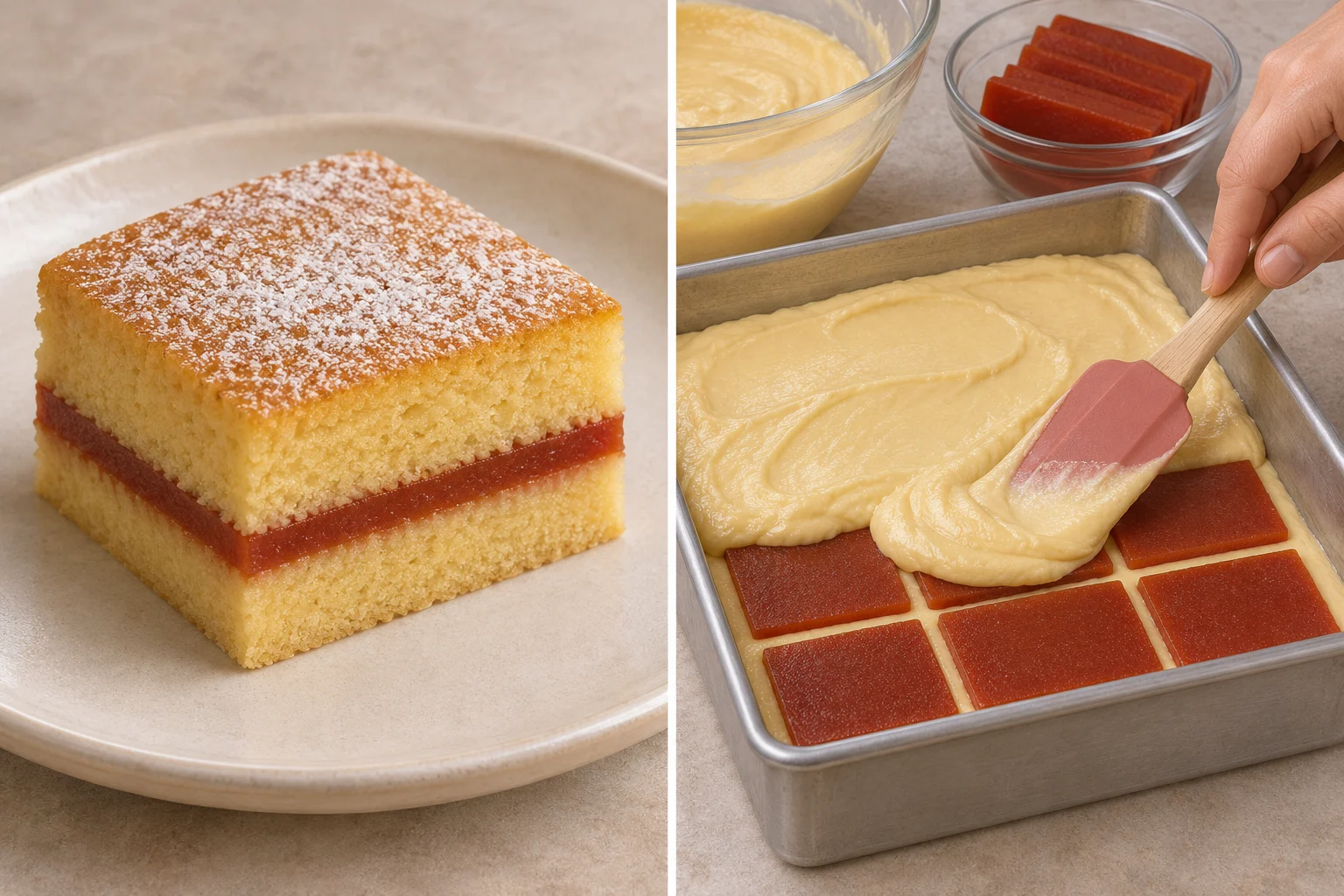
Alondra De Brasilia, who works with tea in Puerto Rico, adds a small amount of vegetable shortening to the butter, creams it with sugar, and then combines flour and eggs alternately. She lays guava paste between layers of batter and levels the top in the pan. Once baked, the sweet is cooled, cut into small squares, and dusted with powdered sugar.
She presents it as a sweet for afternoon tea or birthdays, and she pairs the sweetness of the guava with an oolong tea that has a roasted, nutty aroma.
After the guava paste is laid out, spreading the top batter all at once makes the filling shift easily. In Rebekah Garcia Kalinowski’s version, a stiff batter is placed in small amounts here and there and then spread to the edges until no gaps remain.
If thin slices of cream cheese are placed over the guava before the batter goes on top, cutting reveals layers of red fruit and pale dairy. The tang of the cheese joins the deep sweetness of the guava, so the two flavors overlap in the soft part between the layers of batter.
Cutting Without Breaking the Red Band, and Selling a Square Piece
In the version on Girl Meets Fire, butter and sugar are beaten until light, and the eggs are added one at a time. The writer explains that, to make the batter softer, she also added milk in her own formulation.
The flour batter is used for both the top and bottom layers, and the paste in the middle is laid out so that it forms a single layer. When testing doneness with a bamboo skewer, the cook distinguishes the guava layer, which stays moist even when cooked through, from how far the batter has baked. When the pan has cooled, the sweet is lifted out by both ends of the lining paper and cut into pieces.
Kalinowski describes the texture of this sweet as lying between a cake and a cookie bar cut into squares. The top and bottom layers hold together well enough for a piece to be picked up, and between them is a layer of fruit that meets the teeth softly.
A piece dusted with powdered sugar first releases the sugar as it is brought to the mouth; biting into it brings out the aroma of butter, and the guava lingers afterward. Even among versions baked in the same pan, a batter with milk added, or one that also layers in cream cheese, changes the thickness and flavor of the soft parts.
A 2007 baking message board holds a post titled "Panetela de Guayaba" in which strips of guava are laid between layers of batter, then baked, cooled, cut into squares, and dusted with powdered sugar. The poster explained that she tripled her own recipe to fill one rectangular baking pan.
Vivian of Aguadilla uses a square pan, and Alondra bakes in a square one as well. Even when the size of the pan changes, the method is the same: batter and fruit are layered in a single pan, and the pieces are cut out afterward one by one.
Spoon, a food business in San Juan, combined guava paste with crisp-baked bacon in a 2020 demonstration for Sunday brunch. The batter uses melted butter, coconut oil, aged rum, and other ingredients, with cinnamon added to taste. Finely chopped guava paste is heated in a pot with a little water until it reaches the consistency of jam, and the bacon is then stirred in.
This fruit layer is spread between layers of batter and baked, then cooled, cut into squares, and dusted with powdered sugar. It is a variation that the maker built from the standard version, combining the saltiness and savory flavor of meat with the deep sweetness of the fruit.
Naed Pastelería Variada, which produces in Carolina, Puerto Rico, lists "Panetelas de Guayaba" in several package sizes. Its ingredient labeling includes wheat flour, fat, guava paste, almond and vanilla flavoring, and guava nectar.
Food-selling websites on the island also offer locally made panetela by the single piece. A sweet that is baked in one pan and then cut at home can be bought at the point of sale as a single piece or in a quantity of several pieces.
Cutting after the sweet has cooled has the advantage that the pieces come out in a uniform shape. In both Spoon’s version and Alondra’s, the baked sweet is cooled, cut into squares, and finished with a dusting of powdered sugar.
There is no step of making a sugar layer on the batter before baking; the white powder is added when the sweet is put on the plate, and it sits on the brown baked surface. The red band visible between the top and bottom layers and the whiteness on the surface remain with each piece cut from one pan.
In Cookbooks, Baked Batter and Guava Appear Separately
The pastry chapter of El Cocinero Puerto-riqueño, published in 1859, contains a recipe for "Panetela." Water, sugar, and eggs are combined with flour to make a thick batter, a small amount of fat is added and mixed in, and the batter is baked in a paper-lined pan. Guava does not appear in this recipe.
In the same book, the name panetela also appears in a passage where it is soaked in liquor and used as an ingredient in a pudding. What can be confirmed from the book of that period is that panetela was baked from batter alone and that the baked batter was also used in other sweets.
The same cookbook also gives methods for processing guava separately. They include a recipe in which ripe guavas are split, the seeds removed, and the pulp simmered until soft, and another in which the cooked pulp is strained and combined with a thick syrup. A method of adding back the parts that kept their shape after the pulp was strained is also recorded.
Although baked batter and processed guava appear side by side in the same island cookbook, neither entry records a sweet that layers the two. The work of cooking fruit to change its form and thickness offers a clue to understanding the firm processed pulp that is sandwiched in present-day panetela.
In the Cuban magazine Bohemia in 1957, a writer who had visited Puerto Rico gave the recipe for sopa borracha that was served at a welcome meal. Its base is a panetela made by Carmen Alicia: egg whites are whipped into a meringue-like foam and combined with separately mixed egg yolks, sugar, flour, and other ingredients.
The writer gives a version with no butter or other fat added to the batter and describes it as a sweet to be soaked in syrup. Here too, what is called panetela is the baked batter, which is distinct from the records of versions that sandwich guava.
The Cuban folklore journal Actas del Folklore carries a panetela recipe written by Renée Méndez Capote in 1961. The method is to whip the egg whites slowly with a fork and add the yolks one at a time, with the sugar and flour added a little at a time. The batter is flavored with vanilla and baked in a paper-lined pan.
Its procedure is the same as neither the 1859 Puerto Rican formula nor the 1957 example. From the old sources of the two islands, it can be read that panetela was used as the name of a baked batter and that its formulas varied.
Spanish dictionaries record that in Cuba and Puerto Rico panetela refers to a kind of baked sweet. A Cuban cookbook of 1925 includes panetela layered with egg-yolk cream and meringue, as well as a version in which already-baked batter is soaked in sweet wine.
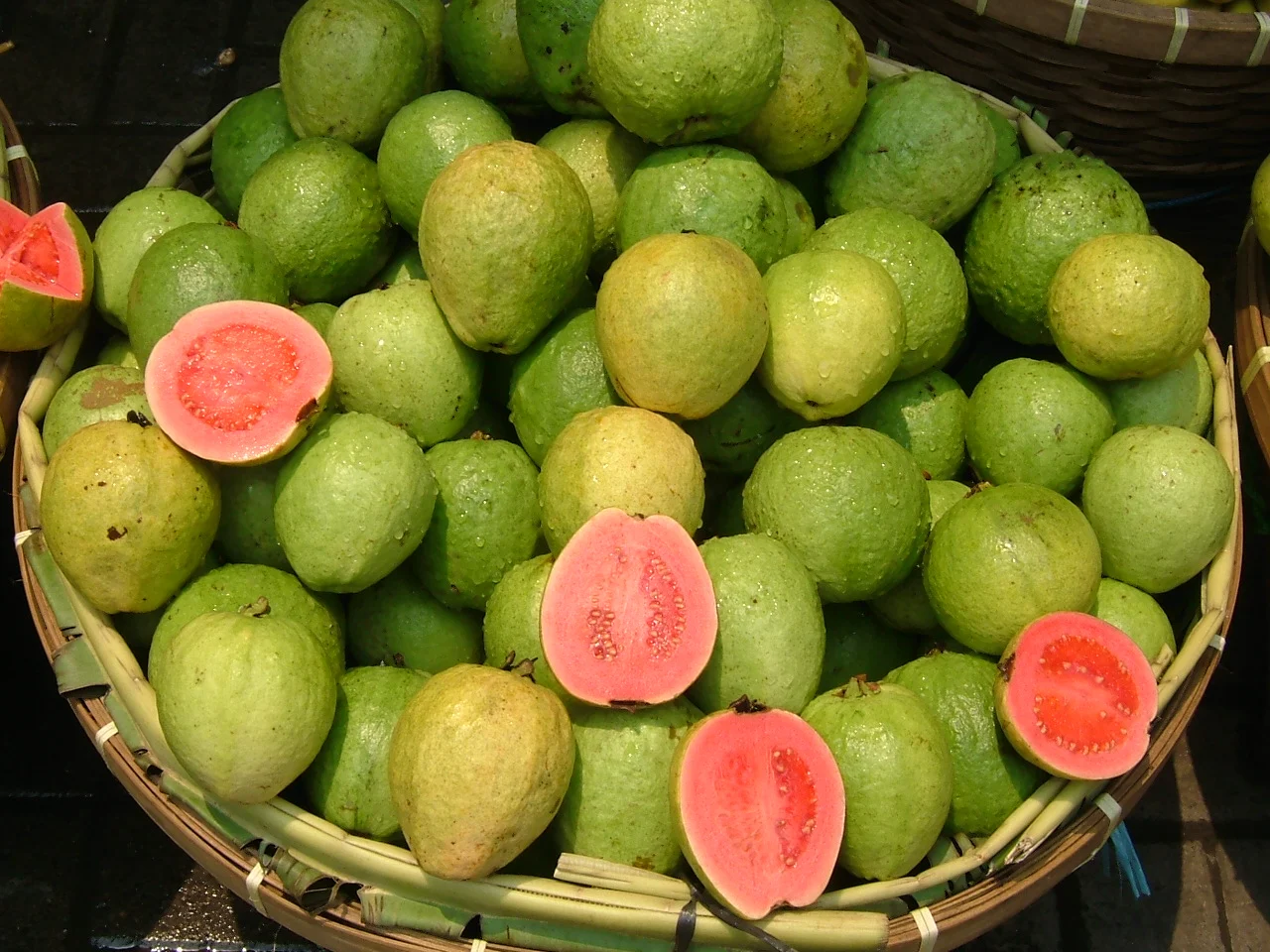
The same book has a recipe for cooking down guava, but it is not written for use in these panetelas. When choosing a guava version today, the words "de guayaba," which indicate the fruit used, are part of what identifies the sweet.
The Cuban Sweet That Sandwiches Guava
A close relative of this sweet in Cuba, also made with guava, is masa real de guayaba. The 2006 cookbook by Beverly Cox and Martin Jacobs describes placing an egg-enriched dough above and below in a shallow rectangular pan, with guava paste sandwiched between. After baking, the sweet is cut into squares, a shape that is easy to sell piece by piece.
The book presents it as a sweet seen in Cuban bakeries and coffee shops. The fruit running horizontally through the cross-section is also seen in Puerto Rico’s panetela de guayaba.
A writer who attended school in Cuba in the 1980s recalls masa real with guava as a school snack. The sweet that the writer remembers was slightly dry and firm.
In the writer’s own reconstruction, the result was tender enough to melt in the mouth. Compared with what Puerto Rican cooks describe as close to cake, how crumbly and how moist the sweet is varies with the maker and the formula, even within the same name.
Processed guava has also long been recorded in Cuba as a separate sweet. The cookbook published in Havana in 1925 by María Antonieta Reyes Gavilán y Moenck combines cooked, strained pulp with an equal weight of sugar and heats the mixture while stirring. When a small amount dropped from a spoon does not spread, it is transferred to a paper-lined box and left to cool.
In this form, the firmed pulp can be eaten on its own. Reading modern recipes that slice it thin and lay it between layers of batter, one sees that the shape-holding quality gained by cooking it down in a pot also serves in the cross-section of the baked sweet.
Old cookbooks record unfilled panetela and guava preserves separately, and in newer Puerto Rican home recipes the sweet with fruit sandwiched inside is given the name "panetela de guayaba." Cuban cookbooks call a sweet with a similar cross-section masa real de guayaba.
It has not been confirmed when the present form arose or in which direction it passed between the two islands. In panetela with thin slices of guava laid in, even when it is cut to a size that a person can pick up piece by piece, the fruit’s flavor comes in together with the top and bottom layers of batter.
Glossary
- Panetela
- The name of a baked sweet found in Puerto Rican and Cuban culinary sources. In old recipes it refers to a baked batter; in present-day Puerto Rican versions, adding "de guayaba" makes it the name of a sweet that sandwiches guava.
- Pasta de guayaba
- Guava pulp and sugar cooked down until firm. It can be cut into thin slices and is laid between the top and bottom layers of batter.
- Masa real de guayaba
- A baked sweet with guava found in Cuban cookbooks. Some versions use an egg-enriched dough for both the top and bottom layers.


