


SweetloreEncyclopedia of World Sweets (834)

Pastelitos Criollos
Pastelitos criollos
Sweet filling wrapped in layered dough and fried into a flower shape
Fried Sweets / Argentina

Pick one up with a finger on the filled center, and the thinly fried edge opens like petals. Pastelitos criollos are an Argentine sweet in which laminated wheat dough is wrapped around a sweet paste of quince or sweet potato and fried. Two sheets of dough, stacked with their corners offset, are pressed down near the filling so that the thin layers at the edge open in the oil. Known as a sweet for the 25 May holiday, they are also made in Villa Elisa, Entre Ríos Province, where townspeople prepare them every year for the parish festival in September.
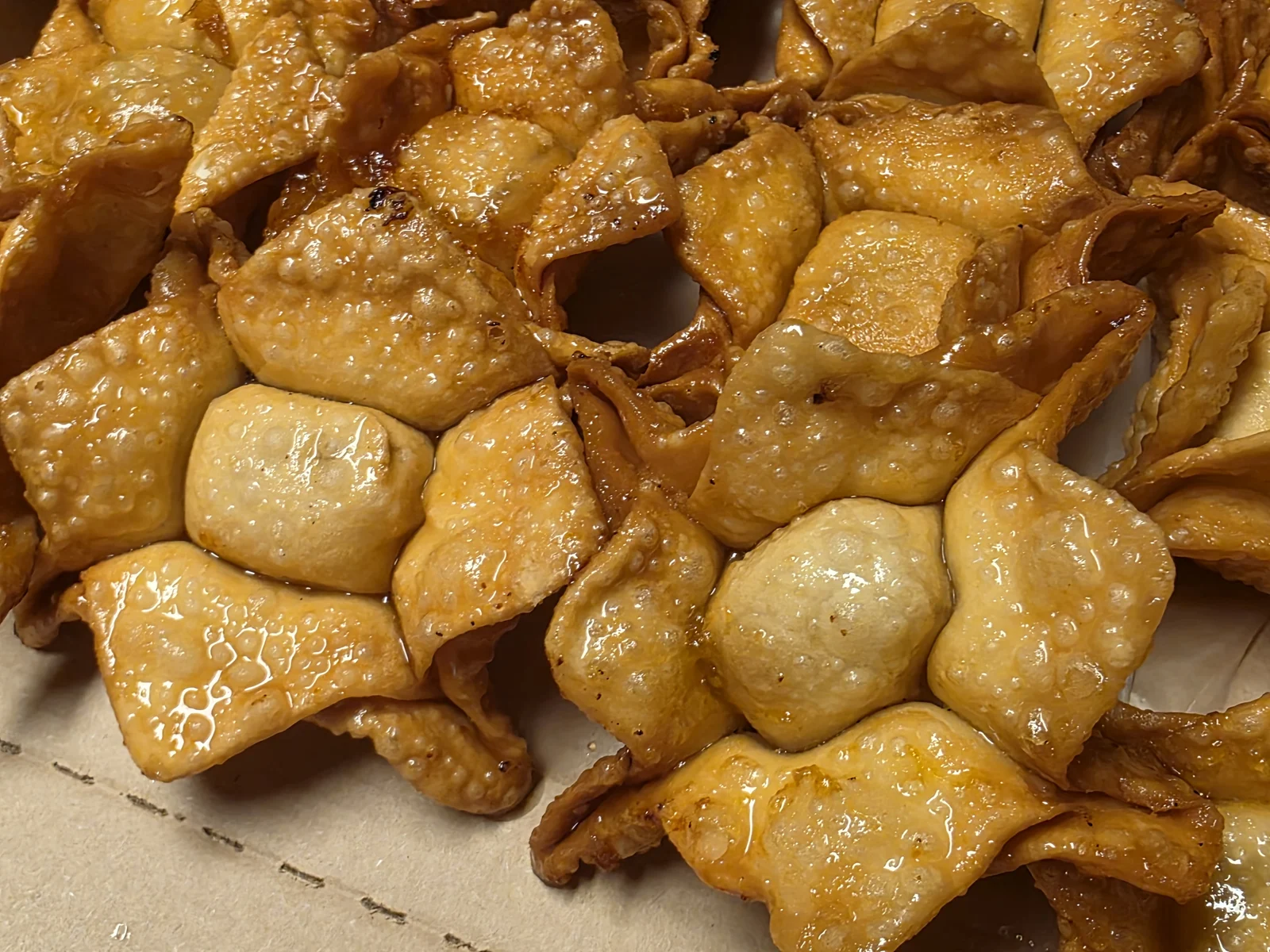
Offsetting the Squares and Sealing Around the Sweet Filling
In the recipe from the Universidad Nacional de La Plata, rolled-out dough is cut into squares 8–10 cm on a side. Diced quince paste is placed on one square, and a second is laid over it with the corners offset. The two sets of corners look like a star. The area around the central filling is moistened with water and pressed shut with the fingers. Unlike the method of aligning all the edges into a flat square, this leaves points extending in eight directions. Because the center is closed while the outer corners are left free, the thin parts of the fried edge look like petals.
Doña Petrona’s transcribed recipe cuts narrow strips 6 cm wide and then divides them into squares; the area around the filling is moistened with water, and another square is laid on top. For the filling, the instructions call for quince cooked with a little water and broken down. With the diced pieces in the university’s version, it is easy to place one identically shaped piece of filling on each square, whereas with mashed quince a small amount is set in the center of the dough. In neither version is the sweet filling spread out to the edge of the stacked dough; space is left around it for sealing with water.
Besides quince paste (dulce de membrillo), some recipes also list sweet potato paste (dulce de batata) among the ingredients. The Villa Elisa heritage documentation likewise records these two fillings for the sweets made at the festival. Quince paste has the flavor of fruit cooked with sugar, while sweet potato paste has a sweet layer made by cooking the tuber. In versions in which the dough is cut into squares and the filling is placed on them, the shape of the dough can be the same for either, so two similar-looking sweets can be distinguished by the flavor inside.
Layers of Fat Open in the Frying Oil
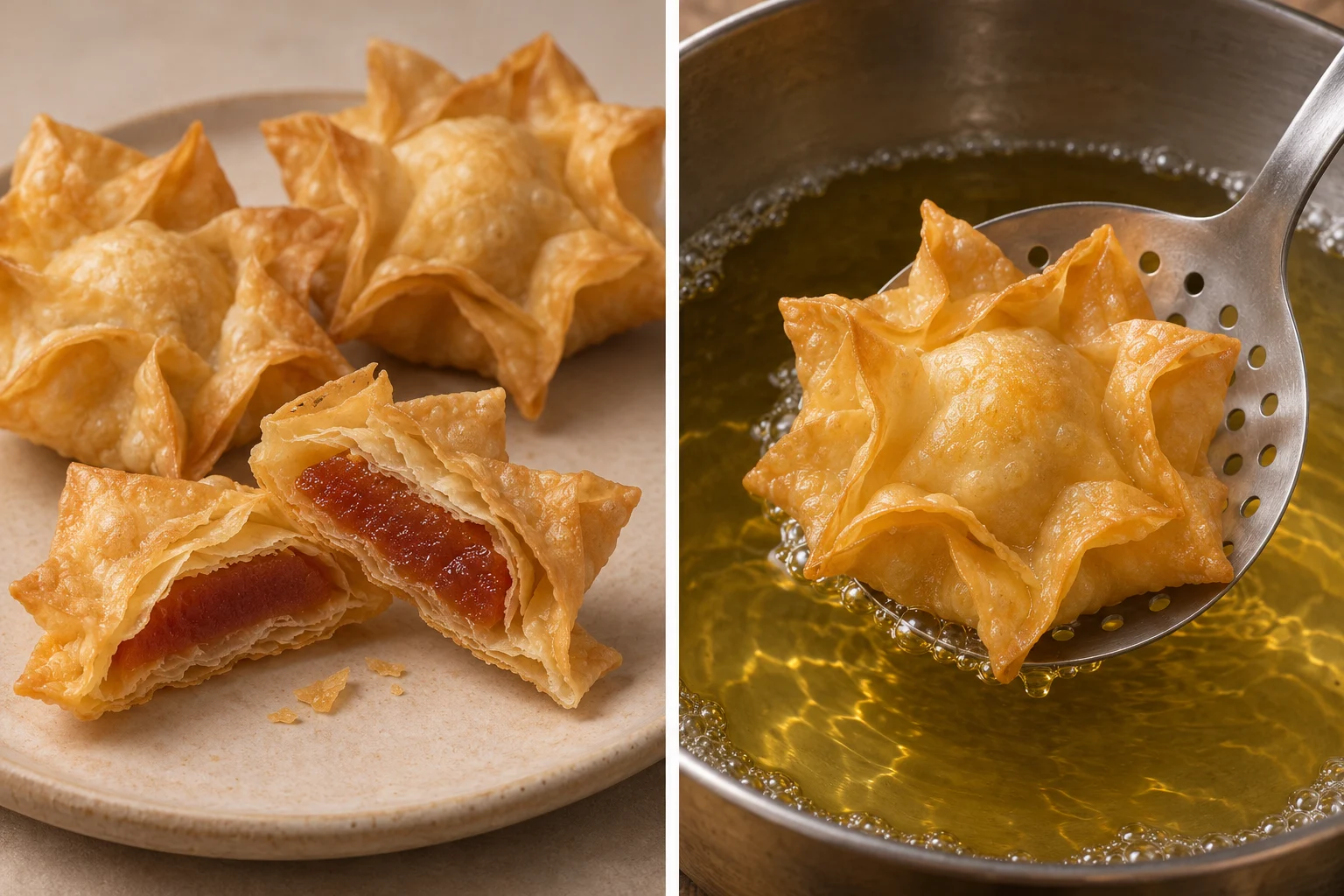
In the version in the recipe collection published by the Universidad Nacional de La Plata, flour and salt are combined with diced butter and rubbed in with the fingers, then water is added little by little to make a smooth dough. After resting for about 20 minutes in the refrigerator, the dough is rolled to a thickness of about 1 cm, brushed with melted butter, dusted with cornstarch, and folded in thirds. The same steps are done three times, and the dough is chilled and finally rolled to about 3 mm. The fat mixed in at the start and the fat brushed onto the rolled-out surface are used separately, and the dough is folded so that the fat-coated surfaces lie between the layers of dough.
In the recipe from Doña Petrona’s cookbook published by the city of Rosario, butter goes into the initial dough, and after the dough is rolled out, soft butter is spread on the surface and flour is sprinkled over it. The dough is folded in half, spread and floured again, folded in four, and then rolled thin with a rolling pin. Where the university’s version sprinkles cornstarch between the folds, the cookbook transcription uses flour. It also differs from recipes that only repeat letter folds in thirds, so the direction and number of folds depend on which recipe is followed.
The recipe from the cooking show Cocineros Argentinos spreads soft margarine on a rolled-out rectangle of dough, sprinkles it with cornstarch, and rolls it up. The roll is pressed by hand back into a rectangle, rested, and rolled out, and the same step is then repeated. Unlike Doña Petrona’s method of folding flat dough, this dough is rolled once into a cylinder and then pressed flat. Because both versions apply fat to the surface before stacking the dough, they are set up so that fine layers show at the edge when fried.
If flour and fat were simply mixed evenly in one step, no fat surfaces would form between the sheets of rolled dough. Letter folds and re-rolling are steps that increase those surfaces. The center, where the upper and lower dough overlap, holds the filling, and the corners and edges are thinner than the center, so fine layers stand out when the pastry is fried. Several recipes call for resting the dough before rolling it because the dough must finally be shaped into a thin sheet that can be cut into squares.
The Rosario transcription instructs frying first in lukewarm oil and then in hot oil, spooning oil over the pastries along the way. A version published by Mendoza Province’s education authority has a step of frying in oil at 140 degrees until the layers open, then moving the pastries to oil at 180 degrees to color them. The idea is to allow time for the pastry to cook through while coloring the surface at the end. If the pastries are removed from the oil judging only by the color of the top surface from the start, the thick area around the center and the thin corners are likely to cook unevenly.
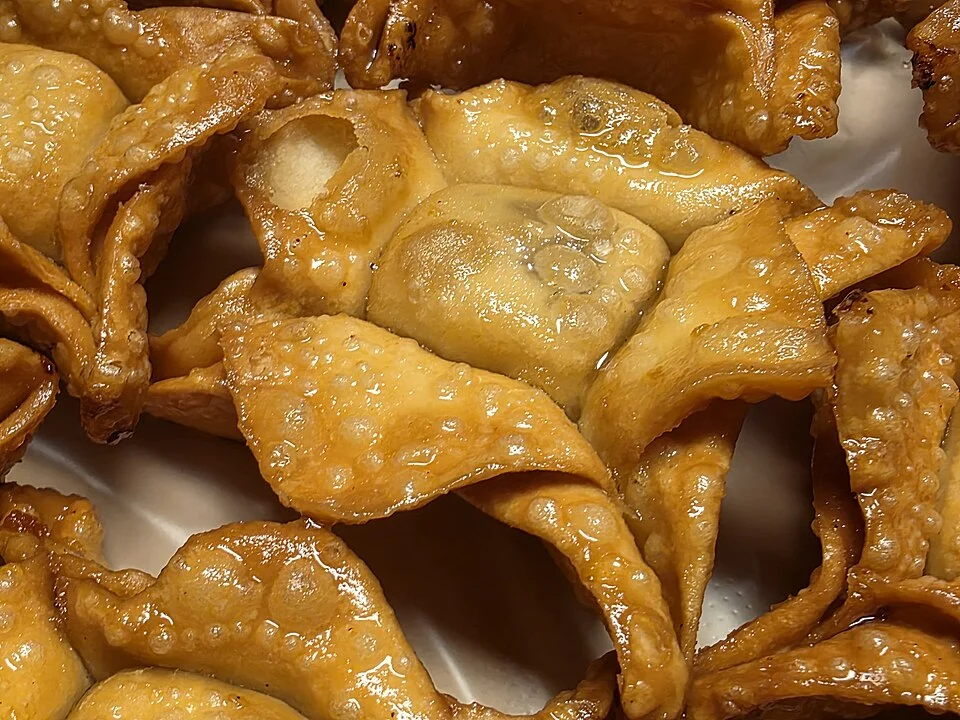
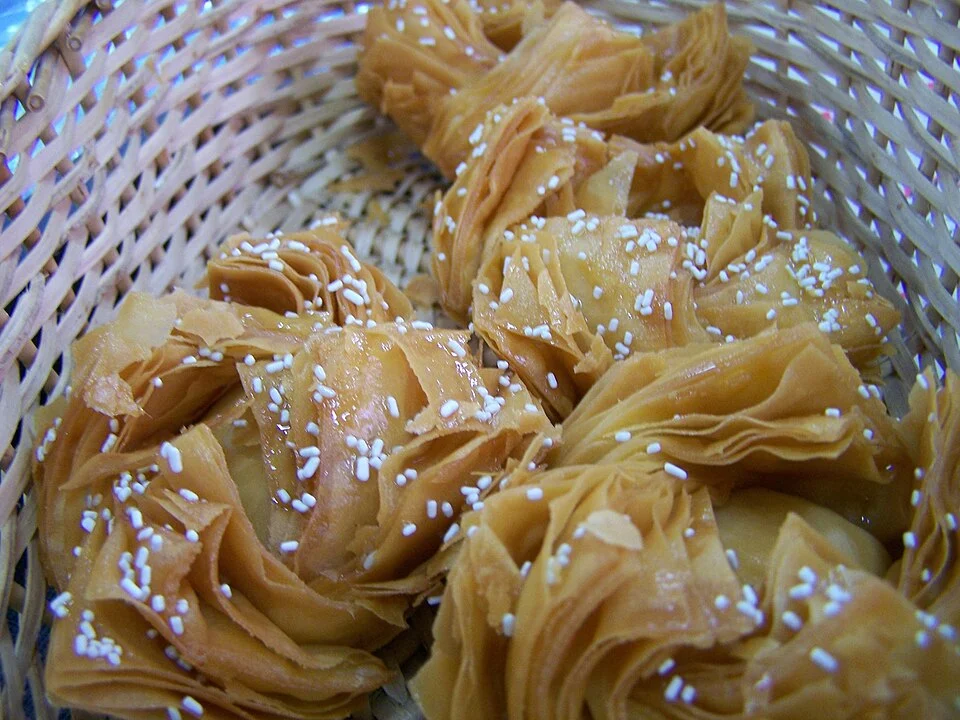
How sweetness is added after the pastries come out of the oil also differs from recipe to recipe. Doña Petrona’s recipe dips the fried pastries in a syrup (almíbar) of sugar simmered with water and vanilla, then scatters small sugar confections (grageas) over them. The television recipe blots the oil off with paper and then brushes on syrup. The Universidad Nacional de La Plata example sprinkles sugar over the surface after frying. The differences among dipping in syrup, brushing it on, and scattering dry sugar show up, apart from the filling, in the sweetness and surface stickiness that the teeth meet first.
In the version that brushes on syrup, one can adjust how far across the edge, where the layers have opened, the syrup is applied. In the version in which the pastries are put into simmering syrup, the syrup touches a wide area of the surface. With dry sugar sprinkled on, there remain places where the grains stick and places where they do not. With any finish, sweetness lies not only in the quince or sweet potato at the center but is also placed on the surface of the fried dough. Just as the softness of the filling follows the shattering bite of the thin dough, a thin layer of fried dough remains beneath the syrup.
Who Makes Them: The May Holiday and the September Festival
The education authority of Mendoza Province, Argentina, presents pastelitos as a sweet to eat on 25 May. Usina del Arte, a cultural venue in the city of Buenos Aires, took up both sweet potato and quince at a Flag Day event and presented a chef’s method of making them. A cookbook recipe conveys steps that can be reproduced in a single household kitchen, while municipal events show in what form the sweets were presented on the holiday. Present-day ways of celebrating can be confirmed from published educational and event materials.
There is also a story that vendors came to sell sweets of today’s form in front of the Cabildo on the day of the May Revolution. Karina Perticone, who studies Argentine food culture, explained in an interview that at the time there were fried pasteles filled with sweets, meat, fish, or fruit. Dishes that enclose a filling in dough can also be found in 19th-century books, but that alone does not establish that the present-day star-shaped quince version was sold in the plaza on 25 May 1810. A school resource from the Universidad Nacional de La Plata also points out the problem of portraying colonial-era people only in stereotyped roles when vendors are depicted at school holiday events.
The Argentine government’s inventory of intangible cultural heritage lists the production of pastelitos for the festival in Villa Elisa, Entre Ríos Province. Ahead of the 8 September festival of the Virgen Niña, donations of ingredients are received, and parishioners and residents make the pastries and sell them on the festival day to townspeople and visitors from nearby. What was recorded as heritage is the formula for frying quince or sweet potato sandwiched in dough, and the custom of residents gathering to make them for that day. Set beside the versions presented in May at schools and municipal events, the occasions on which the same sweet is prepared also differ.
What the Villa Elisa inventory emphasizes is that ingredients are gathered for a fixed festival day each year and the preparation is shared out. In the recipe from the Uruguayan school, the proportions of fat and the way each piece is folded are conveyed as household work. Differences visible in recipes and differences in the occasions on which the sweet is prepared are separate clues for reading regional variation under the same sweet name.
Old Cookbooks and Methods on Both Sides of the Río de la Plata
Elena Perilli’s study of Tucumán food culture of about 1880–1920 lists pastelitos as a fried sweet made on festive days. It explains that dough for empanadas is cut into rectangles, fried, and served with vanilla cream and syrup. Compared with the La Plata version, which encloses quince between two squares, this is also a small fried sweet, but it differs in whether the filling is enclosed inside the dough or something sweet is served alongside the fried dough. This Tucumán account is an example from the north of that period, compiled by later food-culture research.
Juana Manuela Gorriti’s 1890 cookbook includes a small pie in which two square sheets of laminated dough are put together with moistened edges. Egg and cream go inside, and the edge is moistened with milk and closed. She recommends frying it in lard if it is served at lunch and baking it in the oven if it is served at dinner. While a similar technique of joining two sheets of dough with moisture can be found in old cookbooks, reading the filling and the cooking method shows that it is a different dish. An old source with only pastel in its title cannot be counted as a record of today’s sweet pastelitos.
The Doña Petrona recipe reprinted in the Rosario booklet has all the steps: sweet quince is placed in the center of the dough, then fried and finished with syrup. The Villa Elisa material, while likewise recording a sweet filling wrapped in dough, documents collective work for a festival. Read together with the Tucumán version served with syrup, it shows that even where the name and the frying are shared, what was enclosed and where the sweet was eaten can be checked in each individual source. The star-like opening shape is, among these, a feature of the versions that stack square sheets of dough.
In the recipe provided by the Uruguayan life-skills school Genoveva Detjen de Montegui, quince paste is placed on a square of dough, and a single sheet is folded over like a handkerchief and fried. The frying fat is given as a mixture of beef tallow and lard at about 7 to 3. Unlike the Argentine versions, in which the corners of two sheets are offset to make a star shape, only one square is cut at the start, and the fold forms on one side. While the versions share the feature of wrapping quince and frying it, this is a recipe in which shape and fat can be compared separately.
A cookbook quoted by Gustavo Laborde, who studied Uruguayan culinary culture, includes a version in which the quince filling is loosened with hot water to make a soft paste rather than being used as hard lumps. The Doña Petrona recipe reprinted by the city of Rosario also instructs adding water to loosen the quince. If only the step of softening the filling is considered, there are examples on both banks of the river, and this alone cannot determine which country’s method a recipe represents. The actual form of the pastry becomes clear when one looks at how the edge opens in frying, what the filling is, and how sugar or syrup is placed.
Glossary
- Dulce de membrillo
- A sweet made by cooking quince with sugar. Some recipes dice it, and others loosen it with water before adding it.
- Dulce de batata
- A sweet paste of sweet potato. It is used as a filling in festival and home versions.
- Hojaldre
- Here, the method of making layers by folding or rolling dough and fat, and the dough made this way.
- Almíbar
- A syrup made by dissolving sugar in a liquid and cooking it. It is brushed onto fried sweets, or the sweets are dipped in it.
- Gragea
- A small sugar confection scattered over syrup.


