


SweetloreEncyclopedia of World Sweets (834)

Pustakari
Pustakari
Boiled-down milk and sugar, formed into small, firm pieces
Sugar Confections / Nepal

Once milk and sugar have been boiled down to a brown mass in the pan, it is divided into single pieces while still warm. Pustakari (पुष्टकारी) of Nepal is a small confection made by heating khuwa, concentrated milk, together with sugar and then cooling it until firm. The chewy brown dough keeps the aroma of reduced milk and cooked sugar. In the Kathmandu Valley, home to the Newar people, it has been eaten as a snack and offered to the gods, and it has also been used at festivals and weddings. Because it is set in small individual pieces, it also suits being carried home as a souvenir to hand out one piece at a time.
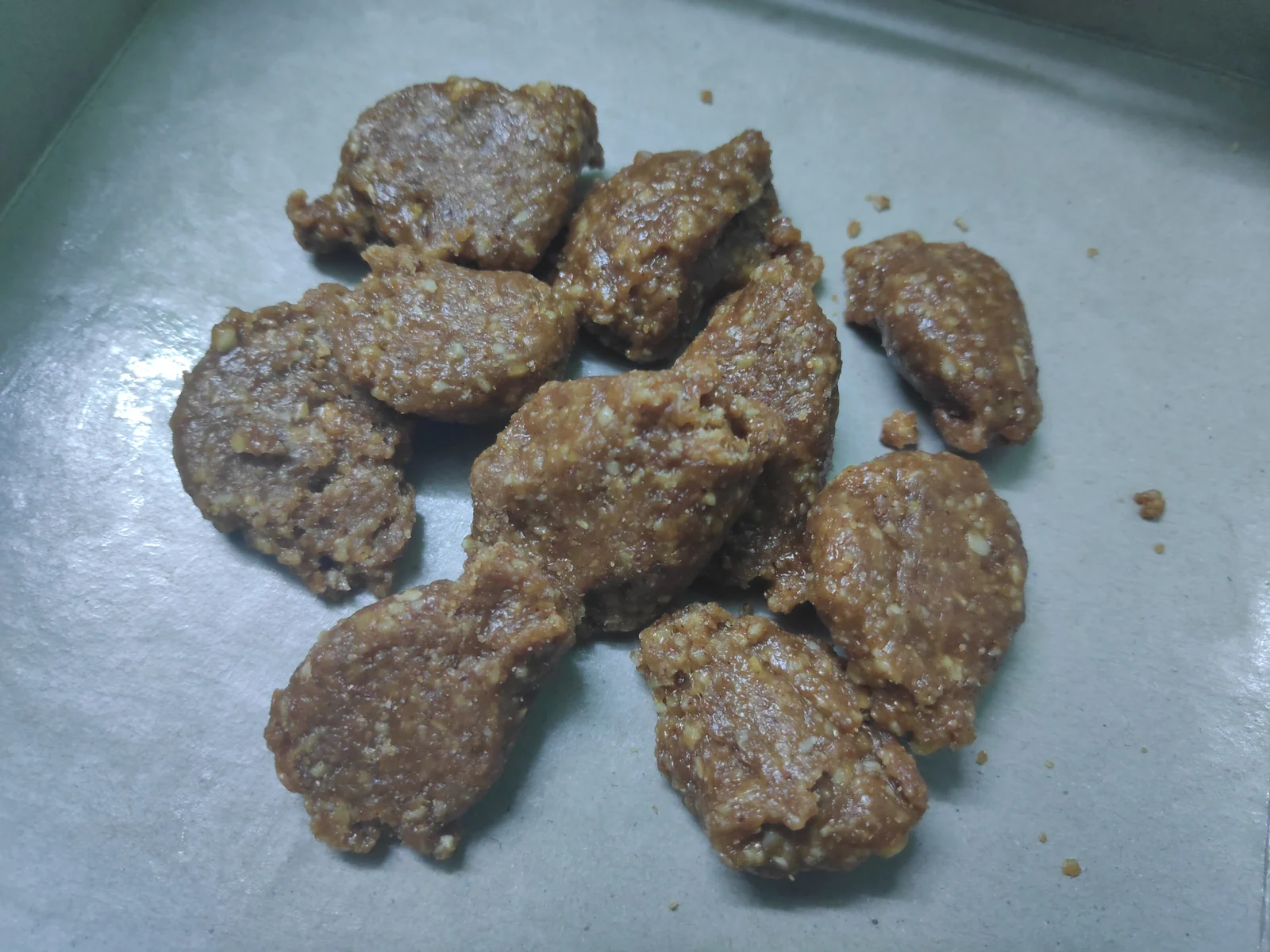
Dividing the Warm Mass into Single Pieces
A dairy-products source held in the library of the Nepal Academy of Science and Technology describes an example in which the finished dough is moved to a greased tray and, when its temperature reaches about 55°C, divided and rolled into pieces of about 10 grams each. The pieces are taken off one by one while the dough can still be shaped by hand, then cooled to room temperature to firm up. This differs from making one large slab, cooling it completely and cutting it with a knife, in the point at which the final shape is decided. In the pan, the aim is to go from a flowing liquid to a mass that does not stick easily when stirred. By the time it is moved to the tray, it holds together enough to be divided, and as it cools further it becomes a firm milk sweet that can be picked up by hand.
Khanal’s procedure also standardizes the pieces at about 10 grams each, but gives 60–65°C as the guide for shaping. In this example the dough is transferred to a stainless-steel or aluminum plate greased with ghee and left until it is firm enough to handle. Although the dividing temperature differs, the sequence is the same: knead in the pan until the dough forms a mass, then weigh out portions in the interval before it has cooled enough to resist reshaping. If the dough were already at its finished firmness when the heat was turned off, there would be no room left to roll it into small pieces.
Coconut powder mixed into the dough and fruits or seeds applied to the outside show up in different places when the sweet is eaten. Arun Khanal, who compiled the technical material, gives examples of coconut, cucumber or pumpkin seeds, raisins and nuts applied to the surface after shaping. When the powder goes into the pan, flecks of it are scattered through the set milk and sugar. Seeds or fruit pressed onto the surface before cooling show the ingredient when that piece is picked up. The Gazette’s standard for packaged products also states that coconut, nuts, dried fruit, clove, cardamom and cinnamon may be added. A surface decoration is therefore one of the choices in the formulation.
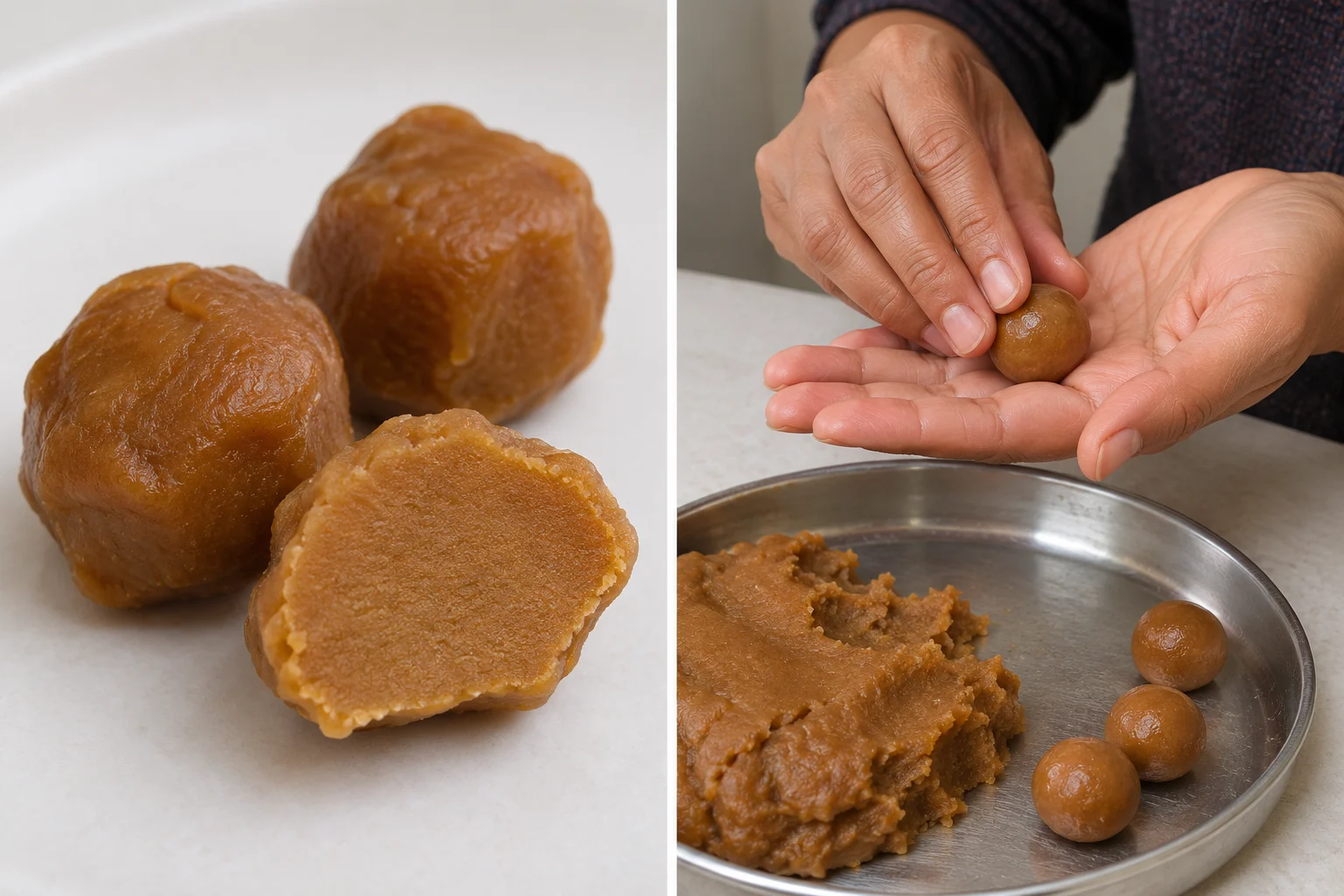
Evaporating the Milk, Then Combining It with Sugar
Khuwa (khoa) is an ingredient made by heating cow’s milk, buffalo’s milk or similar milk to evaporate its water and concentrate the milk solids. It can be eaten as it is or used in other sweets. For pustakari, there is a stage in which the milk is first made into khuwa, rather than being shaped into pieces directly from raw milk. The mass of milk is then broken into small pieces and added to heated sugar. There are two heatings: one that reduces the milk’s water when the khuwa is made, and one in the confectionery pan that gives the sugar its color and aroma. In the Kathmandu Valley, the work is also seen divided between those who make khuwa and those who make sweets from khuwa they obtain.
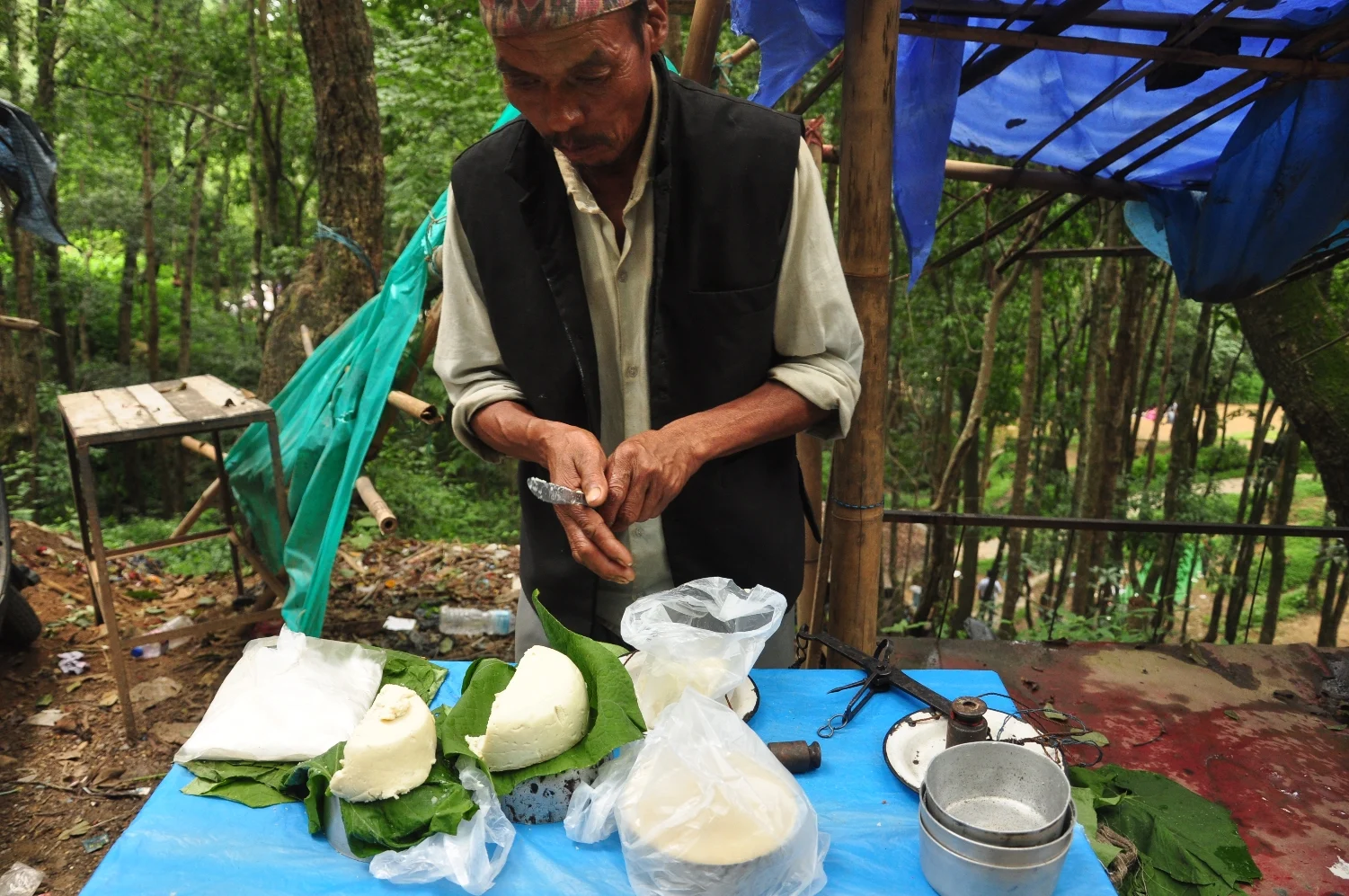
One source gives a formulation of sugar, khuwa, refined wheat flour known as maida, and coconut powder at 100 : 100 : 40 : 3 by weight. Khanal’s example uses 900 grams each of sugar and khuwa, with 200 grams of maida and 30 grams of coconut. In both, the sugar and khuwa weigh the same, but the proportion of flour put into the pan differs. The official standard describes the product as made with sugars, khuwa, milk and ghee heated at high temperature to develop color and aroma, and does not list flour as a required ingredient. The figures in an individual recipe should be read as that source’s own formulation, bearing in mind that the process also varies with the maker and the place.
The Academy library’s source gives an example made with sugar, and also chaku pustakari, which uses molasses instead. When the form of the sugar changes, khuwa is still added and boiled down to make a sweet that can be taken in small pieces. In Khanal’s example, which starts from white sugar, the sugar is melted with stirring in a deep karahi, and crushed khuwa is added once a brown color and a caramel aroma appear. The sugar, white when it went into the pan, and the pale milk are mixed during heating, and this stage leads to the color of the finished sweet.
Which Pan Do 175°C and 116°C Belong To?
The process table in the Academy library’s source gives about 175°C for the stage of melting the sugar, and about 95°C for the stage after khuwa has been added little by little. After the khuwa goes in, the mixture is heated for about 5 minutes with stirring; coconut powder is then added and heated for about 3 minutes. The flour is mixed in after that. The table separates, in order, the time when sugar alone is melted at high temperature from the time when the milk solids and flour are included and the mass is formed. Each separate figure in the temperature table is paired with what is in the pan and when it is checked.
Khanal also separates the temperatures for heating the sugar and the khuwa. The sugar is melted at about 160°C and, stirring constantly, brought to a syrupy brown at 175–200°C. After the crumbled khuwa, maida and coconut are combined, the whole pan is stirred continuously at 93–95°C. Khanal takes the pan off the heat when ghee emerges from the dough and it no longer sticks to the bottom. Watching the dough change into a mass that can be lifted from the pan, he moves on to cooling.
The annual report of the Department of Food Technology and Quality Control includes trials that first fixed the formulation from the ratio of sugar to khuwa and then varied the heating conditions. Using sugar and khuwa together with clove, cardamom, coconut, cinnamon and other ingredients, the report states that a formulation with sugar and khuwa at 1 : 1 gave the preferred color and texture. Heating the khuwa and sugar of that formulation at about 116°C for 7 minutes is said to have produced a medium-hard, brown product. About 175°C is the stage of melting the sugar before the khuwa is added; about 116°C is the trial condition in which the khuwa and sugar are in the same pan. When comparing the two temperatures, one must also check whether the reading is taken before mixing or while the two are being heated together.
A Chewy Piece and Another, Softer Milk Sweet
Among the sweets made with khuwa in Kathmandu is also gudpak (gundpak). Both are brown milk sweets, but the standard of the Department of Food Technology and Quality Control calls for a characteristic firmness in pustakari and softness in gudpak. Some gudpak examples add edible gum, dried fruit, nuts and the like to the khuwa, and an interview at a shop describes it as rich in milk, with a soft, sticky texture. The method sources for pustakari include a process of dividing the dough into small pieces while it is warm and letting it cool into a hard sweet. A difference that the brown color alone cannot settle shows up when a piece is bitten into, and in how it is shaped before it is picked up.
The food standard lists pustakari’s natural caramel color, characteristic taste and aroma, and firmness. It also sets criteria of moisture at 6.0% or less and of fat and protein at 8.0% or more each on a dry-weight basis. It stipulates that no vegetable ghee or oil be used and that the product not be remade from ready-made milk sweets or other confectionery. It also requires sealing in clean, dry, food-grade packaging, with labeling. The table for weighing out the formulation and the criteria for examining the composition and packaging of the finished product check at different points.
The analysis results for samples that Khanal cites also span a range: moisture of 6.68–9.12%, fat of 8.20–13.26% and protein of 12.00–15.85%. The range of samples measured in a laboratory is not the same thing as the items in an official standard. The packaging in the production-technique table is a low-density polyethylene bag, filled in the number or quantity a customer buys, then sealed with the air removed. These steps show that the description of the method does not end at the pan but continues to the single bag handled at the point of sale.
Water is reduced when the milk is concentrated, and in the confectionery pan it is mixed with sugar and the moisture is boiled down further. Separate from the work of judging by hand a firmness that is easy to shape, one can also measure a finished piece and record the moisture that remains.
The analysis example described in the dairy-products source has a moisture of 9%. The same source describes a test in which the sweet was packed in 75-micrometer low-density polyethylene and kept at 18–22°C for about 4 weeks, and it reports no major change in quality related to sensory evaluation, such as flavor. The moisture figure is the value for the sample measured, and the 4-week figure likewise comes with the test’s packaging and temperature. The shelf life of sweets made at home or in another shop cannot be determined uniformly from it.
From Small Worship Dishes to Souvenirs Bought Along the Road
The dairy-products source says that small sweets made with khuwa were used among the Newar people as snacks, as offerings to the gods, and at festivals and weddings. They are also a souvenir taken from Kathmandu to places outside the valley. In 2026, however, The Rising Nepal visited Chhuchhekhola in Hetauda, outside the valley. In the area along the Kanti Highway, which leads to Kathmandu, more than ten businesses process milk and make khuwa, pustakari, gudpak and other items, the paper reports. The paper’s coverage also profiles Laksh Sapkota, who makes khuwa from buffalo milk in Ward 17 of Hetauda and started the business with help from parents. This is a place where khuwa has become a processed-milk product for sale, and sweets made with that khuwa are also lined up along the road. People traveling between the two cities buy them as gifts. This is a flow in which the sweets are made along the highway and handed over in passing, rather than made only in Kathmandu and carried outward.
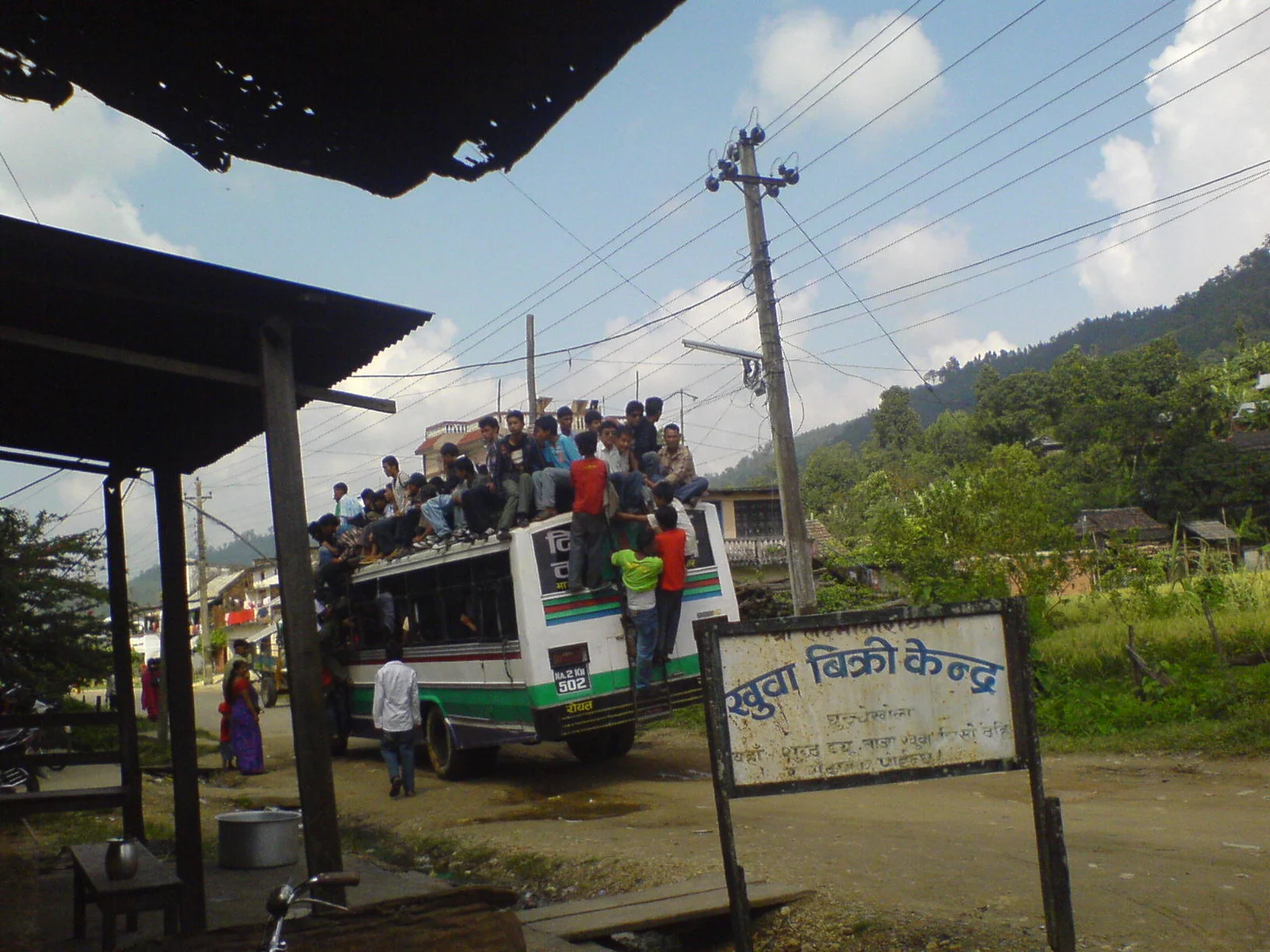
The confectioner Suresh Gamal, interviewed in Kathmandu in 2021, opened his shop after apprenticing at another large shop. Besides pustakari and gudpak, he also made barfi, lalmohan, lakhamari and other sweets. He says both milk sweets are popular with customers, but that he does not know when or how they came about. A family at another shop claims that the grandfather introduced the sweet in town in 1933, but that claim concerns gudpak. The Gazette published the standards for pustakari and gudpak side by side in the Nepali year 2077, but that was a time when quality was being set for products already made in town. No record confirming the year of invention can be found in these sources.
When buying from a shop, besides taking pieces one by one from a tray, one can also pick up a pack after reading its label. The interview article from Kathmandu conveys memories of sales on aluminum trays, and also branded packaging. In another article from 2026, a Makse shop in Kathmandu that packs sweets in boxes and tins offers, besides the traditional flavor, a flavor made with coffee and one made with herbs and unrefined cane sugar. These flavor variations are products of the shop the article visited. The procedure of forming single pieces while the dough is warm connects to scenes of handing out the cooled sweets to each person, and of passing them on in a box as a gift.
Glossary
- Khuwa (khoa)
- A dairy product made by heating milk to reduce its water. Used in Nepali milk sweets.
- Maida
- Refined wheat flour. In the example recipes described in the text, it is mixed into the dough.
- Ghee
- Milk fat from which water and milk solids have been removed, as from butter.
- Karahi
- A deep pan widely used in South Asia.
- Gudpak (gundpak)
- A soft Nepali milk sweet based on khuwa, with nuts, dried fruit and the like added.


