


SweetloreEncyclopedia of World Sweets (834)

Tottenham Cake
Tottenham cake
A cake coloured with mulberries and cut up in Tottenham
Cakes / United Kingdom, London

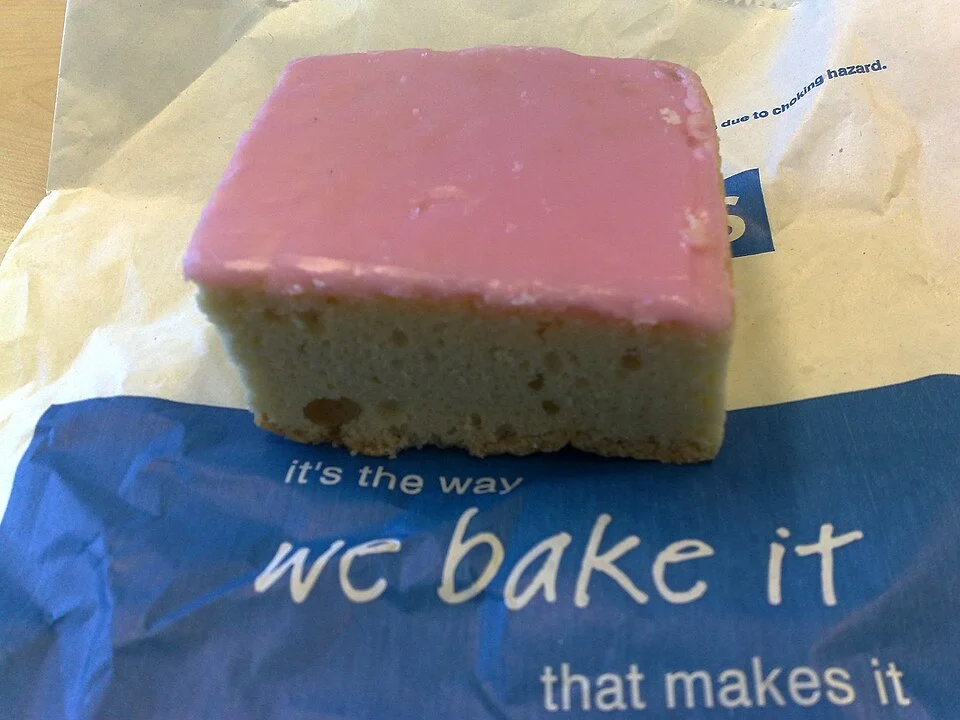
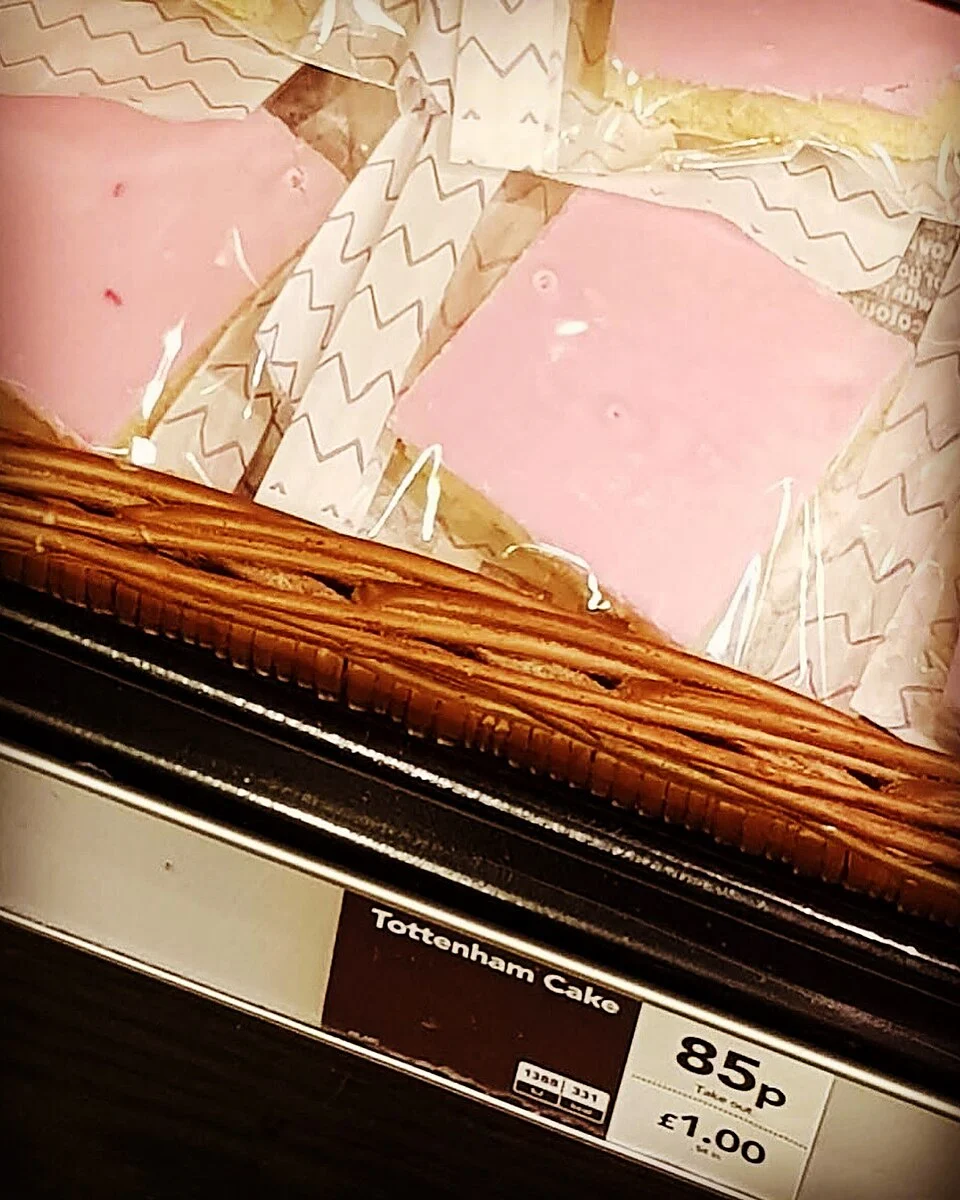
Lower a knife through the pink top and pale cake appears beneath a thin sweet layer. Tottenham cake, which originated in north London, is baked in a large tray and sold cut into small squares. The colour of the icing on top is tied to a mulberry tree at the local Quaker meeting house. Cutting slices from one baked sheet meant there was a piece for everyone, whether a child buying a treat or a child celebrating a football championship.
A Penny a Slice, a Halfpenny for the Ends
Ted Willis, who grew up in Tottenham, recalls in his autobiography a dough resembling a scone. According to a passage presented by the local Quaker meeting, the dough was baked in a long, flat tray, covered with bright pink icing and cut into nearly cube-shaped pieces. A piece cost a penny. But if the topping had not spread evenly or the pieces had been cut out of shape, the smaller pieces were sold at half price. Peter Brown’s material, published by Bruce Castle Museum, also records that the ends could be bought for a halfpenny.
A piece from the edge of the tray keeps both the side that browned against the tin and the face cut by the knife. It differs in shape and feel from a centre piece cut with the knife on every side. Whether the poured topping reached the edge of the cake also varies within a single tray. Willis’s words show that even pieces and small ends were sold at different prices from the same counter. This is a memory of what he ate, and it survives separately from records that list the ingredients of the batter in detail.
The Baker’s Tray and the Round Tin at Home
Tottenham cake recipes in cookery books vary in both batter and cutting. The seventh impression (1905) of Harriet Anne de Salis’s cookery book gives an example with 5 eggs, half a pound each of sugar and flour, 2 ounces of sultanas and a little ammonia as the raising agent, baked in a square tin about 3 inches deep and then iced. The first edition appeared in 1889. The formula preserved in the seventh impression puts dried fruit inside the batter, which is different from the examples in which fruit colours the topping.
In volume 3 of John Kirkland’s The Modern Baker, Confectioner and Caterer, from the early twentieth century, it appears as a baker’s cake made quickly and in quantity for children’s parties and tea gatherings. It is a large batch using more than ten pounds of soft flour, with lard, sugar, currants, chopped orange peel, milk and so on. This formula contains no eggs. The thin topping is flavoured with peppermint, and the cake is usually cut into triangles. The book also notes that the cakes sold well when freshly baked near schools and factories. Like the square cake Willis remembered, a single tray could be divided into small pieces to hand out.
In Kirkland’s method, a tray with a rim about 1½ inches deep is greased and the base lined with paper. Bicarbonate of soda and cream of tartar are added to the batter, and the top of the batter spread in the tray is smoothed with a little milk and left for 10 to 15 minutes. Baking is at 430–440°F (about 221–227°C). The paper makes it easier to remove the broad baked sheet. Once cooled, a paste of icing sugar and boiling water, with a few drops of peppermint, is spread thinly on top. Deciding the size of the triangles according to the number of people at the gathering is part of the method for making the cake in a large tray.
In an oral-history source from Waltham Forest, in north-east London, Nancy Brown remembers that a shop sold large sponges delivered from the company Spillers under the name "Tottenham cake". The topping was white, and the shop cut the sponge into small pieces and sold them one slice at a time. Willis’s recollection of the shop has pink, Kirkland’s formula has peppermint, and this interview has a white layer. The top varies from source to source, but they share the work of cutting a large cake, baked in one batch, to make small items for sale.
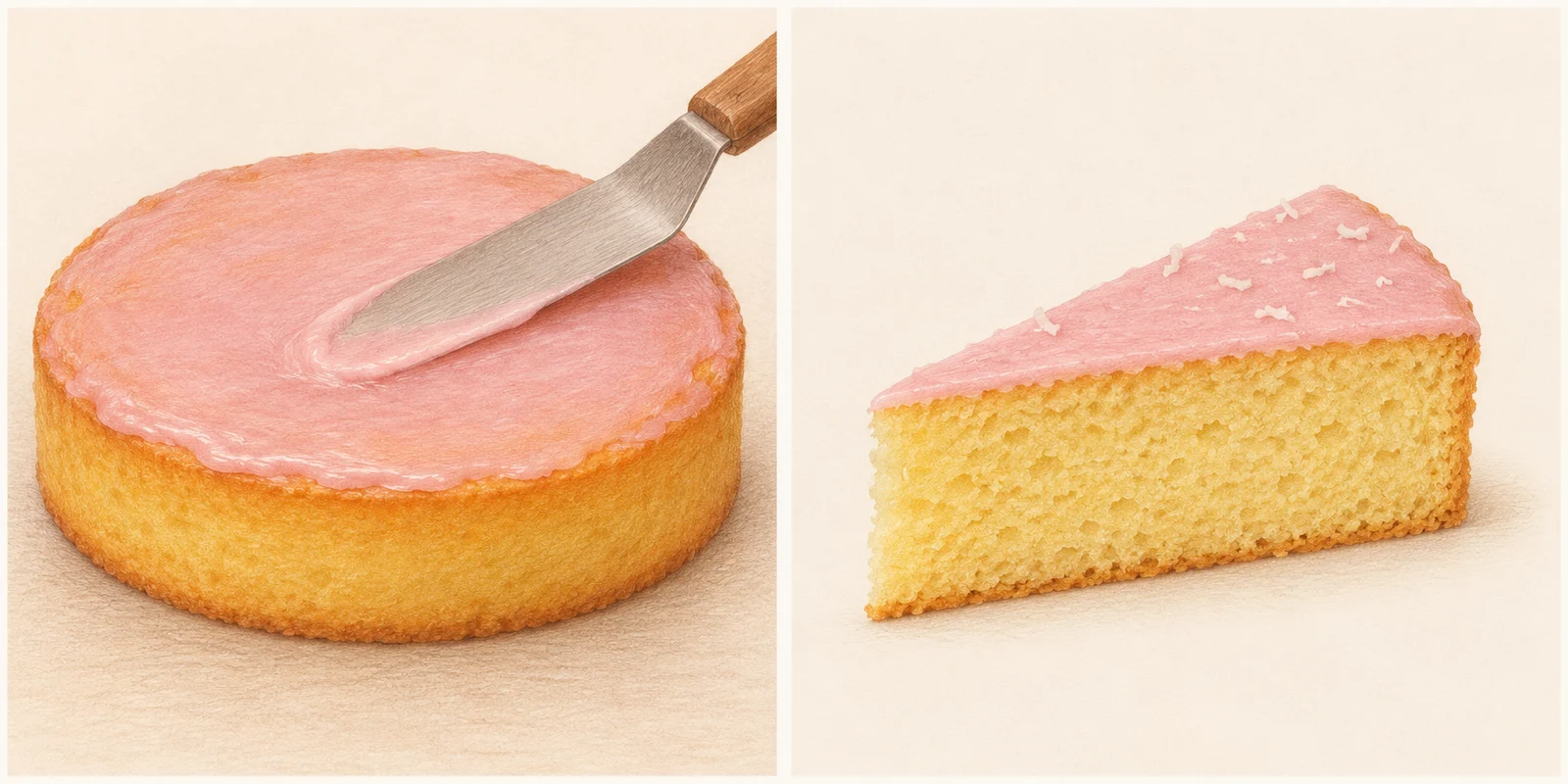
For home bakers, the local historian Peter Brown left a method for baking one cake in a 7-inch round tin. It uses margarine, caster sugar, eggs and self-raising flour, with milk added until the batter drops from the spoon. Vanilla is mixed in, and nutmeg too if desired. It is baked at 150 degrees for 50 minutes. Foil is laid over the top if a flat surface is wanted. Even in a round tin, making one face flat as a base for the icing applied later is the same as in the days of the long tray.
The London organisation Morus Londinium, which promotes mulberry culture, presents a home method based on Brown’s recipe. The tin is about 18 cm in diameter and the fat is butter. Caster sugar and butter are creamed, eggs are beaten in with a little flour, and then the rest of the flour and the milk go in. The cake is baked at 180 degrees for 40 minutes and cooled for about 10 minutes. This is 10 minutes shorter than Brown’s 50, but the temperature and the batter formula differ as well. The two times are guides for baking each batter at its own temperature.
Lifting a Single Sheet of Sponge and Keeping the Cuts Even
Even among home round tins, the batter varies with the formula. Brown’s ingredient list is 6 ounces each of margarine and caster sugar, 3 eggs and 8 ounces of self-raising flour. The milk is not poured in a fixed amount but added while watching the batter as the spoon is tilted. The adaptation has 175 grams each of butter and caster sugar, 3 eggs and 250 grams of self-raising flour, with 3 tablespoons of milk. The tablespoons in the ingredient list and the consistency of batter that drops when the spoon is tilted each serve as a guide for when to stop adding milk.
In a contemporary example presented by Regula Ysewijn, paper is draped over two opposite sides of a 24 × 28 cm tin so that the baked sheet can be lifted out later. Butter and sugar are creamed first, and the eggs are added one at a time, each after the previous one has been mixed in. A teaspoon of flour goes in with the last egg to make the batter less likely to split. The rest of the flour and the baking powder are folded in to keep the batter light, and the milk is mixed in little by little. After the batter is put in the tin, the top is smoothed and the cake is baked for 30–40 minutes on the middle shelf.
This sponge uses 500 grams of flour, 300 grams each of butter and sugar, 6 eggs and 85 millilitres of milk. Fat is worked into the corners of the tin, paper is laid in, flour is dusted over, and the excess is tapped out. It is baked at 160 degrees with the fan setting off. For a cake finished by trimming the edges, being able to lift it from the tin with the paper, and levelling the batter in the tin, help to keep the top flat.
Let the baked sponge cool completely, trim the edges, and spread over the top a topping made from redcurrant juice, or water, combined with pink colouring. While cutting 12 pieces, wipe the knife after every cut. This makes it less likely that the blade drags the previous topping into the next cut, and the boundary between the colour of the top and the pale cake is easier to see. Two ways are presented: adding desiccated coconut or fine sugar grains to the top of each piece after cutting, or leaving the pink surface as it is. It is best eaten on the day it is made or the next day.
Taking the Topping’s Colour from the Burial-Ground Mulberry
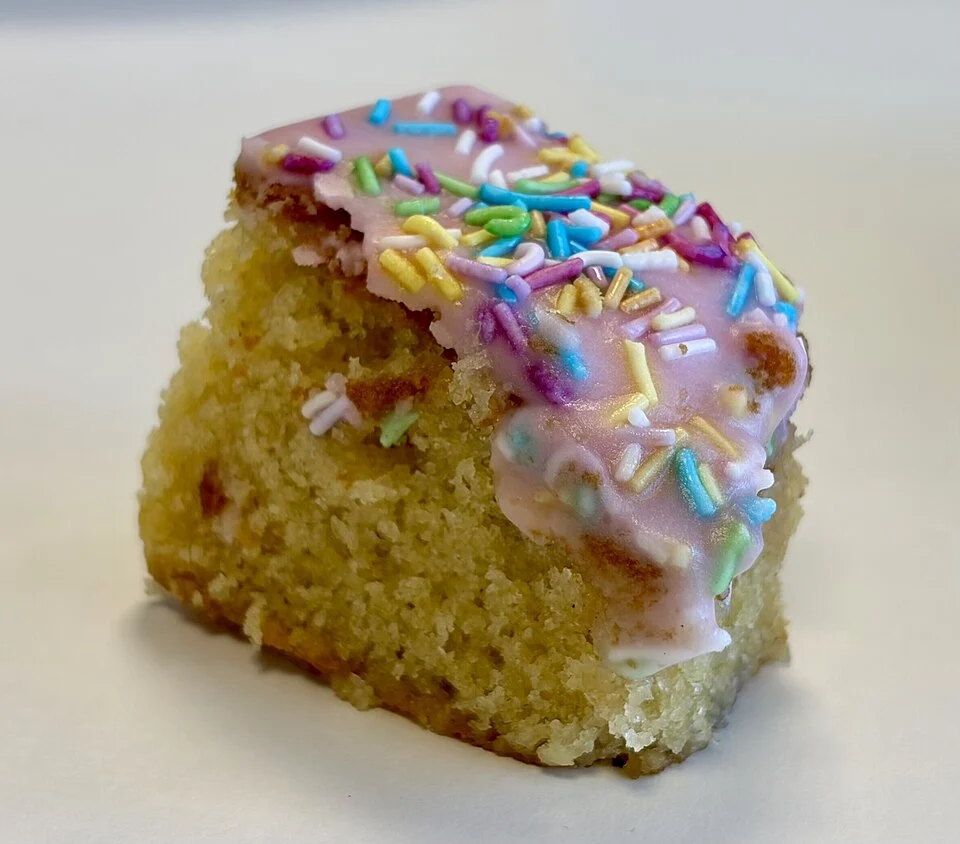
According to the Tottenham Quaker meeting, the colour of the cake made at the meeting house usually comes from the berries of the mulberry tree growing in the burial ground. Peter Brown, who baked the cakes, also named this tree as the source of his juice. The fruit is not mixed into the batter before baking; it is used as the small amount of liquid that dissolves the icing sugar. The deep colour seen in ripe berries spreads through the white icing sugar and turns it pink. Both the place where the tree grew and the reason the colour sits only on top when a slice is viewed from the side are tied to this topping.
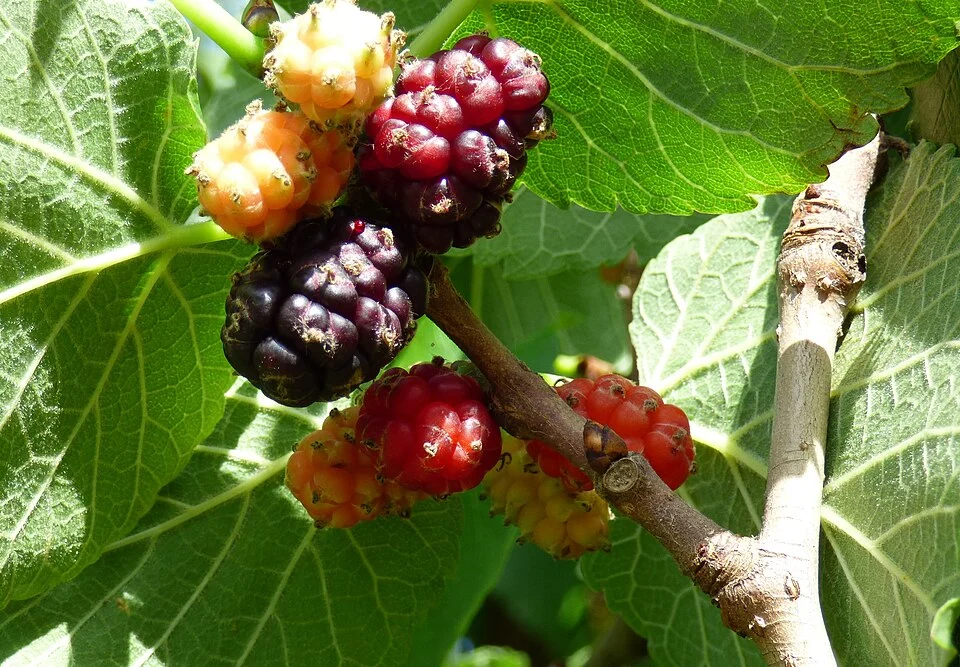
In Brown’s method, a thin liquid of icing sugar dissolved in warm water is brushed on first and absorbed by the cake. A darker icing is layered on top afterwards. To keep the colour on the surface, the upper layer is made a different consistency from the liquid that soaks into the cake first. If mulberries are unavailable, he names blackcurrant or cherry juice, with lemon juice added to taste. Morus Londinium uses 4 tablespoons of mulberry syrup to 100 grams of icing sugar, adding warm water little by little to make a thick paste. If it becomes loose, the thickness is restored with more icing sugar; a single coat covers the top, and desiccated coconut is added.
What touches the mouth is the sugar layer carrying the colour of the juice, the coconut fibres and fine sugar grains scattered on it, and the cake beneath. Brown added, half jokingly, that he always sprinkled coconut on top, but that the shreds easily got caught in the dentures of the people at the meeting house. The museum material states that Greggs also has its own recipe. From the pink layer seen in the cut face of a shop cake, one cannot tell whether it carries the juice of the meeting-house tree, or whether it was finished after brushing with thin sugar water.
On the Day of the Cup Win, a Slice for the Children
The local Quaker meeting records that the artisan Henry Chalkley was a member. The holiday memory preserved in Willis’s autobiography dates to 1901. Tottenham Hotspur won the FA Cup for the first time and, he says, gave cake free to local children. According to the club’s records, they beat Sheffield United 3–1 in the final replay. The victory is in the club’s records; the distribution of cake survives in local recollection. What the sources convey is that a confection sold in shops was also used for celebration; a record giving the year of its invention must be sought separately.
According to the meeting’s records, the burial ground lies behind the meeting house. The first burial was in 1802, and burials ceased after 1893. It is now recorded as having stones set around the edge and turf laid in the centre. This is the place where the source of the mulberries is remembered. In Brown’s recipe, the juice entry names the origin of the tree, and a different juice is listed for people making the cake baked at the meeting house at home.
The Quaker meeting’s local history also includes minutes from 1891. In a harsh winter, cocoa was served to men three times a week in a schoolroom, and the schoolteacher distributed meal tickets for children. This is not a record of cake, but a scene of food being given to local children is recorded ten years before the cup win. The halfpenny ends Willis remembered and the celebratory slice both convey that there was work of cutting a broad tray into small pieces, on the day a child bought a piece in a shop and on the day the town handed pieces out to children.
Glossary
- Quakers
- The common name for the Christian religious body known as the Friends. The Tottenham meeting preserves records relating to artisans and the mulberry tree.
- Icing
- Here, a topping made by combining icing sugar with fruit juice or similar and spreading it over the surface of a baked cake.
- FA Cup
- An English football competition. Tottenham Hotspur won it for the first time in 1901.
- Morus Londinium
- An organisation that promotes London’s mulberry-tree culture and adapted Peter Brown’s recipe.


