


SweetloreEncyclopedia of World Sweets (834)

Zeeuwse bolus
Zeeuwse bolus
Coiling strands of sugar-coated dough into swirls, one at a time
Fermented Pastries / Zeeland, the Netherlands

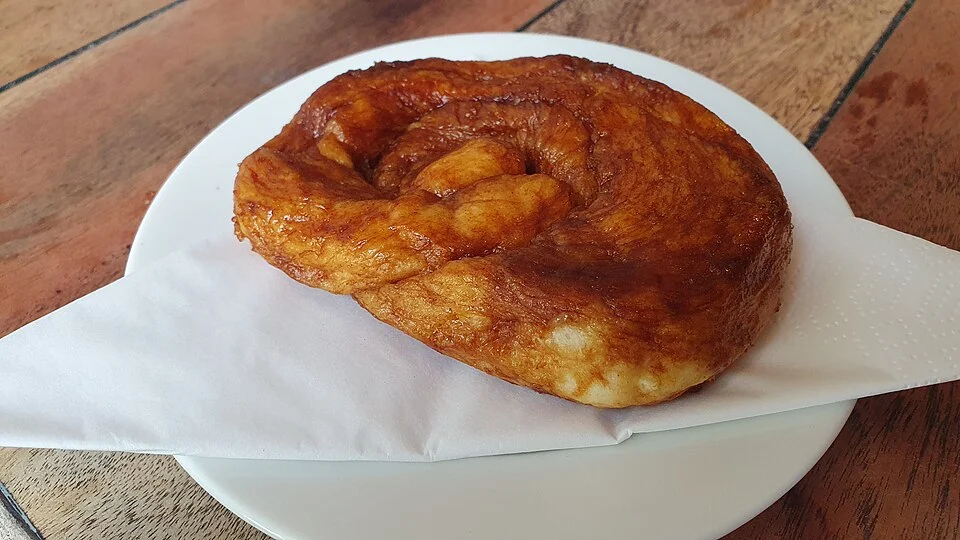
Served on a plate in Zierikzee, in the Dutch province of Zeeland, the Zeeuwse bolus is a spiral bun coated in brown sugar. The edge of the swirl is glossy, and a paler dough shows deep in the folds. If you pull two turns apart, the boundary between the soft yeasted dough and the sticky sugar comes into view. Each strand of dough is stretched out individually, rolled in brown sugar mixed with cinnamon and other ingredients, and then coiled. As a result, after baking, the sugar syrup remains not only on the outer surface but also on the inner surfaces where the turns of the swirl lie against one another. It is a sweet bought at a bakery in the southwest of the Netherlands and eaten with coffee.
Stretching each strand and coating it in sugar
In the recipe on the Zeeland tourism site, 15 g of granulated sugar goes into 500 g of flour, and 250 g of dark brown sugar for coating the outside is mixed separately with cinnamon. The dough uses water, milk, yeast, egg and salt, with butter added during kneading. The 250 g prepared for rolling the strands is not a weight kneaded into the dough from the start. The sugar that clings to the outside melts and forms the sticky brown surface. The inside, kneaded with sugar and butter, becomes the soft, fermented bread, separate from the sugar that covers the outside.
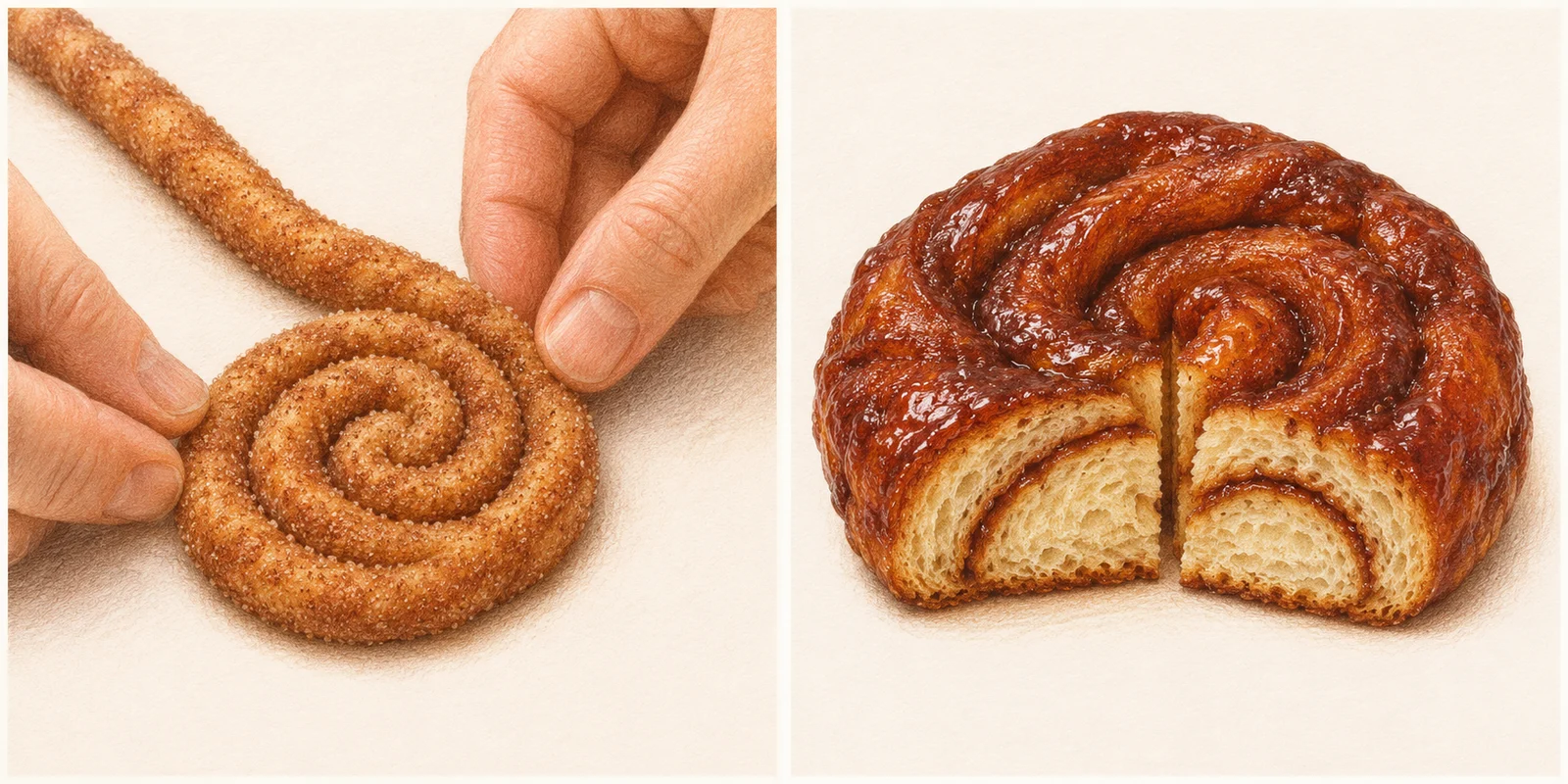
The dough is divided into pieces of about 80 g, rested for about 20 minutes, and each piece is stretched into a strand about 30 cm long. The surface is dampened slightly with water, and the strand is rolled in a container of sugar and cinnamon. Rolling coats the whole circumference, rather than dusting only the one side that happens to be set down by hand. The grains cling readily to damp spots, and if the strand is even in thickness, it keeps a similar width wherever it is held and bent. This is the stage at which brown grains end up on both the surface that shows on the outside of the swirl and the surface that touches the next turn.
In The Sunday Baker’s recipe, each portion of dough is placed directly in the container of sugar and rolled out with the palm to about 30 cm. The sugar sticks to the surface as the strand lengthens. The order of handling differs from the tourism site’s recipe, which fixes the length of the strand first and then dampens it slightly. Finally, the outer end of the coil is tucked underneath. With the tip tucked under, the outer edge is less likely to come apart when a swirl is lifted from the baking sheet. In both recipes, the surface of the strand for each bun is flavored before it is coiled into a swirl.
Zeeuwse Ankers, which presents local culture, also describes making a strand about one inch thick and about 40 cm long, and mixing soft brown sugar, fine sugar and cinnamon. If the same weight of dough is assumed for 30 cm and 40 cm, the longer strand is correspondingly thinner, which changes the number of turns and the surfaces the sugar touches. The sources are not records of testing both at the same weight. If you want to compare where the sugar lies thick on the outside and where paler surfaces show, the difference in length and the sugar blend are separate clues.
The tourism site’s recipe has you knead the ingredients other than the butter for about 6 minutes, then work in the butter during the last 4 minutes or so. In The Sunday Baker’s recipe, yeast is combined with milk, and the butter is added with the sugar and eggs before the flour. The dough is kneaded for about 6 minutes, left covered in a bowl for about 1 hour until it has risen, and then divided into twelve. In both, the dough is kneaded and rested before coiling, but the recipes differ in when the fat is combined, and in whether the dough is divided after resting or rested after dividing. The way the time is organized before an unbaked strand can be stretched also varies from recipe to recipe.
Leaving melted sugar inside and outside the turns
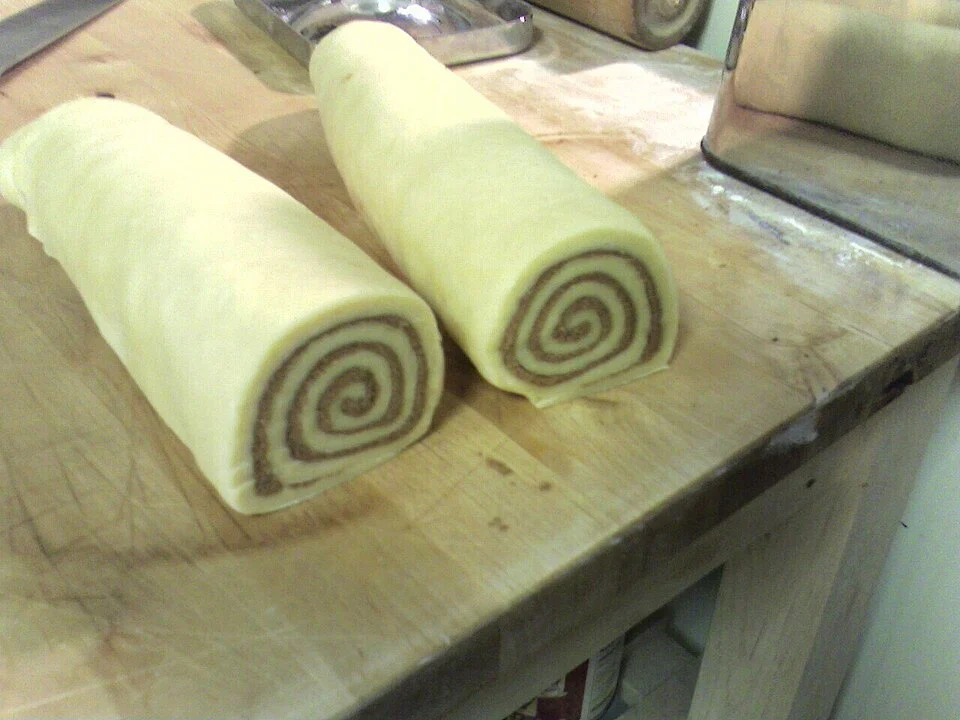
In one method for cinnamon rolls, the dough is rolled out into a rectangle, spread with filling, rolled up into a long log, and cut crosswise into individual rolls. Even before baking, the lines already show on the cut face. For the bolus, portioned dough is stretched into strands, laid sideways and coiled one at a time. The swirls visible from the outside both trace circles, but in the bolus the sugar is applied around the strand. Compared with the cinnamon roll, in which filling is rolled into a thick log, the bolus shows, when opened, the order in which the melted sugar is left on both the outer rim and the inside of the swirl.
In the tourism site’s recipe, the shaped swirls are left to rise for about another 5 minutes and baked at 225°C for about 7 minutes. As soon as they come out, each one is turned over and left to cool on a plate. During baking, the sugar on the surface of the strand melts with moisture from the dough and runs, leaving syrupy sugar on the outer rim and between the strands. If you wait until the sugar on the bottom sets on the baking sheet, it ends up in different places than if you turn the bun while it is still moving. Short baking followed by turning the swirl is what produces the gloss in this recipe.
The Sunday Baker waits about 1 hour, until the swirls have roughly doubled in size on the baking sheet. As a guide, it uses the point at which the dough springs back slowly when pressed with a finger, and bakes at 220°C for about 10 minutes. After baking, the buns are covered with paper, another baking sheet is placed on top, and they are all turned over together. The moment at which the top and bottom are swapped overlaps with the tourism site’s method of turning each bun onto a plate, but the two differ in how the lined-up swirls can be handled. In both, the side that was warmed underneath is turned upward before the sugar cools and sets.
If the strand is coiled closely, it touches the neighboring turn as it puffs up in baking. Deep in the folds, the sugar is less exposed to the oven air than at the outer rim, and it stays moist. Zeeuwse Ankers states that over-long baking makes the bun hard, and taking it out too early leaves the inside underbaked. Continuing to bake to darken the sugar can dry out even the inside of the thin strand. For comparison, look not only at the color, but also at the stickiness of the sugar where the swirl is pulled slightly apart, together with the softness of the bread.
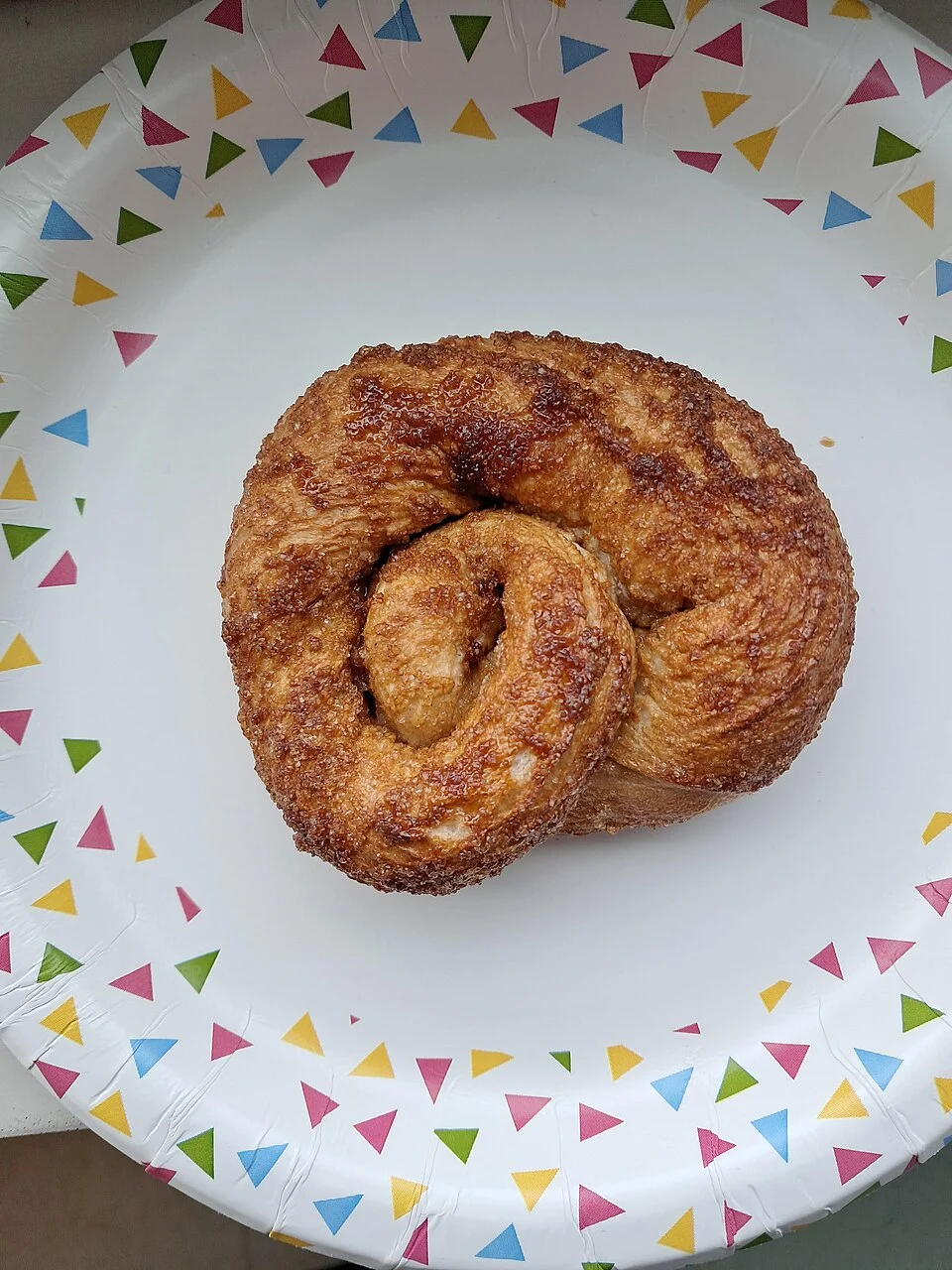
The Yerseke tourism site notes that cinnamon may or may not be added, and that some bakeries use syrup. The Zeeland tourism site’s recipe chooses dark brown sugar, basterdsuiker, together with cinnamon. Within the province, the way the sugar is mixed differs, and opinions on what makes a good bolus are not uniform. The dark color can also come from the sugar itself, so it cannot be judged by baking time alone. Differences show up in what you look at and taste: one bun with a strong aroma of dark sugar, one with a pronounced cinnamon scent, and one in which the sticky sugar reaches your fingers when you pull the swirl.
A name that continued among settlers, and names that vary within the province
Zeeland local sources link the origin of the sweet to Sephardic Jews who were persecuted on the Iberian Peninsula and moved to Middelburg and other places around the end of the 16th century. What is said to have been brought are festive sweets, made with raisins and candied peel in a yeasted dough and fried in oil or baked. To attribute even today’s 30 cm strand and the proportion of cinnamon to old ingredients would require separate contemporary recipes. A local source states that the bakery De Man die Bakt in Zierikzee had an exhibit conveying the Jewish background. It offers an example of a shop that now lines up swirls also explaining the movement of people.
As for the name, one theory traces it, via the Yiddish bole, back to words for sweets and breads of the Iberian Peninsula. The Encyclopedie van Zeeland gives 1841 as an early documented example of the Dutch word bolus for a sweet. The date of the migration and the date from which the name can be read in documents are separate clues. Amsterdam also has boluses. The local source lists the ginger gemberbolus and the almond-paste orgeadebolus. The Joods Cultureel Kwartier also lists these two as sweets to go with tea and coffee. The place name helps to indicate Zeeland’s brown swirl, and the name of the filling helps to indicate the Amsterdam bun.
Within the province, parts of Beveland and Schouwen have the name jikkemiene. The same word is also a dialect form of the personal name Jacomina, and how it came to be attached to the sweet is not settled even in the local sources. In Noord-Beveland, Tholen, Schouwen-Duiveland and parts of Zeeuws-Vlaanderen, there is drol or drolle (drol/drolle), named after the shape. On Walcheren and elsewhere, draoier and stropiedraoier are recorded, and in Middelburg, Arnemuiden and Veere, koekedraoiomme. Some names seem to have been given by someone looking at the outline, and others evoke the turning of the hand during making. The distributions in dialect dictionaries overlap, and apart from a map dividing the sugar blends, the voices that call the same sweet by different names remain in the regions.
Combining sources that record the name of the sweet with sources on the lives of the people who migrated, there is a span of time before it reached the swirl sold in shops. According to the local sources, the settlers in Middelburg used their homes for worship and were also allowed to have a cemetery during the 17th century. The arrival of frying techniques in local cooking is an example from the contact between that community’s food culture and its surroundings. Even if the process by which a bolus-like sweet reached its present form cannot be traced from a single document, the migration that a local shop took up in an exhibit and the swirls that local bakers bake are told at a single counter.
Spreading butter on the flat side
A bun placed next to coffee may also be served at a celebratory meal. One way of eating it, listed in the heritage source, is to spread softened butter on the side that touched the baking sheet and has become relatively flat. Compared with the top, where the fine swirl rises, the flat underside lets a knife slide across it and spread the butter widely. Even with recipes that mix butter into the dough, butter freshly spread at the table adds fat where the baked sugar touches the tongue. In one case, the sweetness is sticky from inside the swirl, and in the other, it is freshly spread butter on the turned-over side.
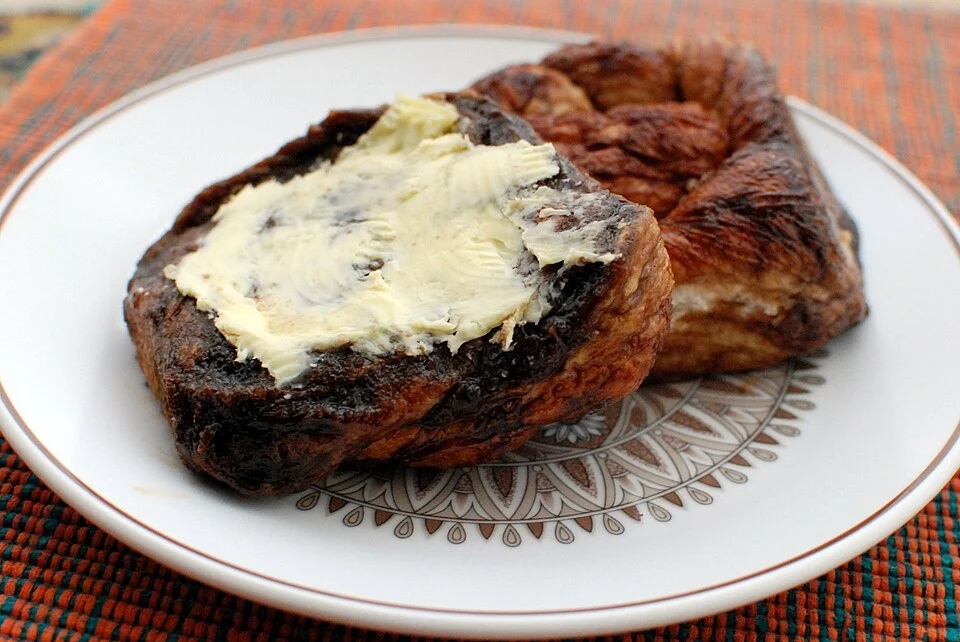
The dough keeps rising after the sugar is applied, so there is no need to press it tightly when coiling. If you leave the tucked-in end as it is and break the bun open where sugar remains between the turns, you can taste, within a single bun, the darker surface near the bottom and the soft bread one after the other. If butter is spread over the whole underside, the same thin layer of fat coats both.
The Encyclopedie van Zeeland records that a competition for bolus bakers was held in Veere in 1988. According to the local sources, the provincial section of the bread and pastry trade association began its competition in 1998, and artisan bakers made 30 May Bolus Day in 2015. If buns that can be bought in shops were gathered at a competition, the thickness of the strand, the stickiness of the sugar and the softness of the baked interior could be compared side by side in one place. The Yerseke tourism site also offers bakery experiences and sets with the ingredients and blends for baking at home. You can check where the sugar ends up on the finished swirl by coiling the strand yourself.
Glossary
- Bolus
- Here, the name of a sweet. Besides the spiral bun of Zeeland, Amsterdam has a different sweet of the same name. The plural is bolussen.
- Sephardic Jews
- A Jewish community with roots in the Iberian Peninsula. Zeeland local sources link their migration to the origin of the sweet.
- Basterdsuiker
- A sugar used in the Netherlands, here a dark brown one. It is mixed with cinnamon and applied to the strands of dough.
- Jikkemiene
- One of the alternative names for the bolus that survive in Zeeland dialect.


