


SweetloreEncyclopedia of World Sweets (834)

Black Bun
Black bun Scotland
A Scottish celebration sweet in which a dark dried-fruit filling is wrapped in pastry
Fermented Pastries / Scotland, United Kingdom

When a knife goes in, a dense layer of raisins and currants, mixed together without gaps, appears beneath the pale crust. After the bite of the thin crust come the moist grains of dried fruit and the scent of spices. Black bun is a sweet in which a fruit filling of this kind is wrapped in a separate thin dough and baked. In Scotland it has traditionally been eaten to welcome Hogmanay on New Year’s Eve. In current recipes, a tin is lined with pastry and filled with the fruit. Nineteenth-century cookbooks also give a method in which the fruit filling and the crust are made separately from the same yeast dough.
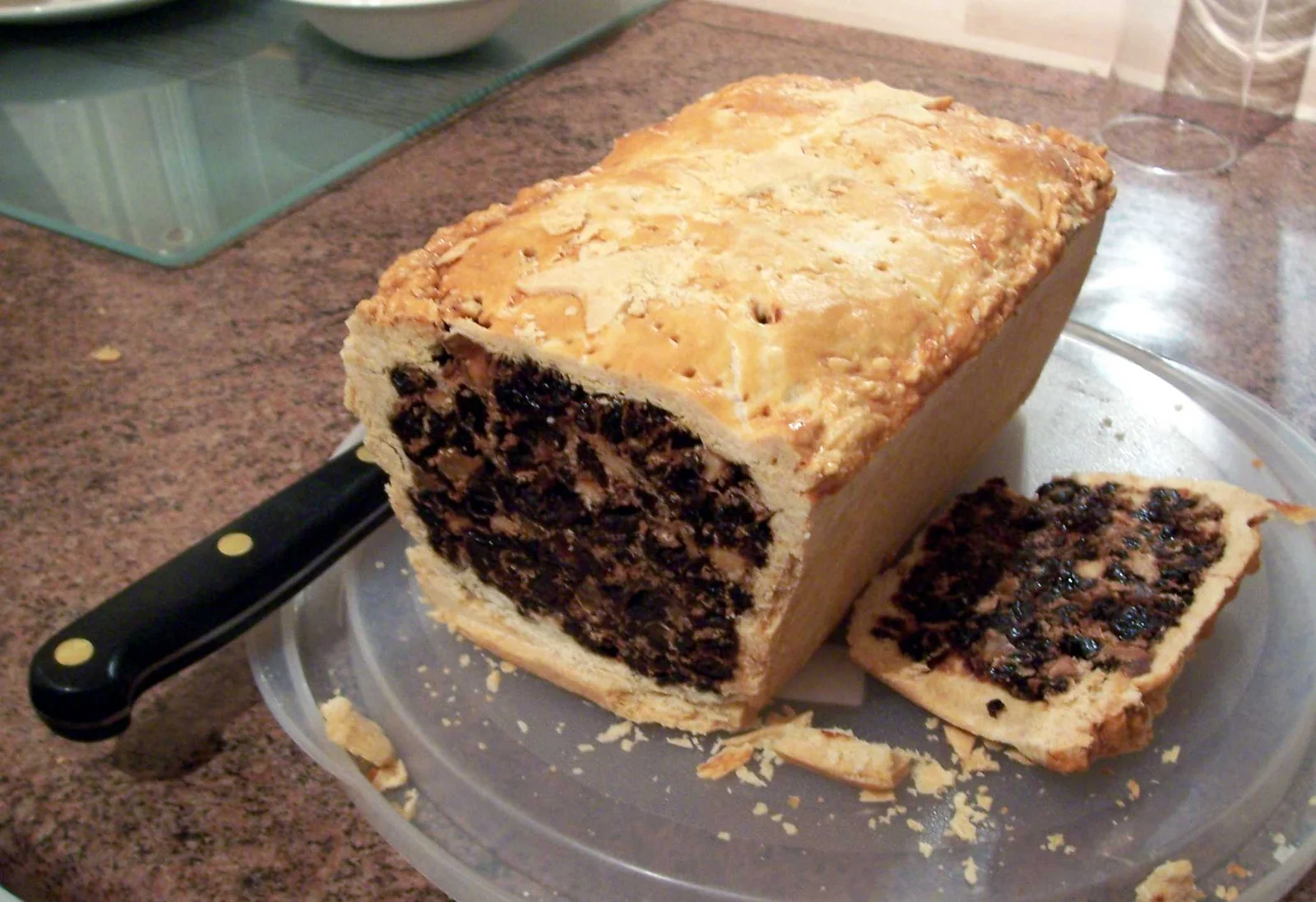
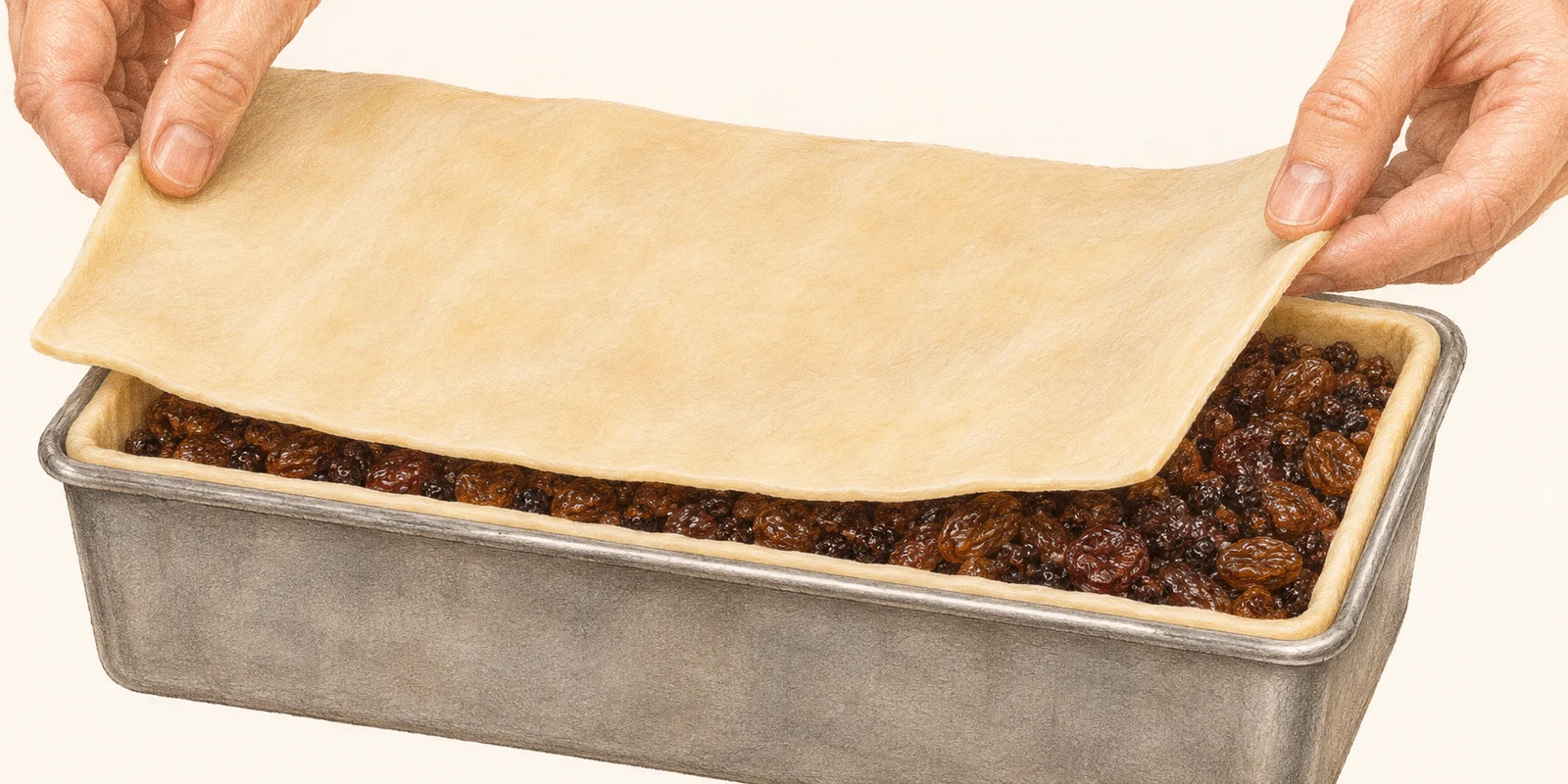
Packing the Fruit into the Tin and Lidding It with Pastry
The BBC recipe for the filling calls for 300 grams each of raisins and currants to 200 grams of flour. It also includes dark muscovado sugar with its molasses flavour, chopped candied peel, ginger, cinnamon and allspice, with a little black pepper added. The two fruits alone weigh three times as much as the flour, so when the bun is sliced, the fruit does not appear as a few dried pieces in a dough but fills most of the cut surface. The dark colour and aroma do not come from the fruit alone: the dark sugar and the mixed spices are also in the filling.
In the recipe presented by BBC Food, the outer dough is made with flour, lard and butter. The fat is rubbed into the flour, and when the mixture resembles breadcrumbs, salt, baking powder and cold water are added to bring it together. It is then chilled while the fruit filling is prepared. This dough is rested without any dried fruit. The filling dough, to which the fruit and spices are added, is mixed in a separate bowl, so a crust that can be rolled thin and a filling rich in fruit can each be prepared at the firmness that suits it.
About two-thirds of the dough made for the outside goes into the tin. It is rolled into a rectangle and fitted against the base and sides of a paper-lined loaf tin. After the filling is added, it is pressed down with a spoon or similar, and the remaining dough is rolled out and laid over the top. Before the lid goes on, the edge is brushed with water, the dough is pressed together where the two meet to seal it, the excess is trimmed away, and a pattern is marked with the tines of a fork. Because the dough encloses the fruit filling on the bottom, sides and top, what you see when the bun comes out of the oven is the surrounding crust. The cross-section of fruit shows only when the bun is taken out of the tin and sliced.
In the BBC recipe, the leftover dough and trimmings are rolled out thinly, shaped into ribbons and attached to the lid. Beaten egg is brushed over the surface, and the bun is baked for 2 hours at 180°C in a conventional oven, then left to cool in the tin before being turned out. The two-hour figure corresponds to the 900-gram loaf tin and the formula of this recipe. Glazing the outer crust with egg and heating the filling thoroughly before it cools both belong to the same stage. This is a method of baking the bun as one thick sweet, which is different from the baking time for small fruit buns baked as separate pieces.
Joining the edges tidies the appearance, and it also gathers the filling into a single bun. Dods’s recipe pierces holes all over the bun, while the 1832 recipe makes holes by passing a skewer through from top to bottom. When the crust encloses the fruit so completely that the filling is hidden, closing the outer crust and making the holes were treated as separate tasks.
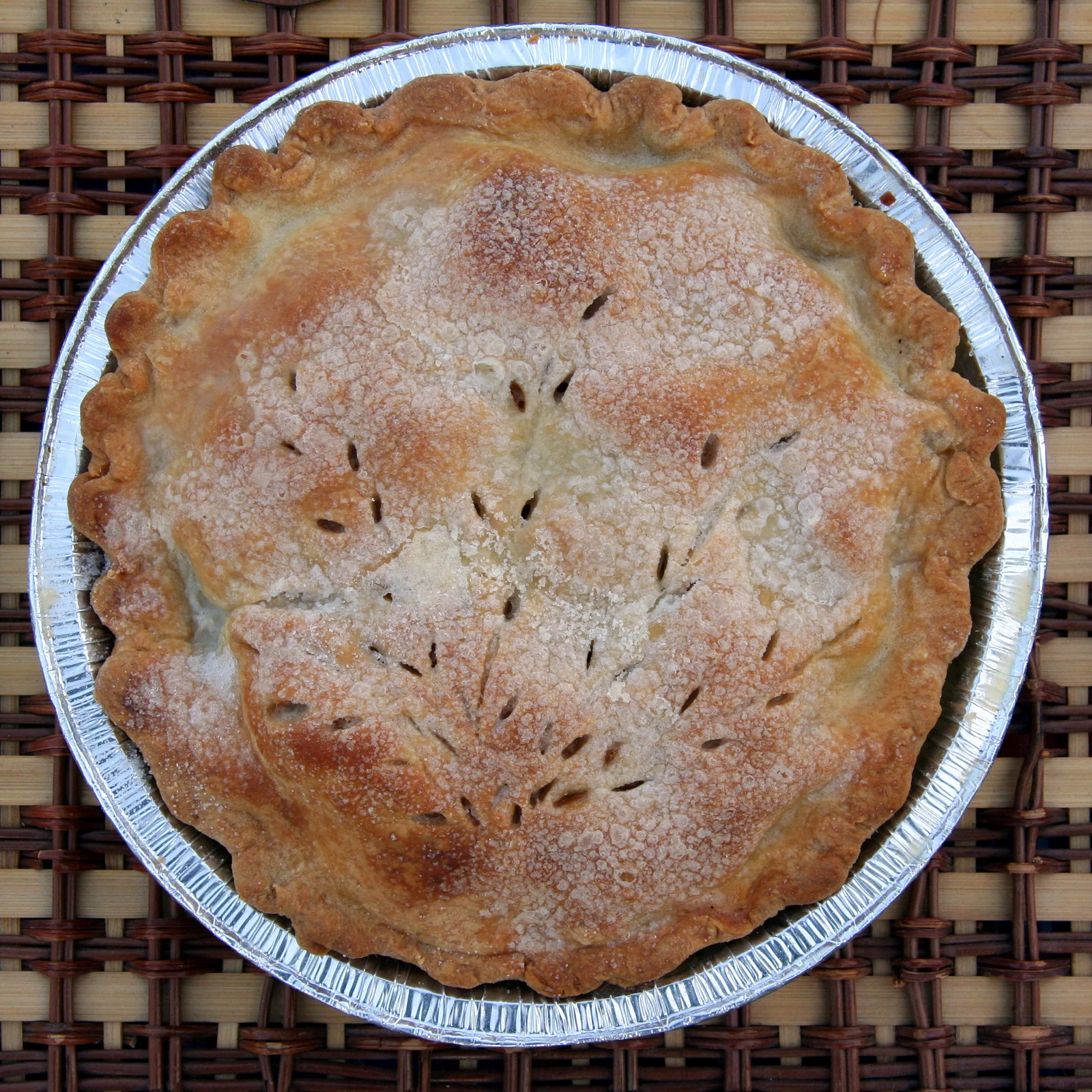
Dividing One Yeast Dough into Filling and Crust
The sixth edition of The Cook and Housewife’s Manual, published by Christian Isobel Johnstone under the name Meg Dods, contains a "Scotch Christmas Bun" that cites Mrs Fraser’s cookery book as its source. In this method, butter, warm water and yeast are added to flour to make a smooth dough, and one third of it is set aside for the outer covering. The rest is rolled out, topped with raisins, currants and other fruit, sprinkled with spices, and kneaded thoroughly to work the fruit in. The outer dough contains no fruit, while the inner dough is given spices and fruit, so two roles are made from a single dough.
The dried fruit in the sixth-edition entry is three pounds of stoned raisins and three pounds of cleaned currants. Almonds cut into long strips and candied orange and citron peel are added, and cloves, cinnamon and ginger are pounded and sifted. Because the large pieces of fruit and the fine spices are prepared separately, the ingredients that give the bun its texture when eaten and those that spread scent through the dough are distinguished before mixing. The spices are not sprinkled on the surface after baking; they are worked into the filling dough together with the fruit.
In this older method, the dough that was set aside is rolled out and wrapped around the fruit-filled mass placed on it. The edge is tidied, holes are made, paper is wrapped around to hold the shape, and the bun goes into a fairly hot oven. The entry says to brush it with beaten egg just before it is taken out. In the BBC recipe, the base and walls are made in a loaf tin and then filled. Here, by contrast, the mass of fruit is formed first and then wrapped on the outside in dough and paper. Brushing egg on the outside is common to both, but when it is applied, and what keeps the whole in shape during baking, are not the same.
Just before this entry, Dods’s book gives a plain bun, a cross bun marked with a cross, and a plum bun containing dried fruit. For the plum bun, currants, candied orange peel, almonds and other ingredients are mixed into the dough of the ordinary cross bun, and the buns are baked in the same way as small buns. Fruit and spices are present there too, but there is no instruction, as in the Christmas bun, to set aside part of the dough and use it for the outside. Comparing successive entries in the same book, it is not only the addition of fruit but also the wrapping of the whole in a fruit-free crust that sets this sweet apart in appearance.
The Cook’s Own Book, published in the United States in 1832, also contains a very similar way of wrapping, under the name Scots Christmas Buns. Nearly one third of a dough made with warm water and yeast is set aside, fruit and spices are worked into the rest, and it is shaped like a thick, round cheese. The seam of the covering is moistened with water and placed at the bottom, and the bun is pierced with a skewer from top to bottom. Floured paper is laid under the base, and paper is wrapped around the sides as well to support the shape. Where the sixth edition of Dods describes the shaping of the covering only briefly, this book also conveys the position of the seam and how the holes are pierced.
According to the reference work Oxford Companion to Food, in the Edinburgh trade that Dods’s book describes, large buns were made before Christmas and sent to other parts of the country. The large sizes used for sale and dispatch are a different case from the modern home loaf tin. When the mass is of a different size, the time needed to cook it through and the amount of crust that wraps it change, even with the same ingredients. Even if an old entry gives some indication of the strength of the heat, the temperatures and times of a modern recipe cannot be applied to it.
The ingredients of the crust in McNeill’s recipe differ from Dods’s method of dividing a single yeast dough. The leavening of the filling also differs: the nineteenth-century entry uses yeast, while the 1929 account lists bicarbonate of soda, buttermilk and the like. The BBC recipe, in addition, uses baking powder and two kinds of fat in the outer dough. All three share the appearance of having a crust, but depending on which ingredients are separated between crust and filling, differences emerge, from a method close to bread-making to one in which a separately made crust wraps a fruit dough.
Looking into the Shop Fronts at the Year’s End
In the year’s end that Robert Louis Stevenson describes in Edinburgh: Picturesque Notes, confectioners’ shops had been displaying piled-up Scotch buns for weeks beforehand. What the writer saw was a dark, densely packed sweet. Alongside it were round shortbreads decorated with New Year greetings made of candied peel and other ornaments, which shows that the shop fronts did not offer just one kind of sweet. Stevenson’s name for the bun is "Scotch bun"; he does not use the present-day term "black bun" as such.
The entry for black bun in the Dictionary of the Scots Language takes a usage example from around 1900 from a text by J. L. Waugh set in Dumfriesshire. In it, the talk is of black bun or currant bread to be taken on New Year visits. F. M. McNeill’s The Scots Kitchen of 1929, which the dictionary also cites, gives as a Hogmanay celebration sweet a filling containing fruit, candied peel, almonds, spices such as ginger and black pepper, and brandy, with a crust of flour, butter and water. The two citations confirm both the context in which the name is used and the combination of ingredients given in the cookbook.
The BBC recipe does not assume the bun will be eaten right after baking; it advises making it ahead so that the flavour can settle. Stevenson likewise records that confectioners displayed buns for weeks before the new year. The time when shop displays began and the period a home baker keeps the bun after baking are not the same figure, but both accounts show that the preparation time is set apart from the New Year table.
Bringing a Bun to the House You Visit at New Year
After midnight, people take their good wishes to houses that have seen in the new year. In Scotland, Hogmanay refers to New Year’s Eve, but its celebration continues into the new year. The custom of making the first visit to someone’s home in the new year is called first-footing. According to the VisitScotland guide, visitors bring a gift, and sweets such as black bun expressed the wish that the household would never run short of food. The wishes the gifts carry differ: coal, for example, is brought so that the household will keep warm. The black bun in Waugh’s text, too, is not a sweet eaten only inside the house but something taken along when visiting.

In considering whether this was a Christmas sweet or a New Year sweet, the records of its names need to be looked at separately. Dods’s book has the name "Christmas Bun", and the shop fronts that Stevenson describes at the year’s end have "Scotch bun". In the twentieth century, McNeill treated "black bun" as a Hogmanay sweet. Oxford Companion to Food presents the view that a Twelfth Night sweet moved to the New Year celebrations. These examples alone, however, cannot show that people changed the day on which they ate it all at once in a particular year, nor explain that change by one specific event.
Black bun, in which a fruit-filled dough is wrapped as a single mass and baked, is displayed in shops by the look of its crust, and at home the colour of the sliced filling comes into view. When it is carried on a Hogmanay visit, the outside you hold in your hand does not show what formula it was baked with. Both the yeast dough conveyed in the nineteenth-century cookbook and the later method of separating crust and filling include a step of enclosing a fruit-enriched interior. A bun is baked for the celebration, and when it is cut and shared with the people who welcomed you or the people you visited, its black filling appears.
Glossary
- Currants
- In this article, small dried grapes. Some formulas use them together with raisins.
- Citron
- A kind of citrus fruit. The older Christmas bun uses its candied peel.
- Hogmanay
- New Year’s Eve in Scotland and the New Year celebrations that follow.
- First-footing
- The custom of visiting a house after it has welcomed the new year. Black bun is one example of a gift brought on such a visit.
- Meg Dods
- The name Christian Isobel Johnstone used for The Cook and Housewife’s Manual.


