


SweetloreEncyclopedia of World Sweets (834)

Baath Cake
Baath cake Goa
A Goan celebration sweet of coconut and semolina
Cakes / India, Goa

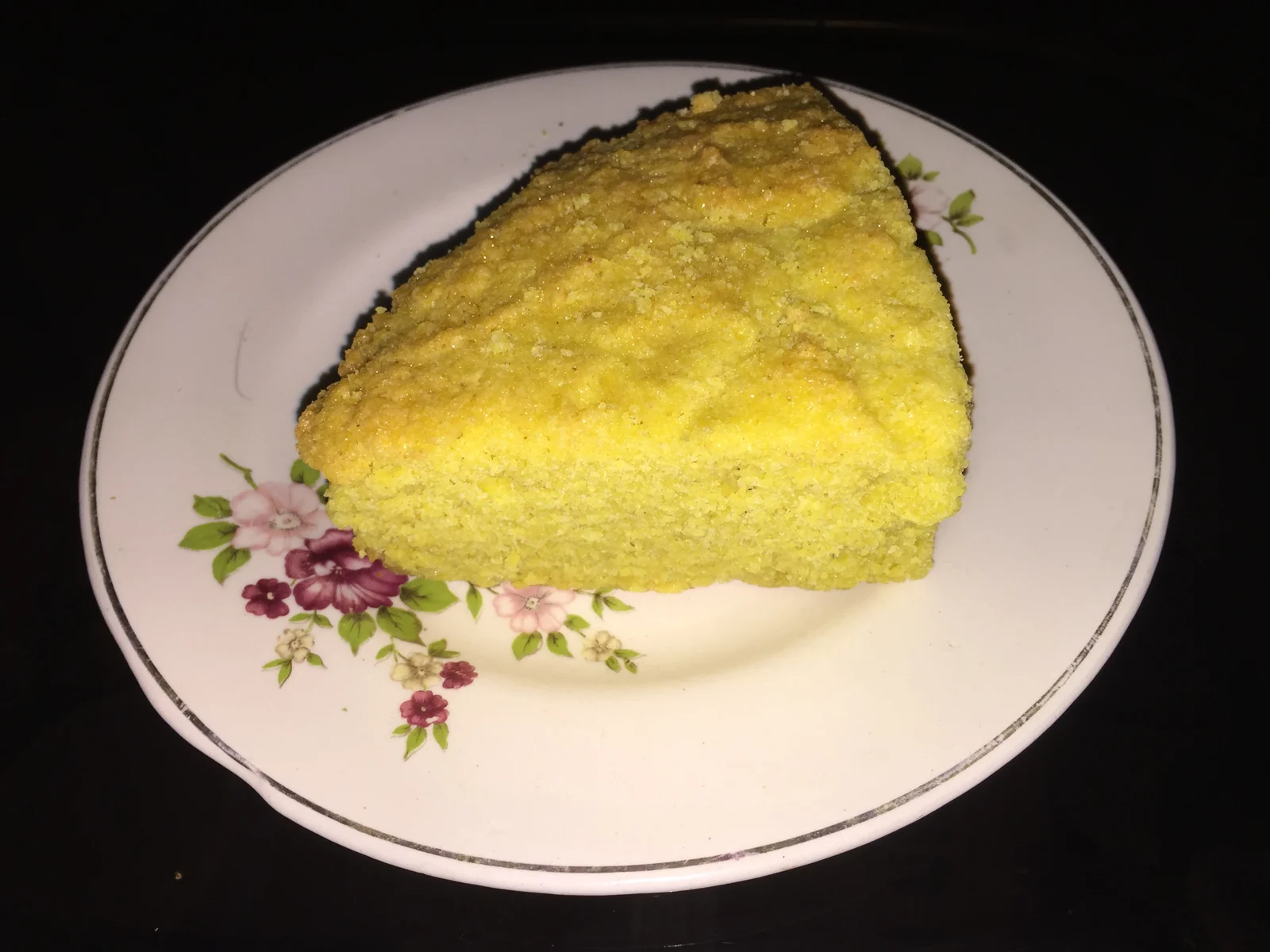
The cut surface shows coarsely ground wheat semolina and fine grains of grated coconut. Baath cake is made at Christmas in Goa, on India’s west coast. Eggs, sugar and butter go into a moist, dense batter that is baked into a cake. Home methods vary: some leave the batter to rest overnight, some let the semolina absorb liquid on the day of baking, and some fold in whipped egg whites. The cake is also called batica or batk (Konkani बात्क), and households differ on whether thin strips of pastry are crossed over the top.
Grains That Soak Up Liquid Overnight
Semolina is a granular flour made from coarsely ground wheat. Goan recipes call it rava or sooji. According to Veena Patwardhan, the batter is rested to give the semolina time to absorb liquid and swell. In the recipe Jessie passes on, butter, sugar, semolina, eggs and coconut are combined and flavored with cardamom, nutmeg and vanilla, then left for at least 8 hours or overnight. The coconut can be fresh or dried and is broken into fine crumbs. Having made the cake several times, Jessie writes that the resting time matters if the cake is to stay moist yet crumble softly.
Another household’s method makes the coconut into a fine paste with rose water. Eggs, sugar and butter are whipped and combined with semolina, and the batter is rested for about 12 hours, then loosened with milk if it is stiff. This example, which pastes the coconut, and Jessie’s, which crumbles it, use the same ingredient name but leave the coconut in the batter in different degrees of fineness. Jessie also says the cake can be made with dried coconut, whereas Xanti Pinto writes that she has never tried dried coconut in her family’s formula. Some formulas do allow dried coconut, but swapping it for fresh in equal amounts does not necessarily mean the same amount of moisture reaches the grains.
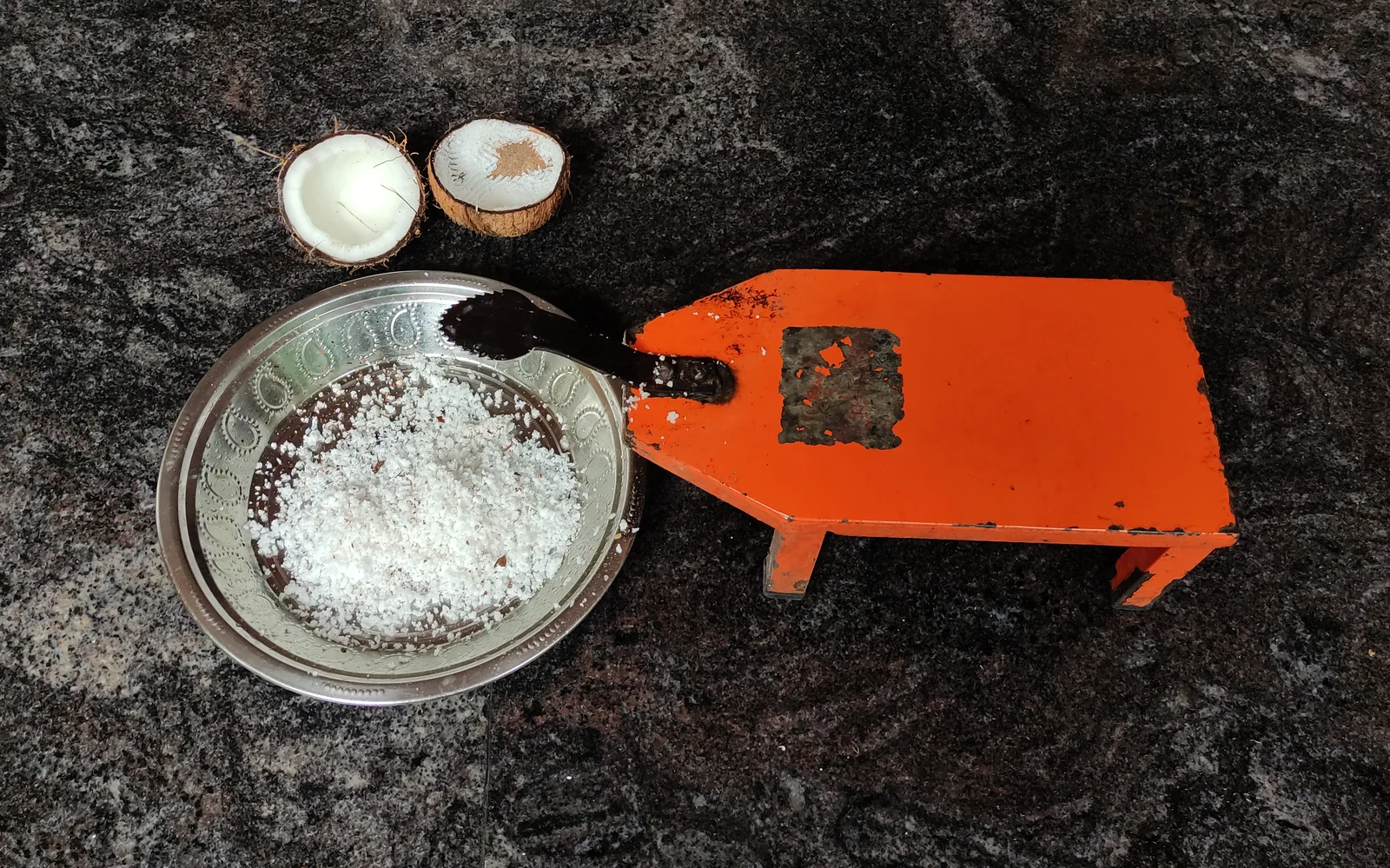
The grandmother of the food writer Nik Sharma grated the white flesh of fresh coconuts and soaked semolina for several hours in coconut milk, made by grinding the flesh with hot water and squeezing it. Compared with the versions that add coconut flesh to milk, here the liquid the semolina absorbs carries the coconut aroma from the start. After Sharma moved to the United States, fresh coconuts became hard to find, and he began making the cake with canned coconut milk and cream. How coconut is added changes not only with how finely the flesh is broken down but also with which form of the ingredient is available where one lives.
Kitchens That Shorten the Resting Time
In Patwardhan’s quicker version, the semolina is first dry-roasted over low heat for about 5 minutes. Grated coconut is ground with a little milk and combined with the other ingredients, and the batter rests for 1 hour in the refrigerator and a further 30 minutes at room temperature. If it is dry, a little milk is added. The batter should not be thin, but just loose enough to drop from a spoon. It is baked at 160°C for 40 to 50 minutes and cooled completely before being removed from the pan. This version keeps a resting step but changes how the semolina is prepared and how long the batter rests, so that it can be baked without being made the night before.
In the recipe of the Meneses family of Goa, egg yolks are added one at a time and then combined with separately whipped stiff egg whites and grated coconut. The method includes no resting time: after mixing, the batter is poured into the pan and baked. The household version presented by Ivan Crasto heats sugar, milk and butter, adds the semolina once the sugar has dissolved, and cooks it for a few minutes. Dried coconut is added and the mixture is cooled slightly, then baking powder and beaten eggs are mixed in before baking. Even the methods that shorten the time show such interventions as returning the batter to room temperature after refrigeration, folding in whipped egg whites, and cooking the semolina first.
Some food articles call the overnight rest “fermentation.” What Patwardhan describes is the semolina absorbing liquid. Jessie’s and Patwardhan’s recipes include baking powder, and in Pinto’s recipe, discussed below, baking soda is added the next day. A method that says only to leave the batter overnight does not show whether yeast is involved or how much it contributes.
When the Surface Browns, How Far Has the Center Baked?
Xanti Pinto’s recipe was handed down from her husband’s grandmother, Clementine D’Souza. It combines 6 eggs, 500 g of sugar, 2 fresh coconuts, 125 g of butter and 250 g of fine semolina, with cardamom and nutmeg added, and the batter is left overnight. It is presented as serving 20 to 30 people, an amount that can be cut up and shared. The next day, baking soda is mixed in, and the batter is put into a paper-lined rectangular pan and baked at 180°C. After about 30 minutes, the deeply browned top is covered with aluminum foil and the cake is baked for another 10 to 12 minutes. It is judged done when a toothpick inserted in the center comes out without batter. Covering only the top is the order of steps when the surface and the center have progressed differently.
Jessie bakes in a round or square pan at 150°C for about 1 hour. Set beside Pinto’s rectangular pan and hotter start, this shows that the formulas, pans and thicknesses all differ, so no single temperature and time fits every pan. The household formula presented by Crasto is baked at 180°C for about 40 minutes. Because it uses semolina warmed with milk, the batter is prepared differently even though the starting oven temperature is the same as Pinto’s. Patwardhan’s example takes as its cues a golden surface with fine cracks and a soft, moist interior. Cut once cool, the cake shows its thickness and the packed grains of the cut face more clearly. In a cake made with semolina and coconut flesh, the grains and moistness show in the mouthfeel more than the air pockets of a fluffy sponge do.
A Cake Beneath a Lattice, a Cake Poured Straight into the Pan
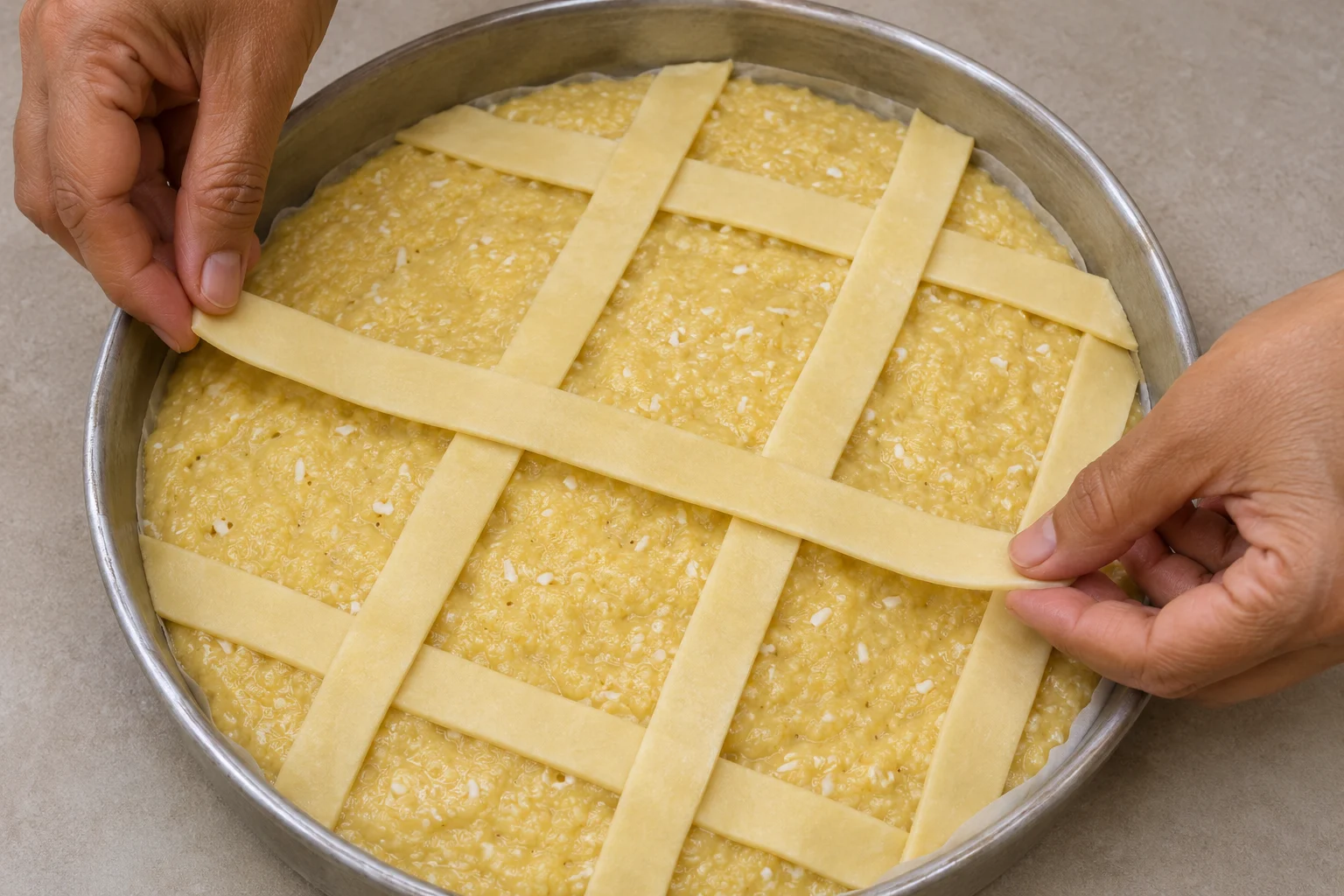
Jessie’s mother put the batter, made the night before, into a pan the next morning, laid a lattice of thinly cut dough across the top, and took it to a neighborhood bakery. The batter was mixed at home, the baking was left to the bakery, and the cake was cut on Christmas morning. Like her mother, Jessie prefers a lattice on top only. She also mentions lining the bottom and sides with shortcrust pastry and laying a lattice over the top. A crisp, fat-enriched dough on the bottom and sides gives a cut slice more places where the outside can be bitten into than a lattice alone. Others, such as Patwardhan, use no pastry and simply pour the cake batter into the pan.
The lattice is laid on separately after the cake batter has been poured into the pan. Jessie’s recipe rubs flour and butter or ghee together with the fingertips, binds the dough with cold water, rolls it thin, and cuts it into strips about 1.3 cm wide. It also gives instructions for lining only the bottom of a round pan with paper, and lining both the bottom and sides of a square pan so the cake can be lifted out. To keep both the lines of the lattice and the sides of the cake neat, the strips for the top and the paper for removing the cake from the pan are used at different stages.
In another household, the memory of the oven itself survives. Hilda Mascarenhas says her grandmother baked in a clay oven. In the method seen by the cookbook author Odette Mascarenhas, a deep pot called a tezal was lined with river sand to carry the heat, an aluminum container holding the batter was set on it, and a flat clay lid was placed over the top. The article also mentions ovens fueled with coconut shells and dried leaves. Together with the story of preparing the batter at home and taking it to a bakery, this shows that handing down the sweet involved more than ingredients: it also meant borrowing a neighbor’s fire and working with the tools a household had. Ovens that differ in fuel and equipment cannot be described by a single baking time.
The Day Sweets Are Delivered, the Day They Are Cut for Tea
Pooja Pandit came to know baath after her marriage, when a neighbor delivered it along with other Christmas sweets. In Goa and elsewhere, the assortment of sweets prepared for a celebration is called kuswar. When one cake is baked and cut at Christmas, a slice of baath can be paired with other sweets and given as a gift. Aparna, on the other hand, writes that butter and eggs were expensive and that not every household made it at Christmas. Although the cake is known as a festival sweet, the quantity a household can make and the ingredients it can obtain vary, and current recipe articles also present it as an accompaniment to tea or coffee.
In on-site reporting in 2019, a long-established shop in Panaji, North Goa, baked a soft, springy batica, while a shop in Loutolim, South Goa, sold a crumbly batica faintly scented with rose water. According to Odette Mascarenhas, some people in South Goa, in Raia, Loutolim and Majorda, also sell home-baked ones for the holidays. A Goan newspaper in 2024 records Perpetua Fernandes of Anjuna making batica, bebinca and other sweets at home, and Franklina Dias of Carancalem saying she makes batica and other sweets with her mother. Delivering the cake to neighbors, making it at home to sell, and displaying versions whose aroma and texture differ from shop to shop all surround this one sweet.
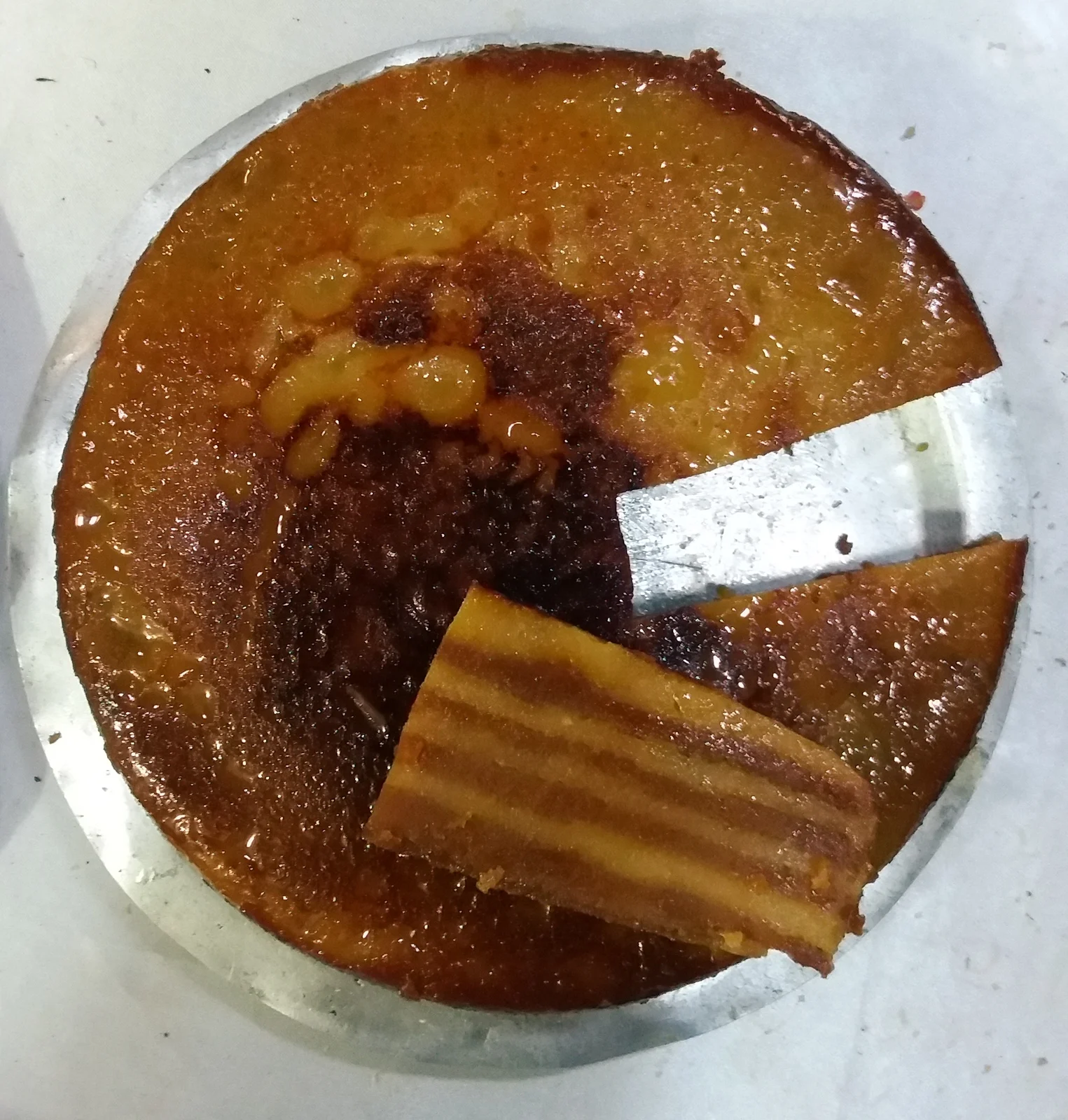
Bebinca is also set out at the same celebrations. It is made with coconut milk, eggs, sugar, flour, ghee and other ingredients; each layer is baked before new batter is poured over it, producing stripes in the cross section. Baath, by contrast, puts a batter of semolina and grated coconut into the pan in one go, and when the cake is cut, the grains are visible across the whole cut face. Even when a lattice is laid on top, the cake is not built by repeatedly baking layers of batter beneath it. Sweets that share an occasion and ingredients can still be told apart by how the cut surface is formed.
Several Names for One Sweet
Jessie gives baath, batica and the Portuguese bolo de rulão (Bolo de Rulão) side by side as names of one cake. Aparna also lists spellings such as Baatica and Batega, and the Meneses family uses Bolo de rulao and Bolo de Batica for the same cake. The Konkani introduction gives बात्क. In a university’s course material on regional cuisine, Batica and Baath appear as separate entries: one is briefly described as a sweet rich in coconut aroma, the other as a semolina cake scented with coconut milk. When the names alone make it hard to tell them apart, looking at the same author’s ingredients and method shows what is meant.
In an interview published by Goa Tourism, Eugenia Rebelo, who ran an airline’s catering section in Margao until 1961, lists batica among the dishes in which the Portuguese-descended residents excelled. Some food articles speculate about a relationship with Portuguese coconut cake. The several names and the methods learned in Goan homes show how the sweet spread through the town, but no source has been found that gives the year of its origin or the person who invented a particular recipe.
Glossary
- Semolina
- A granular flour made from coarsely ground wheat. Also called rava.
- Shortcrust pastry
- A type of pastry dough made with fat and baked to a crisp texture.
- Recipe
- The proportions of ingredients together with the method of making a dish.
- Jessie
- The writer of “Celebration In My Kitchen,” which documents Goan cooking. She passes on her mother’s method for baath.
- Kuswar
- An assortment of sweets prepared at Christmas in Goa and elsewhere.
- Bebinca
- A Goan sweet made by baking the batter one layer at a time.
- Xanti Pinto
- A writer who presents the baath recipe of her husband’s grandmother, Clementine D’Souza.
- Veena Patwardhan
- A food writer who presents both the overnight-rest method and a quicker version.


