


SweetloreEncyclopedia of World Sweets (834)

Parrozzo
Parrozzo
A celebratory sweet from Pescara that reveals a yellow crumb when the dome is cut
Cakes / Pescara, Abruzzo, Italy

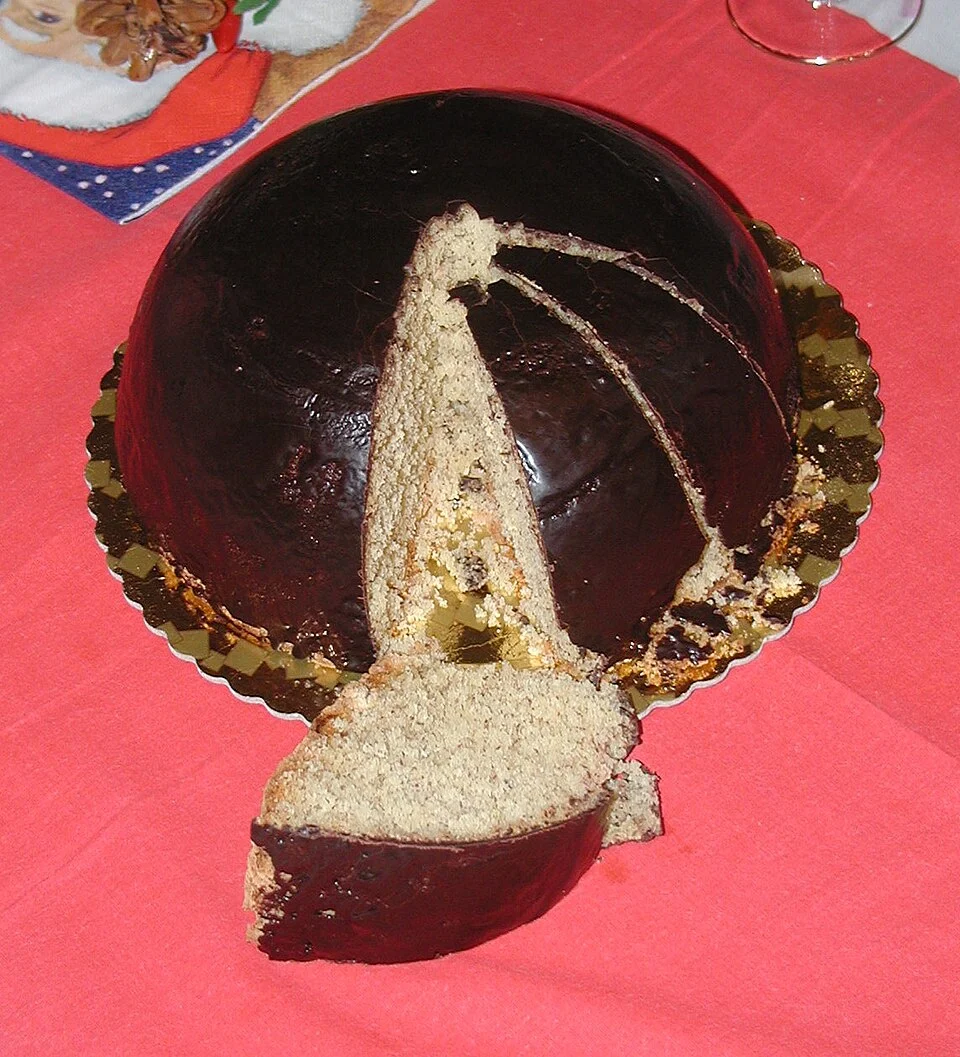
Cut into the surface of a round chocolate dome and a yellow crumb appears beneath the thin coating. This is Parrozzo of Pescara, in Abruzzo, central Italy. An almond-enriched batter is baked in a hemispherical shape and set flat side down, and once it has cooled it is coated with chocolate. In the first bite the aroma of cocoa comes first, followed from within by egg and almond and, in versions made with lemon, the scent of its zest. This round sweet, which is also set on the Christmas table, takes its shape and color from the bread that farmers baked in wood-fired ovens.
Transferring the Two Colors of a Wood-Fired Loaf
The company history published by Unioncamere, the federation of Italian chambers of commerce, gives as the origin pane rozzo, a round loaf that farmers in Abruzzo baked in wood-fired ovens using cornmeal. The confectioner Luigi D’Amico took this bread, a familiar sight close at hand, and reworked it as a sweet. According to sources examined by the literary scholar Sarah Bonciarelli, the yellow of the corn is represented by egg, and the outside, darkened in the wood-fired oven, by a thin layer of chocolate. The almond batter and the cocoa coating are made separately, but when the sweet is cut through, the inner and outer colors match, modeled on the old bread.
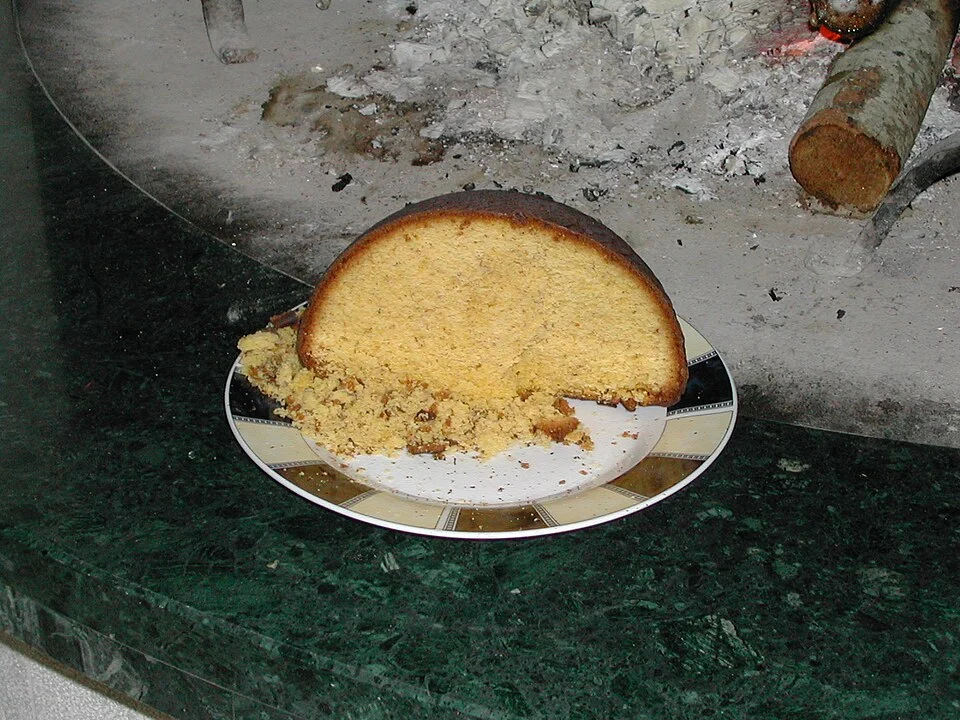
Even with a cornmeal loaf as the inspiration, the flour used in the sweet is not fixed. The home recipe from the food site Dissapore combines 4 eggs with 100 g of almond flour and 100 g of wheat semolina, and adds lemon zest for aroma. The version from the dairy company Galbani uses wheat flour and semolina together, and also offers the option of replacing the semolina with corn flour or potato starch. Before cutting, the cakes look like the same hemisphere, but in the kitchen where the batter is made, the grain or starch paired with the eggs varies widely.
By weight, Galbani’s recipe calls for 6 eggs, 150 g of chopped almonds, 110 g of semolina and 30 g of flour. Of the 150 g of butter prepared, only 50 g, melted, goes into the batter; the rest is melted over a water bath together with the chocolate. In Dissapore’s version with 4 eggs, 80 g of butter is mixed into the batter, and a little milk is added to the chocolate coating. Even if both produce the same dark color on the hemisphere, the flour paired with the eggs and the way the fat is divided toward the outside differ.
Keep the Egg Foam, and Coat the Baked Dome Only After It Cools
In Dissapore’s recipe, the egg yolks are whipped well with sugar, and the almonds, semolina, melted butter and lemon zest are added. What results at this stage is a dense batter. Whipped egg whites, beaten separately, are added last and folded in by turning the spatula from the bottom up. The almonds and semolina are sifted together beforehand. The yolks are first worked with the sugar until the grains blend in, then whipped with an electric whisk until pale. If the stage of evening out the flour and butter is completed first, then after the whites are added you can concentrate on combining them without crushing the foam. The small holes in the cut slice are formed from the moment the eggs are whipped, before the batter is poured into the mold.
For the baking mold, you can use a heatproof mold made for zuccotto, the hemispherical dessert. Dissapore’s mold is buttered and lightly dusted with almond flour, and Galbani also prepares its mold with fat and flour. The batter is poured in with the rounded part down, and both versions bake at 180 °C for about 40 minutes. Dissapore removes the cake from the mold only once it has cooled completely. When it is turned out, the flat surface that faced up during baking becomes the base, and the curve that followed the inside of the mold shows on the outside. There is also a suggestion to bake in small heatproof containers. In Dissapore’s version, for example, the same quantity of batter is divided into four and baked in heatproof aluminum containers or small zuccotto molds. If you have no hemispherical mold, another option is an ordinary pan up to 24 cm in diameter; the steps of turning out the cake and covering it with chocolate are the same in that case.
In Sapori d’Abruzzo, liqueur is added to the egg yolks beaten with sugar, along with ground almonds, semolina and lemon zest. Dissapore also lists baking flavoring or amaretto as options to strengthen the aroma. A lemon scent mixed into the egg batter before baking remains inside the cut slice, and if a drink is served at the table, the aromas can be matched bite by bite. Even when the chocolate on the outside is the same color, how the sweet tastes depends on when the aroma is put inside.
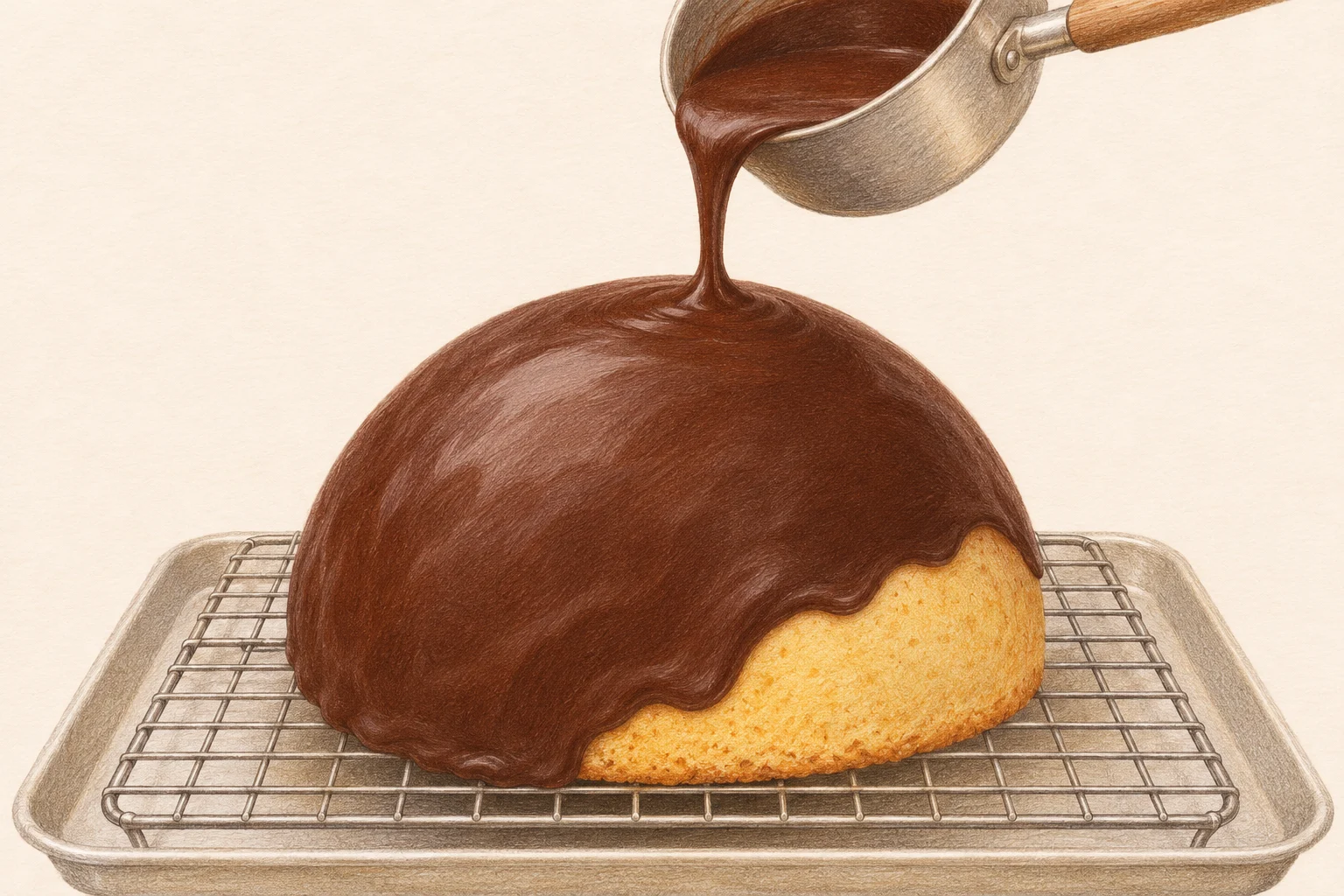
The coating is made by melting chocolate over a water bath. Dissapore mixes in a little milk, and Galbani adds butter. In Galbani’s method, the cooled cake is set on a rack, the chocolate is poured over it from above, and it is smoothed with a spatula. If a plate is placed underneath, it catches what runs down the curve. Dissapore also suggests adding butter so that the coating does not dry out too much if the cake is stored; the suggestion from that site is to add 10 g of butter when melting. When the knife enters the rounded part, the thin coating is the first place the blade touches, and it covers the batter down to near the base. If you cut after the coating has settled, you notice, along with the difference in color, that the thin outer layer breaks first and the bite then goes into the crumb.
The Sweet Arrived First, and the Poem Entered the Box
According to the federation’s company history, the D’Amico family’s business in Pescara began in 1850. They dealt in wine, grain, salted fish, and ship’s tools and materials. They set up shop at the corner of the street and Piazza Garibaldi, starting with trade serving the fishing industry and the Bourbon fortress. Under the founder’s son Biagio, the range narrowed to foodstuffs. After the First World War, a grandson with the same name as the founder expanded the business and later opened a café bearing the sweet’s name. However, the year in which the sweet was first made is not backed by complete sources: Dissapore and Galbani give 1920, and Bonciarelli 1926. The founding of the trading house, the first making of the sweet and the opening of the café each belong to a different point in time.
The dated record is a letter of 27 September 1926 from D’Amico to the Pescara-born poet Gabriele D’Annunzio. In Bonciarelli’s transcription, the name Parrozzo already appears; D’Amico sends the sweet together with memories of their home town and asks for the poet’s approval. The D’Amico company says the poet was involved in the naming, while the Italian food culture association AIFB, reading the letter, interprets what was asked as approval of a sweet that already had a name. To determine the year it was first made, a record showing under what name it was made before this letter would be needed.
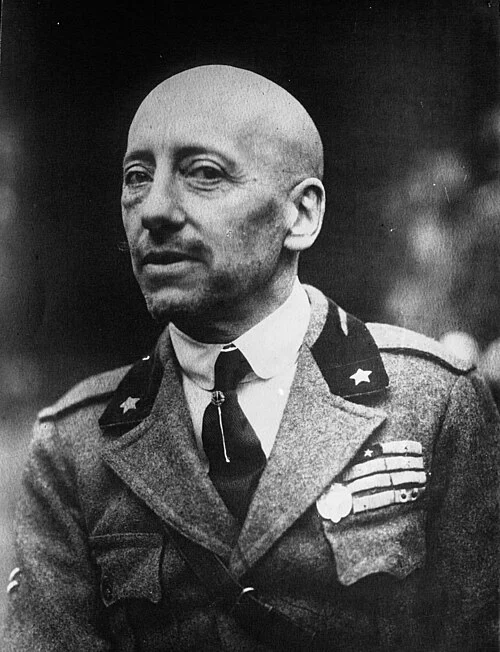
According to the Vittoriale encyclopedia, which preserves D’Annunzio materials, in November 1926 the poet tasted the sweet that the mayor of Pescara had brought to Gardone. The same encyclopedia and Bonciarelli’s paper preserve a poem in Pescara dialect dated 9 November. Addressed to the confectioner as “A Luiggìne D’Amiche,” it describes the sweet with words such as the town’s patron saint, earth plowed by oxen and round cheeses. To a sweet whose shape was taken from wood-fired bread, the poet added words drawn from the foods and landscape of his home region. The poem also appeared in the December issues of the newspaper Il Secolo.
The poem later came to be read on the thin paper and wrapping inside the box, and according to the encyclopedia, a dedication written in the poet’s commemorative book was also printed on the packaging. The relationship among letter, dialect poem and signature that Bonciarelli discusses becomes concrete when one looks at whom each text reaches outside the shop. The addressed letter reached the person to whom the sweet was sent; the poem in the newspaper reached readers of the page; the words on the packaging reached those who bought the sweet or received it as a gift. On opening the box, one could see the name of the land and of the maker before cutting the sweet.
The photograph of the shop’s exterior published by the federation dates from 1927. The shop-opening announcement of that year, included by Mario Massarotti, says that because Parrozzo had already become well known, a shop was being set up, with an opening ceremony on 2 July. A printed volume of the same year, cited in a study of Pescara’s industrial history, likewise shows that the D’Amico company was known for confectionery and that Parrozzo was one of several products. According to the federation, production and sales spread to other parts of Italy in the 1920s and 1930s, and some records say its premises were destroyed during the Second World War. The company history notes that the business was rebuilt after the war but did not return to its former state at once, and that in the late 1970s it reduced its café operation and concentrated on production. Later sales destinations also include the United States, Canada and Australia. A sweet that is baked and cut at home also has a history of being packed in boxes at a city shop and carried far away.
A Slice at Christmas, One Small Dome per Person
Search for “Parrozzo” in the Abruzzo region’s list of traditional agri-food products and it appears in the category covering bread, pastries and similar products. This is a source that gives the names of traditional foods; individual formulas can be read from the published recipes of pastry shops and food media. In Scanno, in the mountains of the same region, Pan dell’Orso (Pan dell’Orso), devised in 1970 by the Di Masso pastry shop, also uses almonds. Di Masso’s batter contains honey, butter, eggs and other ingredients, and its products include one with dark chocolate on the surface and another with the surface uncoated and chocolate in the batter. Sweets that at a glance resemble each other in color and appearance differ in the aroma of honey and in where the chocolate goes.
The present-day D’Amico company lists an aerated batter made with almond flour and a thin layer of dark chocolate as its features. The 460 g and 640 g in its listing are sizes for slicing, and the 20 g single serving is the “Parrozzino.” Put a large one on the Christmas table and its round form is on display; cut it for the number of guests, and the thin coating and yellow interior are visible on each plate. Dissapore also suggests coffee, tea and Aurum, a Pescara orange liqueur, to go with it. The Vittoriale encyclopedia presents the sweet and the liqueur together as Pescara products associated with the poet. With a batter made with lemon zest, the aroma of orange layers over a bite of almond and cocoa. Even with the same Aurum, in the use that Dissapore offers as a way to vary the aroma, it is mixed into the batter before baking instead of being served separately. Poured into a glass, the sweet and the liqueur can be tasted alternately; put into the batter beforehand, every slice of the dome carries the aroma from within.
Glossary
- Pane rozzo (also pan rozzo)
- A cornmeal bread said to have been baked in wood-fired ovens in Abruzzo. A clue to the sweet’s name and appearance.
- Semolino
- The wheat semolina that the recipes pair with almonds.
- Stampo da zuccotto (zuccotto mold)
- A heatproof mold used here to bake the batter in a hemispherical shape.
- Aurum
- An orange liqueur from Pescara. Some recipes serve it with the sweet.


