


SweetloreEncyclopedia of World Sweets (834)

Punschkrapfen
Punschkrapfen
A Viennese petit four that encloses fruit and rum aromas within pink glaze
Cakes / Austria

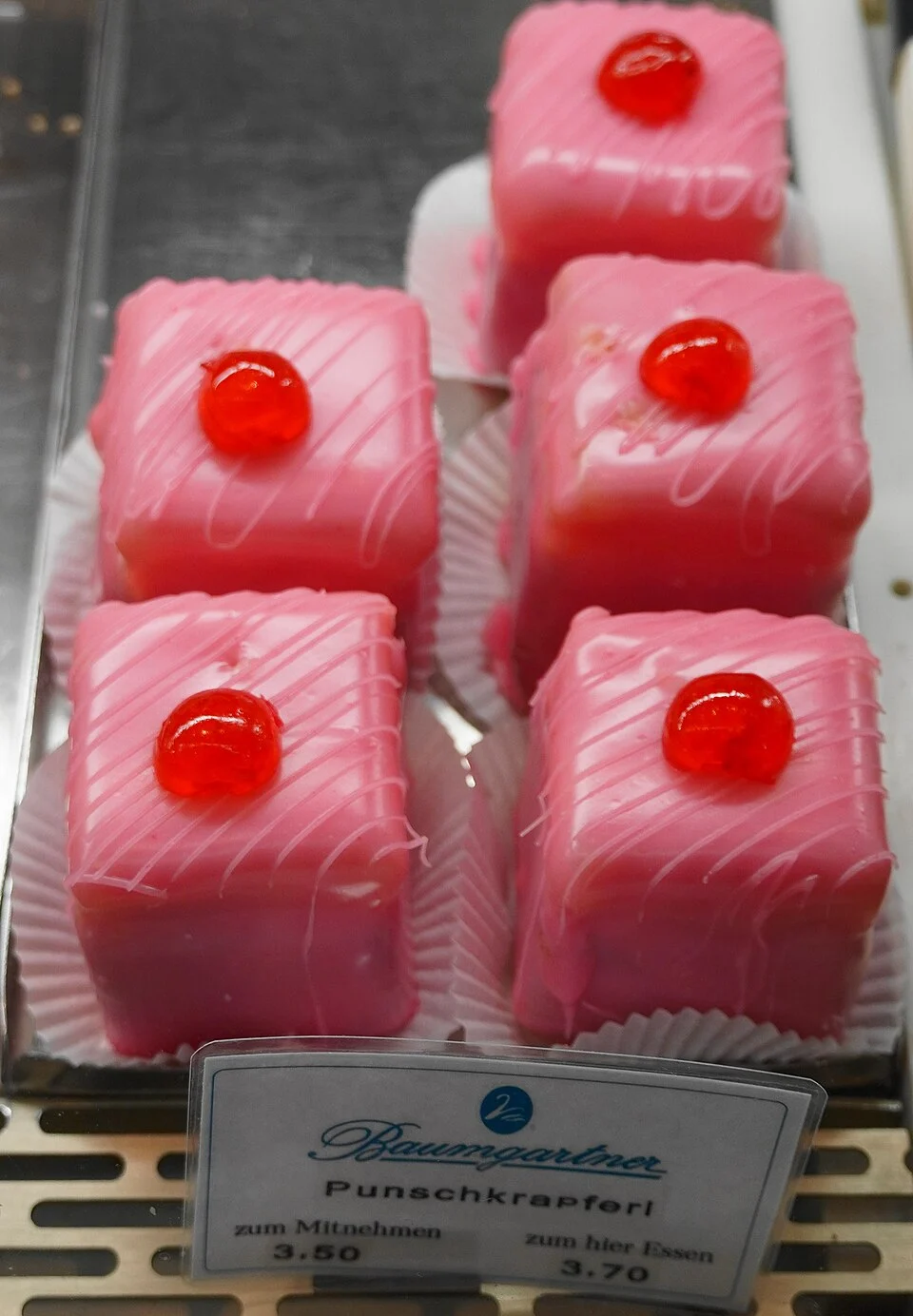
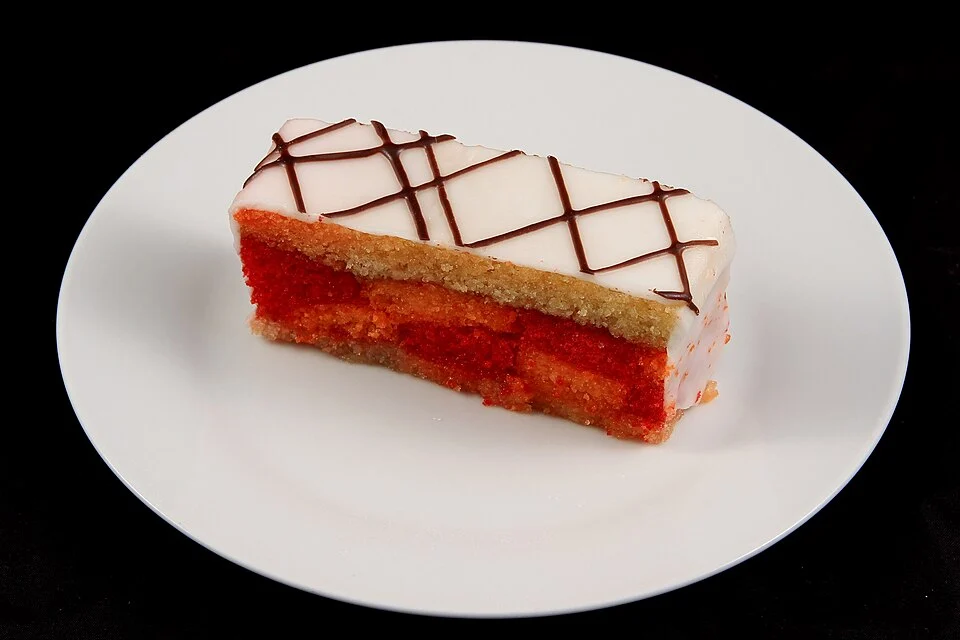
Break the pink corner of one lined up in a display case, and beneath the thin sponge you will see a moist layer of fine crumbs pressed together. Punschkrapfen is a small Austrian cake: sponge soaked with rum and apricot jam is sandwiched between thin baked sheets, and each piece is covered in pink glaze. In Vienna it is also affectionately called Punschkrapferl. Punsch is punch, a mixture of fruit juice and liquor. Inside the square corners or rounded outline, whether the tartness of apricot or orange, the aroma of rum, or the depth of chocolate comes forward depends on what the sponge inside has absorbed.
A thin sheet for the lid, a thick bake crumbled small for the filling
Beneath the exterior you see in the display case are two kinds of sponge baked from the same batter. In the formula that Markus Braunauer, pastry chef at Zum Schwarzen Kameel, presented to the Austrian Broadcasting Corporation (ORF), 10 eggs and 280 g of sugar make about 30 pieces. After the eggs and sugar are whisked well, 200 g of flour and 40 g of cornstarch are folded in gently by hand. About one third of the batter is spread thin and baked at 200°C for about 10 minutes; this makes the sheets that go on the top and bottom. The rest is spread thickly on another tray and baked at 180°C for about 40 minutes. Once cooled, it is torn by hand and used for the filling. The outer layer is assembled as intact sheets and only the inner sponge is crumbled, so using two trays lets the thickness and the degree of baking differ.
In the version that the Vienna Tourist Board presents from the Sacher cookbook Das Neue Sacher-Kochbuch, the dry ingredients and melted butter are added to beaten eggs and sugar. About one third is spread to a thickness of 3 mm and baked in a convection oven at 220°C for about 8–10 minutes. The rest goes into a 24 cm diameter tin, is baked at 170°C for about 15 minutes, and is cut into cubes of about 1 cm. The dry ingredients are 70 g of flour and 90 g of cornstarch, together with 60 g of melted butter. Braunauer’s broadcast version uses a larger proportion of flour and no butter, so even within the shared idea of using one sponge for both the thin sheets and the filling, the batters differ. Whether the sponge is torn by hand, as Braunauer does, or cut into even cubes, juice and liquor enter through the cut surfaces. The thin layer left uncut holds the moist crumbs from above and below.
The version from the German baking-ingredients company Dr. Oetker cuts the top and bottom rectangles from a single sheet baked on one tray, then moistens the leftover trimmings with apricot fruit spread and rum. The mixture is made just firm enough to hold together when pressed, then sandwiched between sheets of plastic wrap, rolled into a rectangle and stacked with the top and bottom sheets. At Braunauer’s shop, which bakes a fresh tray for the filling as well, the suggestion is to cut circles from the large assembled slab, roll the remaining pieces into balls and coat them in glaze to make a different sweet. Whether the trimmings of the thin sheets are taken right after baking and moved into the filling, or the trimmings left after shaping are rolled into another small sweet, there are uses for leftover batter.
Crumbs soaked with punch, supported from above and below
In the Tourist Board’s version, the cut cubes of thick sponge soak up a liquid made from apricot jam, rum, orange juice and zest, and sugar. The liquid combines 200 mL of freshly squeezed orange juice, the grated zest of one orange, 60 mL of rum, 150 g of apricot jam and 100 g of sugar. It is brought to a boil once, cooled, combined with the sponge and left for about 30 minutes. If only the surface of the cubes is wet, the crumbs fall apart when pressed. Once they have absorbed the liquid and hold together like dough, they are ready to be shaped. In the version that Braunauer presents separately as his shop’s method, two rums of different strengths, an orange liqueur and apricot jam are mixed directly into the sponge. Whether liquids are combined, boiled and then added, or the aroma of the liquor is transferred directly to the sponge, the fruit and liquor aromas turn out differently.
For the Tourist Board’s 12 pieces, 24 discs of 3 cm diameter are cut from the thin sheet. Warmed, strained jam is brushed on the discs. A cutter ring is set over one disc, the filling is added to a height of about 2.5 cm and pressed down. The ring is removed and a second disc serves as the lid. Braunauer’s broadcast method is to halve the thin sheet, spread and press the filling over the half brushed with apricot jam, cover it with the other half and freeze it for 2–3 hours. The chilled slab is turned over so that the side dusted with icing sugar, which keeps it from sticking to the work surface, becomes the bottom. Jam is brushed on the top and circles of about 4 cm in diameter are cut out. Pressing the filling as a slab gives an even height all at once, and cutting it in a grid instead of into rounds gives angular pieces.
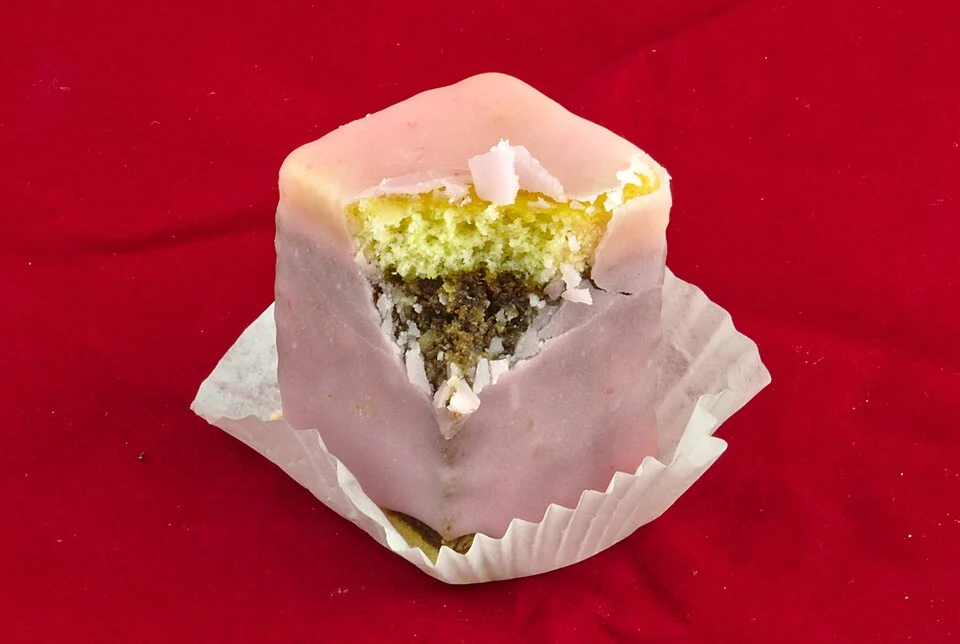
The jam on the sponge layers adds flavor and also joins the top and bottom sheets to the inside. In the Tourist Board’s version, the assembled cakes are set on a rack and frozen for 1 hour, then heated jam is brushed over the outside as well and left to dry for 20 minutes. This thin fruit film covers the fine pores of the sponge, and glaze poured over it makes the surface irregularities less noticeable. Warming and straining the jam leaves no large pieces of fruit, so it can be brushed thinly even over the corners of a small cake. Even when a large slab is assembled, as Braunauer does, the top is smoothed with jam before the cutter is applied. At the boundary between outside and inside there is fruit flavor, and the construction keeps the lid from coming far away from the filling when a fork goes in.
Pouring pink fondant and letting the excess drip off
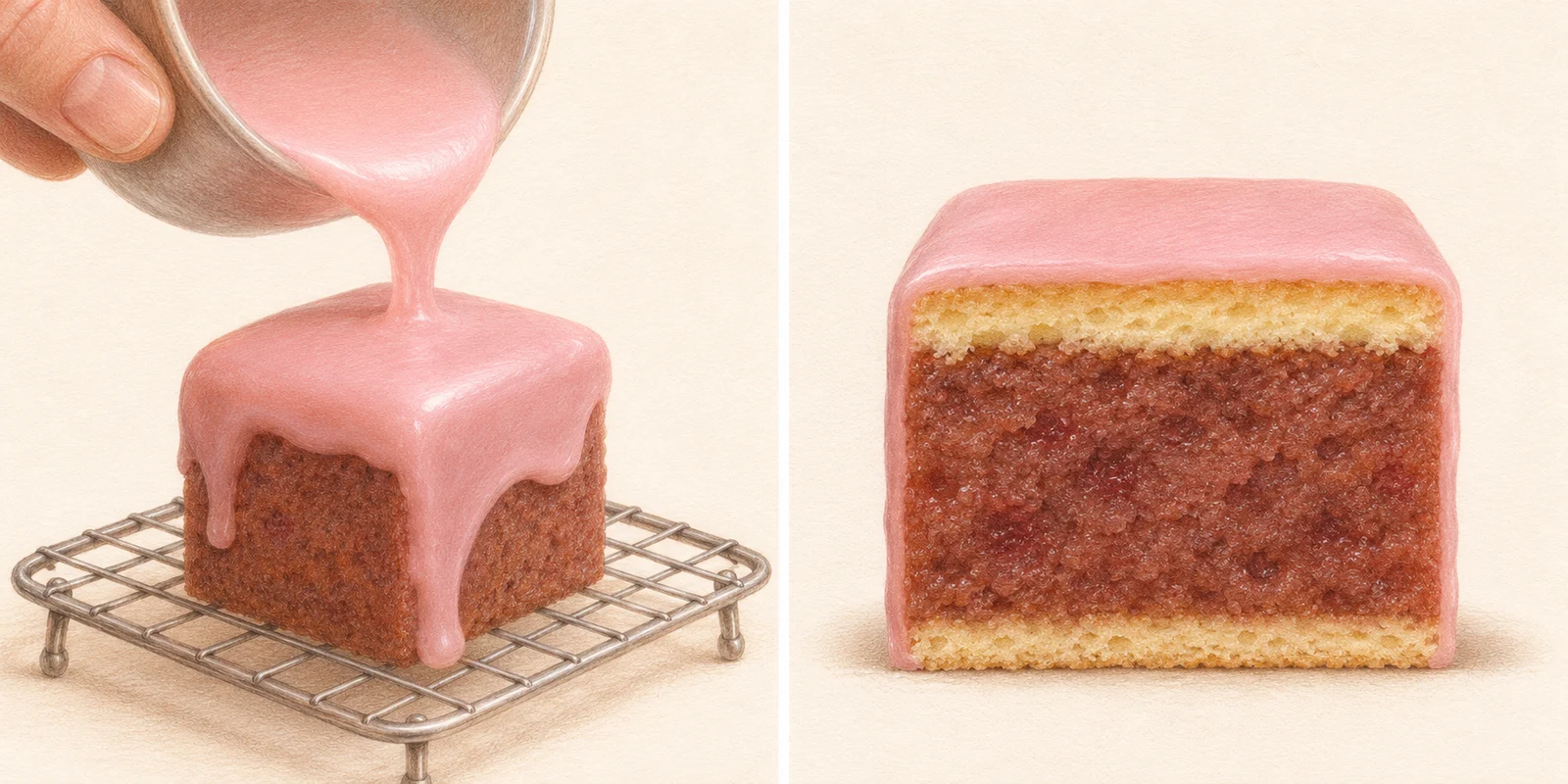
The whiteness and smoothness of fondant come from fine sugar crystals dispersed in a concentrated sugar syrup. In the Tourist Board’s version, 300 g of fondant is warmed in a bain-marie to no more than 40°C, lemon juice is added, and it is tinted pink with reduced cherry juice or food coloring. When it has cooled to about 30°C, it is poured on quickly, and before the surface dries, a cocktail cherry or fine lines of chocolate can be added as desired. The cakes rest on a rack for at least 30 minutes and then go into fitted paper cups. The Tourist Board suggests a sweet wine as the drink. It is a pairing of a sweet drink with a small cake in which the juice-soaked layer and the glaze are eaten together. When you take a purchased piece out of its paper, the same pink is found on the sides as well as on top, because the glaze runs down and forms a thin layer.
In Braunauer’s broadcast formula, 25 mL of water and food coloring are added to 125 g of fondant, and the cakes are dipped in it. The loosened glaze drips down beneath the rack, and the layer that remains on the surface is dried without refrigeration. The chilling is done earlier, less for the glaze than to make the dough, formed by pressing the top and bottom sheets together, easier to cut out. Of two sweets of similar color, one tinted with cherry juice takes in juice, while one tinted with food coloring has no more juice even though the color is the same. There are also Austrian versions that add rum to the glaze.
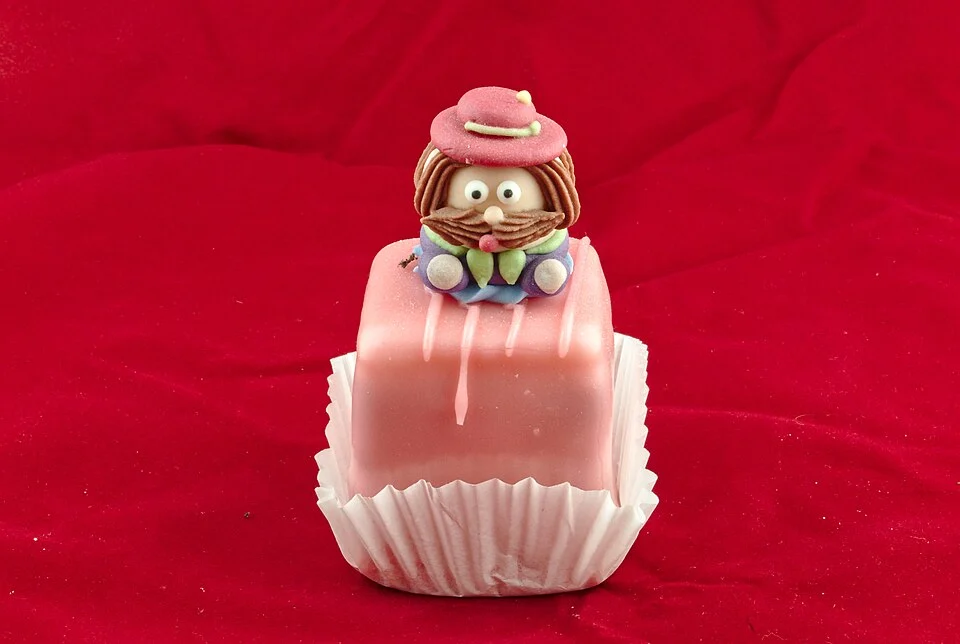
Even under the same pink, color and flavor change with what is crumbled and mixed in. In the formula of a Burgenland wedding-pastry maker presented in Die Presse, the sponge left after cutting circles is combined with separately baked and crumbled chocolate cake, melted chocolate, apricot jam and rum. In the Tourist Board’s formula, which boils the juice, chocolate is added only to the decoration if it is used. Der Standard, which compared Vienna shops side by side, also describes one piece in which chocolate comes forward, one with an orange aroma and one in which the crispness of the glaze remains.
The punch is added after the sponge has been baked. In methods that do not return the cake to the oven afterward, the stage at which heat is applied to the liquor differs between a rum-containing liquid boiled once and rum added directly to the baked sponge. The Austrian Food Codex Commission cites this sweet as an example of a baked good that uses liquor as an ingredient, and distinguishes it from alcohol used to dissolve flavorings. The mixed juice aroma and the pink glaze do not reveal the kind or amount of rum used.
Boxes carried to Viennese cafés, and shops that make it a single bite
Before leaving for Britain in 1939 on a Kindertransport, the transports that took children fleeing Nazi persecution abroad, Vienna-born Josef Eisinger delivered pastries. According to his memoir, he fixed boxes of cream pastries and Punschkrapfen to a rack attached to his back and cycled along streets with cobblestones and tram tracks, delivering to cafés and pastry shops in the city. This testimony from the late 1930s contains no formula, but it preserves a scene of small pastries being carried from shop to shop.
Today at Zum Schwarzen Kameel, it appears on the display-case menu alongside slices of Linzer torte and Esterházy torte. It is also included in the shop’s assortment of small pastries, and Gerstner serves it as a bite-sized petit four for standing receptions. Tastings at several Vienna shops show a range in size, from about 40 g to about 140 g per piece. In a similar shape, the smaller the piece, the larger the glazed surface relative to the filling, and a single bite takes in the jam seam as well. At a size served on a plate, you can scoop out just the center with a fork and taste more of the liquid-soaked sponge.
On shop shelves, the Faschingskrapfen, which carries the same “Krapfen” name, is a round yeast-leavened dough fried in oil on both sides, filled with apricot jam and dusted with icing sugar. Even if both choose apricot as the fruit, the small cut sweet has sponge soaked with rum and juice layered inside, while in the fried one the jam comes out from within the fermented dough. Which dough is made into a bite shows not only in the name but also in the shape on the plate and in the process.
Cut first, or show the cut face
In neighboring Czechia, punčový řez is a cut cake that shows its punch-flavored layers. In the version from the Prague pastry shop Myšák, sponge soaked with cooked fruit liquid is layered and topped with fondant. Czech cooking shows also feature versions made with pear or mango. Vienna also has a method of assembling the cake as a slab and then cutting it, but in a small sweet whose cut sides are wrapped in glaze as well, the color inside shows at the first bite. The Czech cut cake shows red or pale bands from the side beneath the glaze poured over the top.
At the 2020 announcement of Vienna’s municipal coalition agreement, Mayor Michael Ludwig presented Christoph Wiederkehr with an oversized Punschkrapferl. In a later interview, the mayor explained the design, with pink used widely on the outside and a little red placed on top, as a gift showing that the two sides had negotiated as equals. In an interview with a local newspaper a few days later, the cake was cut and shared among several people at City Hall. An ordinary single piece is cut before finishing and wrapped entirely in glaze, and at a standing reception it can be picked up as it is. At City Hall, by contrast, the pink cake was shown first, and when it was cut at the table, its inside was divided among several people. Because its form is known as a Viennese sweet made one piece at a time, the stage at which it is cut also became part of the spectacle when it was presented to others.
Glossary
- Punsch
- Punch. In confectionery, the term refers to a liquid made by combining rum, fruit juice, sugar and the like to flavor sponge, or to the filling soaked with that liquid.
- Fondant
- The base of a white, smooth glaze containing fine sugar crystals. In this sweet it is loosened, colored and used to cover the shaped dough.
- Petit four
- A small sweet prepared in a bite-sized form. In shop assortments and standing-reception menus, small Punschkrapfen are also served in this form.
- Kindertransport
- The transport abroad of children fleeing Nazi persecution. In his memoir, Eisinger writes about his delivery work before leaving Vienna for Britain in 1939.


