


SweetloreEncyclopedia of World Sweets (834)

Baked Alaska
Baked Alaska
A meringue dessert with cold ice cream sealed beneath a browned surface
Desserts / United States, New York, etc.

Baked Alaska is a dessert in which ice cream is set on a base such as sponge cake, covered in a meringue of egg whites whipped with sugar, and browned on the surface. Cut into it with a knife and you find soft foam beneath a thin, browned crust, with cold ice cream beyond that. Layers of such different temperatures and textures can be cut together because the thoroughly frozen filling is covered with foam, and the dessert is taken off the heat while only the outside has colored.
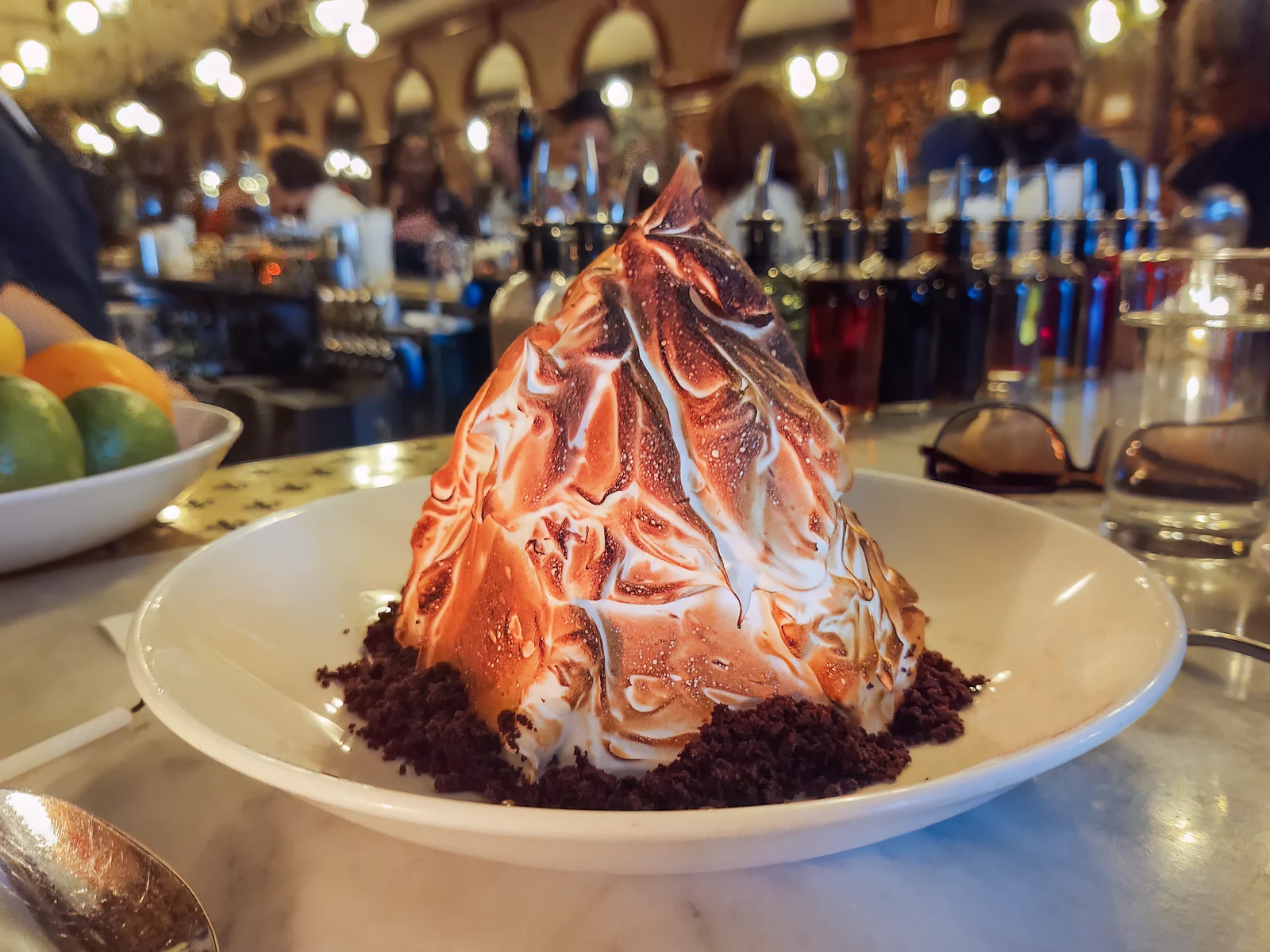
Freeze the ice cream first, then cover it with foam
The process begins with chilling rather than baking. In a King Arthur Baking example, raspberry and mango ice creams are packed in alternating layers in a bowl, topped with a brownie cut to fit the bowl’s opening, and frozen. With these two tart fruits, the cut face shows a pattern of differently colored ice creams, and the dark chocolate base sits at the bottom. When the bowl is turned out onto a plate, the brownie ends up underneath, topped by a dome of ice cream that has taken the rounded shape of the bowl. If the ice cream is frozen together with its base, the meringue can be spread on as soon as the dessert comes out of the freezer, without having to reshape ice cream that is starting to soften. Charles Ranhofer’s 1894 recipe also directs that the cake and the molded ice cream, once assembled, be kept in a cold place until the dessert is finished.
The foam is spread from the top down to the bottom edge, covering the point where the ice cream meets the base. Fannie Merritt Farmer’s cookbook calls for a thin sponge that extends half an inch (about 1.3 centimeters) beyond the ice cream all around, with meringue spread smoothly over the top. A base with some margin lets the foam be spread right to its edge, sealing the covering along the bottom. In France, Auguste Escoffier uses a génoise sponge 2 centimeters thick as the base and specifies a meringue of an even thickness of about 1.5 centimeters. Although the shapes and dimensions differ, both methods close up any gaps where the ice cream would be exposed before the dessert is heated.
When egg whites are whipped, their proteins form thin films around tiny air bubbles. Sugar helps keep the foam stable. A practical activity in the British science-education magazine Catalyst focuses on the air trapped in this foam. Even when the outside of the meringue is exposed to heat, it takes time for that heat to cross the air-filled layer and reach the cold ice cream. The sponge base also contains small air pockets, which slow the transfer of heat from below. Freezing the ice cream hard and keeping the heating brief work together, so the interior is still cold when the dessert is cut.
When an oven is used, the whole dessert goes into a hot oven and comes out once the surface of the meringue has colored. Farmer’s recipe also calls for quick browning, and in the Catalyst activity students check that, when the dessert is cut, frozen ice cream can be seen inside the hot meringue. In this activity, a sponge about 20 centimeters in diameter and 2.5 centimeters thick is spread with jam and baked at 200 °C for about 10 minutes. This differs in both size and construction from Ranhofer’s individual molded portions, which take about 2 minutes. The sponge is already baked and the ice cream already frozen; the finishing step needs only enough heat to brown the surface of the foam. The longer the dessert stays in the oven, the more heat travels inward, even through the foam covering.
With a torch, the outside of the dessert is browned by moving the heat from one spot to another. The King Arthur Baking recipe uses a Swiss meringue, in which the egg whites and sugar are warmed until the sugar dissolves and then whipped. Once the dessert is covered, the torch flame is kept moving rather than held in one place. Whether the surface is smoothed or left with swirls and peaks also changes how the finished dessert looks. In a slice with an uneven surface, the spoon passes first through the thin browned crust on the peaks, which color first, then through the soft foam inside, and finally into the cold center. For cutting a large dessert into portions, the company’s recipe uses a knife dipped in hot water and wiped dry, rewarmed before each slice. This extra step helps the blade pass through ice cream that is still holding its shape.
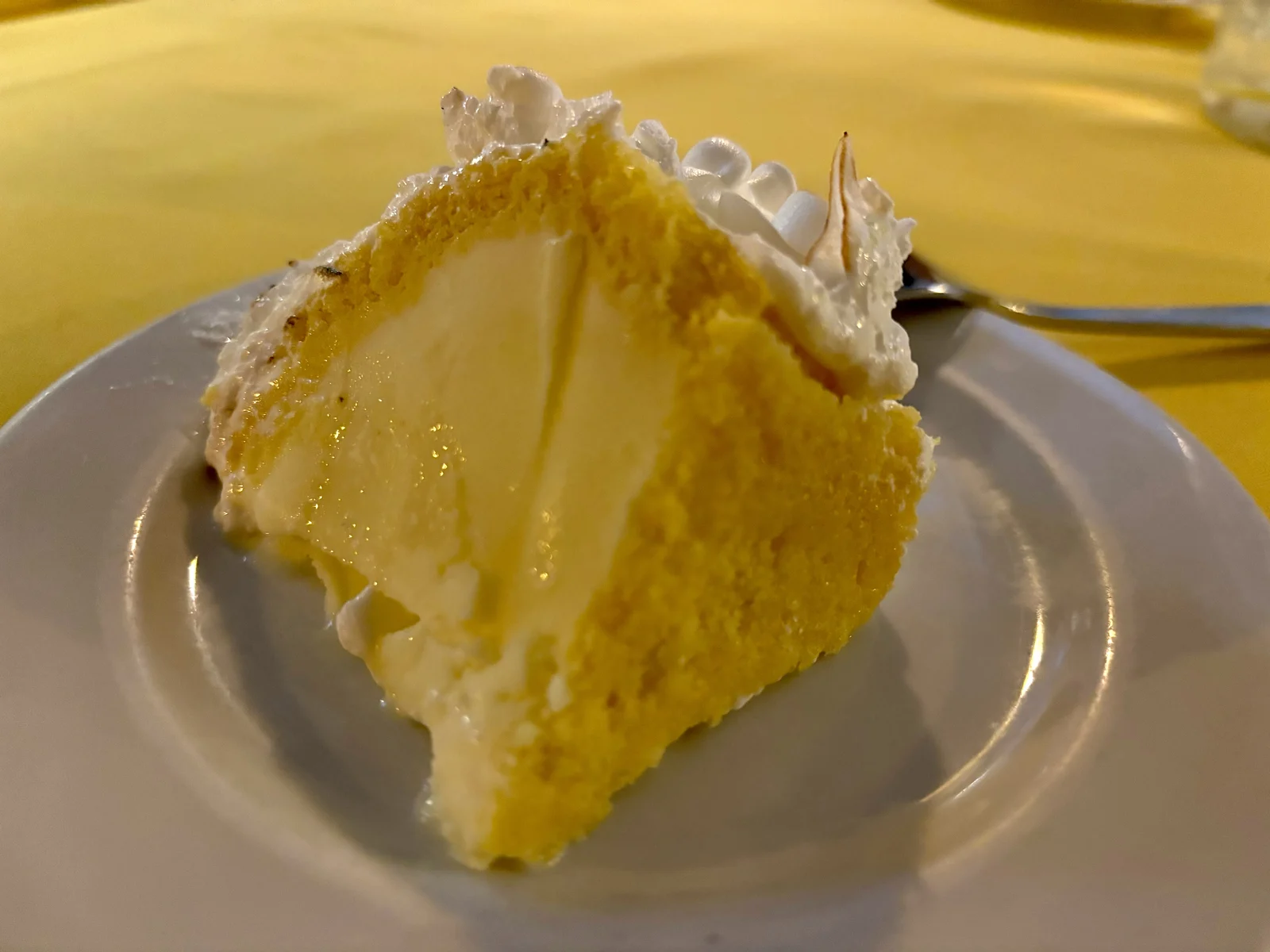
Individual portions baked in the kitchen, a large dessert cut at the table
Ranhofer’s The Epicurean, published in 1894, includes recipe No. 3538, “Alaska, Florida.” A vanilla-flavored Savoy-style sponge is baked in small molds about 7 centimeters in diameter, hollowed out and spread with apricot marmalade. Banana and vanilla ice cream, frozen in a separate mold, is then fitted onto it. When the cake is cut, the apricot flavor sits between the sponge and the ice cream.
In the kitchen, shortly before serving, meringue is piped onto each portion from the bottom upward. The foam is made thinner toward the tip to form a cone, and the dessert goes into a hot oven for about 2 minutes. The instructions say to take it to the table as soon as it turns a light golden brown. The illustrations of the finished dessert show molded ice cream covered with piped meringue. The book’s suggested menus also list the ice cream “Alaska, Florida” with the reference number 3538. The book shows only that the recipe was included in menus. When it was actually served to guests would have to be confirmed from dated menus or restaurant records.
In Farmer’s The Boston Cooking-School Cook Book, a 2-quart (about 1.9-liter) brick of ice cream is set on a single thin sheet of sponge. The dessert is assembled on a paper-covered board, spread smoothly with the egg-white-and-sugar foam, browned quickly in the oven and then transferred to a platter. The book describes the paper-covered board, like the sponge and the foam, as a material that conducts heat poorly. Page 448 carries the heading “Baked Alaska.” The public edition consulted bears copyright notices for several years, so the year in which this heading was first printed cannot be determined from that page alone.
Ranhofer’s small cones are sized to be served one per person. With Farmer’s recipe, a single rectangular dessert is cut with a knife into as many portions as needed. The dinner dessert menu at Gage & Tollner in Brooklyn includes a Baked Alaska for two to share. Layers of mint, dark chocolate and amarena cherry ice cream, with the crunch of chocolate cookie, are covered with meringue browned on the surface. Whether individual portions are assembled in advance or a large dessert is brought to the table also determines who cuts through the layers beneath the browned surface, and where.
The Alaska name, and frozen desserts in warm crusts
This dessert is associated with Delmonico’s restaurant in New York, and one story holds that it was named to mark the United States’ purchase of Alaska. What Ranhofer’s cookbook, published in 1894, confirms is the name “Alaska, Florida” and the method. The publication year is also recorded in a holding library’s bibliographic record. The book’s recipe and suggested menus do not show how the purchase came to be linked with the name, or when the dessert was first served at the restaurant.
The pairing of a cold filling with a warm crust appears at the table even before these cookbooks. At a dinner at the President’s House in 1802, Manasseh Cutler noted in his diary a dry, thin, flaky crust served with the ice cream. A letter by Samuel Latham Mitchill describes balls of frozen filling enclosed in warm pastry. What the two men left are descriptions of texture and temperature as the dish was served; they mention no ingredients or steps that would indicate a covering of whipped egg white.
A separate memorandum in Thomas Jefferson’s own hand, held by the Library of Congress, records how the cold filling was made. Egg yolks and sugar are combined with cream heated with vanilla, then cooked and strained. The mixture is chilled in a container with ice and salt and frozen while the portion that freezes to the inside is scraped off with a spatula. Finally, it is packed into a mold and kept in ice until serving. To release the ice cream, the outside of the mold is warmed. The handwritten memorandum records how the ice cream was frozen and unmolded, while the two 1802 accounts describe a table at which it was served in a warm crust.
The oven-finished omelette and the bombe set alight at the table
Escoffier’s Le Guide culinaire, published in 1903, includes the omelette norvégienne as a variety of omelette en surprise. An oval of génoise is set on a long platter, and ice cream of the desired flavor is mounded on top. It can be made with a dairy ice cream or with a fruit ice. The covering of stiffly beaten egg whites is smoothed flat, and more of the same meringue is piped on as decoration. The dessert is colored quickly over fierce heat and served before the heat reaches the center. In this case, “omelette” means a frozen dessert with an egg-white covering that protects the ice cream.
On the same page, the cherry version mixes cherry ice cream and kirsch-soaked cherries into an ice flavored with redcurrant and raspberry. After the dessert comes out of the oven, cherries steeped in spirits are arranged around it, and warmed kirsch is set alight at serving. This finish, in which spirits are set alight, is called flambéing. The mandarin version uses a mandarin ice and is surrounded by fruit coated in sugar boiled until it sets hard. Even within a single cookbook, the final step before the dessert goes to the table varies: foam browned in the oven, spirits burning around the dish, or a sugar coating on fruit.
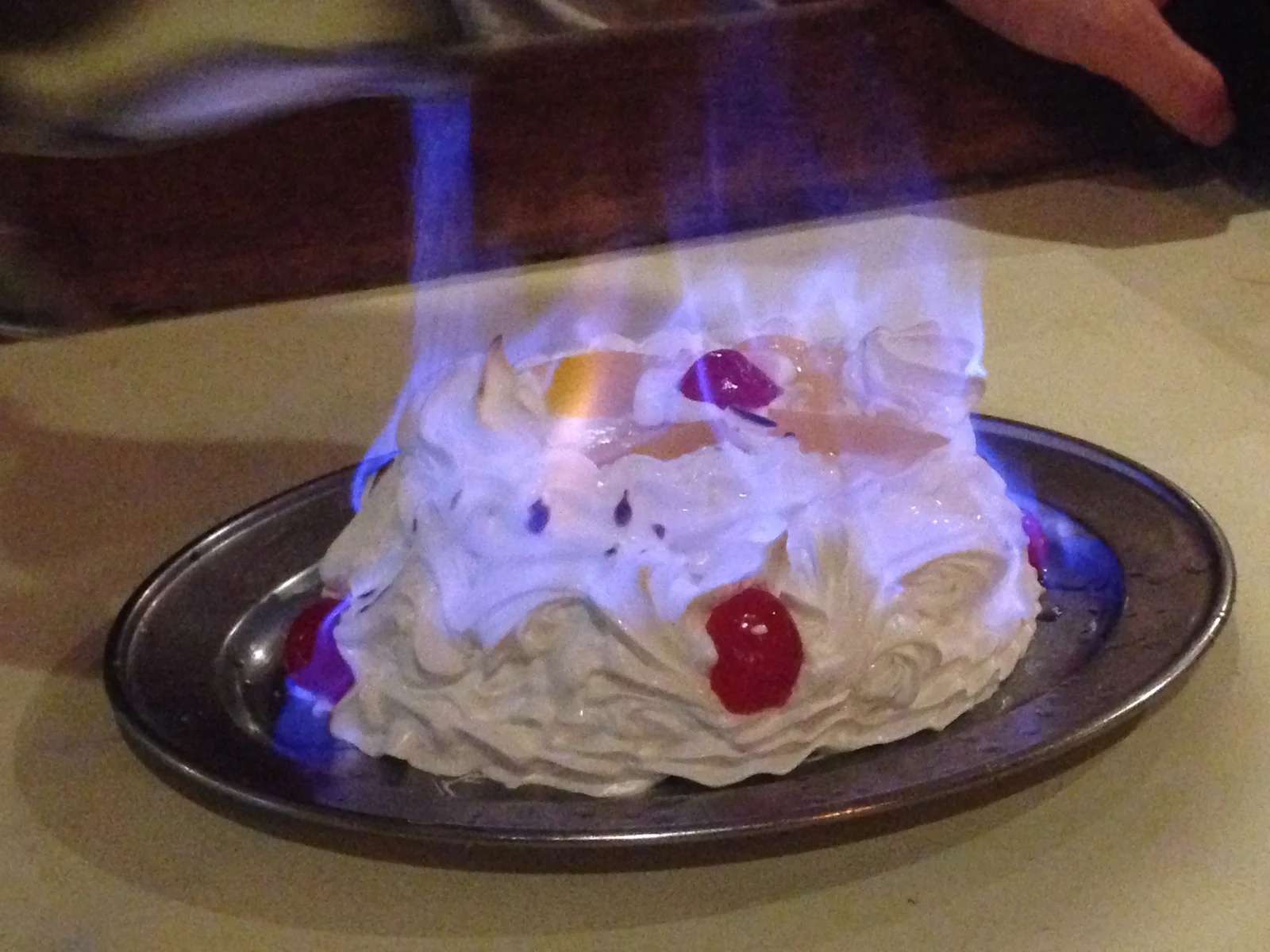
The bilingual menu of Chesa, a restaurant at The Peninsula in Hong Kong, lists “焗火焰雪山” alongside “Baked Alaska.” In a set menu for four, it is the dessert served after a cheese fondue, eaten by dipping bread, and a main course. The Chinese section lists ice cream, meringue and rum, while the English section describes an ice cream cake topped with flamed meringue. Escoffier uses kirsch around the cherries, whereas Chesa’s dessert includes rum. The menu shows what the dessert is called in Hong Kong and gives one example of how it is served there; it does not show when it was first served in the city.
Shashlik in Singapore also serves Baked Alaska as a dessert flamed beside the table. The restaurant is run by Hainanese cooks who have long prepared Russian and European dishes; it was opened in 1986 by nine people who had worked at its predecessor and pooled their money. The restaurant lists this dessert and cherries jubilee as dishes flambéed beside the guests. When the foam is browned in the oven before the dessert is brought out, the cut face shows the contrast in temperature. When spirits are set alight at the table, another step takes place in front of the guests before the dessert is cut.
Glossary
- Meringue
- A foam made by beating air into egg whites and adding sugar. It is heated briefly to color its surface and encases the ice cream.
- Génoise
- The sponge Escoffier uses as a base. His book specifies an oval 2 centimeters thick.
- Swiss meringue
- In the King Arthur recipe, a meringue made by warming egg whites and sugar until the sugar dissolves, then whipping them.
- Flambé
- A finish in which spirits are set alight. Escoffier’s cherry version directs that warmed kirsch be set alight at serving.


