


SweetloreEncyclopedia of World Sweets (834)

Bossche bol
Bossche bol
A large choux filled with cream and covered in chocolate
Baked Sweets / Netherlands · ’s-Hertogenbosch

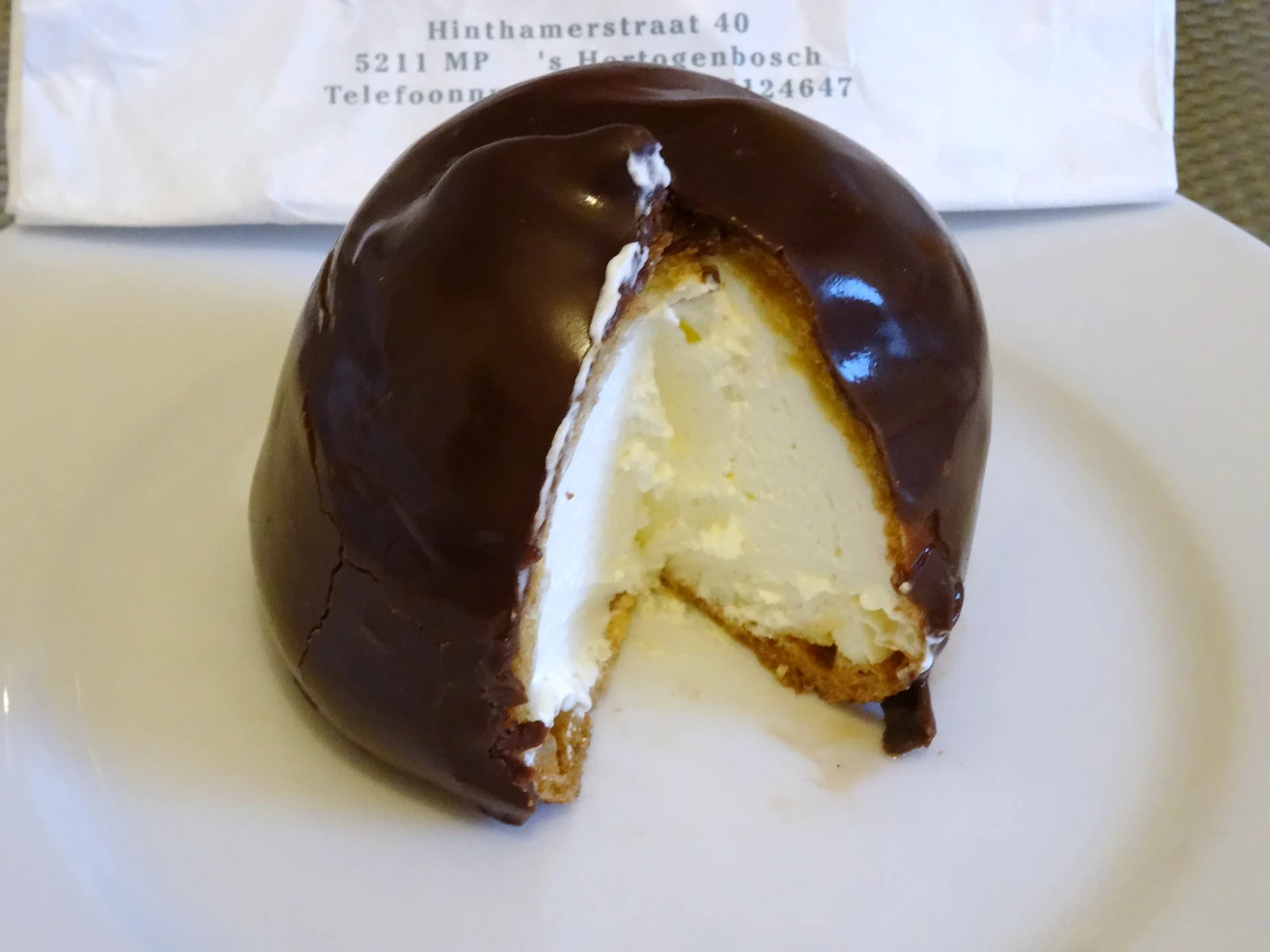
When a knife cuts into the round pastry coated in dark chocolate, white cream spreads out from inside the thin choux shell. The Bossche bol is a pastry of ’s-Hertogenbosch, commonly called Den Bosch, in the southern Netherlands. In one shop cited by a tourist guide, it measures about 12 cm in diameter. A large choux shell is baked and cooled, and whipped cream is piped in from the bottom. This white filling is also the version that a local pastry shop announced in a newspaper in 1924 as a new product.
Baking a Shell That Holds Plenty of Cream
The dough is a choux pastry, called soezenbeslag in Dutch. In the published recipe of the pastry chef Robèrt van Beckhoven, water and butter are heated, and flour and salt are added to the boiling liquid. The pan is returned to the heat, and the mixture is stirred and cooked until a thin film remains on the bottom of the pan. This step takes the mixture from flour that has merely been added to a liquid to a dough that can be handled with a spatula. The dough is moved to a bowl, and once it has cooled slightly, beaten eggs are added.
The eggs are added a little at a time, each addition being absorbed into the dough before the next. Van Beckhoven gives as a guide a dough that falls from the spatula, and he explains that too much egg relative to the flour makes the dough hard to shape. In this example a raising agent is also mixed in at the end, and the dough is piped onto a baking tray in even sizes with a piping bag. The home-cook example from the retailer DekaMarkt shapes mounds with a moistened spoon and leaves a space between each. Because the dough spreads as it bakes, neighboring pieces are already set apart when they are placed on the tray.
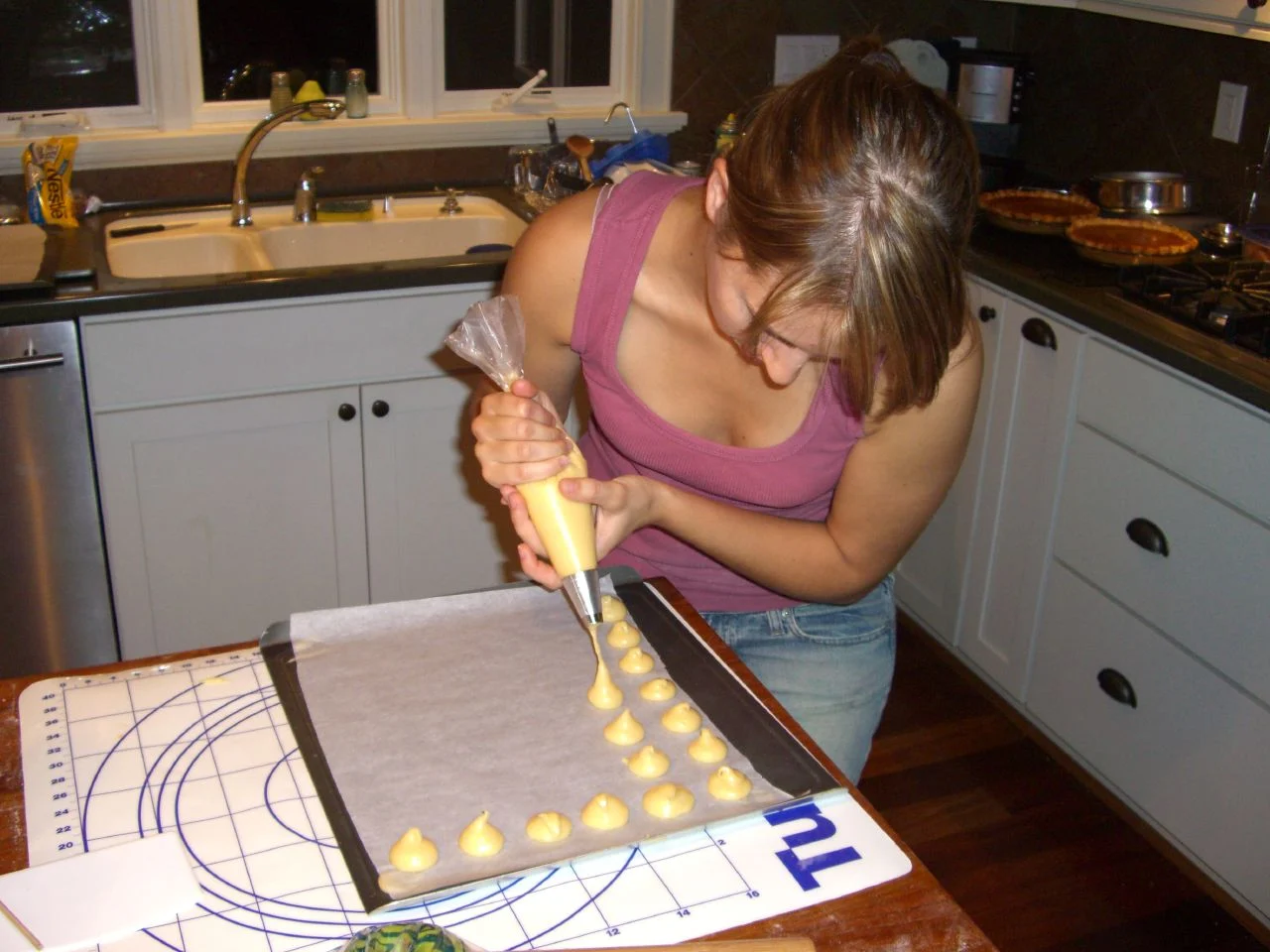
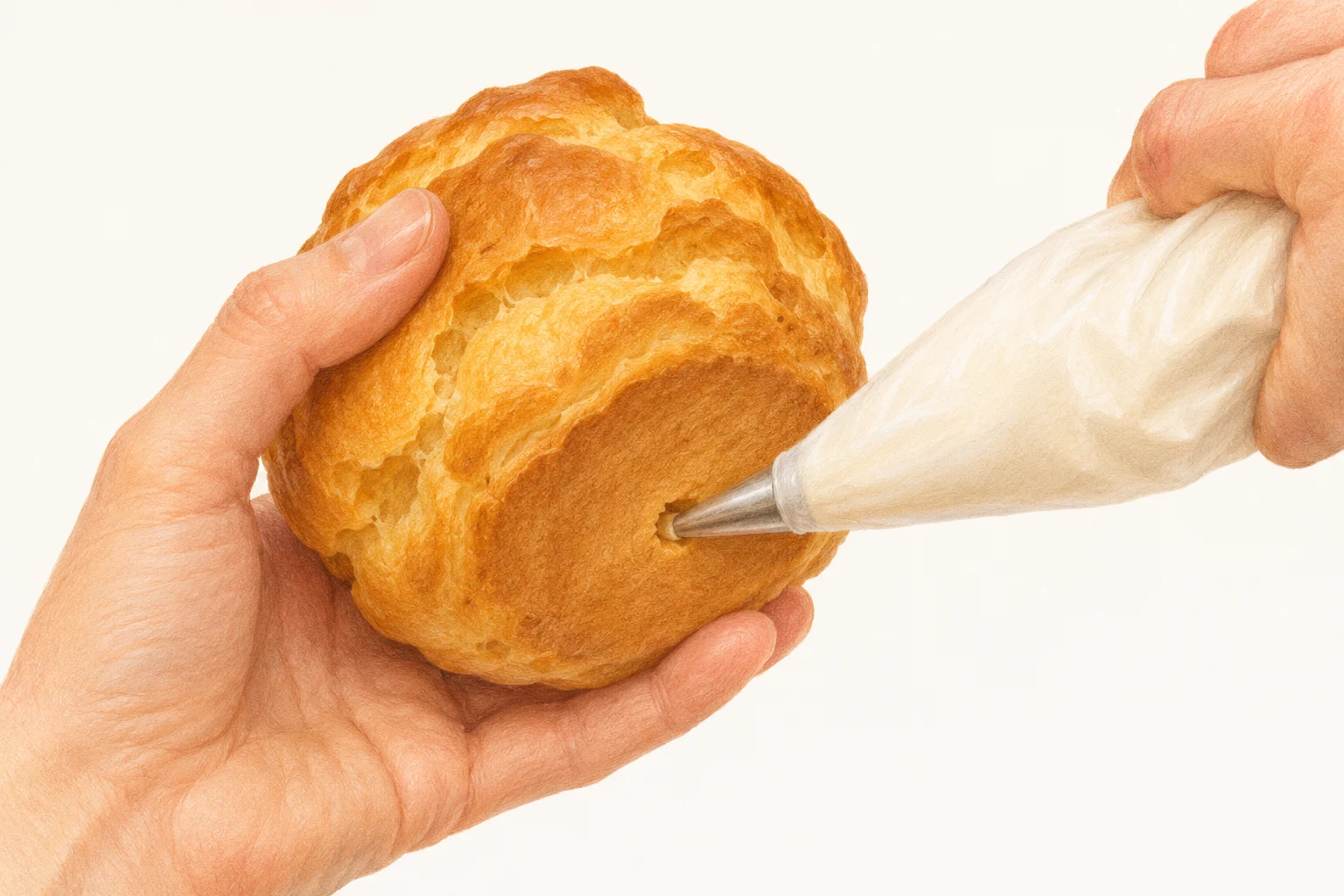
Oven conditions are given for each example. Van Beckhoven’s example preheats the oven to 220°C, sprays a little water inside to create steam, and bakes for about 25 to 30 minutes. DekaMarkt bakes at 200°C. When the shells are done, they are pierced in the base and turned over, then dried for another 5 minutes in the oven with the heat switched off. The cream goes later into the cavity that formed while the shells were hot. Drying them before cooling means the empty shells can be carried, or held by the base and dipped in chocolate. Until the cream goes into the cooled cavity, the baked shell supports the shape of the pastry.
Filling from the Bottom and Coating the Outside with Chocolate
In van Beckhoven’s example, the cooled choux is held by its base and dipped deep into liquid chocolate, then placed in the refrigerator to let the coating settle. A small hole is then made in the base, and whipped cream (slagroom) is piped in. There is no hole on top for decorating with cream, so the filling opening is not visible when the pastry is served on a plate. The filling is done from the bottom so that the coating is not touched and damaged. A local profile of the intangible cultural heritage also describes the method of filling from the bottom and the craftsmen’s ingenuity in covering the choux with chocolate.
In DekaMarkt’s example, the cream is filled first and the chocolate is spread around afterward. The chocolate for the coating is melted with the remaining cream over low heat. Another procedure published by van Beckhoven simmers sugar, water and cocoa, then takes the pan off the heat and combines the mixture with dark chocolate. The menu of Jan de Groot’s shop describes its own coating as a combination of chocolate, sugar and cocoa butter. Makers differ on whether to dip and then fill, or to fill and then coat. Whichever order is used, of the layers that reach the mouth last, the one covering most of the surface is the chocolate.
The craftsmen’s recollections in the intangible heritage materials also mention tools for dipping choux in chocolate. One shop removed the middle tine of a fork and bent the outer tines to use it. Jan de Groot remembers that other shops, after passing choux through chocolate, set them on a stick. When it came to lifting a round choux while covering its outside broadly, each pastry shop devised a tool from what was at hand. Modern home examples also differ, with some holding the base and dipping the choux into the liquid, and others applying the chocolate with a brush or similar tool.
When a knife is put to a portion, the thin skin beneath the chocolate cracks first, and the whipped cream spreads softly. Strik Patisserie’s product material explains that a light choux is filled with cream containing milk fat and finished with a dark chocolate coating. The shop also notes that if the pastry is left standing, droplets of water may appear on the chocolate and the condition of the cream may change. Because a baked shell, cold cream and a set coating come together in one pastry, the mouthfeel of each layer changes with the time that passes after it is made.
The Netherlands also has other choux pastries topped with chocolate. Strik Patisserie’s material explains that the pastry called a moorkop uses chocolate-flavored fondant, whereas the shop’s Bossche bol uses a dark chocolate coating and a hollow choux. In the examples compared by the food media outlet 24Kitchen, another chocolate pastry is covered only on top and may be decorated with cream or fruit. Makers use the name in varying ways, and the differences between their methods can be checked by looking at how much of the pastry is covered, the decoration on top, and the filling opening in the base.
Two Fillings Side by Side in Shop Fronts on Visstraat
The town’s heritage institution, Erfgoed ’s-Hertogenbosch, has collected pastry shops’ advertisements from local newspapers to examine what ball-shaped pastries were called. In 1892, De Klok on Vughterstraat advertised roombollen, and another pastry shop, Mandos-Baudouin, advertised chocolade roombollen. These names show that a way of naming that linked chocolate and cream already existed in the town in the nineteenth century. Because the advertisements give no detailed cross section or method, the filling at that time cannot be treated as the same as today’s whipped cream.
In an advertisement of 19 January 1903 confirmed by the institution, De Klok used the name chocolade bol and announced its sale alongside other pastries. In 1919, another Lambermont shop wrote in an advertisement that it had handled a pastry of the same name for more than thirty years. The 1903 advertisement gives a date that can be verified, while the figure of more than thirty years is the shop’s own account at the time. We cannot learn as much about the baked dough or the filling, but it can be confirmed that the name of the pastry was being used early on as a shop’s product.
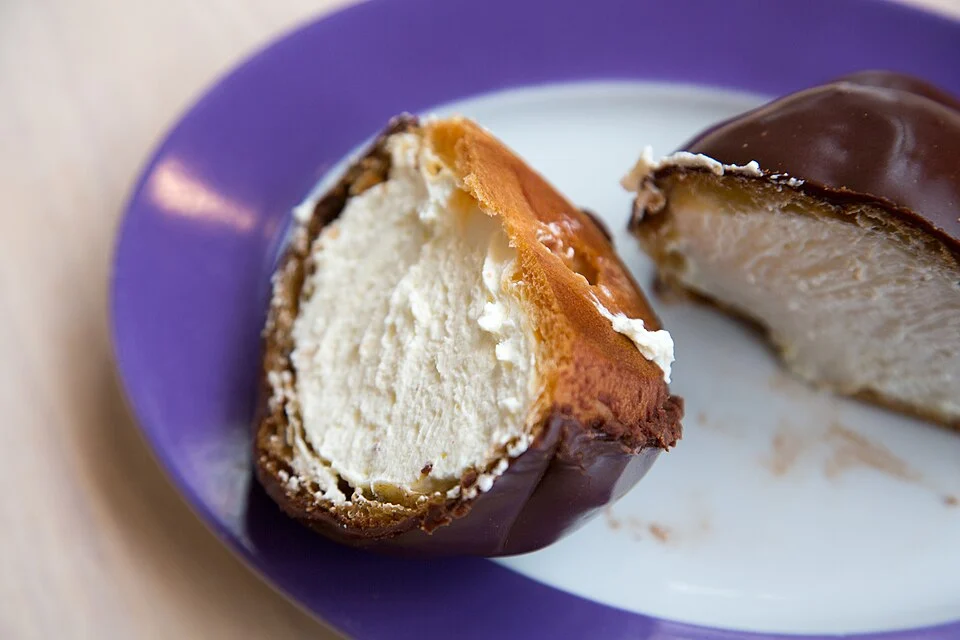
A difference in ingredients can be read in an advertisement from February 1924 by the Lambermont pastry shop at Visstraat (formerly spelled Vischstraat) no. 16. It announces a new product filled with whipped fresh cream, in addition to the conventional cream-filled version. The sale date identified by the heritage institution is 23 February. The advertisement of the time does not state the detailed composition of the earlier cream, and the institution suggests that it may have been the pastry cream (custard) used in pastry shops. The white cream filling common in later Bossche bollen appears in this advertisement as an alternative option.
The shop did not withdraw the earlier product immediately. According to the heritage institution, both appeared in its advertisements until 1938, and customers could choose the filling. Later advertisements present the whipped-cream version. In present-day descriptions of the pastry, whipped cream is standard, but reading the product names and descriptions in the newspapers year by year shows that there was a time when two fillings stood side by side in the shop. It is an example in which one can trace how the change in filling was written into the words used for the product.
Another account attributes the whipped-cream filling to Henri van der Zijde, a pastry chef from The Hague. The town’s heritage institution presents, with photographs and advertisements, the fact that he opened a shop at Visstraat 25 in 1920. The institution examined the advertisements he placed and reported that it could not confirm any material carrying the pastry’s name. There are various theories about who first devised it on a street with several pastry shops. As a contemporary source in which the date and the filling can be confirmed together, there is the Lambermont advertisement of 1924.
From a Pastry Shop near the Station to the Market Square
As a shop that handles the Bossche bol in Den Bosch today, the North Brabant tourist guide lists Jan de Groot’s shop near the station. The town’s heritage institution has published a photograph of the shop from 1965 and a photograph of a member of the shop’s staff holding the pastry in 1996. The shop’s menu says that the formula used for the coating is handed down within the family. What the 1924 newspaper advertisement shows is a different shop. Tracing both the shop that is well known today and the makers who can be confirmed from old advertisements shows that the pastry has spread beyond a single shop.
The pastry also has a local name. In the explanation by a city archive staff member, reported by the public broadcaster NOS, local people sometimes call it sjekladebol. The staff member also cites a theory that the mayor called it “Bossche bol” on the radio in order to introduce the town. There is room to verify when the name derived from the city’s name arose; in advertisements, chocolade bol, which denotes chocolate, appears first. When the name now in use became widespread has to be traced separately from when the method of making the pastry changed.
The town’s photographic archive also holds a scene from a children’s parade in 1985, in which the children dressed as Bossche bollen. The dark, round form could be conveyed by its shape even away from shop showcases and pastry advertisements. The provincial tourist guide includes, besides current pastry shops, a walking route linking the market square, associated with the painter Hieronymus Bosch, and pastry shops. There are two pleasures: buying the pastry at a single shop, and learning about it within the town by following the streets and squares that appeared in advertisements.
In 2024, to celebrate the 100th anniversary of the date shown in the Lambermont advertisement, people from the town archive and a local bakery introduced the history of the pastry near Visstraat 16, where the shop once stood. In the same year, at the initiative of the bakery Royal, a small museum themed on the pastry also opened. The intangible heritage materials present this exhibit as an effort to spread widely the knowledge that craftsmen have built up. The 1924 date indicates what the town commemorated, and its scope differs from the birth year of round chocolate pastries as a whole.
When served with coffee at a shop, a single large one shows its round shape clearly even on a small plate. Because it is filled with cream, where and in which direction the knife goes changes how the white filling appears. The coating that Den Bosch craftsmen have refined conveys the round shape and the flavor of the cream together. Before it is cut, it looks like a sphere covered in chocolate; after it is cut, the thin edge of the shell and the cream can be seen. The form of a pastry whose advertisements sold the difference in filling remains in the cross section on a single plate.
Glossary
- Soezenbeslag
- Choux pastry in which eggs are mixed into a cooked flour dough.
- Slagroom
- Here, the whipped cream that is piped into the choux.
- Chocolade bol
- The name for a round chocolate pastry, also found in local newspaper advertisements.
- Visstraat (formerly Vischstraat)
- The street where the shops of Lambermont and van der Zijde stood.


