


SweetloreEncyclopedia of World Sweets (834)

Bethmännchen
Bethmännchen
A Frankfurt Marzipan Sweet Topped with Three Almonds
Baked Sweets / Frankfurt, Germany

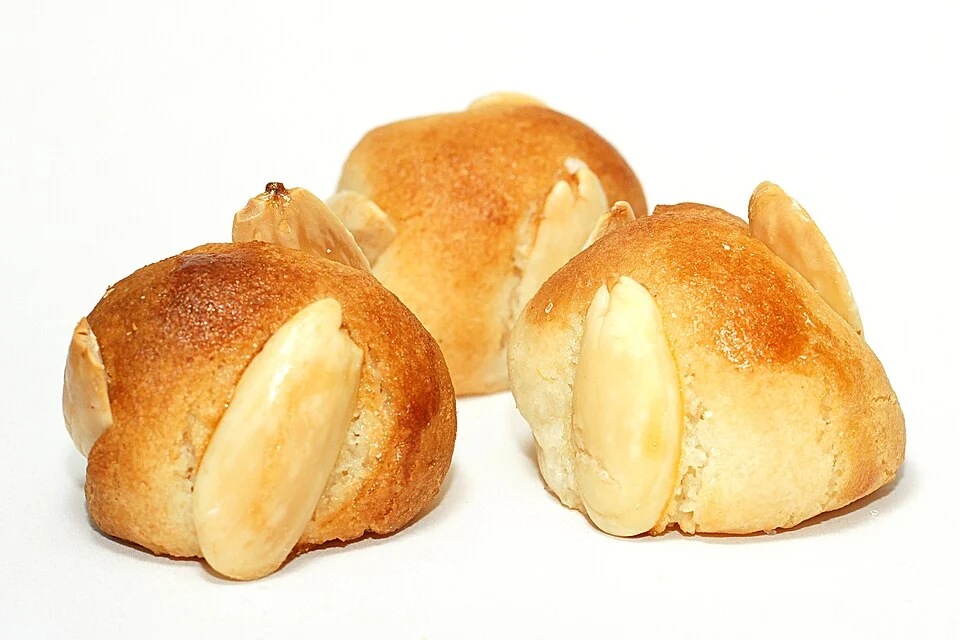
Three halved almonds stand upright around the side of a round ball of dough. The browning is deep on top, while the three almonds on the sides stay pale. Bethmännchen are small baked marzipan sweets loved in Frankfurt, Germany. Bite into an outer almond and your teeth sink into the finely ground almond dough beneath it. They appear at winter Christmas markets, and some confectioners make them all year round. Dough formulas and oven use differ from shop to shop, and the hand-placing of the three almonds gives all these variations a single, recognizable form.
Almonds Worked into the Dough, and Almonds Stood on the Surface
It is on the outside that the shape of the almond remains. Inside, the sweet uses Marzipanrohmasse, the raw marzipan paste for confectionery, made by working almonds and sugar together finely. In the Hessen Tourismus recipe, 250 g of raw marzipan is combined with 80 g of powdered sugar, 65 g of ground almonds, 40 g of wheat flour and 1 egg white. The marzipan already contains almonds, and separate powdered almonds are added to it. The egg white is mixed in with the flour and marzipan to form the dough. This differs from a meringue, which is leavened by whipped egg-white foam; here the mixture is worked until it can be rolled by hand into small balls.
About 25 pieces are taken from this batch, and separately prepared blanched almonds are split in half lengthwise. The whole almonds the state tourism board lists for decoration weigh 50 g, and each ball of dough takes three halves. If they are placed on top of the round dough, the three almonds overlap, so they are spaced around the side and pressed in with the pointed end facing up. If the dough is shaped by gathering it slightly toward the top, the almonds frame the slope from three sides. If the dough sticks to your hands, a Hessian children’s environmental magazine advises in its recipe that keeping your hands cold makes it easier to roll.
The recipe that Confiserie Graff of Frankfurt-Rödelheim presented to a regional broadcaster uses the same 250 g of raw marzipan with 50 g of powdered sugar, rose water, halved almonds and egg yolk. Here no additional ground almonds, flour or egg white appear among the ingredients. Graff also notes that moistening the almonds for the outside with water helps them stick when pressed into the round dough. Even where the three almonds standing on the surface are the same, the dough beneath can differ: some versions use flour and egg white, others are built mainly on the marzipan itself.
Rose water, water scented with roses, is added in a few drops to taste in the state tourism board’s example, and Graff likewise sets no fixed amount. Because it is a water-based flavoring, it is added in a small quantity while the dough is being mixed, separately from the water used to moisten the halved almonds so that they stick. How strongly it is layered over the almond aroma is the maker’s choice. For example, the recipe in the children’s environmental magazine puts 1 tablespoon of rose water into 400 g of marzipan and arranges the dough with its almonds on two baking sheets. Even for a flavored sweet, the ingredient list alone does not show how strong the flavoring is.
The Time It Takes to Color the Tips
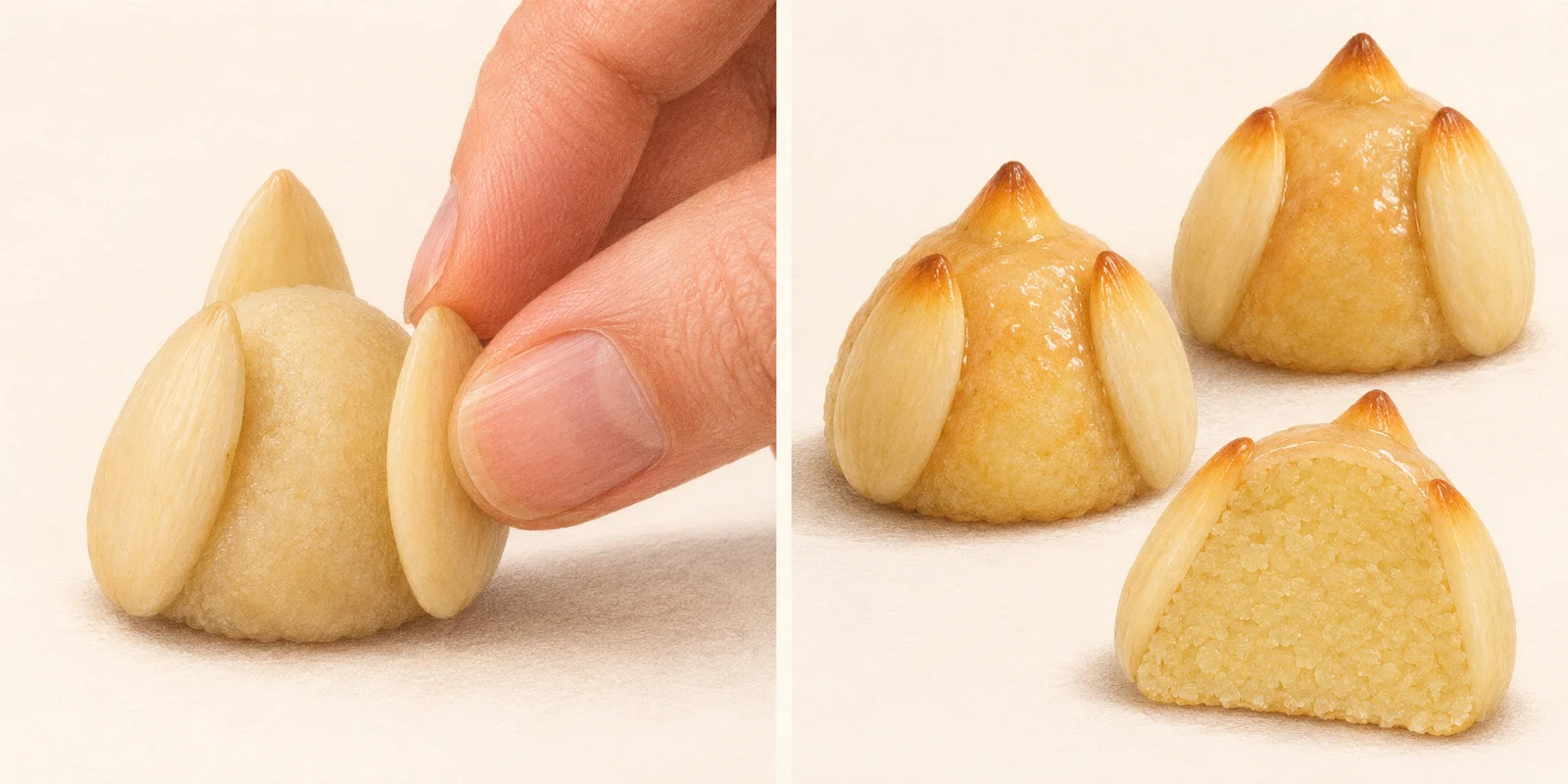
In the Hessen Tourismus method, the marzipan, the dry ingredients and the egg white are processed in a mixer until the dough is smooth, and then it is rolled into small balls. Once the almonds are attached, the balls go onto a greased baking sheet or one lined with baking paper. After the egg white that binds the dough, the egg yolk now comes in: 1 yolk is dissolved in 1 tablespoon of water and brushed thinly over the surface. They are baked in the middle of a 150 °C oven with top and bottom heat for 12–15 minutes, until lightly colored. Pastry chef Marcel Seeger also uses egg yolk, and explains that it gives a gloss and makes the decorative almonds less likely to come off. Some methods also allow time for the surface to dry. The state tourism board says that when the yolk is brushed on and the balls are baked the next day, the exposed outside hardens slightly and holds its outline better in the oven. In this case the almonds are attached the day before, and the yolk is brushed on and the balls are baked the next day.
In a baker’s recipe presented by a local Frankfurt organization, the procedure is to knead sugar and rose water into the marzipan, form it into a sphere or a cone, attach the almonds and then let it dry overnight. The next day it is brushed with a mixture of sugar and egg white and baked in a 200 °C oven until the tips turn light brown. Graff, by contrast, brushes on egg yolk, bakes for about 5 minutes at 250 °C and finishes with Abflämmen, a brief application of heat to the surface. Even when the same shape appears in the cold season, which glaze is used, how far in advance the dough is rolled and how long it stays in the oven differ from place to place. Each figure is tied to its own formula and finishing procedure.
In the recipe from the Hessian children’s environmental magazine, photographs follow the dough being rolled with cold hands, the almonds being attached and the egg yolk being brushed on. In this recipe, baked for 10 minutes at 200 °C, the unbaked dough is as pale as the almonds, and after baking a darker color appears on top of the dough. The contrast visible in the photographs does not come from preparing two doughs of different colors before baking; it results from brushing the surface with egg yolk and then heating it. The gloss on the outside, which the brush reaches, and the feel of the marzipan inside, which is noticed only when you bite, are brought together in the same piece.
Brenten Raised by a Wooden Mold, Three Almonds Set by Hand
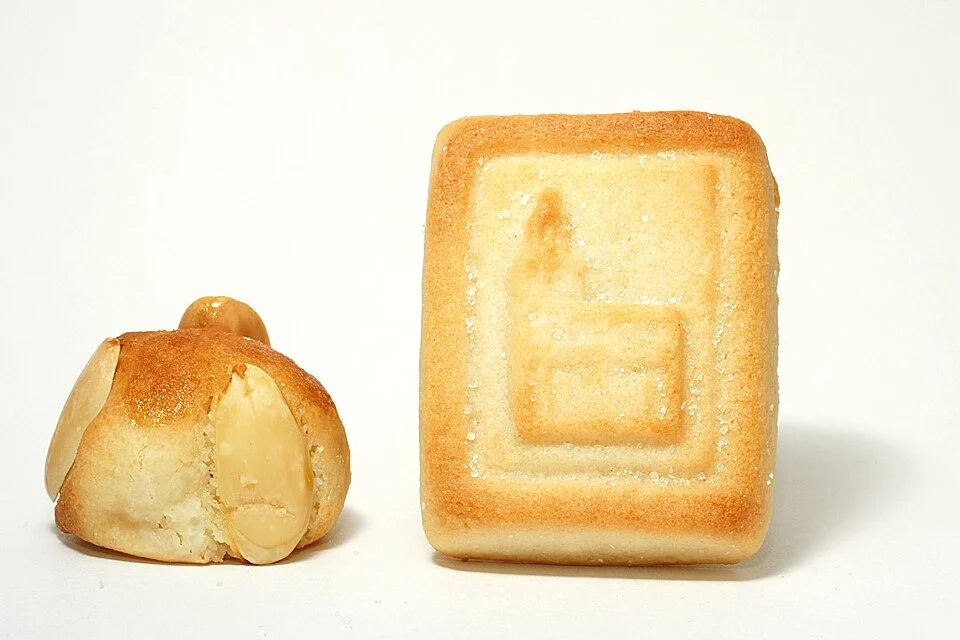
Among Frankfurt’s almond sweets is the Frankfurter Brenten, which has ingredients similar to those of Bethmännchen. A city document distinguishes them by method: Brenten are made by pressing dough into a wooden mold, while Bethmännchen are made by attaching almonds to rolled dough. In the side-by-side photograph, the square sweet with a pattern transferred onto its flat surface is the Brenten, and the round dough with almonds stood in one by one is the Bethmännchen. Brenten get their surface from a carved mold, whereas Bethmännchen have halved almonds placed by hand, with a turning motion of the fingers.
In the recipe from the city of Wetzlar, powdered sugar, egg white and rose water are added to raw marzipan, which is rolled out to about 1 cm. A floured wooden mold is pressed in, and the shapes that come out are dried for 24 hours before baking. A method of cutting the dough into sticks instead of using a mold is also given. The confectioner Hollhorst presents Brenten formed in a wooden mold and baked individually, with a baked crust on the surface and a soft interior. Like the round Bethmännchen, the Brenten patterned with a wooden mold are made by this shop all year round.
A newspaper article visiting a Frankfurt confectioner describes wooden molds made of birch, carved with 12 kinds of patterns such as cherries and flowers. That shop has long ordered its marzipan from the same supplier in Lübeck, rolls it by machine to a thickness of about 11 mm, presses in the mold and then cuts the pieces apart. In the recipe of the confectioner Cathérine Jamin, 80 g of powdered sugar and rose water are mixed into 400 g of marzipan, and the dough is rolled out to about 6 mm. The pattern is made with the mold, the pieces are dried for 4 hours and baked at high heat, and then egg white is brushed on for gloss. Compared with the hand work of rolling each Bethmännchen one by one, Brenten have a tool that transfers the pattern all at once, yet differences between shops and makers remain in the thickness, the drying time and the order of glazing.
The Story of Four Almonds Becoming Three
The story that Bethmännchen were born from Brenten involves the Bethmann family, Frankfurt bankers. Hessen Tourismus relates that the cook Jean Paul Gautenier made the Brenten dough into bite-sized pieces, flavored with rose water, so that they could be served easily with afternoon tea. Because the family had four sons, the story goes, he first decorated them with four almonds, and after the son Heinrich died in 1845 he reduced the number to three. It is told not as a carved pattern being carried over to a hand-made ball, but as new marks for the four sons being placed on the surface of the ball.
The year of invention and the cook’s name vary by source. The cook whom the state tourism board calls Jean Paul Gautenier is called Jacques Gautenier in Frankfurt city publicity. Teaching materials from Frankfurt museums and others give 1836 in one passage and 1838 in another question. The 1838 account that appears on German Wikipedia names Simon Moritz von Bethmann as the cook’s employer. According to the Frankfurter Personenlexikon, this banker died in 1826, so the explanation that the 1838 employer was he himself involves a chronological discrepancy. The family continued afterward, and the Personenlexikon also reports, as hearsay, the story that the sweet was devised in the Bethmann household. There are clues for thinking about the relation between the sweet’s name and the family, but the year in which it settled on three almonds cannot be determined from this story alone.
It is also said that when princes gathered in Frankfurt in 1863, the sweet was served to guests at the Bethmann house and became known beyond the city. The story survives in Hessen Tourismus material and in school teaching materials, and the Deutsches Historisches Museum has an illustration showing the assembly itself. The museum’s illustration, published in Leipzig in September 1863, depicts the great banquet in the Römer, the old town hall. The August assembly discussed reform of the German Confederation. What the illustration records is the banquet at the town hall; what was served to guests at the Bethmann house is a story passed on by teaching materials and similar sources. Because this is a sweet in which the eye still goes to the three almonds, people have laid family events and city conferences over its bite-sized form served to guests and the number of almonds decorating it.
A Winter Counter, and Shops That Roll Them All Year
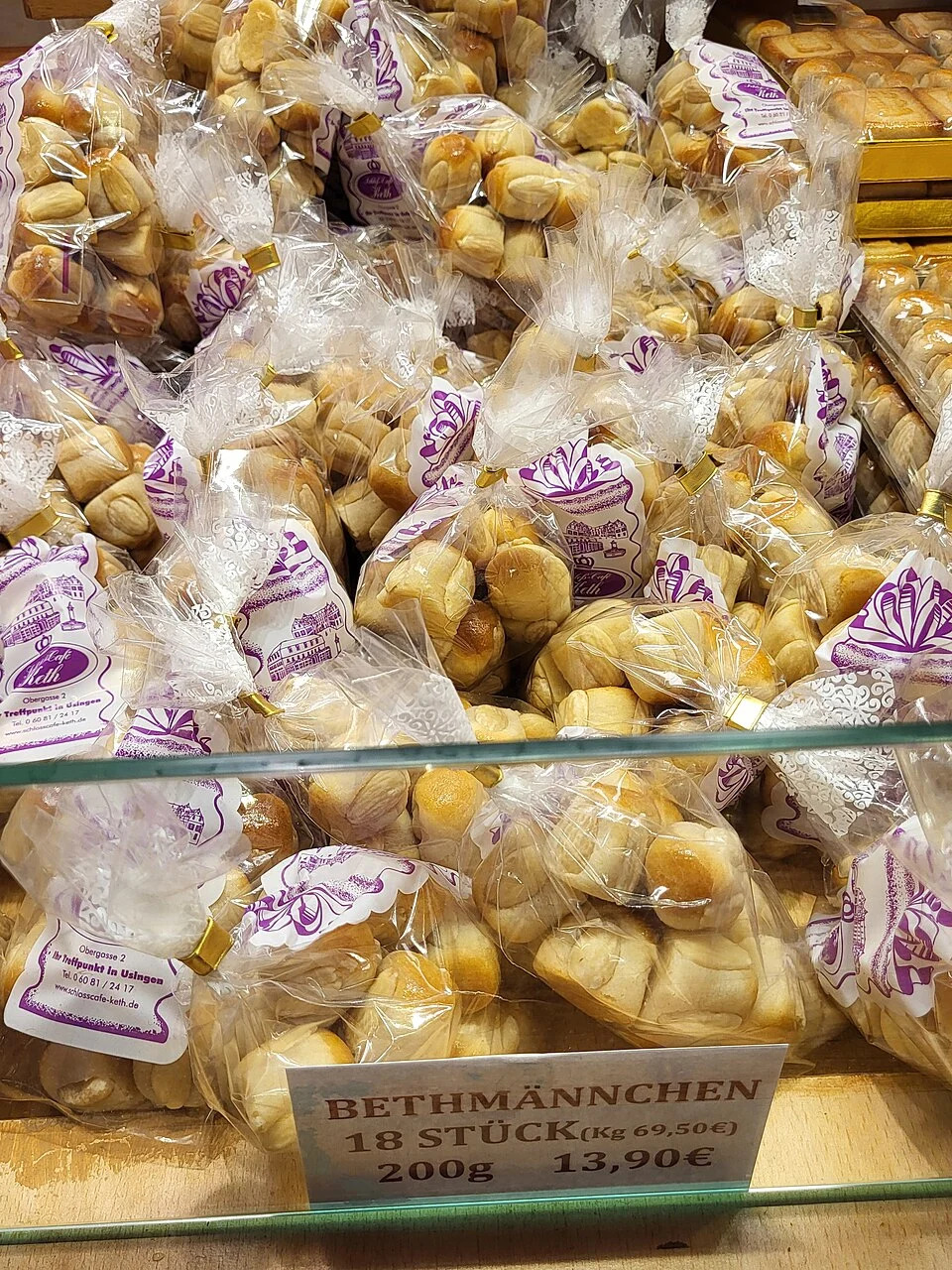
A Frankfurt school teaching material lists Bethmännchen as an indispensable sweet of the Christmas market, and also states that they can be bought all year round at many of the city’s confectioners. The confectioner Jamin says it sells them throughout the year and that at Christmas they are chosen as gifts. Rausch’s shop also rolls each one by hand, brushes it with egg and bakes it. Even in shops that prepare large quantities, pressing three almonds into the round dough so that they do not hide one another goes on piece by piece. The deep-browned top and the pale almonds are a clue, even when you see only the outside of a bag, for picking out this small ball from the other marzipan sweets at the same counter.
Jamin’s dough is said to use marzipan made from Mediterranean almonds, honey and rose water. Almonds are in both the dough and the decoration, and sweetness and aroma show the shop’s formula. One of the containers in which Rausch’s sells its sweets is a Bembel bearing the word Frankfurt. In the city’s tourist information, a Bembel is a blue-gray ceramic pitcher for pouring the local apple wine, and in Sachsenhausen there is a pottery that turns them on the wheel. Attaching handles to the vessel, painting patterns on it and glazing it are done in a different workshop from the confectioner’s work of pressing almonds into balls of marzipan. Like the bagged sweets at the winter market, sweets packed in a pitcher also become a Frankfurt gift that can be carried out of the city.
Glossary
- Marzipanrohmasse
- Raw marzipan paste for confectionery, made by working almonds and sugar together.
- Rose water
- Water scented with roses. A small amount is added to sweets to flavor them.
- Abflämmen
- A method of browning the surface of a sweet briefly at high heat. In this article it is used following Graff’s recipe.
- Brenten
- Frankfurt almond-dough sweets. One method of making them involves pressing the dough into a wooden mold to impress a pattern.


