


SweetloreEncyclopedia of World Sweets (834)

Bremer Klaben
Bremer Klaben
A Bremen winter sweet generously filled with dried fruit
Baked Sweets / Germany, Bremen

When a knife cuts through the glossy baked crust, raisins appear throughout the pale crumb. Bremer Klaben is a yeast-leavened sweet loaf long enjoyed at Christmastime in the northern German port city of Bremen and its surroundings. A fat-rich yeast dough is mixed generously with sultanas and candied citrus peel, then baked long and flat. The moist crumb carries the sweetness of the fruit, with a scent of cardamom. The sweet bears the name of Bremen and is registered as a Protected Geographical Indication (PGI) of the EU.
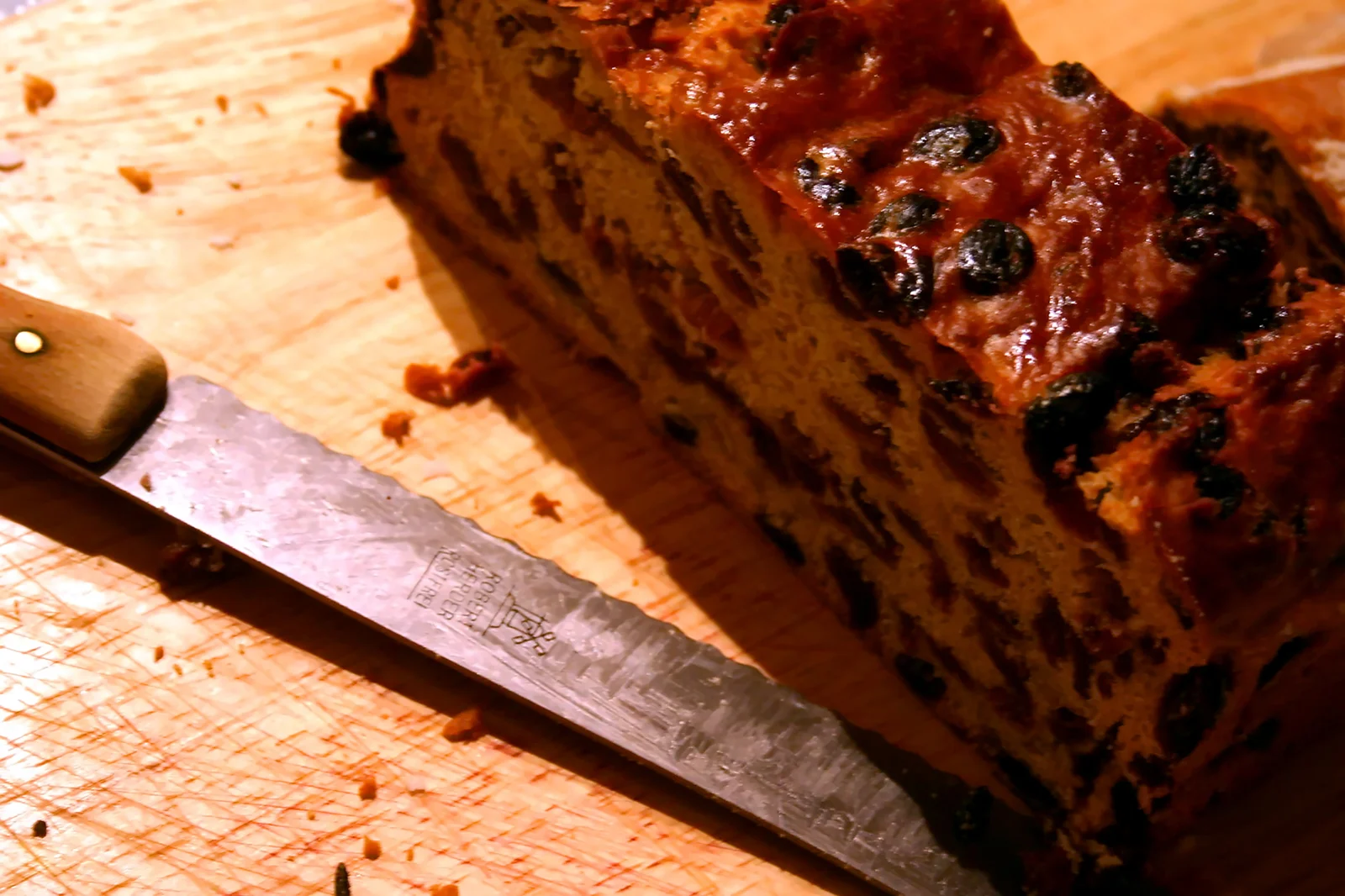
Fruit at Nearly the Weight of the Dough
Take a slice of Klaben and you will find fruit packed not only at the surface but all the way through. According to the product specification in the PGI application, published in the EU Official Journal in 2009, the weight ratio of dough to fruit is roughly 1:1. Recipes vary from maker to maker, but the fruit comes close to matching the weight of the dough, which is made of flour combined with sugar, fat and other ingredients. In sweets baked with fruit scattered on top, the pieces sit mainly at the surface; in Klaben they emerge from within the dough wherever you cut. The dough holds the shape of each slice, and where the dried fruit is plentiful, the texture of the pieces remains when you bite into it.
The sultanas are the main ingredient, joined by candied lemon peel (Zitronat) and candied orange peel (Orangeat). For the lemon, both the candied peel and the grated zest are used. Almonds are also included, and vanilla and cardamom add fragrance. Because the sweetness of the raisins and candied peel is layered with the aroma of citrus and cardamom, the flavour does not lean toward sweetness alone, despite all the fruit. The application specification allows either butter or margarine as the fat in the dough. Rum and rose oil may optionally be used for flavouring, and even when both are added, their total is no more than 5% of the weight of the whole product. This limit uses a different reference weight from the one used when weighing the dough and fruit.
Scaling the recipe down to a home batch gives a sense of how much filling there is. The recipe (Rezept, meaning the proportions of ingredients and the method) that Bremen’s regional portal presents in German calls for 1 kg of flour, 600 g of raisins, and 125 g each of candied lemon peel and candied orange peel. Those three items come to 850 g, and 125 g of chopped almonds are added to them. The dough contains 250 g of butter, milk, sugar and other ingredients, and the raisins are first soaked in rum. In this home example, cinnamon is used together with the cardamom. The figures that can be compared, 1 kg of flour against 850 g of fruit, are weights at the point of measuring the ingredients. The 1:1 figure in the application specification is based on the whole dough, including milk, fat and the rest.
Knead the Dough First, Add the Fruit Later
A slice laden with fruit can be cut without falling apart because a cohesive dough is made before the fruit is mixed in. In the procedure for professional bakers, a pre-dough fermented with yeast is prepared, the main dough is kneaded and left to rest, and the fruit is then added to it. Before the fruit goes in, it is easier to judge how far the dough itself has been worked, and when the pieces are added afterward, the baker can concentrate on stretching the dough and spreading the filling evenly throughout. Because the dough already carries fruit of nearly its own weight at this stage, both stretching and finishing call for handling that keeps the pieces from separating from the dough.
In the home method, fresh yeast is dissolved in lukewarm milk, and once it foams, it is combined with the flour and butter and kneaded. The baker waits until the dough has roughly doubled in size, then mixes in the rum-soaked raisins, candied peel and almonds. The fermentation after shaping the dough into a long, narrow form is the step that lets the fruit-laden dough rise before baking. The professional procedure has a pre-dough ahead of the main kneading, while the home example is guided by the yeast foaming in the milk and by the size of the kneaded dough. Although the way the first fermentation proceeds differs, the fruit goes in only after the dough has come together.
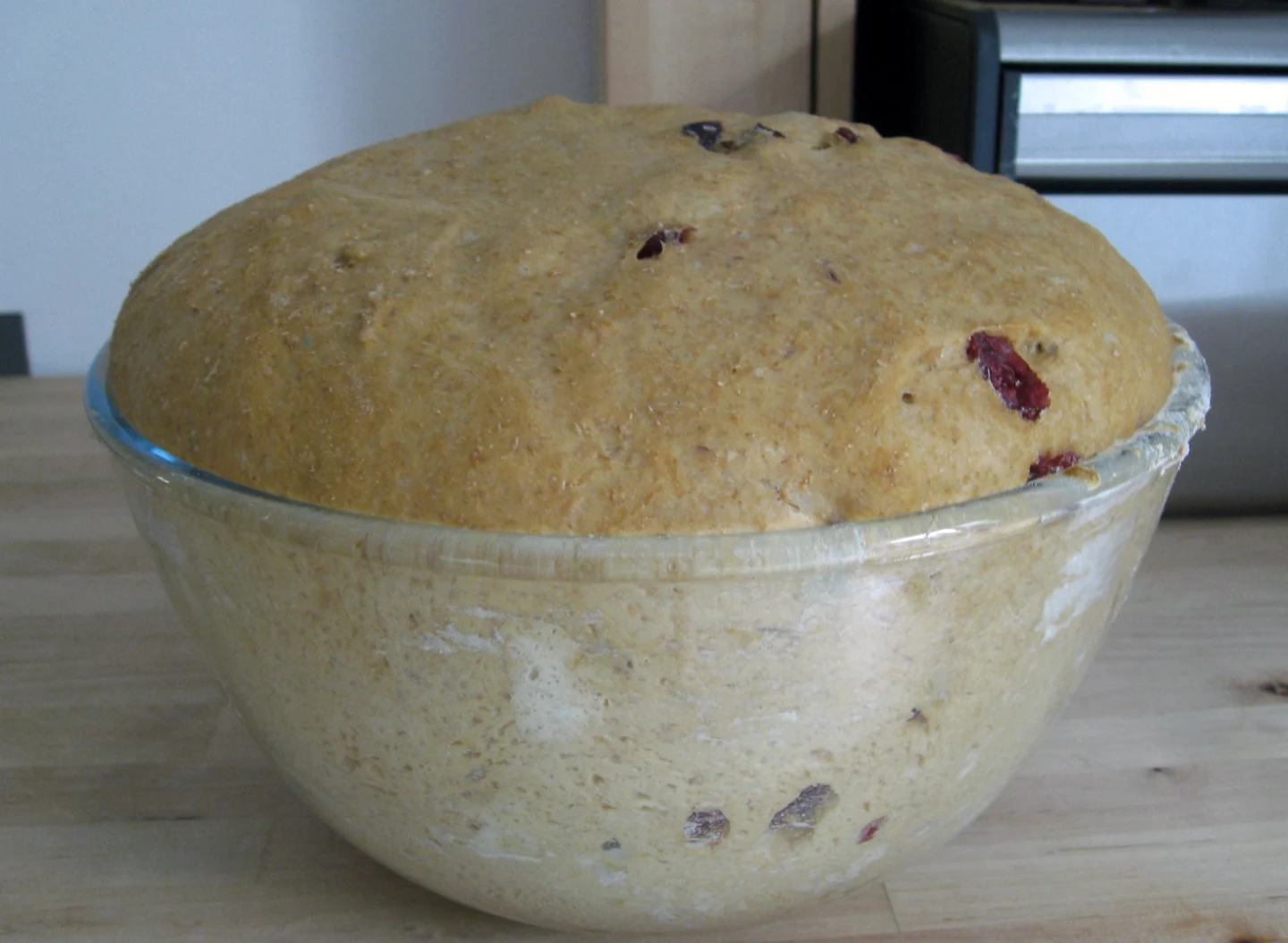
When the dough is placed in a long mould, its swelling sides follow the mould, giving a flat outline and a nearly square cross-section. In the professional process described in the application specification, examples are given of putting in 5 kg or 6 kg of dough, depending on the size of the mould. These figures show the amount placed in a single mould before baking; they are separate from the standard for the baked product and from the weight of a slice bought in a shop. At home, besides using a mould, the regional portal also describes baking the loaf on a baking sheet lined with paper. Even with dough shaped into the same long, narrow form, a baking sheet has no walls to support the sides, so the outline differs from that of a loaf baked in a mould.
Lowering the Oven Temperature to Bake Through to the Centre, and Glazing the Surface
When dough laden with fruit is baked in a large mould, the surface may take on colour while the heat has not fully reached the centre. The professional specification lowers the oven temperature during baking. One example starts at 220°C and finishes at about 170°C, with a baking time of about 55 to 65 minutes depending on size. The target temperature at the centre is around 92 to 94°C. Because the loaf is first heated at a high temperature and the oven is then turned down, the centre has time to warm up without the surface being strongly baked throughout. Doneness is not judged by surface colour alone; the loaf is baked through to the middle before it is taken out. To finish the dough between the fruit without drying it out, both the surface and the centre need to be watched.
In the home recipe, the loaf bakes for about 60 to 70 minutes on the middle rack of a preheated oven, at 180°C with top and bottom heat or 160°C with a fan oven, and is covered with aluminium foil if it darkens too much along the way. In the professional example, lowering the oven temperature is a condition for baking dough in a large mould; at home, the amount of dough baked at one time and the way heat reaches it through the mould or baking sheet are different. If a home temperature and time are transferred to a large mould, or if dough divided into small pieces is started at the same high temperature as in the commercial example, the outer colour and the way heat penetrates to the centre will not be the same.
Klaben’s thin gloss is prepared even before baking. According to the application specification, a continuous thin base layer of flour and water is made on the surface, and after baking an egg-white coating is applied. The baked loaf is taken out of the mould right away and cooled slowly. Adjusting the oven temperature to finish the inside of the loaf and making a base layer to give the surface its gloss are separate steps. With the egg-white finish, the light brown of the crust shows, and when a knife goes in, moist, fruit-filled dough appears just inside the crust.
Stollen’s White Coat, Klaben’s Baked Colour
Stollen, another German winter sweet, is also made from a yeast dough rich in dried fruit. Dresdner Christstollen, for example, as presented by the Dresden protection association, contains raisins, candied citrus peel and almonds, along with butter and clarified butter. Many of the ingredient names overlap, so what characterises the texture of Klaben is the proportion taken up by fruit and fat, in addition to what is used. The Bremen bakers’ guild links the generous use of these two to Klaben’s moist texture.
A difference is visible even before cutting. In the Dresden example, butter and sugar are used after baking, and white powdered sugar covers the outside. Klaben omits the finish of brushing on butter and sprinkling with sugar after baking, and shows its baked colour. Stollen is made in different ways in different places, but setting one Dresden example beside Klaben shows that even when fruit-filled doughs have something in common, the appearance and the feel of the surface in the mouth change according to where on the baked loaf, and with which ingredients, it is finished.
Ingredients from the Harbour, and the Bakers Who Baked Klaben
To put raisins into a dough in amounts that rival the dough itself, and to add citrus peel and spices, there must be a route for obtaining those ingredients. The PGI application documents cite trade in overseas goods through the port of the Hanseatic city of Bremen as the background to Klaben’s production. While sweet fruit and spices reached the city’s craftsmen from the harbour, the baked sweet also went out to sea. The same document reports that, because it keeps well, sailors took it with them on voyages. Who first baked it, and when, is not clear.
A document of the Bremen city council from 1593 mentions a trade of baking Klaben. The regional portal introduces such a craftsman as a Klavenbecker. This is the year in which the trade appears in the records; it does not tell us when Klaben was first baked or what its recipe was at the time. According to the application documents, in 1637 the Klaben bakers and the cake bakers formed a single guild. They also report that in Bremen at the end of the 17th century, about one third of the types of white bread were made from Klaben dough. This is neither a proportion of the number of items sold or the quantity produced, nor of the number of sweets sold under the name Klaben. From a description that counts the types of white bread made, we can infer that this dough was used in more than one form.
Explanations of the name, too, bring in the weight and shape of the dough. According to the Bremen bakers’ guild, one theory connects it to Klöben, a Low German word for something large and solid. Another theory relates it to Klöve, meaning a cleft, or Klave, meaning split wood and the like, and derives the name from the long, narrow shape with its splits. The weighty cut face and the long, narrow outline can still be seen today, but there are several views about which word gave the sweet its name.
Sold by the Slice at the Market, Shipped in Boxes at Christmas
In Bremen, the Klabenanschnitt, the cutting of the first Klaben of the season, takes place on the Market Square in mid-November. The 2009 application documents report the custom that the mayor cuts the first slice. At the event on 10 November 2022, two experienced master bakers baked the Klaben using the ovens at the bakers’ guild facility. According to the city council’s press office, the preparations took a week, and the Klaben brought to the site came to 100 m in total. The report from the Bürgerpark says that it was sold by the slice for 2 euros, and the proceeds were donated to the Bürgerpark, a park in the city.
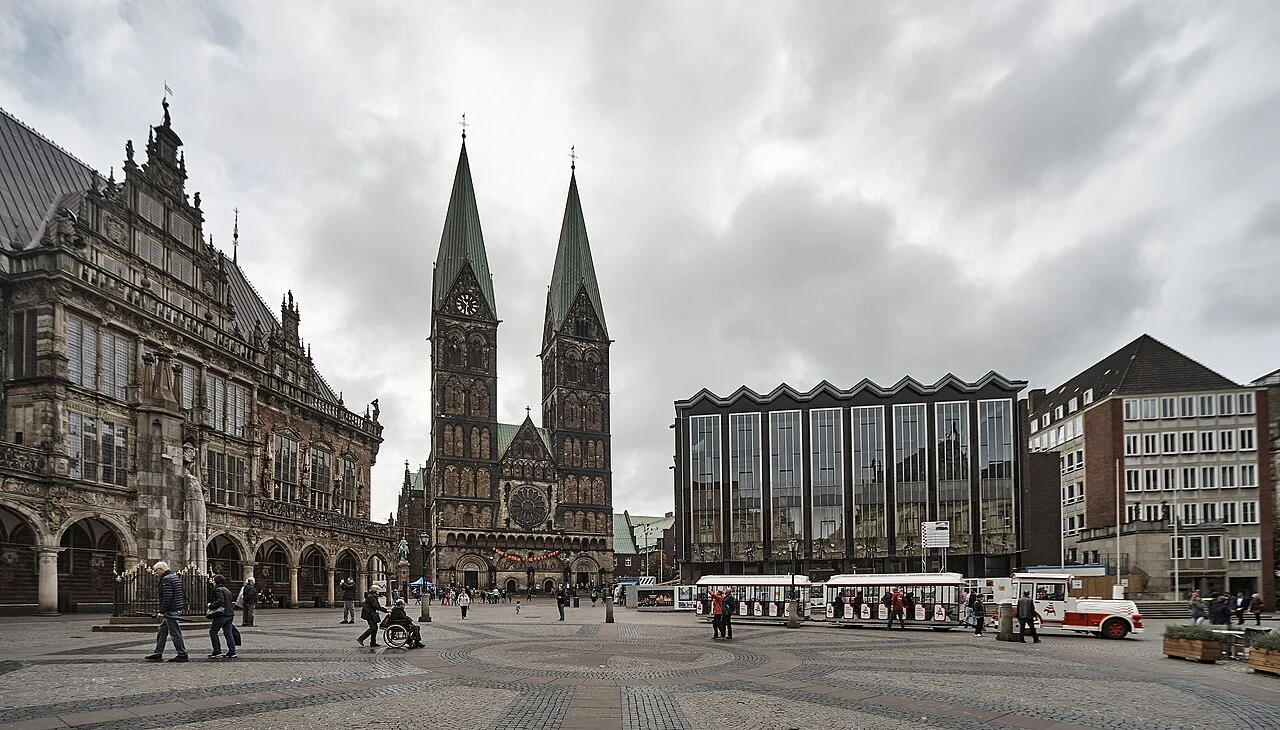
Away from the Market Square event, Klaben can also be bought in shops to take home. The family-run confectioner Knigge makes Klaben alongside Baumkuchen and tea pastries in its workshop on Sögestraße in the old town. According to Bremen’s regional portal, the shop bakes Klaben all year because tourists also ask for it, and some customers ship it at Christmas as a gift in place of a greeting. The home recipe says that after baking and cooling thoroughly, the loaf keeps for several weeks wrapped in aluminium foil, and it also describes the custom of baking it several weeks before Christmas so that the flavour and aroma meld. The long-keeping sweet that was taken aboard ships serves both as a sweet baked early in preparation for winter and as a gift to send to people far away.
The ways of eating Klaben that the guild describes include serving it sliced with coffee or tea, and topping it with ham or with Mettwurst, a type of sausage. The traditional way the guild cites is to lay a thin slice of Klaben on dark bread spread with butter. Even though Klaben is not finished with butter on the outside when it is baked, there is a way of eating it at the table with butter. A sweet slice full of fruit is eaten together with the town’s bread and cured meats.
Where the Bremen Name Applies
“Bremer Klaben” entered the register of Protected Geographical Indications (PGI), which protects the names of foods tied to their place of origin, through a European Commission regulation dated 30 November 2009. The production area defined in the application summary includes the city of Bremen and the surrounding area, as well as Bremerhaven and Verden. A system was also set out in which the manufacturer’s name appears on the packaging and makers are entered in a producers’ register managed by the Bremen bakers’ guild. Recipes for baking with similar ingredients measured out at home are widely published, but to sell a product under the PGI name, it matters not only that the dough and fruit are combined in the stated way, but also that it is made in the defined area and can be traced to its maker.
Glossary
- Sultana raisins
- The dried grapes used in Klaben. They are mixed into the dough together with candied citrus peel.
- Pre-dough
- A dough fermented with yeast before the main kneading. In the published specification for Klaben, the pre-dough is prepared first and the main dough is kneaded afterward.
- Klabenanschnitt
- An event on Bremen’s Market Square at which Klaben is cut and shared, announcing the start of the season for this sweet.
- Protected Geographical Indication (PGI)
- An EU scheme that registers and protects the names of foods tied to their place of origin.


