


SweetloreEncyclopedia of World Sweets (834)

Broas Castelares
Broas castelares
A Christmas sweet of sweet potato dough brushed with egg yolk and baked
Baked Sweets / Portugal, Lisbon

Broas castelares are Portuguese Christmas sweets, slightly tapered at both ends and thick through the middle. The surface is a deep gold, from egg yolk brushed on before baking, and beneath it lies a soft dough of mashed sweet potato combined with two kinds of flour. The traditional products record for Lisbon and the Tagus Valley gives a shape about 8 cm long and about 4 cm wide at the widest point. Bend or cut one, and the surface, which sets first in the oven, cracks, while the dough inside stays moist with the sweet potato’s moisture. The two parts are made differently: the filling is cooked in a pot, and the surface is colored in the oven at the end.
Turning Mashed Sweet Potato into a Dough That Can Be Portioned by Hand
In the agricultural authority’s traditional products record, a sweet paste is made first from sweet potato and sugar. Ground almonds, wheat flour, cornmeal, eggs, and orange and lemon zest are then added. Where bread starts with flour and adds water, this dough starts with a moisture-rich root and mixes flour into it. If large lumps remain in the mashed sweet potato, the firmness of the dough changes with every portion taken from the pot. To shape pieces on a flat tray, the dough is first mixed in the pot until it holds together in the same way however small the portion taken.
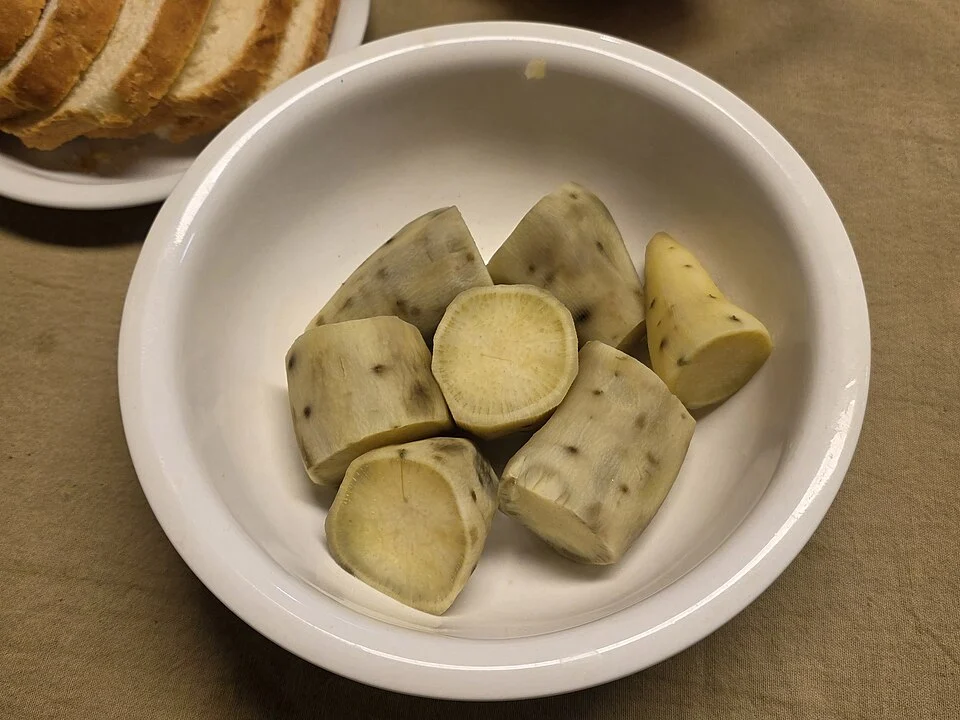
Wheat flour and cornmeal both take up the moisture of the sweet potato. When moisture is added, wheat flour develops a network of gluten, but cornmeal does not develop the same stickiness. The way the meal is ground also changes how much grain remains on the tongue. Luís Miguel Costa, who publishes a home recipe, names two jobs for the cornmeal: holding the sweet potato’s moisture and giving a texture with a fine graininess. Some formulas use a combined weight of the two flours that does not exceed the weight of the sweet potato itself, and in the baked interior a moist cohesiveness remains rather than the springiness of a kneaded flour dough.
The recipe from the Lisbon Tourism and Hotel School, published by Portugal’s tourism board, calls for 2 kg of peeled sweet potato, 500 g of cornmeal and 250 g of wheat flour. The sugar is 2 kg, the same as the sweet potato, and the recipe also uses 500 g of honey, 250 g of grated coconut, 10 eggs and citrus zest. Whatever the number of pieces this yields, the formula shows the proportion of sweet potato to sweeteners and the difference in quantity between the two flours. The school returns the mixed dough to a copper pot and cooks it over heat. After the first cooking, when the sweet potato is boiled, the dough, now containing flour and eggs, is heated a second time so that it first reaches a firmness at which it can be shaped. The agricultural authority’s record does not describe returning the dough to the pot in the same way.
Costa boils the sweet potato in water with a pinch of salt, drains it and purees it. He adds sugar and honey and heats until the mixture boils, then adds the almonds, orange zest, eggs and cinnamon, followed by the flour. He stirs over the heat until the dough forms a single mass that leaves the pot, then moves it to another container and chills it in the refrigerator before dividing it. Like the school’s recipe, it uses a pot before the oven, but this one also explains that the dough is cooled thoroughly before being shaped by hand. It separates the work of mixing while the dough is warm from the work of pressing the cold dough with the hands.
Costa’s recipe uses 450 g of sweet potato with 500 g of sugar and 50 g of honey. In addition to 200 g of cornmeal and 80 g of wheat flour, it includes almonds in two forms: 100 g ground and 60 g chopped. Although both are sweet potato and sugar doughs, it is not the school’s large batch scaled down in the same proportions. The school’s formula, which mixes in coconut, and the home formula, which varies the nuts between meal and pieces, leave different things inside the cut piece.
How Almonds and Coconut Change the Aroma
The agricultural authority’s examples also record a version that uses coconut and orange flavoring in place of almonds and orange and lemon zest. The school’s formula chooses coconut but keeps the orange and lemon zest and adds honey. The recipe published by the Pão de Ló festival mixes honey, eggs, citrus zest and sugar into warm sweet potato, then combines ground almonds and two kinds of flour. Some versions combine coconut with honey, and others combine almonds with honey. Each combination of nut, citrus and sweetener added to the sweet potato dough survives in its own version.
Rather than adding juice to loosen the dough, grating citrus zest into it gives fragrance without greatly changing the amount of moisture the sweet potato has to be matched with. In the version that chooses orange flavoring, the orange scent comes even without any bits of peel. Pieces of almond, the fibers of grated coconut and the fragrance of zest are each perceived differently inside the sweet. Because every version colors the surface with egg yolk, only the glossy golden look is shared; the grains and aromas that remain when you bite in are noticed only once the sweet is opened.
Tapering the Ends and Brushing the Top with Yolk
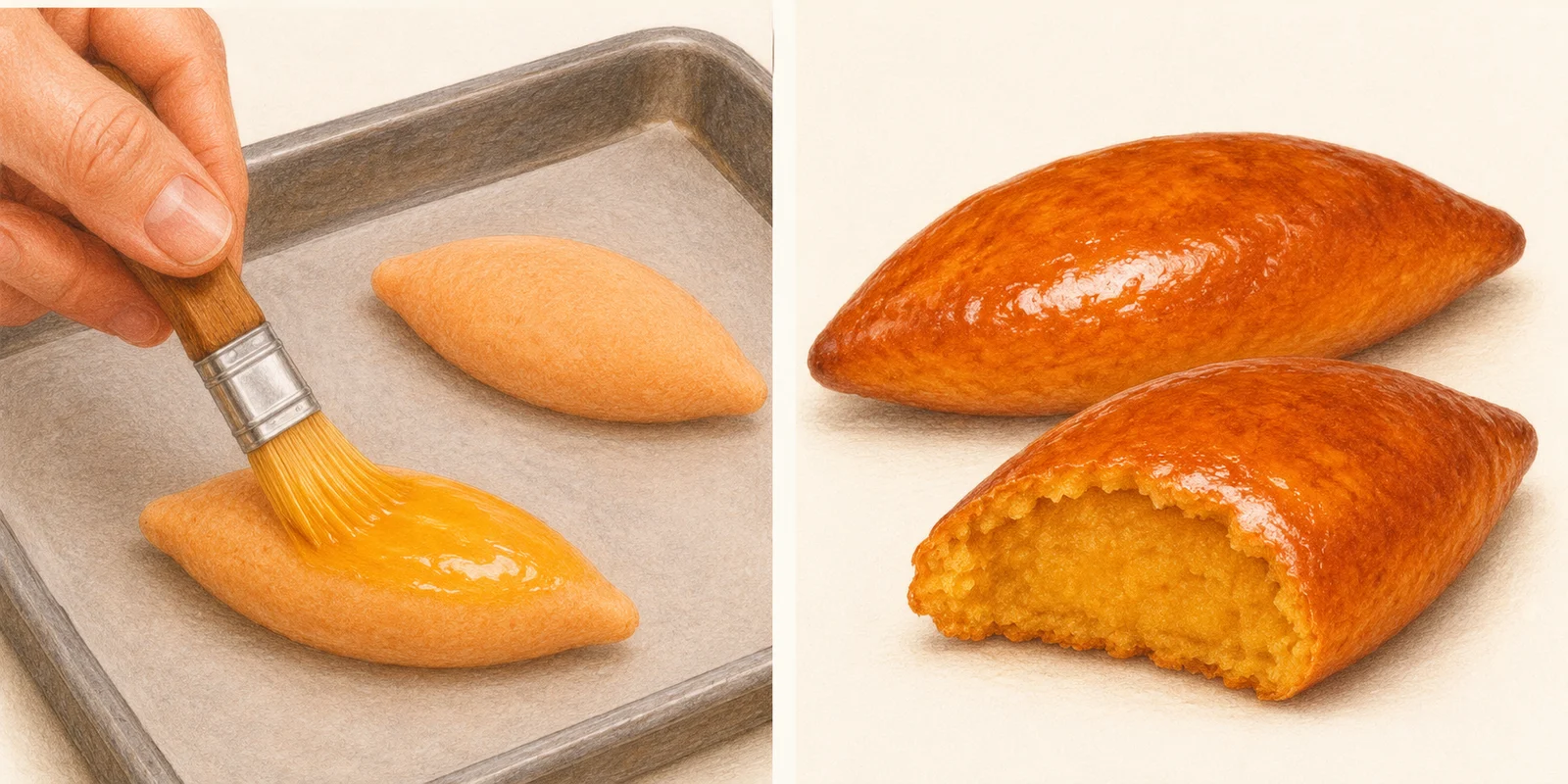
The festival’s published recipe takes about 30 g of dough, rolls it into a ball once, lengthens it like a croquette and presses it lightly. Another home-oriented version portions the dough with two spoons. Costa’s version takes about 40 g of cold dough at a time, flattens it slightly and draws out both ends. The center keeps its thickness while the ends thin, so the distance heat must travel inward is shorter at the ends than at the center. The shape separates, within a single piece, the place where the yolk on the surface colors first from the place where the sweet potato dough stays soft. Makers have their own guidelines for size and weight.
In the agricultural authority’s record, some versions line the tray with a thin edible sheet called obreia, and in the past the dough was also set on orange leaves. When a sheet is used, the baked sweets are cut apart along their outlines. The leaf is not mixed into the dough like peel but is placed between the base and the tray. The festival’s recipe greases the tray with butter and dusts it with flour, and Costa’s version lines it with paper. Lift one and look underneath, and the underside does a different job from the yolk-browned top: in some cases a thin sheet stays attached and is cut, and in others each piece is released from paper or flour. The sources that mention leaves do not allow us to judge how much aroma passed into the interior.
When the pieces are arranged on the tray one by one, the shaped weight and the lining are chosen separately. In the festival’s recipe, the dough is rolled and lightly pressed, then set on a buttered and floured tray. Costa’s recipe, which lines the tray with paper first, chills the dough and pinches off portions. In every case, the preparation of the base and the application of the egg wash are finished before the pieces go into the oven. Only when a sheet is laid down, as in the official record, is there a further step of following the outline when the baked pieces are separated.
The yolk on the surface has a different role from the eggs mixed into the dough. In Costa’s recipe, whole beaten egg is brushed on first, left to dry a little, and then yolk alone is brushed on. The oven is preheated to 200 °C, and the pieces are baked for 10 to 12 minutes, until deeply colored. While this divides the coating on each small piece into two layers, the school brushes on yolk and bakes at 280 °C, and another home recipe with almonds preheats to 230 °C. Reading these temperatures also requires knowing the shaped size, how the surface is coated and how far the dough was heated in the pot.
The freshly baked surface has a deep gold color and a gloss. The agricultural authority’s record also includes a finish in which the surface is wiped with a cloth, where needed, to bring up the shine. Inside the dough, the colors of the sweet potato and cornmeal remain, and the yolk, applied only to the top, creates a place that browns more deeply than the interior. In the school’s formula and in Costa’s version, the flour and eggs have already been cooked in the pot, so the baking does not continue until the inside becomes a dry, hard sweet; the cook watches for the surface to color. Dividing the dough into 40 g or 30 g portions also changes the surface area of the ends and the thickness left inside.
A Shop Name Preserved in a Lisbon Street
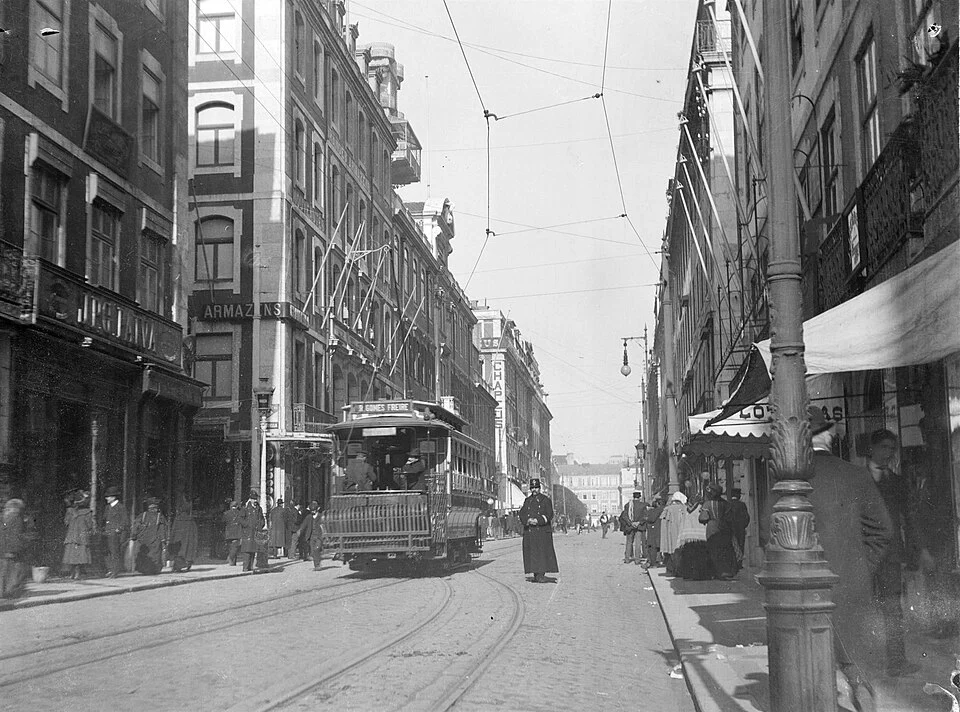
The name Castelar is linked with the Confeitaria Francesa on Rua do Ouro in Lisbon. The Almada municipal bulletin presents a tradition that the Castelar brothers who ran the shop devised the sweet. The Pão de Ló festival’s account gives 1860 as the shop’s founding year. The agricultural authority’s traditional products record calls it an old preparation and states that its origin is unknown. The shop whose founding year survives and the story that tells of the sweet’s invention differ in how reliable the sources are. In the history of a sweet remembered as a specialty of an old Lisbon shop, the brothers and the name of the street appear.
Costa writes that in the household in northern Portugal where Costa lived, the sweet was not seen for long, while in Lisbon the custom continues of going to old confectioners before Christmas to buy it. It is also a sweet that Portugal’s tourism board presents in its nationwide Christmas guide, and what one person ate at home differs in scope from what is listed in a guide introducing a region. Whether it is a sweet set out at one’s own home or one chosen by going to a shop in that season also changes how it comes to be remembered.
At the Christmas Table, Taken One Piece at a Time
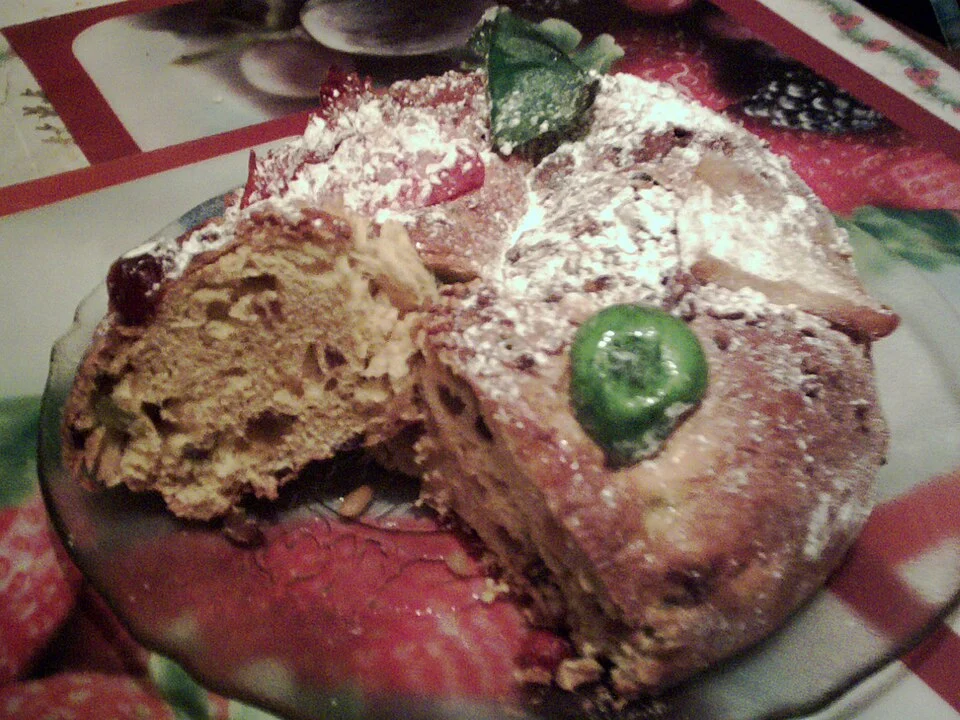
In the tourism board’s Christmas guide, broas castelares appear alongside Bolo-Rei, a ring-shaped cake decorated with candied fruit and other toppings, and filhós, which are fried in oil. A Bolo-Rei is a large ring cut and served on the spot, whereas broas are of a size already divided by person at the stage of going onto the tray. A fried sweet takes its color in the oil, while broas are small portions of sweet potato dough set out on a tray and baked from the top. Even when all of them are on the same holiday table, the order of preparation and the hand movements for dividing them differ.
The tourist guide for Óbidos, north of Lisbon, ran a series of features on local Christmas dishes and included the method of Eugénia, a resident of the Santa Maria, São Pedro e Sobral da Lagoa district. The same guide’s list of Christmas shops also includes an item of this name. In one case a local person teaches the method for the home kitchen, and in the other the same place sells it as a seasonal item. The custom Costa describes of going to shops in Lisbon and the case of passing on the method in Óbidos are two routes by which the sweet reaches tables across towns.
The same traditional products record for Lisbon and the Tagus Valley also includes another baked sweet called simply broas. These are dark ovals decorated with halved almonds, eaten at Christmas and in some places on All Saints’ Day. The castelares have sweet potato and two kinds of flour inside a similarly elongated outline, and what remains on the surface is the baked color of the brushed yolk rather than decorative nuts. Lift one from the tray, and the long ends break first between the fingers while the center stays a little thicker and soft. In telling these two similarly named sweets apart, there are differences both in the outside, which looks the same size, and in the dough one feels after cutting.
Glossary
- Broa
- Here, a single small baked sweet. The plural is broas. Not every food with the name broa contains sweet potato.
- Obreia
- A thin edible sheet. In the examples in the traditional products record, it is laid on the tray and cut around the sweets after baking.
- Confeitaria Francesa
- The confectionery shop of the Castelar brothers, said to have stood on Rua do Ouro in Lisbon.
- Bolo-Rei
- A ring-shaped sweet made with fruit and nuts, found on the Portuguese Christmas table.


