


SweetloreEncyclopedia of World Sweets (834)

Chelsea Bun
Chelsea bun
A London sweet bun rolled up with dried fruit
Fermented Pastries / United Kingdom, London

The Chelsea bun is a small sweet bun with a London place name. It is made from a yeast dough enriched with butter and other ingredients, rolled up with raisins and sugar, and baked. Dark dried fruit shows between the spirals, and buns baked side by side have corners on their sides. When a sugar glaze is brushed on after baking, the surface that touches the fingers and lips is sweet too, and in a single bite that sweetness combines with the sweetness of the fruit rolled along the spirals of the dough.
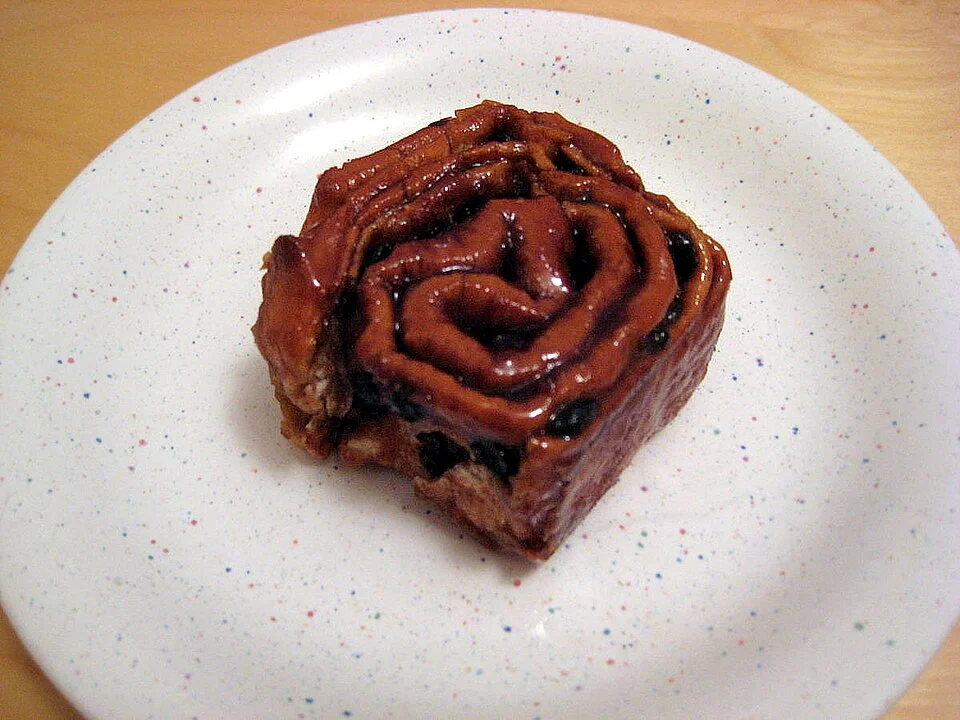
Rolling in the Fruit, and Proofing to Give the Sides Corners
The spiral seen from above a bun appears when thinly rolled dough is rolled up and cut from the end of the log. What is scattered over the dough before rolling is a mixture of brown sugar, cinnamon and dried fruit. If the fruit is added at the kneading stage, it is distributed through the whole dough. If it is placed on dough spread out on the work surface, the fruit lines up along the rolled layers in the cut face. A baked bun with dark specks along the spiral is the result of adding the fruit in this order and then cutting.
The National Trust recipe (the proportions of the ingredients and the method) has two places for butter. First, two kinds of flour, sugar, yeast, salt, milk and water are mixed, and butter is added to the combined dough and mixed in until the dough is smooth. In this recipe, 250 g of strong flour is combined with 125 g of plain flour; half of the water is added at first, and the rest is added according to how the dough comes together. The butter here goes through the whole bread. When the covered dough has risen to about double its size, it is rolled out on the work surface into a rectangle of even thickness and brushed with separately melted butter. This butter, like the fruit and sugar, stays along the rolled layers. Rolling the dough to the same thickness all the way to the edges of the rectangle avoids a thick part of the dough overlapping in one place when it is rolled up.
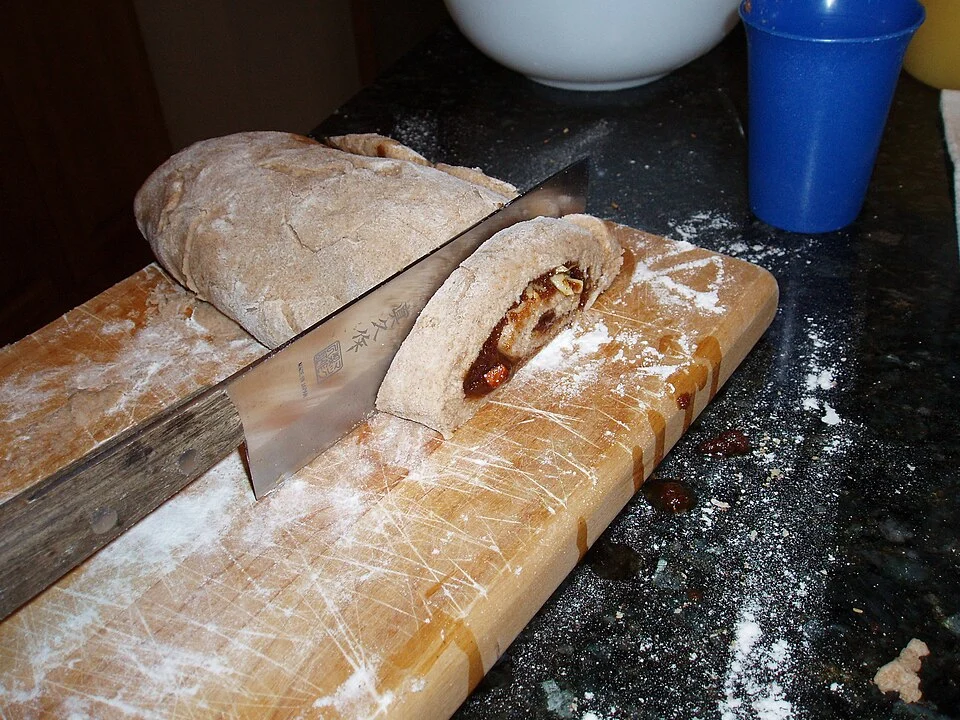
In the National Trust method, the log of dough is cut into nine pieces of equal width, which are placed on a baking tray, covered, and left until they again about double in size. The spacing on the tray affects the shape after baking. If the pieces are set out with room to spread, and the proofed dough pieces touch one another, the faces that meet become flat. Just after shaping, the round cut faces stand out; as the buns swell on the tray, corners form on the outside. How they are arranged in a square tin or mould with sides also leads to differences in the shape seen from the side.
A household manuscript of about 1827 held by the National Library of Scotland also offers a clue about how the buns were arranged. The culinary historian Mary-Anne Boermans, who introduced it, draws attention to a small illustration showing individual buns on a tray, set apart from one another. If the spacing is such that the dough reaches across during proofing, even round buns set apart acquire flat faces where they touch. The corners on baked buns can thus also be produced by the spacing at which the dough is placed.
The manuscript carried a title indicating that these were buns for shops. From this, Boermans raises the possibility that it was the method of a craftsman who supplied confectionery to shops with sales counters. If, even when the famous Bun House was in business, others were making buns of the same name for a different trade, that offers a clue for considering both the reputation of the flavor people ate in the shop and the widely circulated method.
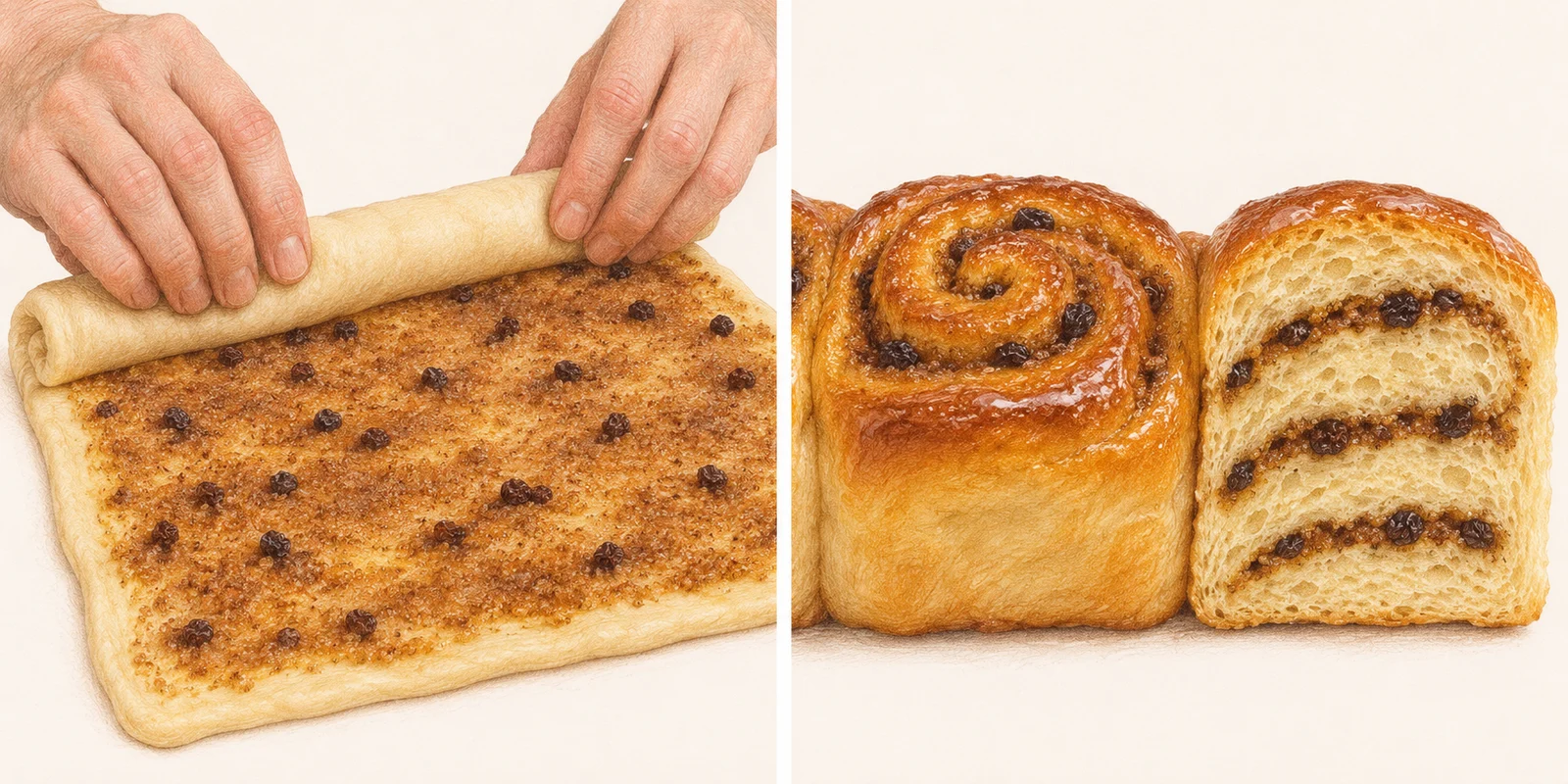
Diamonds and Spiral Strips in a Craftsman’s Book
Robert Wells’s trade pastry book The Pastrycook & Confectioner’s Guide makes Chelsea buns in two ways, based on the London bun dough given earlier. One is to dot the rolled-out dough with butter here and there, fold it like puff pastry, roll it out lightly, and cut it into diamonds of about 4 inches. The proving is lighter than for London buns. This method has no step of scattering fruit over one large sheet and rolling it up; the shape of the cut folded dough becomes the shape of each bun. It is a form made under the same name, apart from the spiral method commonly seen today.
In the book’s other method, the dough is rolled out into a square and cut into long strips, brushed with egg, and sprinkled with sugar and currants (small dried grapes). Each strip is rolled up from the end, set in a square tin with sides, proved, and baked. Whereas the modern National Trust example rolls up a single sheet of dough and then divides it into nine, the strip method fixes the amount for each bun before rolling up. The two are similar in that spirals show on the tray of dough, but the point at which the maker divides the dough into single portions differs.
Wells’s next entry is the Bath bun. It says the London bun dough may be used here too, baked in frames or tart tins. Before baking, egg white is brushed on top and sifted sugar is sprinkled over it. In the Chelsea bun’s strip method, where fruit is sprinkled on and the strip rolled up, the sugar goes between the layers of dough as well. Even in a craftsman’s formula where the same dough could be used for both, changing the mould, the shaping, and where the sugar is added made separate buns named for different towns.
Aroma in the Spiral, and Sweetness Applied After Baking
The National Trust example is baked in a conventional oven at 180°C for 15–20 minutes, until risen and golden, and melted honey is brushed on immediately. In addition to the sugar and fruit on the rolled layers, the honey adds shine and stickiness on top of the baked surface. Honey is the finish in this organization’s modern recipe. What glaze the old London shops used cannot be traced back from this recipe.
Colonial Williamsburg in the United States, which researches historical cooking, in a trial based on past accounts, gently warms milk and sugar and spoons a little over each freshly baked bun. Because the glaze is thin, the spirals and fruit remain visible, and there is no step of covering the bun with a thick white icing. The baking is also pale, and the directions finish it before the surface hardens. The soft exterior comes not from the amount of glaze alone but also depends on how far the buns are baked beforehand. This version also differs in how the dough is made: butter is rubbed into the flour from the start, and separately combined egg, warmed milk, yeast and other ingredients are added.
In the same institution’s example, in addition to the fruit, butter and sugar for rolling, cinnamon or lemon zest can be used to taste. Boermans, too, made lemon zest optional in her modern reconstruction based on the manuscript, because although lemon appears in one old account, there is not enough record to show that it was always used. Even within the same spiral, a citrus aroma cannot be followed by eye the way pieces of fruit can. When considering what the aroma was like, texts describing the recipe and the flavor, as well as drawings showing the shaping, offer clues.
A Penny in 1711, a Shop in Pimlico, and Good Friday
What Jonathan Swift recorded in Chelsea in 1711 were the cries of bun sellers that he heard in the street and his own purchase. On a walk he bought one for a penny, and he wrote in a letter that it was stale and that he did not like it. This record gives the name and price of the sweet being sold, but it says nothing about whether it had a spiral or what dried fruit it contained. Compared with Wells’s book and the household manuscript, which trace the methods known today, it tells of how the buns were sold at a much earlier date.
The location of the Old Chelsea Bun House, according to the London Museum’s records, was Jews Row in Pimlico. The 1869 local history Chelsea, in the Olden & Present Times also says that it stood slightly east of the Chelsea parish boundary, that a long single-storey colonnade projected over the street, and that there were a dwelling and a garden behind. The name Chelsea, which people used when looking for the sweet or the shop, extended beyond the parish boundary of the time.
In the watercolour by Frederick Napoleon Shepherd in the London Museum, a baker in a white apron and cap holds a tray of buns, and a shop attendant stands by the counter. The museum describes it as the interior of the shop, which also had a collection of clocks and curiosities. The tray in the watercolour shows baked sweets laid out in rows, but it offers only limited clues to the recipe for a single bun. According to the local history, the royal family also patronized the shop: it is said that George II and Queen Caroline, and George III and Queen Charlotte, visited, and that the queen gave a silver vessel and five guineas. Swift’s penny and the local history’s five guineas are sums from separate scenes: an everyday sweet, and a shop talked about for its royal visits.
The shop also drew customers on Good Friday, before Easter. In addition to the spiral Chelsea buns, it sold hot cross buns, which are marked with a cross on top. Charles Hindley, who recorded the street cries of London in the 19th century, reports that two bun shops in Chelsea claimed to be the original, and that the front of the shop was crowded on Good Friday. The custom of buying cross-marked buns also bore on the sales and the crowds that day.
Henry Mayhew’s London Labour and the London Poor, on the other hand, features a man who sold Chelsea buns near Westminster, calling out in a carrying, singing voice. This seller said that about 20 years before the interview he had gone around the streets throughout the year. The times Mayhew gives as the best-selling periods on the street are Good Friday, Easter and Whitsuntide. There is also an account that, apart from Good Friday, the buns were sold with other sweets at Greenwich fair. Among the people who sold according to the seasonal crowds, the book records an example of someone who sold this item all year round. A product bearing the name Chelsea was not bought only by customers queuing on Good Friday at the shops claiming to be the original. The cries of sellers walking in other districts also carried the name of the sweet to the people who lived there.
Spirals on Display in a Cambridge Shopfront
Fitzbillies in present-day Cambridge says that it was founded in 1920 by the brothers Ernest and Arthur Mason. The shop’s Chelsea bun is a sweet dough rolled around currants, brown sugar and spices, cut to show the spiral, and coated in syrup. The recollection of the food writer Jane Grigson, presented in the shop’s history, tells how, after the Second World War, in a period when goods were still scarce, people queued to buy at the shop, and the buns were prized at undergraduate tea parties. The era and the place of sale differ from London’s street selling; here the bun is remembered as a treat for tea in Cambridge.
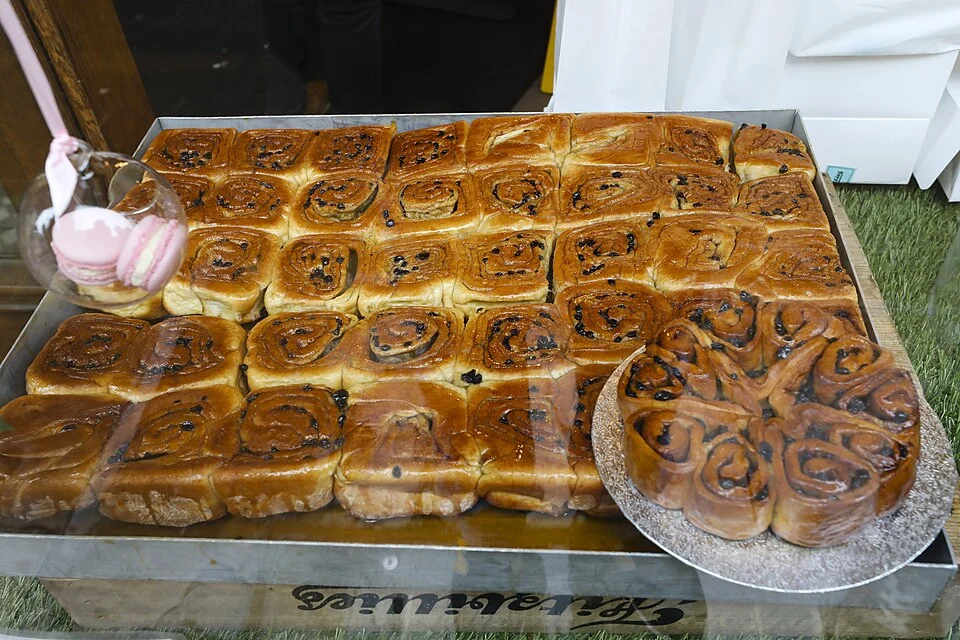
The diamonds in Wells, the strips that are rolled up, and the spirals cut from the log in the modern example each have a step that determines the shape. The sweet gloss seen in the shop also changes in flavor with the ingredients the maker chooses: honey, milk and sugar, or that shop’s syrup. On the Fitzbillies tray, one can see together the upper surface showing the spiral and the flat sides formed where the buns meet.
Glossary
- Bun
- A small portion of bread or sweet bread. The Chelsea bun in this article is mainly about the method of raising the dough with yeast.
- Currants
- Here, small dried grapes. They are rolled into the dough in Wells’s recipe and others.
- Jonathan Swift
- The writer who recorded in The Journal to Stella that he bought a Chelsea bun for a penny in 1711.
- Hot cross bun
- A bun marked with a cross on top. The Chelsea shops also sold them on Good Friday.


