


SweetloreEncyclopedia of World Sweets (834)

Gubana
Gubana
The Natisone festive cake of nuts and raisins, rolled twice
Fermented Pastries / Friuli, Italy

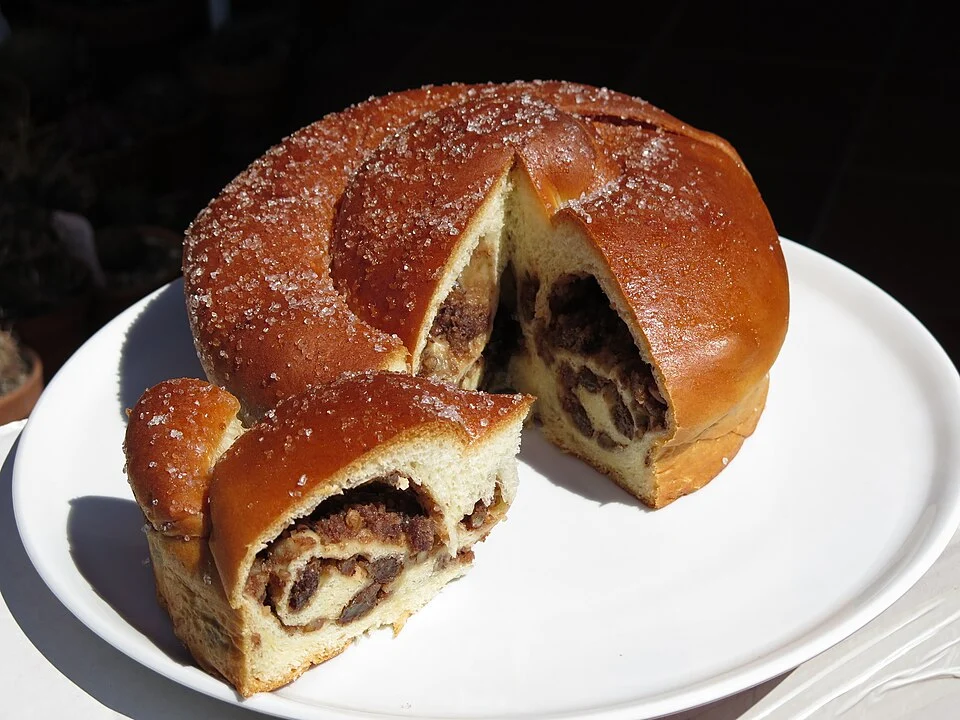
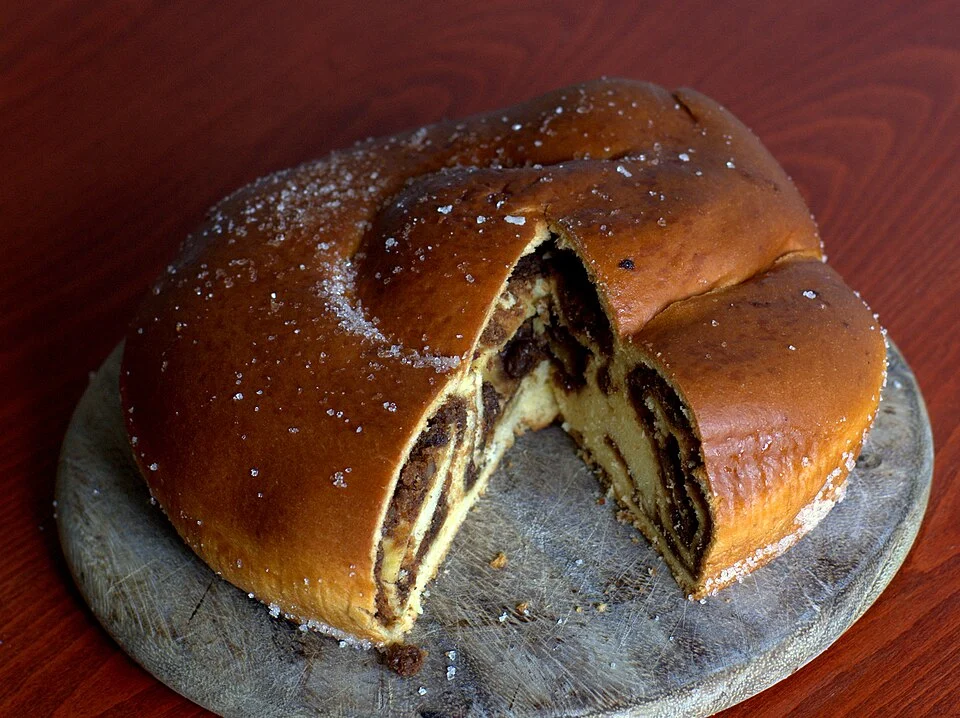
In every slice, layers of puffed dough alternate with dense bands of walnuts and raisins. Gubana is a baked sweet from the Natisone Valleys in northeastern Italy, on the border with Slovenia. A filling of nuts, raisins and liquor is rolled up in a stretched yeasted dough, and the resulting long roll is coiled into a spiral and baked. The round cake is cut at Christmas and Easter, at village festivals and at weddings. The pattern on the cut face shows the handwork behind it: the filling prepared in the kitchen and the dough rolled twice.
Rolling the Thinly Stretched Dough Twice
The dough of the Natisone Valleys gubana contains flour, eggs, sugar, butter and yeast. At the local producer Gubana del Foro, the dough and the filling are prepared separately, and the filling is laid on dough stretched to a few millimeters. Although the dough is a thin sheet before baking, the rolled gubana is left to rise, so the cross-section shows layers of nuts alternating with layers of puffed, bread-like dough. The dough itself, enriched with butter and eggs, is rich, and a single continuous outer sheet encloses the filling.
The filling published by the same workshop includes walnuts, hazelnuts, raisins, pine nuts, almonds and amaretto, flavored with grappa or rum. A guide from the tourism body of Benečija describes a method that combines chopped walnuts and pine nuts with sugar and raisins softened in grappa (a spirit distilled from grape pomace). The nuts give a firm bite, while the raisins retain the softness of the fruit and the aroma of the liquor. The choice of liquor and nuts differs from household to household and from workshop to workshop.
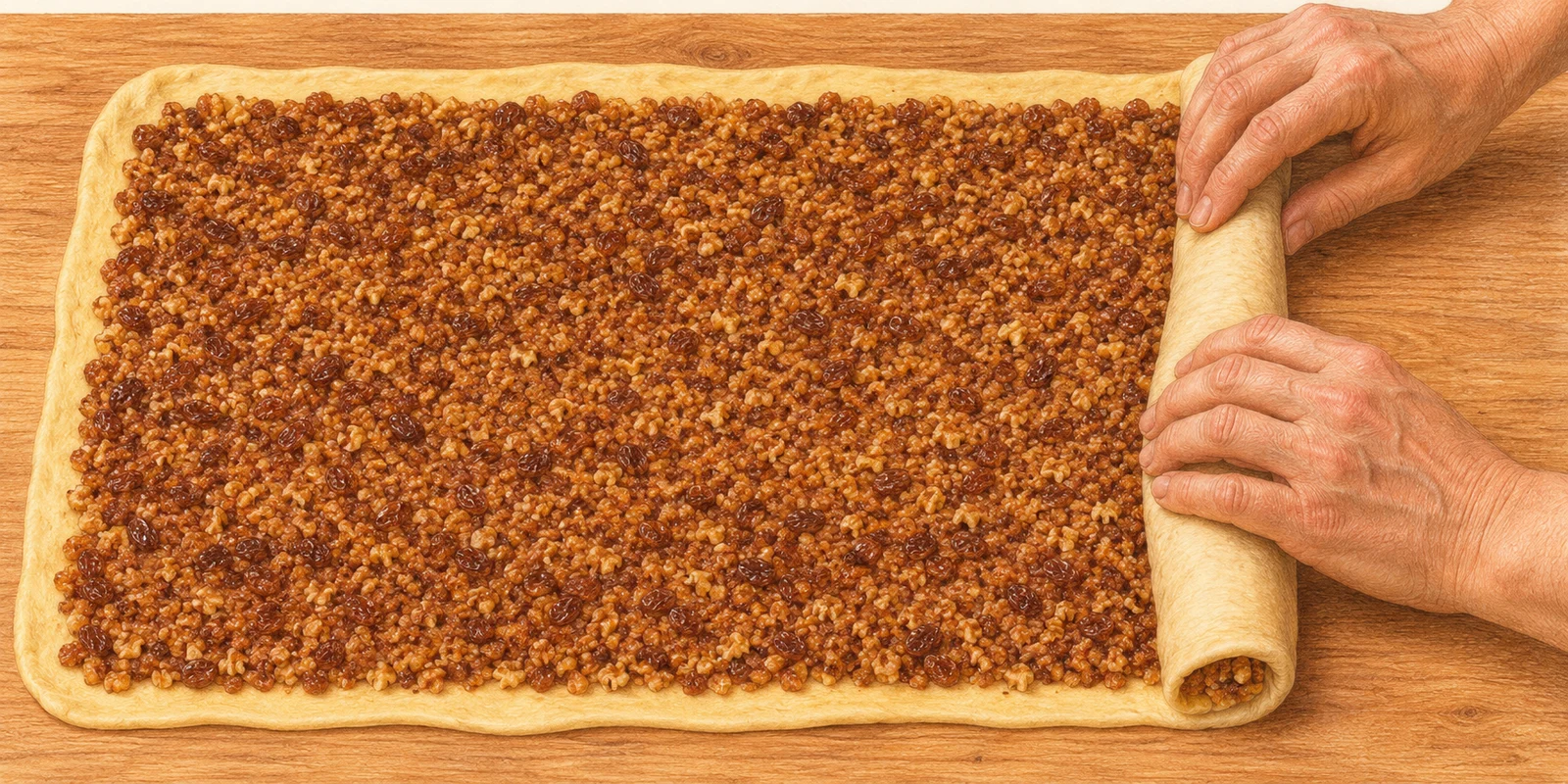
In the first rolling, the dough spread with filling is rolled up like a strudel into a long, narrow roll. The second step is to coil that long roll into a spiral from one end and transfer it to the baking pan. The inner layers formed by rolling in the filling overlap with the outer spiral formed by coiling the roll. When the cake is cut through the center of the spiral, the rolled-in filling appears at several points on the cut face. Spreading the filling over the whole sheet first also means that, once baked and sliced, each bite has thin dough and filling in alternation.
In the method recorded in a food guide for Friuli Venezia Giulia, flour and yeast are mixed first and left to rest for about 30 minutes. The preparation proceeds in stages, and finally the remaining ingredients, apart from the nuts used in the filling, are added and kneaded in. The guide cites workshops that divide the process into anywhere from one to four stages, and notes that each workshop sets its stages to obtain a soft baked dough that stays soft. One example calls for letting the dough rise in a round mold and then baking it at about 150–170°C for about 1 hour, with the time varying according to weight. A piece of dough before baking weighs about 500 grams, a weight that does not include the filling rolled in afterward.
The rolled dough is left to rest and rise before it goes into the oven. Gubana del Foro likens the baked color to that of hazelnuts and also cites the granulated sugar on the surface as a feature. In a record of home methods from Benečija, the surface was brushed with beaten egg after shaping and sprinkled with sugar, and the gubana was baked in the household oven or carried to a house with an oven suited to baking. Household ovens were fired with thin branches. Whether a gubana could be baked in the house where the dough was kneaded depended in part on the oven. The inside of the thinly stretched dough is soft because it surrounds the filling, while the outside, coated with egg and sugar, browns and gives a different texture at the edge of the slice.
Carrying the Home-Rolled Cake to the Oven
The liquors used in home fillings also include slivovka, a spirit distilled from plums. A regional guide also describes a home recipe that adds chestnuts, as an example of using local ingredients. A regional guidebook of 1912 records that plum spirit was distilled in the San Pietro district, that plums and walnuts were planted around the villages, and that places such as Savogna and Grimacco were chestnut-growing areas. The walnuts grown near the villages and the spirit made from plums went into the kitchen filling in a changed form. The 1912 guidebook lists the products of the land, and regional records dealing with home methods show which of those products were used to prepare the cake.
A regional guide from Benečija tells how, at a wedding, the bride handed a gubana wrapped in a white cloth to the parish priest, and how gubana was also given to the guests at the end of the wedding feast. In Drenchia, a couple not yet publicly engaged were asked, indirectly, when the day for baking the gubana would be. A cake that required kneading the dough, waiting for it to rise, making the filling, and rolling and baking enough for everyone thus also served as a phrase about preparing for marriage. Both uses are recorded: a cake served on a day of celebration and a gift for guests to take home.
In a poem published in Friuli nel Mondo in 1972, Dino Menichini portrayed gubana at Christmas, Epiphany, patron saints’ feast days, confirmations and weddings. In the poem, mothers pound walnuts, pine nuts and raisins at length in a mortar and add breadcrumbs and home-made liquor. They wrap the mixture in a strip of dough, sprinkle it with sugar and mark it with a cross. At the end of the poem, two people share a slice that one of them has brought. The work depicts a cake awaited at length in the kitchen and goes on to show to whom it was given once baked.
A tourist guide to the valleys also mentions štruki, small parcels that enclose a filling of the same kind in small amounts. In one method the small parcels are fried in oil, and at farmhouse weddings they are said to have been handed out in place of confetti, the sugar-coated sweets served at celebrations. In the home method of boiling them, they are topped with melted butter and sprinkled with sugar and cinnamon. Gubana, baked as one cake and then cut, and štruki, finished one small parcel at a time, differ in the amount of dough around the filling of nuts and raisins and in how heat reaches it, and the texture of each mouthful also differs.
From the Village Festival Cake to the Workshop
Page 173 of the Guida delle Prealpi Giulie, published in 1912, states, among the foods of the valley area, that gubana is indispensable at village festivals. The account by Ivan Trinko, which the tourism body of Benečija reproduced from that book, also includes a scene at the festival of San Pietro on 29 June, where people from outside gathered to taste local sweets and drink a wine called cividino. The February 1959 issue of Friuli nel Mondo reported on the festival of St. Anthony in Clenia, and the same article features people gathered from neighboring villages, dancing to the accordion and a tasting of gubana.
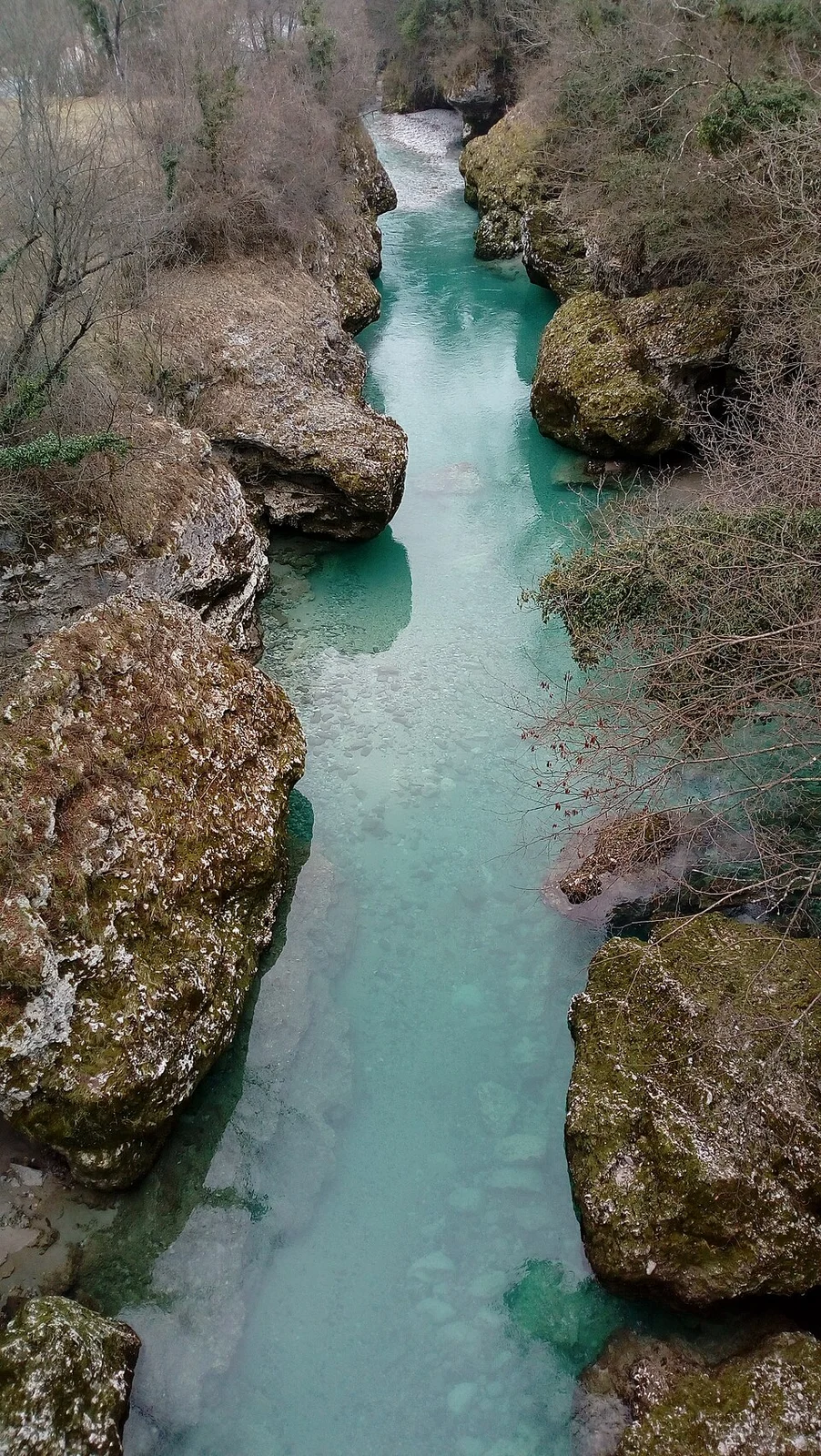
On 29 June 1965, a gubana competition was held at the festival of Saints Peter and Paul in San Pietro al Natisone. According to the history given by Vogrig, around 1960, before the competition, the Tilio bakery in Pulfero sold it irregularly, and a bakery in Savogna baked gubana on request from dough that households had prepared. The work was divided between those who kneaded at home and those who ran the oven, and after the competition it gradually spread as workshop production. In 1973 an association of businesses in the valley was formed, and in 1983 one was formed around Cividale; Vogrig states that in 1990 the two associations merged.
A 2003 issue of the Udine Chamber of Commerce’s magazine contains a report on a workshop based at Ponte San Quirino in San Pietro al Natisone. The producer named the selection of walnuts, hazelnuts and raisins as part of the work, and the shop handled tastings and distribution. The report also shows that the places where makers and eaters meet had multiplied, from a cake entered in a competition to one that a workshop produces from selected ingredients and sells over the counter.
How Far Can the Old Name Be Traced?
Among the old stories linked to the name gubana is one that it was served at the banquet welcoming Pope Gregory XII to Cividale in 1409. The producer Vogrig also mentions a contract of 1576 in which the cake is said to have been named as a gift to accompany a land rent. Research on Friulian local history reports that no sweet by that name could be found in contemporary documents of 1409, and that, within the range of museum libraries and local manuscripts examined, it could not confirm a publication said to have introduced the 1576 document. The banquet story was also passed down through a tradition from Gemona published in a magazine of 1901.
The local history research also cites a poem from Gorizia dated 14 March 1714, looking back on the Tolmin revolt. The poem lists foods for Easter, and among them is a name that can be read as gubana. The researchers consider the fact that the word accompanying the name means an herb in Friulian, which suggests a savory dish. The producer’s history presents it as a song of 1713, the year of the revolt. What the old records show here goes only as far as the use of a similar name in the early 18th century; whether it was the same as today’s sweet cake is not known.
Away from the Valley, the Dough Changes
The city of Gorizia presents an Easter cake as gubana goriziana, or presnitz. It reports a custom of preparing the cake at home during Holy Week and eating it at the Easter meal. It shares with the Natisone cake the rolling of a filling of walnuts, pine nuts, raisins and liquor. In the city’s recipe, a puff pastry of flour and butter, folded in, is made with rests between turns, and egg yolks and white wine are added. In the Natisone examples the dough rises through yeast, while in the Gorizia city recipe folding creates the layers, so even though both enclose a nut filling, the fineness of the layers that crumble when the dough is bitten differs.
The Gorizia recipe also includes candied citron and orange peel and either rum or Marsala. The nuts are coarsely ground, the raisins are soaked in liquor, the peel is added, and the filling is left to rest. The filling is set on a thin rectangle of puff pastry, rolled, then coiled, brushed on the surface with beaten egg and baked at 180°C. The weight ratio of filling to dough in the city’s recipe is about 3 to 1. With such proportions, the character of the town’s recipe shows not only in the quantity of nuts but also in the bits of peel visible on the cut face and the citrus aroma.
The food guide for the same region also gives separate entries to presnitz and putizza of Trieste and Gorizia. In the presnitz example, a folded dough is used, and the filling uses roasted hazelnuts, cocoa, apricot jam and rum. In the putizza example, the preparation is divided into three stages: preparing the yeast, a base dough made with part of the ingredients, and a final dough with the remaining ingredients added, and the filling is spread over the thinly stretched dough. Taking the spiral form common to the region as a starting point, and looking at how each dough is leavened and what fruit is added through candied peel or jam, shows how each rolled cake turns out.
Gubana is also written gubanca or gubanza in local sources. One explanation links the name to a Slovene word meaning "fold", a name that readily calls to mind the handwork of shaping the cake by rolling the dough. A guide from Benečija also lists a folded-dough cake of the same name in Cividale. In the yeasted-dough version of the Natisone Valleys, a slice with nuts and raisins rolled in has been passed from person to person, at spring festivals and winter celebrations alike.
Glossary
- Grappa
- A spirit made in Italy by distilling the grape pomace left after winemaking. Some local recipes use it to soften the raisins.
- Slivovka
- A plum spirit that appears in regional sources. It flavors the gubana filling.
- Štruki
- Small filled parcels from the Natisone Valleys. They use a filling similar to gubana’s and are either fried or boiled at home.
- Pasta sfoglia
- Puff pastry, in which dough enclosing butter is rolled out and folded in layers. In the gubana presented by the city of Gorizia, this dough encloses the filling.


