DRUG

パレード伏見洋菓子店

SweetloreEncyclopedia of World Sweets (834)

SWEETS&CAKES

Espumilla

Espumilla Ecuador

Guava-scented egg-white foam piled onto a thin baked cone

Desserts / Ecuador

Pink Espumilla piled high in swirls on a waffle-patterned cone, scattered with small colorful sprinkles.

Espumilla is an Ecuadorian sweet made by whipping egg white and sugar and flavoring the foam with fruit. Even when piled high enough to spill over the cone, it is the fine bubbles of the egg white that hold the shape. Bite into the thin baked cone and it cracks crisply, while the foam on top dissolves as it touches the tongue. Guava is known as a traditional flavor in Quito; in Cuenca some versions put the pulp into the foam, and in nearby Baños some use juice boiled with sugar. Small colored sugar confections or fruit may also decorate the top.
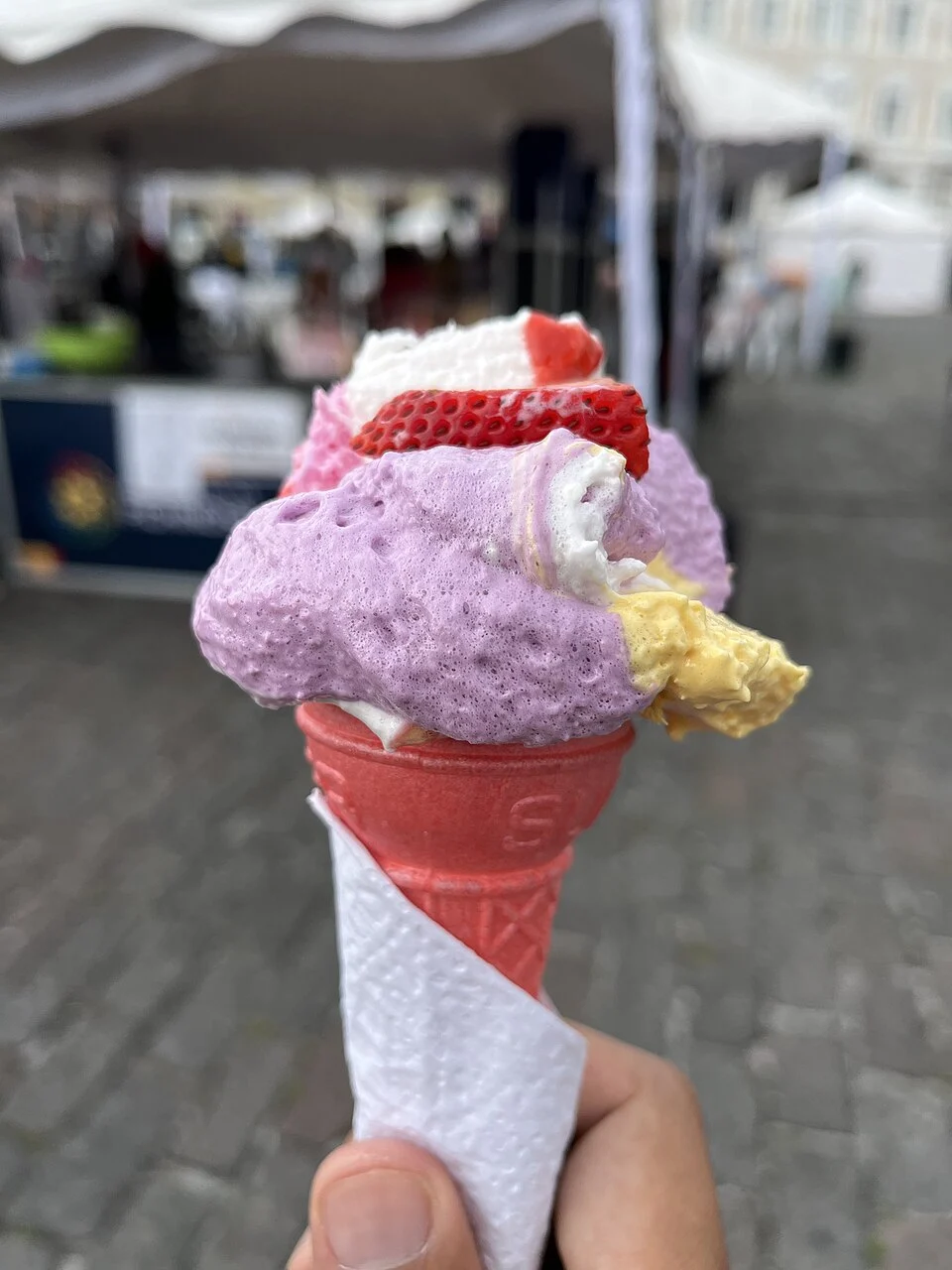
Pale purple foam piled on a cone, topped with red decorations
Espumilla served on a cone. Pale purple foam is piled above the rim of the cone, with red decorations visible on the surface. Reduced version from the source. Photo: LittleT889 / Original posting and rights / CC BY 4.0.

Foam Piled on a Cone, and Decorations That Stay on the Teeth

With a cone of thin baked wafer, the foam and its container can be bitten and eaten together. The University of Cuenca record lists a crisp shell, and the Baños parish record lists a wheat-flour cone among the ingredients. The cone is a vessel for holding the egg-white foam in the hand, and it adds a crunch that the foam lacks. When the sweet is served in a cup, the foam and decorations are scooped up with a spoon, and the vessel adds no crunch.

In La Reposterita’s mora example, fruit-juice syrup is added to the whipped egg white in a thin stream. This is because the amount can be adjusted while mixing, unlike pouring in a large amount at once. The finished foam can go into a cup or onto a cone, and small sugar confections are scattered on top. In a cup, the vessel supports the foam on all sides; when the foam is piled high on a cone, the part set on top has to hold its own shape. Even with the same foam, the first bite differs depending on whether you eat from the cone or scoop from a vessel.

In the Baños parish example, part of the finished mixture is set aside and tinted with plant-based coloring. Besides small sugar confections, chopped strawberries, grapes and peaches decorate the foam, sometimes with shreds of coconut or jam. Guava goes into the foam first, while the decorative fruit remains on the surface at the end. The fruit aroma you sense with the foam and the decorative fruit that releases juice when bitten reach you at different moments, even within a single mouthful.

Between a version that cooks guava and uses the pulp and one that boils mora juice and adds it in a thin stream, the state of the fruit liquid when it meets the egg white differs. In a recipe that mixes in the pulp, the guava pieces are scooped up along with the foam; in one that uses strained juice, large particles such as seeds are less likely to remain in the foam. These recipes have no stage in which the foam is put into an oven to set. The firmness of the foam when mixing ends, and its ability to hold its shape when piled on the cone, lead to a texture different from that of baked meringue.

Guava Pulp, and Strained and Boiled Juice
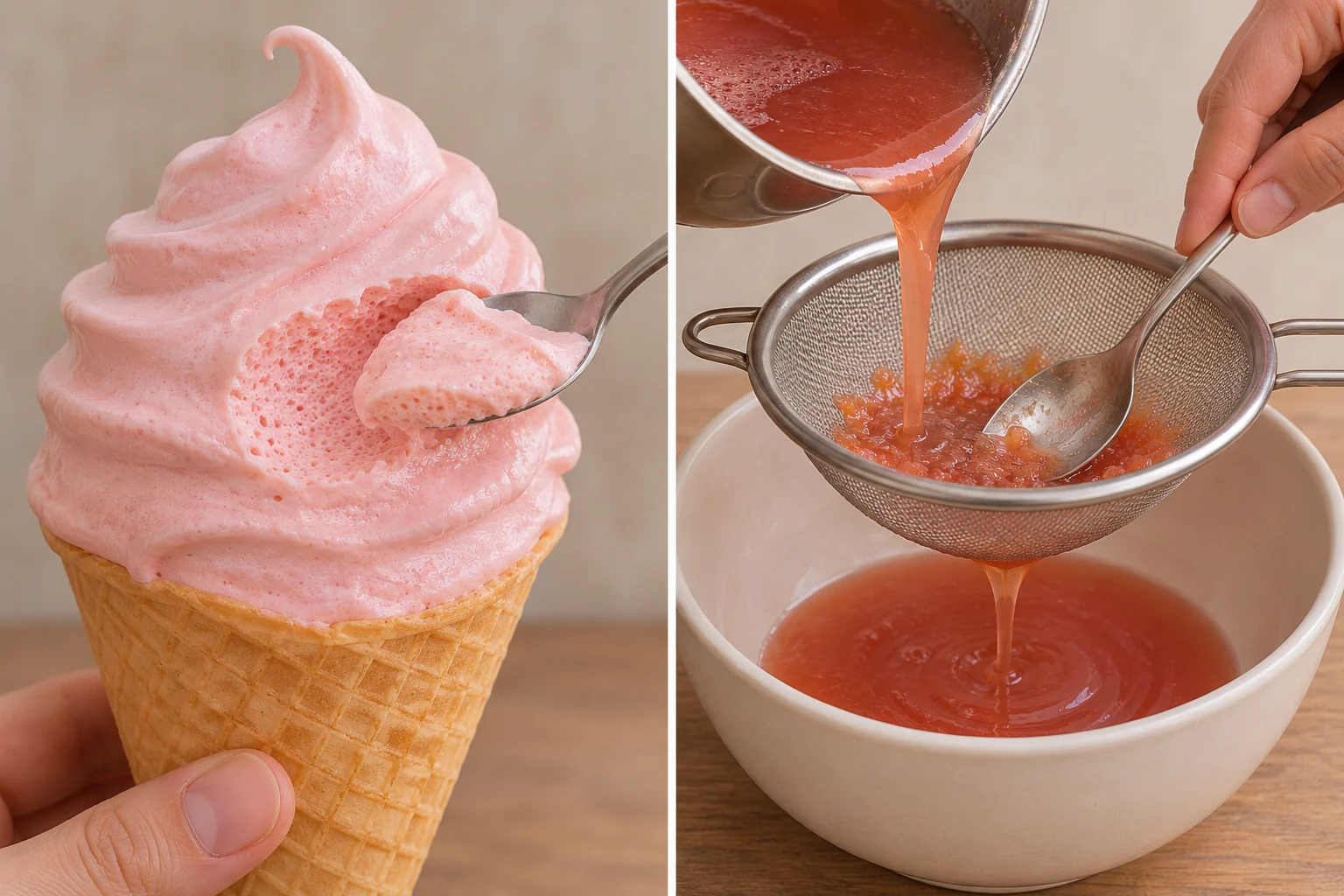
Reconstruction image (AI-generated): the fine foam of espumilla on a cone, and the step of straining guava syrup
Reconstruction image (AI-generated). On the left, espumilla piled on a cone is scooped with a spoon to show the inside of the foam. On the right, the step of straining the guava juice to be combined with the foam. Drawn on the basis of Cultural record of Baños, Ecuador, p. 154.

The Baños parish record begins with straining washed and split guavas. Sugar and water are added to the extracted juice and boiled, and the syrup, not yet too hot, is combined with the egg white a little at a time while whipping. Unlike chopping the fruit and putting it in as is, this leaves no large seeds in the foam and lets the guava flavor the whole of the scooped foam.
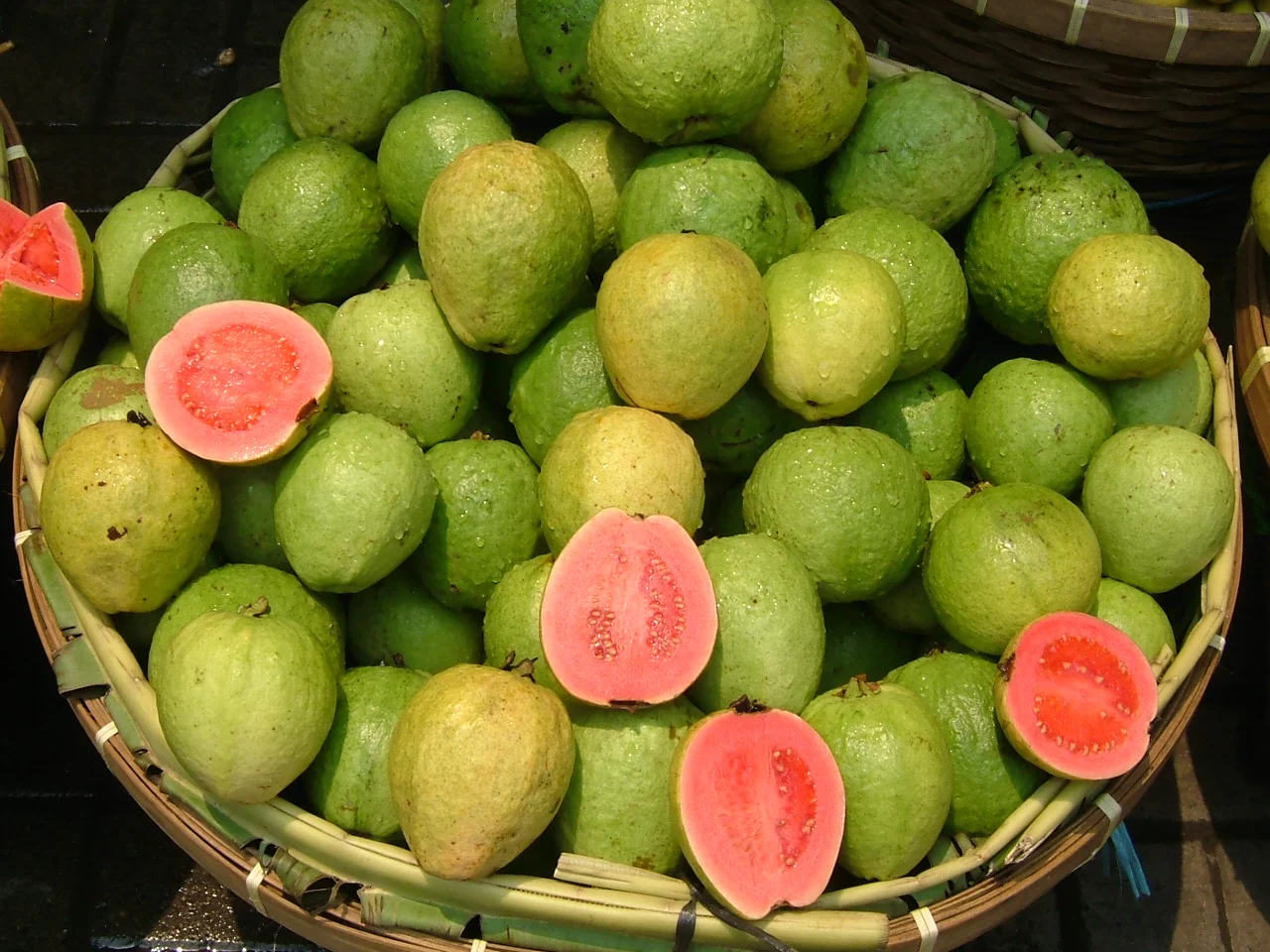
Yellow-green guava skin and cut flesh
Guava fruit. In the Baños example, the juice is strained and then boiled with sugar. Photo: Sakurai Midori / Original posting and rights / CC BY-SA 2.1.

The example in the University of Cuenca thesis, from the same province, heats 15 guavas to extract the pulp, mixes in sugar and lemon, then adds the whites of 3 eggs one at a time and whips until peaks form. The Baños example boils juice and sugar into a syrup before combining it with egg white. In the university example, there is a separate step of combining the heated pulp with sugar and lemon, and no instruction to reduce a juice syrup first. Depending on when the sugar is added and which part of the fruit is used, the liquid and pulp that enter the foam differ.

La Reposterita, an Ecuadorian pastry-ingredients company, publishes a recipe that uses mora juice in place of guava. It specifies 400 grams each of juice and sugar and 200 grams of egg white; the mora juice is boiled with the sugar over medium heat, with 110°C as one guide. Meanwhile the egg white is whipped separately, and the boiled juice is poured in a thin stream and mixed. Here the process of first making the egg-white foam and then adding the fruit syrup is stated explicitly.

In the company’s procedure, the syrup is boiled for 10 minutes over medium heat, or until it reaches 110°C. The 110°C is a guide for the syrup thickened in the pan, not the temperature of the finished sweet after the egg white is combined.

The Baños parish document says that when whipping by hand, one uses the forearm and begins by mixing in small circles; once the volume increases and the foam can hold its shape, the motion becomes larger, with strong back-and-forth strokes. It is a method that does not simply combine the same ingredients but changes the motion according to the volume and shape of the foam. The university example takes the point at which peaks form as the end point. Not only time or the number of strokes but how well the mixture holds its shape is the guide to the next step.

A Shop in Ibarra, and a Trial Measuring Syrup Temperature

Sandra Viviana Pascal Castro of "Espumilla Dulce Amor" in Ibarra, Imbabura Province, uses guava pulp that has been heated, cooled and strained. She first whips egg white with sugar and vanilla, then adds the pulp a little at a time, and adds lemon once the foam is firm enough to hold its shape. Because the University of Cuenca example adds sugar and lemon to the pulp first, the order in which fruit and foam are combined is reversed even though the ingredients are similar. In the Ibarra maker’s record, vanilla is used at the stage of whipping the egg white, separate from the lemon added at the end.

A pastry study from the Universidad Internacional del Ecuador also tries a recipe that uses gelatin in addition to guava and lemon. The syrup of sugar and water is taken to a guide temperature of 115°C, poured in a thin stream onto egg white that has begun to foam, and lemon juice and rehydrated gelatin are added. It is not presented as the standard recipe for the sweet sold on the street, but as a research example assuming small quantities of 8 grams each. Compared with the Baños and Ibarra recipes, which use no gelatin, another ingredient is added at the stage of shaping the foam.

The Ibarra shop’s record uses a pot to heat the guava, and prepares bowls, a strainer, spoons and cones for whipping and serving. The university trial lists the measuring of ingredients, syrup temperature and whipping method as controlled items. While one source specifies the state of the syrup with a thermometer, what remains in the shop interview is the procedure of adding the pulp little by little to build thickness until it can be scooped with a spatula. Which stages are expressed in numbers and which are checked by the feel of the mixing also reflect differences in the purpose for which the recipe was recorded.

Quito’s tourism office names guava as a traditional flavor and presents examples made with banana, strawberry, orange, passion fruit, soursop and others. A record of many types of fruit alone does not show whether every shop makes it by the same process. There are examples that boil the juice and put it into the foam, as in the published mora recipe, and others that mix pulp and lemon first, as in the Cuenca recipe. Looking at a fruit’s name together with the state of the liquid or pulp when it goes into the foam makes it possible to distinguish methods even under the same flavor name.

A Cookbook from Quito, and a Family That Kept Selling

According to the bibliographic record of the Municipal Library of Girón, issue no. 23 (1985) of Cultura, the journal of the Central Bank of Ecuador, carries an article introducing the cookbook of Doloritas Gangotena y Alvarez. A university report examining an espumilla business in Quito quotes a recipe from that article, describing a method of whipping 6 egg whites, boiling 1 libra of sugar and combining it with the syrup, not yet too hot. The quoted passage does not mention guava. What can be traced here is a transcription of a recipe derived from the cookbook; it is not a record that shows the form of today’s cone-served sweet or when street selling began.

A study from the Universidad San Francisco de Quito introduces the Gangotena materials as a cookbook compiled in households of the time. Comparing modern fruit-flavored examples with the syrup and egg-white method in this cookbook, the two share the step of putting sweetness into the egg-white foam, while the handling of fruit and decoration is known in more detail from later sources. That a food’s name appears in an old cookbook and that a later way of presenting it for sale was already established at that time must be verified separately.

The list of sources in a study published in Revista América records the Gangotena cookbook as dated 12 June 1893 in Quito. The date can be traced from the manuscript’s bibliographic entry, and the description of egg white and syrup from later articles. While the cookbook’s entry is a clue that the name of this sweet was used in households of the time, confirming whether it was the same as today’s guava foam requires checking the manuscript against the relevant pages of the article that introduced it.

Blanca Manobanda Morales, who sells sweets in Quito, tells in a local interview how she has sold espumilla as the third generation of her family. In addition to presenting the sweet as something one can buy in the center of the capital, the interview is a source showing that a particular family has carried on both the method and the trade. The interview reports that she also presented the sweet in London in 2024. What this case shows is that one maker presented the sweet in another place. It is not a record showing who first sold it in Quito.

A Church Entrance, and the Town Where Fruit Is Bought

The University of Cuenca thesis relates the story of María Crispuma, who learned the method from Livia Cojillo at a house where she worked as a domestic worker, and who then sold it in Cuenca after passing through several towns. According to the interview the thesis cites, a church entrance was an easy place to sell. She is also introduced as the first person to make it in Cuenca, but what can be confirmed here is her biography as reported years later and testimony about where she sold. No record is presented that examined when other makers began selling.
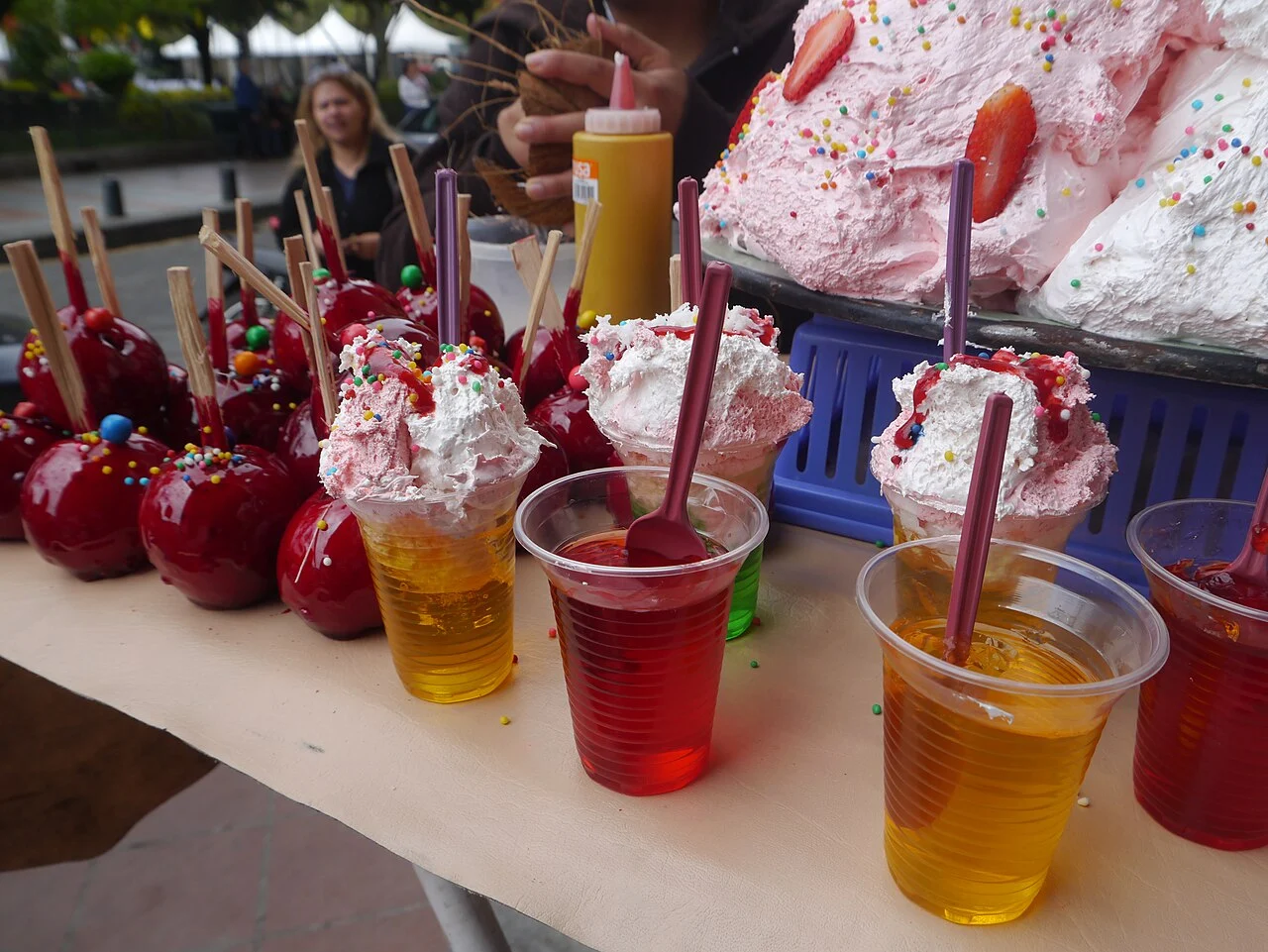
In front of Cuenca Cathedral, foam decorated with fruit sits alongside red candy-coated apples and colored jelly
A stall in front of the Cathedral of the Immaculate Conception in Cuenca. Espumilla decorated with fruit is displayed beside candy-coated apples and jelly. Reduced version from the source. Photo: Edjoerv / Original posting and rights / CC BY-SA 4.0.

In the Baños parish administrative document, women who learned the method from their mothers make the sweet, and sales are said to stand out after Sunday Mass and on festival days. For guava, it records a case of choosing and buying from sellers in Paute. Even among accounts from the same province of Azuay, the Cuenca interview shows the skill one maker acquired and her place of trade, while the Baños record shows the transmission among the parish’s women, the sourcing of fruit, and Sundays and festivals. It is a sweet for which not only the foam on the cone but also where the fruit is bought and when sellers take their places are recorded.

The Baños parish document describes the sweet as one enjoyed at festivals while noting that it is made throughout the year. That stalls stand out on Mass and festival days is not the same as the making season being limited. Comparing the variety of fruit presented in Quito with the guava from a specific source recorded in Baños, some stalls offer many flavors to choose from, while some examples place weight on where a single fruit is sourced. These are differences that cannot be judged from the color of the foam or the decoration on top.

Glossary

Espumilla
Here, an Ecuadorian sweet in which egg white and sugar are whipped and combined with fruit flavor.
Almíbar
Syrup made by dissolving sugar in a liquid and boiling it. In the Baños example in the text, guava juice is used.
Mora
Here, a fruit of the blackberry group. In the example in the text, the juice is boiled with sugar and put into the egg white.
Gragea
Small sugar confections scattered on foam piled on a cone or in a cup.
Barquillo
Here, a cone of thin baked batter, on which the foam is piled and eaten together with it.
TOPEspumilla | Cafe & Sweets Parade Kyoto

(FAQ)

All You Need to Know

Do you have gluten-free sweets made without wheat flour?

Yes. We offer sweets made without wheat flour, such as madeleines made with rice flour. However, they are made in the same kitchen as products that use wheat flour. If you have a wheat allergy or need to strictly avoid wheat, please consult our staff before purchasing.

Do you use additives such as preservatives or emulsifiers?

We do not add preservatives or colorings when making our sweets.

Some of our baked goods (such as madeleines and chocolat) use baking powder to help the batter rise. In addition, ingredients we purchase, such as chocolate, may contain additives such as emulsifiers that help maintain their quality.

To see the ingredients we use, please check the ingredients listed on each product page.

When is the Seasonal Citrus and Lemon Curd Cake available?

This cake is sold on an irregular basis.
It is often available on Saturdays, Sundays and public holidays. We post updates on in-store availability as needed in our Instagram Reels, so please check there.

Do you sell fresh cakes on Wednesdays?

We do not currently sell fresh cakes on Wednesdays.
On Wednesdays, we mainly sell baked sweets and drinks.

*Many customers have asked about this, but no decision has been made yet about selling fresh cakes on Wednesdays.

Can I request noshi paper (noshi kakegami) for gifts, presents, and the like?

For gift boxes in sizes M and L, we offer inner noshi (uchi-noshi) only, at 100 yen (tax included) per sheet. Please specify the top inscription and name inscription, and place your request at least 3 days in advance. For same-day requests, please consult the shop.

Do you offer OEM (manufacturing of original products)?

We are currently accepting consultations on OEM requests, depending on their details.
To start, please contact us through the inquiry form with details such as your product concept, desired quantity, and sales purpose.

Where is the shop located?

Cafe & Sweets Parade Kyoto is in Uoya-cho, one street south of the Otesuji Shopping Street, a 4-minute walk from Keihan Fushimi-Momoyama Station and a 5-minute walk from Kintetsu Momoyama-Goryomae Station. Parade stands in an area full of history and charm. Nearby are Torisei, a sake and yakitori restaurant run by a long-established sake brewery; Teradaya, said to be the place where Sakamoto Ryoma was attacked; the Fushimi Jikkokubune, wooden boats that take you along the canal; and many other places.
For the exact location and other details of Cafe & Sweets Parade Kyoto, please check Google Maps↗︎.

What days is the shop open?

We are open every Wednesday through Sunday from 11:00 to 18:00 (last order 17:30). We are regularly closed on Mondays and Tuesdays.
On public holidays, we are open on some days and closed on others.
We may also close temporarily on irregular days, or open on regular closing days. For the latest information, please check Instagram↗︎ or Google Maps↗︎.

How can I place a large order?

Yes, we accept orders through this inquiry form.
Large orders are orders of 21 or more units, or orders with 10 or more delivery addresses.

Can you tell me about allergens in your products?

Whether a product uses egg, wheat flour, peanuts, walnuts, other nuts or dairy products is stated on the allergen list page and on each product’s page.

Peanuts (groundnuts) and walnuts are shown separately from “other nuts” such as almonds.

Points of caution other than the items above, such as sesame, gelatin and honey, are written in the “Notes” section of each product. However, not all allergens are listed. For assortments such as gift boxes, the ingredients of each sweet included are listed under [Ingredients] on the product page.

If you have any questions, please ask our in-store staff or call us (075-644-4118) before purchasing.

Do any of your products contain alcohol?

Yes. We mainly use liquor in the following sweets:

• Canelé de Bordeaux (rum)
• Galette Bretonne (with rum)
• Madeleine au Chocolat (with liqueur: Grand Marnier)

The Galette Bretonne and the Madeleine au Chocolat are also available in “without rum” and “without liqueur” versions, respectively, made without liquor.

▼Gift boxes
• Classic Baked Sweets Gift Box L [9 Varieties, 15 Pieces]: includes 2 Galettes Bretonnes (with rum)
• Classic Baked Sweets Gift Box M [9 Varieties, 9 Pieces]: includes 1 Madeleine au Chocolat (with liqueur)
• Gluten-Free Gift Box [S] and Gift Box [M] with Higuchi Apiary: contain no sweets made with liquor

Even in baked sweets, a small amount of alcohol may remain. Children, pregnant women, people sensitive to alcohol and anyone who will be driving should take care.

For seasonal products, please check the “Notes” section on the allergen list page.

Is there parking?

The shop does not have its own dedicated parking lot. If you are coming by car, please use one of the paid coin-operated parking lots nearby.
If you are coming by train, the shop is about a 4-minute walk from Fushimi-Momoyama Station on the Keihan Main Line and about a 5-minute walk from Momoyama-Goryomae Station on the Kintetsu Line.

Can I eat and drink in the shop?

Yes, you can enjoy your order in our in-store eat-in space. Seating consists of 5 counter seats and 4 terrace seats (2 tables for 2 people each). High-speed Wi-Fi is also available.
Takeout is available as well. Opening hours are 11:00–18:00 (last order 17:30).

Where can I check the day’s cake selection and sold-out items?

The fresh cakes we sell change from day to day. We post updates on in-store availability as needed on Instagram↗︎.
Items may sell out after a post. If you want to be sure to get something, please call us (075-644-4118).

Do the 2 types of lemon cake differ in how they should be stored and how long they keep?

Yes. The lemon cake with icing must be kept refrigerated and keeps until the end of the day of purchase. The lemon cake without icing can be stored at room temperature and keeps for approximately 7 days from the date of manufacture. Please prioritize the date shown on the label of the product you have.

How long do baked-goods gifts keep, and how should I store them?

As a guideline, baked-goods gifts keep for about 2 weeks from the date of manufacture. Please store them in a cool place, away from direct sunlight and high temperature and humidity. The exact date is printed on the back of each individual sweet.

What payment methods can I use in store?

▼In store
• Cash
• Credit cards: Visa, Mastercard, JCB, American Express, Diners Club, Discover
• Transit IC e-money: Suica, PASMO, ICOCA, Kitaca, TOICA, manaca, SUGOCA, nimoca, Hayakaken
• Other e-money: iD, QUICPay+
• Code payments: PayPay, Rakuten Pay, d Barai, au PAY, Merpay, WeChat Pay, Alipay+, and others

Apple Pay and Google Pay can be used if one of the e-money services or cards listed above is registered.

What kind of cream puff is the Oven-Baked Cream Puff?

It is our classic cream puff: a crisp cookie-crust choux generously filled with a rich cream that combines fresh cream with custard made using “Sakura” eggs from a purely Japanese chicken breed.
It must be kept refrigerated; please eat it on the day of purchase. We also offer a caramel-flavored version, the “Oven-Baked Caramel Cream Puff.”
For details, please see the Oven-Baked Cream Puff product page.

What Are Meringue Cookies?

Meringue cookies are sweets made by baking and drying meringue, which is egg white and sugar whipped together. At Parade, we use kibi sugar (Japanese cane sugar) and finish them with a light texture: a crisp first bite, then an airy, fizzy melt in your mouth.

What kind of sweet is a sablé diamant?

True to its name, which means “diamond” in French, this is a sablé coated with sugar that sparkles around the outside. For the sugar coating, we use vanilla sugar that we make by hand in our shop from vanilla bean pods.
It keeps for about 3 weeks. Please store it in a cool place, away from direct sunlight, high temperatures and humidity. It is also included in our baked goods gift boxes.
For details, please see the Sablé Diamant product page.

Is the Galette Bretonne available both with and without rum?

Yes. It is available both with rum and without rum. The individually sold Galette Bretonne contains rum. The rum-free version is included in our gift boxes. Please contact the store to ask whether it can be purchased individually.

What kind of sweet is a Linzer torte?

The Linzer torte is a sweet associated with Linz, Austria, combining a nut pastry with jam. At Parade, we layer a cinnamon-scented pastry, almond batter and our house-made framboise (raspberry) jam, and bake them together.

What baked goods can I choose as a gift (temiyage) from Fushimi?

We offer Gifts M and L, assortments of our classic baked goods; Gift S, with sweets made with rice flour; and a gift that includes honey from Kyoto Higuchi Apiary. You can choose based on the number of pieces, the ingredients, and the recipient’s preferences. As a guideline, the baked goods keep for about 2 weeks from the date of manufacture.

How do the gift boxes differ by type?

They differ in the types and number of sweets they contain.
・Classic Baked Goods Gift Box M [9 types, 9 items]: 2 types of sablé (12 pieces each), Galette Bretonne, 3 types of madeleine, financier, Sésame Matcha, Boule de Neige Chocolat
・Classic Baked Goods Gift Box L [9 types, 15 items]: 2 types of sablé (12 pieces each), Galette Bretonne (2 each without rum and with rum), Honey Madeleine, Madeleine Chocolat (without liqueur), financier, Sésame Matcha, Boule de Neige Chocolat
・[Gluten-Free] Gift Box [S]: 4 Honey Madeleines, 2 Madeleine Chocolat (without liqueur), 2 Sésame Matcha, 2 Boule de Neige Chocolat
・Gift Box [M] with Higuchi Bee Farm: 8 classic baked goods in 7 types, plus Wildflower Honey (160 g) from Kyoto Higuchi Bee Farm
The sweets made with liquor are the Galette Bretonne (with rum) in the L box and the Madeleine Chocolat (with liqueur) in the M box. For full details, please see the list of gift boxes.

What kinds of honey, eggs and chocolate do you use?

The ingredients we use vary by product. Our main ingredients are as follows.
• Honey: Purely Japanese honey from Higuchi Apiary in Fushimi, Kyoto (Honey Madeleine, Caramelized Honey Canelé, etc.)
• Eggs: “Sakura” eggs from purely Japanese-bred hens (Oven-Baked Cream Puff, Canelé de Bordeaux, Honey Madeleine, etc.)
• Chocolate: Chocolate from Valrhona of France (Madeleine Chocolat, etc.)
• Butter: Cultured butter (Brown Butter Financier, Galette Bretonne, etc.)
Please check each product page for that product’s ingredients.

Is there an ideal temperature or way to warm the sweets so they taste their best?

Depending on the product, there are recommended ways to enjoy it.
• Canelé de Bordeaux: Warming it for 3–5 minutes in a toaster oven that has not been preheated makes the caramel on the surface crisp, giving it a texture close to freshly baked.
• Brown Butter Financier: Warming it in a toaster oven for about 1–2 minutes gives it a texture and aroma close to freshly baked.
• Linzer Torte: The ideal serving temperature is 5–20°C.
• Lemon Cake (with icing): We recommend letting it sit at room temperature for a little while to enjoy the fluffy texture of the cake, or, in summer, enjoying it chilled straight from the refrigerator.
Toaster ovens heat differently depending on the model, so please keep an eye on the sweets while warming them to avoid burning.

How many people do Size 4, Size 5 and Size 6 whole cakes serve?

Parade’s “Decoration Cake with Fresh Cream and Seasonal Fruit” serves approximately 3–4 people in Size 4, 4–6 people in Size 5 and 6–7 people in Size 6. Please choose a size based on how much will be eaten and whether it will be served together with other sweets.

How long can I carry a cake? Do I need ice packs or an insulated bag?

Please plan on carrying it for about 1 hour. Conditions vary depending on the temperature, the type of cake and how you travel, so if you are planning a long journey, please consult the shop before purchase.

Can I have a message plate or candles added to a birthday cake?

The “Decoration Cake with Fresh Cream and Seasonal Fruit” comes with an original cookie plate and 1 set of 5 candles. A charge applies to candles from the 2nd set onward.

Are the sweets for sharing at work individually wrapped? How many people can a gift serve?

The Classic Baked Goods Gift is an assortment of sweets packed in individual bags. Note, however, that “9 items” does not mean 9 pieces: some items, such as the sablés, contain several pieces in one bag. Please think separately about how many people you are giving to and how many bags you want to give each person.

What is the difference between a financier and a madeleine?

Generally, a financier is characterized by the flavors of egg whites, almonds, and browned butter, while a madeleine is typically based on a batter made with whole eggs. At Cafe & Sweets Parade Kyoto, we offer the Brown Butter Financier and a madeleine made with rice flour and honey.

Do canelés taste better warmed? How do you recommend eating them?

If you warm Parade’s Canelé de Bordeaux for about 3 to 5 minutes in a toaster oven that has not been preheated, the caramel on the surface becomes crisp, and you can enjoy a texture and aroma close to freshly baked. Because heating varies by model, please keep an eye on it while it warms.

Can cakes and baked goods be frozen?

Because ingredients and finishing differ from product to product, we do not state that all cakes and baked goods can be frozen under the same conditions. Please first check each product’s storage instructions and date label. If you plan to freeze a product, please consult the shop before purchasing and tell us the product name.

What is the difference between sablés, cookies and galettes?

“Cookie” is a name for a wide range of baked goods. “Sablé” is used as a name describing a texture that crumbles softly like sand, and “galette” is used for sweets with a flat shape, among other things. Parade’s Galette Bretonne is a thick-baked cookie made with butter.

Can I get paper bags, small bags for sharing or gift wrapping?

In store, paper bags, plastic bags, bags for baked goods and gift wrapping are available for a fee. Prices vary by type and size. Please let us know how many you need and any wrapping requests before purchase.

News Letter

We send the latest news from Cafe & Sweets Parade Kyoto and money-saving coupons exclusive to our followers. Add us as a friend on LINE. Something good should come your way.

* We usually send notices of sales launches on Sunday mornings.
* Depending on the content, messages may be sent only to certain segments of subscribers.

Thank you for signing up!
We hope you look forward
to our next email.

Access

Cafe & Sweets Parade Kyoto

〒612-8041

Heights Momoyama No. 105, 574 Uoya-cho, Fushimi-ku, Kyoto-shi, Kyoto

* If you are coming by car, please use a nearby parking lot.

VIEW MORE GOOGLE MAP