


SweetloreEncyclopedia of World Sweets (834)

Pinza triestina
Pinza triestina
An Easter sweet bread that opens three ways, and the table with ham
Fermented Pastries / Trieste, Italy

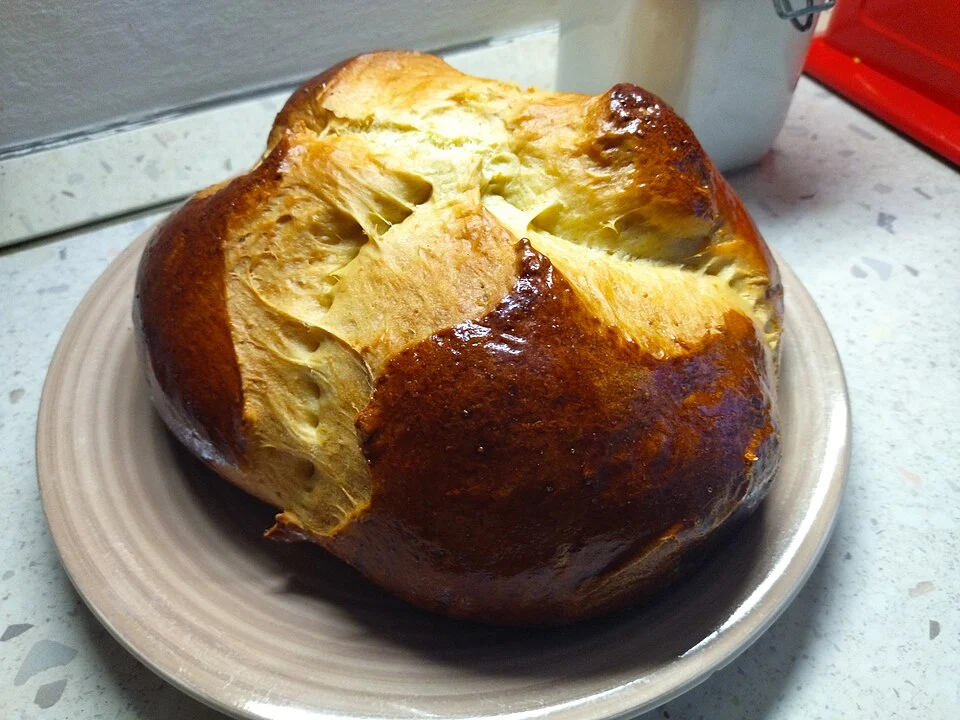
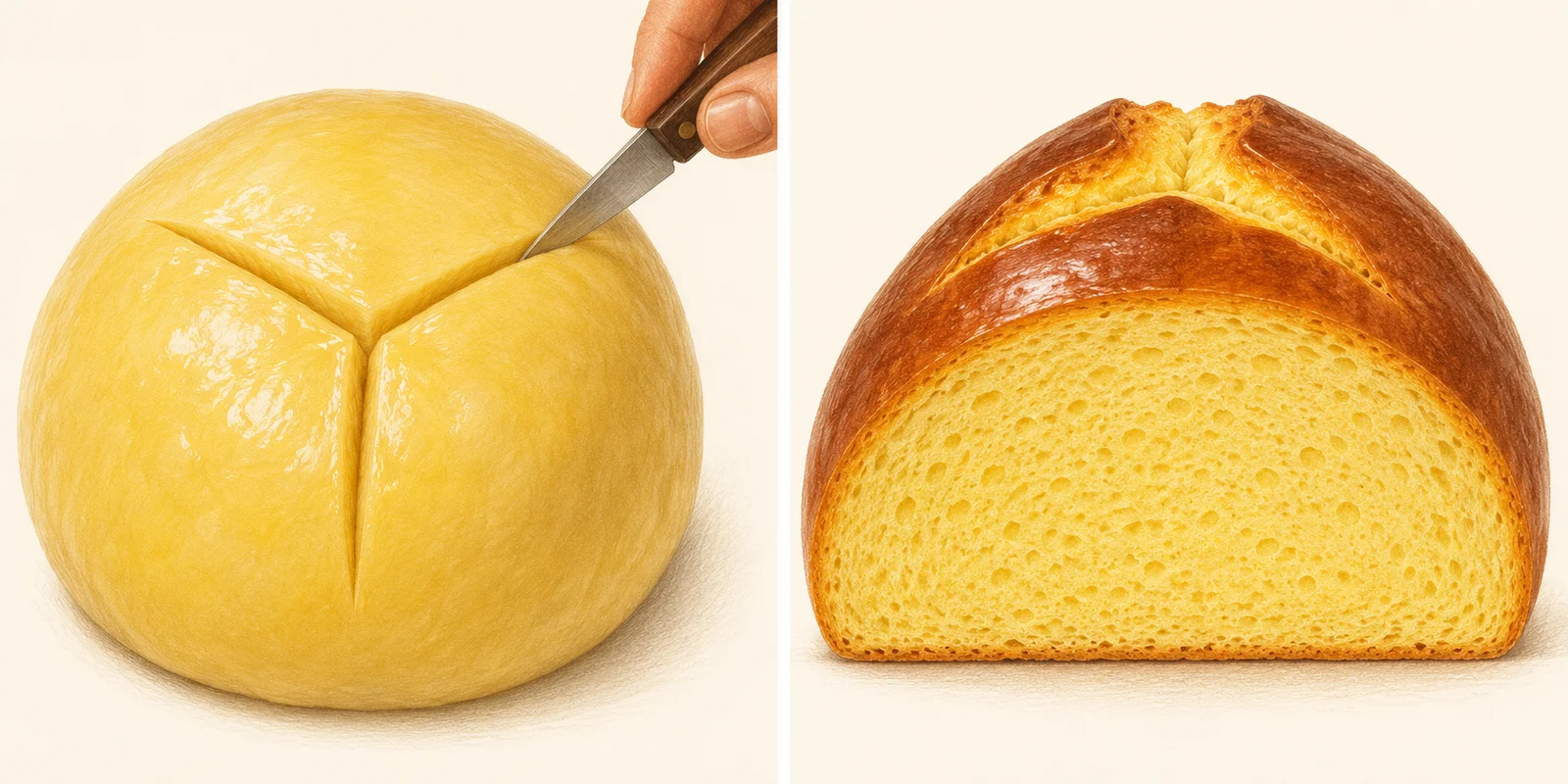
Pinza triestina, from Trieste, is an Easter leavened bread whose pale crumb opens in three directions between areas of deep brown crust. A single rounded loaf is cut with three slashes before baking, so the crown that swells in the oven splits apart. It has long been baked in Trieste, at the northern tip of the Adriatic, and around Gorizia, a little way inland. The inside, made with sugar, eggs and butter, is sweet. It is set on the same plate as salty ham or sliced thinly and filled with ham. To keep both the crown and the crumb in each slice, check the height of the round loaf and cut down from the top.
Combining yeast and flour, then adding the remaining ingredients in two stages
ERSA, the rural development agency of Friuli Venezia Giulia, presents it as a bread of the former provinces of Trieste and Gorizia. The ingredients are flour, sugar, butter, eggs, oil, honey, yeast, milk, salt and flavourings. Sweetness does not come from sugar alone, since honey is used as well, and the fat combines butter with oil. All of these go into the dough. Unlike a bread whose sweetness or aroma comes only from something brushed on after baking, this one shows a dough made with eggs and honey even after the crust is cut.
ERSA’s method begins by mixing flour, water and yeast and leaving the mixture at about 32 °C for around 30 minutes. A dough for fermentation is prepared first. Half of the remaining ingredients are then added and kneaded in, and the dough rests for about 1 hour. The other half is added last, and the whole is kneaded once more. The three stages do not simply mean kneading the same dough for longer. Ingredients are added once the first dough has rested, and the dough is finally brought to one containing sweetness, eggs and fat. The initial 32 °C is the temperature of the environment in which the yeasted dough is placed. It is not a figure for carrying out the whole process at that temperature after the other ingredients are added.
Butter also contains water, while oil is liquid at room temperature. When the dough is brought together, each works its way into the flour and liquid differently, so if the fats were swapped in equal amounts, ease of mixing and elasticity could change as well. The pattern of holes seen when a dough made with eggs and honey is cut is not determined by the ingredient list alone. It also depends on the kneading, the temperature and the resting time at each stage. With this method of preparing an initial starter and then adding new ingredients, the dough can be checked after each mixing before moving on.
The example published by the mill Molino Moras likewise prepares a small dough from 40 g of flour, water and yeast. After it has risen, flour, eggs, softened butter and sugar are added in two portions. Whole eggs and yolks are worked in first, and the second dough uses orange zest and, if desired, rum. What is measured in differs from the ERSA example, which also lists honey and milk, but the sequence overlaps, moving from the first fermentation to a dough rich in eggs and fat. An example that checks at each stage whether the dough has risen adds visible cues on the work surface to sources that give fixed times.
Opening the crown and cooking slowly to the center
Seen from above, the three slashes run outward from near the center of the circle. When the skin of the dough is pulled taut in the oven, the slashed places open first and the pale dough inside shows. Even when the three masses look lifted, they remain joined as one at the base. The slashes are not marks for dividing the loaf among diners. Slicing horizontally and thinly produces surfaces that can hold ham, while cutting down from the top puts both the browned crust and the interior in each slice. The three visible slashes and the number of slices the loaf is cut into are separate tasks, one done before baking and the other after.
In the regional source’s example, the loaf is baked for about 40–45 minutes in an oven heated to 170 °C. There is a lag between the top crust taking color and the heat reaching the round center. The outside, which contains eggs and sugar, colors readily, and in a cut surface the interior retains its air bubbles. Changing the size of a loaf changes the distance to the center at the same heat. The depth of the slashes and the way the dough is rounded are steps that affect where the surface opens. The dark and pale areas separate after rising not because the crust is painted in two colors but because the dough inside emerges in the oven.
The Molino Moras example brushes egg yolk over the rounded, rested dough and, once the yolk has dried, cuts a Y shape about 2 cm deep. The round surface the brush passed over browns, and the interior, opened up later, shows bright dough. In the interview with the baker Jerian about how it is made, too, the knife goes in from the center outward in three directions after egg yolk is brushed on. In that example the surface is stretched taut when the dough is rounded. Even with slashes of the same length, how the crown opens in the oven looks different depending on what was brushed on before cutting and how taut the round dough was.
Among Easter round breads, too, the Paduan example of the Venetian fugassa has a cross cut into it, an egg-white glaze, and almonds and pearl sugar on top. In the regional pinza source, what stands out is the outline that opens in three directions. Comparing the grains on the surface and how many cracks extend when the loaf leaves the oven shows that even round breads made at about the same time have different styles. In Trieste there is also a tradition that sees the round pinza as the sponge soaked in vinegar during Christ’s Passion, and the titola of the same season as the nails. The meaning of the shape told at the festive table and the practical function of slashing the loaf where it swells in the oven overlap in the form of one bread.
A sweet slice, served with salty ham
According to the regional sources, households with an oven baked it for Easter and served it with ham that had been wrapped in bread and cooked. The bread wrapped around the ham to cook it and the sweet pinza cut for guests are different things. When baking in the kitchen, the sweet dough does not soak up meat juices, and ham sliced at the table can be paired with the soft bread. The regional tourism guide also lists pairings with raw ham and cooked ham. A slice containing honey or sugar eaten on its own differs, in the sweetness and egg aroma that linger in the mouth, from one eaten after salty ham.
The Accademia Italiana della Cucina writes that it was hard to cook the sweet well in the oven of an old wood-burning kitchen, and that some cookbooks advised having a baker bake it. In some cases the dough was kneaded at home in many stages, and the rounded loaves were then taken to the town oven. The honey and egg dough prepared at home and the work of heating a single round loaf in the baker’s oven continue within the steps of making the Easter bread. Just as present-day examples check temperature by number, a place was needed back then too to open the round shape and bake it through.
A local article from Trieste refers to a booklet Angelo Jerian published in 1955. That Katharina Prato’s book contains a pinza recipe also appears in the regional source. What the Accademia Italiana della Cucina cites is the Italian edition published in Trieste in 1892, while the Austrian agricultural authority refers to the 1895 German edition. Looking at each year and edition, the record of eating it in town at Easter can be traced through cookbooks from the late 19th century and a 20th-century local booklet. These bibliographic details cannot determine the earliest year it was made at home.
In the home-style example from Jerian’s interview, dividing the dough into two gives about 370 g per loaf. Egg yolk is brushed on, the slashes are made, and the loaf is baked starting at 150 °C with a fan, lowering the temperature, and finally checked by inserting a thin wooden skewer into the middle while watching the color. The times and the use of the oven differ from the example that takes ERSA’s 170 °C and about 40–45 minutes as given. Both are examples of baking several Easter round loaves. Watching the color first and taking the loaf out after checking the center are judgments that hold across methods, whatever the temperature figures.
An Istrian breakfast and an Austrian blessing basket
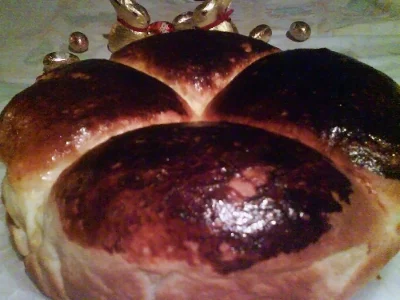
In a tourism guide to the Istrian peninsula, pinca is a sweet bread served at Easter breakfast. It cites an example made from a round dough with raisins, marked with a cross and decorated with olive leaves. On the same plate are Easter eggs, ham, onion, salt and sometimes radishes. When pinza is served with ham in Trieste too, salty elements are not mixed into the bread and baked. The eater matches them to a slice that has been cut. Looking separately at the cross versus the three-way cut, at whether fruit is visible in the dough, and at whether eggs and meat are set alongside allows a concrete comparison of Easter breakfasts by the sea.
In Žminj, Istria, the tourist board says there is an event before Easter at which a method using a baking lid is passed on to the next generation. When a lid encloses the dough, one can show not only the shaping on the work surface but also where the fire is placed and when the baked bread is taken out. Compared with the 170 °C oven in the Trieste regional source, both the tool surrounding the bread and the handling of the fire change. The raisins and olive leaves in the tourist guide are ingredients that appear in a breakfast example. Whether every Istrian household uses fruit, or how the bread is decorated, cannot be decided from that single example.
Austrian Osterpinze are also cut in three directions. In examples from Styria and elsewhere, a colored hard-boiled egg is sometimes placed in the central hollow. The agricultural authority describes the custom of taking the bread to be blessed on the Saturday before Easter, in a cloth-covered basket together with smoked meat, eggs, horseradish and other foods. At the table it is also served with meat, and there are examples eaten sweet with butter or jam. When an egg is placed on it, the spot that opened in the oven is used. Mixing egg into the raw dough to make the inside soft and placing a boiled egg on the crown of a celebratory bread are different uses of the same ingredient.
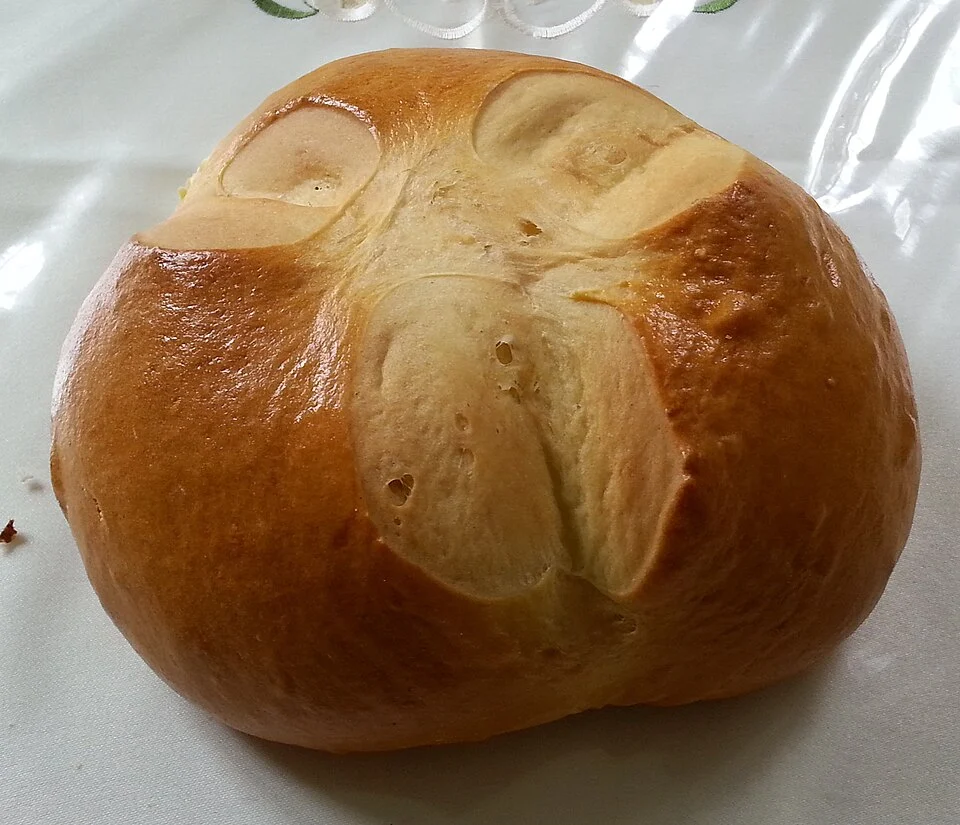
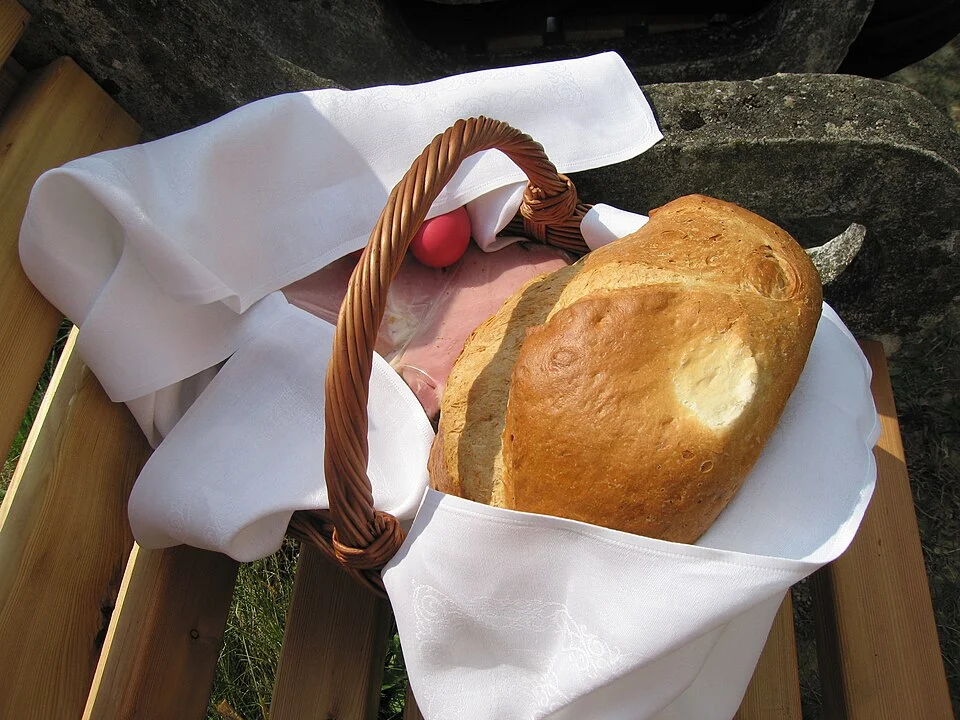
In the method given by the Austrian agricultural authority, the dough is divided into 330 g portions and rounded, then brushed twice with egg wash and left to dry. Using oiled scissors and watching the spacing left and right, three cuts are made to half the thickness. It is an example baked at 190 °C for about 25 minutes. The form resembles the Trieste example of putting a knife in from the center outward, but the blade, the depth and the oven heat each differ. Comparing the three faces of the crown one by one shows concretely what breads with close names share and where each maker changes the approach.
There is also an Osterpinze in the Görz style, using the old German name for Gorizia. The Austrian agricultural authority mentions the possibility that it came from Gorizia in the 19th century. In Styria there are examples flavored with anise, which is used in a different place from the raisins of Istria or the almonds on top in the Veneto. Trieste and Gorizia are regions listed together in the same regional source entry. Deciding on a single route of transmission in the past would require other sources, but whether the baked loaf has three cuts, what aroma is added, and what it is served with on the same plate can be compared across sources from each place where it is made.
Glossary
- Pinza / related terms (pinza / pinca / Pinze)
- Names that appear in examples from the Italian-speaking world, Istria and Austria. They do not mean that the ingredients or even the cuts are identical.
- Prosciutto cotto nel pane
- Ham wrapped in bread dough and cooked. When it is served with pinza, the sweet bread is cut separately.
- Titola
- A confection of a different shape made at Easter in Trieste, in the same season as pinza.


