


SweetloreEncyclopedia of World Sweets (834)

Karachi Halwa
Karachi halwa
Cooking starch and sugar together, carrying on the name of a city
Sugar Confections / Karachi, Pakistan, and elsewhere

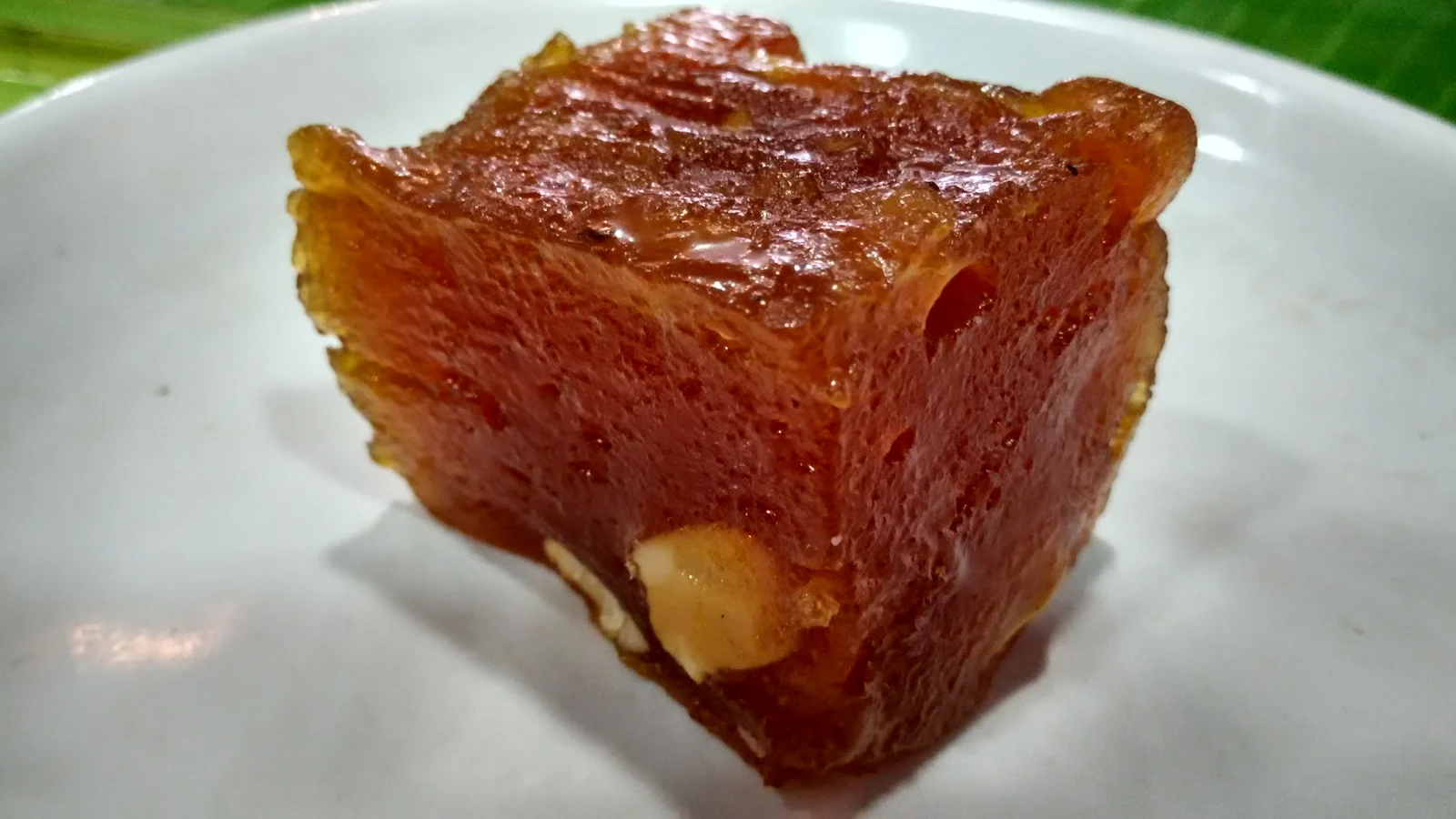
Viewed from the side, a translucent orange slice shows grains not only in the nuts used as decoration but also inside the cut surface. Karachi halwa (Karachi Halwa, کراچی حلوہ) is a South Asian sweet in which starch is cooked and stirred with sugar syrup, then cooled and cut. The mass is glossy and elastic, and the texture changes when the teeth meet a nut. Some shops make it with starch extracted by soaking wheat in water, and some home recipes use cornstarch. A method of cooking wheat starch under the name Bombay halwa appears in a cookbook published before the 1947 Partition of India and Pakistan.
Soaking Wheat and Waiting for the Cloudy Water to Settle
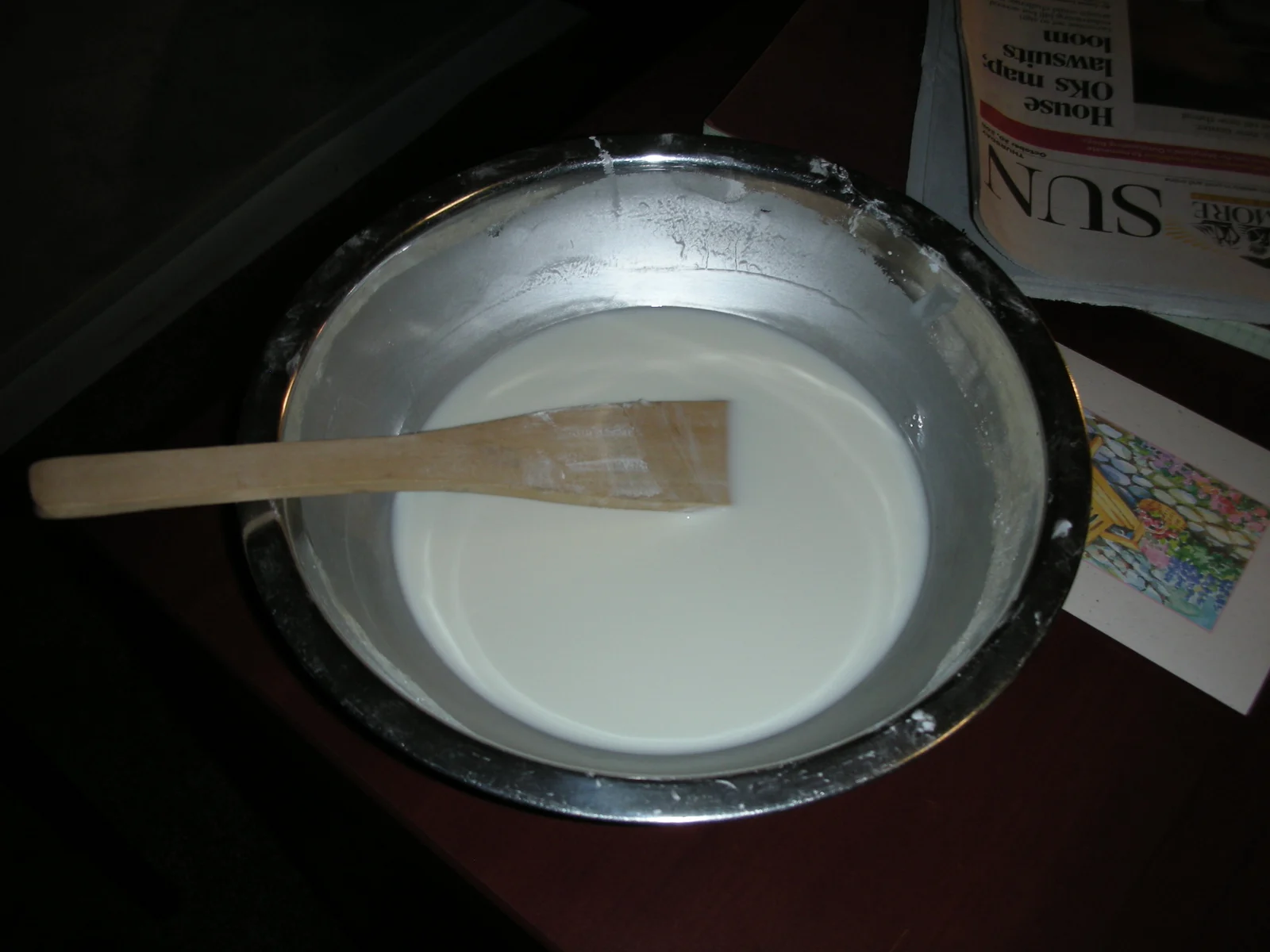
Junisha Dama, who visited confectioners in Mumbai and Delhi, records cases in which starch obtained from wheat and other sources is called nishasta, and the sweet is called nishasta jo halwo. The wheat grains are washed and soaked, with the water changed. The grains, softened by the water, are coarsely ground and strained through a thin cloth, more water is added, and the cloudy white liquid is put into an earthenware vessel. After about a day, the white component sinks to the bottom. The water above is poured off, and what remains at the bottom is spread out and dried, giving the white powder that goes into the pan. Only after soaking, straining through cloth, settling and drying does the cooking of the sweet begin.
In The Khaki Kook Book (1917), the Bombay Halwa of no. 98 by Mary Kennedy Core uses cream of wheat, a coarsely ground wheat. One pound is soaked in water for 3 to 4 hours and rubbed through strong coarse cloth, and the cloth is dipped in water many times to draw out the starch. The sequence of letting that water stand and collecting the sediment is similar to the work described in modern interviews. In the preceding no. 97, Halwa, coarsely ground wheat is fried in butter or similar fat, and water and sugar are added once it has taken on a faint color and a fragrance rises. In no. 97 the grains stay in the pan as they cook, whereas in no. 98 the water is strained and the starch that has settled is cooked, so the part of the same coarse meal that becomes the sweet differs.
In the 1967 edition, Balbir Singh presents this sweet as a Sindhi one and writes that, besides cornflour, nishasta or arrowroot can also be chosen. In this recipe, cornflour is a white cornstarch that is scattered into water and added. Methods range from soaking wheat and collecting the sediment to measuring out a commercial white powder and dissolving it in water. In Singh’s book, the water in which the sugar is boiled and the cold water into which the starch is scattered are prepared separately. Mixing the white powder with water is preparation for putting starch that has already been extracted into the next pan.
Stirring Until It Leaves the Bottom of the Pan
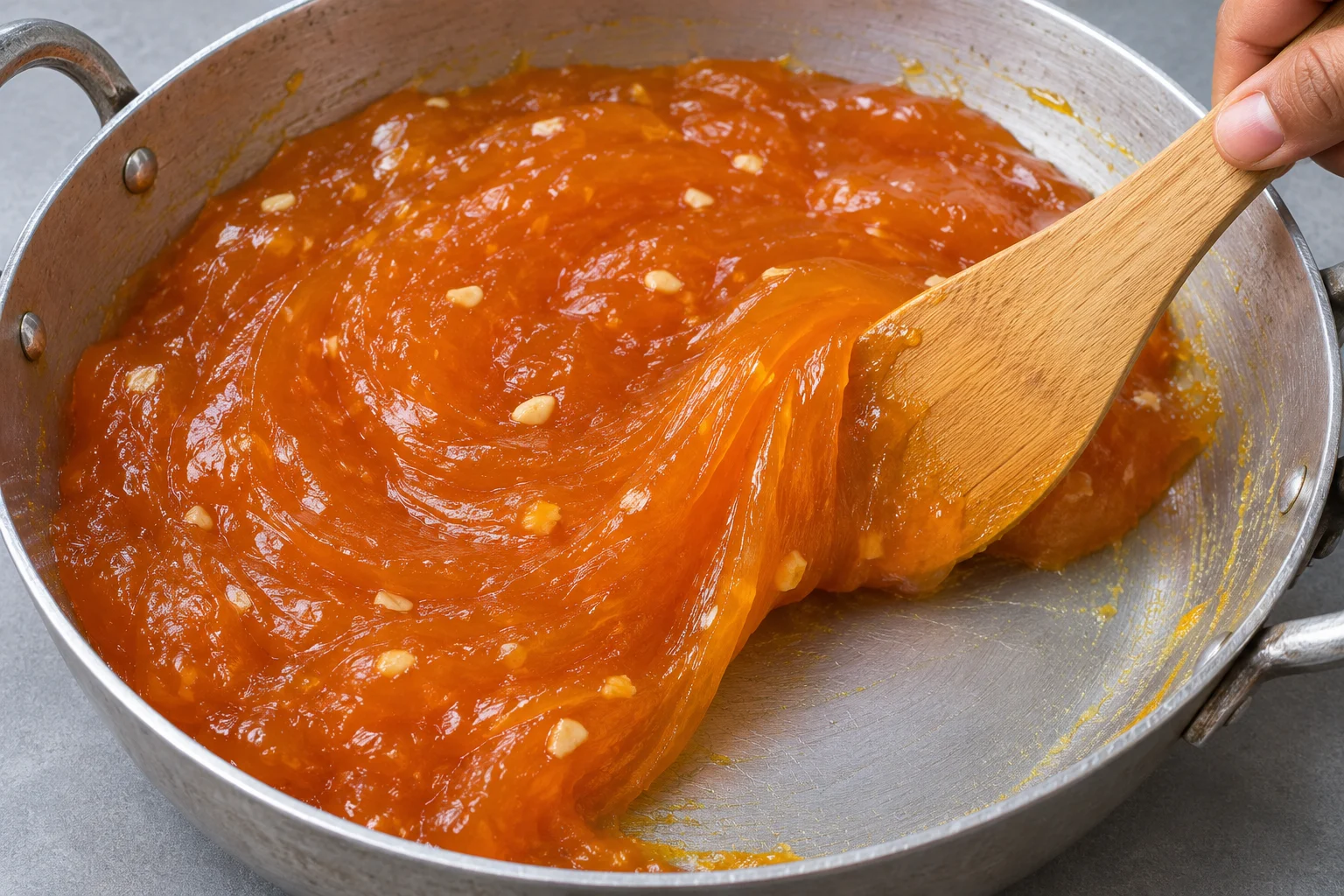
Core boils white sugar to a stage suited to confectioner’s fondant and adds wheat starch to it. When the mixture forms a mass as it cooks and is stirred, she adds butter and keeps cooking until it is so stiff that the stirring hand meets strong resistance. Rose water, thinly sliced almonds and cardamom are added after that. She also gives a method that uses salted Crisco in place of butter. The order in which the flavorings and nuts go in does not change, and the mass is cooked while watching how it moves in the pan.
Singh dissolves the sugar and boils it for 5 minutes, strains it through cloth, and adds the powder dispersed in cold water and the coloring ingredient. She stirs over medium heat, and when lumps form she adds lemon or lime juice. When the mixture begins to stick to the bottom, warmed ghee or olive oil is added little by little. The guide for the time until it leaves the sides of the pan and comes together as one mass is 30 to 45 minutes. How the mass and the pan separate each time the spatula is moved is the cue for when to add more fat and when to turn off the heat. The nuts and flavorings are added, the mass is transferred to a greased square dish, and it is pressed flat with the bottom of a greased ladle. When it has cooled and set, it is cut into diamond shapes, and if it is hard and difficult to cut, the blade is warmed slightly.
The recipe presented in Urdu by Saadat Siddiqui calls for 250 grams of cornstarch to 1 kilogram of sugar. The powder dissolved in water is added to the sugar syrup and simmered over low heat, and then cardamom, a seed mixture called char magaz, a sourness-giving ingredient and food coloring are added. It is spread on a tray and decorated with almonds and pistachios. The ingredient list does not include ghee. In the recipe in the Marathi-language Maharashtra Times, lemon juice is added once the sugar has dissolved, powder dispersed in separate water is poured in a little at a time, and from the point when it begins to come together, ghee is added one spoonful every 3 to 4 minutes, four times in all. After it is spread on a tray, it is left at room temperature for 3 to 4 hours before cutting.
A method that cooks the mass for a long time in the pan and finishes it firm gives a strong chew. Dassana Amit presents a home example in which the halwa is finished soft but can still be cut once it sets. Chabbu halwo, mentioned in Dama’s interviews, is a name derived from the Sindhi word for chewing. The sensation of chewing a sweet with strong pull and the moment of biting into a nut come together in the same mouthful.
The Cross Section with Nuts, and the Colors of Each Shop
At Punjabi Chandu Halwai in Mumbai, wheat starch is the main ingredient, combined with cardamom and nuts. The orange item topped with almonds is also called Chandu halwa, and the shop’s product listing carries the name Karachi halwa. The shop’s Bombay Ice Halwa combines cornstarch with milk, sugar and ghee and is spread into a thin slab. It is also called Mahim halwa, and Sachin Bal, a member of the family, says it has been made at the shop for more than sixty years. Even for halwas on the same shelf, the height of a cut piece, and the milk and starch used, differ.
Tallu Sweets, in its answer to Dama’s interview, says it uses nishasta and adds no spices. A cook at Karachi Halwa House in Delhi gives an example in which color comes from pistachio paste for green and saffron for orange, with aroma from cardamom, nutmeg, mace and other spices. There are also methods that use food coloring, as in Siddiqui’s recipe. In a photo showing the shapes of cashew nuts in a glossy red mass, the nuts placed on the surface draw the eye. From the visible decoration and color alone, it is not possible to identify each nut or spice kneaded into the mass.
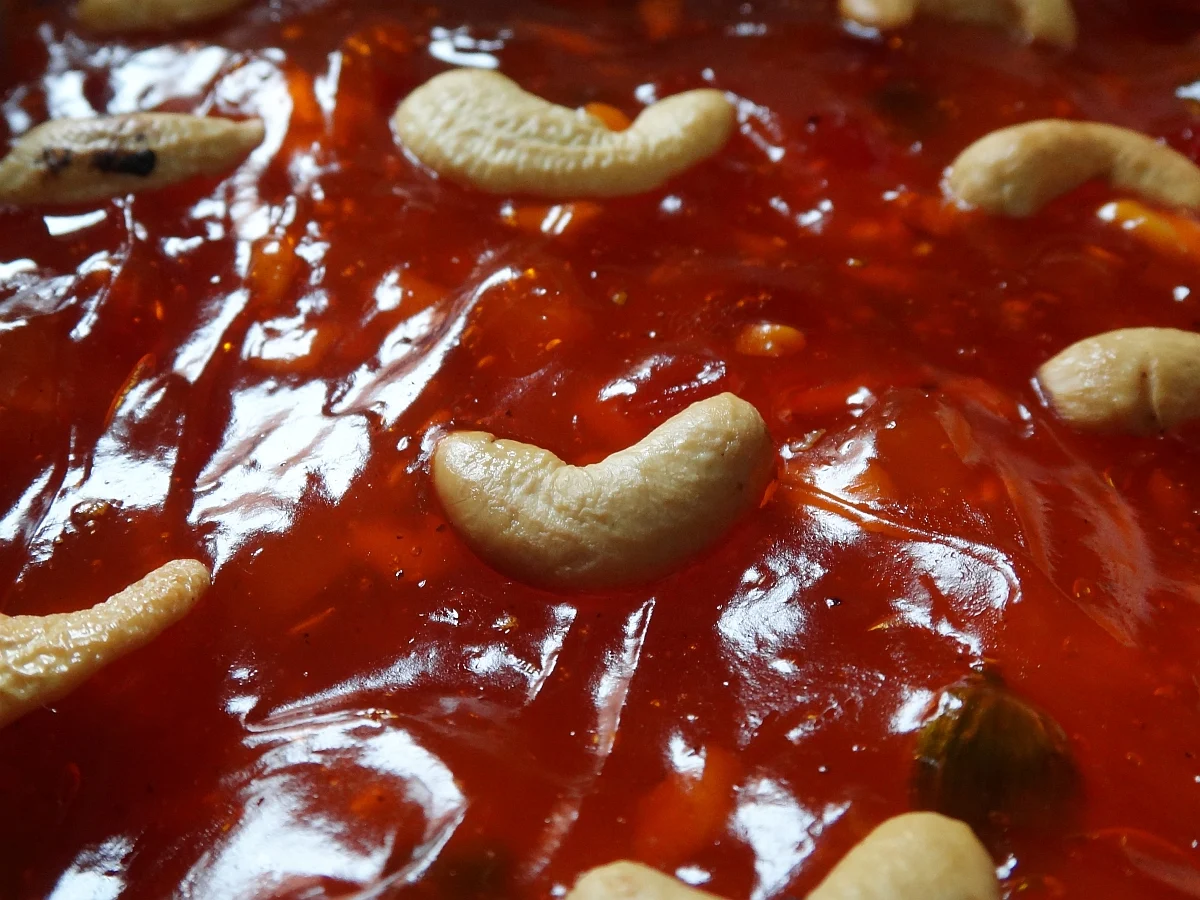
In Core’s book, "Bombay Halwa" is followed by "Turkish Delight." No. 99 gives a cooking procedure like that of no. 98, uses gum arabic in place of wheat starch, and omits the butter. Thinly sliced almonds, rose flavor and cardamom are common to both. Singh also likens Karachi halwa to lokum, citing the addition of fat and nuts. The comparison, made to call to mind an elastic sweet, appears in two books from different periods.
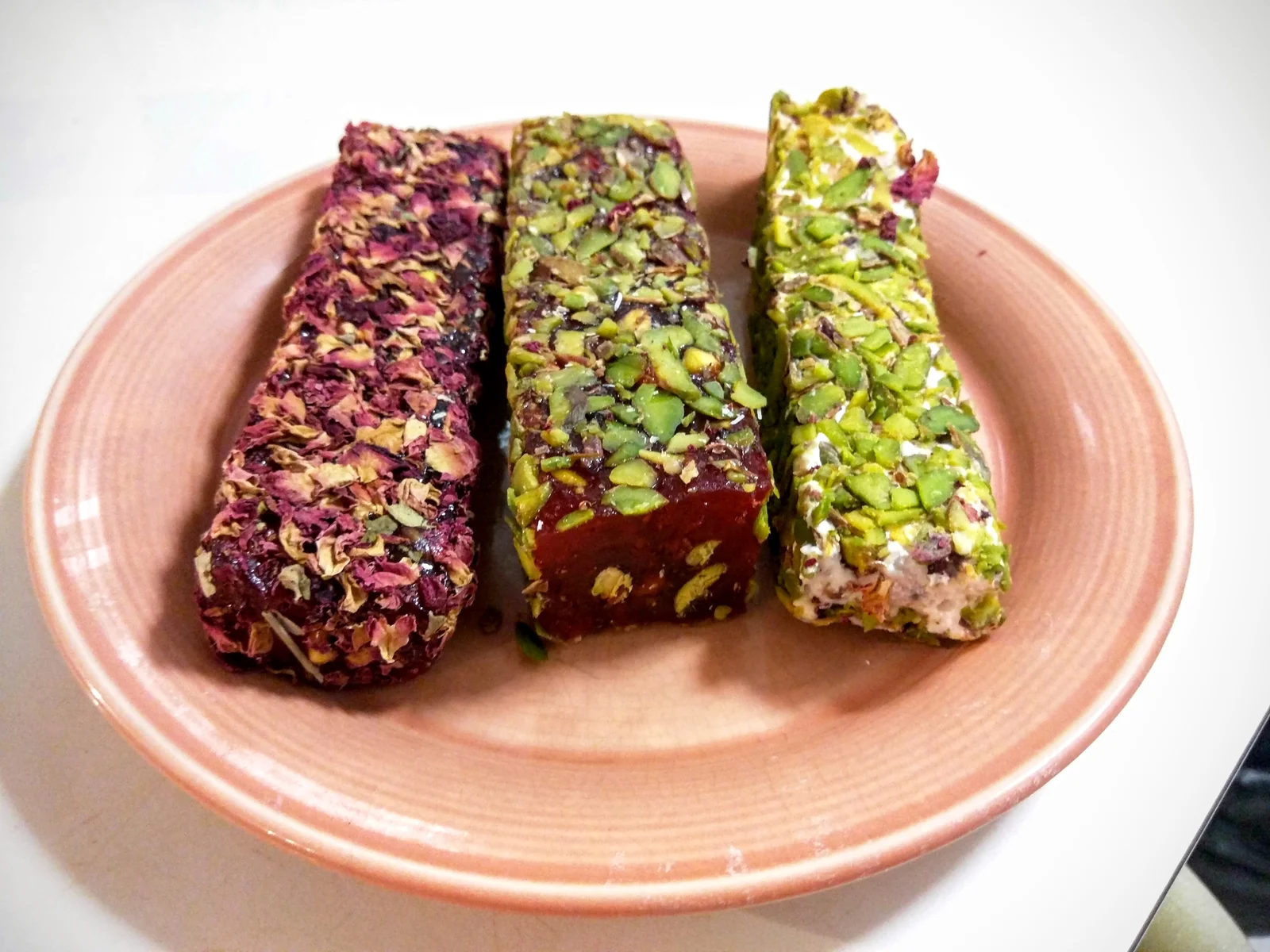
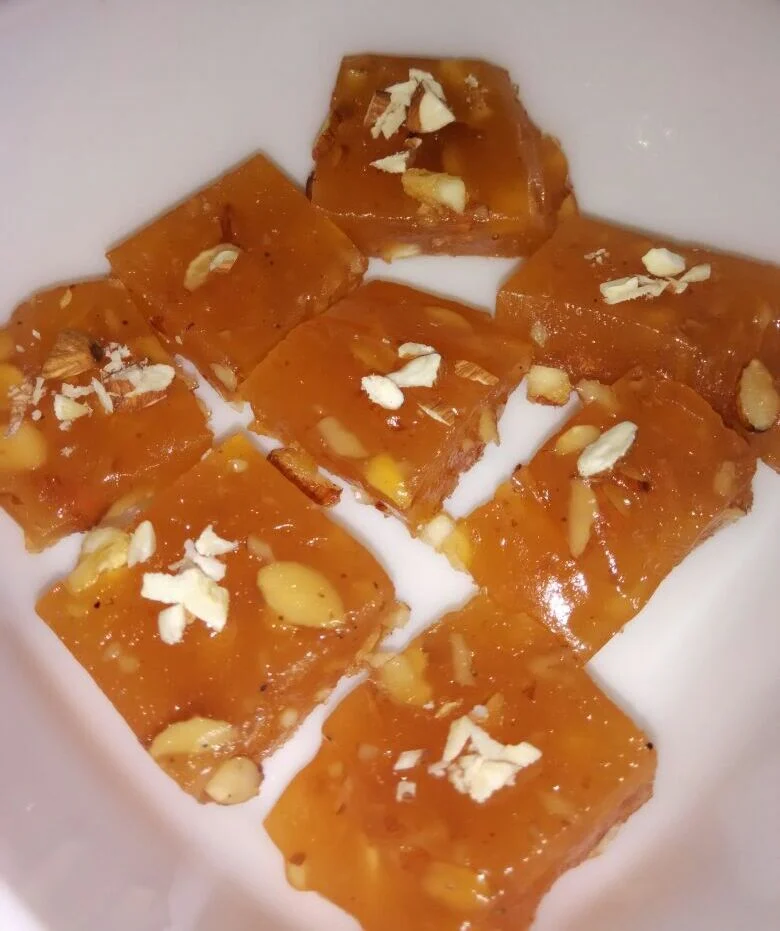
The three photos show a piece with nuts inside, a plate of squares cut and arranged, and a surface topped with cashew nuts. Singh mixes almonds and pistachios in when the cooking is done, and after transferring the mass to the dish she also scatters almonds on top, if desired. Even with the same nuts, those added while the mass is cooking appear in the cut surface, and those placed after it has been flattened on the tray show on the top. In Core’s comparison recipes, almonds go into both confections, but modern photos of lokum also include forms coated in pistachios or petals. One recipe in a cookbook does not determine the finish of every neighboring example.
A Method with Bombay in Its Name, and Shops That Came from Karachi
The Bombay halwa in the 1917 cookbook was a sweet made by straining wheat to extract starch, boiling it down with sugar, and working it with butter or similar fat. The migration of the families who run shops appears in the records around the 1947 Partition. Because the cookbook was printed earlier, the cookbook’s name and the business in Bombay after migration can each be traced in the sources. Whether it was first made in Karachi or Bombay, and when it began to be called by the name of Karachi, is not known.
The family says Chandulal opened a shop in Karachi in 1896. In the 1940s Karachi had three shops and a factory. The booklet of the 1939 All India Industrial Exhibition in Karachi carries an advertisement selling several kinds of halwa, including "BADAMI," as souvenirs of the city. A contribution in Dawn News Urdu that introduced the booklet also records that almond halwa made by craftsmen from Meerut was sold at the venue. After Partition, the family opened a shop in Zaveri Bazaar in Bombay and expanded to Grant Road and elsewhere. According to his grandson Bharat Bhushan Bal, more than twenty people who had worked in Karachi were also received in Bombay.
The family of Punjabi Ghasitaram Halwai founded their business in Karachi in 1916. After Partition, the founder’s son Govardhandas sold parathas and halwa from a handcart in Kalbadevi, Bombay, and opened a shop in 1949. An interview that includes the account of a great-grandson describes jelly-like Karachi halwa as one of several items popular at the time. Chaina Ram in Delhi states that it began in 1901 in Anarkali Bazaar in Lahore and moved in 1948 to Chandni Chowk in Delhi. It lists regular, pistachio and tinned versions. The same sweet name remains in the trade of a shop that left Karachi and a shop that left Lahore.
Served at Wedding Breakfasts and Given to Departing Guests
Dama writes that at her own sister’s wedding, Sindhi halwa was given to departing guests. The white achho halwo of a family whose ancestral village is Nasarpur in Sindh uses arrowroot, sugar, cardamom and pistachios, and no color is added. On the morning of a wedding it is sometimes served with sev, thin salty fried snacks. The custom of serving a sweet piece with a salty fried snack, and the occasion of wrapping it for guests to take away, both appear in the same family’s account.
Another use that Dama heard about is prasad offered to a goddess. Alka Keswani, who spoke with her, explains that on the night of a ritual this halwa is sometimes offered in place of dishes cooked that day or sweets made from mawa, concentrated milk. Of the case of giving it at weddings, Dama writes that in the past it was packed in the luggage of guests going home over a long journey by bullock cart. The sweet a household considered it kept in stock also had distinctions in when it was eaten and to whom it was given.
Ahmer Naqvi, who leads food tours in Karachi, suggests that the name Karachi halwa used in Pakistan too may be a name that spread in India and was carried back by people who migrated. Another interviewee mentions households that order betrothal sweets from Umerkot or Mirpur Khas in Sindh. The packaging, the form and the people who choose differ among a shop’s tinned product, the white halwa of a wedding morning, and a gift for the journey home. By working starch and sugar together and cooling it into a piece that can be handed over, it reaches both those leaving a shop and guests returning from a celebration.
Glossary
- Nishasta (nishasta, nishashta)
- Starch extracted from wheat and other sources. One method is to soak and crush wheat and collect the sediment from the strained water.
- Arrowroot (arrowroot)
- Starch derived from plants such as Maranta arundinacea. In Singh’s cookbook it is listed among the choices of powder for halwa.
- Ghee (ghee)
- Milk fat obtained by removing the water and milk solids from butter and similar products. In some methods it is added in small amounts during cooking.
- Cardamom (cardamom)
- A spice of the ginger family whose seeds and other parts are used for flavoring.
- Char magaz (char magaz)
- A mixture of seeds used in the Urdu-speaking world and elsewhere. In Siddiqui’s recipe it is added to the cooked mass.
- Gum arabic (gum arabic)
- A water-soluble material obtained from the sap of acacia species. In Core’s cookbook it is used for Turkish delight.
- Mace (mace)
- A spice made by drying the aril that surrounds the nutmeg seed.


