DRUG

パレード伏見洋菓子店

SweetloreEncyclopedia of World Sweets (834)

SWEETS&CAKES

Karlovarské oplatky of Karlovy Vary

Karlovarské oplatky

Thin discs moistened with thermal water and baked together with nut powder

Baked Sweets / Czechia · Karlovy Vary

Karlovarské oplatky of Karlovy Vary: a thin round golden wafer with a raised leafy wreath and central fountain, a small fragment beside it.

Lift one of these discs, wider than a palm, and you can tell how light and thin the baked sheet is. Karlovarské oplatky are wafers about 19 cm in diameter, made in a spa town in western Czechia. Between two thinly baked sheets, a powder of hazelnuts, sugar and other ingredients is scattered, and the sheets are baked together a second time. Along the rim, a leafy branch stands out in relief; inside it is a name, and in the centre is either the spa’s fountain or a chamois. The town’s mark is not merely baked onto the surface: the town’s thermal water is also used when the batter is mixed and again when the first-baked discs are moistened.
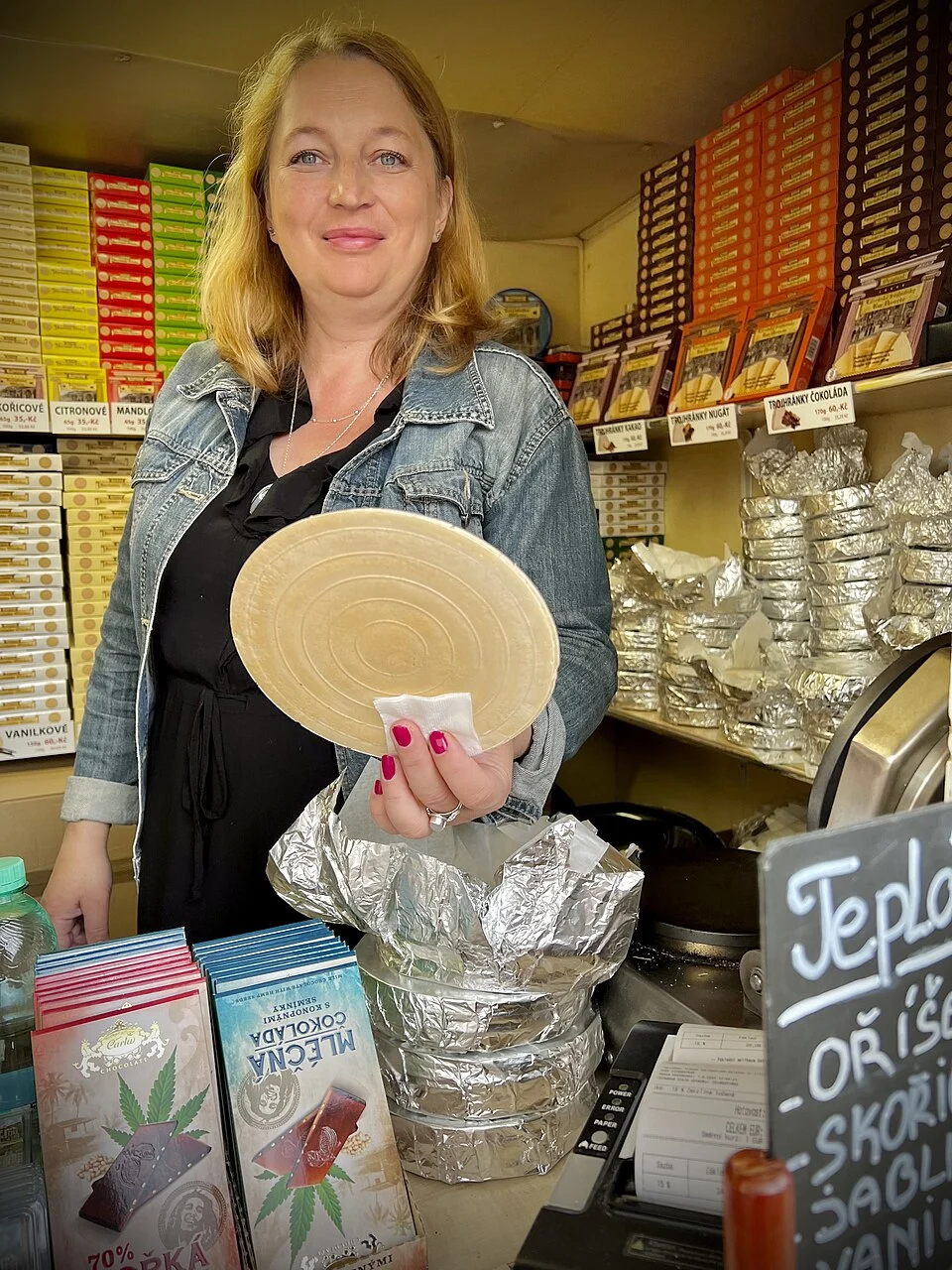
A hand holds up a thin round oplatek, seen from the front, at a sweets stall in Karlovy Vary
An oplatek photographed in Karlovy Vary. The disc held in the hand gives an idea of its size and thinness. Photo by Sharon Hahn Darlin (1 June 2022). Original posting · Photographer’s posting · CC BY 2.0.

Embossing the Pattern on the First Plate, Then Moistening Again with Thermal Water

According to the summary of the specification published in the Official Journal of the European Union in 2007, flour, sugar, milk, eggs, starch, fats and other ingredients are weighed out, the vegetable fat is liquefied, and everything is mixed with fresh local thermal water. The resulting batter is fluid enough to be poured into the machine’s vessel and is pale yellow in colour; it is left to stand for about 60 minutes at 20–26 °C. The Czech-language notice describes the batter as not fermented with yeast, yet the ingredient list in the same notice includes baking powder. Because some English renderings say that no raising agent is used, the ingredient list and the Czech description need to be read together. The standing time here is not described as a step for increasing volume with yeast, as in bread.

The batter is poured thinly onto a rotating baking plate at 220 °C and baked, and each sheet comes out 2 mm or less in thickness. This measurement refers to one of the two sheets that make up the finished product. The first plate carries a pattern, and the heat sets the thin batter while leaving the design on it. In the notice, the outer band encircled by a leafy branch is 30 mm wide, and inside it sits a circular inscription at least 20 mm wide. The fountain at the centre represents the spring emerging at the surface, and the chamois is tied to the legend of the town’s founding. The raised branch and lettering remain visible even after the box is opened and the sweet is picked up.
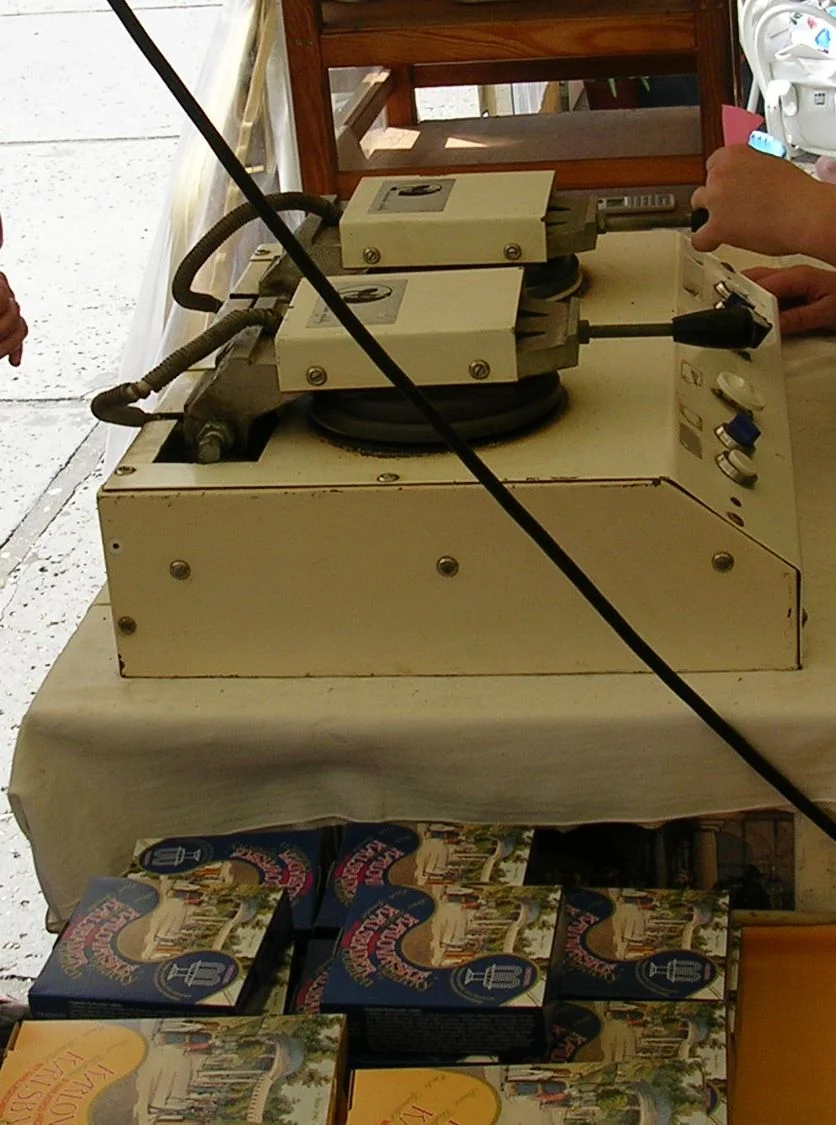
On the worktable of a shop that handles oplatky in Karlovy Vary, two round baking plates with handles sit side by side
An oplatky baking plate photographed in front of the Hotel Thermal in Karlovy Vary on 2 August 2006. In the original posting, it shows local production. The photograph does not reveal the temperature, whether a rotating machine is used, or which stage of factory production it represents. Photo by ŠJů. Original posting · CC BY-SA 3.0 · original image.

The baked discs are moved to a humidifying chamber before the sugar filling is sandwiched between them. According to the summary of the specification, the conditions are 40 °C and 90% humidity for at least 48 hours. The discs are aligned in the same direction and weighted so that they do not warp while being moistened. This matters because, when the two sheets are later stacked, an outward-facing edge that has warped reduces the area of contact. Local thermal water is used here as well, but it serves different purposes: in the batter it binds the flour, and in the chamber it keeps the air around the baked discs humid. The applicant links the character of the thermal water to the crispness and aroma of the finished product. The notice does not state how much moisture passes into the sheets during humidifying; it records, as part of the method, how the water is used at these two points.

When the town presents its springs, it gives the temperature of the water gushing from the Vřídlo (Vřídlo), at the centre of town, as 73.4 °C. The colonnade that opened in 1975 also offers cooled thermal water for those who wish to drink it. The thermal water described in the 2007 application notice is likewise water that wells up hot from deep underground and contains hydrogen carbonates, sulphates and chlorides. Whether the water is drunk at the spring or used for baking wafers, its temperature is adjusted to its use. The 220 °C baking plate and the 40 °C humidifying chamber in the notice are production-equipment conditions set independently of the temperature of the spring.

Scattering Sugar and Hazelnuts, Then Baking Together at 180 °C

Next, hazelnuts are finely ground together with sugar and spread by hand over the lower disc. The filling forms a uniform layer of 1 mm or less, and a second disc is laid over it. Some products use almonds, cocoa, vanilla, cinnamon and other flavourings, but the procedure is common to all: the two sheets are baked separately, and powder is scattered between them. At a broken edge there are two thin baked sheets, and the flavour of sugar and nuts comes from the narrow space between them. The texture of the two sheets meets the teeth first, followed by the aroma of nuts and cocoa.

The baking together is done on a separate rotating plate at 180 °C, which has no relief for impressing a new pattern. The first plate, at 220 °C, bakes the patterned discs; the second joins the two filled sheets into one. Because the faces are aligned and then reheated, the method of making the two thin layers differs from that of sweets in which a finished piece is cut across and spread with filling. At the time of the application, boxes were specified as 5 pieces at 125 g, 6 pieces at 150 g and 8 pieces at 200 g, in each case about 25 g per piece. Wide discs lie flat in a stack in the box, and each piece consists of two baked sheets with a layer of nuts and other ingredients between them.
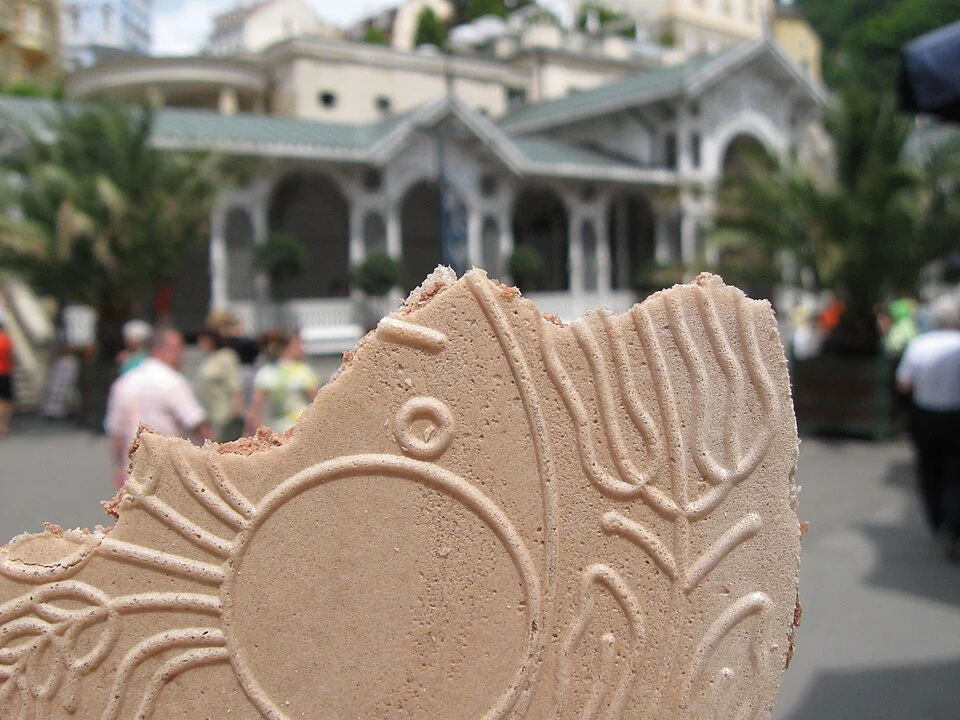
Against the colonnade of Karlovy Vary, the bitten edge of a patterned, chocolate-flavoured wafer
A bitten chocolate-flavoured oplatek. The thin edge and the relief on the surface are visible. In the background is the Tržní kolonáda (Market Colonnade) in Karlovy Vary. Photo by Juan de Vojníkov (15 June 2009). Original posting · CC BY-SA 3.0.
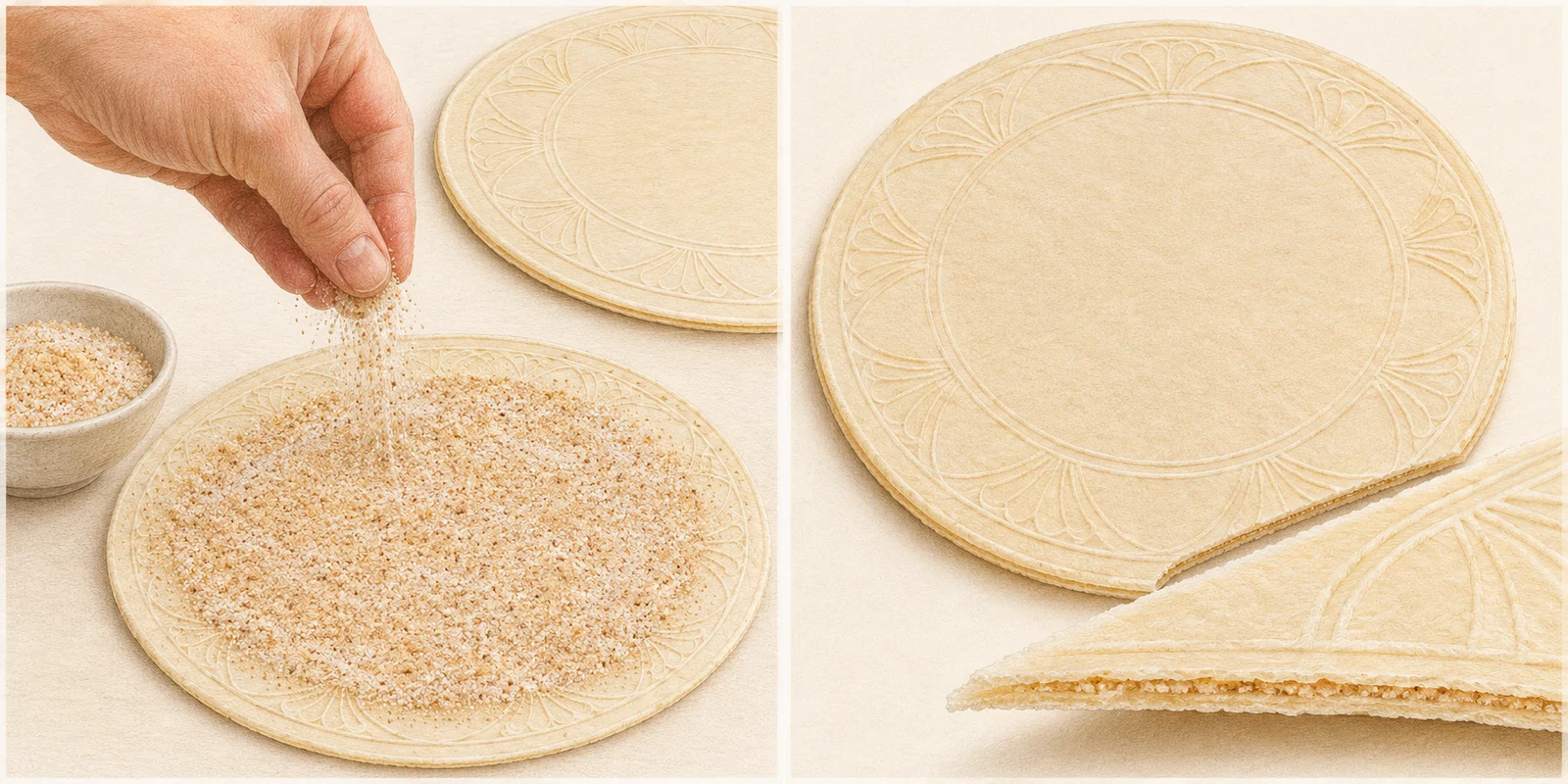
Reconstruction image (AI-generated). At left, a thin disc with fine grains scattered over it and the disc to be laid on top; at right, two thin baked sheets with fine grains between them
Reconstruction image (AI-generated). Sugar and hazelnuts being scattered over a thin sheet baked first (left), and a cross-section of an oplatek after the two sheets have been baked together (right). Source: the specification of Karlovarské oplatky in the Official Journal of the European Union.

A Sweet Served to Spa Guests with Tea, Now Supplied by Specialist Workshops

The application notice reports that the museum in Karlovy Vary holds an old wafer-baking iron. A guidebook for spa guests published in 1788 also mentions the wafers, and the history given by a local producer presents the sweet as something the town’s women served to guests with tea. The iron is a tool for baking batter thin, and the guidebook is a clue to the sweet served to guests. Whether the present size of about 19 cm, or the humidifying time, was fixed in the same way in the past cannot be determined from that tool and guidebook alone.

The notice states that around 1810 Anna Grasmuck produced the wafers on a small scale in the kitchen of the Golden Shield hotel. Until the middle of the nineteenth century, however, mainly home-baked wafers met the town’s demand. In 1867 a specialist workshop known under the name of Barbara Bayer was founded; the notice records that it delivered the sweets to the German Emperor Wilhelm I and won recognition at international exhibitions. The producer’s history adds that the Bayer firm shipped across Europe and supplied the court in Vienna. The thin sweet served to guests in the spa town began to travel beyond the town together with the name of a workshop.

The applicant states that in 1904 there were 22 specialist producers in the area, baking about 4 million wafers a year. The number rose to 26 in 1939, but after the Second World War production continued at about half of them; after nationalisation in 1948, the wafers were made until 1989 at the Karlovy Vary plant of the state-run Orion. The notice says that after that, with the reintroduction of the market economy, members of a local producers’ association took over production. Even if the town’s name remains on the same box, the places and organisations that prepare and ship each wafer have changed over time.

The notice says the wafers won a gold medal at the 1900 Paris Exposition Universelle and were among the best-selling items in the Czech pavilion at Expo 2000 in Hanover. A century after the gold medal, visitors at the fair could enjoy a wafer with a meal, and there were also boxes they could take home as a product of the country. Karlovy Vary today still has shops that bear the name. The town’s tourist information presents the wafers as a sweet sought by people strolling along the spa colonnades. Bought by the box, the discs can be carried home stacked; and when one is held up and looked at, near a shop or the colonnade, the town’s mark appears even in the thin sheet.
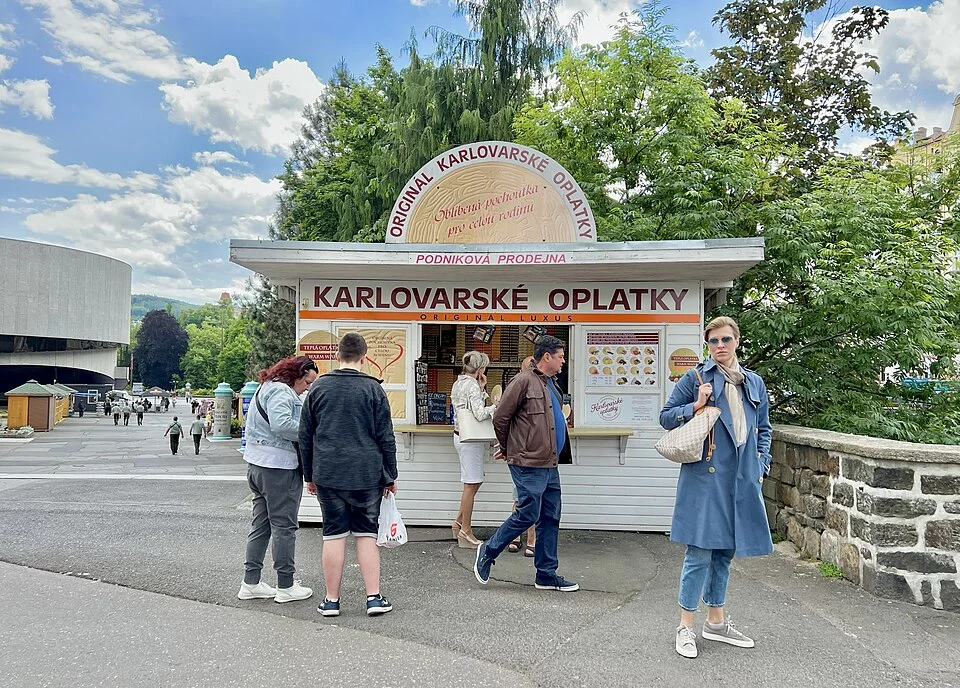
In Karlovy Vary, people pass in front of a stall with a sign reading Karlovarské oplatky
An oplatky stall in Karlovy Vary. The name of the sweet, which includes the place name, is displayed on the front of the building. Photo by Sharon Hahn Darlin (1 June 2022). Original posting · Photographer’s posting · CC BY 2.0.

Similar Round Shapes, but Different Town Names and Patterns

Mariánské Lázně, another spa town in western Czechia, has its own, different oplatky (Mariánskolázeňské oplatky). Czech industry materials list a round product in which two thin sheets of 19 cm diameter are joined with a filling, and another that is stacked in several layers and cut into fan shapes. In 2009 the name Mariánské Lázně was registered as a separate Protected Geographical Indication (PGI). Because the round shape alone makes them hard to tell apart, the name on the sweet or the box, the pattern on the surface, the area of production, and the use of thermal water given in the specification serve as distinguishing marks.
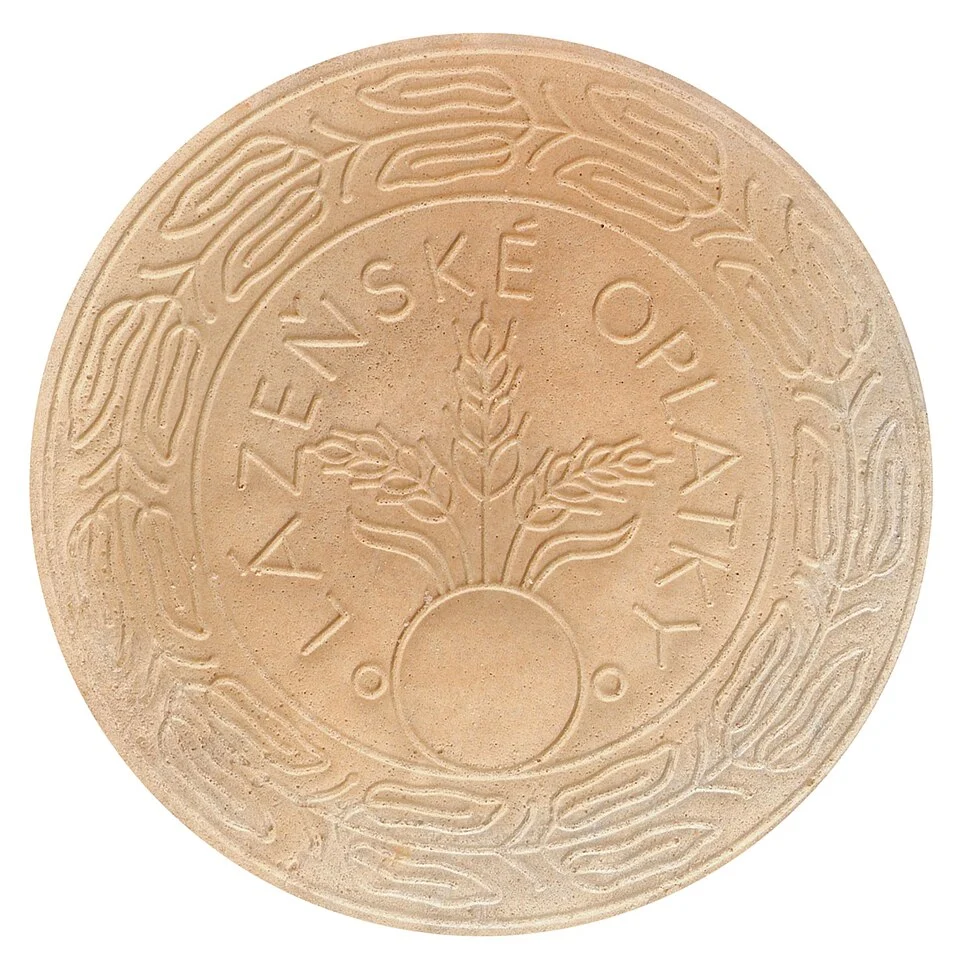
Spa wafer of Mariánské Lázně. A different inscription and design are embossed on the round face
A spa wafer of Mariánské Lázně, shown for comparison. The relief reads "Lázeňské oplatky". The file name carries the German name of Karlovy Vary, Karlsbad, but the description of the subject in the original posting identifies it as a product of Mariánské Lázně. Photo by Alice Wiegand (Lyzzy) (June 2006). Original posting · CC BY-SA 3.0.

Karlovy Vary also makes a different product, Karlovarské trojhránky. The application notice for this one describes a method in which wafers are spread with a cocoa or chocolate filling, stacked, and cut into triangles. In the round product, a disc made of two baked-together sheets is one product; in the triangular one, a piece cut from the stack is one piece. According to the notice for trojhránky, crushed discs are mixed in at 7% of the filling, and the whole is made creamy. Eight sheets are stacked, each spread on its upper face, then pressed, trimmed at the edges and cut into eight. Even when wafers of the same diameter are stacked, the form in which the product finally reaches people differs from that of oplatky, which are boxed as thin discs. The triangles are wrapped individually, and boxes of 150 g or 200 g are given as examples.

How the Name "Karlsbad" Is Treated in Other Markets

The application notice states that on 1 February 1974 the name was entered as No. 72 in the national register of appellations of origin. Separately, the preamble of the 2011 implementing regulation records that it was protected in Czechia as a geographical indication in 1967. Czechia applied to the EU in 2004, the summary of the specification was published in the Official Journal in 2007, and registration as an EU Protected Geographical Indication took place in 2011. Domestic protection and registration, and the EU application, publication and registration, each have their own dates.

Germany and Austria objected to the Czech application. The European Commission acknowledges that the German Karlsbader Oblaten arose from producers in the town once called Karlsbad, and that it and the Czech Karlovarské oplatky are translations of each other. Because the German name continued to be used in other markets for sweets with a shared origin, the regulation allowed that name to be used for products not conforming to the specification for five years after entry into force. Trademarks protected by registration or use before the application date of 20 October 2004 were treated differently: provided they meet the general requirements of trademark law, the regulation states that the registration of this geographical indication cannot invalidate them or prevent their use.

The Commission notes that, although material was submitted showing the German name used as a generic description, no example was given of the identical Czech name being used for similar products as a whole outside the region. The names used at shop fronts are linked by translation, but the decision on protection differed according to which language’s usage the submitted material showed.

In the objections, the extent of the designated area, the nature and use of the thermal water, and the pattern on the surface were also contested. The Commission records that the competent national authority checked these points and that no manifest error was found. The work carried out in the designated area runs from mixing the batter through baking and humidifying to baking together. The notice also states that producers keep records of their raw-material suppliers and shipment destinations and attach producer information to the product, and that the Plzeň office of the Czech agriculture and food inspection authority supervises compliance with the specification. The steps required to be carried out around the town concern both the equipment used in the workshops and the records kept. Pick up a wafer and trace the branch and lettering on its rim with a finger, and the question of which plate gave it its form, and where the two sheets were joined, connects with the place name on the box.

Glossary

Oplatky
the Czech word for thinly baked wafers. Here it refers to the sweet that bears the place name Karlovy Vary.
Karlsbad
the German name of Karlovy Vary.
Humidifying chamber
production equipment that gives moisture to baked discs. In the Karlovy Vary specification, the discs are humidified with thermal water and held down with weights to prevent deformation.
Trojhránky
here, a sweet in which wafers are layered with a filling and cut into triangles.
Protected Geographical Indication (PGI)
a scheme that protects the names of foods whose quality, reputation or other characteristics are linked to a region.
TOPKarlovarské oplatky of Karlovy Vary | Cafe & Sweets Parade Kyoto

(FAQ)

All You Need to Know

Do you have gluten-free sweets made without wheat flour?

Yes. We offer sweets made without wheat flour, such as madeleines made with rice flour. However, they are made in the same kitchen as products that use wheat flour. If you have a wheat allergy or need to strictly avoid wheat, please consult our staff before purchasing.

Do you use additives such as preservatives or emulsifiers?

We do not add preservatives or colorings when making our sweets.

Some of our baked goods (such as madeleines and chocolat) use baking powder to help the batter rise. In addition, ingredients we purchase, such as chocolate, may contain additives such as emulsifiers that help maintain their quality.

To see the ingredients we use, please check the ingredients listed on each product page.

When is the Seasonal Citrus and Lemon Curd Cake available?

This cake is sold on an irregular basis.
It is often available on Saturdays, Sundays and public holidays. We post updates on in-store availability as needed in our Instagram Reels, so please check there.

Do you sell fresh cakes on Wednesdays?

We do not currently sell fresh cakes on Wednesdays.
On Wednesdays, we mainly sell baked sweets and drinks.

*Many customers have asked about this, but no decision has been made yet about selling fresh cakes on Wednesdays.

Can I request noshi paper (noshi kakegami) for gifts, presents, and the like?

For gift boxes in sizes M and L, we offer inner noshi (uchi-noshi) only, at 100 yen (tax included) per sheet. Please specify the top inscription and name inscription, and place your request at least 3 days in advance. For same-day requests, please consult the shop.

Do you offer OEM (manufacturing of original products)?

We are currently accepting consultations on OEM requests, depending on their details.
To start, please contact us through the inquiry form with details such as your product concept, desired quantity, and sales purpose.

Where is the shop located?

Cafe & Sweets Parade Kyoto is in Uoya-cho, one street south of the Otesuji Shopping Street, a 4-minute walk from Keihan Fushimi-Momoyama Station and a 5-minute walk from Kintetsu Momoyama-Goryomae Station. Parade stands in an area full of history and charm. Nearby are Torisei, a sake and yakitori restaurant run by a long-established sake brewery; Teradaya, said to be the place where Sakamoto Ryoma was attacked; the Fushimi Jikkokubune, wooden boats that take you along the canal; and many other places.
For the exact location and other details of Cafe & Sweets Parade Kyoto, please check Google Maps↗︎.

What days is the shop open?

We are open every Wednesday through Sunday from 11:00 to 18:00 (last order 17:30). We are regularly closed on Mondays and Tuesdays.
On public holidays, we are open on some days and closed on others.
We may also close temporarily on irregular days, or open on regular closing days. For the latest information, please check Instagram↗︎ or Google Maps↗︎.

How can I place a large order?

Yes, we accept orders through this inquiry form.
Large orders are orders of 21 or more units, or orders with 10 or more delivery addresses.

Can you tell me about allergens in your products?

Whether a product uses egg, wheat flour, peanuts, walnuts, other nuts or dairy products is stated on the allergen list page and on each product’s page.

Peanuts (groundnuts) and walnuts are shown separately from “other nuts” such as almonds.

Points of caution other than the items above, such as sesame, gelatin and honey, are written in the “Notes” section of each product. However, not all allergens are listed. For assortments such as gift boxes, the ingredients of each sweet included are listed under [Ingredients] on the product page.

If you have any questions, please ask our in-store staff or call us (075-644-4118) before purchasing.

Do any of your products contain alcohol?

Yes. We mainly use liquor in the following sweets:

• Canelé de Bordeaux (rum)
• Galette Bretonne (with rum)
• Madeleine au Chocolat (with liqueur: Grand Marnier)

The Galette Bretonne and the Madeleine au Chocolat are also available in “without rum” and “without liqueur” versions, respectively, made without liquor.

▼Gift boxes
• Classic Baked Sweets Gift Box L [9 Varieties, 15 Pieces]: includes 2 Galettes Bretonnes (with rum)
• Classic Baked Sweets Gift Box M [9 Varieties, 9 Pieces]: includes 1 Madeleine au Chocolat (with liqueur)
• Gluten-Free Gift Box [S] and Gift Box [M] with Higuchi Apiary: contain no sweets made with liquor

Even in baked sweets, a small amount of alcohol may remain. Children, pregnant women, people sensitive to alcohol and anyone who will be driving should take care.

For seasonal products, please check the “Notes” section on the allergen list page.

Is there parking?

The shop does not have its own dedicated parking lot. If you are coming by car, please use one of the paid coin-operated parking lots nearby.
If you are coming by train, the shop is about a 4-minute walk from Fushimi-Momoyama Station on the Keihan Main Line and about a 5-minute walk from Momoyama-Goryomae Station on the Kintetsu Line.

Can I eat and drink in the shop?

Yes, you can enjoy your order in our in-store eat-in space. Seating consists of 5 counter seats and 4 terrace seats (2 tables for 2 people each). High-speed Wi-Fi is also available.
Takeout is available as well. Opening hours are 11:00–18:00 (last order 17:30).

Where can I check the day’s cake selection and sold-out items?

The fresh cakes we sell change from day to day. We post updates on in-store availability as needed on Instagram↗︎.
Items may sell out after a post. If you want to be sure to get something, please call us (075-644-4118).

Do the 2 types of lemon cake differ in how they should be stored and how long they keep?

Yes. The lemon cake with icing must be kept refrigerated and keeps until the end of the day of purchase. The lemon cake without icing can be stored at room temperature and keeps for approximately 7 days from the date of manufacture. Please prioritize the date shown on the label of the product you have.

How long do baked-goods gifts keep, and how should I store them?

As a guideline, baked-goods gifts keep for about 2 weeks from the date of manufacture. Please store them in a cool place, away from direct sunlight and high temperature and humidity. The exact date is printed on the back of each individual sweet.

What payment methods can I use in store?

▼In store
• Cash
• Credit cards: Visa, Mastercard, JCB, American Express, Diners Club, Discover
• Transit IC e-money: Suica, PASMO, ICOCA, Kitaca, TOICA, manaca, SUGOCA, nimoca, Hayakaken
• Other e-money: iD, QUICPay+
• Code payments: PayPay, Rakuten Pay, d Barai, au PAY, Merpay, WeChat Pay, Alipay+, and others

Apple Pay and Google Pay can be used if one of the e-money services or cards listed above is registered.

What kind of cream puff is the Oven-Baked Cream Puff?

It is our classic cream puff: a crisp cookie-crust choux generously filled with a rich cream that combines fresh cream with custard made using “Sakura” eggs from a purely Japanese chicken breed.
It must be kept refrigerated; please eat it on the day of purchase. We also offer a caramel-flavored version, the “Oven-Baked Caramel Cream Puff.”
For details, please see the Oven-Baked Cream Puff product page.

What Are Meringue Cookies?

Meringue cookies are sweets made by baking and drying meringue, which is egg white and sugar whipped together. At Parade, we use kibi sugar (Japanese cane sugar) and finish them with a light texture: a crisp first bite, then an airy, fizzy melt in your mouth.

What kind of sweet is a sablé diamant?

True to its name, which means “diamond” in French, this is a sablé coated with sugar that sparkles around the outside. For the sugar coating, we use vanilla sugar that we make by hand in our shop from vanilla bean pods.
It keeps for about 3 weeks. Please store it in a cool place, away from direct sunlight, high temperatures and humidity. It is also included in our baked goods gift boxes.
For details, please see the Sablé Diamant product page.

Is the Galette Bretonne available both with and without rum?

Yes. It is available both with rum and without rum. The individually sold Galette Bretonne contains rum. The rum-free version is included in our gift boxes. Please contact the store to ask whether it can be purchased individually.

What kind of sweet is a Linzer torte?

The Linzer torte is a sweet associated with Linz, Austria, combining a nut pastry with jam. At Parade, we layer a cinnamon-scented pastry, almond batter and our house-made framboise (raspberry) jam, and bake them together.

What baked goods can I choose as a gift (temiyage) from Fushimi?

We offer Gifts M and L, assortments of our classic baked goods; Gift S, with sweets made with rice flour; and a gift that includes honey from Kyoto Higuchi Apiary. You can choose based on the number of pieces, the ingredients, and the recipient’s preferences. As a guideline, the baked goods keep for about 2 weeks from the date of manufacture.

How do the gift boxes differ by type?

They differ in the types and number of sweets they contain.
・Classic Baked Goods Gift Box M [9 types, 9 items]: 2 types of sablé (12 pieces each), Galette Bretonne, 3 types of madeleine, financier, Sésame Matcha, Boule de Neige Chocolat
・Classic Baked Goods Gift Box L [9 types, 15 items]: 2 types of sablé (12 pieces each), Galette Bretonne (2 each without rum and with rum), Honey Madeleine, Madeleine Chocolat (without liqueur), financier, Sésame Matcha, Boule de Neige Chocolat
・[Gluten-Free] Gift Box [S]: 4 Honey Madeleines, 2 Madeleine Chocolat (without liqueur), 2 Sésame Matcha, 2 Boule de Neige Chocolat
・Gift Box [M] with Higuchi Bee Farm: 8 classic baked goods in 7 types, plus Wildflower Honey (160 g) from Kyoto Higuchi Bee Farm
The sweets made with liquor are the Galette Bretonne (with rum) in the L box and the Madeleine Chocolat (with liqueur) in the M box. For full details, please see the list of gift boxes.

What kinds of honey, eggs and chocolate do you use?

The ingredients we use vary by product. Our main ingredients are as follows.
• Honey: Purely Japanese honey from Higuchi Apiary in Fushimi, Kyoto (Honey Madeleine, Caramelized Honey Canelé, etc.)
• Eggs: “Sakura” eggs from purely Japanese-bred hens (Oven-Baked Cream Puff, Canelé de Bordeaux, Honey Madeleine, etc.)
• Chocolate: Chocolate from Valrhona of France (Madeleine Chocolat, etc.)
• Butter: Cultured butter (Brown Butter Financier, Galette Bretonne, etc.)
Please check each product page for that product’s ingredients.

Is there an ideal temperature or way to warm the sweets so they taste their best?

Depending on the product, there are recommended ways to enjoy it.
• Canelé de Bordeaux: Warming it for 3–5 minutes in a toaster oven that has not been preheated makes the caramel on the surface crisp, giving it a texture close to freshly baked.
• Brown Butter Financier: Warming it in a toaster oven for about 1–2 minutes gives it a texture and aroma close to freshly baked.
• Linzer Torte: The ideal serving temperature is 5–20°C.
• Lemon Cake (with icing): We recommend letting it sit at room temperature for a little while to enjoy the fluffy texture of the cake, or, in summer, enjoying it chilled straight from the refrigerator.
Toaster ovens heat differently depending on the model, so please keep an eye on the sweets while warming them to avoid burning.

How many people do Size 4, Size 5 and Size 6 whole cakes serve?

Parade’s “Decoration Cake with Fresh Cream and Seasonal Fruit” serves approximately 3–4 people in Size 4, 4–6 people in Size 5 and 6–7 people in Size 6. Please choose a size based on how much will be eaten and whether it will be served together with other sweets.

How long can I carry a cake? Do I need ice packs or an insulated bag?

Please plan on carrying it for about 1 hour. Conditions vary depending on the temperature, the type of cake and how you travel, so if you are planning a long journey, please consult the shop before purchase.

Can I have a message plate or candles added to a birthday cake?

The “Decoration Cake with Fresh Cream and Seasonal Fruit” comes with an original cookie plate and 1 set of 5 candles. A charge applies to candles from the 2nd set onward.

Are the sweets for sharing at work individually wrapped? How many people can a gift serve?

The Classic Baked Goods Gift is an assortment of sweets packed in individual bags. Note, however, that “9 items” does not mean 9 pieces: some items, such as the sablés, contain several pieces in one bag. Please think separately about how many people you are giving to and how many bags you want to give each person.

What is the difference between a financier and a madeleine?

Generally, a financier is characterized by the flavors of egg whites, almonds, and browned butter, while a madeleine is typically based on a batter made with whole eggs. At Cafe & Sweets Parade Kyoto, we offer the Brown Butter Financier and a madeleine made with rice flour and honey.

Do canelés taste better warmed? How do you recommend eating them?

If you warm Parade’s Canelé de Bordeaux for about 3 to 5 minutes in a toaster oven that has not been preheated, the caramel on the surface becomes crisp, and you can enjoy a texture and aroma close to freshly baked. Because heating varies by model, please keep an eye on it while it warms.

Can cakes and baked goods be frozen?

Because ingredients and finishing differ from product to product, we do not state that all cakes and baked goods can be frozen under the same conditions. Please first check each product’s storage instructions and date label. If you plan to freeze a product, please consult the shop before purchasing and tell us the product name.

What is the difference between sablés, cookies and galettes?

“Cookie” is a name for a wide range of baked goods. “Sablé” is used as a name describing a texture that crumbles softly like sand, and “galette” is used for sweets with a flat shape, among other things. Parade’s Galette Bretonne is a thick-baked cookie made with butter.

Can I get paper bags, small bags for sharing or gift wrapping?

In store, paper bags, plastic bags, bags for baked goods and gift wrapping are available for a fee. Prices vary by type and size. Please let us know how many you need and any wrapping requests before purchase.

News Letter

We send the latest news from Cafe & Sweets Parade Kyoto and money-saving coupons exclusive to our followers. Add us as a friend on LINE. Something good should come your way.

* We usually send notices of sales launches on Sunday mornings.
* Depending on the content, messages may be sent only to certain segments of subscribers.

Thank you for signing up!
We hope you look forward
to our next email.

Access

Cafe & Sweets Parade Kyoto

〒612-8041

Heights Momoyama No. 105, 574 Uoya-cho, Fushimi-ku, Kyoto-shi, Kyoto

* If you are coming by car, please use a nearby parking lot.

VIEW MORE GOOGLE MAP