


SweetloreEncyclopedia of World Sweets (834)

Marquesitas
Marquesitas
A thin wafer rolled while hot, and the saltiness of Edam cheese
Baked Sweets / Yucatán Peninsula, Mexico

Roll a thin, freshly baked wafer into a tube, and as it cools it hardens until it snaps crisply between the teeth. Marquesitas (marquesitas) are a sweet from Mexico’s Yucatán Peninsula, made by putting a filling on the wafer and rolling it while it is still hot. A standard filling is shaved queso de bola, the round Edam cheese. The saltiness of the cheese meets the sweet wafer, and choosing cajeta or fruit jam gives a sweet filling instead. In Mérida, they are known as a treat that you take from the hands of the person baking it in a town square.
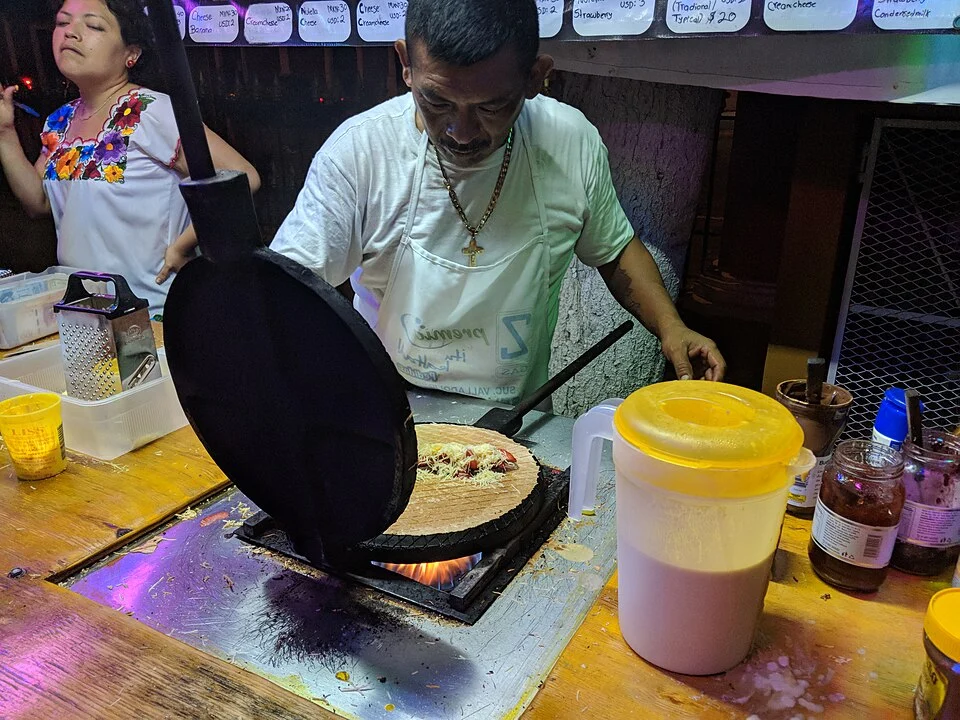
Spreading the batter thin between the upper and lower plates
At a stall that the chef Rick Bayless saw in Mérida, two hinged iron plates were set over a propane flame. The plates were about 14 inches (roughly 35 cm) wide, and a small amount of liquid batter was placed in the center of the lower plate. When the upper plate is closed and the two handles are pressed, the batter spreads thinly across the broad surface. It may look like a crepe, but a crepe touches a hot surface on one side only, whereas here a plate presses from above as well. Pressing the handles sets the thickness of the batter, and the heated plates above and below bake it into a wafer thin enough to roll.
A cookbook compiled by the Quintana Roo tourism agency presents a recipe by Francisco Jesús Puch Paredes. In it, egg whites are whipped, and then sugar, flour, melted butter, vanilla and milk are added in turn. The flour ranges from 500 to 750 g per liter of milk, and the mixed batter is liquid, like crepe batter. Both sides of the cooking plates are buttered, then closed and pressed, and the batter is baked so that no excess liquid is left. The batter is not kneaded and shaped first, as a thick bread dough would be; its thinness and width are set once it is between the plates.
For home cooks, Bayless describes a method using a wafer mold about 8 inches in diameter. Compared with the 14-inch plates he saw at the stall, even a single wafer comes out smaller in diameter. About a quarter cup of batter goes into the home mold, which is pressed closed, and in the version cooked over a gas flame the mold is turned every 15 to 20 seconds. For the plates in the cookbook, the guide is within 30 seconds per side; for Bayless’s other mold, it is about 2 to 3 minutes for both sides together. When comparing times, one has to consider the amount of batter, the equipment and the turning interval together.
Bayless also gives another home recipe, made in a krumkake mold about 6 inches in diameter. Krumkake is a sweet baked thin and rolled, and the mold used here is the hinged pair of plates made for it. In this recipe, about 1½ tablespoons of batter go in the center, the mold is turned after about 30 seconds, and the other side bakes for about 30 seconds. The idea of pressing a small amount of batter thin from above and below works even without the large stall plates. With different equipment, though, the length of the rolled wafer and the amount of cheese that fits on a single sheet are not the same.
Nor do Bayless’s two home recipes use the same batter simply resized to the mold. The recipe for the 8-inch mold mixes 1 cup of flour with ½ cup of milk, ½ cup of sugar, ¼ cup of vegetable oil and other ingredients. The example for the krumkake mold uses ½ cup of flour, 3 eggs, ⅓ cup of sugar, 6 tablespoons of vegetable oil and water. The Quintana Roo cookbook has a method with whipped egg whites and melted butter. The basic form, baking a flowing batter thin, is shared, but how milk, eggs and fat go in is not fixed to a single way.
Even with the same pair of plates, the handling differs between the time spent pressing the top and the time spent over the heat. The krumkake recipe first presses the handles, then eases off when batter emerges from between the plates. In the mold Bayless saw at the stall, too, batter sometimes spills past the edge. Not everything that spreads there is rolled in; what has come out is removed. The amount of batter taken for one sheet, the width of the plates and how far the batter spreads under pressure all bear on how thin the wafer is that remains in the tube.
Fill and roll before it cools
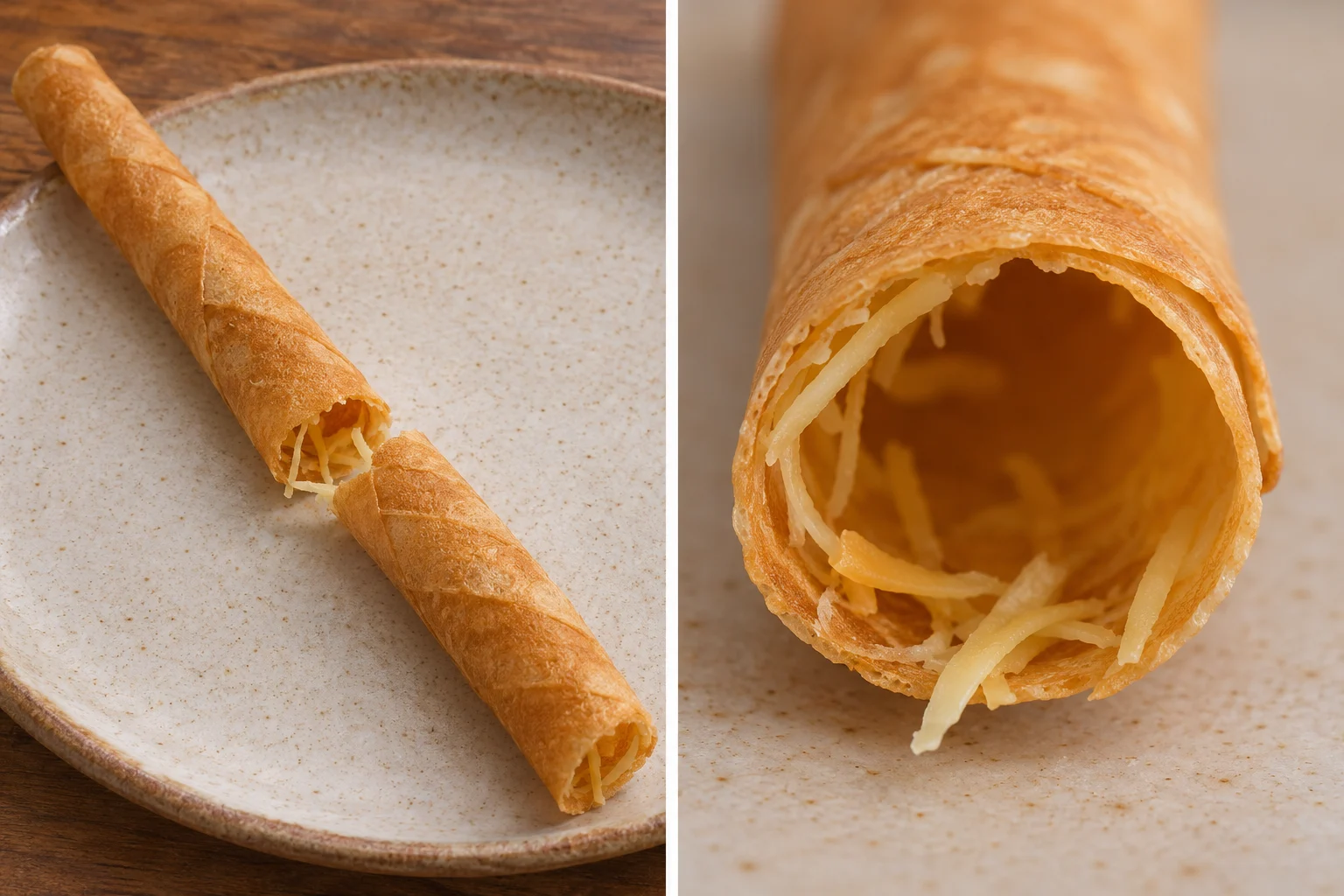
When opening the plates, check whether the wafer has taken on color and can be lifted from the plate. In Bayless’s recipe, if it sticks to the plate it is baked a little longer, and a thin spatula is slipped under it once the surface is golden and releases easily. The filling goes on while the wafer is still warm. If you wait long, the wafer cools and approaches the point where it cracks when bent. The filling is placed and the wafer rolled immediately after it comes off the plate so that the tube is formed while the wafer can still just be bent.
In the example using the krumkake mold, the finished tube is set seam side down for a few seconds. This keeps the end of the roll from opening while the wafer crisps and sets. The Quintana Roo cookbook likewise says to place the filling while the wafer is hot and wrap it like a taco. Whether it is rolled all the way into a tube or wrapped closer to a folded-in-half shape also affects where the filling shows and where the wafer breaks when bitten. Both recipes include a step of wrapping while the baked wafer can still change shape.
In Bayless’s recipe, those filled with cheese or cajeta are eaten right after they are made. Wafers baked the same way but without a filling and kept in an airtight container are treated separately. When the filling is placed on a warm wafer and rolled, the feel of the baked wafer and the sensation of cheese or cajeta in the mouth are settled together, all at once. When you eat a wafer that was left unfilled, you notice how the wafer alone breaks. Finishing a stall item before your eyes, after you have chosen the filling, is also part of savoring the thin wafer.
Shaving round cheese onto a sweet wafer
The name queso de bola refers to a spherical cheese. In the method Bayless saw at a Mérida stall, salty Edam is shaved and scattered over the baked wafer. A solid piece would make the filling thick, but shaving and scattering it lets the filling spread across the surface before the thin wafer is rolled. When you bite into the wafer, small pieces of cheese come out where it cracks. Rather than sweetening the cheese itself, the combination layers a wafer containing sugar and a salty filling in a single tube.
Edam is a cheese that originated in the Netherlands, and it has been used in several dishes on the Yucatán Peninsula. Apart from marquesitas, the Quintana Roo cookbook also includes a tostada with shaved queso de bola on bread. In asking why cheese is used in marquesitas, one can separate two points: that the round cheese is used in local cooking, and when cheese began to be put into the thin wafer made for ice cream. For the former, the state’s cookbook has several examples. For the latter, the clues are shop records and traditions told in Mérida.
When cajeta is used, instead of being shaved and scattered like cheese, a sweet liquid of simmered milk is drizzled onto the wafer. Among the examples Bayless gives is one with both cajeta and Edam. The Quintana Roo cookbook lists Edam, cajeta, peanut cream and fruit jam, along with sweetened condensed milk and chocolate. Even as sweet fillings increase, the practice of pairing them with salty cheese remains. Which of the things placed on the wafer gives saltiness, and which clings and stays on the wafer, depends on the filling chosen.
From an ice cream wafer to a roll made at the stall
Accounts of the origin of Mérida’s marquesitas name Leopoldo Mena Bonilla, of an ice cream shop. In the story Bayless relates, around 1930, in the winter season when ice cream sales fell, the shop served an item made with a thin wafer. Another account, reported in the Mexican press, says that Leopoldo Mena and Carmen Muñoz made it in the late 1930s. Another introduction from Yucatán gives 1945. The accounts agree on a link to the ice cream shop’s business, but the dates do not agree closely enough to narrow it to one year.
The obituary of Leopoldo’s grandson, Vicente Mena Heredia, states that Leopoldo founded the ice cream shop Polito in 1910 and that its main shop was in Mérida’s Santiago neighborhood. This is an article about the founding of the shop, not a record of marquesitas being sold in 1910. Looking separately at the year of the shop and the year the new wafer item is said to have been served, one sees that the ice cream shop tied to today’s sweet was already operating earlier. There is also a story linking the name to the daughters of a marquis, but the dates and records of the naming remain within the realm of tradition.
The Quintana Roo cookbook states that there is a dispute over the origin between Mérida, Yucatán, and Chetumal, Quintana Roo, and then introduces the range of fillings in Chetumal. An account of the place of origin and a record of what is sold in a particular town can be viewed separately. Comparing the Edam scattered at Mérida stalls with the choice of fillings described in the Chetumal cookbook, one finds that within the Yucatán Peninsula there is a shared format of a thin wafer, and sources that speak of filling options by locality.
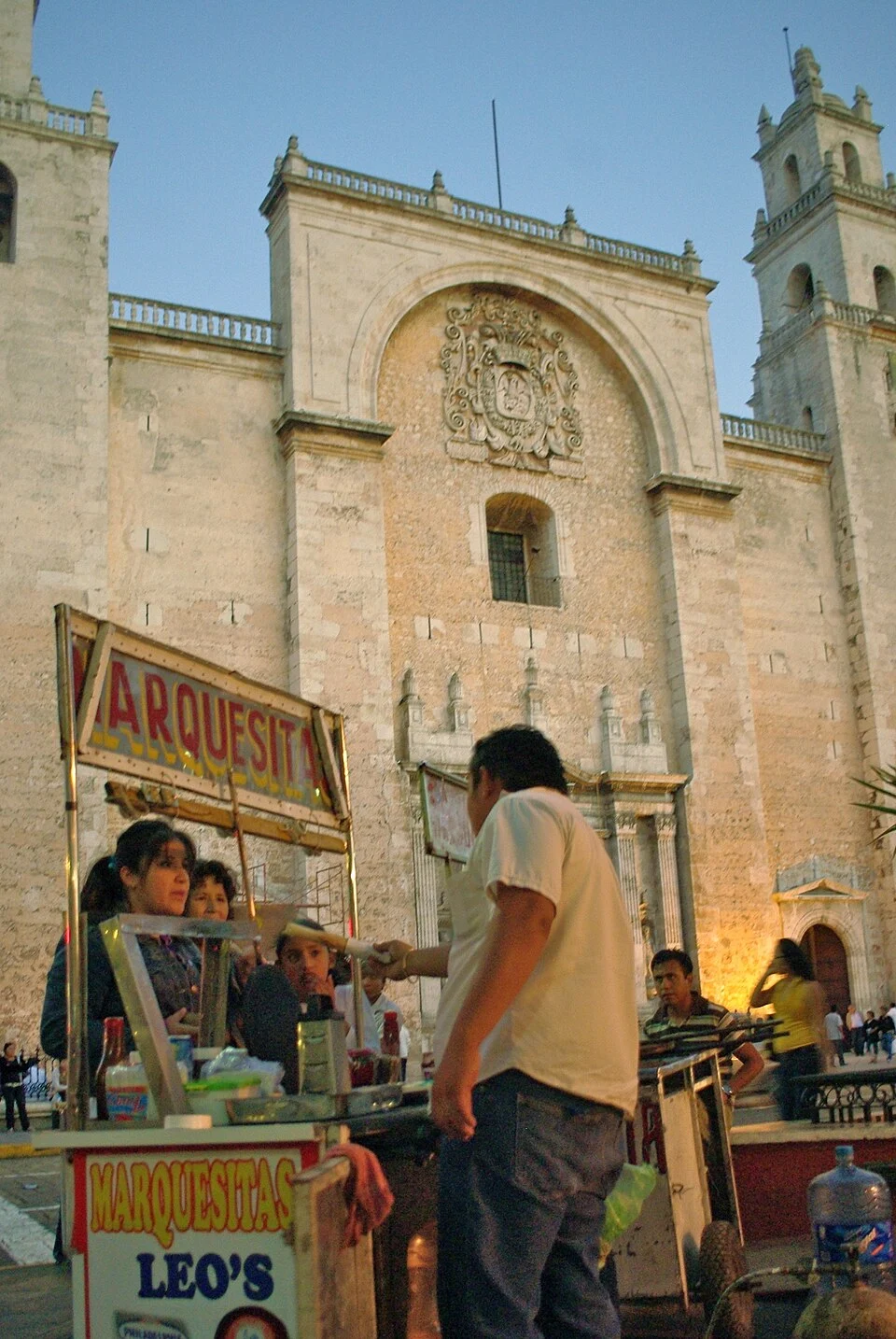
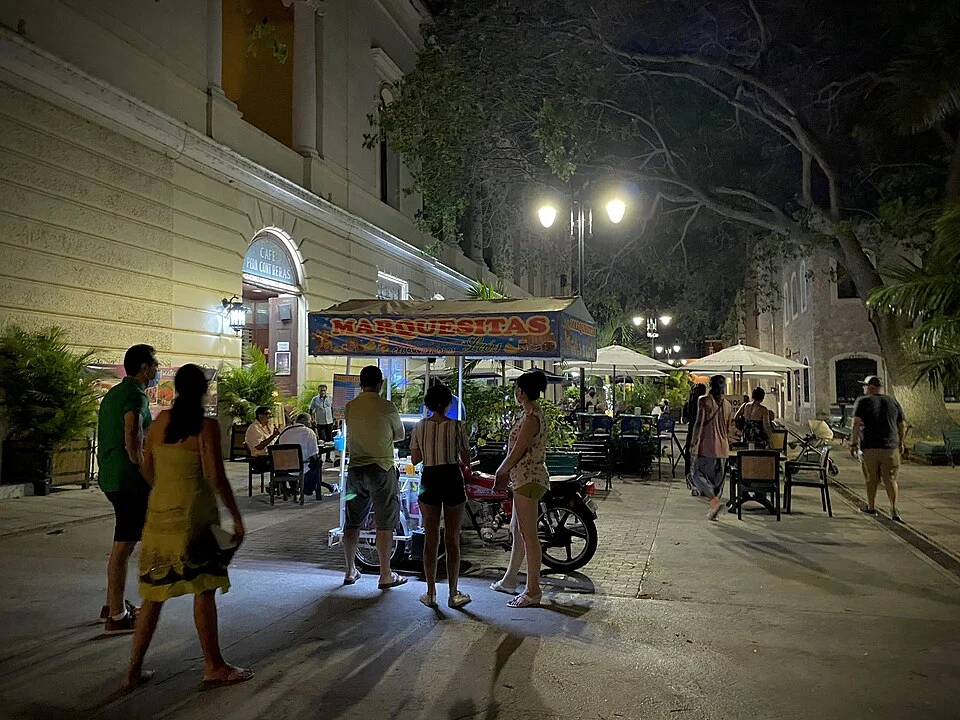
When Bayless visited the main plaza in Mérida, stalls were lined up opposite the San Ildefonso Cathedral after dark. He says that he later saw sellers in Mexico City, Oaxaca and Tijuana as well. That similar plates and baking methods are seen in other towns is not evidence for deciding who first made it in that town. Even when the varieties of filling increase along the way, the work of pressing and spreading the batter on order and rolling the baked wafer while it is hot is what identifies this sweet.
At a Yucatán products event held in Mexico City by the state of Yucatán, Lorena Zulú, who had moved her stall there from Paseo de Montejo in Mérida to sell, said that a combination of cheese and guava paste was popular. According to the state’s press release, she made them while replenishing the strawberries and bananas. Another seller, Celia Zapata, who normally has her stand in Las Américas park in Mérida, said that at the event orders pairing a sweet hazelnut and cocoa cream with cheese were frequent. Even as more people choose sweet fillings, both combinations include cheese.
For this event, the state of Yucatán recorded more than 4,500 marquesitas sold in the first five days. This is a figure for sales at the venue over a limited period, and it does not show which filling is eaten most on the peninsula. The accounts of the two sellers are concrete examples of bakers from Mérida going to another city and preparing several sweet fillings to go with cheese. Even away from the town plaza, the stall method of finishing remains in placing the filling while the wafer can still be bent by hand and eating it once the wafer is crisp.
Glossary
- Queso de bola
- Refers to a spherical cheese. In Yucatán marquesitas, shaved Edam is sometimes used.
- Cajeta
- A Mexican sweet made by simmering milk and sugar. In this article, an example of a filling drizzled onto the wafer.
- Krumkake
- A sweet made by baking a thin wafer and rolling it. Rick Bayless presented a home recipe for marquesitas that uses its mold.
- Leopoldo Mena Bonilla
- Founder of the Mérida ice cream shop Polito. He appears in the traditions about how marquesitas came to be made.
- Carmen Muñoz
- In an account reported in the Mexican press, said to have taken part, together with her husband Leopoldo Mena, in establishing the method.
- Vicente Mena Heredia
- Leopoldo’s grandson. He ran an ice cream shop in Mérida.
- Rick Bayless
- The chef who presented the baking method he saw at a Mérida stall and a method using a home mold.
- Lorena Zulú and Celia Zapata
- Sellers who run stalls in Mérida. At Yucatán’s event in Mexico City, they spoke about the fillings customers chose.
- Francisco Jesús Puch Paredes
- The person who contributed the marquesita recipe to the Quintana Roo cookbook.


