


SweetloreEncyclopedia of World Sweets (834)

Kue Lapis
Kue lapis
Rice batter divided by color and steamed layer by layer
Cakes / Indonesia

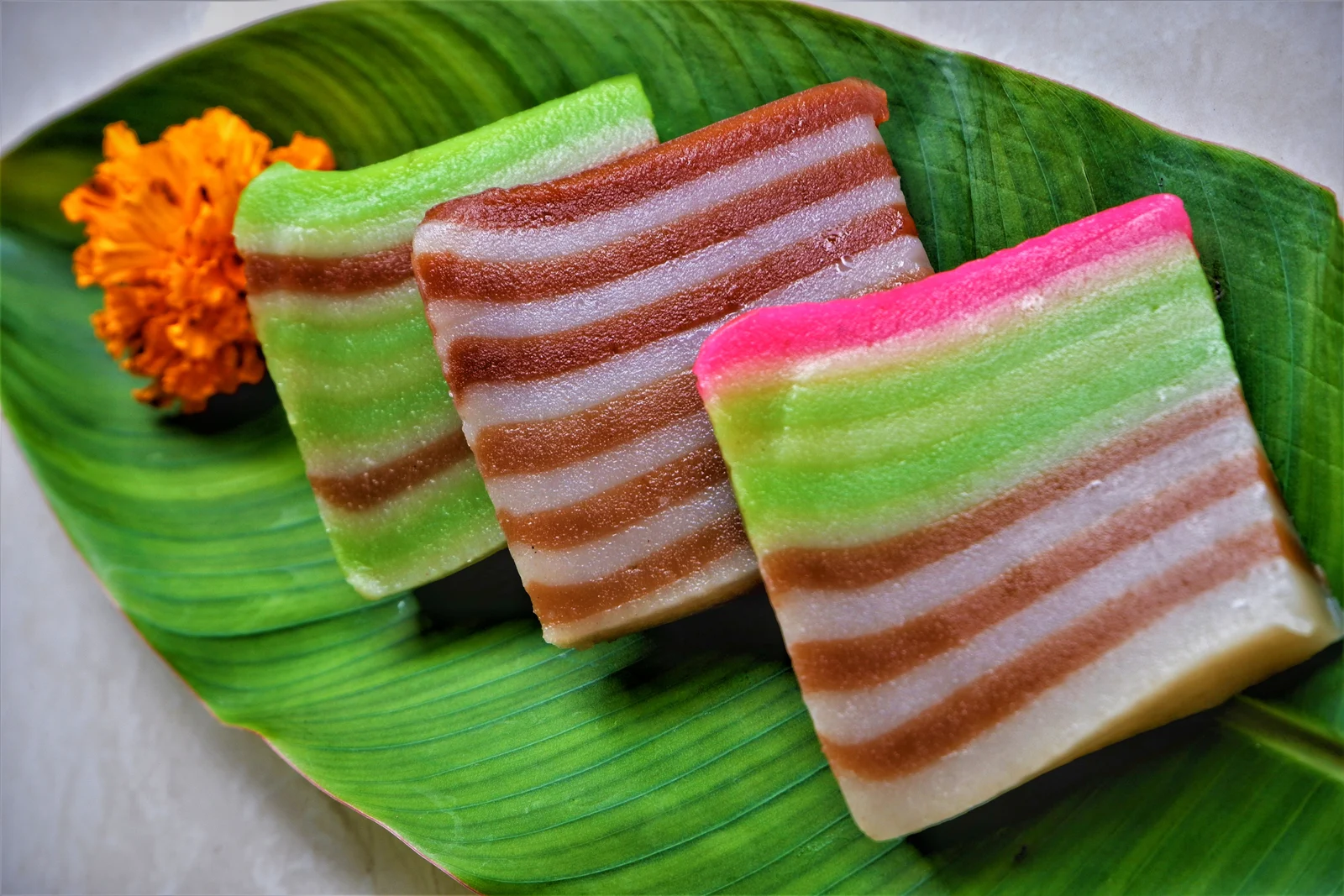
Pick up a slice of kue lapis and you can see thin bands stacked one on another, and the whole piece bends slightly in the hand. The surface is glossy, the bite is springy, and the flavor of coconut milk spreads through the mouth. Indonesian kue lapis is made from a batter of rice flour and other starches dissolved in coconut milk. The batter is poured into a mold a little at a time, one color after another, and steamed after each pour. The boundaries between colors, visible from the side, mark where each layer waited until it could hold the next pour of batter.
Five Minutes Before the Next Color
In the culinary practice manual of Esa Unggul University, the recipe calls for 275 g of rice flour, 75 g of sago starch and 300 g of sugar, with 950 ml of coconut milk. Salt and pandan leaves are added to the coconut milk, which is brought to a boil while stirring. Poured a little at a time over the flour and sugar while still warm, the leaf-scented liquid loosens the whole mixture. At first it is a single batter. It is worked until no lumps of flour or sugar remain, and then the portion to be colored is set aside.
The manual divides the batter into three portions and lists red and green food coloring separately among the ingredients. In the Pangkalpinang example, part of the batter is left white. In Madiun, East Java, the batter is divided into two: a portion to be colored and a portion left as it is. The number of colors does not determine the number of layers. With two colors, the cook can pour them alternately and run the same color through the cross-section in several places. The red and green in the manual are taken from the same pandan-scented batter, so a difference in color does not simply mean a difference in flavor.
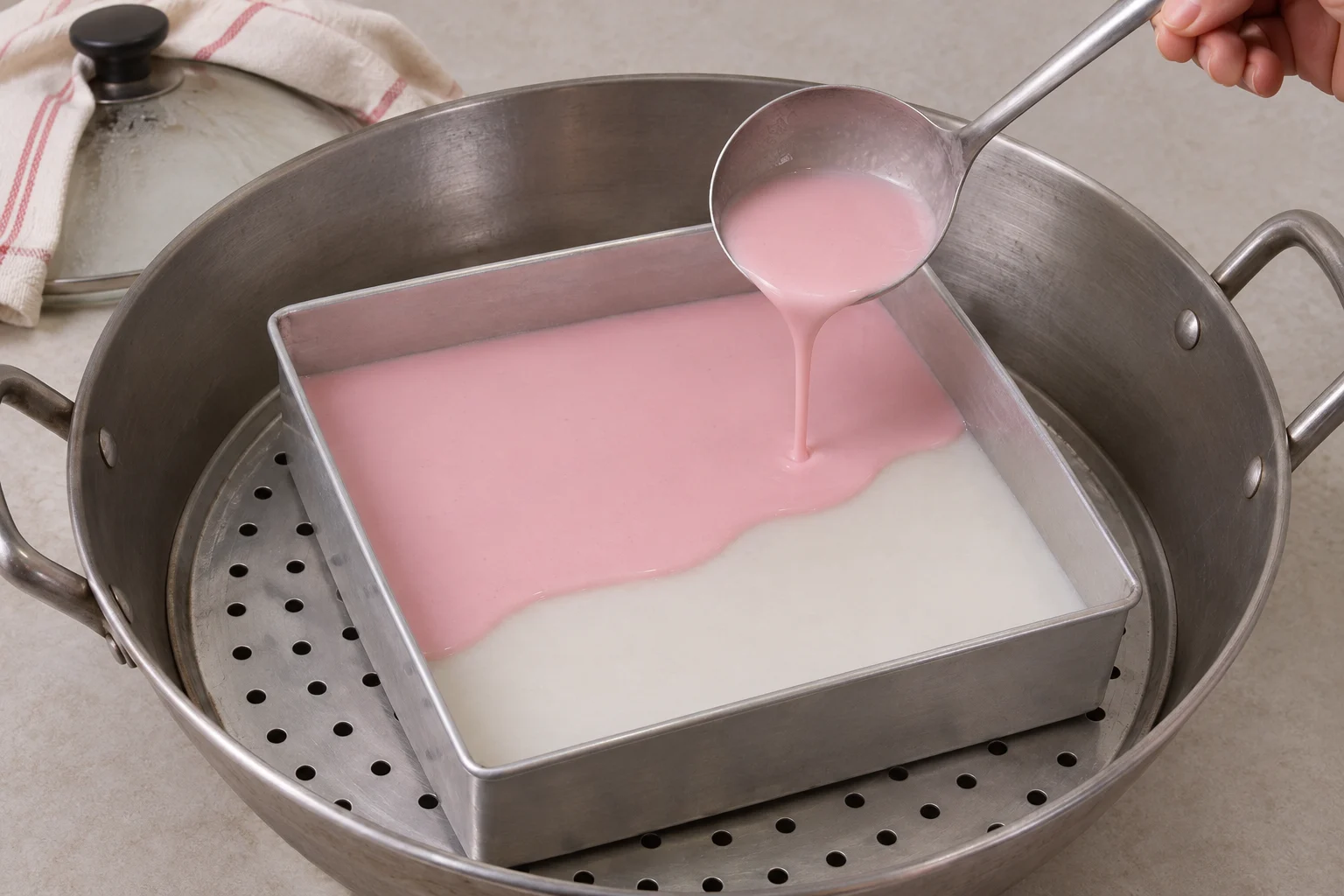
The manual has the cook warm an oiled 20 cm square mold in the steamer first, then pour in about 50 ml of batter for the first layer. After steaming for about five minutes, the next color is poured onto the set layer. If a color is layered on while the one beneath is still liquid, the colors bleed and the boundary collapses. Setting the mold level and measuring out the same amount each time, so that the batter reaches the corners, gives bands of even thickness. After the final layer is poured, the cake is steamed for another 30 minutes. The short steaming sets a surface that can hold the next pour, and the final long steaming cooks the whole stack of layers through. The cake is removed from the mold and cut only after it has cooled.
The moment to add the next color is also described by the state of the batter. The Madiun method takes the point when the first layer is about half steamed as the guide, and the white batter is taken up one deep ladleful at a time. Dwi Setiati, who studied the kue lapis of Pangkalpinang on Bangka Island, recorded that once the first layer is about half steamed, a few spoonfuls of another color are poured on. The same work is repeated until the batter is used up, and the cake is taken out once the whole has steamed through. Read alongside the university manual, this shows that, besides how many minutes to steam and how many milliliters to pour, the state in which the earlier layer stays in place without running was also a cue for timing.
Because the lid is lifted many times, droplets of condensation also affect the result. Nyonya Cooking, a home-cooking source, explains that drips falling from the lid onto a middle layer leave spots, and so it suggests catching the drips with a cloth wrapped around the lid. The same recipe says that if the flour has settled at the bottom, the batter should be stirred again before pouring. Once steamed, the cake is cooled thoroughly and cut with a knife lightly coated in oil, which makes it less likely that batter will cling to the blade. A supple piece can also be eaten by holding the edge of a color boundary and peeling off the thin layers one at a time.
In the Nyonya Cooking example of alternating red and white layers, one cup of rice flour is combined with half a cup of wheat flour and two tablespoons of tapioca starch. The mold is a square or round pan of about 20 cm, and one pour is one third of a cup. Even for a mold of about 20 cm, the amount per layer differs from the manual’s, and the color poured first also varies from one recipe to another. A square pan can give rectangular bands and a round pan can give fan shapes radiating from the center, but in both the order of the pours can be seen from the side.
Batters of Rice Flour with Sago, and Batters Based on Starch
In the manual, sago starch, which comes from the sago palm, is added to a base of rice flour. This gives the steamed cake more spring. The Pangkalpinang example combines 400 g of rice flour with 300 g of wheat flour, and uses 750 g of sugar and seven cups of coconut milk in the source’s units. The proportion of wheat flour is close to that of rice flour. The flour and liquid are mixed until smooth, and the batter is divided into a portion left white and a colored portion. The ratios of ingredients differ, but the procedure is shared: each poured color is steamed until set, a little at a time.
A thesis held by Universitas Muhammadiyah Palembang describes a tapioca-based kue lapis treated in earlier research. It uses 250 g of cassava starch with 9 g of glutinous rice flour added, together with thick and thin coconut milk. The color comes from an extract of red dragon fruit peel. The thesis describes the tapioca-based version as soft and springy, with the flavor of coconut milk. Both the coloring agents and the flours come in several combinations, so even when a cross-section shows the same red, one cannot tell which ingredient provided the color.
Kue pepe, found in Betawi food culture, is a closely similar steamed sweet. According to a culinary source published by Indonesia’s Ministry of Foreign Affairs, it is made mainly from starch such as sago or tapioca, with coconut milk, sugar and a little salt. Layers of three colors (red, green and white) or two colors (brown and white) are stacked, and the result is a springy kue basah, that is, a moist cake. detikFood, in an article on Betawi occasions, says it also appears at celebrations and prayer gatherings. The name and the formula differ from those of the rice-flour kue lapis, but colors are likewise arranged in the cross-section of the steamed layers.
In reporting by detikFood, a Betawi kue pepe that combines rice flour and sago also appears. In this example each color is steamed for about five minutes, and the finished cake is cut into rectangles. When sold at markets or confectioners’, each piece is wrapped separately so that the sticky surface does not touch anything. The sight of the colored layers when the wrapping is opened in the shop is connected to the work of adding color little by little in a large mold. Since sources differ on whether rice flour is included, a formula using only starch cannot be treated as a condition of kue pepe as a whole.
A Madiun Record Using Mung Bean Flour
The reprint of Mustikarasa, a cookbook published in 1967 by Indonesia’s Ministry of Agriculture, contains a formula for kue lapis (Madiun). The flour is a quarter of a kilogram of mung bean flour. Milk extracted from grated coconut is combined with sugar and vanilla, the flour is dissolved in it, and only one half is colored. The two batters are put alternately into an oiled, warmed mold and steamed. The same name, kue lapis, is used both for the rice flour and sago formula used in cooking classes today and for the mung bean formula preserved in the cookbook.
The kue pepe (Wonosobo) in the same book lists tepung kandji, in an old spelling, in its ingredients to mean starch flour. Coconut milk, sugar, salt and vanilla are combined, and colored and uncolored portions are steamed in layers in an oiled mold. Modern reporting presents kue pepe as a Betawi sweet, while the cookbook preserves a formula that carries the name of Wonosobo in Central Java. Because the same compilers headed an East Javanese mung bean flour sweet as kue lapis and a Central Javanese starch sweet as kue pepe, the pairing of place and ingredient can also be read from the headings.
In BiblioAsia, the food-culture magazine of the National Library Board Singapore, Christopher Tan notes that a Dutch-language cookbook of 1972 lists kue lapis cina, and that a 1980 book by Siti Nur Zainuddin-Moro includes the red-and-white lapis merah putih as a Betawi example. Following names that refer to colors or places shows that steamed layered sweets were recorded by different writers. The publication years mark when the names and methods entered the record.
From the Market to the Offering Table in Pangkalpinang
When Setiati studied the food of the Chinese community in Pangkalpinang, she recorded cases in which kue lapis, kue bugis and kue apem were prepared for honoring ancestors at graves. All of them are jajanan pasar, market snacks that can be bought on ordinary days. Among the items offered on a special day are sweets that people also share as everyday snacks. Because the report also gives a formula that combines wheat flour, the same study lets one confirm both what is offered and which flours are steamed, and how, in that town.
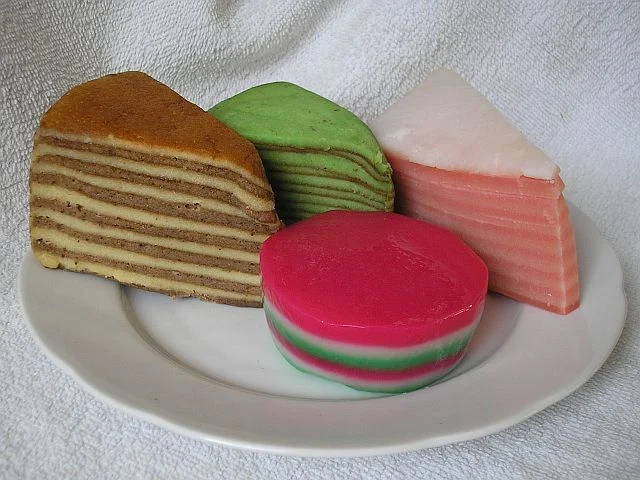
According to another study of the same city, the layers of the kue lapis prepared for Lunar New Year carry a wish for prosperity that builds up in many layers. This study lists both lapis legit, made by baking thin layers of batter one after another, and kue lapis. The offering at graves of an item bought at the market and the Lunar New Year record of a wish for layered prosperity involve different occasions for preparing the sweet. Two sweets with similar names can also appear side by side at an event, so the meaning of the layers and whether the batter is steamed or baked are separate clues.
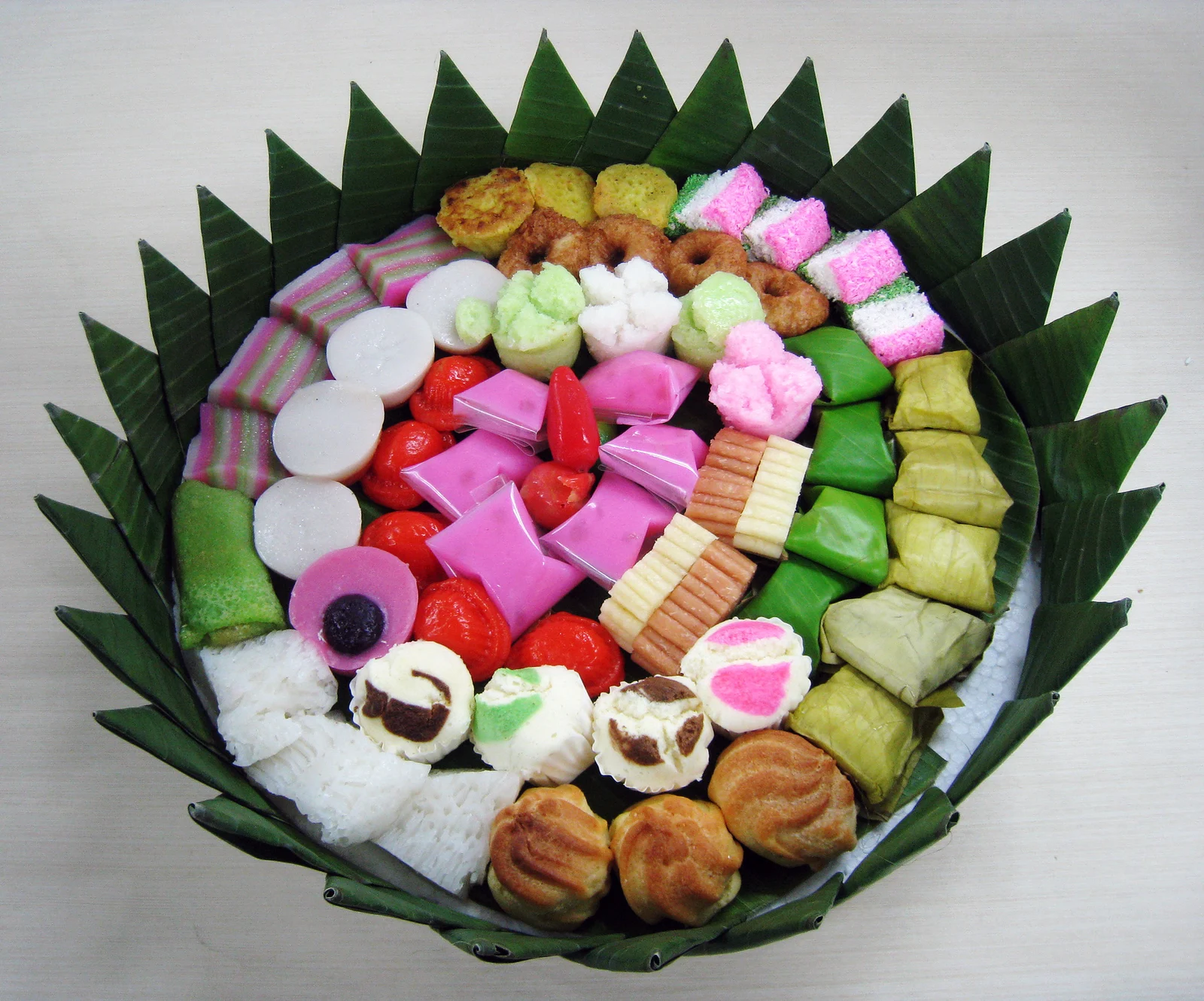
A photograph that Tan took at a Jakarta market shows a kue lapis made by steaming rice flour. The items widely called market sweets are sold cut into pieces, and may also be arranged on a single platter to suit a festival. Even when a banded slice is paired with other kue, the poured colors and the order of steaming remain visible from the side.
Singapore’s Nine-Layer Cake (九層糕)
In an exhibition teaching resource for children, the Peranakan Museum in Singapore presents kue lapis as a nine-layer sweet in rainbow colors. A cultural resource from the Singapore government says that among the Chinese it is sometimes called 九層糕 (nine-layer cake), and that some versions have more than nine layers. The number nine is also linked in some beliefs with long life and good fortune. For those who know it as one of the Nyonya kuehs, peeling it apart color by color is also part of the pleasure. While there are versions that use pandan only for fragrance, Nyonya Cooking also shows examples in which the leaf is mixed with coconut milk to give a pale green and butterfly pea gives blue.
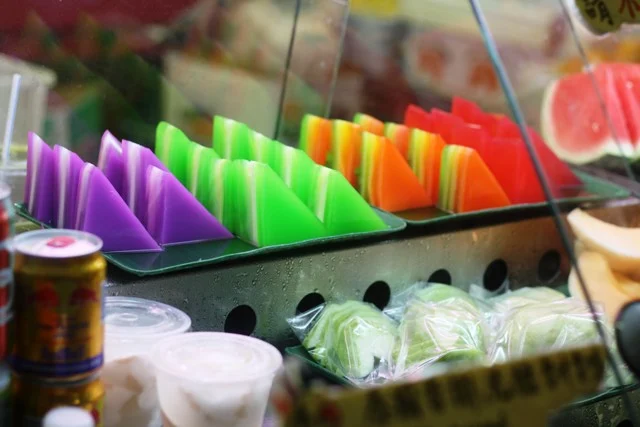
The government resource also notes that a similar sweet made with sago is called lapis sagu. That the same resource separately introduces a baked lapis is a clue for telling apart two sweets with similar names. The steamed nine-layer cake offers the pleasure of peeling the colors apart, while the baked lapis legit has many thin layers of a butter-rich batter. Seeing differently colored sweets side by side at a stall in Singapore conveys how many varied versions fall under the name nine-layer.
The Pangkalpinang method begins by pouring the white batter. The Madiun cookbook measures with a ladle, and the university class puts about 50 ml into the mold each time. Whether the sweet shows nine rainbow layers or repeats two colors, each new layer is made on top of a thin layer that has been steamed until set. Every change of color at the cut face appears as a single line marking the time spent waiting until the lid could be lifted from the steamer and the next batter poured.
Glossary
- Pandan
- A leaf used to add fragrance in Southeast Asian cooking and sweets.
- Sago starch
- Starch obtained from the sago palm, used to give steamed sweets their springiness.
- Tapioca starch
- Starch obtained from the cassava root.
- Kue pepe
- A sweet in which colored batters, made with starch such as sago or tapioca, are steamed in layers.
- Kue basah
- A term for moist, water-rich cakes and snacks.
- Jajanan pasar
- Snacks and light foods that can be bought at a market.
- Lapis legit
- A cake made by baking thin layers of batter one at a time.
- Nyonya kueh
- A term for sweets handed down in settings such as Peranakan households in Southeast Asia.


