


SweetloreEncyclopedia of World Sweets (834)

Kuih Kosui
Kuih kosui
A brown or green steamed springiness, served with white coconut flesh
Desserts / Malaysia

Kuih kosui, unmolded from a mold no bigger than a rice bowl, has a glossy brown surface topped with white grated coconut. In the first bite the springiness of the small piece comes through, and fine strands of coconut linger on the tongue. This steamed sweet, made in Malaysia and elsewhere, comes in a brown version that draws on the aroma of gula melaka and in a green version colored with pandan leaf liquid and white sugar. Steamed in individual cups, it keeps a rounded outer edge; steamed in a large mold, it is cooled and then cut. Differences in method show in the shape of the vessel, the color and the flour, and where the grated coconut is placed.
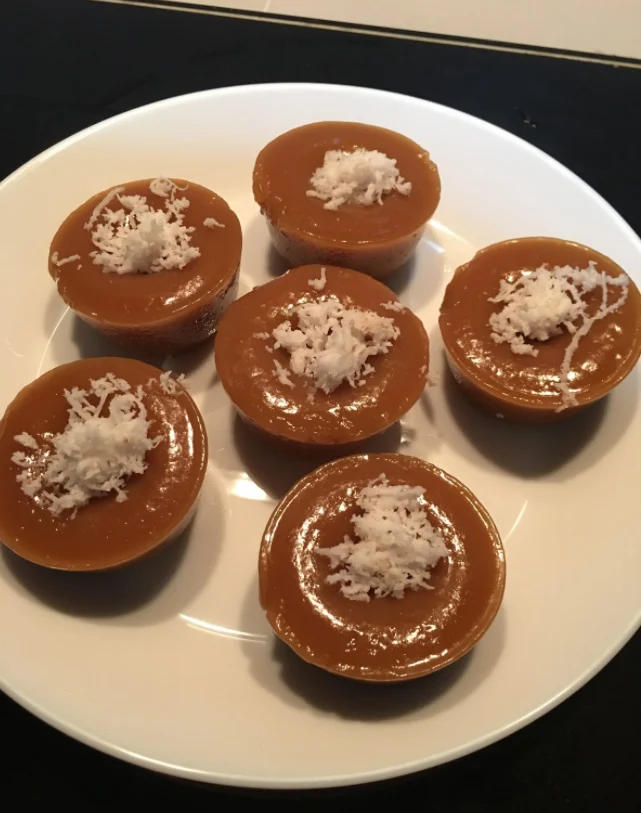
Green from leaves, brown from melted sugar
In the method of the flour miller Tiga Gajah Cho Heng, 100 g of rice flour and 50 g of tapioca starch are sifted, and 380 ml of water is added. Pandan liquid, made by blending the leaves with 150 ml of water, is mixed with 180 g of white fine granulated sugar and an alkaline liquid. The two mixtures are combined and strained again, stirred over medium heat for about 2 minutes, poured into molds, and steamed for about 20 minutes. The water in which the leaves were blended carries the color and aroma, and it also becomes part of the liquid that disperses the flour. With white sugar, the green of the leaves comes through. If pandan is added only as a flavoring, the way the liquid is prepared changes as well.
For a kosui that turns amber as it cools, a brown sugar such as gula melaka is melted first. The home-cooking site Corner Café heats 75 g of chopped gula melaka and 45 g of white sugar with 170 ml of water and three pandan leaves, torn along the veins and knotted. The aroma of the leaves passes into the syrup, and the leaves are removed when the liquid mixed with the flour is strained. In the green recipe, the color of the leaves stays in the sweet. In the recipe where the sugar is cooked with the leaves, the brown of the sugar remains, with the leaf fragrance reaching the nose afterward. The glossy brown comes about differently from a color produced by baking in a mold.
THC combines 40 g of rice flour, 45 g of tapioca starch, and 15 g of mung bean starch for its green, pandan-flavored kosui. Sugar and an alkaline liquid go into the blended leaf liquid, and after the flours are mixed in, boiling water is added to give a light thickness. In this recipe, empty bowls are steamed for five minutes first to warm them, and after the batter is poured in, they are steamed for 10 minutes. Tiga Gajah Cho Heng combines the flour and the leaf liquid and then puts them in a pot over heat. Even for similar sweets with visible leaf green, the breakdown of the flours differs, as does the source of heat used to thicken the batter before steaming.
Kosoi made with wheat flour, and handling that keeps the flour from settling
In "Kuih Kosoi," which the cook Ali Afindi contributed to a regional magazine in Terengganu, the ingredients are two cups of wheat flour, one cup of tuber flour, seven cups of water, two slabs of sweetener, and one cup of white sugar. The sugar is dissolved in the water, the mixture is cooled slightly, the flour is added, and finally edible lime dissolved in a little water is stirred in. The liquid is strained, placed in a preheated steamer, and steamed in a large mold for about 45 minutes; it is cooled completely and then cut. In the magazine’s photograph, white coconut flesh sits on angular brown pieces. The amounts resemble those of the green recipe, which combines rice flour and tapioca at 2 to 1 by weight, but flour measured by the cup differs in weight and character.
In MyResipi’s recipe, which treats kuih kaswi and kosui as the same item, thick coconut milk is used in addition to rice flour, tuber flour, brown sugar, and edible lime water. The liquid in which pandan and sugar have been boiled is cooled and the ingredients are combined, put in a mold, steamed for about 45 minutes, cooled, and cut. Sesudu Kitchen also has a kaswi in which 140 g of wheat flour and 80 g of tuber flour are dissolved in cold water and combined with cooled syrup. Even with similar kinds of flour, it differs from Corner Café’s recipe, in which warm syrup is poured in a thin stream, in how much heat is used at the point of mixing. If hot liquid hits part of the flour in a mass, thickening begins there first, so in formulas that use heat, the batter is stirred without pause while the liquid is poured in.
In Sesudu’s recipe with wheat flour, the flour is not cooked first in the pot used to bring the batter together; it is combined with cooled syrup and then strained. As the flour and water blend, white lumps are loosened, and any hard bits or leaves are left on the strainer. Compared with straining a batter that has already thickened from heating, the stickiness as it passes through the strainer also differs. Both are finally set by steaming, but when the batter is moved to the steamer, the point at which the cook has to intervene before the finish differs: one begins with a batter that pours smoothly, the other involves stirring up what has collected at the bottom of the mold.
In Corner Café’s single-pan recipe, 50 g of tapioca starch and 30 g of rice flour are dissolved in water, the syrup is mixed in, and the batter is strained. Unlike the regional magazine’s recipe with its large mold, this cook warms a round pan 15 cm in diameter inside the steamer, pours in the batter, and stirs only for the two or three minutes while the bottom begins to set. The pan is then covered and steamed for 15 to 20 minutes. When batter is poured in turn into small cups, flour tends to settle at the bottom of batter that has stood for a while. The extra step of stirring again before pouring, like making the molds uniform in shape, works to give the first piece and the last piece a similar stickiness.
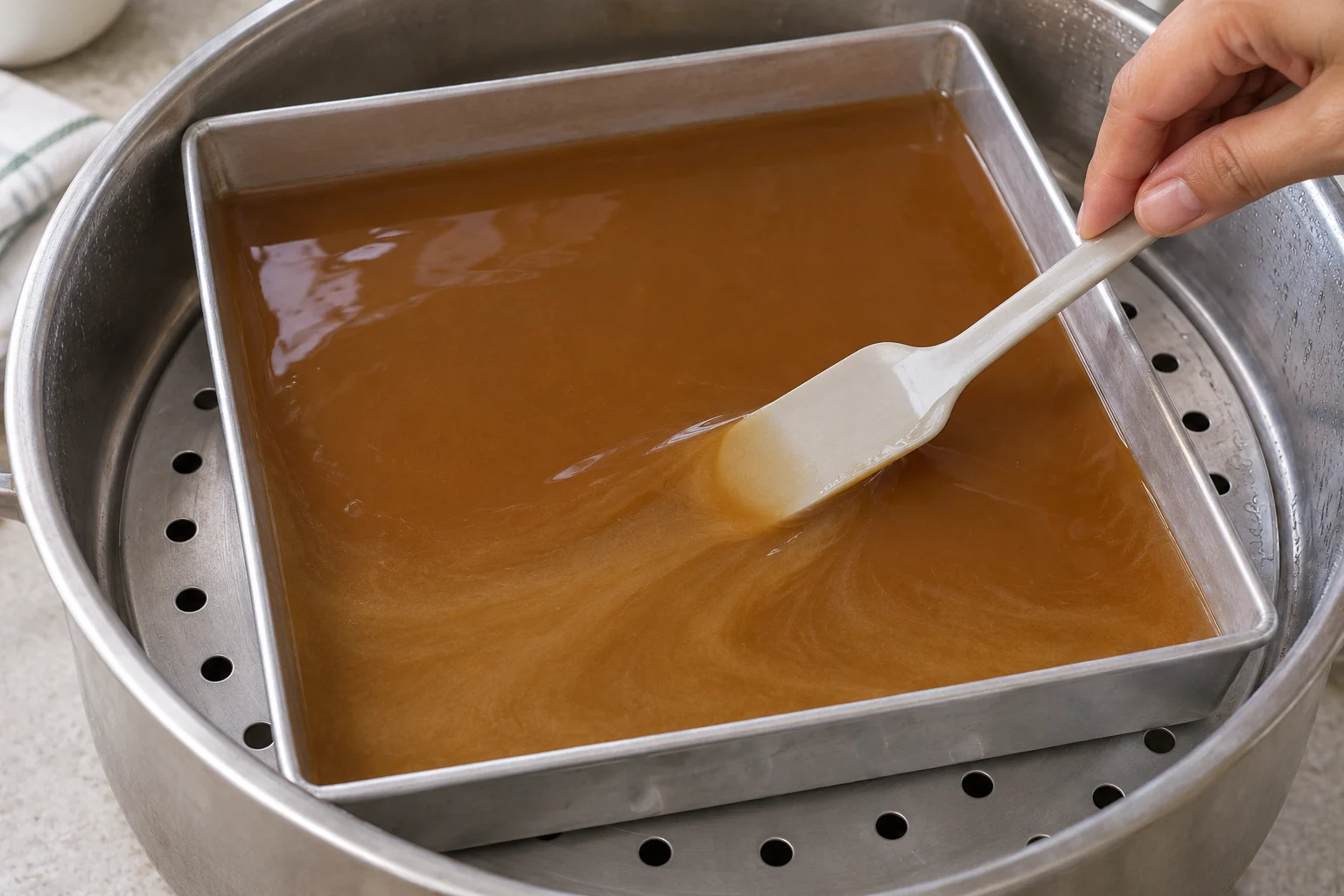
Rounded edges from the steaming vessel, corners from the knife
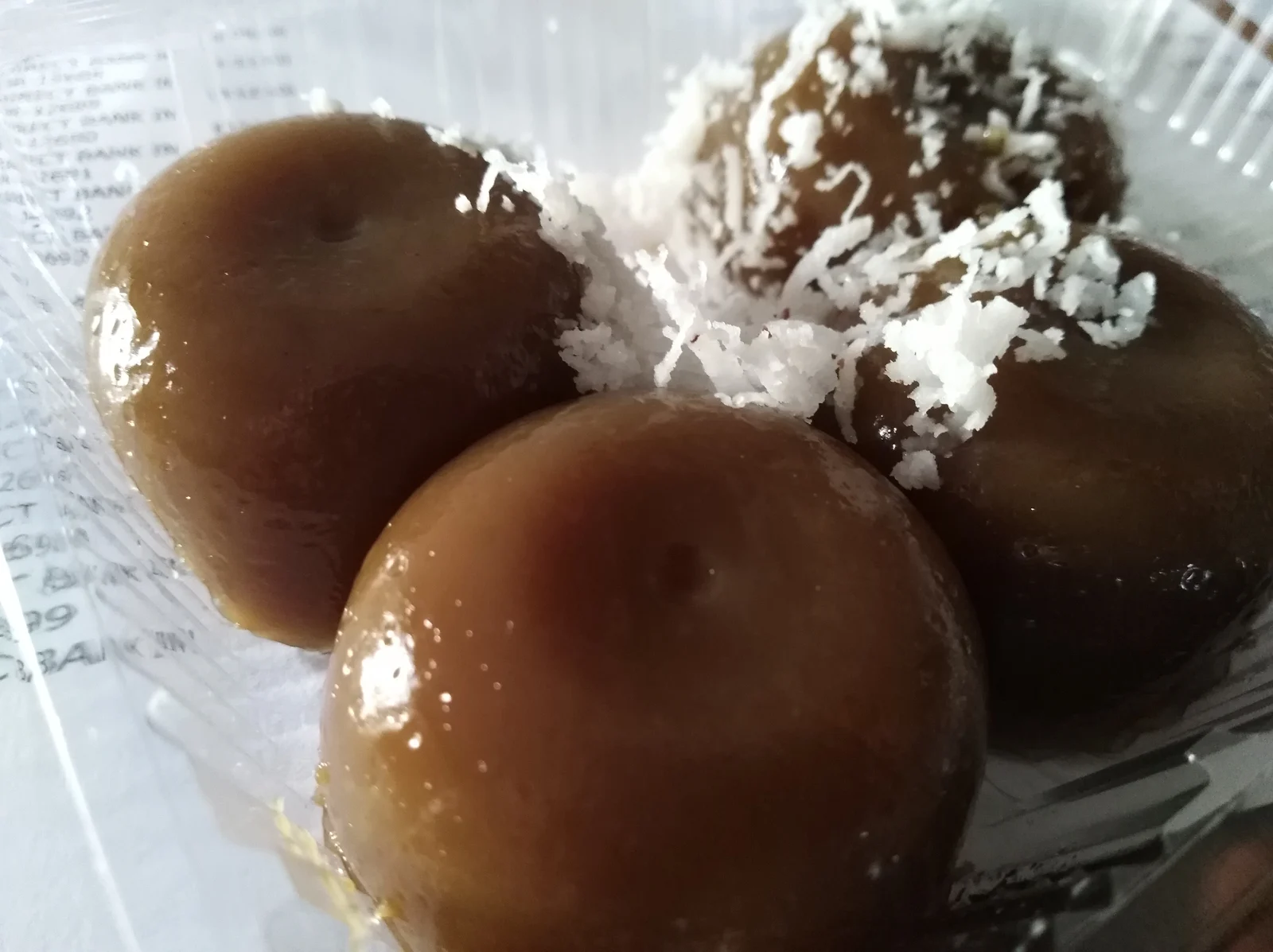
Steamed in small molds, the sweets take a rounded outline along the bottom and sides of the vessel. Some Nyonya recipes that use small bowls leave a shallow dimple on top. When the batter is steamed in one large mold and cut after it cools, the cut faces have corners. Steaming times are about 20 minutes in the flour miller’s small-mold recipe and about 45 minutes for the large Terengganu mold, but the formulas for the flour and liquid also differ. Heat travels differently through small molds filled to a similar height and through the center of a deep, large mold. The marks that can form on top from water dripping off the lid, and the shallow dimple in the center of individual sweets, also cannot be attributed to a single cause from the finished appearance alone.
In methods that combine edible lime with water, air kapur is added between the flour and the liquid. It appears both in MyResipi’s recipe with rice flour and in the Terengganu recipe with wheat flour. Tiga Gajah Cho Heng writes "lye water" and does not indicate whether it has the same concentration as in the other recipes or which components it contains. Even if the number of spoonfuls is the same, when the type of flour, the amount of water, and the strength of the added liquid differ, the differences in springiness after steaming cannot be explained from the spoon count alone. Because a sweet unmolded warm from a small mold easily damages its edges, and because the corners of cut pieces drag in a large mold, several recipes wait until the sweet has cooled before moving to the next step.
Choosing the surface that wears the grated coconut
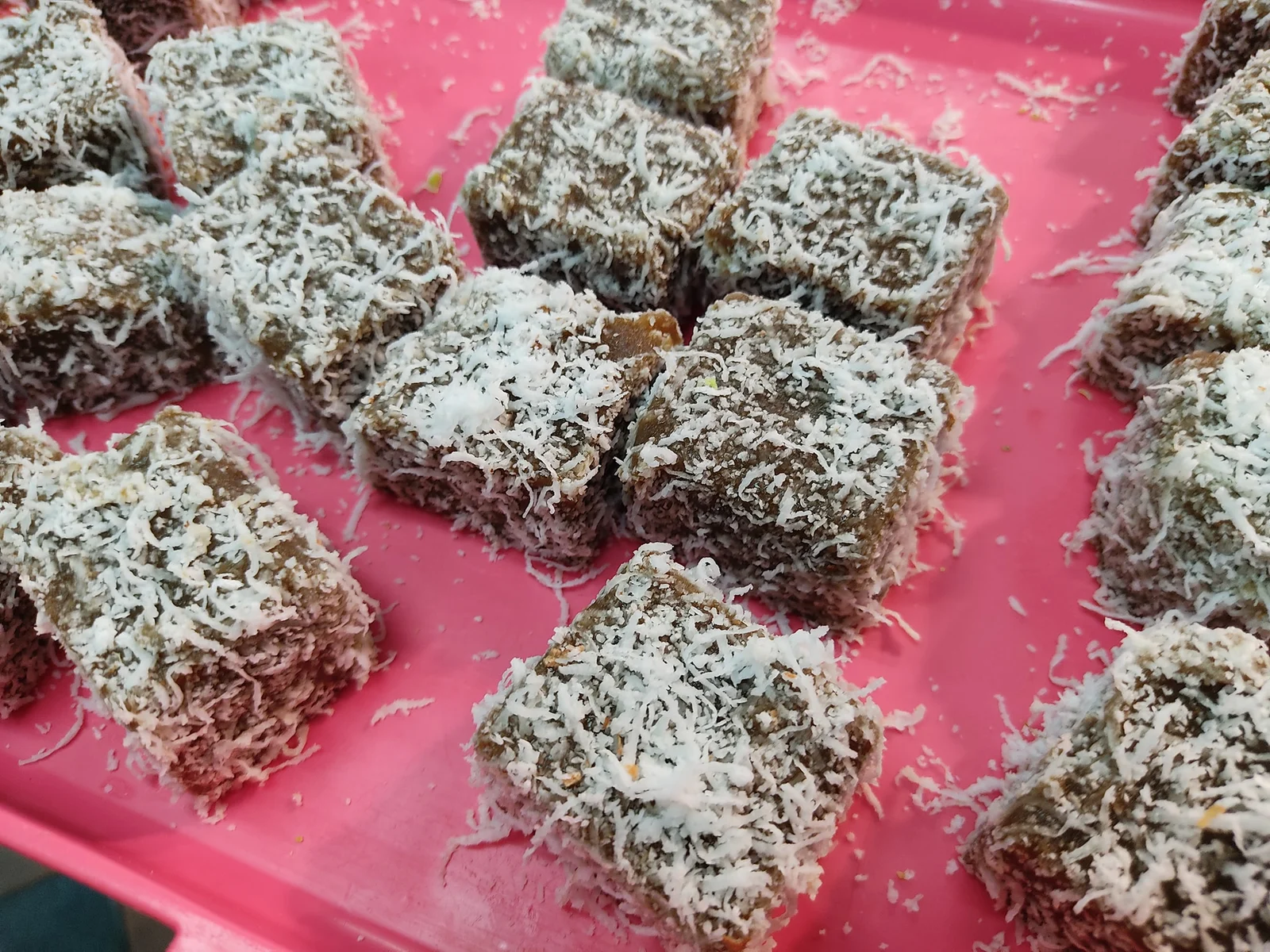
The Terengganu cook mixes a little salt into the grated flesh of young coconut and serves it alongside the cut sweet. The flour miller’s green recipe also finishes with coconut flesh combined with salt. Corner Café steams the two separately and cools them, then rolls the cut pieces in the coconut or scatters it over them. If the white flesh is placed on a piece taken out of its bowl, the brown outside is visible on the plate. If a piece is rolled over the flesh, the fibers also reach the sides and bottom, where it is held with the fingers. With salt on the surface, the sweetness of the sugar in the batter follows after the coconut touches the lips and tongue.
The cook Eddie’s kosui uses 90 g each of rice flour and tapioca starch, and 220 g of gula melaka boiled with pandan. The aroma of the removed leaves stays in the syrup, but those leaves are not returned to the batter; the grated coconut is instead wrapped in separate leaves and steamed for 10 minutes. The steamed, cooled sweet is cut into small pieces with a knife or kitchen scissors, or scooped out one bite at a time with an ice-cream scoop. Though in both cases the sweet was made as a whole in the mold, a piece with knife marks and a scooped bite with a curved surface differ in which faces the coconut flesh clings to.
Where the coconut goes depends not only on which surface receives the flesh but also on whether milk is mixed into the batter. In Corner Café’s large-mold recipe, separately steamed flesh is combined with a batter of sugar and water. In MyResipi’s rice-flour kaswi and Che Nom’s lompang, flesh is served alongside before eating, and coconut milk also goes into the batter. In the latter, thin milk also goes into the syrup, and pandan is boiled with it. Even in a cross-section where no white fibers are visible, the coconut flavor continues, and apart from the grated flesh on the outside, the coconut is also tasted in the liquid that binds the rice flour.
Passed on under the names kaswi, kosoi, and lompang
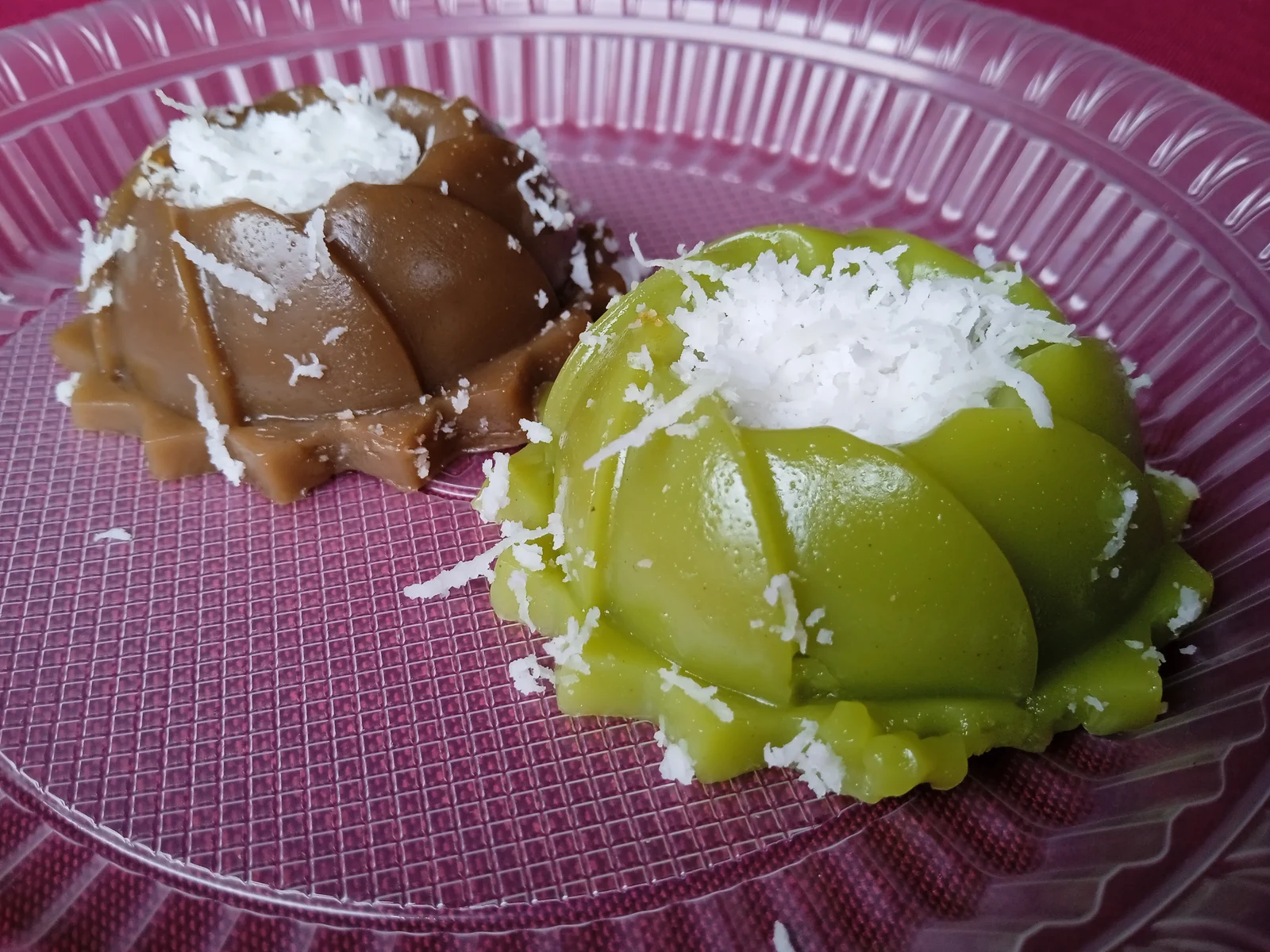
Research on Nyonya cuisine lists kueh koswee, or kuih kosui, as a steamed sweet made with palm sugar. The sweet that the Terengganu cook gave as "kosoi" in the regional magazine is a cut sweet of wheat flour and tuber flour. A Malaysian compendium on intangible cultural heritage lists kuih kasui as an alternative name under Kasui and describes it as a steamed sweet made with palm sugar. These are the names used by the individual speakers and sources. Color, mold, and flour cannot be settled by the name alone.
MyResipi also has a recipe that calls one item by both names, kaswi and lompang, and mixes wheat flour, tuber flour, and cornstarch. By contrast, what Che Nom calls lompang adds cornstarch to rice flour, along with white sugar, gula melaka, and thin coconut milk, and is steamed for 15 to 20 minutes in small greased molds. Compared with the Terengganu kosoi, the flour, the liquid, and the mold all differ. Rather than reading it as meaning that anything written as lompang always contains rice flour, it is more revealing to check whether each maker unmolded the sweet from small vessels or cooled it and cut it with a knife, since this shows the relation between the springiness of a bite and its appearance.
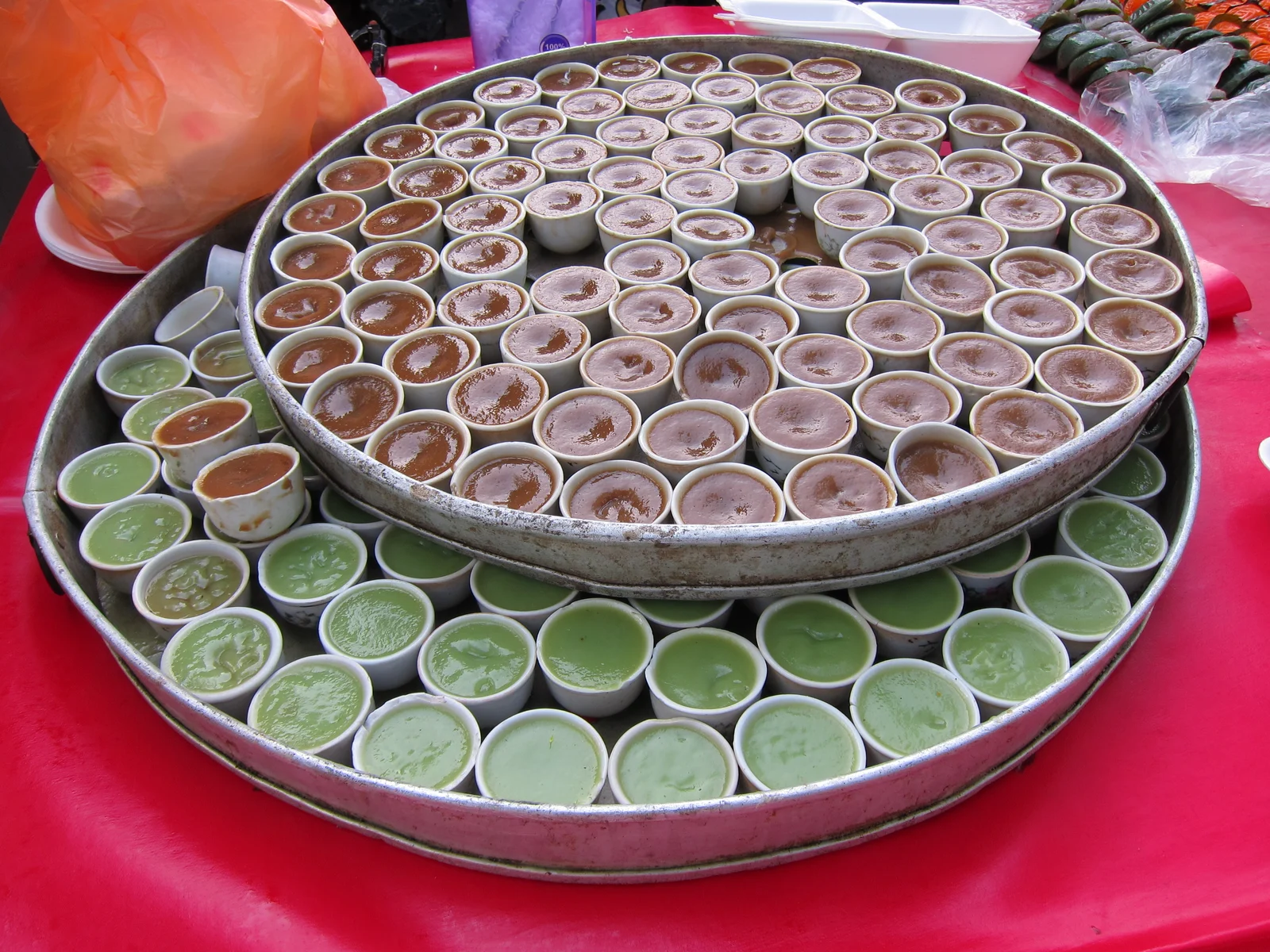
When several people eat at afternoon tea, as with Che Nom’s lompang, one piece taken out of its cup can be set out for each person. In recipes written for gatherings or sale, where the batter is steamed in a large mold, the number of pieces to take is decided afterward, and the sweet can be cut into diamonds to suit the diners. In Rempapa’s announcement in Singapore, the cook uses gula melaka chosen at the market and includes a kosui covered with lightly salted flesh in an assortment of a few pieces each of several sweets. The shop presents it as a dish that carries on a family recipe. Whether a single sheet is steamed at home or a shop packs several different sweets together, the point they share is that the kosui is portioned into bite-size pieces at the end and the coconut flesh is added. A sweet in small cups has as many surfaces as there are cups, while a piece cut from a large mold has surfaces that do not appear until it is cut. In both cases, the white flesh goes on after steaming. By looking at whether rounded edges line up or white fibers cling to square pieces, one can tell how many vessels were prepared before steaming and what was cut after cooling.
Glossary
- Gula melaka
- A brown sugar made from palm. In some kosui recipes it is melted and added to the batter.
- Air kapur
- Water containing edible lime. A small amount is added in some methods. The product name and concentration need to be checked for each recipe.
- Lompang
- A related steamed sweet. Some recipes use the name interchangeably with kaswi, while others distinguish them by formula and mold.
- Nyonya
- A term that appears in literature on Peranakan food culture. Kosui is listed there as one of its steamed sweets.


