


SweetloreEncyclopedia of World Sweets (834)

Khanom Krok
Khanom krok
Baking a rice shell in round hollows and layering coconut on top
Desserts / Thailand

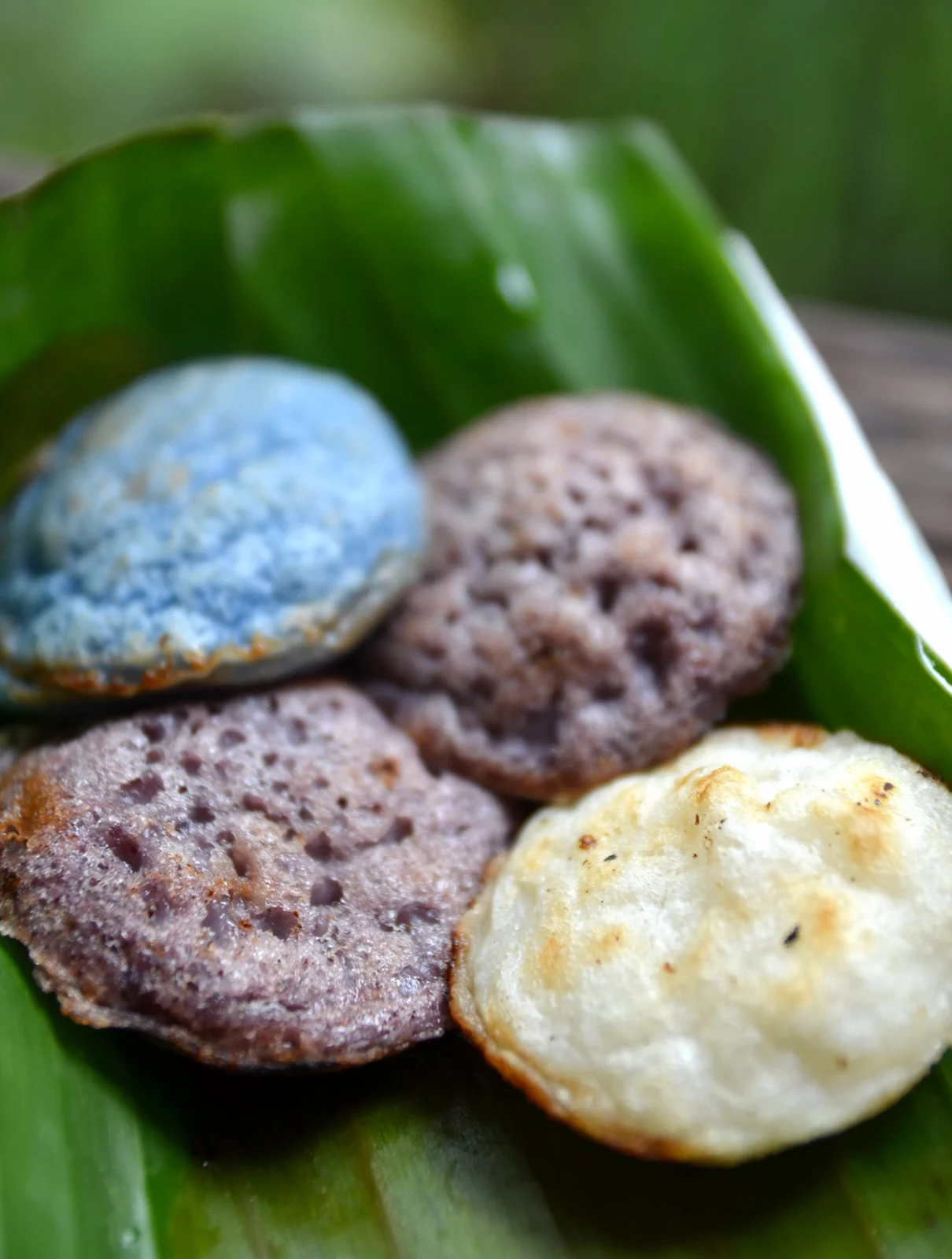
Bite into a small, browned round and the thin rim cracks first, releasing the soft coconut milk center. Khanom krok (ขนมครก) is a Thai sweet made by pouring rice batter into a mold with rows of shallow round hollows, adding a coconut topping, and baking it. Each baked piece stands like a tiny bowl, with a base and a raised rim. It can be eaten as is, or two pieces can be joined with their soft sides facing inward. The contrast between a fragrant outside and a soft inside begins with two questions: what the rice is ground with, and when the two liquids go into each hollow.
Raw Rice, Cooked Rice, and Coconut
According to the Princess Maha Chakri Sirindhorn Anthropology Centre, which studied old implements from Ko Samui, islanders once washed old rice, soaked it overnight, and ground it on a stone mill together with cooked rice, salt, and water. In the Phetchaburi example presented by the Thai Rice Foundation, non-glutinous rice is soaked for six hours and ground with cooked rice and salt, along with coconut. Both examples use soaked raw rice and cooked rice. Soaking lets raw rice break down finely on the mill, and the water-swollen cooked rice adds stickiness. When the batter leaves the stone mill, it must be able to flow into a hollow and reach the rim, and it must also form a thin base inside. Using both raw and cooked rice is probably a preparation suited to those requirements.
In the Phetchaburi source, the base consists of 2 liters of rice, 6 cups of water, 1 tablespoon of salt, and 2 cups each of cooked rice and coconut. The coconut does not go only into the creamy liquid poured on top later. The topping, prepared in a separate vessel, combines 10 cups of milk pressed from five coconuts with 1 kg of white sugar and 1 tablespoon of salt. The foundation presents this region’s topping as relatively sweet, and as an example of a preference for tasting the coconut surface itself, without scattered chopped scallions. These figures are for the batter and topping made in one batch; the amount that goes into a single hollow is only a small part of it. The base contains cooked rice and ground coconut, and the top holds sweetened coconut milk, so coconut remains both on the baked surface of the rice and inside it.
The Kamphaeng Phet Rajabhat University recipe calls for 1¼ cups of non-glutinous rice flour and ⅓ cup of cooked rice. These are blended with 1 cup of thick coconut milk, ½ cup of thin coconut milk, sugar, sea salt, and clear limewater, then left to rest for 15–20 minutes. Even though the step of washing raw rice and grinding it on a stone mill is skipped, cooked rice stays in the base. For the topping, ¾ cup of thick coconut milk is mixed with ⅛ cup of sugar, ¼ teaspoon of sea salt, and only ½ tablespoon of rice flour. A batter high in rice forms a thin shell, and coconut milk with a little flour sets to a creamy consistency on top. The Samui method for the topping is to bring thick coconut milk and salt to a boil once and let it cool before use. A piece in which the coconut is tasted with salt and a piece seasoned with sugar and a little flour differ in the sweetness and thickness of the upper layer.
For the coconut milk in the base, some recipes combine the thick milk pressed from the flesh with the thin milk pressed afterward. The Kamphaeng Phet recipe uses both in the base and only the thick milk in the topping. In the old Samui example, thick milk is used only on top, so the point at which the aroma reaches the mouth differs from the Phetchaburi version, in which the coconut scent comes from the base. Rather than assuming that everything white is coconut, it helps to read the piece as rice below and a creamy liquid above, and this also shows in which part the sugar and salt go.
Two Liquids, Added to the Same Hollow at Different Times
In the Kamphaeng Phet example, the base batter is poured to about three-quarters of each hollow, which has been heated over medium heat and lightly oiled. Once the batter touching the bottom and sides begins to set, the topping is added and the pan is covered. If the batter forming the base is still completely liquid, it mixes easily with the liquid poured in. The cook waits until the base and rim have set along the mold, then pours the white topping into the space left. In Phetchaburi, the base starts at about half the depth of the hollow. These two depths are guides for different recipes. The thickness of the rice left at the bottom and the amount of coconut left on top are decided not only by how the ingredients are measured, but also by how far each hollow is filled first.
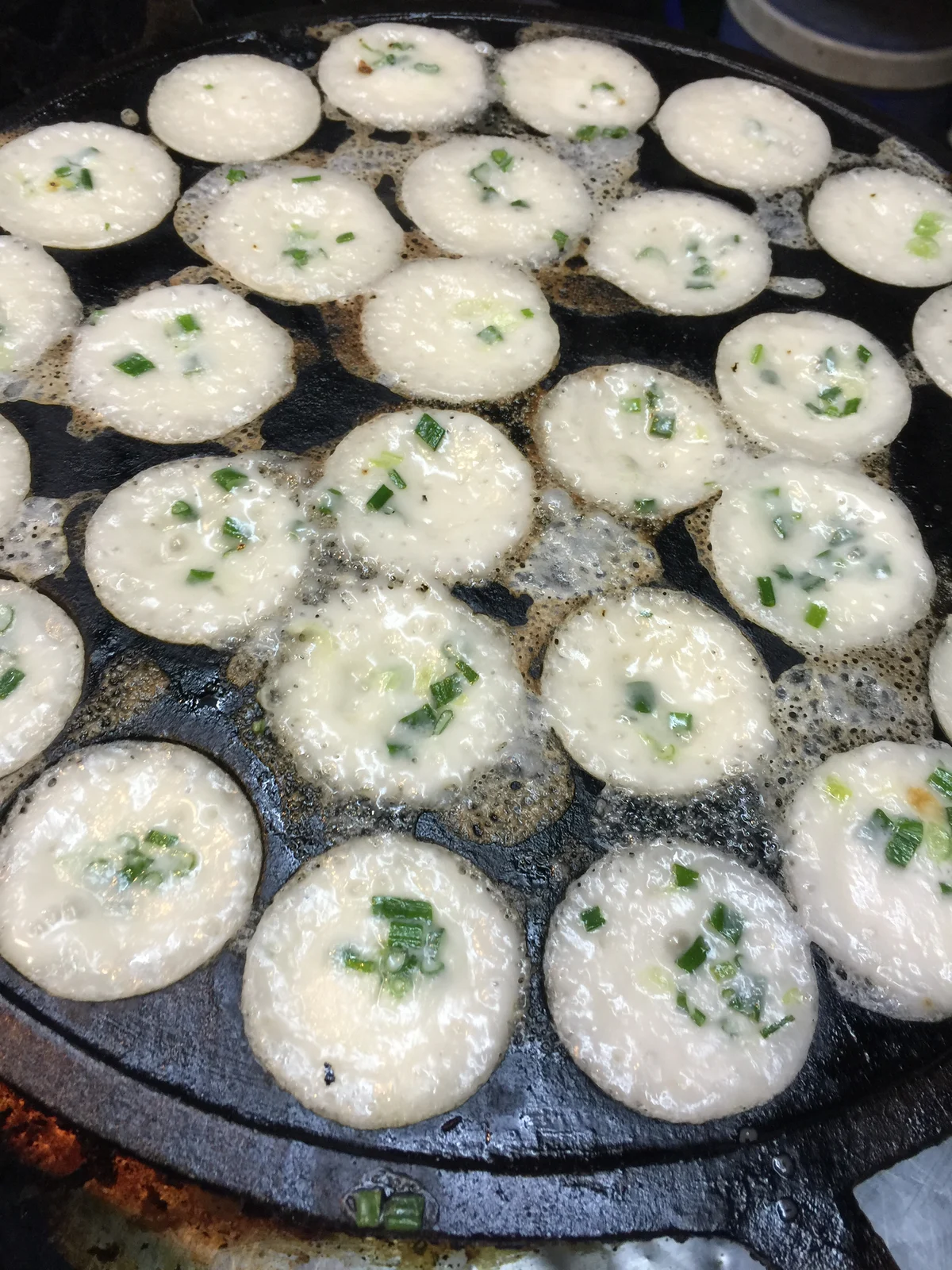
Toppings can also be added to the upper side once baking has begun. The Kamphaeng Phet source lists chopped scallions, diced taro, and corn kernels. Scallions give a green aroma, while taro and whole corn kernels each add something to chew. The top surface in the Phetchaburi example puts the coconut forward in both aroma and texture. Even at the same size, the piece can change in whether the white topping or the surface baked against the mold touches the tongue first. With or without toppings, the base and rim are browned fragrantly where they touch the mold, and the top receives heat under the lid. The lid, which holds in hot air, and the rice that has already formed a thin bowl support the soft topping.
On Samui, Opening One Hollow at a Time to Check the Color
The bao khanom krok recorded on Ko Samui is a round, flat clay mold with many hollows, set over a charcoal fire in a clay stove built directly beneath it. Rather than covering everything with one large lid, a small lid is placed over each hollow. Before heating, there is a task of wiping the hollows one by one with coconut husk fiber wrapped in white cloth. Rice batter is poured into the heated mold and covered; after two to three minutes, about half a teaspoon of coconut milk is added to each hollow, and it is covered once more. The sequence of making the baked surface first and adding the upper layer afterward is reflected even in the tool, with a lid opened and closed for each hollow.
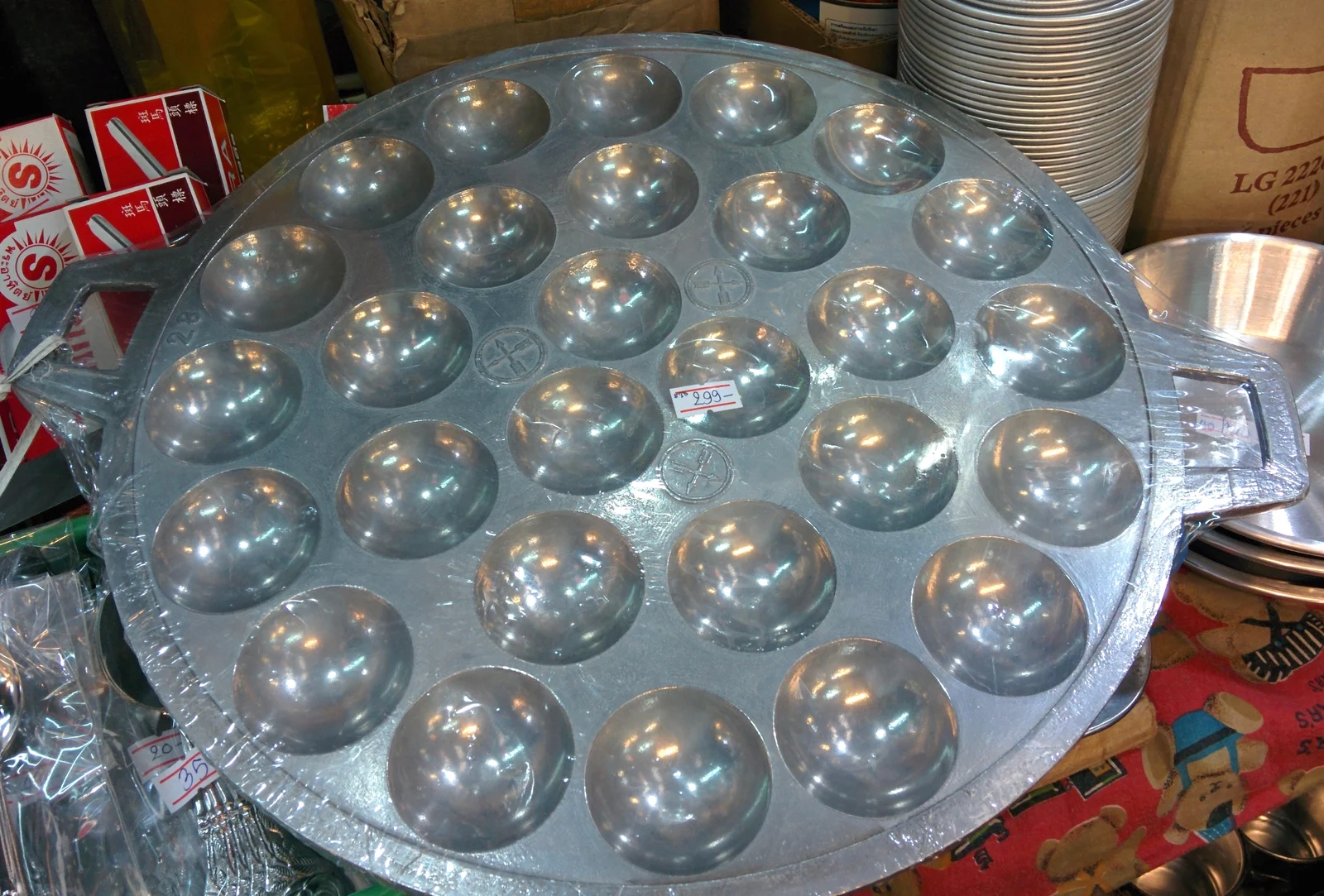
When the rim turns yellow-brown, a spoon is slipped in to lift the piece out. According to the island record, over a charcoal fire the central hollows are hotter than the outer ones, so they cook first. Opening each lid lets the cook look at the differently colored rims one hollow at a time, even in batter set in the same mold, and remove only the pieces that are done. Two baked pieces are joined and placed on a leaf. The banana leaf here is not wrapping for steaming the preparation; it is a mat for carrying and eating the sweet after it leaves the mold. In the combination of charcoal and clay mold described in the source, the positions of the fire and the mold even determine from which hollow a spoon goes in and which piece moves to the leaf first.
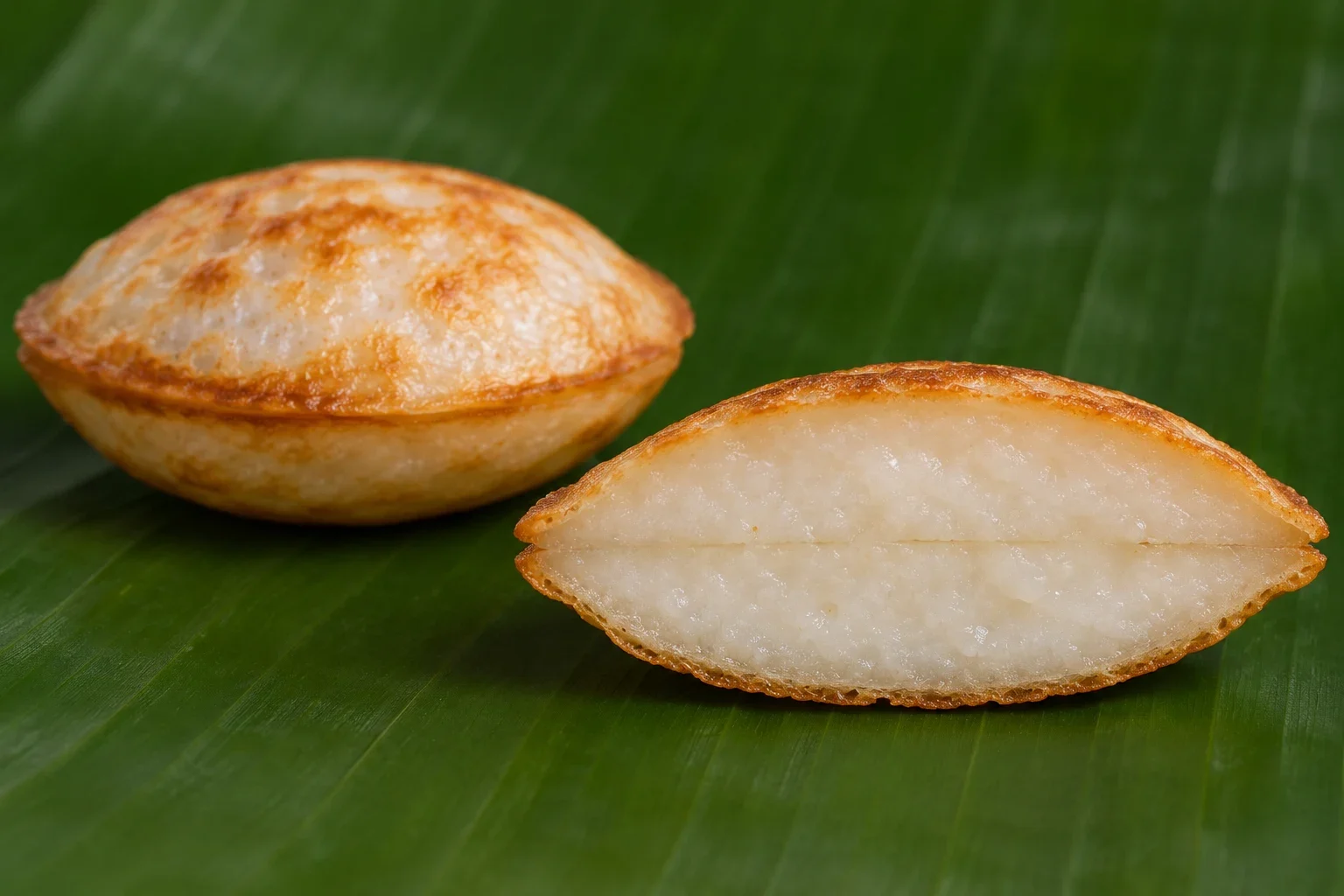
The same source gives, as a modern example, a metal mold that is easy to handle and durable, along with gas. The way the fire is prepared changes, but it notes that if the outside turns hard and the inside watery, the heat is not stable. The inside of a baked piece is soft because the coconut topping stays moist even after it has been heated through. A center that still flows like the liquid poured into the mold is different, in eating terms, from a rim that can be lifted away with a soft center. Because each hollow is small, one piece has plenty of baked rim around it. If a single sheet of batter of the same thinness were baked on a wide surface, a raised rim could form only around the outer edge. When two thin rims are joined, both baked surfaces face outward and the soft topping gathers inside.
The Town That Made the Molds, and Stalls That Sell as They Bake
Clues from the Ayutthaya period also lie in the baking molds. Khaosod English presents testimony records about Ayutthaya and explains that Ban Mo, a potters’ village west of the Sabua Canal in the old capital, made utensils, including those for khanom krok. The record that a utensil for a sweet had a name and that potters made it shows that baking in that form was a known craft. What the source conveys is the utensil. Which rice was ground and put into it, and whether two liquids were already used then, cannot be settled from the description of the tool alone. To view today’s varieties with scallions or corn and the molds made by the old potters as one dish at the same point in time, records of recipes and serving are also needed.
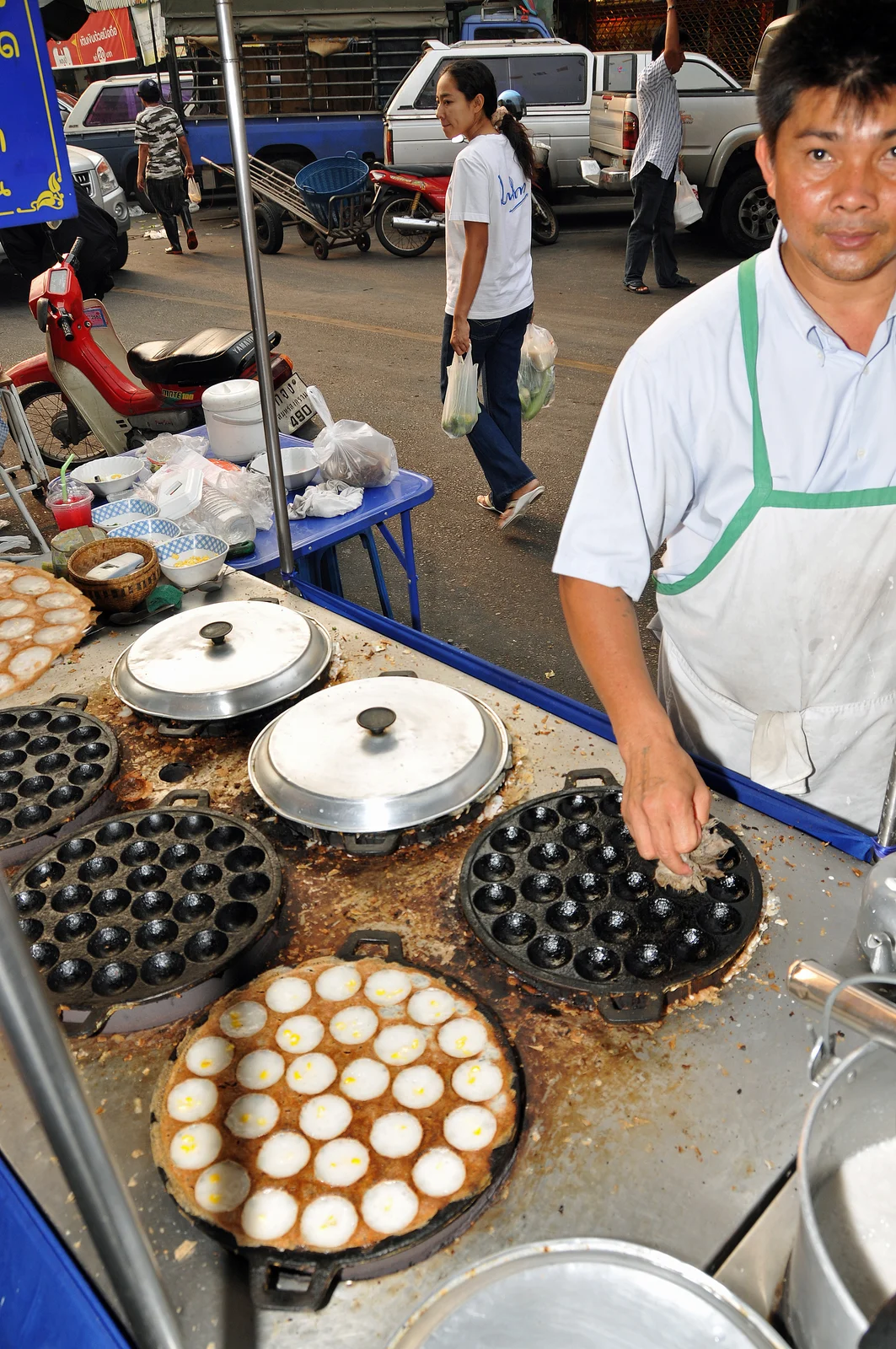
When the sweet is baked at the point of sale, customers can see the liquid poured into the hollows and the pieces with baked rims lifted out with a small spoon. A piece just out of the mold has crisp browning on its sides. After a while, as moisture from inside moves into the shell, the texture changes even at the rim of the same piece. Even when the outside has cooled enough to hold, heat may remain in the coconut within. With several molds at the front of the stall, one or two pieces that finished earlier can be ready to sell beside hollows still baking. Whether the mold is clay or metal, the source on the tools and the scene at the stall share one point: the cook checks which hollow can be lifted out and finishes the sweet in batches small enough to hand over on the spot.
Similar Hollowed Pans, Different Results
Regional articles also mention foods baked by pouring batter into hollows, such as mont lin maya in Myanmar and paniyaram in South India. A shallow hollow receives one piece’s worth of liquid and can produce the same baked shape repeatedly. Even so, from what state the rice is ground, whether coconut is mixed into the batter or poured on top separately, and how pieces are joined are not decided by the shape of the hollow. The shared baking equipment allows the actions of making to be compared. To consider how something spread from one place to another, one must confirm when the tool or recipe was used. Even within Thailand, local examples remain in the handling of batter and heat, as in the salt-flavored topping of Samui and the sweet topping of Phetchaburi.
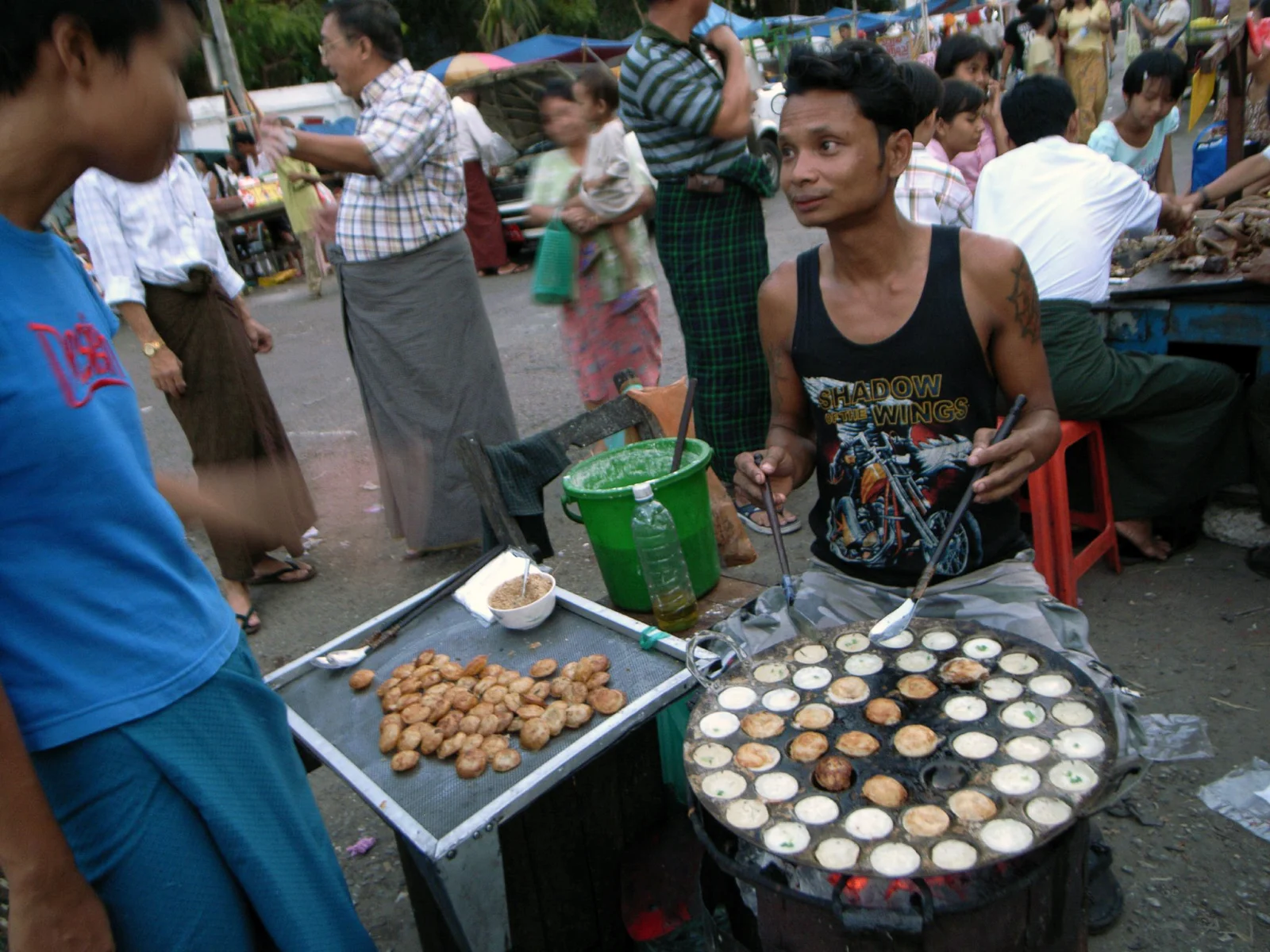
The Yangon photograph likewise shows white batter still in the mold, pieces browned in the pan, and finished ones on a rack. The scene of finishing several pieces in round hollows can be compared with the photographs of Thai stalls. Whether the lids were opened and closed one hollow at a time as on Samui, or whether milk was poured in at a later time, cannot be told from the visible circles. If the comparison is limited to the mold, even the food of another region shows the use of hollows on the same kind of griddle for batter at different stages.
When khanom krok is introduced in Japan, the round hollows’ resemblance to a takoyaki pan is a handy reference point. In the Nippn example, batter is put into a takoyaki pan and spread up the inside of each hollow before the coconut topping is added. If the first liquid fills the hollow completely, there is no room left for the topping. Because a thin layer of rice is formed on the bottom and sides first, leaving room for coconut inside, the technique differs from turning the batter inside the hollow to bake a ball, even though the roundness of the hollow is used. If one piece is removed and two are joined, what the hand touches from outside is the side baked against the mold, one face per piece. In the Nippn example, rice flour and soft (cake) wheat flour are sifted for the base, and after pouring, the pan is held by both ends and rotated left and right. After the topping and chopped green onions or corn are added, the pan is covered and cooked over low heat for about ten minutes. The explanation also says that where batter has joined across hollows, it is separated with a spoon or scissors before the pieces are taken out. Separating a piece from the neighboring hollow and taking out two pieces to join them are different tasks, even within this recipe using the same utensil. Finally, by checking how soft the space between two pieces is, and how thin the base and rim are on a single piece, one can trace the rice preparation and the work of pouring the liquid in two stages within a single bite.
Glossary
- Non-glutinous rice (ข้าวเจ้า, khao chao)
- One category of rice in Thai, distinguished from glutinous rice. Here it refers to rice that is soaked and ground, or the source of rice flour.
- Thick coconut milk (หัวกะทิ, hua kati)
- The rich liquid pressed from coconut flesh. The thin milk is called หางกะทิ (hang kati). In the Kamphaeng Phet method, both are used in the base and the thick milk in the topping.
- Bao khanom krok (เบ้าขนมครก)
- A mold with hollows made specifically for khanom krok. The Ko Samui source records a clay mold with a lid for each hollow, and its stove.
- Ban Mo (Ban Mo)
- Here, a potters’ village said to have stood west of the Sabua Canal in Ayutthaya. Testimony about its production of cooking utensils is presented as source material on the sweet’s history.


