


SweetloreEncyclopedia of World Sweets (834)

Marillenknödel
Marillenknödel
Whole apricots wrapped in dough and coated with toasted breadcrumbs
Baked Sweets / Austria (Wachau and elsewhere)

Marillenknödel are Austrian dumplings made by wrapping an apricot in dough, boiling it, and rolling it in breadcrumbs fried in butter. In Austria the apricot is called Marille and the dumpling Knödel. When you cut into one, the crisp, distinct crumbs spill out, and the softened fruit appears from beneath the dough. The sweetness of the sugar is still edged with the apricot’s tartness. The dish belongs to a tradition of fruit dumplings spanning Bohemia and Austria, and it can be served as a dessert or as a sweet main course.
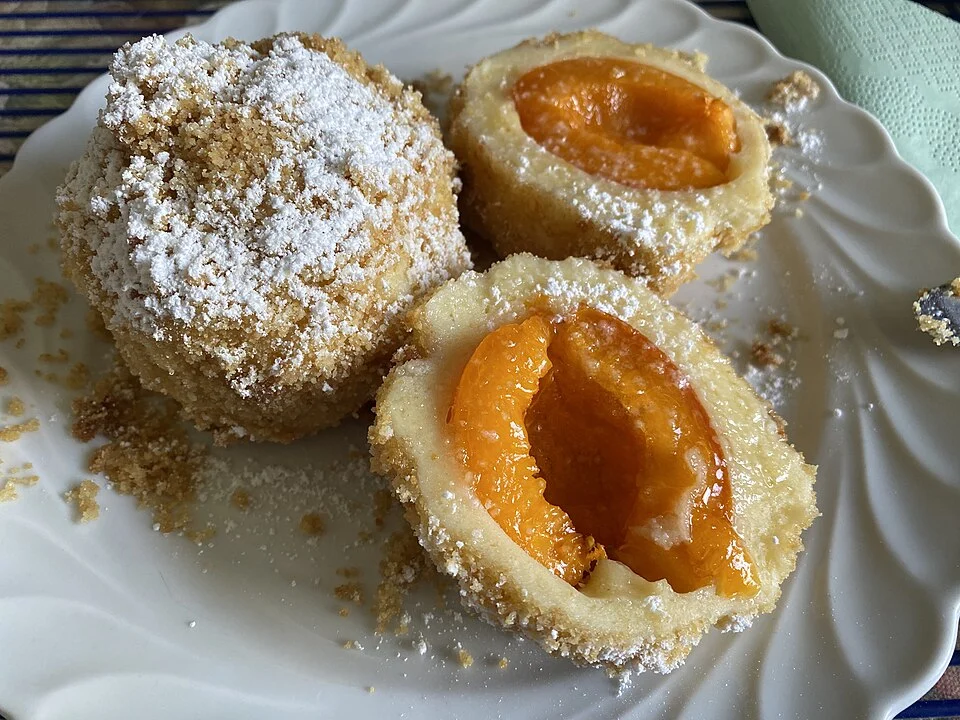
Crumbs, Dough, Apricot: Each Cooked Separately
The three layers visible in the cut surface do not come out of the same pot at once. The dough and fruit are cooked together in hot water, while the crumbs are fried golden in butter in a separate pan. The boiled dumplings are drained, rolled in the crumbs, and dusted with powdered sugar. The coarse, crunchy texture against the soft dough comes not from re-browning the surface but from coating the dumplings at the end with crumbs that were toasted beforehand until fragrant. Draining off the cooking water before coating also serves to keep the crumbs from getting too wet, so that their crunch is preserved.
There are two places where sweetness is added to the apricot’s tartness: the surface, dusted with powdered sugar at the end, and the center, where the stone was. In the recipe (the ingredient proportions and method) presented by Austria’s agriculture and food ministry, the apricots are washed and wiped dry, the stone is pushed out with the handle of a wooden spoon, and a sugar cube is put into the hole. In a sweet filled with chopped fruit that is cooked beforehand, the sugar and juice mix during cooking. Here the apricot keeps the form of a single whole fruit and is covered in dough, so the place where the flesh cooks and releases its juice lies inside the dough.
The dough is shaped into a log about 5 cm in diameter, and each slice is flattened. It is wrapped around the nearly round fruit, and the edges are drawn together and closed. If there is a lot of dough relative to the size of the fruit, the layer to get through before reaching the flesh is thick; if there is little, dough and flesh are more likely to come together in one bite. Even within a single dumpling, the dough may be thicker only at the seam where the edges overlap. Beyond the figures in the ingredient list, the size of the fruit and how the dough for each dumpling is rolled out show up in the cut surface.
Depending on their size, the dumplings are boiled for 12 to 15 minutes in gently simmering water, nudged lightly from time to time to turn them. The agriculture and food ministry presents three doughs (potato, Topfen, and a dough cooked in a pot) with the same boiling method once the fruit is wrapped. Because the flesh is cooked inside the dough, transferring the same boiling time to a different method means looking at whether the fruit is whole or halved, and how the thickness of the dumpling and of the dough differs. Setting the Czech examples, which belong to the Bohemian line, beside the Austrian ones makes these differences in conditions easy to see.
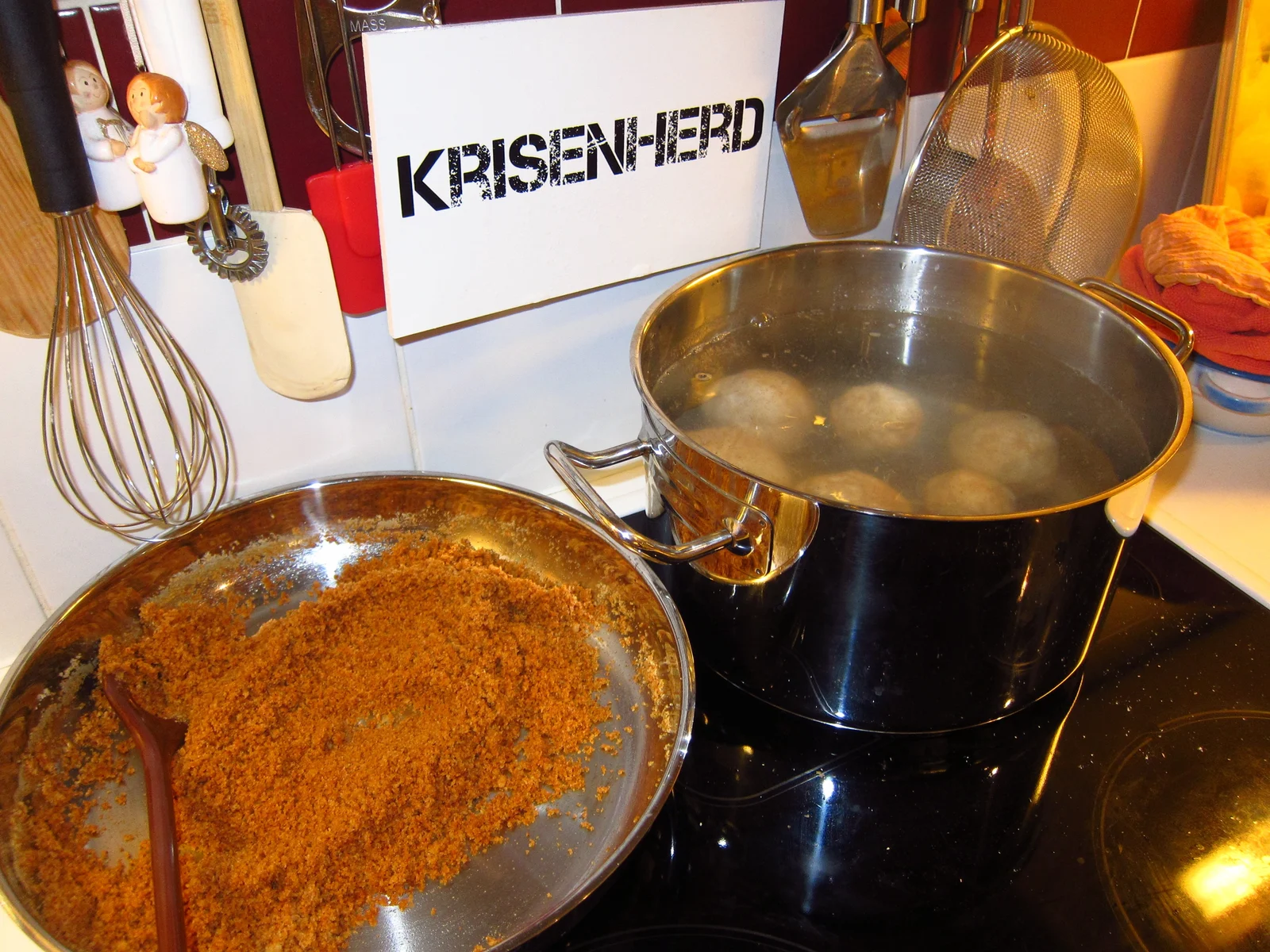
One Apricot, Three Doughs
Potato dough is based on floury potatoes boiled in salted water. The potatoes are cut small and even so that they cook uniformly; after draining, they are left in a hot oven for about 15 minutes to let the steam escape. They are pushed through a sieve while still hot and, once cooled, combined with flour, butter, egg yolks, and salt. For 500 g of peeled raw potatoes, the recipe calls for 120 g of flour. Because the proportion of potato is large, the moisture of the potatoes and how much graininess remains affect how easy the dough is to handle around the fruit, its thickness, and its mouthfeel. When the dough is soft, adding or reducing flour is not the only thing to consider. This recipe adjusts the potatoes’ moisture first and only then mixes in the flour. It offers a clue to why doughs made with the same quantities can differ.
The Topfen dumpling, in contrast to the potato dough whose steam is released beforehand, calls for chilling time after mixing. Topfen is a fresh cheese made by curdling milk and separating off the whey. Soft butter is combined with salt and grated lemon zest, an egg and an egg yolk are worked in, and then 400 g of Topfen and 150 g of flour are mixed in; the dough rests in the refrigerator for 3 to 4 hours. The lemon aroma you meet when eating apricot and dough together is not added to the surface or to the center of the fruit but kneaded into the dough that covers the flesh.
Brandteig, cooked in a pot, is made by bringing milk, butter, and salt to a boil, adding flour, and stirring until the dough comes together and pulls away from the pot and the wooden spoon. Letting it cool slightly before adding the eggs is a step it shares with the preparation of choux pastry. From here on, though, it differs from choux, which is piped and baked to form a hollow. The pot-cooked dough is rolled thin, wrapped around the fruit, and in the boiling water becomes the layer covering the flesh. In the agriculture and food ministry’s recipes, the potato and Topfen doughs make 18 dumplings and the Brandteig makes 12. When reading the formulas, the amount of dough and the proportion of flesh need to be compared on a per-dumpling basis.
At Tables in Bohemia and Austria
Czech kitchens also turn apricots into dumplings. In the tvarohové knedlíky of Czech public television, soft tvaroh, with the whey separated off, is mixed with flour and salt and wrapped around pitted, halved apricots. Set beside the method of filling each whole fruit with a sugar cube, the shape of the flesh in the cut surface, the amount of dough in a bite, and the place where the sweetness is put all differ. The dumplings are boiled until they float, then served with grated hard tvaroh, powdered sugar, and melted butter. The soft cheese goes into the dough around the fruit, and the hard one is scattered on the surface. It is a dish that uses a fresh cheese of the same name both inside and out.
Another example from Czech public television wraps apricot pieces in a yeast dough, lets it rise, and boils the dumplings for 3 to 4 minutes depending on their size. The boiled dumplings are split with a fork and served with butter, tvaroh, and other toppings. Air bubbles formed by the fermentation are in the dough, and grated cheese touches the tongue on the surface. This too differs in role from the toasted crumbs that create the surface texture in the Austrian examples. All of them bring out the softness of the apricot, but what the teeth meet first changes with the combination of the dough around the fruit and the way the dish is served. Even in Czechia there is no single fixed recipe; what is compared here is two examples.
Fruit dumplings also appear on the table when a meal is built around sweet dishes. Unlike baked sweets cut small and handed out after a meal, warm, round dumplings are plated whole, accompanied by toasted crumbs or cheese. The use of preparation time differs too: one day for boiling and sieving the potatoes, another for mixing the Topfen dough a few hours ahead and chilling it, another for cooking flour in a pot. The Austrian agriculture and food ministry records how sugar and potatoes, once expensive, became cheaper toward the end of the 18th century, and how fruit dumplings became a more familiar Mehlspeise (a flour-based dish). Dishes of this kind, made with flour, potatoes, and the like, also became everyday home cooking and food for fast days.
How Whole Fruit Came to Appear in 19th-Century Cookbooks
The 1699 cookbook Neues und nutzbares Koch-Buch includes dumplings made with apples and cherries. According to the agriculture and food ministry, the method used stewed chopped apples, dried cherries, and grated toasted bread, with cinnamon and sugar added. The rolled dumplings are dusted with flour, fried in hot lard, and then warmed in cherry soup. They are linked to the Marillenknödel as round dishes made with fruit, but the fruit pulp and bread mixed inside form a single dough. Compared with today’s Marillenknödel, whose cross-section divides into an outer dough and an inner fruit, the form differs, even though both are "fruit dumplings."
Examples that wrap a whole fruit appear in 19th-century cookbooks. Tobias Müller, who has reported on food culture, cites a Bohemian plum dumpling from 1845 and an apricot dumpling in Josefine Zöhrer’s Salzburg cookbook Neues Salzburger Kochbuch für mittlere und kleine Haushaltungen, published in 1873. He also finds examples that wrap apricots in a thin Topfen dough in the 1882 magazine Wiener Hausfrau and in the 1890 edition of Katharina Prato’s Die süddeutsche Küche. Wrapping fruit in a separately prepared dough, using apricots in place of plums, and mixing Topfen into the casing can thus be traced through separate records.
Prato’s cookbook was first published in 1858 and went through further editions. The year in which a dish can be traced differs depending on whether one counts the year the title first appeared or the year of the edition that contains the recipe. The publication years of Zöhrer’s book and of Wiener Hausfrau are likewise the years in which the recipe is known to have been printed. These records do not settle who first wrapped an apricot, or in whose home. Within a dish that has continued across Bohemia and Austria, the methods of many kitchens remain, each choosing its own fruit and dough anew.
Danube Apricots, Shared in Town at Harvest Time
In the Wachau along the Danube, the summer apricot is a local specialty. "Wachauer Marille" is the name of a fruit protected by the European Union as a Protected Designation of Origin (PDO). The specification records the growing area, the shape of the fruit, and the groups of varieties, and the agriculture and food ministry’s materials also list a variety group called Kegelmarille. What this name confirms is the provenance of the fruit that goes into the center of the dumpling. Whether the casing is made of potato or Topfen, and what is rolled onto the outside, are decided in the kitchen, independently of the fruit’s name.
Fruit growing in the Wachau rests on the land and climate stretching along the Danube. On apricot cultivation, the agriculture and food ministry explains that the climates of the Pannonian side and the Waldviertel side meet there, and that the Danube also influences the climate. The difference between daytime and nighttime temperatures during ripening also affects the aroma and flavor of the fruit. Apart from the recipe that determines the dumpling’s dough, this is where local conditions bear on the taste of the fruit itself.
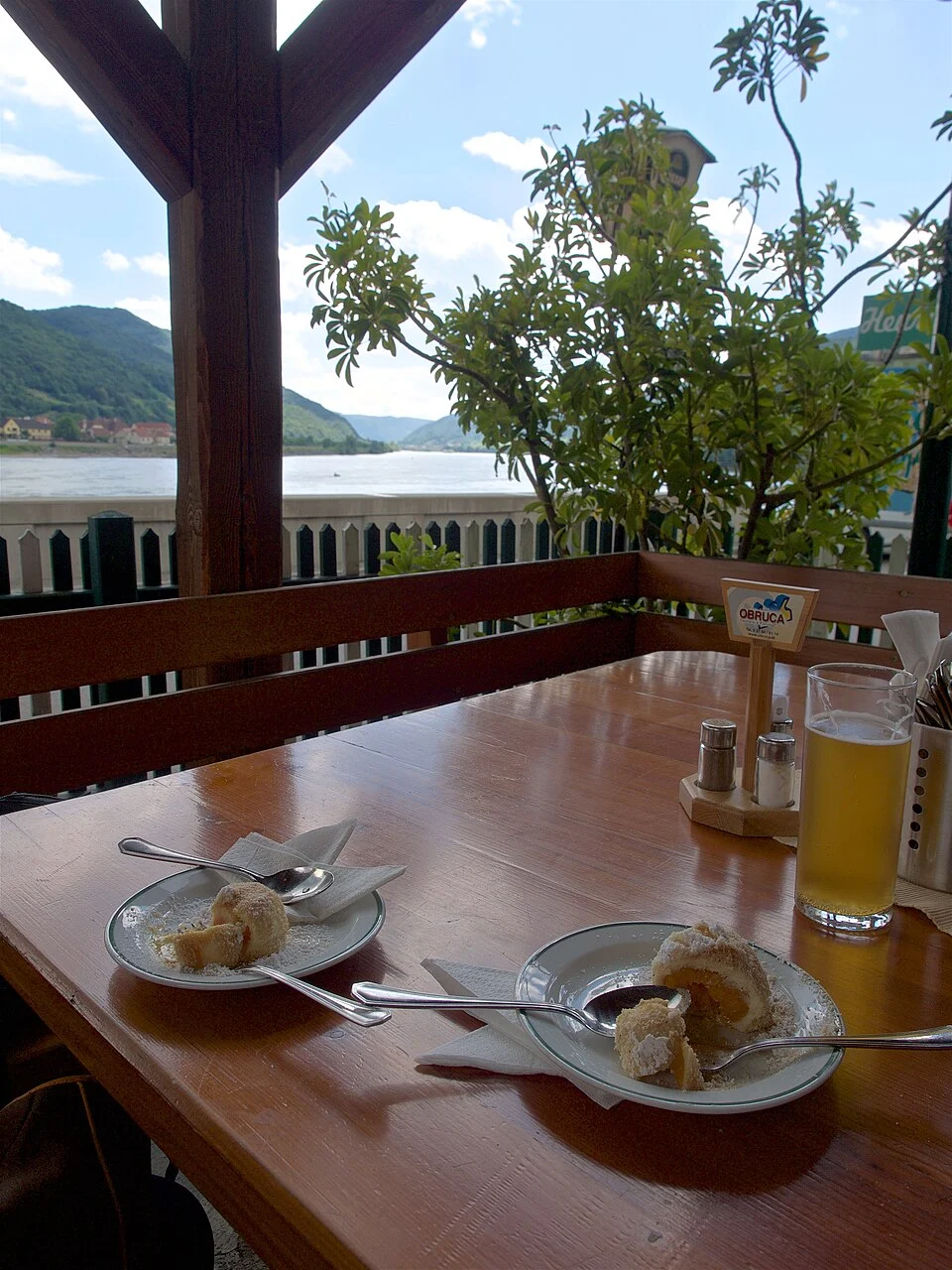
In Spitz in the Wachau, an apricot festival is held in July. In 2024, from the 19th to the 21st, stalls selling apricot dishes and processed products stood in the square in front of the church, a local band played, and a folk dance group performed. According to the town’s record, the dumplings that festival visitors ate were prepared in the kitchen of the town’s school, carried to the square in insulated containers once boiled, and handed out from a dumpling serving device at the venue. People gather in the town during the apricot season, and a dish that wraps each fruit one by one is divided between the school kitchen and the square so that it can be served warm. The dumpling that encloses a single fruit becomes a dish for many people to eat together in the summer harvest.
Glossary
- Topfen and tvaroh
- The names used in Austria and Czechia, respectively, for a fresh cheese made by curdling milk and separating off the whey. The Czech example in the text also includes a hard type that is grated over the dish.
- Brandteig
- A dough made by adding flour to a liquid such as water or milk, cooking it in a pot, and adding eggs. In this article it refers to the dough that wraps the apricot before boiling.
- Protected Designation of Origin (PDO)
- Here, the European Union geographical indication applied to the fruit name "Wachauer Marille."


