DRUG

パレード伏見洋菓子店

SweetloreEncyclopedia of World Sweets (834)

SWEETS&CAKES

Ozark Pudding

Ozark pudding

A baked apple-and-nut dessert that passed from the Truman family into the newspapers

Desserts / United States, Ozark region

Ozark Pudding with a browned top cracked open, showing a yellow interior with apple pieces and chopped nuts, topped with a dollop of white cream

Ozark pudding is an American dessert in which chopped apples and nuts are bound with egg, sugar, and a little flour, then baked in a dish. Break through the browned surface and the apples beneath are soft and cooked through, while the nuts give some bite. Served warm with cold ice cream, it releases the aroma of the fruit from underneath. It is said to have been one of the favorite desserts of President Harry S. Truman, a native of Missouri, and the version credited to his wife, Bess, passed into people’s hands through newspapers and cookbooks.

An Egg Batter Binds the Apples and Gives the Pudding Its Shape

In a newspaper clipping held by the U.S. National Archives, one egg is mixed with ¾ cup of sugar until smooth. Two tablespoons of flour are combined with baking powder and salt and then added to the egg. Half a cup each of chopped apples and nuts goes in, along with vanilla, and the mixture is poured into a greased pie dish. There is no step of kneading dough to line the dish with a separate thin crust; the egg batter fills the gaps between the fruit and the nuts. It is baked at 350°F (about 177°C) for 35 minutes and cut into four servings. The clipping also preserves two suggestions for serving: with whipped cream or with ice cream.

The version presented by the Truman Library Institute likewise beats one egg and the sugar until smooth, for a longer time, and uses chopped apples and nuts. The greased pie dish, the 350°F temperature, and the 35-minute baking time are the same as in the clipping. It also mentions, as one option, flavoring with a little rum. The two sources differ in the figure for baking powder, so that amount should be read from each source separately. The clipping gives 1¼ teaspoons, while the Institute’s 2019 web posting gives it as "1 1/14." What the surviving sources confirm is this difference in notation; at what stage the figure changed cannot be determined.

When the Loveless Cafe, a restaurant in Tennessee, re-creates this dessert, it finely chops tart Granny Smith apples and chooses pecans as the nut. The National Archives clipping specifies neither the apple variety nor the type of nut. The American food writer Sheri Castle cuts tart cooking apples into pieces about 1.3 cm square. Differences in coarseness change the experience: you may scoop up more small chopped bits, or bite into one cooked apple cube at a time. When nuts are chopped and combined with the fruit, pieces that stay firm are scattered among the softened apples.
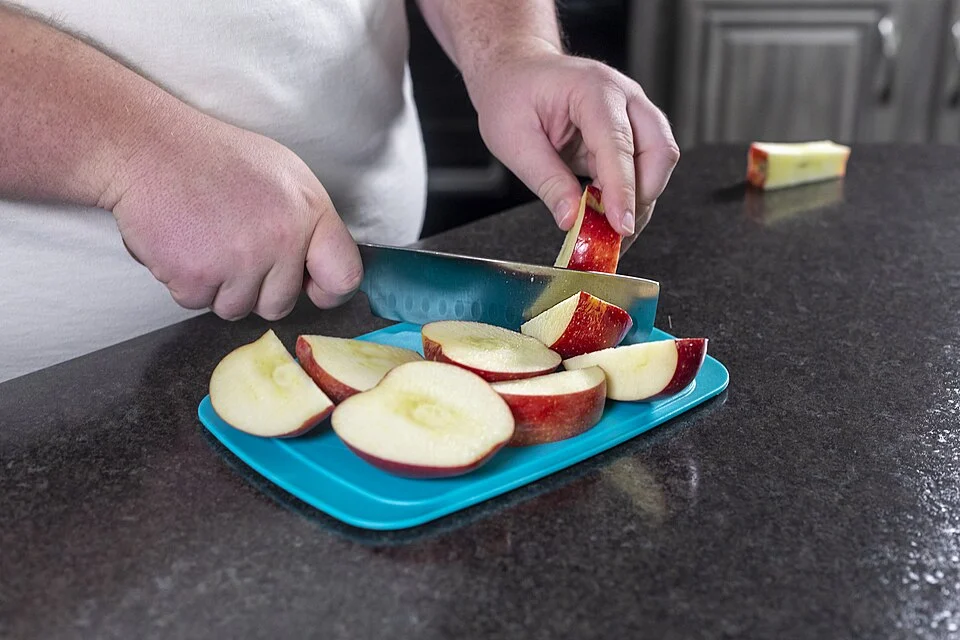
A hand cutting a red apple with a knife on a cutting board
A comparison photograph showing hands cutting apples. The apple variety in the photograph is unknown, and it is not a photograph of the pudding. Photo: Bridget Brown / Alabama Extension / original on Flickr / CC0 1.0.

Castle beats the egg with salt and adds the sugar a little at a time until the mixture thickens. She mixes the apples, pecans, and vanilla first and folds in the flour and baking powder last. The newspaper recipe mixes the dry ingredients first and then adds the fruit and nuts. The order differs, but in both the beaten egg holds the flour and the solid ingredients together. Castle uses a buttered 9-inch (about 23 cm) square deep dish and bakes at 325°F (about 163°C) for about 40 minutes. She looks for a browned surface and bubbling in the filling where it meets the edge of the dish. After baking, she lets it rest for at least 10 minutes and serves it warm or at room temperature.

Castle describes the center of her version as sticky, like a pecan pie with small pieces of apple in it. The edges bubble and stay chewy, and the thin top cracks lightly. The Loveless Cafe bakes the pudding in a buttered pie dish and lets it cool to room temperature. One recipe judges doneness by how far the filling has bubbled in a deep dish; the other lets the pudding cool well before cutting it from the dish. Baking time and temperature therefore have to be read together with the pan and the quantity used. In both, the butter is applied to the dish and is not an ingredient worked into the egg batter.
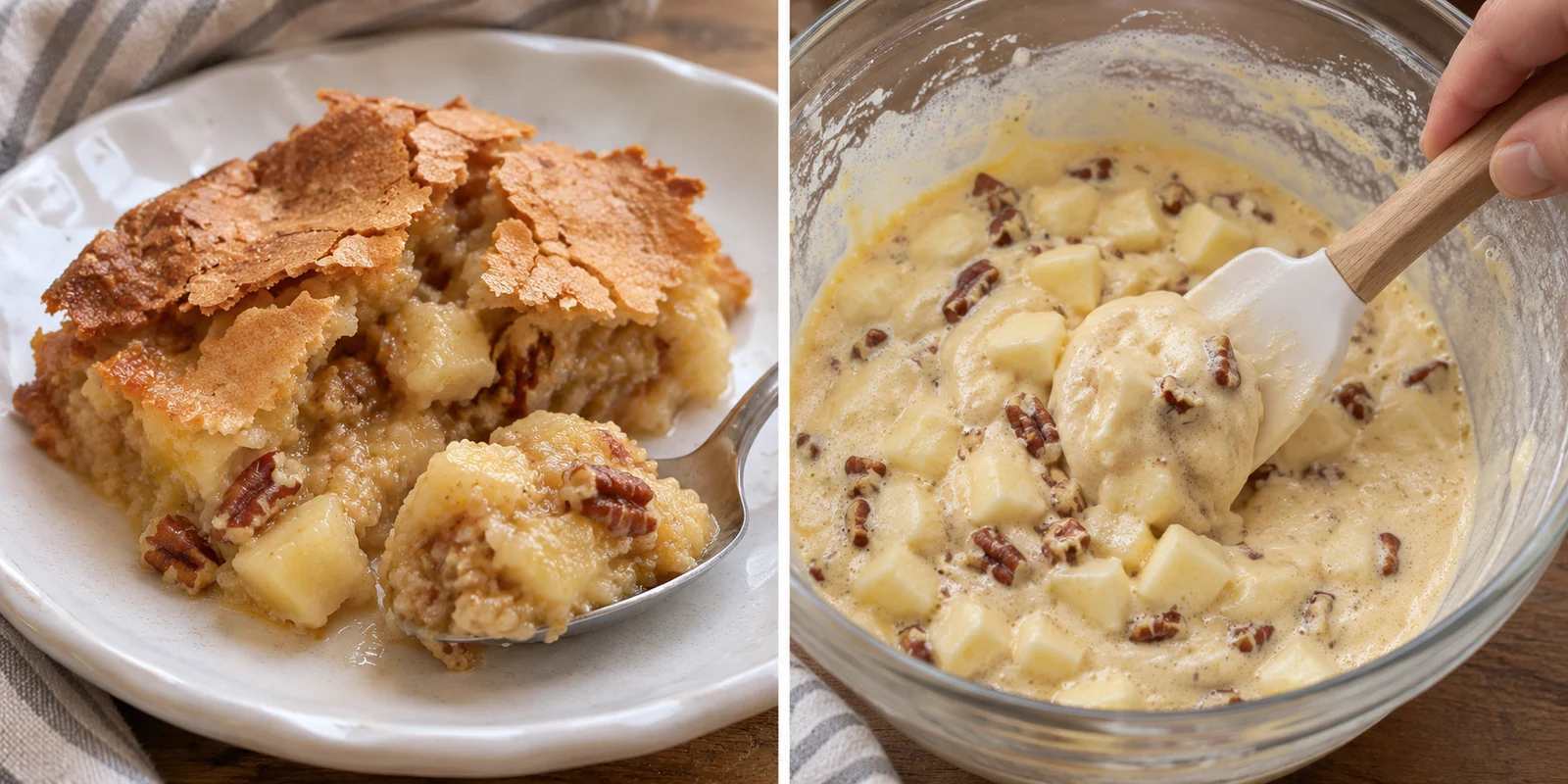
Reconstruction image (AI-generated). On the left, a serving with a thin baked top and apples and pecans visible. On the right, apples and pecans being mixed into the egg batter.
Reconstruction image (AI-generated). On the left is a baked slice, with apples and pecans visible beneath the thin baked top. On the right, small pieces of apple and pecan are being mixed into the egg batter before baking. Sheri Castle’s recipeを参照。

Readers Who Baked the Newspaper Recipe Write Back

According to the U.S. National Archives, Bess’s recipe appeared in several newspapers as part of an article introducing the Truman family, around the time of the 1949 presidential inauguration. After the account of the family attending the ceremony, readers found a recipe they could try with the eggs and apples in their everyday kitchens. However, the Archives’ commentary notes that some papers gave wrong quantities or left out ingredients when they reprinted it. Even if the figures can be read on one clipping at the National Archives, that does not mean the newspapers delivered in other towns were the same.
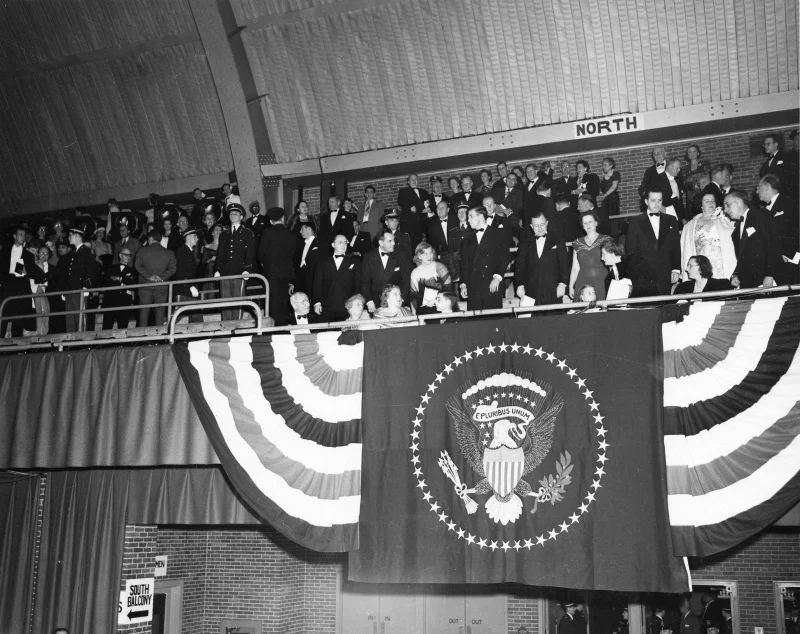
The Truman family seated in the stands at the 1949 inaugural celebration
Inaugural celebration in Washington, D.C. Harry, Bess, and Margaret Truman sit in the front row. Photo: Abbie Rowe / National Park Service / Harry S. Truman Library & Museum, 73-2842. The holding institution lists it as public domain.

The Archives also presents an anonymous letter that it dates to around 1949. The writer told Bess that she had baked the pudding several times and that each time the batter overflowed the pie dish. Another complaint from a reader is also passed down: the pudding was hard to release from the dish, and sugar and butter, which were still expensive at the time, were wasted. When a batter that rises is poured into a shallow dish, how much goes in is also important information for the cook. But this letter conveys only what happened in one home. The edition of the newspaper that was read, the measured figures, the depth of the dish, and the condition of the oven have not survived together, so the cause of the failure cannot be traced to any particular misprint.

A modern recipe republished by the U.S. National Food Museum uses 2 eggs and 4 tablespoons of flour. The quantities of sugar, apples, and nuts, however, are the same as in the clipping presented by the Archives. Because some ingredients are doubled while others stay the same, it is not simply a single clipping’s recipe doubled. To get a thicker pudding, the museum advises using a deep pan and placing a baking sheet underneath in case the batter overflows. These instructions accompany the modern re-creation and do not identify the dish used by the writer of the letter.

The records speak from another angle about whose favorite it was. The National Archives explains that a dessert with apples and nuts was one of Harry’s favorites and that Bess had the recipe for it. The Truman Library’s biography of Bess notes that her daughter Margaret reported it as one of her mother’s favorite sweets. The Library of Congress takes up Bess’s recipe in its feature on the Congressional Club Cook Book, a collection of recipes from the households of members of Congress, judges, and other government officials. The cookbook began in 1927, and the exhibit photograph shows the 1965 edition. 1965 is the year of the edition on display; the photograph does not show when Bess’s recipe was first included.

Nuts Gathered Locally, Nuts Chosen by the Recipe

In the Ozarks, wild black walnuts are gathered in autumn, hulled, and shipped. Missouri State University Libraries has published a 2020 interview with Larry and Jackie Melton and others, who ran a hulling station on a farm near Springfield. Nuts gathered by local residents were brought to the station, hulled, and sent on for processing. This is a record of which nuts were available in autumn and how they were handled. The "chopped nuts" in the recipe bearing Bess’s name are not specified as black walnuts, and the fact that they were gathered in the same region does not allow one ingredient to be settled on.
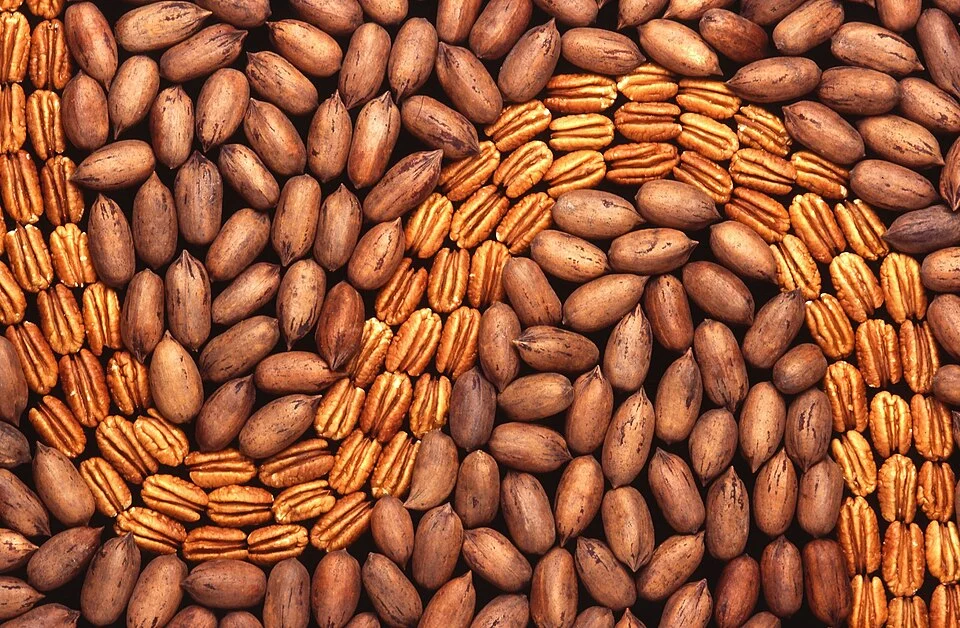
A pecan with its shell removed, showing lengthwise ridges, beside a nut still in its shell
Pecans in the shell and shelled. They show the nut chosen by the Loveless Cafe and Sheri Castle. Photo: Scott Bauer / USDA Agricultural Research Service, K7235-2. Public domain as a work of the U.S. federal government.

Midwest Old Settlers and Threshers Cookbook, a 1976 community cookbook from Iowa, includes a recipe by Ruth Snell. It calls for 4 cups of chopped apples, 1 cup of nuts, and 2 cups of flour. Margarine and sugar are creamed first, then combined in turn with the eggs and the flour mixed with nutmeg and cinnamon. The chopped apples and nuts go in last, and the batter is spread in a greased pan of about 23 × 33 cm and baked at about 177°C for 1 hour. The flour and apples per egg are both greater than in the newspaper recipe, and it serves 12 to 15. The butter in the modern recipes of Castle and the cafe is what coats the dish, whereas Snell’s margarine goes into the batter from the point where the sugar is mixed. Comparing how each begins in the mixing bowl, Bess’s clipping starts from beaten egg, while Snell creams the fat and adds the eggs afterward.

Huguenot Torte, Served Baked Side Up

Huguenot torte, handed down in Charleston, South Carolina, is a dessert of baked apples and nuts whose surface has a texture like meringue. According to the Oxford Companion to Sugar and Sweets, Evelyn Anderson, who made desserts at the local Huguenot Tavern, contributed the recipe to the regional cookbook Charleston Receipts. The publisher, the Junior League of Charleston, gives the date of the first edition as November 1, 1950.

A source that cites an interview by John Martin Taylor, who studied Charleston food culture, says that Anderson ate Ozark pudding at a church supper in Galveston, Texas, later adapted it herself, and served it under a name taken from the restaurant where she worked. This is the woman’s own recollection, recorded after the cookbook appeared. The name evokes French religious history, but what this testimony traces directly is a church supper in the United States and a name that stayed with a Charleston restaurant.

Materials from the Jackson County Historical Association, which has published the 1966 Three Arts Club Cookbook, also include Kaye Browder’s "Huguenot Torte." Whole eggs are beaten and combined with sugar, a little flour, baking powder, chopped tart apples, pecans, and other ingredients, and the batter is baked in two rectangular pans. The sugar and flour per egg are in the same proportions as in Bess’s clipping. Where the clipping does not specify the type of nut and bakes at 177°C for 35 minutes, Browder specifies pecans and bakes at about 163°C for 45 minutes.

Once the torte is browned and has formed a crust, Browder scoops it out with a spatula, baked side up, onto a large platter and adds whipped cream and chopped nuts. It can also be divided into 16 smaller portions. Snell’s single pan is cut into 12 to 15 servings, and there is a suggestion to serve it with ice cream while still slightly warm. Castle serves hers with lightly sweetened whipped cream. Even when warm apples and cream are taken in one bite, the baked layer felt when the top is first broken and the texture of the nuts that meets the teeth later both remain. With whipped cream, there is none of the change that comes while waiting for ice cream to melt, and it can be scooped up together with the baked layer as soon as it is served. Browder’s instruction to lift the baked top without breaking it is meant to carry that texture through to the plate. That the tool for serving each portion is a spatula also suits this finish: rather than scooping only the soft filling from the bottom of a deep dish, it carries the surface and filling together.

Glossary

Pecan
Here, the nut chopped and baked with the apples. The Castle and Loveless Cafe recipes specify the type.
Black walnut
A nut gathered in places such as the Ozarks. Missouri State University Libraries has published an interview about the hulling station and the harvest.
Cooking apple
An apple used in baked dishes. Castle chooses tart ones, and the cafe uses Granny Smith.
Huguenot torte
A baked apple-and-nut dessert handed down in Charleston, South Carolina. Its recipe appeared in a regional cookbook published in 1950.
TOPOzark Pudding | Cafe & Sweets Parade Kyoto

(FAQ)

All You Need to Know

Do you have gluten-free sweets made without wheat flour?

Yes. We offer sweets made without wheat flour, such as madeleines made with rice flour. However, they are made in the same kitchen as products that use wheat flour. If you have a wheat allergy or need to strictly avoid wheat, please consult our staff before purchasing.

Do you use additives such as preservatives or emulsifiers?

We do not add preservatives or colorings when making our sweets.

Some of our baked goods (such as madeleines and chocolat) use baking powder to help the batter rise. In addition, ingredients we purchase, such as chocolate, may contain additives such as emulsifiers that help maintain their quality.

To see the ingredients we use, please check the ingredients listed on each product page.

When is the Seasonal Citrus and Lemon Curd Cake available?

This cake is sold on an irregular basis.
It is often available on Saturdays, Sundays and public holidays. We post updates on in-store availability as needed in our Instagram Reels, so please check there.

Do you sell fresh cakes on Wednesdays?

We do not currently sell fresh cakes on Wednesdays.
On Wednesdays, we mainly sell baked sweets and drinks.

*Many customers have asked about this, but no decision has been made yet about selling fresh cakes on Wednesdays.

Can I request noshi paper (noshi kakegami) for gifts, presents, and the like?

For gift boxes in sizes M and L, we offer inner noshi (uchi-noshi) only, at 100 yen (tax included) per sheet. Please specify the top inscription and name inscription, and place your request at least 3 days in advance. For same-day requests, please consult the shop.

Do you offer OEM (manufacturing of original products)?

We are currently accepting consultations on OEM requests, depending on their details.
To start, please contact us through the inquiry form with details such as your product concept, desired quantity, and sales purpose.

Where is the shop located?

Cafe & Sweets Parade Kyoto is in Uoya-cho, one street south of the Otesuji Shopping Street, a 4-minute walk from Keihan Fushimi-Momoyama Station and a 5-minute walk from Kintetsu Momoyama-Goryomae Station. Parade stands in an area full of history and charm. Nearby are Torisei, a sake and yakitori restaurant run by a long-established sake brewery; Teradaya, said to be the place where Sakamoto Ryoma was attacked; the Fushimi Jikkokubune, wooden boats that take you along the canal; and many other places.
For the exact location and other details of Cafe & Sweets Parade Kyoto, please check Google Maps↗︎.

What days is the shop open?

We are open every Wednesday through Sunday from 11:00 to 18:00 (last order 17:30). We are regularly closed on Mondays and Tuesdays.
On public holidays, we are open on some days and closed on others.
We may also close temporarily on irregular days, or open on regular closing days. For the latest information, please check Instagram↗︎ or Google Maps↗︎.

How can I place a large order?

Yes, we accept orders through this inquiry form.
Large orders are orders of 21 or more units, or orders with 10 or more delivery addresses.

Can you tell me about allergens in your products?

Whether a product uses egg, wheat flour, peanuts, walnuts, other nuts or dairy products is stated on the allergen list page and on each product’s page.

Peanuts (groundnuts) and walnuts are shown separately from “other nuts” such as almonds.

Points of caution other than the items above, such as sesame, gelatin and honey, are written in the “Notes” section of each product. However, not all allergens are listed. For assortments such as gift boxes, the ingredients of each sweet included are listed under [Ingredients] on the product page.

If you have any questions, please ask our in-store staff or call us (075-644-4118) before purchasing.

Do any of your products contain alcohol?

Yes. We mainly use liquor in the following sweets:

• Canelé de Bordeaux (rum)
• Galette Bretonne (with rum)
• Madeleine au Chocolat (with liqueur: Grand Marnier)

The Galette Bretonne and the Madeleine au Chocolat are also available in “without rum” and “without liqueur” versions, respectively, made without liquor.

▼Gift boxes
• Classic Baked Sweets Gift Box L [9 Varieties, 15 Pieces]: includes 2 Galettes Bretonnes (with rum)
• Classic Baked Sweets Gift Box M [9 Varieties, 9 Pieces]: includes 1 Madeleine au Chocolat (with liqueur)
• Gluten-Free Gift Box [S] and Gift Box [M] with Higuchi Apiary: contain no sweets made with liquor

Even in baked sweets, a small amount of alcohol may remain. Children, pregnant women, people sensitive to alcohol and anyone who will be driving should take care.

For seasonal products, please check the “Notes” section on the allergen list page.

Is there parking?

The shop does not have its own dedicated parking lot. If you are coming by car, please use one of the paid coin-operated parking lots nearby.
If you are coming by train, the shop is about a 4-minute walk from Fushimi-Momoyama Station on the Keihan Main Line and about a 5-minute walk from Momoyama-Goryomae Station on the Kintetsu Line.

Can I eat and drink in the shop?

Yes, you can enjoy your order in our in-store eat-in space. Seating consists of 5 counter seats and 4 terrace seats (2 tables for 2 people each). High-speed Wi-Fi is also available.
Takeout is available as well. Opening hours are 11:00–18:00 (last order 17:30).

Where can I check the day’s cake selection and sold-out items?

The fresh cakes we sell change from day to day. We post updates on in-store availability as needed on Instagram↗︎.
Items may sell out after a post. If you want to be sure to get something, please call us (075-644-4118).

Do the 2 types of lemon cake differ in how they should be stored and how long they keep?

Yes. The lemon cake with icing must be kept refrigerated and keeps until the end of the day of purchase. The lemon cake without icing can be stored at room temperature and keeps for approximately 7 days from the date of manufacture. Please prioritize the date shown on the label of the product you have.

How long do baked-goods gifts keep, and how should I store them?

As a guideline, baked-goods gifts keep for about 2 weeks from the date of manufacture. Please store them in a cool place, away from direct sunlight and high temperature and humidity. The exact date is printed on the back of each individual sweet.

What payment methods can I use in store?

▼In store
• Cash
• Credit cards: Visa, Mastercard, JCB, American Express, Diners Club, Discover
• Transit IC e-money: Suica, PASMO, ICOCA, Kitaca, TOICA, manaca, SUGOCA, nimoca, Hayakaken
• Other e-money: iD, QUICPay+
• Code payments: PayPay, Rakuten Pay, d Barai, au PAY, Merpay, WeChat Pay, Alipay+, and others

Apple Pay and Google Pay can be used if one of the e-money services or cards listed above is registered.

What kind of cream puff is the Oven-Baked Cream Puff?

It is our classic cream puff: a crisp cookie-crust choux generously filled with a rich cream that combines fresh cream with custard made using “Sakura” eggs from a purely Japanese chicken breed.
It must be kept refrigerated; please eat it on the day of purchase. We also offer a caramel-flavored version, the “Oven-Baked Caramel Cream Puff.”
For details, please see the Oven-Baked Cream Puff product page.

What Are Meringue Cookies?

Meringue cookies are sweets made by baking and drying meringue, which is egg white and sugar whipped together. At Parade, we use kibi sugar (Japanese cane sugar) and finish them with a light texture: a crisp first bite, then an airy, fizzy melt in your mouth.

What kind of sweet is a sablé diamant?

True to its name, which means “diamond” in French, this is a sablé coated with sugar that sparkles around the outside. For the sugar coating, we use vanilla sugar that we make by hand in our shop from vanilla bean pods.
It keeps for about 3 weeks. Please store it in a cool place, away from direct sunlight, high temperatures and humidity. It is also included in our baked goods gift boxes.
For details, please see the Sablé Diamant product page.

Is the Galette Bretonne available both with and without rum?

Yes. It is available both with rum and without rum. The individually sold Galette Bretonne contains rum. The rum-free version is included in our gift boxes. Please contact the store to ask whether it can be purchased individually.

What kind of sweet is a Linzer torte?

The Linzer torte is a sweet associated with Linz, Austria, combining a nut pastry with jam. At Parade, we layer a cinnamon-scented pastry, almond batter and our house-made framboise (raspberry) jam, and bake them together.

What baked goods can I choose as a gift (temiyage) from Fushimi?

We offer Gifts M and L, assortments of our classic baked goods; Gift S, with sweets made with rice flour; and a gift that includes honey from Kyoto Higuchi Apiary. You can choose based on the number of pieces, the ingredients, and the recipient’s preferences. As a guideline, the baked goods keep for about 2 weeks from the date of manufacture.

How do the gift boxes differ by type?

They differ in the types and number of sweets they contain.
・Classic Baked Goods Gift Box M [9 types, 9 items]: 2 types of sablé (12 pieces each), Galette Bretonne, 3 types of madeleine, financier, Sésame Matcha, Boule de Neige Chocolat
・Classic Baked Goods Gift Box L [9 types, 15 items]: 2 types of sablé (12 pieces each), Galette Bretonne (2 each without rum and with rum), Honey Madeleine, Madeleine Chocolat (without liqueur), financier, Sésame Matcha, Boule de Neige Chocolat
・[Gluten-Free] Gift Box [S]: 4 Honey Madeleines, 2 Madeleine Chocolat (without liqueur), 2 Sésame Matcha, 2 Boule de Neige Chocolat
・Gift Box [M] with Higuchi Bee Farm: 8 classic baked goods in 7 types, plus Wildflower Honey (160 g) from Kyoto Higuchi Bee Farm
The sweets made with liquor are the Galette Bretonne (with rum) in the L box and the Madeleine Chocolat (with liqueur) in the M box. For full details, please see the list of gift boxes.

What kinds of honey, eggs and chocolate do you use?

The ingredients we use vary by product. Our main ingredients are as follows.
• Honey: Purely Japanese honey from Higuchi Apiary in Fushimi, Kyoto (Honey Madeleine, Caramelized Honey Canelé, etc.)
• Eggs: “Sakura” eggs from purely Japanese-bred hens (Oven-Baked Cream Puff, Canelé de Bordeaux, Honey Madeleine, etc.)
• Chocolate: Chocolate from Valrhona of France (Madeleine Chocolat, etc.)
• Butter: Cultured butter (Brown Butter Financier, Galette Bretonne, etc.)
Please check each product page for that product’s ingredients.

Is there an ideal temperature or way to warm the sweets so they taste their best?

Depending on the product, there are recommended ways to enjoy it.
• Canelé de Bordeaux: Warming it for 3–5 minutes in a toaster oven that has not been preheated makes the caramel on the surface crisp, giving it a texture close to freshly baked.
• Brown Butter Financier: Warming it in a toaster oven for about 1–2 minutes gives it a texture and aroma close to freshly baked.
• Linzer Torte: The ideal serving temperature is 5–20°C.
• Lemon Cake (with icing): We recommend letting it sit at room temperature for a little while to enjoy the fluffy texture of the cake, or, in summer, enjoying it chilled straight from the refrigerator.
Toaster ovens heat differently depending on the model, so please keep an eye on the sweets while warming them to avoid burning.

How many people do Size 4, Size 5 and Size 6 whole cakes serve?

Parade’s “Decoration Cake with Fresh Cream and Seasonal Fruit” serves approximately 3–4 people in Size 4, 4–6 people in Size 5 and 6–7 people in Size 6. Please choose a size based on how much will be eaten and whether it will be served together with other sweets.

How long can I carry a cake? Do I need ice packs or an insulated bag?

Please plan on carrying it for about 1 hour. Conditions vary depending on the temperature, the type of cake and how you travel, so if you are planning a long journey, please consult the shop before purchase.

Can I have a message plate or candles added to a birthday cake?

The “Decoration Cake with Fresh Cream and Seasonal Fruit” comes with an original cookie plate and 1 set of 5 candles. A charge applies to candles from the 2nd set onward.

Are the sweets for sharing at work individually wrapped? How many people can a gift serve?

The Classic Baked Goods Gift is an assortment of sweets packed in individual bags. Note, however, that “9 items” does not mean 9 pieces: some items, such as the sablés, contain several pieces in one bag. Please think separately about how many people you are giving to and how many bags you want to give each person.

What is the difference between a financier and a madeleine?

Generally, a financier is characterized by the flavors of egg whites, almonds, and browned butter, while a madeleine is typically based on a batter made with whole eggs. At Cafe & Sweets Parade Kyoto, we offer the Brown Butter Financier and a madeleine made with rice flour and honey.

Do canelés taste better warmed? How do you recommend eating them?

If you warm Parade’s Canelé de Bordeaux for about 3 to 5 minutes in a toaster oven that has not been preheated, the caramel on the surface becomes crisp, and you can enjoy a texture and aroma close to freshly baked. Because heating varies by model, please keep an eye on it while it warms.

Can cakes and baked goods be frozen?

Because ingredients and finishing differ from product to product, we do not state that all cakes and baked goods can be frozen under the same conditions. Please first check each product’s storage instructions and date label. If you plan to freeze a product, please consult the shop before purchasing and tell us the product name.

What is the difference between sablés, cookies and galettes?

“Cookie” is a name for a wide range of baked goods. “Sablé” is used as a name describing a texture that crumbles softly like sand, and “galette” is used for sweets with a flat shape, among other things. Parade’s Galette Bretonne is a thick-baked cookie made with butter.

Can I get paper bags, small bags for sharing or gift wrapping?

In store, paper bags, plastic bags, bags for baked goods and gift wrapping are available for a fee. Prices vary by type and size. Please let us know how many you need and any wrapping requests before purchase.

News Letter

We send the latest news from Cafe & Sweets Parade Kyoto and money-saving coupons exclusive to our followers. Add us as a friend on LINE. Something good should come your way.

* We usually send notices of sales launches on Sunday mornings.
* Depending on the content, messages may be sent only to certain segments of subscribers.

Thank you for signing up!
We hope you look forward
to our next email.

Access

Cafe & Sweets Parade Kyoto

〒612-8041

Heights Momoyama No. 105, 574 Uoya-cho, Fushimi-ku, Kyoto-shi, Kyoto

* If you are coming by car, please use a nearby parking lot.

VIEW MORE GOOGLE MAP