


SweetloreEncyclopedia of World Sweets (834)

Pet de sœur
Pets de sœur
A French-Canadian spiral sweet made by rolling brown sugar into pie dough
Baked Sweets / Quebec, Canada

Dough left over from making pie is rolled out, spread with butter and brown sugar, and rolled up. When the roll is sliced and baked, a brown spiral shows on each cut face. Pet de sœur (literally "nun’s fart") is a French-Canadian baked sweet that has long been made in Quebec and Acadia.
Baked on a baking sheet, the edges of the roll turn crisp. Baked with a syrup poured over it, the underside of the dough is coated in sweet liquid. The spiral on the cut face is the trace of thinly rolled dough layered with sugar. With each bite, the lightness of the baked crust gives way together with the sweetness of melted sugar. Two methods survive: the home method of gathering scraps of pie dough, and a method of making the dough from flour specifically for this sweet.
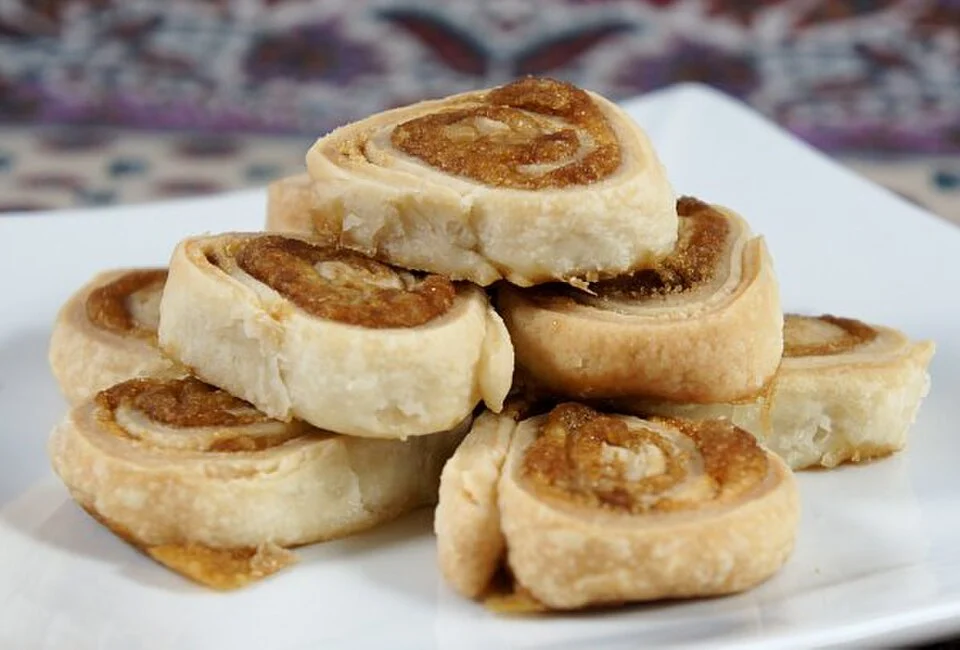
Gathering Pie-Dough Scraps into a Spiral
The Office québécois de la langue française describes pet de sœur as a sweet in which pie dough is spread with fat and a sweet ingredient, rolled up, sliced into rounds, and baked in the oven. Its examples are butter and brown sugar. The sweetness is applied to one side of the rolled-out dough.
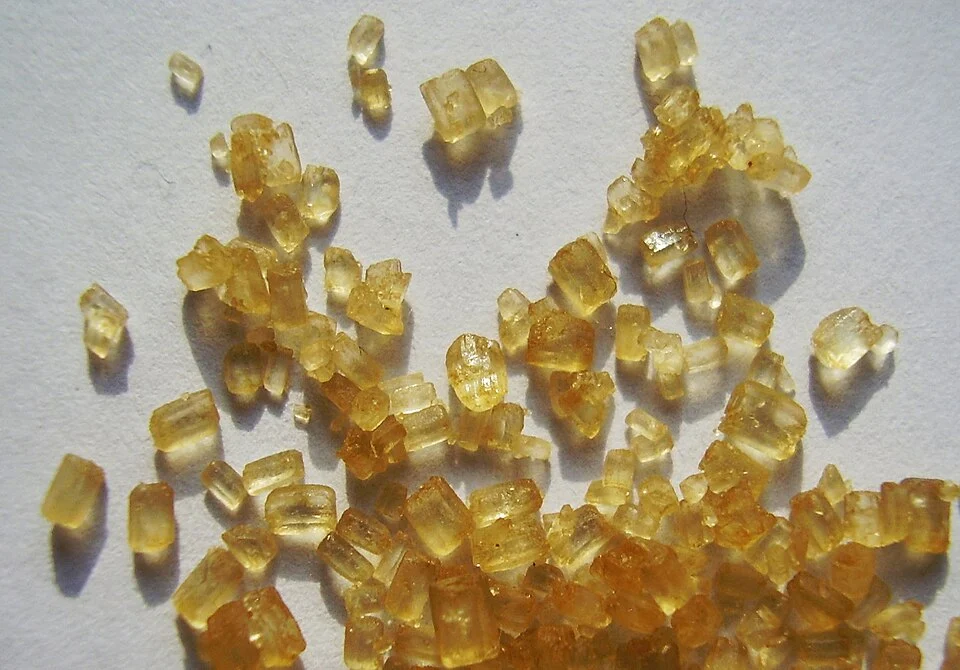
Because the filling is placed on one side and rolled in, the cut face before baking shows the color of the flour dough and the brown of the sugar alternating several times. Unlike a sweet that is dusted with sugar on the surface after baking, each bite also alternates thin layers of rolled dough with the sweet filling set into them.
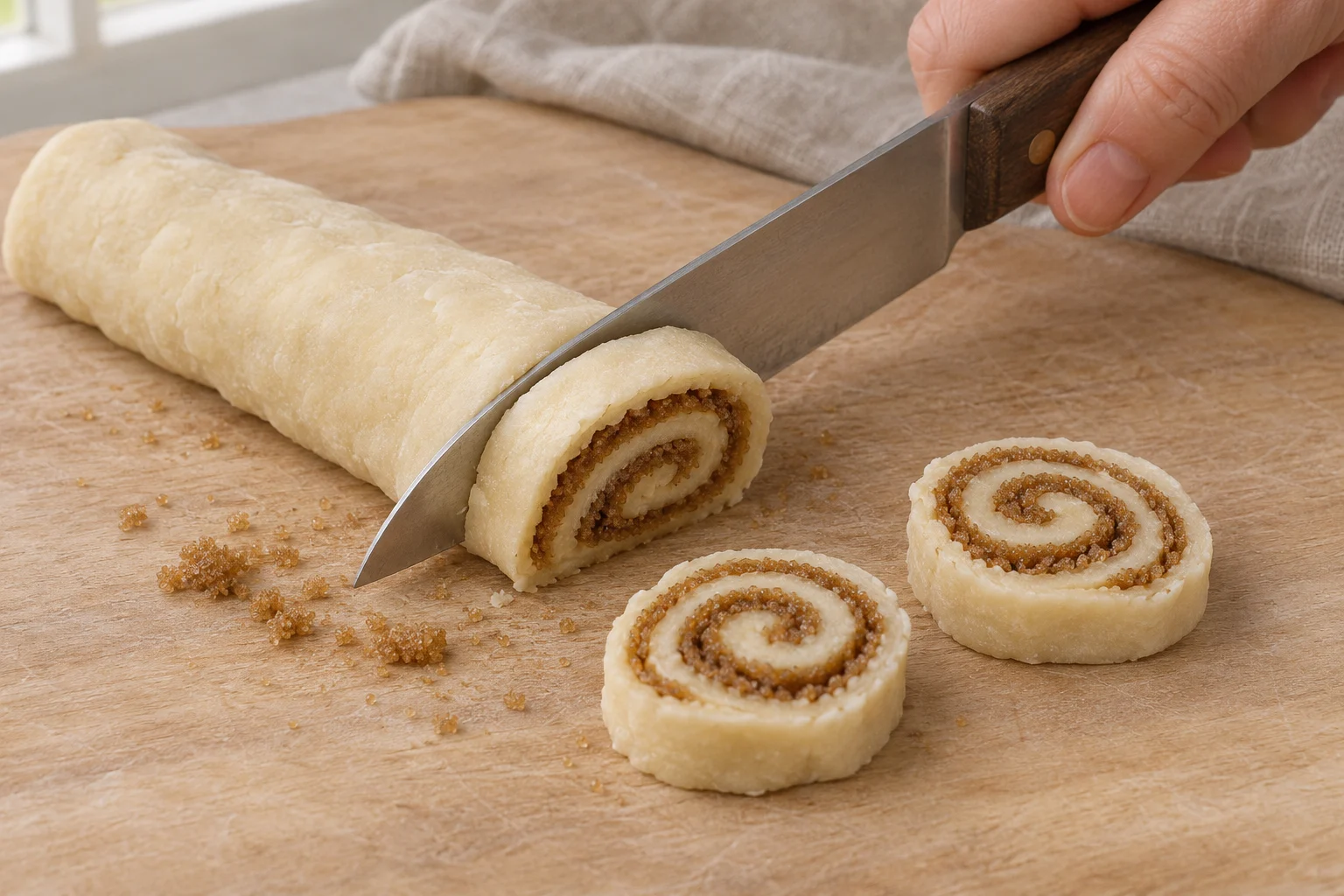
In teaching material that the Quebec author Andrée Poulin attached to a picture book, about 200 grams of leftover pie dough is gathered and rolled out to a thickness of 3 to 4 mm. A mixture of melted butter and brown sugar is spread over it, and the dough is rolled up from one edge. After the two ends are trimmed off, the roll is cut into slices about 2 cm wide. The slices are laid cut side up on a baking sheet lined with baking paper and baked at about 177°C for 20 minutes.
Because there is no step for making a separate syrup, the sugar that melts during baking spreads mainly between the layers of the rolled dough and from the cut faces. Rolling the dough thin and cutting the slices to an even width turn leftover scraps into small sweets of uniform shape.
Madawaska, Maine, in the United States near the Canadian border, also has a record of using pie-dough scraps. A family recipe collection of the local historical society, made available by the Terriot family society, includes a method contributed in 1985 by Rolande R. Levesque.
Leftover dough is rolled out, brushed thinly with butter, sprinkled with sugar and cinnamon, cut into coin-like rounds, and baked on a baking sheet. The record advises checking several times until the pieces are browned, because they burn easily. The same record also gives a variation made with molasses, a little sugar, and butter; whether cinnamon or molasses is used changes the flavor that is rolled into the dough.
The amount of leftover dough varies with how many pies were made and how much was trimmed from the pie pans. The Madawaska record does not fix a weight for the dough, and the butter is also adjusted to taste. Poulin’s teaching material gives a weight and a thickness, so that the pieces have a uniform shape before they go into the oven.
Unlike cookbooks that build a formula from the flour up, these two examples start from dough that is already usable. Though both make a spiral, the difference in how quantities are written shows the practice of turning the scraps left in the kitchen into the next sweet.
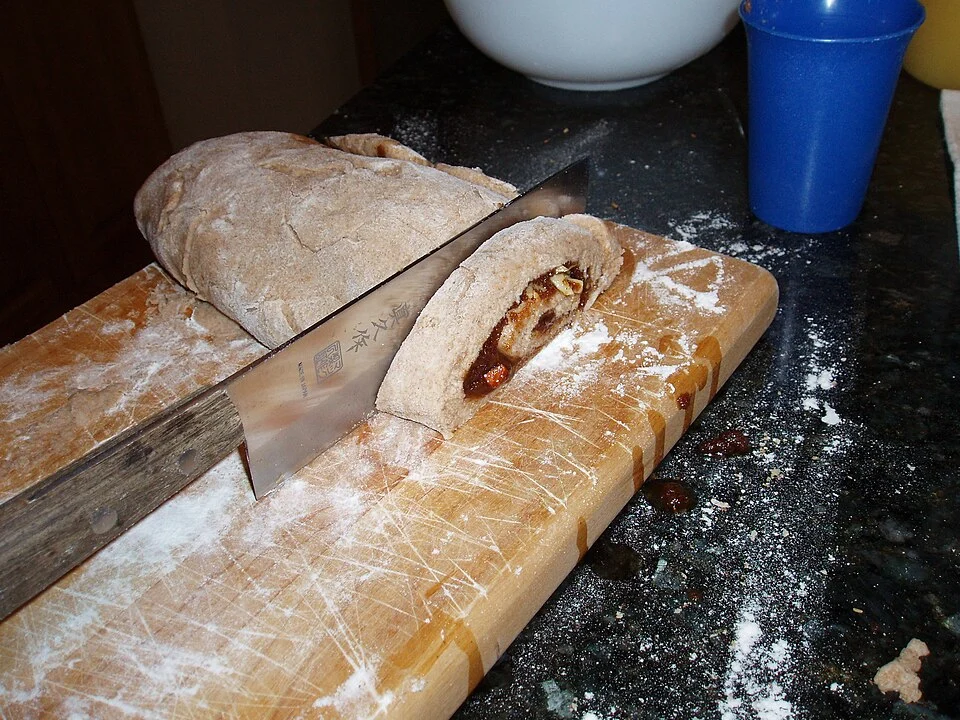
The Acadian Method: Baked in Syrup
In a booklet published by the Musée acadien du Québec in Bonaventure, Quebec, pie dough is not assumed to be on hand. The dough is made by combining flour, baking powder, and salt and working in lard by hand. The dough is rolled into an oval or rectangle, margarine is spread over the surface, and brown sugar is spread on top, leaving a margin at the end where the roll closes.
The rolled dough is sliced into rounds and arranged in a dish. A syrup prepared from water, brown sugar, and a little margarine is poured over it, and the rounds are baked at about 177°C for 20 to 25 minutes. The sugar is divided between the part rolled inside the dough and the part that reaches the dough from the bottom of the dish.
The method of Anida Boudreau, presented as another Acadian example, puts milk and egg into the dough. It is rolled to a thickness of about 6 mm, and the slices are about 2.5 cm wide. Butter and brown sugar are spread over the dough, and a syrup made with equal amounts of brown sugar and water is poured over the slices arranged in the pan.
Whereas the museum’s booklet gives a syrup that also uses water and a little margarine, the only ingredients listed for Boudreau’s syrup are brown sugar and water. The baking time is also somewhat longer, 25 to 30 minutes. Even among rolled, baked sweets presented under the same name, the liquid that binds the dough and the syrup that surrounds it differ.
When the pieces are baked one by one on a baking sheet, the cut faces and edges of the dough are exposed to the oven’s heat. Melted butter and sugar stay between the layers of dough, while the outer rim dries out and becomes easy to bite through.
When the syrup is put in a deep dish for baking, sweet liquid touches the part near the bottom of the dish even while the upper side of each cut face browns. If the pieces are scooped from the bottom before they cool, the juice can be served together with the spiral of dough. Even with the same slices, the amount of juice that reaches the mouth differs between a version in which syrup pools at the bottom of the plate and one in which pieces are lifted one by one from a baking sheet.
The Fisherman’s Bourrique and the New Year Table
In his 2005 account of Acadian foods at the turn of the year, the folklorist Jean-Claude Dupont calls a sweet that sometimes concluded the main meal on New Year’s Day bourrique du pêcheur. He writes that it pleased guests and was enjoyed not only at the start of the year but throughout the year. In this method, dough made with lard is rolled out and spread with butter, then with maple sugar, brown sugar, or molasses thinned with water, and sprinkled with nutmeg.
Sweetening rolled-out dough and rolling it up is common to the other examples of pet de sœur. The flavoring ingredient is cinnamon in the Madawaska family’s method and nutmeg in Dupont’s record.
The slices Dupont describes are about 3.8 cm thick each. They are arranged in a pan, hot water and white sugar are added on top, and the pan goes into the oven until a layer of sugar forms on the dough. Inside the roll goes the maple sugar, brown sugar, or molasses and spices that were chosen, and the white sugar added to the dish sweetens the outside.
Poulin’s version, in which the dough is cut thinner and baked on a baking sheet, yields smaller pieces and is baked without added liquid. The bourrique in the New Year records keeps its rolled shape while also taking on a coating of sugar on the outside in the dish.
The Musée acadien says that swollen spiral sweets are called bourriques in some regions and gives the meaning "navel" in old Acadian speech. An explanation published in The French-Canadian Genealogist, drawing on New Brunswick tourism material, also introduces other names such as rondelles, rosettes, and hirondelles. Rondelles means slices, and rosettes means small roses.
Dupont’s collection, on the other hand, has bourrique du pêcheur, with a word meaning "fisherman" attached. Besides names that evoke the look of the rolled dough, a name used at Acadian tables was also recorded.
Related Names in France, and the Dough Baked in Canada
Pet de sœur literally means "nun’s fart." The Office québécois de la langue française says the name may originate in Acadia and lists spellings both with and without hyphens. The English entry nun’s fart is likewise a name that conveys the French joke as it is, rather than describing how the sweet is made.
The Musée acadien cites a story that nuns rolled and baked leftover dough so as not to waste it, but states that the origin is unknown. The Madawaska recipe collection has a home method that actually uses leftover dough, and it offers one example of how such a method was handed down.
The similarly named pet-de-nonne denotes, in French dictionaries, a beignet that puffs up when dropped into hot oil. In the method in the cookbook Les Petits Plats pas cher, published in Paris in 1895, water and butter are brought to a boil, flour is added, and the mixture is cooked over heat while being worked. After it cools a little, eggs are added one at a time, the rested dough is dropped into oil, and after frying it is sprinkled with sugar.
The spiral on the sliced rounds of Canadian pet de sœur is made by spreading out the dough and then rolling sugar and fat into it. The beignet in the French cookbook is made from dough brought together in a pot and dropped into oil to puff, so even though the names are related, the way the dough is handled differs from the start.
The Quebec children’s picture book Le père Noël raffole des pets de sœur links pet de sœur with Santa Claus, and its teaching material has pie dough rolled up as a sweet to share at year-end gatherings. Dupont’s bourrique, described in the Acadian New Year meal, is a sweet whose slices are baked together with sweet juice and served to guests at the end of the meal.
Although both are sweets shared at the turn of the year, one can be lifted from a baking sheet and handed over, while the other is scooped from the bottom of a dish together with the sweet juice. The form in which the sweet is carried to the table also preserves each household’s way of turning leftover dough into a dish.
Twelve Spirals Arranged on a Tart
The Quebec public broadcaster Télé-Québec publishes a method for Rosanna’s maple tart in which spirals are arranged on top of a round pie. First, half of the dough is rolled out and fitted into a tart pan, and maple sugar is sprinkled over the bottom. The other half is rolled out separately, spread with butter, layered with maple sugar, flour, and cinnamon, rolled up, and cut into twelve rounds. The rounds are arranged in the pan, cream is poured over them, and the tart is baked.
Here, the form of a sweet cut into small pieces and baked remains on the surface of each slice of the tart. At the bottom are maple sugar and cream, and on top is the browning of the rolled dough.
In the recipe in the culinary magazine RICARDO, store-bought laminated pastry dough is used, with one version rolled with brown sugar and cinnamon and another rolled with hazelnut paste and chopped nuts. The rolled dough is half-frozen, sliced into rounds, and baked with each round laid in a muffin tin.
Unlike the maple tart, in which the rounds are arranged on a single sheet of dough fitted into a pan, here each hollow in the tin supports one spiral. Biting into the nut-filled dough, one meets pieces of nut between the layers, while in the cinnamon version the sugar and spice spread along the layers.
A learning booklet on Quebec folklore has a method in which dough made with lard, rolled thicker than for pie, is topped with soft butter, brown sugar, and cinnamon. After rolling, the slices are cut about 1.3 cm wide, arranged in a dish, and baked at about 190°C; there is no step of pouring syrup over them.
The following page uses the cups and teaspoons in that formula for practice in converting to the metric system. This is an example in which a sweet handed down in the kitchen became a subject of study, preserved in a form that specifies even the thickness of the rolled dough and the width of the slices.
Glossary
- Cassonade
- Here, the brown sugar used in Canadian recipes. It is combined with butter and rolled into the dough, or combined with water to make a syrup.
- Bourrique
- A name for a spiral sweet in parts of Acadia. The Musée acadien gives the meaning "navel" in old Acadian speech.
- Lard (saindoux)
- Fat made from pork fat. In the museum’s method it is worked into the dough, while margarine is used for the rolled-in filling and the syrup.


