


SweetloreEncyclopedia of World Sweets (834)

Quesitos
Quesitos Puerto Rico
Thin layers of baked pastry and a bite of sweet cream cheese
Baked Sweets / Puerto Rico

Bite into a freshly baked, slender pastry and the thin dough flakes apart first, then sweet cream cheese lingers on the tongue. Quesitos are pastries sold in Puerto Rican bakeries and similar shops. Whether the cheese is laid in as a bar or first worked together with sugar before wrapping changes how the filling turns out. The way the egg wash before baking and the sugar glaze after baking are applied also shapes the sheen on the surface that shoppers see at the counter.
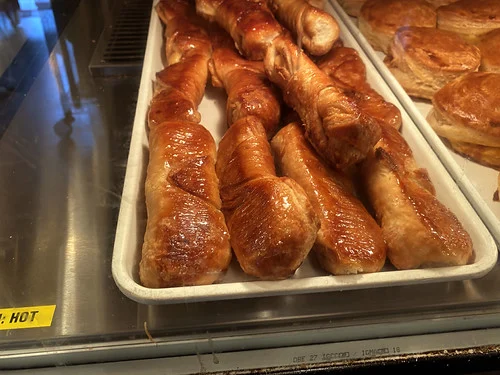
A Cheese-Filled Pastry with Rising Thin Layers
In Spanish, quesito is a diminutive of queso, "cheese," expressing smallness or affection. One example of what bakeries call by that name is a slender laminated pastry wrapped around sweetened cream cheese.
Because the dough is made of thin, stacked layers, the baked exterior has a light crispness. The milky filling stays inside the dough, and together with the sweet, glossy surface it gives three distinct textures in a single bite.
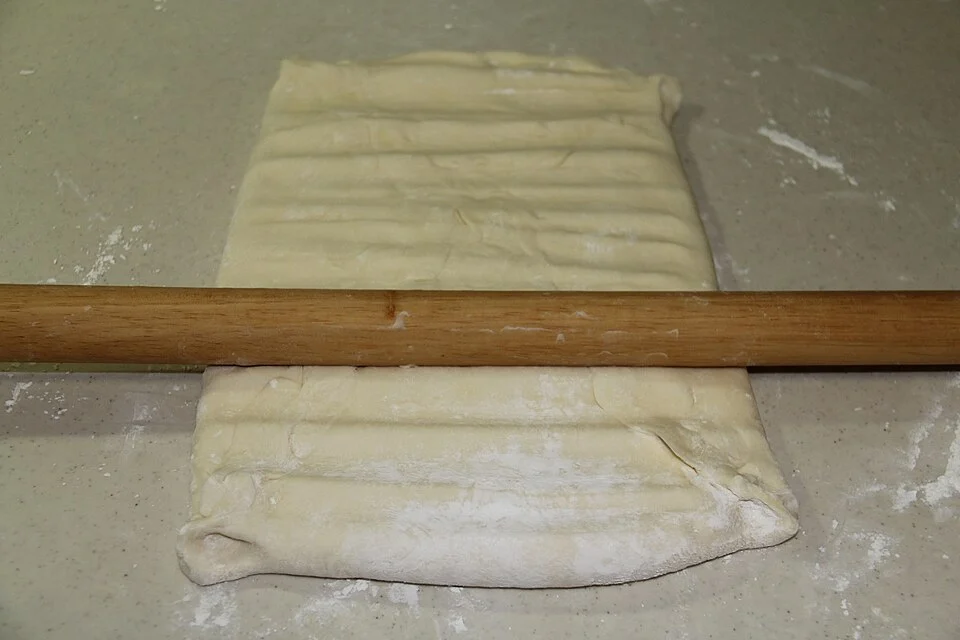
The laminated pastry used for the outside of quesitos is a dough made by layering fat between thin sheets of dough, rolling it out and folding it, then repeating the process. When the dough is heated in the oven, the moisture it contains turns to steam and pushes the stacked layers apart.
In a cross-section of baked puff pastry, many thin sheets of dough are visible. Because quesitos wrap the filling in that dough, a single pastry contains both layers that crumble lightly at the edges and a soft interior that touches the cheese.
In the version by cook Marta Rivera, a bar of cream cheese is placed on one side of a rectangle of puff pastry, with sugar added beside it. The short edge of the dough is folded over the cheese, and the pastry is then rolled up, starting from the filled side. It is rolled to the edge brushed with egg wash and sealed, shaped into a slender, cigar-like form.
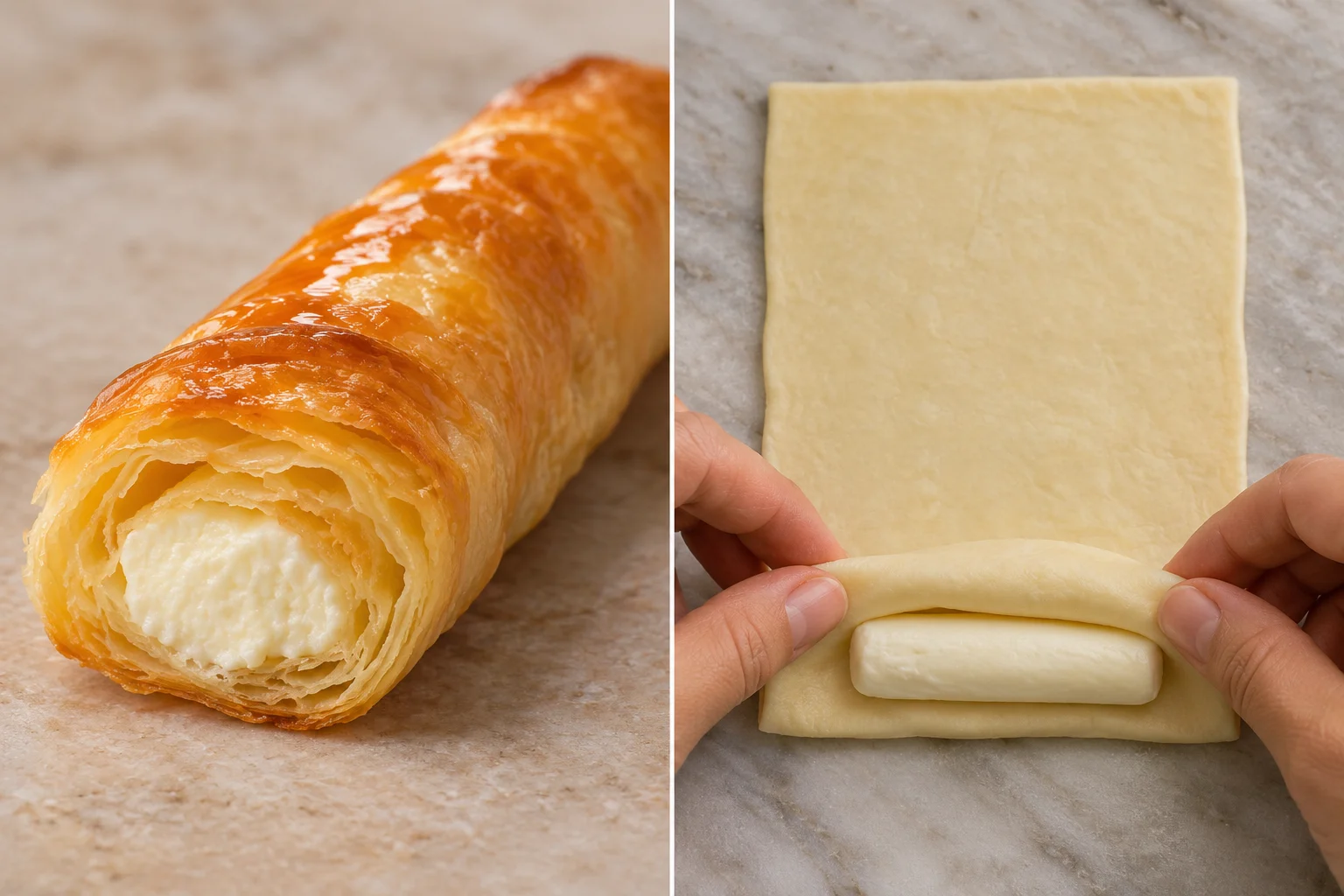
Because the sugar is set beside the cheese rather than mixed into it, the order of preparation differs from the method in which the filling is worked together first and then wrapped.
In Andy Tous’s version, cream cheese and sugar are mixed thoroughly and then spooned onto the puff pastry. The dough is cut into squares and folded from a corner to enclose the filling, then rolled. The first fold is pressed down with egg white and honey, so the same ingredients both seal the seam and put a gloss on the outside.
Rivera’s method of laying in a bar of cheese and Tous’s method of wrapping a mixed cheese filling both keep the filling inside a slender shape so that every bite contains both pastry and cheese.
Rivera first ate quesitos in Puerto Rico, when she visited her fiancé’s family. She recalls going to a bakery in Las Vistas every morning during her stay to buy them. Back in a life where she could not buy the same pastry nearby, she made repeated trial batches to recreate at home what she had eaten in the shop.
She writes that getting the pastry to bake to the crispness she wanted gave her more trouble than filling it with cheese. Her recipe covers both making the dough from scratch with a fold-and-roll method and starting from store-bought puff pastry sheets.
Egg Wash Before Baking, Gloss Added After
Rivera brushes a thin layer of egg wash over the top and sides of the shaped quesitos, then pierces the top once with a fork. She explains that by opening a steam vent after applying the egg wash, she hopes to keep the wash from running into the hole and closing it.
The cue for taking them out of the oven is a deep golden-brown surface with a dry look, not yet glossy with glaze. The pastry is removed according to the color of the baked dough, and the sweet gloss is added afterward.
What Rivera brushes on after baking is a syrup made by boiling corn syrup, granulated sugar and water. The syrup is taken off the heat and cooled, and the pastries are moved from the baking sheet to a rack to settle briefly. The guide to thickness is a syrup that flows smoothly off the brush but lets the last drop fall slowly, and it is spread in a thin coat over quesitos that are still warm.
In Tous’s recipe, egg white and honey are brushed on the surface before baking and sugar is scattered over it. A thin coat of honey can be brushed on again after baking. At which stage the sweet exterior is created differs with the finish.
Lucía Merino, who runs Lucía Pâtisserie in San Juan, bases her quesitos on the laminated-pastry versions popular locally but uses croissant dough in her own shop. She makes the cheese filling to the shop’s own formula and brushes on a honey glaze right after the pastries come out of the oven.
Croissant dough also has laminated layers, and the baked surface has a thin, flaking crispness. In the quesitos Merino describes for her shop, a dough she is practiced in making is combined with the filling and the glazing of a local pastry.
In the version by Sinai Vespie, who oversees pastry at the University of Notre Dame, the cheese is mixed with confectioners’ sugar, vanilla and a little salt and piped with a pastry bag along the diagonal of a square of dough. Opposite corners are folded to the center, and the overlap is sealed with egg wash.
Egg wash and granulated sugar are added before baking, and a syrup is brushed on after cooling. Even within a single recipe, sugar is used in different places, in the filling, in the grains on the surface and in the liquid applied afterward, each creating sweetness and the mouthfeel of the surface.
One at the Bakery, One from the Kiosk
The name quesitos also appears in a response issued in May 1997 by Puerto Rico’s Department of Labor and Human Resources. In reply to a company operating several kiosks in shopping centers, it lists the items sold there, including coffee, biscuits, cakes, quesitos and popcorn. It also notes that the items carried differ from one sales point to another.
This document does not describe the dough or the shape, but it shows that the pastry’s name was used not only in neighborhood bakeries but also for items at small sales points in commercial facilities.
The year production began before the 1997 administrative document, and the first shop to make this pastry, cannot be determined from the records covered here. Comparing current shops and cooks’ recipes shows that, under the same name, quesitos include some shaped long and slender, some wrapped with overlapping corners, and some finished with different glazes. Reading with attention to the shop and the period helps avoid treating one form as every way of making them.
In 2004, the trade paper Caribbean Business reported on the remodeling of Los Cidrines in Río Piedras. It said the shop had begun to offer prepared dishes and light meals, and that customers could choose quesitos alongside breads such as pan de agua and pan sobao.
A business case study of the food wholesaler Efraín Núñez, as of 2010, lists cream cheese, guava, doughnuts and quesitos among the company’s own-brand baking ingredients and products for sale. The pastry’s name appears both at bakeries that sell finished goods and at a wholesaler that supplies ingredients and products to the baking trade.
A bakery called Barcelona in Trujillo Alto displayed a name meaning "house of quesitos" at its storefront. A 2020 judgment of the Puerto Rico Court of Appeals records the name written on that shop’s counter.
The list of attached materials also includes a television broadcast from early 2019 that featured heart-shaped quesitos. The broadcast material cited in the judgment is an example of a pastry in a different shape being presented.
At Merino’s shop, pastries are served with Puerto Rican coffee, and those made with local fruit change with the season. In another guide from a tourism agency, quesitos and mallorca, another bread pastry, are paired with Puerto Rican coffee at Casalta in San Juan.
Among the items lined up on a bakery counter, the combination of thin pastry layers and cheese is what characterizes quesitos. Even with the same drink alongside, the dough and filling of the pastry chosen differ from shop to shop.
According to El País in January 2025, in Bad Bunny’s short film DeBÍ TiRAR MáS FOToS, there is a scene in which an older man orders a quesito at a café. What the server is about to hand him is not the cheese version he is used to.
The customer assumes that saying the name of the pastry is enough to convey what is in it. As the assumption that it contains cheese wavers in the exchange between the two, the scene portrays differences of generation and daily life in the words used at the same counter.
The 1997 administrative document shows that the name quesitos was used for an item sold at a commercial facility’s sales point. In present-day methods, whether cream cheese is worked together with sugar or wrapped separately, and whether the gloss is applied before or after baking, varies by maker. What one notices in the mouth in such differences is not only the flavor of the cheese but also the lightness of the layers and the mouthfeel of the sweet liquid brushed on the outside.
Shops That Put Fruit Next to the Cheese
La Ceiba in San Juan states that it was founded in 1962 and lists quesitos among the items it bakes daily. Cuban sandwiches are another signature item of the same shop. The founding year conveys the shop’s history, and the product guide conveys its present range.
Another maker, Don Quesito, lists as a standard item a sweet cream cheese laminated pastry finished with a golden glaze, and presents a guava-filled pastelito as a separate product. Even a maker that specializes in quesitos may give a fruit pastry a different name.
There are also quesitos that wrap guava and cheese together. Meseidy Rivera purées the pulp of canned guava with ingredients such as lime juice and layers it over cream cheese mixed with confectioners’ sugar. The filling is placed diagonally on a square of dough, the corners are overlapped, the pastry is baked, and confectioners’ sugar is sprinkled over the surface.
She writes that canned guava, which she needs, was hard to find in the American Midwest, and that she had family bring some back from Florida. When the pastry is opened, there is a layer of fruit pulp over the white cheese, and the aroma of guava with lime is layered over the sweet, milky flavor.
Pastries filled with the same combination of cheese and fruit are also found in Cuban-style bakeries. Versailles in Miami offers guava and cheese pastelitos on its takeout menu. In Vespie’s pastelillo recipe, guava paste is sandwiched between sheets of laminated pastry and the edges are pressed together before baking.
These are examples that overlap with Puerto Rican quesitos in ingredients and finish, but the menu and recipes consulted each show a pastry made in its own place. Which one passed to which cannot be determined from these two records.
When the shop’s name differs, the pastry made with the same guava is called something different at the counter. In the same article, Vespie presents both cream cheese quesitos and guava pastelillos. The latter uses two sheets of laminated pastry, top and bottom, with sliced guava paste between them and the edges pressed together.
Set beside the versions that wrap cheese from the corner, the position of the filling changes with the cut and the seam. Rather than hearing only the name of the fruit, pairing the name of the pastry with its shape tells you what kind of bite to expect.
Glossary
- Quesito
- Diminutive of queso, "cheese." The plural is quesitos. In Puerto Rican bakeries, the name refers to a pastry wrapped around sweet cheese.
- Hojaldre
- Laminated puff pastry dough. Thin layers of dough and fat are built up, and steam produced during baking pushes the layers apart.
- Café con leche
- Coffee with milk. A drink combining milk and coffee.


