DRUG

パレード伏見洋菓子店

SweetloreEncyclopedia of World Sweets (834)

SWEETS&CAKES

Shahi Tukda

Shahi tukda

A dish of fried bread soaked in sweet milk

Desserts / India: the North and Hyderabad

Two triangular pieces of Shahi Tukda in a shallow white dish, browned at the sides, with a yellow topping, nut slivers, red threads and a silver fleck.

The browned edges of bread show from a plate of triangles. Thick milk and chopped nuts lie on top, and when a spoon goes in, a piece that was crisp at first cuts softly. Shahi tukda (Shahi tukra, शाही टुकड़ा) is a sweet in which bread fried or browned in fat is soaked with sugar and reduced milk. When the milk is added differs from kitchen to kitchen. Some cooks simmer the bread again in the pan of milk, and others pour chilled milk over it just before serving.
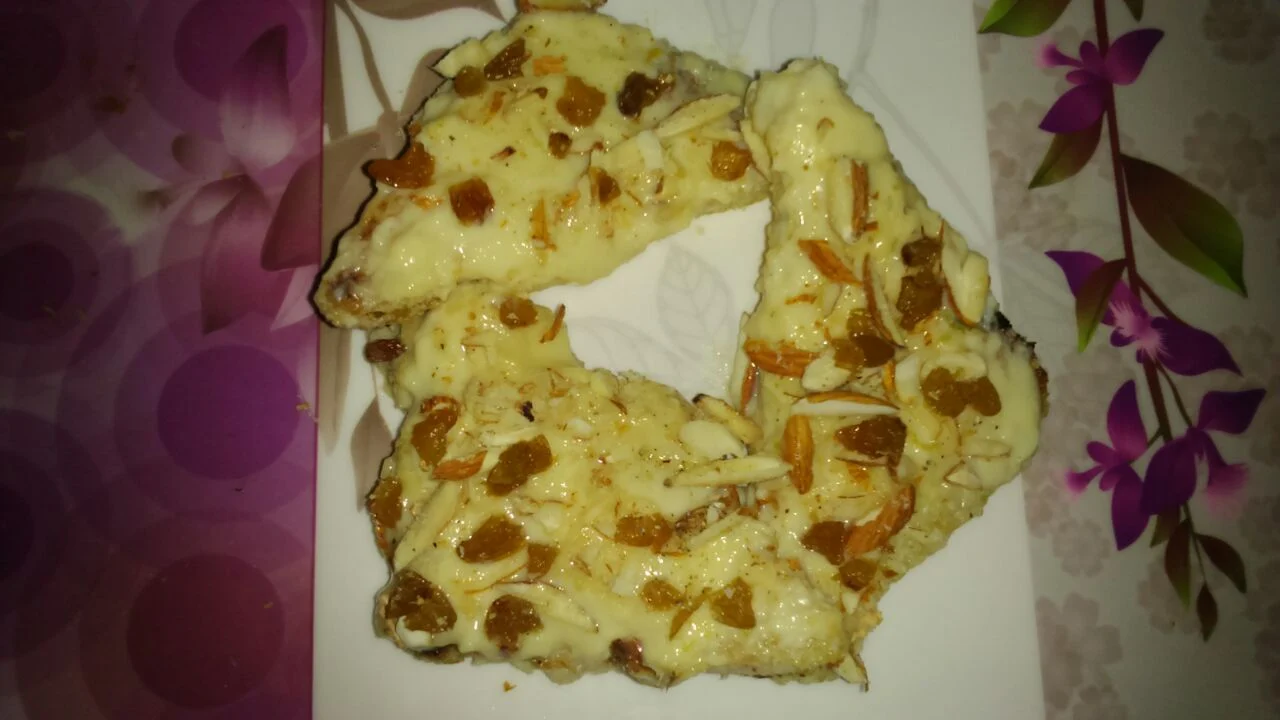
A plate of triangular-cut bread covered in milk and scattered with nuts and other toppings
The finished dish in a version made with condensed milk and grated paneer. The edges of the bread and the thick milk on top are visible. Shashank7200, Wikimedia Commons, CC BY-SA 4.0.

The piece decided on when the bread is cut and the bite taken with a spoon at the table are not necessarily the same size. On a plate that serves one thick slice, the spoon cuts through the bread together with the milk on the surface. In a sweet laid out on a tray as small pieces, several pieces of bread come up with the milk. Whether the crusts are removed, what the bread is dipped in, and whether it is baked in the same dish are tasks done before and after the milk is poured, and they change the bite at the table.

Thick Slices Browned in Ghee, Milk Reduced in a Separate Pan

Afzal Ahmad, who cooks for the former ruling family of Mahmudabad near Lucknow, cuts square sandwich bread about 2.5 cm thick and removes the crusts. He browns the slices in a frying pan of melted ghee, turning them, for about two to three minutes. Ghee is the milk fat left when water and other components are removed from butter; it touches the cut surfaces as they brown and passes its aroma into the bread until the slices take on color. Using fat is also a step that gives a flavor different from simply drying the surface.
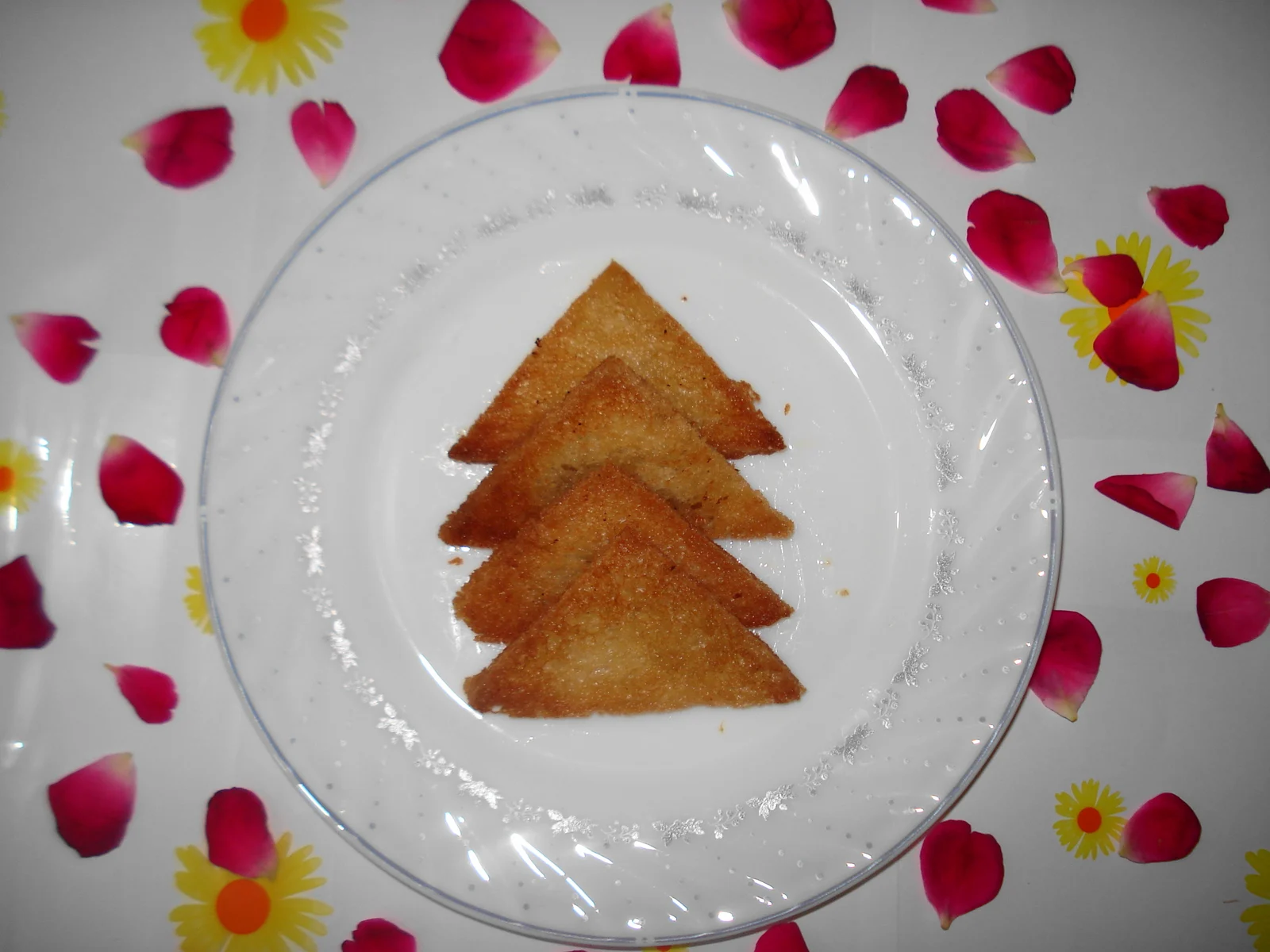
Fried triangles of bread laid out before the milk is added
Fried bread for shahi tukda. This is not a photograph taken during frying. Miansari66, Wikimedia Commons, CC BY-SA 4.0.

Ahmad prepares two liquids. He boils whole milk with cardamom, lowers the heat, and reduces it for about one hour to one and a half hours, stirring occasionally. When it thickens, he adds saffron soaked in water and part of the sugar. The rest of the sugar is boiled with water into a syrup and left to cool. Sugar goes into both the milk and the syrup, and what the bread touches first is the cooled syrup.

In Ahmad’s method, eight cups of milk go with five green cardamom pods. The total sugar is 1¼ cups, of which ⅓ cup goes into the thickened milk. After wiping out the pan in which the bread was browned, he boils the rest with one cup of water. Before the fried bread goes into the pan of milk piece after piece, it is first moved to a plate, and he waits for the syrup made in the frying pan to cool as well. The heat that browns in fat, the heat that thickens the milk, and the heat that dissolves the sugar each have a different role.

He passes the bread through that syrup, moves it to the pan of milk, and simmers it at a bubble for about four to six minutes. The surface colored with ghee is softened afterward by soaking up milk. The milk in the pan is divided between the part that soaks into the bread and the part that is spooned over it on the plate. Because this version scatters toasted almonds and, if desired, adds edible silver leaf, the thin leaf is handled only after the cooking and soaking are finished.

When the Indian tourism authority introduces the shahi tukda of a Hyderabad shop, the fried bread is soaked in saffron syrup and served with rabri. Preparing sweet, thick milk is common to both, but in Ahmad’s version the color and aroma of the saffron go into the milk. If saffron goes into the syrup, the bread already carries its aroma before the milk is poured on. Even for a single ingredient, which pan it goes into changes the order in which it reaches each piece.

In another chapter of the Uttarakhand Open University textbook, the rabri for shahi tukda is made by reducing milk to one quarter of its original volume. The malai pushed to the edge of the pan is returned at the end, and sugar and cardamom are mixed in. The fried bread stays in the syrup for about 10 to 15 seconds, is not heated in the pan of milk, and has one to two teaspoons of rabri spread over each piece. Read in sequence with Ahmad’s version, which simmers the bread in milk for four to six minutes, this shows the difference between a finish that wets the surface of the bread with syrup and holds thick milk on top, and one that soaks the bread through in the pan.
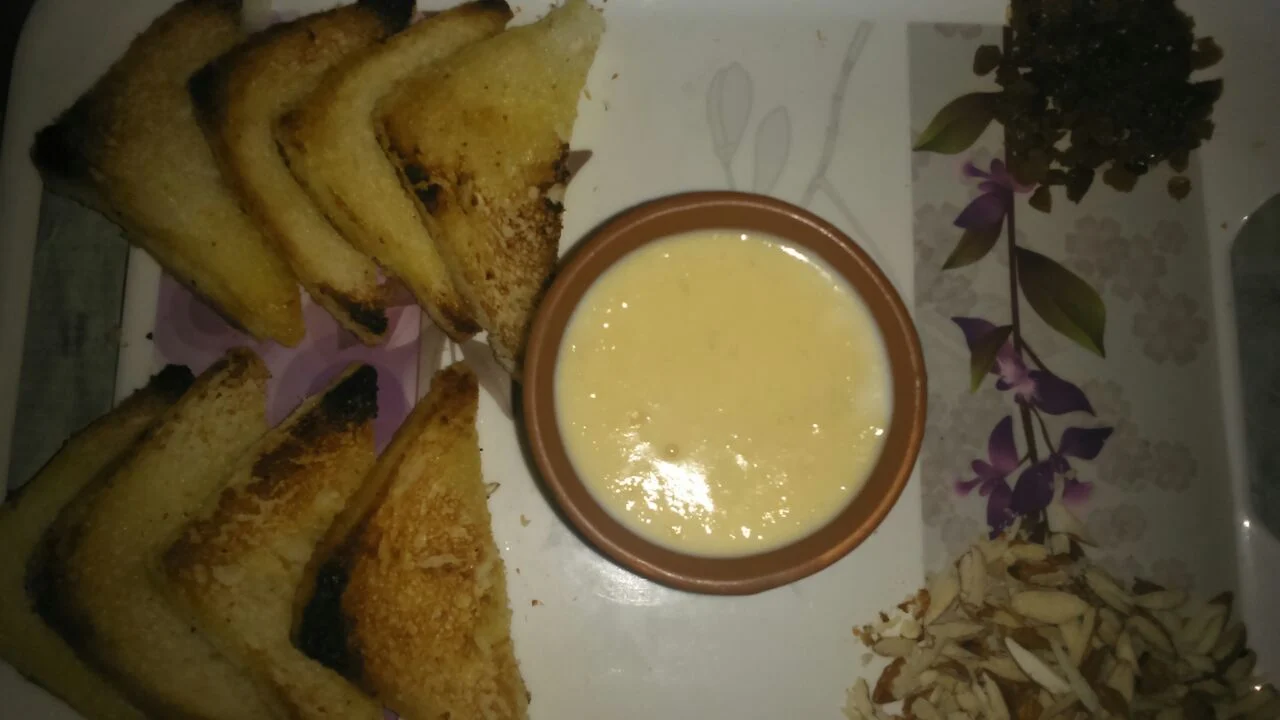
Assembly table with baked triangles of bread, a bowl of milk, and nuts and other toppings laid out
The bread and toppings arranged before the milk is poured on. The version in the photograph is made with condensed milk and paneer. Shashank7200, Wikimedia Commons, CC BY-SA 4.0.
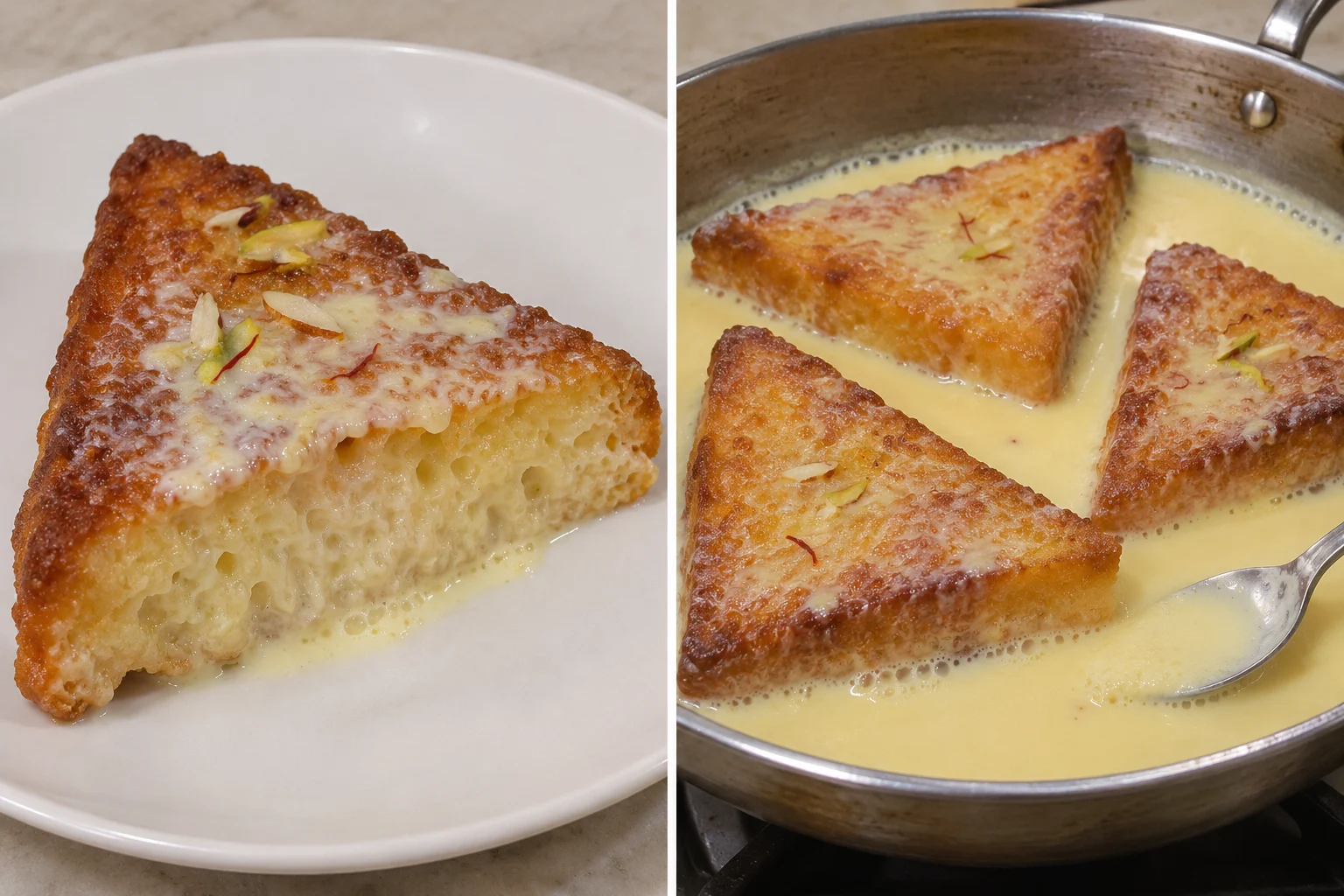
Reconstruction image (AI-generated). The cut surface of fried bread soaked with sweet milk, and the stage of simmering triangles of bread in thick milk.
Reconstruction image (AI-generated). The left side shows a triangle of bread cut open, with the browned edge left in place and the inside soaked with thick milk. The right side shows the stage in which bread that has been fried and coated with syrup is simmered in milk until soft. It was made with reference to Afzal Ahmad’s recipe.

In Hyderabad, Small Pieces Are Spread on a Tray

An Indian tourist guide explains that the "double" in double ka meetha comes from double roti, the name of a bread that puffs up well when baked. The bread is lightly baked or fried and soaked in syrup, and milk scented with saffron and cardamom is poured over it. The finishing touches it lists are cashew nuts, almonds, raisins and edible silver leaf. The same guide describes it as a sweet served at weddings and parties and gives shahi tukda as another name.

In the practical manual of the Central Board of Secondary Education, eight slices of thin-sliced bread are cut into squares, fried, drained of oil and arranged on a tray. The first liquid poured on is cardamom syrup; nuts, raisins and the like fried in ghee are added, and milk prepared in a separate pan is mixed in. Khoa, the concentrated solids of milk, is crumbled into the milk, which is scented with saffron. There is no step of simmering the bread with the milk. It is left to soak in the tray and served, with thirty minutes as the upper limit.

Cutting thin slices into squares makes the size of each soaked piece different from that of a thick slice. In the manual’s example, several small pieces fit on a spoon along with the milk and nuts. Khoa is a milk material that has already gone through the step of reducing water, so the stage at which richness is added differs from Ahmad’s pan, in which milk alone is simmered for more than an hour. The nuts fried in ghee are set aside before milk gets into each piece, and even after the pieces have absorbed milk, things of different firmness remain on the plate.

The Uttarakhand Open University textbook removes the crusts, divides each slice into four, and fries the pieces in ghee. Next, milk is added to a pan in which sugar and water have been boiled, and when it thickens, cardamom and khoa go in. Combining milk and syrup before pouring over the bread is where it differs from the manual. If liquid is poured twice over bread spread on a tray, what touches the bread first is the syrup. If it is poured once by this textbook’s procedure, a liquid containing milk solids touches the bread from the start.
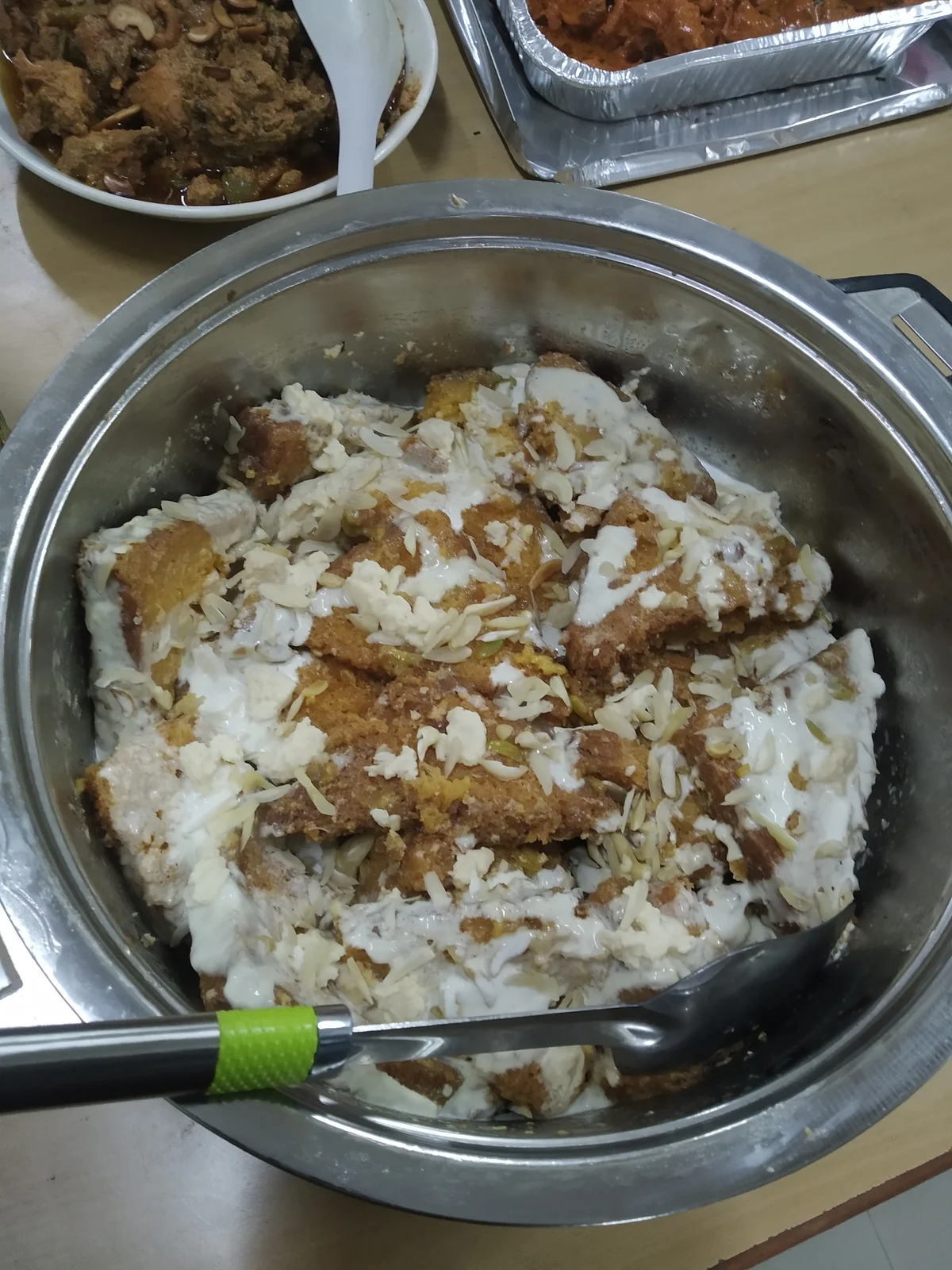
A large bowl of double ka meetha with small pieces of bread and a large serving spoon
An example of double ka meetha as served. The photographer shot it as a sweet accompanied by a large spoon and did not record the ingredients or where it was served. Muzammil, Wikimedia Commons, CC BY-SA 4.0.

Where the same university’s textbook introduces the sweets of Hyderabad, weddings, gatherings, Ramadan and Eid appear. Within the sources, some passages equate it with what is called shahi tukda in the Mughlai cuisine of the north, and others treat it as a similar sweet. There is a distance between reading it as another name in a tourist guide and knowing what thickness a maker cuts the bread and how it is served at the point of sale. Beyond the name used when ordering, looking at how the bread is cut and in what order the milk and sugar are applied shows how each bite is put together.

Baked in a Pie Dish and Chilled, or Only the Milk Chilled and Poured On

In June 1955, the English-language staff bulletin of the International Bank for Reconstruction and Development published the Pakistani shahi tukda presented by Bushra Qureshi. Four slices of sandwich bread have their crusts removed, are halved, and are fried brown in shortening. Milk is reduced over low heat from two cups to one, and, according to the quantities in the recipe, two cups of sugar are mixed in. The bread is arranged in a pie dish, the milk is poured over, and it is baked for 15 minutes. Almonds and pistachios are scattered on top, and it is chilled in the refrigerator for about an hour before serving.

In Qureshi’s dish, a branded shortening is used in place of ghee, and because the sugar is mixed into the milk, one pan of syrup for dipping the bread can be left out. Instead of carrying fried bread to a pan of milk, the milk is poured into the pie dish, and the bread and milk are heated in the same vessel. The year 1955 establishes when one Pakistani example made with this fat and this equipment appeared in a food column that could be read outside South Asia.

In the example presented by Selina Parvin in Old Dhaka, Bangladesh, the bread is cut into triangles and browned light brown on both sides in ghee. The milk is reduced by about half, sugar and sweetened condensed milk are added, and it is left to cool. There is no step of putting the bread into a pan of warmed milk; cold milk is poured into a dish in which the bread has been arranged, and it is served. Between Qureshi’s example, in which a refrigerated plate is served at the end, and the Dhaka example, in which chilled milk is combined with the bread in the dish, what is done while the bread is in contact with the milk differs.

In the Dhaka example, the ingredient list gives ¼ cup of sugar and ½ cup of sweetened condensed milk for eight cups of milk. The sugar does not need to be boiled separately and cooled, but two sweet ingredients go into the reduced milk. Because the milk is poured over the fried triangles, the bread touches the cold milk at the time of plating. In a version in which heat is not applied again, the maker judges the thickness of the chilled milk and then passes it to bread that still has its originally cut edges.

A family recipe collection associated with Amroha in Uttar Pradesh browns white bread slice by slice in ghee, then moves the slices to sweet milk reduced to about the consistency of cream and simmers them for 15 minutes. On the serving plate, the shape of each slice that has absorbed the milk remains. A separate version in the same book, bearing the name of Safia, mixes egg, cream and other ingredients into milk-moistened bread and bakes it at 170°C for one hour, or until set. What is cut after brief refrigeration is not a single slice of bread but a mass that has set together with the milk and egg.

In this collection, the 15 minutes for the sweet that keeps the shape of the bread and the one hour for the sweet set with egg and cream also relate to the point at which the finished sweet is cut. Whether the size of a piece is decided before the bread is simmered in milk, or the sweet is cut for the first time after baking, the cross-section differs even when the same sandwich bread is used. The triangles of Old Dhaka keep their shape while receiving the chilled milk.

A Name Suggesting Royalty, and a Piece Served at a Shop Counter

Shahi is a word relating to royalty, and tukda means a piece. The recipe of Ahmad, presented in 2014, soaks thick slices of bread in syrup, moves them to a pan of milk, and tops them with almonds and silver leaf. Over bread, a familiar ingredient, are layered milk thickened over a long time and a thin leaf handled by hand. The person who passed on this version was the cook of the former ruling family of Mahmudabad.

The food-culture chapter of Celebrating Delhi states that Delhi cooks used the well-risen bread brought by Europeans for shahi tukda. At banquets in the wealthy households of Shahjahanabad, dishes such as cooked-rice dishes, meat dishes and fried breads are served. As examples of sweets, it lists firni, made of milk and rice; jalebi, fried batter dipped in syrup; and shahi tukda, which pairs sweet concentrated milk and nuts with fried bread. The chapter places the sweet at banquets but does not state the date at which today’s proportions and steps came together.
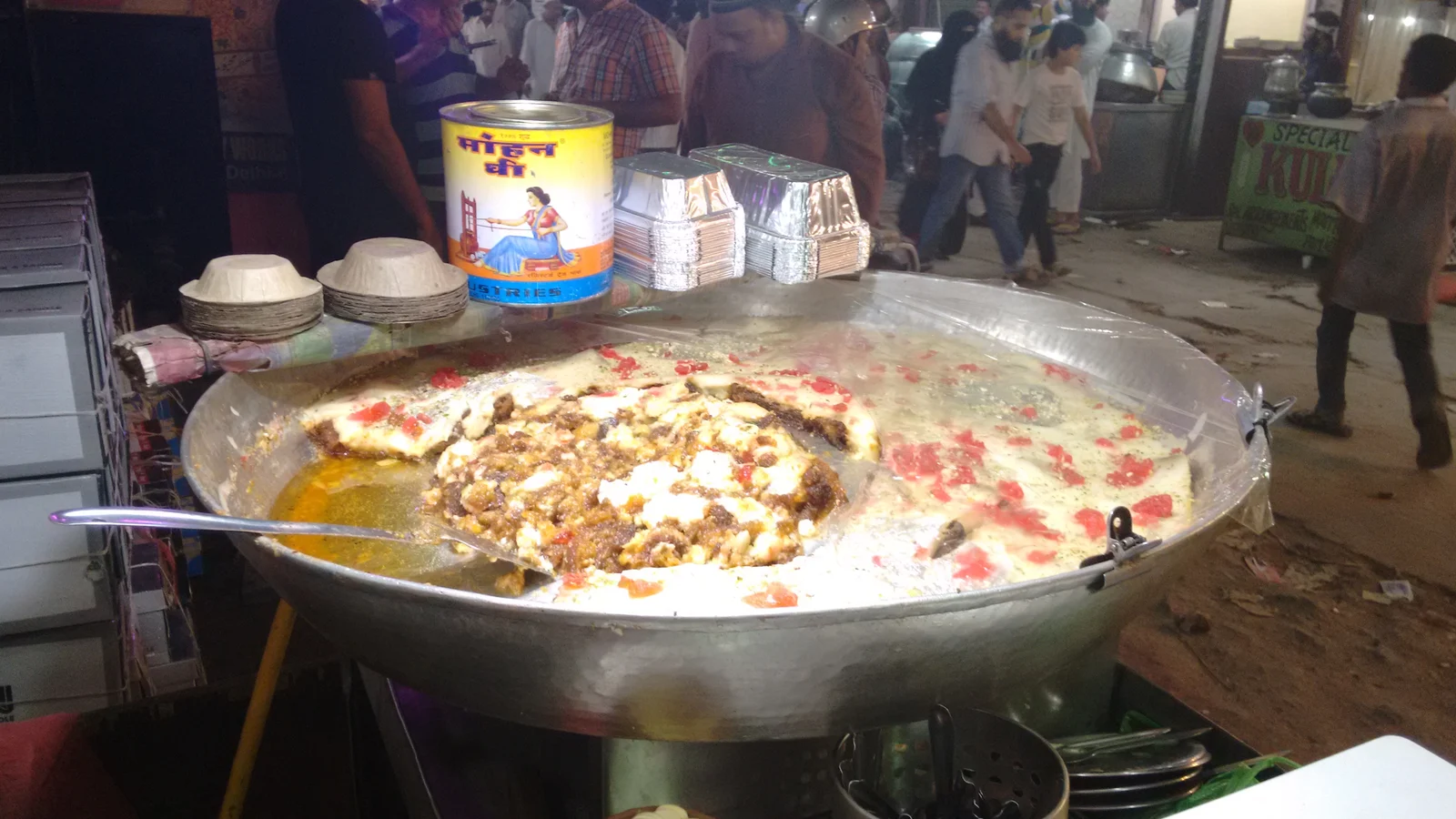
At a shop in Delhi, shahi tukda prepared in a large shallow vessel
Cool Point in Delhi. The photographer notes that it is enjoyed with cream and cherries. Anwesha394, Wikimedia Commons, CC BY-SA 4.0.

At shops in Delhi, the bread and milk before plating are kept together in a large vessel. From the single shallow vessel in the photograph, one cannot tell what fat the cook used first or when the sugar was added. The shop photograph conveys a different scene of serving from the courtly household example, in which nuts and leaf are placed after the portion is taken, and from the Hyderabad textbook, which divides the bread by the spoonful.

A Delhi banquet, a Hyderabad wedding and a Mahmudabad cook’s plate are not the same in period or in the way the vessel is used. When a thick slice of bread is topped with milk and served as one piece, the nuts go on that one piece. Bread spread on a tray is divided by the spoonful, and the version made in a pie dish goes to the oven in the same dish in which the bread was arranged. If one cuts into the bread that first received syrup, the bread that received chilled milk just before serving, and the bread baked with egg-enriched milk, how far each kitchen let the milk penetrate remains in the softness of a piece.

Glossary

Ghee
Milk fat obtained by heating butter and removing the water and other components. Used to cook bread and nuts.
Rabri (rabdi)
A milk sweet made by reducing milk and sweetening it. In this article, it is served with fried bread.
Double roti
The name of a bread that puffs up well. Said to be the origin of the name double ka meetha.
Khoa (khoya, mawa)
An ingredient made by heating milk to drive off its water and concentrate the solids.
Shortening
A solid fat used in confectionery and frying. In this article, it was used to fry the bread in the 1955 example.
Edible silver leaf (varq, chandi ka barq)
A thin leaf of silver placed on sweets and other foods.
TOPShahi Tukda | Cafe & Sweets Parade Kyoto

(FAQ)

All You Need to Know

Do you have gluten-free sweets made without wheat flour?

Yes. We offer sweets made without wheat flour, such as madeleines made with rice flour. However, they are made in the same kitchen as products that use wheat flour. If you have a wheat allergy or need to strictly avoid wheat, please consult our staff before purchasing.

Do you use additives such as preservatives or emulsifiers?

We do not add preservatives or colorings when making our sweets.

Some of our baked goods (such as madeleines and chocolat) use baking powder to help the batter rise. In addition, ingredients we purchase, such as chocolate, may contain additives such as emulsifiers that help maintain their quality.

To see the ingredients we use, please check the ingredients listed on each product page.

When is the Seasonal Citrus and Lemon Curd Cake available?

This cake is sold on an irregular basis.
It is often available on Saturdays, Sundays and public holidays. We post updates on in-store availability as needed in our Instagram Reels, so please check there.

Do you sell fresh cakes on Wednesdays?

We do not currently sell fresh cakes on Wednesdays.
On Wednesdays, we mainly sell baked sweets and drinks.

*Many customers have asked about this, but no decision has been made yet about selling fresh cakes on Wednesdays.

Can I request noshi paper (noshi kakegami) for gifts, presents, and the like?

For gift boxes in sizes M and L, we offer inner noshi (uchi-noshi) only, at 100 yen (tax included) per sheet. Please specify the top inscription and name inscription, and place your request at least 3 days in advance. For same-day requests, please consult the shop.

Do you offer OEM (manufacturing of original products)?

We are currently accepting consultations on OEM requests, depending on their details.
To start, please contact us through the inquiry form with details such as your product concept, desired quantity, and sales purpose.

Where is the shop located?

Cafe & Sweets Parade Kyoto is in Uoya-cho, one street south of the Otesuji Shopping Street, a 4-minute walk from Keihan Fushimi-Momoyama Station and a 5-minute walk from Kintetsu Momoyama-Goryomae Station. Parade stands in an area full of history and charm. Nearby are Torisei, a sake and yakitori restaurant run by a long-established sake brewery; Teradaya, said to be the place where Sakamoto Ryoma was attacked; the Fushimi Jikkokubune, wooden boats that take you along the canal; and many other places.
For the exact location and other details of Cafe & Sweets Parade Kyoto, please check Google Maps↗︎.

What days is the shop open?

We are open every Wednesday through Sunday from 11:00 to 18:00 (last order 17:30). We are regularly closed on Mondays and Tuesdays.
On public holidays, we are open on some days and closed on others.
We may also close temporarily on irregular days, or open on regular closing days. For the latest information, please check Instagram↗︎ or Google Maps↗︎.

How can I place a large order?

Yes, we accept orders through this inquiry form.
Large orders are orders of 21 or more units, or orders with 10 or more delivery addresses.

Can you tell me about allergens in your products?

Whether a product uses egg, wheat flour, peanuts, walnuts, other nuts or dairy products is stated on the allergen list page and on each product’s page.

Peanuts (groundnuts) and walnuts are shown separately from “other nuts” such as almonds.

Points of caution other than the items above, such as sesame, gelatin and honey, are written in the “Notes” section of each product. However, not all allergens are listed. For assortments such as gift boxes, the ingredients of each sweet included are listed under [Ingredients] on the product page.

If you have any questions, please ask our in-store staff or call us (075-644-4118) before purchasing.

Do any of your products contain alcohol?

Yes. We mainly use liquor in the following sweets:

• Canelé de Bordeaux (rum)
• Galette Bretonne (with rum)
• Madeleine au Chocolat (with liqueur: Grand Marnier)

The Galette Bretonne and the Madeleine au Chocolat are also available in “without rum” and “without liqueur” versions, respectively, made without liquor.

▼Gift boxes
• Classic Baked Sweets Gift Box L [9 Varieties, 15 Pieces]: includes 2 Galettes Bretonnes (with rum)
• Classic Baked Sweets Gift Box M [9 Varieties, 9 Pieces]: includes 1 Madeleine au Chocolat (with liqueur)
• Gluten-Free Gift Box [S] and Gift Box [M] with Higuchi Apiary: contain no sweets made with liquor

Even in baked sweets, a small amount of alcohol may remain. Children, pregnant women, people sensitive to alcohol and anyone who will be driving should take care.

For seasonal products, please check the “Notes” section on the allergen list page.

Is there parking?

The shop does not have its own dedicated parking lot. If you are coming by car, please use one of the paid coin-operated parking lots nearby.
If you are coming by train, the shop is about a 4-minute walk from Fushimi-Momoyama Station on the Keihan Main Line and about a 5-minute walk from Momoyama-Goryomae Station on the Kintetsu Line.

Can I eat and drink in the shop?

Yes, you can enjoy your order in our in-store eat-in space. Seating consists of 5 counter seats and 4 terrace seats (2 tables for 2 people each). High-speed Wi-Fi is also available.
Takeout is available as well. Opening hours are 11:00–18:00 (last order 17:30).

Where can I check the day’s cake selection and sold-out items?

The fresh cakes we sell change from day to day. We post updates on in-store availability as needed on Instagram↗︎.
Items may sell out after a post. If you want to be sure to get something, please call us (075-644-4118).

Do the 2 types of lemon cake differ in how they should be stored and how long they keep?

Yes. The lemon cake with icing must be kept refrigerated and keeps until the end of the day of purchase. The lemon cake without icing can be stored at room temperature and keeps for approximately 7 days from the date of manufacture. Please prioritize the date shown on the label of the product you have.

How long do baked-goods gifts keep, and how should I store them?

As a guideline, baked-goods gifts keep for about 2 weeks from the date of manufacture. Please store them in a cool place, away from direct sunlight and high temperature and humidity. The exact date is printed on the back of each individual sweet.

What payment methods can I use in store?

▼In store
• Cash
• Credit cards: Visa, Mastercard, JCB, American Express, Diners Club, Discover
• Transit IC e-money: Suica, PASMO, ICOCA, Kitaca, TOICA, manaca, SUGOCA, nimoca, Hayakaken
• Other e-money: iD, QUICPay+
• Code payments: PayPay, Rakuten Pay, d Barai, au PAY, Merpay, WeChat Pay, Alipay+, and others

Apple Pay and Google Pay can be used if one of the e-money services or cards listed above is registered.

What kind of cream puff is the Oven-Baked Cream Puff?

It is our classic cream puff: a crisp cookie-crust choux generously filled with a rich cream that combines fresh cream with custard made using “Sakura” eggs from a purely Japanese chicken breed.
It must be kept refrigerated; please eat it on the day of purchase. We also offer a caramel-flavored version, the “Oven-Baked Caramel Cream Puff.”
For details, please see the Oven-Baked Cream Puff product page.

What Are Meringue Cookies?

Meringue cookies are sweets made by baking and drying meringue, which is egg white and sugar whipped together. At Parade, we use kibi sugar (Japanese cane sugar) and finish them with a light texture: a crisp first bite, then an airy, fizzy melt in your mouth.

What kind of sweet is a sablé diamant?

True to its name, which means “diamond” in French, this is a sablé coated with sugar that sparkles around the outside. For the sugar coating, we use vanilla sugar that we make by hand in our shop from vanilla bean pods.
It keeps for about 3 weeks. Please store it in a cool place, away from direct sunlight, high temperatures and humidity. It is also included in our baked goods gift boxes.
For details, please see the Sablé Diamant product page.

Is the Galette Bretonne available both with and without rum?

Yes. It is available both with rum and without rum. The individually sold Galette Bretonne contains rum. The rum-free version is included in our gift boxes. Please contact the store to ask whether it can be purchased individually.

What kind of sweet is a Linzer torte?

The Linzer torte is a sweet associated with Linz, Austria, combining a nut pastry with jam. At Parade, we layer a cinnamon-scented pastry, almond batter and our house-made framboise (raspberry) jam, and bake them together.

What baked goods can I choose as a gift (temiyage) from Fushimi?

We offer Gifts M and L, assortments of our classic baked goods; Gift S, with sweets made with rice flour; and a gift that includes honey from Kyoto Higuchi Apiary. You can choose based on the number of pieces, the ingredients, and the recipient’s preferences. As a guideline, the baked goods keep for about 2 weeks from the date of manufacture.

How do the gift boxes differ by type?

They differ in the types and number of sweets they contain.
・Classic Baked Goods Gift Box M [9 types, 9 items]: 2 types of sablé (12 pieces each), Galette Bretonne, 3 types of madeleine, financier, Sésame Matcha, Boule de Neige Chocolat
・Classic Baked Goods Gift Box L [9 types, 15 items]: 2 types of sablé (12 pieces each), Galette Bretonne (2 each without rum and with rum), Honey Madeleine, Madeleine Chocolat (without liqueur), financier, Sésame Matcha, Boule de Neige Chocolat
・[Gluten-Free] Gift Box [S]: 4 Honey Madeleines, 2 Madeleine Chocolat (without liqueur), 2 Sésame Matcha, 2 Boule de Neige Chocolat
・Gift Box [M] with Higuchi Bee Farm: 8 classic baked goods in 7 types, plus Wildflower Honey (160 g) from Kyoto Higuchi Bee Farm
The sweets made with liquor are the Galette Bretonne (with rum) in the L box and the Madeleine Chocolat (with liqueur) in the M box. For full details, please see the list of gift boxes.

What kinds of honey, eggs and chocolate do you use?

The ingredients we use vary by product. Our main ingredients are as follows.
• Honey: Purely Japanese honey from Higuchi Apiary in Fushimi, Kyoto (Honey Madeleine, Caramelized Honey Canelé, etc.)
• Eggs: “Sakura” eggs from purely Japanese-bred hens (Oven-Baked Cream Puff, Canelé de Bordeaux, Honey Madeleine, etc.)
• Chocolate: Chocolate from Valrhona of France (Madeleine Chocolat, etc.)
• Butter: Cultured butter (Brown Butter Financier, Galette Bretonne, etc.)
Please check each product page for that product’s ingredients.

Is there an ideal temperature or way to warm the sweets so they taste their best?

Depending on the product, there are recommended ways to enjoy it.
• Canelé de Bordeaux: Warming it for 3–5 minutes in a toaster oven that has not been preheated makes the caramel on the surface crisp, giving it a texture close to freshly baked.
• Brown Butter Financier: Warming it in a toaster oven for about 1–2 minutes gives it a texture and aroma close to freshly baked.
• Linzer Torte: The ideal serving temperature is 5–20°C.
• Lemon Cake (with icing): We recommend letting it sit at room temperature for a little while to enjoy the fluffy texture of the cake, or, in summer, enjoying it chilled straight from the refrigerator.
Toaster ovens heat differently depending on the model, so please keep an eye on the sweets while warming them to avoid burning.

How many people do Size 4, Size 5 and Size 6 whole cakes serve?

Parade’s “Decoration Cake with Fresh Cream and Seasonal Fruit” serves approximately 3–4 people in Size 4, 4–6 people in Size 5 and 6–7 people in Size 6. Please choose a size based on how much will be eaten and whether it will be served together with other sweets.

How long can I carry a cake? Do I need ice packs or an insulated bag?

Please plan on carrying it for about 1 hour. Conditions vary depending on the temperature, the type of cake and how you travel, so if you are planning a long journey, please consult the shop before purchase.

Can I have a message plate or candles added to a birthday cake?

The “Decoration Cake with Fresh Cream and Seasonal Fruit” comes with an original cookie plate and 1 set of 5 candles. A charge applies to candles from the 2nd set onward.

Are the sweets for sharing at work individually wrapped? How many people can a gift serve?

The Classic Baked Goods Gift is an assortment of sweets packed in individual bags. Note, however, that “9 items” does not mean 9 pieces: some items, such as the sablés, contain several pieces in one bag. Please think separately about how many people you are giving to and how many bags you want to give each person.

What is the difference between a financier and a madeleine?

Generally, a financier is characterized by the flavors of egg whites, almonds, and browned butter, while a madeleine is typically based on a batter made with whole eggs. At Cafe & Sweets Parade Kyoto, we offer the Brown Butter Financier and a madeleine made with rice flour and honey.

Do canelés taste better warmed? How do you recommend eating them?

If you warm Parade’s Canelé de Bordeaux for about 3 to 5 minutes in a toaster oven that has not been preheated, the caramel on the surface becomes crisp, and you can enjoy a texture and aroma close to freshly baked. Because heating varies by model, please keep an eye on it while it warms.

Can cakes and baked goods be frozen?

Because ingredients and finishing differ from product to product, we do not state that all cakes and baked goods can be frozen under the same conditions. Please first check each product’s storage instructions and date label. If you plan to freeze a product, please consult the shop before purchasing and tell us the product name.

What is the difference between sablés, cookies and galettes?

“Cookie” is a name for a wide range of baked goods. “Sablé” is used as a name describing a texture that crumbles softly like sand, and “galette” is used for sweets with a flat shape, among other things. Parade’s Galette Bretonne is a thick-baked cookie made with butter.

Can I get paper bags, small bags for sharing or gift wrapping?

In store, paper bags, plastic bags, bags for baked goods and gift wrapping are available for a fee. Prices vary by type and size. Please let us know how many you need and any wrapping requests before purchase.

News Letter

We send the latest news from Cafe & Sweets Parade Kyoto and money-saving coupons exclusive to our followers. Add us as a friend on LINE. Something good should come your way.

* We usually send notices of sales launches on Sunday mornings.
* Depending on the content, messages may be sent only to certain segments of subscribers.

Thank you for signing up!
We hope you look forward
to our next email.

Access

Cafe & Sweets Parade Kyoto

〒612-8041

Heights Momoyama No. 105, 574 Uoya-cho, Fushimi-ku, Kyoto-shi, Kyoto

* If you are coming by car, please use a nearby parking lot.

VIEW MORE GOOGLE MAP