


SweetloreEncyclopedia of World Sweets (834)

Tinginys
Tinginys
A Lithuanian confection of broken, chilled biscuits, enjoyed for the pattern of its cut rounds
Sugar Confections / Lithuania

In a thin slice, biscuit pieces of various sizes show against the deep color of the cocoa. Tinginys is a Lithuanian confection made by breaking baked biscuits and binding them with sweetened condensed milk, butter and cocoa, then chilling the mixture. It can be wrapped into a log and sliced into rounds, or packed into an angular mold. Simply unwrapping it does not reveal the scattered pieces inside; each cut of the knife shows a different pattern. The cocoa part melts in the mouth, while the biscuit, slightly softened by moisture, keeps some resistance to the bite.
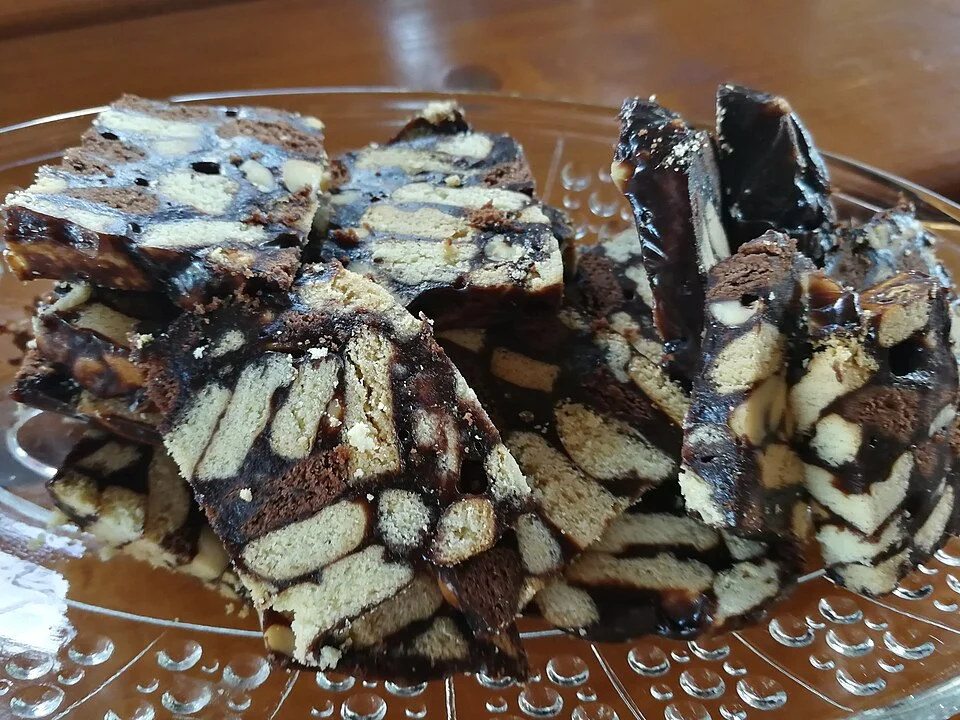
The Size of the Biscuit Pieces Remains in the Cut Surface
In the Vilnius culinary guide, Queensberry, a business in the city, presents a version that combines 400 g of sweet, crisp biscuits with 400 g of sweetened condensed milk. It also uses 190 g of unsalted butter and 2 tablespoons of unsweetened cocoa. The biscuits are plain ones, such as Maria-type biscuits, with little decoration or cream, and 100 g of hazelnuts or dried cranberries is added. The condensed milk, equal in weight to the biscuits, is milk that has been concentrated and sweetened with sugar; besides sweetness, it creates a stickiness that spreads through the broken pieces. This recipe contains no chocolate bar and no added sugar.
Biscuits broken by hand give a mixture of large and small pieces, unlike biscuits ground evenly into crumbs. A Lithuanian-language home recipe gives about 1.5–2 cm along the longer side as a guide. Fine crumbs fill the spaces between the large pieces, and the large pieces show a pale face when the blade passes through them. If everything is close to powder, more surface absorbs the liquid, and the contrast between the dark ground and the pale faces fades when the roll is cut. If the liquid does not reach between the large pieces, the slices crumble more easily partway through, even after chilling. This size matters not only for the appearance but also for tasting the cocoa and the biscuit as separate textures.
In a pan, melt the butter, then add the condensed milk and cocoa, and warm the mixture while stirring until the lumps of powder disappear. Take it off the heat, let it cool a little, and pour it over the pieces while it is still fluid. This avoids softening the biscuits abruptly with liquid straight off the boil, and the pieces are combined before the liquid cools completely, thickens and has trouble reaching the cracks. The stirring only needs to coat each piece in the dark liquid. If the pieces are not mashed through to the inside to even out the color, the pale faces appear only when the roll is cut with a knife.
A slice made with hazelnuts has hard nuts that meet the teeth, distinct from the biscuit. A slice with dried cranberries gains tartness where it is bitten. Some recipes vary the amount of cocoa: more gives a stronger cacao aroma, and less lets the sweetness of the milk come through. Because the sweetness of the condensed milk and of the biscuits themselves also differs from recipe to recipe, the amount of each ingredient needs to be read together with the spoonfuls of cocoa.
Wrapped, Pressed at the Ends, Chilled and Sliced
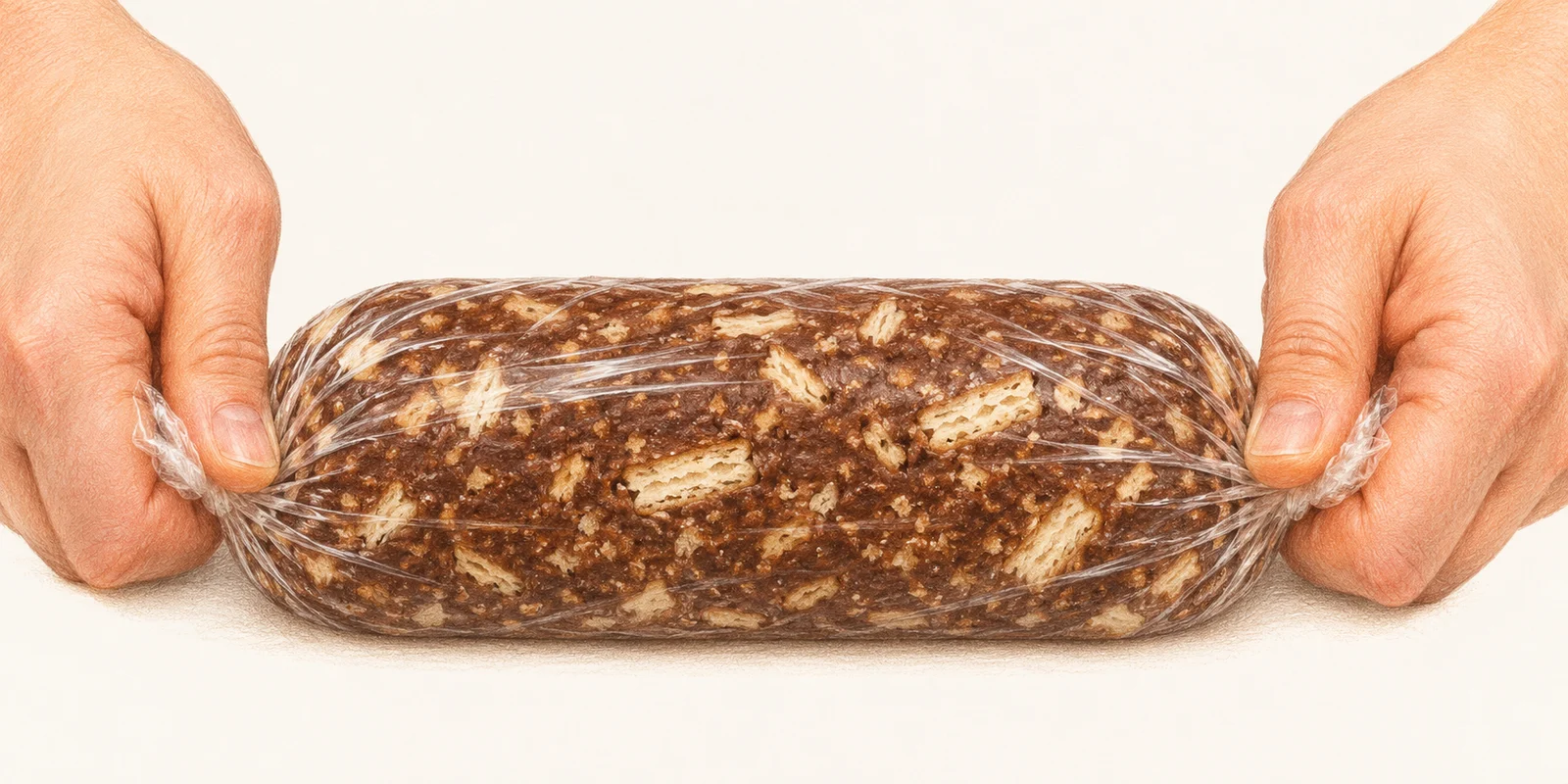
In the Queensberry version, the mixture is left to cool thoroughly, set on cling film, gathered into a log, and pressed firmly at both ends. A home recipe for a rectangular shape uses a loaf pan lined with paper or film, and the mixture is packed into the corners and pressed down. Whether wrapped or molded, leaving fewer gaps makes the chilled, firmer slices less likely to crumble as they are cut. The marks of the wrapping may remain on the glossy surface, but the arrangement of the biscuit pieces stays hidden inside the wrapping.
The Vilnius guide says to chill it in the refrigerator for at least 4 hours, ideally overnight. A home recipe for the rectangular form cuts slices about 1–1.5 cm thick. This is a confection in which the time spent waiting for it to chill and become sliceable is longer than the time spent warming and mixing. Tinginys means "lazy one" in Lithuanian, and a tourist guide connects the name to the short preparation time. In the kitchen, you break biscuits that are already baked, combine them in a pan, and leave the rest to the refrigerator while the shape settles.
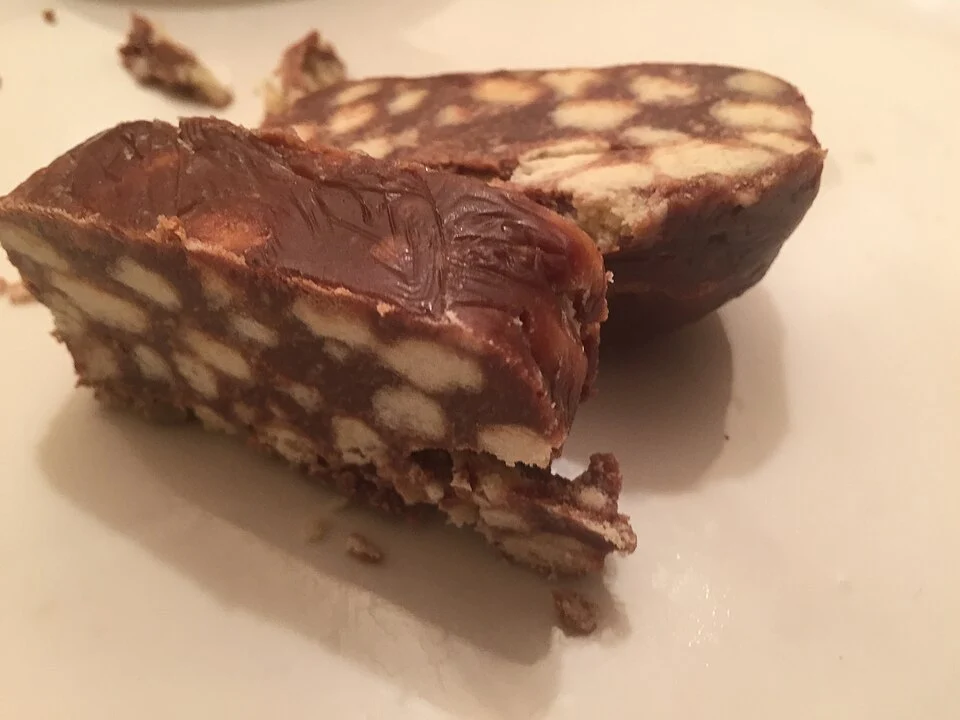
In 2013, in the US Lithuanian-American magazine Bridges, Teresė Vekteris presented Gaidelis biscuits, marked with a rooster, as the biscuit used in Lithuania. In the US, where they were not easy to obtain, she says she also made it with shortbread or animal-shaped crackers. For forming, she lists wrapping into a thin log and cutting squares from a rectangular pan, as well as turning it out of a deep pan or ring mold and cutting it like a cake. Whatever the shape, the process is the same: mix in the broken pieces, chill and slice.
A Factory in Kaunas, and a Story Preserved in Kitchens
According to Alvydas Surblys, a historian who has studied Kaunas’s confectionery industry, a chocolate and sugar-confectionery factory was founded on Daukšos Street in the Old Town in 1888. At first it carried the name "J. Ashkinazi," and between the two world wars that company and Tilka were known for a wide range of confectionery. The 1888 record tells us that a company making chocolate and sugar confectionery existed in Kaunas. The story of a home sweet made by mixing biscuits and chilling them has been told as belonging to a different period.
The story most often told places it around 1967 in Kaunas, where a woman put a lot of sugar into chocolate and crushed biscuits at hand into it, and the mixture cooled into a sliceable sweet. Sources differ on how the original liquid turned out, saying it became too sticky or a loose syrup, and none gives a record that identifies the maker or a contemporary recipe. A Vilnius culinary guide lists it as a sweet that has been eaten since the Soviet period. The ingredients actually used in kitchen recipes are store-bought biscuits, sweetened condensed milk and cocoa powder. Already-baked goods and ingredients that keep well come together in the home method.
A White, Milky Slice, and Sweets from the Market
Varškės tinginys uses varškė, a dairy product made by separating the liquid from curdled milk. In a recipe presented by Indrė, a berry farmer, on a cooking program of Lithuania’s public broadcaster, the quantities are 400 g of sieved varškė, 200 g of butter, 150 g of sweetened condensed milk and 450 g of biscuits. It also includes 300 g of fresh strawberries, the zest and juice of a lime, and mint. There is less condensed milk than in the cocoa versions, and moisture also comes in from the dairy product and the fresh fruit. Indrė explains that for a drier result, you can increase the biscuits.
At home, it goes into the refrigerator overnight in its mold and, once turned out, is decorated with strawberries and mint. Fruit appears within the pale color of the milk, and the tartness of lime and strawberry is added. Confetti, a Vilnius producer, uses varškė, butter, sweetened condensed milk and homemade biscuits, combined with dried apricots and dried cranberries. Fresh strawberries release juice, while dried fruit keeps a chewy bite. Even when mixed into the same white base and chilled, the choice of fruit changes the texture of the pieces met in the mouth.
According to a tourist guide, at the Kaziukas Fair, a craft fair in Vilnius, you can also find tinginys with pieces of šakotis. Šakotis is a baked confection made by pouring batter onto a rotating spit so that branch-like projections form. At the fair you can come across that baked confection mixed in as pieces into a sweet made with a pan and a refrigerator. Casa la Familia, a Vilnius restaurant, appears in the same guide as an example of serving it with homemade ice cream.

If the sweet is chilled in advance, at home it can be served slice by slice once guests arrive, with coffee, tea or milk. In search trends for the previous year, reported by Lithuania’s public broadcaster in 2022, tinginys ranked among the most searched recipes in the country. This was an announcement by a retailer, not a figure based on how many times households made it. It was being searched for as a sweet that can also be made at home, alongside the combinations of ingredients met at the market.
A Log with Fruit Jelly, and Layers of Lined-Up Biscuits
Latvia’s Saldā Brunete also uses crushed biscuits and cocoa. According to the Investment and Development Agency of Latvia, the Poļu Nams product is based on a recipe from the grandmother’s generation and is also called chocolate sausage. According to co-founder Gunita Kugrēna, her husband remembered a sweet made by a schoolmate’s grandmother and learned the basic method from her. When they started in a small kitchen in Riga, they broke the biscuits themselves and cut up fruit jelly, called marmalāde, to mix in. The product description lists cocoa, raisins, fruit jelly and biscuits.
In the Latvian product, cutting the fruit jelly begins before the cocoa is stirred in the pan. Similarly, in a 2015 home recipe sent to Draugas, a Lithuanian-language newspaper published in the US, walnuts, soaked dried apricots and dried prunes are cut to the size of beans. After the moisture is wiped off, they are mixed in and bound with a cream thickened with milk and starch, plus butter and lemon. The author writes that, because so much nut and fruit cutting was involved, she and a friend called it "hard worker."
In Kugrēna’s workshop, soft fruit jelly sometimes melted into the warm mixture, and its shape could not be seen when cut. Just as Lithuanian recipes mix while watching the temperature so that the biscuit pieces remain intact, the Latvian makers also took care over what to keep solid. The finished slice gains the textures of fruit jelly and raisins. The story passed from the schoolmate’s grandmother to the workshop is the history of this product. It can be distinguished from the question of which side of the border first produced the sweet.
Italy’s salame di cioccolato breaks dry biscuits and shapes them into a cylinder. In the Il Cucchiaio d’Argento recipe, the biscuits are combined with butter, sugar, egg and melted dark chocolate. Sliced, it looks close to tinginys, and the difference lies in what holds the pieces together. The Lithuanian recipes combine sweetened condensed milk, butter and cocoa powder, while the other uses melted chocolate bars, so the milk and cacao that enter the dark part of the cut surface take different forms.
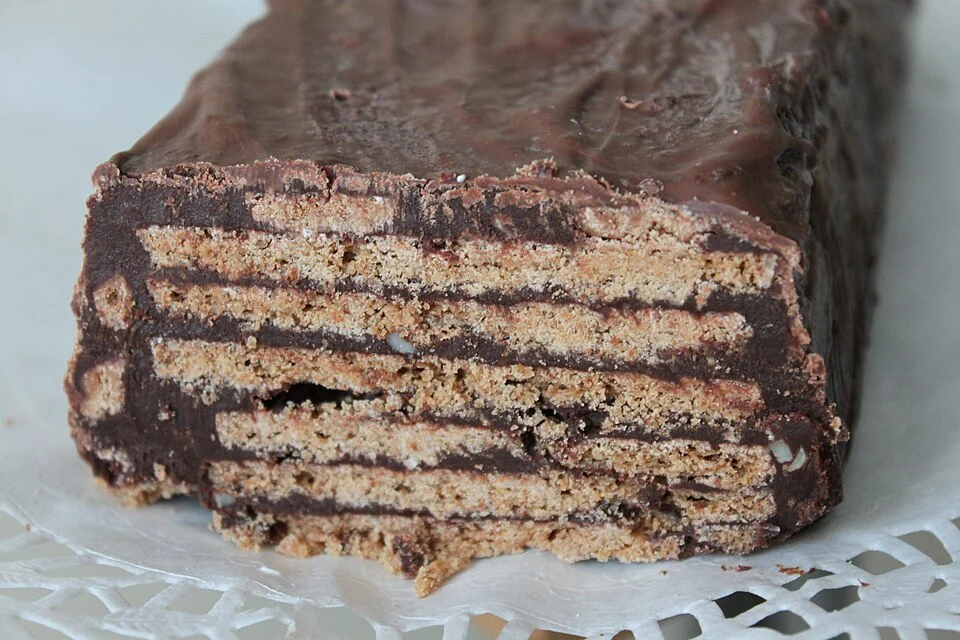
In the Dr. Oetker version of Germany’s Kalter Hund, chocolate, coconut fat and cream are combined, and biscuits are layered in a rectangular mold with their faces aligned. The work of chilling and slicing is shared with tinginys, and in the cut surface the pale biscuits form straight lines. Tinginys can also be made in a mold of the same shape, but because pieces broken beforehand are mixed in, the pale color remains in irregular shapes. Even with the same mold, the cut face shows how the biscuits were placed.
Glossary
- Sweetened condensed milk
- A dairy product made by concentrating milk and adding sugar. In tinginys it is combined with cocoa and butter to make the sweet base that coats the biscuits.
- Varškė
- A dairy product made by separating the liquid from curdled milk. In varškės tinginys it is used as the milky base that binds the biscuits.
- Kaziukas Fair
- A craft fair in Vilnius. A Lithuanian tourist guide presents it as a fair where tinginys with pieces of šakotis can be found.
- Alvydas Surblys
- A historian who researched Kaunas’s chocolate and sugar-confectionery industry from sources such as company records and advertisements.
- Saldā Brunete
- A confection made by Poļu Nams in Latvia. It uses cocoa and biscuits, with raisins and fruit jelly added.
- Salame di cioccolato
- An Italian confection in which crushed biscuits and chocolate are bound together and shaped like a salami.
- Gunita Kugrēna
- Co-founder of Poļu Nams, a Latvian confectionery maker. She described how a sweet taught to her at home became a product.


