DRUG

パレード伏見洋菓子店

SweetloreEncyclopedia of World Sweets (834)

SWEETS&CAKES

Bremer Kluten

Bremer Kluten

White mint fondant, wrapped in chocolate on one side only

Sugar Confections / Bremen, Germany

Three Bremer Kluten, rectangular bars each half cream-white and half brown, lying at different angles.

Bremer Kluten are a peppermint sugar confection enjoyed in Bremen, in northern Germany. Each piece is a rectangle about the size of two sugar cubes laid side by side, with dark chocolate on one end and a white face left bare at the other. When you bite in, the outer layer cracks and the fondant inside dissolves on the tongue. At the white end the mint flavor comes first; bite into the dark end and the slight bitterness of cacao joins it. A single piece taken from the bag offers two textures, sugar and cacao.
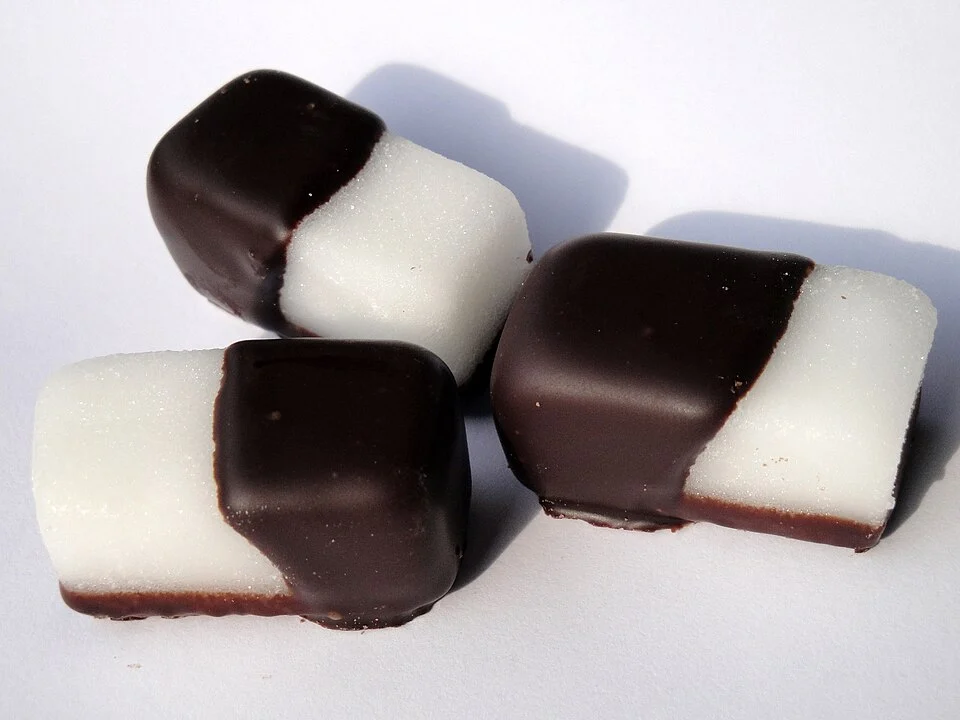
Three Lühders Bremer Kluten, each coated on one side with dark chocolate
A milky-white face meets the chocolate at a clear boundary, and a thin brown rim is also visible on the base. Photo by Reise Reise, CC BY-SA 3.0, reduced to 960 pixels wide. Original · License

Fine Sugar That Holds the Edges

The white core is peppermint-flavored fondant. Fondant is a state in which fine sugar crystals are dispersed in a sugar syrup; at the center of the sweet it holds the shape of the edges, yet it dissolves smoothly when it touches the tongue. Confectionery research explains that the smaller the crystals, the harder it is for the tongue to detect the grittiness of individual particles. Mouthfeel is not determined by particle size alone; it also depends on how much of the syrup in which the crystals are dispersed remains. In experiments on fondant in general, changing the proportion of crystals also changes how the fondant flows when stirred and how well it holds its shape.

Heating sugar and water to drive off moisture produces a concentrated sugar solution. The solution is then cooled and stirred under conditions in which crystals form easily. The more places where crystals can start, the more the sugar divides into many small particles rather than growing a few large ones. Confectionery experiments follow heating, cooling and stirring separately in order to find out at which stage and in what quantity crystals appear. For example, a 2023 model study limited to sugar and water presented a method for measuring how crystals increase and how the mixture flows; the cooking temperatures and mixing methods used in Bremen workshops cannot be confirmed from the published materials of retailers.

The researchers consider that the force of working the cooled liquid also acts on the clusters of crystals. In observations of the 2023 samples, large aggregates of crystals formed partway through stirring and then decreased with further mixing. At first the stirring produces particles, and later a force that breaks up clumped particles is added, so even when the same stirring continues, more than one change takes place in the pot. Even if the inside of a broken piece looks white and uniform, the particles within it may include some that have stuck together and some that were broken apart during kneading.

In a 2025 model study of fondant, a concentrated solution of water and sucrose was stirred at different temperatures. Comparing samples crystallized at 25 °C, 40 °C, 55 °C and 70 °C, the average particle size in that experiment was larger at the higher temperatures. So that individual particles could be distinguished and counted, the researchers diluted the samples with saturated sucrose solution before photographing them under a microscope. Comparing a photograph with many small particles to one in which large, angular particles are mixed in reveals differences that cannot be seen when fondant is held in the hand.
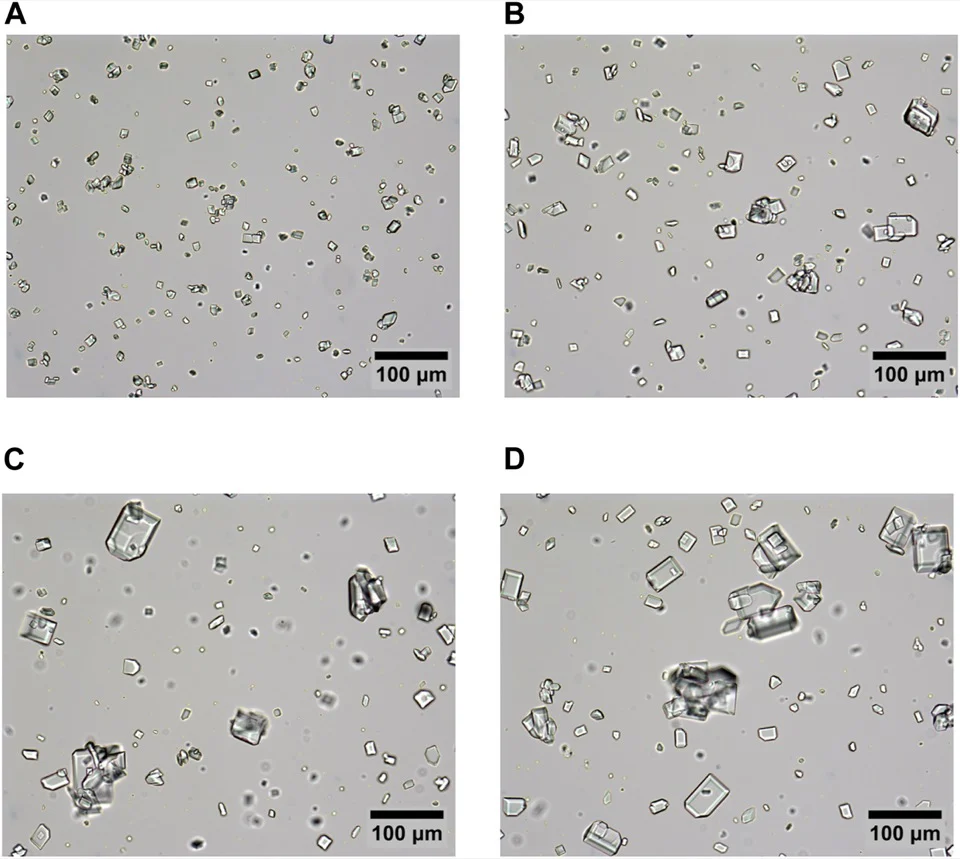
Microscope photographs of sucrose fondant samples crystallized at four different temperatures
Figure 2 of the study, showing samples crystallized at 25 °C (A), 40 °C (B), 55 °C (C) and 70 °C (D). Each sample was diluted so that individual particles could be distinguished. Hartge, Flöter and Vilgis, 2025, CC BY 4.0, reduced to 960 pixels wide and converted to JPEG. Original · License

Paulsen’s 150 g bag lists sugar, glucose syrup, cocoa mass, invert sugar syrup, cocoa butter, natural peppermint oil and the emulsifier sunflower lecithin. Invert sugar contains glucose and fructose, which form when sucrose splits. Among studies on how to keep fondant stable, one added an enzyme that breaks down sucrose to its samples and compared the sugar composition and hardness over a number of days. The product label shows that several sugars are used, but it does not show how the white core and the outer layer are made, that is, which ingredients go into each and in what proportions.

Schrader, which sells Lühders products, explains that the mint fondant is given a thin sugar coating and then covered on one side with dark chocolate. The sugar coating, close in color to the white core, still lies on the surface, so if you put the white end in your mouth, the tongue touches it before it touches the core. On the chocolate side, one more layer lies over that coating and core. Even a piece that looks simply white and black from the outside has an order of layers: a core shaped into a block, a thin sugar coating, and chocolate on one side. On the surface of the white end, fine grains that catch the light can be seen.

How Deeply the Piece Is Dipped in Chocolate

A retailer that handles Lühders products for trade customers lists one piece as about 3 × 1.5 × 1.5 cm. One dimension is roughly twice the other two, so the city’s description of two sugar cubes laid side by side gives a fair picture of the shape. Once the white core has been formed so that it can be lifted, the work moves on to dipping one end in chocolate. Bonbon Pingel explains that each piece is made by hand and then dipped in chocolate. Dipped about halfway, the piece shows a white face and a dark face side by side, and depending on the depth and angle of dipping, the boundary may look slightly slanted.

Bite the white side and the sweetness of sugar and the flavor of mint come first. On the dark side, the thin chocolate breaks and then the sugar inside dissolves, with the bitterness of cacao overlapping the cool mint. Even when a piece is eaten whole, the place where the teeth meet chocolate bites differently from the white side. Increasing the amount of coating increases the chocolate surface that is touched first. When more peppermint oil goes into the core, the strength of the aroma perceived even from the white side changes. Even to bring out the taste of a single ingredient, the amount used in finishing and the amount mixed into the core are matters handled at different stages.

When the dipped end is lifted out, the chocolate that clings to it cools and hardens into a thin surface. The core keeps its shape because sugar crystals are dispersed in the syrup. The two faces that appear to continue as one edge before the piece goes into the mouth are also the result of two overlapping processes: the chocolate, liquid when the core was dipped, setting, and small particles emerging from the concentrated syrup. The thin brown line that can be seen wrapping around from the base is one form that the applied chocolate takes.

The city’s guide introduces the rectangle with dark chocolate by likening it to Dominostein, a square confection. When you pick up a Kluten, the white face at one end and the outline of the edges continuing from it are the clues for recognizing it. Break it and the white mint core appears. Labels such as 150 g or 125 g show the contents of the whole bag, and about 3 cm is the length of a single product at one retailer. Neither figure shows that every shop applies a sugar coating of the same thickness and dips the chocolate to the same depth.
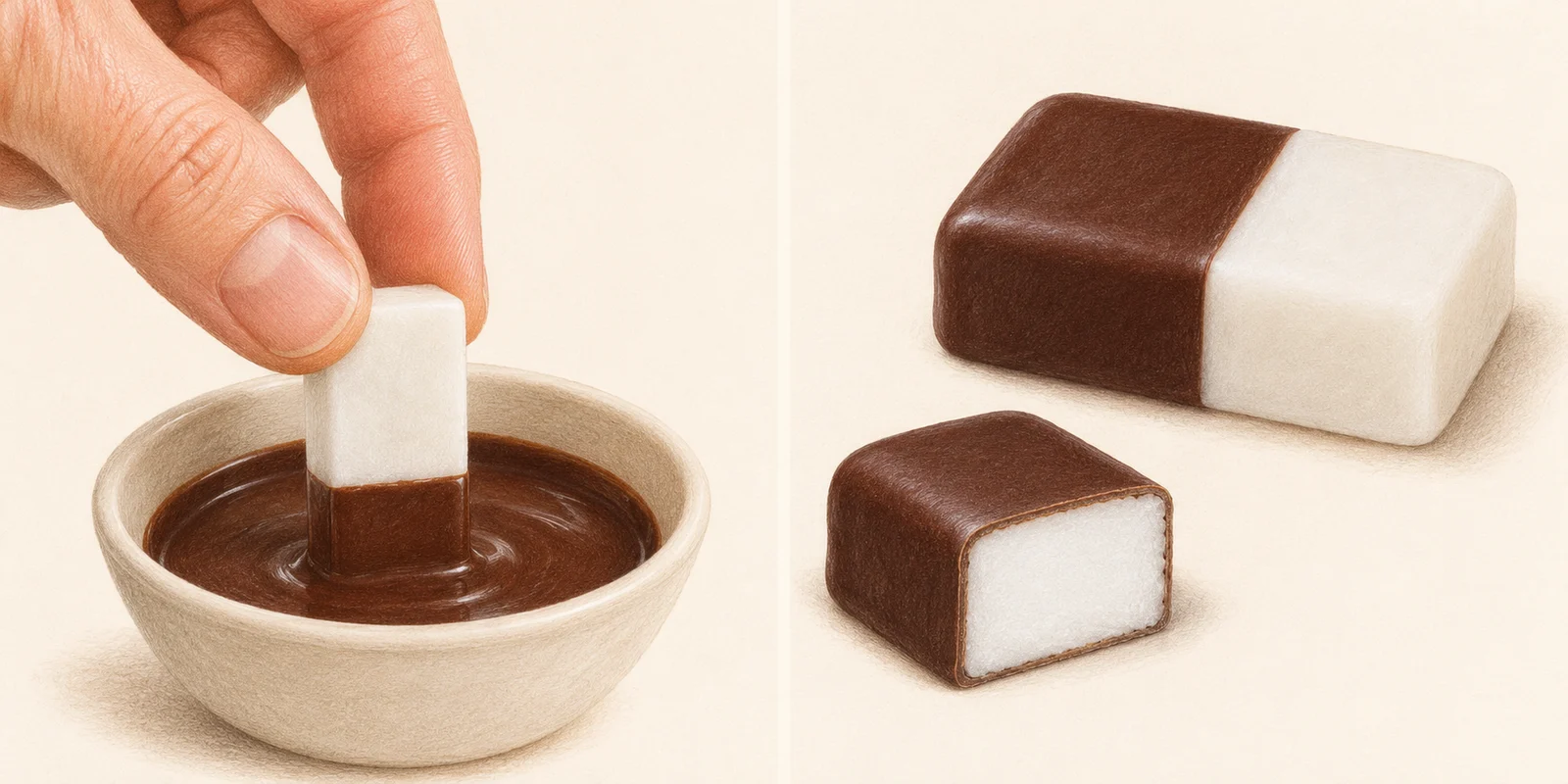
Reconstruction image (AI-generated). At left, one side of a white prism is dipped into liquid brown chocolate; at right, a cross-section showing the white core and thin chocolate
Reconstruction image (AI-generated). Dipping one end of the fondant in chocolate (left) and a cross-section of the chocolate-coated side (right). The reference is the explanation by Bonbon Pingel, a Bremen manufacturer.

From the Autumn Fair to a Christmas Decoration

Bremen’s tourist guide says that small pieces of mint fondant were already popular in the 19th century. A regional news report says they originated in Bremen in 1865, but it does not cite an advertisement from that year or a confectioner’s recipe book going back that far. Schrader’s description mentions the autumn Freimarkt and the Christmas market. What the city’s chronology can trace is the history of Bremen’s autumn fair itself. The beginning of the fair and the birth of the sweet belong to separate records, and the city’s chronology alone does not show since when Kluten have been on sale.
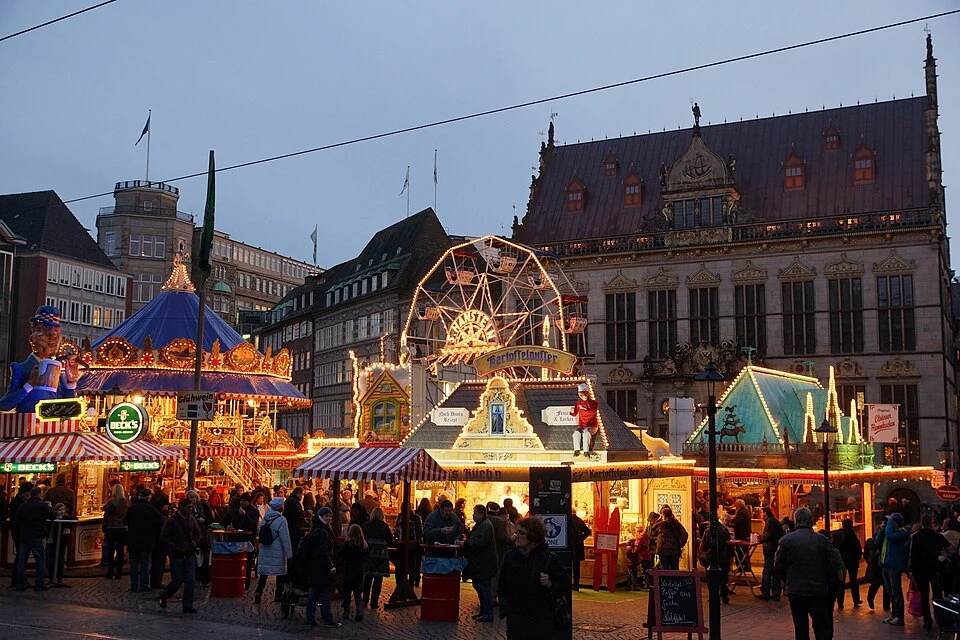
Kleiner Freimarkt in the evening, with stalls and rides lined up in a Bremen square
The Marktplatz in October 2012. It was one venue of the autumn fair, and the photograph does not show the sweet itself. Photo by Allie_Caulfield, CC BY 2.0, reduced to 960 pixels wide. Original · License

At the Freimarkt, you can take a small piece from the bag and eat it on the spot. If you buy a bag at the Christmas market, you can serve what you take home later with tea, or share it piece by piece at home. From the ssellers’ explanation that the same sweet is sold at both the autumn and the winter market, what can be read is not that the recipe changes with the season, but that a form that can be served straight from an opened bag suits both markets.

In the November 1965 issue of the newspaper Das Ostpreußenblatt, Kluten appear as a decoration for a spice-cake house made at Christmas. The suggestion is to build the walls and roof from baked panels, make snow from icing, and then line up white and chocolate-colored mint sweets in the yard as a fence. The article does not name the maker or the year of invention, but it is written so that readers of the time could connect the name with the two-colored appearance. The block shape, which can be picked up straight from the bag, was also used to line up identical pieces around the yard of the house.

Babbeler on a Stick, Klaben Cut into Slices

Bremen also has the Bremer Babbeler, a peppermint-scented stick candy. The ingredients the city lists are natural peppermint oil, sugar, glucose syrup and water. You hold the long stick and lick the surface bit by bit. Kluten, by contrast, are a sweet in which you bite into a short block and taste the mint core and the cacao in a single mouthful. The city’s record that Albert Friedrich Bruns, a confectioner from Walle in Bremen, devised a sweet in 1886 concerns the stick-shaped Babbeler. Both let you enjoy the scent of mint in the same city, but the state of the sugar and the time spent enjoying it in the mouth differ.
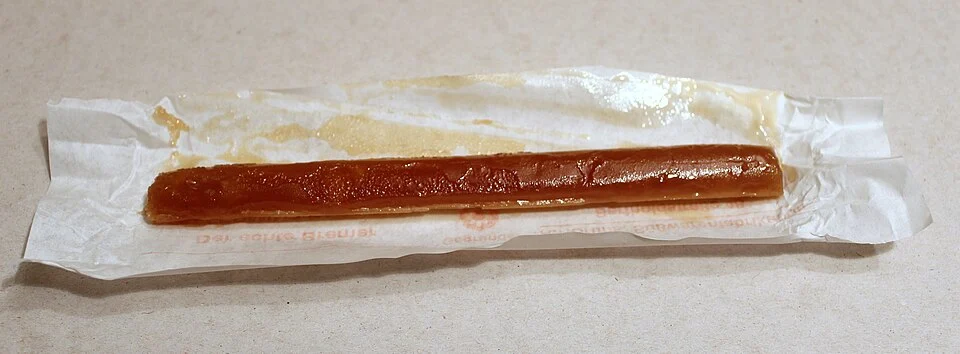
A long amber Bremer Babbeler with its paper unwrapped
A stick candy, also made in Bremen, that is licked at its full length. Photo by XenonX3, CC0 1.0, reduced to 960 pixels wide. Original · License

The similarly named Bremer Klaben is a large baked cake containing plenty of dried fruit. The city says that its name was mentioned in the Bremen council in 1593, and describes it as a sweet eaten in winter. Whereas Klaben is a baked loaf cut to suit the number of people eating it, Kluten are already single bite-size pieces by the time the finishing chocolate is applied. Even when the names sit close together in guides to winter sweets and souvenirs, the sugar or fruit is eaten differently in each case: one is cut and served on a plate, one is held by a stick and licked, and one comes piece by piece in a bag.

Taking One Piece, Handing Over a Bag

The city’s guide lists Kluten as a souvenir found at confectioners and bakeries in the city, in the old town and in the Schnoor. Handing over a bag makes a small gift, and if you eat as you walk, you can open the bag you bought and take just what you need. At both the market stalls and the confectioners in town, there is no need to cut anything or set out plates after leaving the shop. Because only one side is dark, even when several pieces overlap in the bag, you can recognize the sweet from the color of the visible end and the outline of the edges.

In the photograph of the actual product, the three pieces face different ways: one has its dark side toward the front, and another has its white end toward the front. Whichever way you hold a piece, the color of the end tells you the flavor of the first bite. In the example in Schrader’s description in which a thin sugar coating is applied, a white coating lies even inside the black face. Apart from the weight of a bag or the number of pieces in it, the maker’s work can be seen in the layers revealed when a piece is broken and in how far the dark part extends.

As the history of Lühders, the retailer presents the following: the company began trading in 1909 in Wandsbek, Hamburg, and a later generation introduced automatic molding equipment for jelly and fondant. What this shows is that a sweet whose name is familiar in Bremen also circulates as the product of a company that began in another port city. Taken out of the bag, the piece combines the fondant that forms the block with chocolate that has set thinly on one side. It is a form in which you can check, mouthful by mouthful, how the core containing fine sugar dissolves and how the cooled, hardened outer layer bites.

Glossary

Fondant
A confectionery material in which small sugar crystals are dispersed in sugar syrup. In Kluten it forms the mint-flavored core.
Invert sugar (Invertzucker)
A sugar containing the glucose and fructose obtained by breaking down sucrose. On product labels it is listed as a syrup.
Babbeler
Bremen’s stick-shaped mint candy. It differs from Kluten in both shape and the way it is eaten.
Freimarkt
Bremen’s long-running autumn fair. One of the settings in which Kluten have been sold.
TOPBremer Kluten | Cafe & Sweets Parade Kyoto

(FAQ)

All You Need to Know

Do you have gluten-free sweets made without wheat flour?

Yes. We offer sweets made without wheat flour, such as madeleines made with rice flour. However, they are made in the same kitchen as products that use wheat flour. If you have a wheat allergy or need to strictly avoid wheat, please consult our staff before purchasing.

Do you use additives such as preservatives or emulsifiers?

We do not add preservatives or colorings when making our sweets.

Some of our baked goods (such as madeleines and chocolat) use baking powder to help the batter rise. In addition, ingredients we purchase, such as chocolate, may contain additives such as emulsifiers that help maintain their quality.

To see the ingredients we use, please check the ingredients listed on each product page.

When is the Seasonal Citrus and Lemon Curd Cake available?

This cake is sold on an irregular basis.
It is often available on Saturdays, Sundays and public holidays. We post updates on in-store availability as needed in our Instagram Reels, so please check there.

Do you sell fresh cakes on Wednesdays?

We do not currently sell fresh cakes on Wednesdays.
On Wednesdays, we mainly sell baked sweets and drinks.

*Many customers have asked about this, but no decision has been made yet about selling fresh cakes on Wednesdays.

Can I request noshi paper (noshi kakegami) for gifts, presents, and the like?

For gift boxes in sizes M and L, we offer inner noshi (uchi-noshi) only, at 100 yen (tax included) per sheet. Please specify the top inscription and name inscription, and place your request at least 3 days in advance. For same-day requests, please consult the shop.

Do you offer OEM (manufacturing of original products)?

We are currently accepting consultations on OEM requests, depending on their details.
To start, please contact us through the inquiry form with details such as your product concept, desired quantity, and sales purpose.

Where is the shop located?

Cafe & Sweets Parade Kyoto is in Uoya-cho, one street south of the Otesuji Shopping Street, a 4-minute walk from Keihan Fushimi-Momoyama Station and a 5-minute walk from Kintetsu Momoyama-Goryomae Station. Parade stands in an area full of history and charm. Nearby are Torisei, a sake and yakitori restaurant run by a long-established sake brewery; Teradaya, said to be the place where Sakamoto Ryoma was attacked; the Fushimi Jikkokubune, wooden boats that take you along the canal; and many other places.
For the exact location and other details of Cafe & Sweets Parade Kyoto, please check Google Maps↗︎.

What days is the shop open?

We are open every Wednesday through Sunday from 11:00 to 18:00 (last order 17:30). We are regularly closed on Mondays and Tuesdays.
On public holidays, we are open on some days and closed on others.
We may also close temporarily on irregular days, or open on regular closing days. For the latest information, please check Instagram↗︎ or Google Maps↗︎.

How can I place a large order?

Yes, we accept orders through this inquiry form.
Large orders are orders of 21 or more units, or orders with 10 or more delivery addresses.

Can you tell me about allergens in your products?

Whether a product uses egg, wheat flour, peanuts, walnuts, other nuts or dairy products is stated on the allergen list page and on each product’s page.

Peanuts (groundnuts) and walnuts are shown separately from “other nuts” such as almonds.

Points of caution other than the items above, such as sesame, gelatin and honey, are written in the “Notes” section of each product. However, not all allergens are listed. For assortments such as gift boxes, the ingredients of each sweet included are listed under [Ingredients] on the product page.

If you have any questions, please ask our in-store staff or call us (075-644-4118) before purchasing.

Do any of your products contain alcohol?

Yes. We mainly use liquor in the following sweets:

• Canelé de Bordeaux (rum)
• Galette Bretonne (with rum)
• Madeleine au Chocolat (with liqueur: Grand Marnier)

The Galette Bretonne and the Madeleine au Chocolat are also available in “without rum” and “without liqueur” versions, respectively, made without liquor.

▼Gift boxes
• Classic Baked Sweets Gift Box L [9 Varieties, 15 Pieces]: includes 2 Galettes Bretonnes (with rum)
• Classic Baked Sweets Gift Box M [9 Varieties, 9 Pieces]: includes 1 Madeleine au Chocolat (with liqueur)
• Gluten-Free Gift Box [S] and Gift Box [M] with Higuchi Apiary: contain no sweets made with liquor

Even in baked sweets, a small amount of alcohol may remain. Children, pregnant women, people sensitive to alcohol and anyone who will be driving should take care.

For seasonal products, please check the “Notes” section on the allergen list page.

Is there parking?

The shop does not have its own dedicated parking lot. If you are coming by car, please use one of the paid coin-operated parking lots nearby.
If you are coming by train, the shop is about a 4-minute walk from Fushimi-Momoyama Station on the Keihan Main Line and about a 5-minute walk from Momoyama-Goryomae Station on the Kintetsu Line.

Can I eat and drink in the shop?

Yes, you can enjoy your order in our in-store eat-in space. Seating consists of 5 counter seats and 4 terrace seats (2 tables for 2 people each). High-speed Wi-Fi is also available.
Takeout is available as well. Opening hours are 11:00–18:00 (last order 17:30).

Where can I check the day’s cake selection and sold-out items?

The fresh cakes we sell change from day to day. We post updates on in-store availability as needed on Instagram↗︎.
Items may sell out after a post. If you want to be sure to get something, please call us (075-644-4118).

Do the 2 types of lemon cake differ in how they should be stored and how long they keep?

Yes. The lemon cake with icing must be kept refrigerated and keeps until the end of the day of purchase. The lemon cake without icing can be stored at room temperature and keeps for approximately 7 days from the date of manufacture. Please prioritize the date shown on the label of the product you have.

How long do baked-goods gifts keep, and how should I store them?

As a guideline, baked-goods gifts keep for about 2 weeks from the date of manufacture. Please store them in a cool place, away from direct sunlight and high temperature and humidity. The exact date is printed on the back of each individual sweet.

What payment methods can I use in store?

▼In store
• Cash
• Credit cards: Visa, Mastercard, JCB, American Express, Diners Club, Discover
• Transit IC e-money: Suica, PASMO, ICOCA, Kitaca, TOICA, manaca, SUGOCA, nimoca, Hayakaken
• Other e-money: iD, QUICPay+
• Code payments: PayPay, Rakuten Pay, d Barai, au PAY, Merpay, WeChat Pay, Alipay+, and others

Apple Pay and Google Pay can be used if one of the e-money services or cards listed above is registered.

What kind of cream puff is the Oven-Baked Cream Puff?

It is our classic cream puff: a crisp cookie-crust choux generously filled with a rich cream that combines fresh cream with custard made using “Sakura” eggs from a purely Japanese chicken breed.
It must be kept refrigerated; please eat it on the day of purchase. We also offer a caramel-flavored version, the “Oven-Baked Caramel Cream Puff.”
For details, please see the Oven-Baked Cream Puff product page.

What Are Meringue Cookies?

Meringue cookies are sweets made by baking and drying meringue, which is egg white and sugar whipped together. At Parade, we use kibi sugar (Japanese cane sugar) and finish them with a light texture: a crisp first bite, then an airy, fizzy melt in your mouth.

What kind of sweet is a sablé diamant?

True to its name, which means “diamond” in French, this is a sablé coated with sugar that sparkles around the outside. For the sugar coating, we use vanilla sugar that we make by hand in our shop from vanilla bean pods.
It keeps for about 3 weeks. Please store it in a cool place, away from direct sunlight, high temperatures and humidity. It is also included in our baked goods gift boxes.
For details, please see the Sablé Diamant product page.

Is the Galette Bretonne available both with and without rum?

Yes. It is available both with rum and without rum. The individually sold Galette Bretonne contains rum. The rum-free version is included in our gift boxes. Please contact the store to ask whether it can be purchased individually.

What kind of sweet is a Linzer torte?

The Linzer torte is a sweet associated with Linz, Austria, combining a nut pastry with jam. At Parade, we layer a cinnamon-scented pastry, almond batter and our house-made framboise (raspberry) jam, and bake them together.

What baked goods can I choose as a gift (temiyage) from Fushimi?

We offer Gifts M and L, assortments of our classic baked goods; Gift S, with sweets made with rice flour; and a gift that includes honey from Kyoto Higuchi Apiary. You can choose based on the number of pieces, the ingredients, and the recipient’s preferences. As a guideline, the baked goods keep for about 2 weeks from the date of manufacture.

How do the gift boxes differ by type?

They differ in the types and number of sweets they contain.
・Classic Baked Goods Gift Box M [9 types, 9 items]: 2 types of sablé (12 pieces each), Galette Bretonne, 3 types of madeleine, financier, Sésame Matcha, Boule de Neige Chocolat
・Classic Baked Goods Gift Box L [9 types, 15 items]: 2 types of sablé (12 pieces each), Galette Bretonne (2 each without rum and with rum), Honey Madeleine, Madeleine Chocolat (without liqueur), financier, Sésame Matcha, Boule de Neige Chocolat
・[Gluten-Free] Gift Box [S]: 4 Honey Madeleines, 2 Madeleine Chocolat (without liqueur), 2 Sésame Matcha, 2 Boule de Neige Chocolat
・Gift Box [M] with Higuchi Bee Farm: 8 classic baked goods in 7 types, plus Wildflower Honey (160 g) from Kyoto Higuchi Bee Farm
The sweets made with liquor are the Galette Bretonne (with rum) in the L box and the Madeleine Chocolat (with liqueur) in the M box. For full details, please see the list of gift boxes.

What kinds of honey, eggs and chocolate do you use?

The ingredients we use vary by product. Our main ingredients are as follows.
• Honey: Purely Japanese honey from Higuchi Apiary in Fushimi, Kyoto (Honey Madeleine, Caramelized Honey Canelé, etc.)
• Eggs: “Sakura” eggs from purely Japanese-bred hens (Oven-Baked Cream Puff, Canelé de Bordeaux, Honey Madeleine, etc.)
• Chocolate: Chocolate from Valrhona of France (Madeleine Chocolat, etc.)
• Butter: Cultured butter (Brown Butter Financier, Galette Bretonne, etc.)
Please check each product page for that product’s ingredients.

Is there an ideal temperature or way to warm the sweets so they taste their best?

Depending on the product, there are recommended ways to enjoy it.
• Canelé de Bordeaux: Warming it for 3–5 minutes in a toaster oven that has not been preheated makes the caramel on the surface crisp, giving it a texture close to freshly baked.
• Brown Butter Financier: Warming it in a toaster oven for about 1–2 minutes gives it a texture and aroma close to freshly baked.
• Linzer Torte: The ideal serving temperature is 5–20°C.
• Lemon Cake (with icing): We recommend letting it sit at room temperature for a little while to enjoy the fluffy texture of the cake, or, in summer, enjoying it chilled straight from the refrigerator.
Toaster ovens heat differently depending on the model, so please keep an eye on the sweets while warming them to avoid burning.

How many people do Size 4, Size 5 and Size 6 whole cakes serve?

Parade’s “Decoration Cake with Fresh Cream and Seasonal Fruit” serves approximately 3–4 people in Size 4, 4–6 people in Size 5 and 6–7 people in Size 6. Please choose a size based on how much will be eaten and whether it will be served together with other sweets.

How long can I carry a cake? Do I need ice packs or an insulated bag?

Please plan on carrying it for about 1 hour. Conditions vary depending on the temperature, the type of cake and how you travel, so if you are planning a long journey, please consult the shop before purchase.

Can I have a message plate or candles added to a birthday cake?

The “Decoration Cake with Fresh Cream and Seasonal Fruit” comes with an original cookie plate and 1 set of 5 candles. A charge applies to candles from the 2nd set onward.

Are the sweets for sharing at work individually wrapped? How many people can a gift serve?

The Classic Baked Goods Gift is an assortment of sweets packed in individual bags. Note, however, that “9 items” does not mean 9 pieces: some items, such as the sablés, contain several pieces in one bag. Please think separately about how many people you are giving to and how many bags you want to give each person.

What is the difference between a financier and a madeleine?

Generally, a financier is characterized by the flavors of egg whites, almonds, and browned butter, while a madeleine is typically based on a batter made with whole eggs. At Cafe & Sweets Parade Kyoto, we offer the Brown Butter Financier and a madeleine made with rice flour and honey.

Do canelés taste better warmed? How do you recommend eating them?

If you warm Parade’s Canelé de Bordeaux for about 3 to 5 minutes in a toaster oven that has not been preheated, the caramel on the surface becomes crisp, and you can enjoy a texture and aroma close to freshly baked. Because heating varies by model, please keep an eye on it while it warms.

Can cakes and baked goods be frozen?

Because ingredients and finishing differ from product to product, we do not state that all cakes and baked goods can be frozen under the same conditions. Please first check each product’s storage instructions and date label. If you plan to freeze a product, please consult the shop before purchasing and tell us the product name.

What is the difference between sablés, cookies and galettes?

“Cookie” is a name for a wide range of baked goods. “Sablé” is used as a name describing a texture that crumbles softly like sand, and “galette” is used for sweets with a flat shape, among other things. Parade’s Galette Bretonne is a thick-baked cookie made with butter.

Can I get paper bags, small bags for sharing or gift wrapping?

In store, paper bags, plastic bags, bags for baked goods and gift wrapping are available for a fee. Prices vary by type and size. Please let us know how many you need and any wrapping requests before purchase.

News Letter

We send the latest news from Cafe & Sweets Parade Kyoto and money-saving coupons exclusive to our followers. Add us as a friend on LINE. Something good should come your way.

* We usually send notices of sales launches on Sunday mornings.
* Depending on the content, messages may be sent only to certain segments of subscribers.

Thank you for signing up!
We hope you look forward
to our next email.

Access

Cafe & Sweets Parade Kyoto

〒612-8041

Heights Momoyama No. 105, 574 Uoya-cho, Fushimi-ku, Kyoto-shi, Kyoto

* If you are coming by car, please use a nearby parking lot.

VIEW MORE GOOGLE MAP