


SweetloreEncyclopedia of World Sweets (834)

Pruneaux fourrés d’Agen
Pruneaux fourrés d'Agen
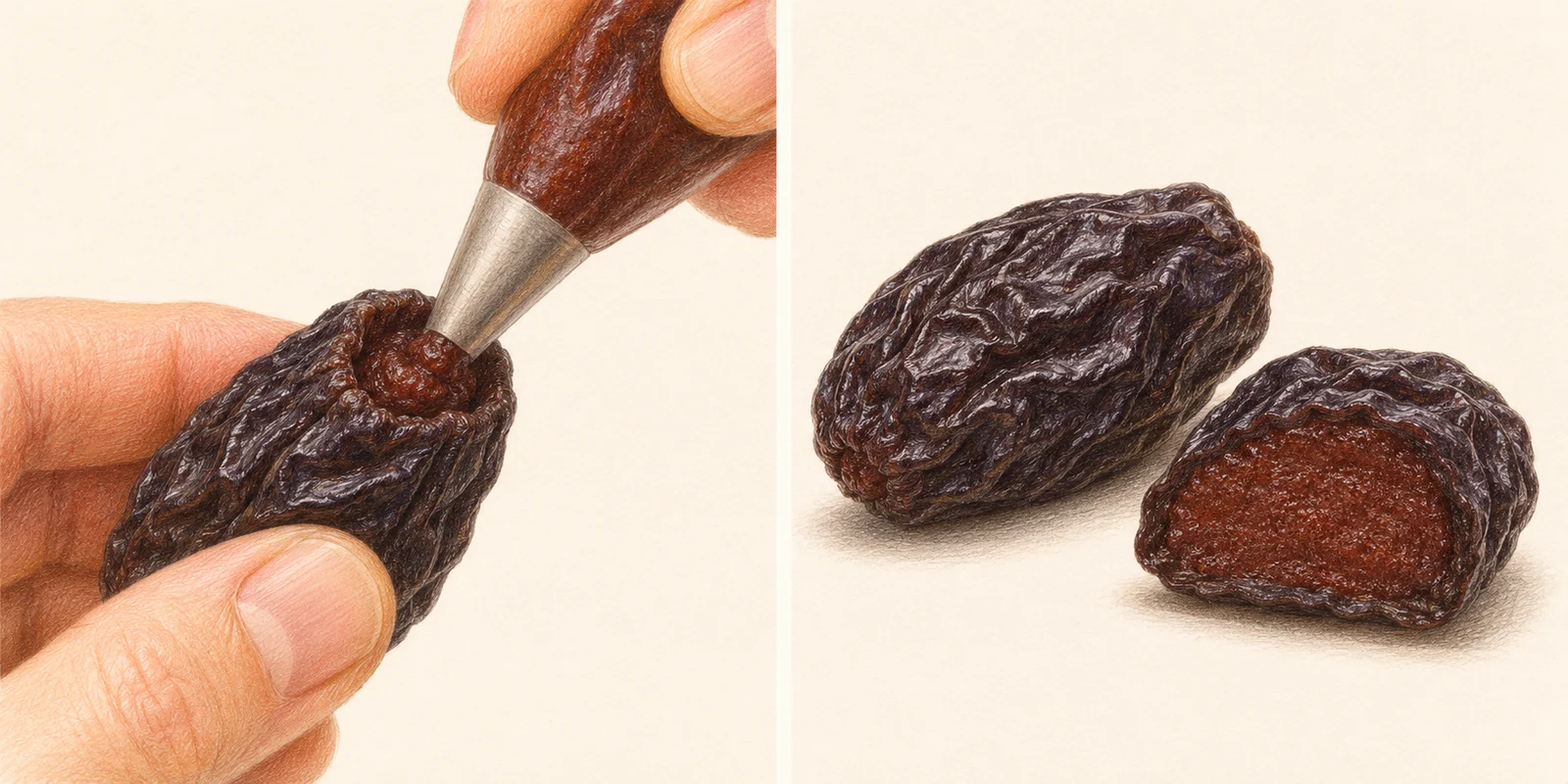
Filling Agen dried plums with fruit cream
Sugar Confections / Agen, France

Split a single dried plum and, inside the wrinkled outer flesh, you find a cream made from the same fruit. Pruneaux fourrés d’Agen are stuffed confections made with prunes from Agen in southwestern France. The cream is placed where the stone was removed, so the dried flesh forms the outer shape, and a soft filling remains inside when you bite in. When you open a box, you can take the pieces out one at a time. From growing and drying the fruit in the orchard to filling one fruit with another and selling it as a confection, several different kinds of work are layered into each piece.
The Pitted Prune Becomes a Vessel of Flesh
The shop at the prune museum sells soft, pitted prunes filled with a smooth prune cream. The 2025 catalogue of the seller, Sudreau, describes pitting the fruit with scissors and filling it with cream by hand. Each fruit is opened individually and the stone is taken out, but the pouch of flesh is left intact. Compared with a method in which the fruit is first chopped, kneaded into a paste and later rolled into small balls, this approach keeps the visible outline and wrinkles of each individual piece. The scissors are one example from this shop; the descriptions from Maison du Pruneau and Maison Roucadil also mention filling the cream by hand.
For its filling, Maison du Pruneau uses prunes, apples, sugar, glucose, pectin and vanilla flavoring, among other ingredients. Here, “cream” means a soft filling that contains fruit. Pectin, which occurs in fruit, is also used in jams and confections to hold fruit pulp together. When this filling is placed where the stone was, the teeth meet dried flesh on the outside and a kneaded paste on the inside. Although the same fruit is used in both places, treating it differently before filling leaves a different mouthfeel outside and in.
Favols labels its product as 45% pitted prunes and 55% cream. The inside contains, besides prunes, sugar, glucose, apple, apricot, fruit-derived pectin and natural vanilla flavoring. In the 125 g box from Maison Roucadil in the Lot-et-Garonne department, the product is 40% pitted PGI prunes and 60% cream, and the cream consists of prunes, sugar, water, glucose syrup, pectin and natural vanilla flavoring. These proportions belong to each product. Set side by side, the two labels show that the amount of filling and whether other fruit is used in the cream can vary independently.
Besides small boxes of 125 g and 250 g, Roucadil’s confectionery section also carries a 230 g metal box and a 520 g box. The version with Armagnac-flavored cream is listed as a 250 g small box. The 125 g label, which gives the ingredient proportions, does not show the proportions of every product on the shelf. Because products differ by packaging and flavor, the size of a product and what is inside each piece can be checked in that product’s own entry.
From Plums Fallen from the Tree to Dried Fruit That Can Be Sorted
The plums that become prunes are of a variety called prune d’Ente. According to the French Ministry of Agriculture, harvest usually runs from mid-August to mid-September. Ripe fruit falls when the tree is shaken gently. Guides from the growing region describe spreading cloths under the tree to catch it. Because even the fruit on a single tree does not ripen all at once, the producers’ association explains that it is picked in several passes. Before the fruit goes into a confection that is pitted one piece at a time, the ripest is first gathered in the orchard.
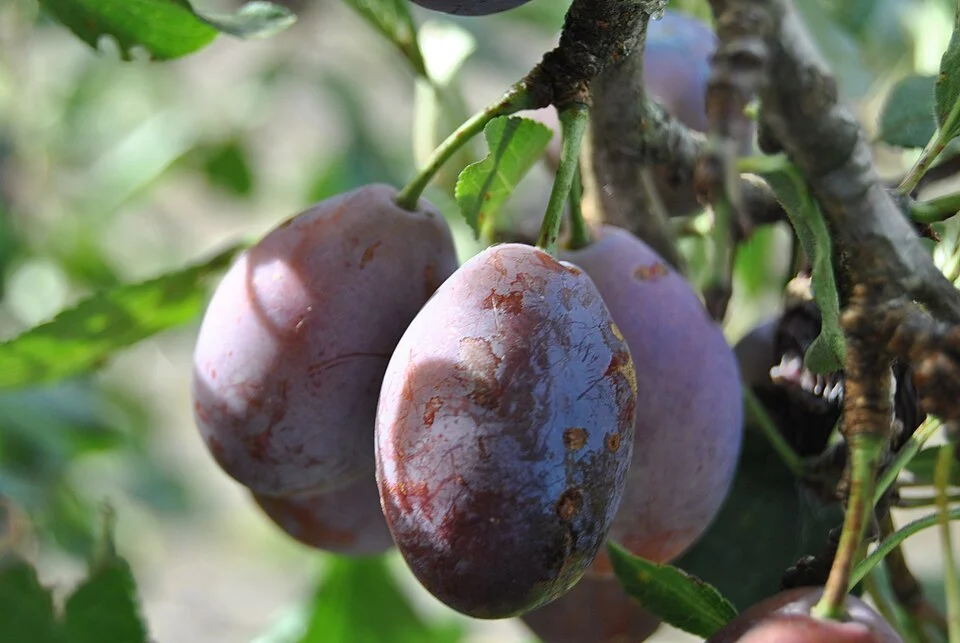
The PGI area for products made from this plum variety is centered on Lot-et-Garonne and includes parts of Gironde, Dordogne, Lot, Gers and Tarn-et-Garonne. The Ministry of Agriculture states that about 76% of production is concentrated in Lot-et-Garonne, at the center. Plum trees also bear fruit for the first time at around their third year. Ripe fruit can be picked before drying and then sent on to the filling stage after drying only because the growing region continues, year after year, to raise and gather the crop.
In drying equipment in which the harvested fruit is spread on fine mesh and air is blown through, drying takes about 20 to 24 hours. The Ministry of Agriculture gives an example in which, on average, about 3 kg of fresh fruit yields 1 kg of Agen prunes. Water leaves the roundness the fruit had on the tree, and wrinkles form on the surface. Once drying is finished, the fruit goes on to storage and sorting, and evening out the sizes belongs to the processing stage. The drying time and weight ratio vary with the fruit and the equipment. Pitting to suit the shape and size of the flesh comes only after the dried fruit has been graded.
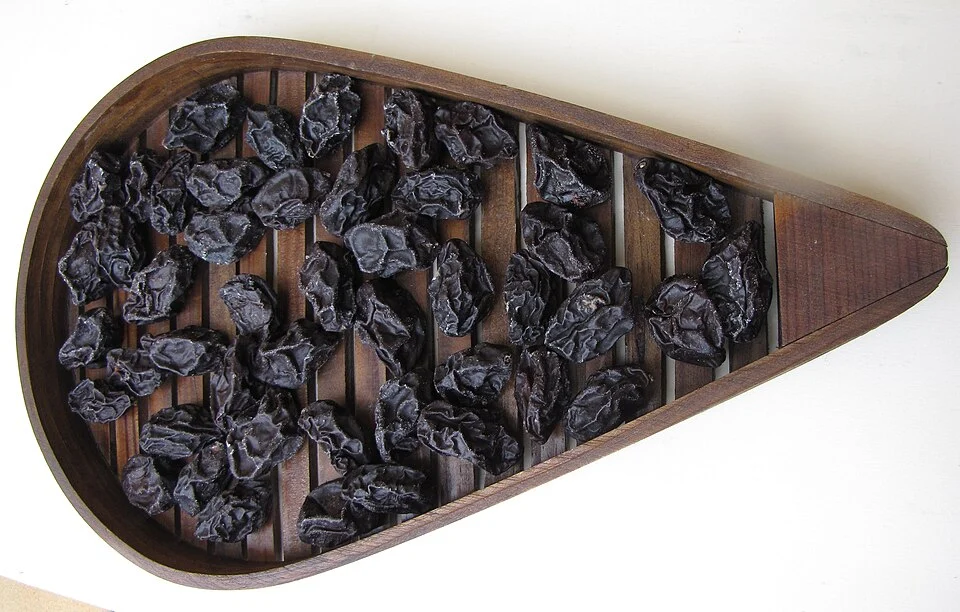
The department’s exhibition materials describe how drying equipment changed from old ovens to steam-powered equipment and drying tunnels. Trays loaded with fruit were placed on trolleys and moved around. While each fruit spread on a tray was being dried, tools were also made to carry huge quantities of fruit and send it on to sorting. Between the forced-air tunnels that the Ministry of Agriculture presents today and the older equipment recorded in the catalogue, the tools available up to the point of gathering the dried fruit differ.
After drying, the fruit may be rehydrated with water or steam to restore moisture. According to the producers’ association, the moisture content of rehydrated PGI prunes is normally at most 35%. Rehydration softens the fruit, but products with more moisture added fall outside that condition. Mi-cuit (semi-dried) is a category made by stopping the drying when 30–35% moisture remains, without rehydrating. Whether moisture is restored after drying or the moisture already present is retained by stopping early, both are work on the fruit that takes place before the filling is added.
Reading Which Ingredient a Place Name on the Packaging Applies To
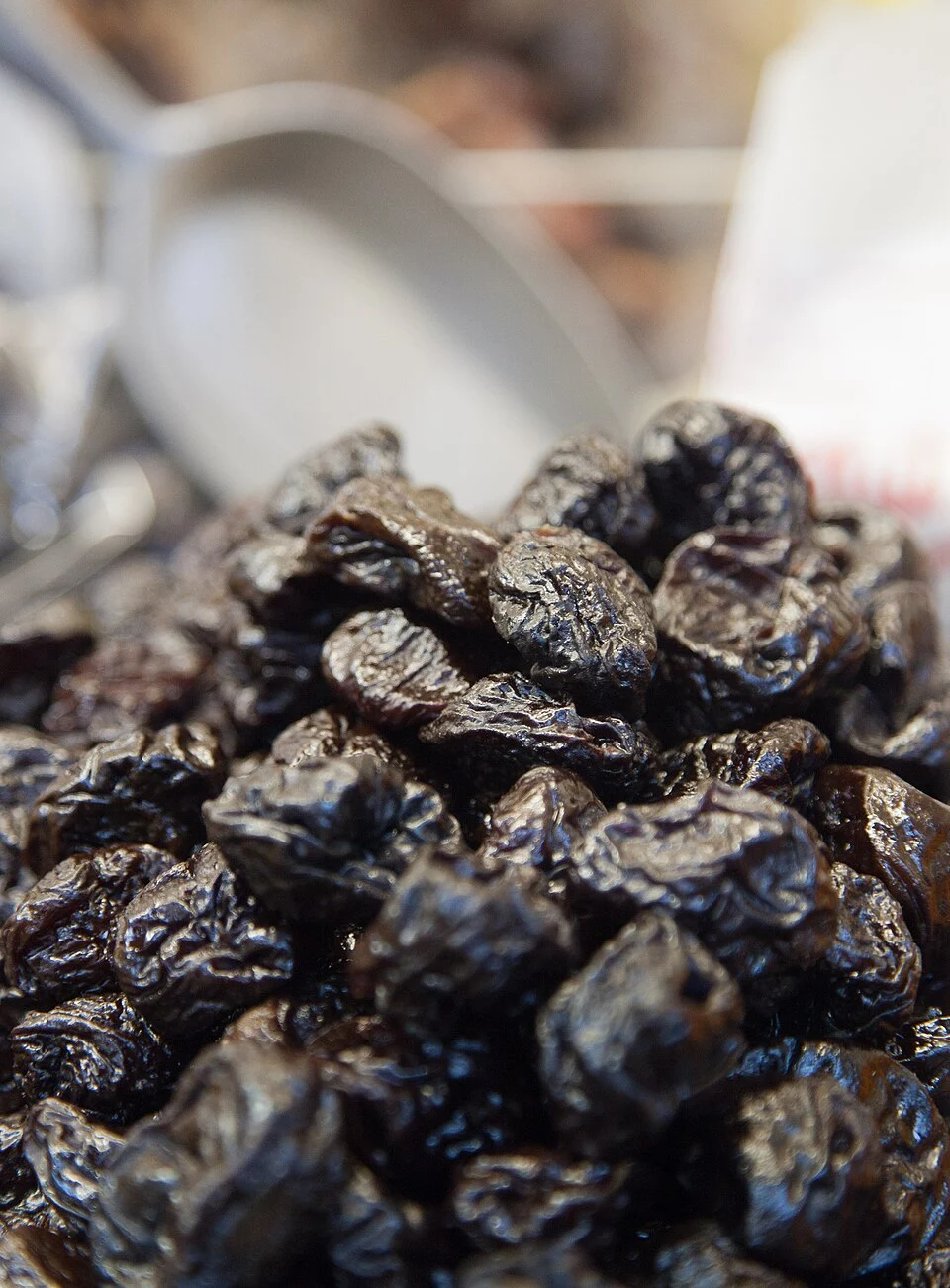
“Pruneaux d’Agen” has been covered by Protected Geographical Indication (PGI) since 2002. The French Ministry of Agriculture explains that everything from harvesting the plums used as raw material through drying and packaging takes place in an area centered on Lot-et-Garonne and extending into neighboring departments. The specification approved in 2017 covers whole fruit, pitted fruit and fruit reshaped for processing, and also records the difference between products eaten as they are and raw material sent to processing companies. A product in which the flesh is eaten as it is, one piece at a time, and the work of later adding a filling to make a confection each have separately verifiable conditions.
Some businesses, such as Maison du Pruneau, make confections using PGI prunes as the raw material. Roucadil’s box likewise gives the proportion and ingredients of the cream separately from the conditions for pitted Agen prunes. The specification notes that local artisans have long made sugar confections and similar goods using prunes. When fruit that meets the certification conditions is pitted and a different ingredient is put inside, the aroma and the kinds of fruit you sense when eating the filling appear in each maker’s labeling for its confection.
Liqueur Flavors, Almonds and Chocolate
Roucadil and Favols both offer stuffed prunes with an Armagnac-flavored filling. In products where the whole dried fruit is preserved in liqueur or sugar syrup, the liquid surrounds each piece. In products where a flavored cream is filled into the prune, you meet that aroma when you bite through to the center. As a different preparation, there are also fruits coated on the outside with chocolate, and some products combine cream-filled confections and chocolate confections in the same box. Even when they sit side by side in a box, the work of covering with chocolate and the work of filling the center can be read separately.
In the department archives’ exhibition catalogue, five trays for the regional Christmas hold prunes stuffed with almond paste or fruit paste alongside chocolate-covered prunes. The wrinkles that follow the flesh may look similar, but when split open, some confections have almond inside, while others have chocolate further outside the dark skin. The shop at the museum describes a 300 g box holding about 15 to 18 pieces, to be eaten as they are or served with vanilla ice cream. Favols also offers a tin, and in both box and tin the pieces can be taken out one at a time.
Confectionery Names and Tins Preserved in Agen Shops
According to the department archives, from the mid-nineteenth century, merchant houses dealing in prunes developed around Agen, Villeneuve and Marmande. As drying and sorting became industrialized, trade expanded, and syrup-preserved, liqueur-soaked and stuffed versions were also made. Even when the equipment for drying the fruit was reformed, how many pieces go into a box and what is put inside the fruit remain separate decisions. The catalogue also records that dried fruit was sorted by size and packed into wooden or metal boxes, and that in paper-lined boxes the fruit was arranged to look like the flowers of a tree. The boxes and product names convey that, besides trading in the fruit, shops sold confections in their stores that customers could give as gifts.
The work of arranging evenly sized fruit in a paper-lined box in the form of a flower had a name: fleurage. The catalogue states that the women practiced in this work were called fleureuses. What you see first on opening the box is a row of fruits, one by one, that on the branch had faced in different directions. Setting fruit in a box after it has dried and kept its shape differs from removing a single stone and filling the fruit with a paste, but in both, the hand’s way of handling the flesh one piece at a time can be seen.
The catalogue includes a tin from the Agen confectioner Boisson, said to date from the first half of the twentieth century. It holds stuffed, sugar-glazed prunes called “Rajanēzu” (ラジャネーズ in the Japanese source). An advertisement for the same product appears on another page, but the advertisement’s description gives no year of production. The local newspaper La Dépêche later reported that Paulus Boisson of the Boisson family devised the stuffed version, giving 1871 in a 2012 article and 1876 in a 2015 article. The tin and the advertisement show that the product was sold under a name, while the two newspaper articles preserve different years for the same person’s story. For that reason, when reading the tradition that he was the first to make it, the year the newspapers reported cannot be treated as a direct record of when the shop began making the confection.
The 2012 report features people choosing the new boxed confections, prunes and jams then on sale, in a shop decorated with old boxes and jars holding fruit confections. Some are travelers taking them home from a trip, and others are locals buying them as gifts. If you pick one piece from a heavy box, the wrinkles on the outside come from the work of drying plums from the orchard, and the smoothness at the center comes from the work of removing the stone and filling it with a separately made cream. In Agen shops, the fact that the outside and the inside can be packed in a box while each is kept intact has linked the form of the confection with the way it is given.
Glossary
- Prune d’Ente
- The plum variety used for Agen prunes.
- PGI
- Protected Geographical Indication, which protects the name of a product tied to a particular area.
- Pectin
- A component found in fruit that is also used to hold together jams and processed fruit products.
- Armagnac
- A distilled spirit made from grapes in southwestern France. It is used to flavor the cream in some of the products described here.


