


SweetloreEncyclopedia of World Sweets (834)

Binagol
Binagol
Root crop and syrup layered in a coconut shell and wrapped in leaf
Desserts / Philippines (Leyte Island)

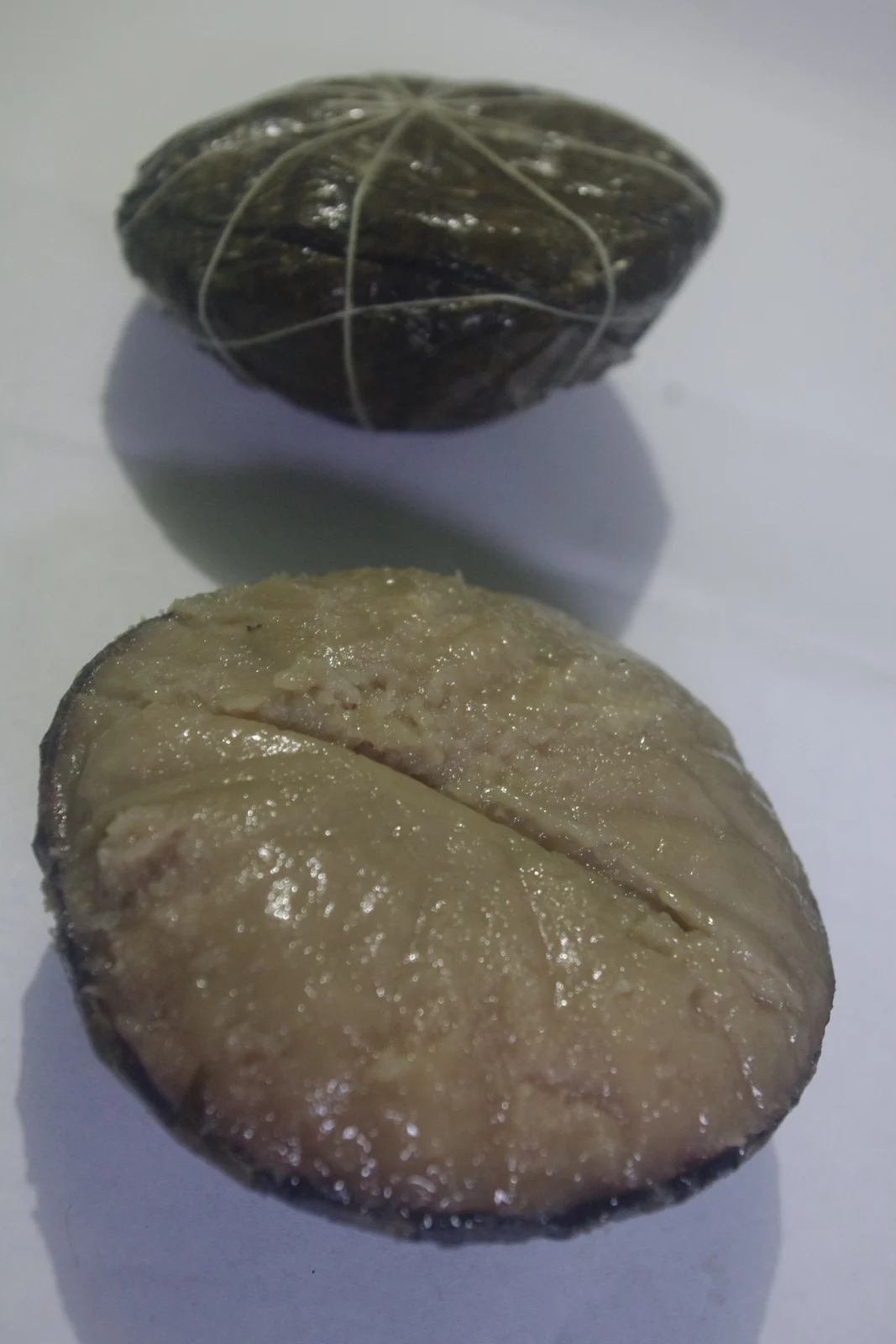
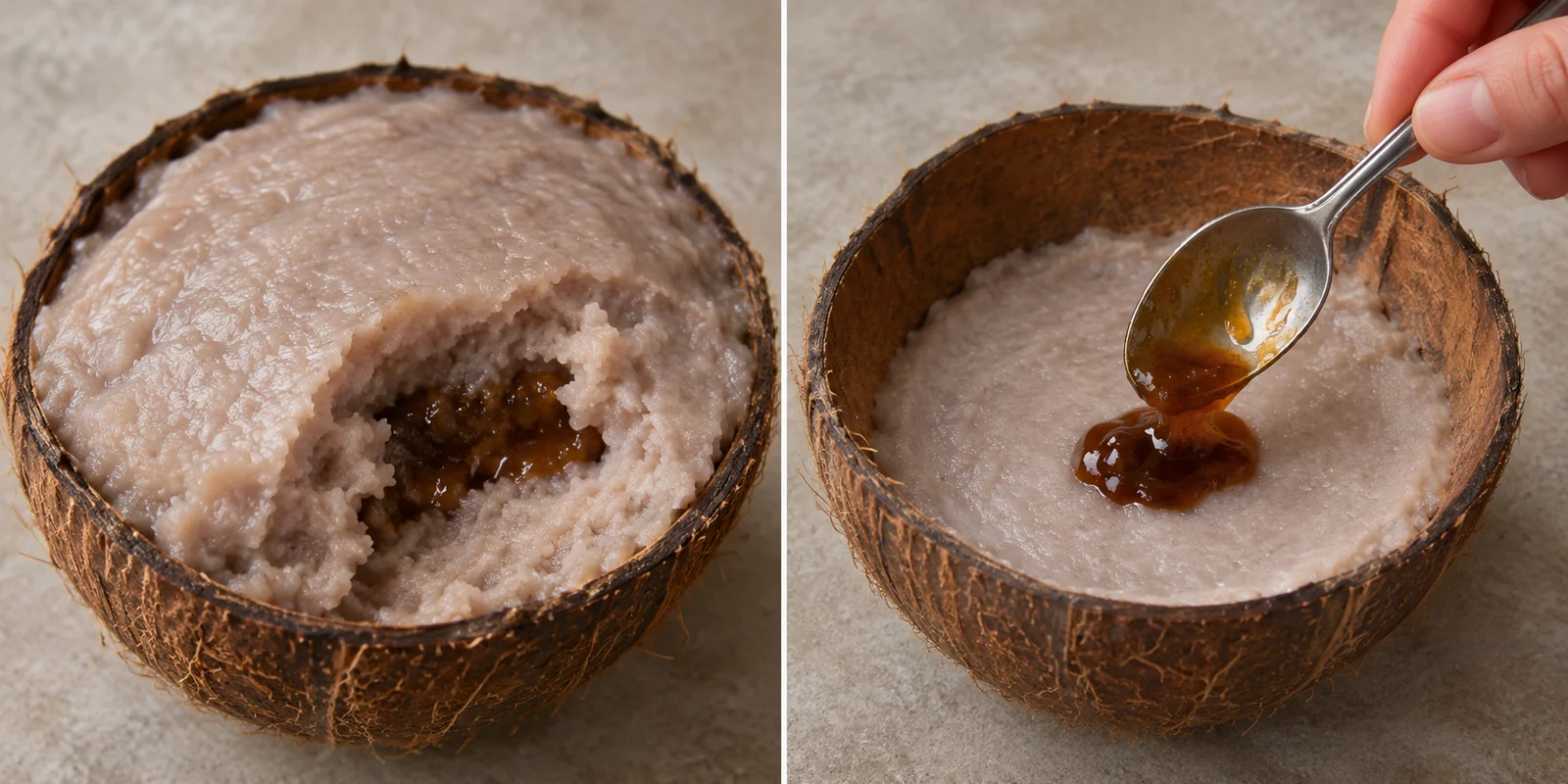
Place a coconut shell in your palm, untie the string, and lift off the banana leaf. The hemispherical shell is filled with a batter of grated root crop that has been cooked for a long time. Run a spoon along the rim and the batter lifts out following the curve of the shell. Keep eating toward the center and you reach a pocket of syrup made by cooking down sugar and coconut milk. Binagol is made in Dagami and other towns on Leyte in the central Philippines. The root crop is packed into a shell and closed with a leaf lid. Workshops in Dagami use a root crop called talyan, while makers in Pastrana, on the same island, use taro and cassava.
Filling the Shell from the Bottom, with Syrup in the Center
At the workshop of Terry and Teresa Ortega in Dagami, a layer of talyan batter is spread in a halved shell, sweet syrup is added, and another layer of root-crop batter is placed on top. Spooning from the surface, the first thing you touch is the root crop. Dig to the center and the syrup mixes in; scoop near the shell wall and the proportion of root crop is larger. A single shell has deep and shallow parts, and the position of the syrup cannot be seen from outside. The syrup does not set inside the shell as sweet liquid poured in from above. Instead, the trace of batter being put in twice, with syrup placed between the two layers, appears in the order in which you eat.
The coconut shell holds this shape during cooking and, once the binagol has cooled and been sold, becomes the vessel for eating it. A dictionary of Waray, the language spoken on Samar and Leyte, lists bagól as a word for a hard shell such as that of a coconut. Binagol also uses milk pressed from the coconut flesh, but the milk goes in when the batter and syrup are made. After the flesh has been removed, the shell travels with the confection through filling, wrapping, selling and eating. A trial on Leyte that filled the shell with other ingredients also used the name binagol, which suggests how closely the name is tied to the shell as an eating vessel.
Grating the Talyan and Combining It with the First Pressing
Carla Mortel, who visited the Ortega family, recorded talyan as a long, large root crop. The roots are washed, peeled and grated into a batter so fine that no shape remains. Coconut flesh is also grated, and the thick milk from the first pressing is added. The makers said they then use the thinner later pressings to keep the talyan batter moist. Sugar and peanuts also go into this batter. The product list for Terry’s, compiled by JICA and the Philippine Department of Trade and Industry, also includes glutinous rice. Setting the ingredients on the product list beside the order that can be gathered from the account of someone who watched the work shows that even a single workshop has to decide at which stage each ingredient goes in.
Kuukai Delicacies, which The Philippine Star covered in 2003, obtained talyan on Leyte and ground it by machine to even out the particle size. Interviews at Terry’s record that its talyan was bought from Samar. Even when confection-making towns are on the same island, the route by which the root crop arrives differs from one workshop to another. The purchased roots are peeled and cut small before being combined with the pressed liquid, so when a finished shell is opened, nothing remains of the size or shape the roots had when they were dug. The smoothness of the batter when it is leveled over the bottom and sides of the shell is connected to the grinding stage that evens out the particles.
At Terry’s, peeling and chopping the root crop, grating the coconut and pressing the milk are done on the first day; the ingredients are mixed and cooked the next day. JICA’s process chart also notes that the quantity to prepare was written on a whiteboard. Grating and pressing are tasks that come before the day the shells are lined up and set over the fire. Even if orders increase on another day, it is not enough simply to add empty shells and leaves. The root crop and pressed liquid are prepared first, and the filling is matched to the batch that goes into the pot, so the number of pieces that can be made is tied to the quantity prepared and to the next day’s work.
At this workshop, when large orders came in, a day’s work sometimes ran until late at night. An employee who answered the interview said that working long hours could affect the quality of the product. Afterward, the staff were reportedly split into two groups doing different tasks on the same day. This is an account of reorganizing the work so that duties were divided by process and several tasks proceeded on the same day. The seven hours of cooking shown in the process chart remain even when the hands-on work before and after is divided up. In deciding how many pieces to make and when to put them in the pot, the tasks to finish before cooking are separated from those done after cooling.
Tying the Leaf, Taking the Shell Out of the Pot and Retying It
The banana leaf covering the mouth of the shell is held in place with string wound around the outside. Mortel’s record of her workshop visit describes putting the shells in a large pot, adding water and keeping it at a boil for at least 7 hours. In JICA’s process chart, the cooking at Terry’s is described as "steaming," followed by 2 hours of cooling after the 7 hours. Of the two sources on the same workshop, it is the visit record that mentions how the shells are placed in the water. Reading separately the flow common to both (leaf-closed shells set in a pot, cooked for a long time, then cooled) and the example that specifies where the water is helps avoid confusing the state of the cooking.
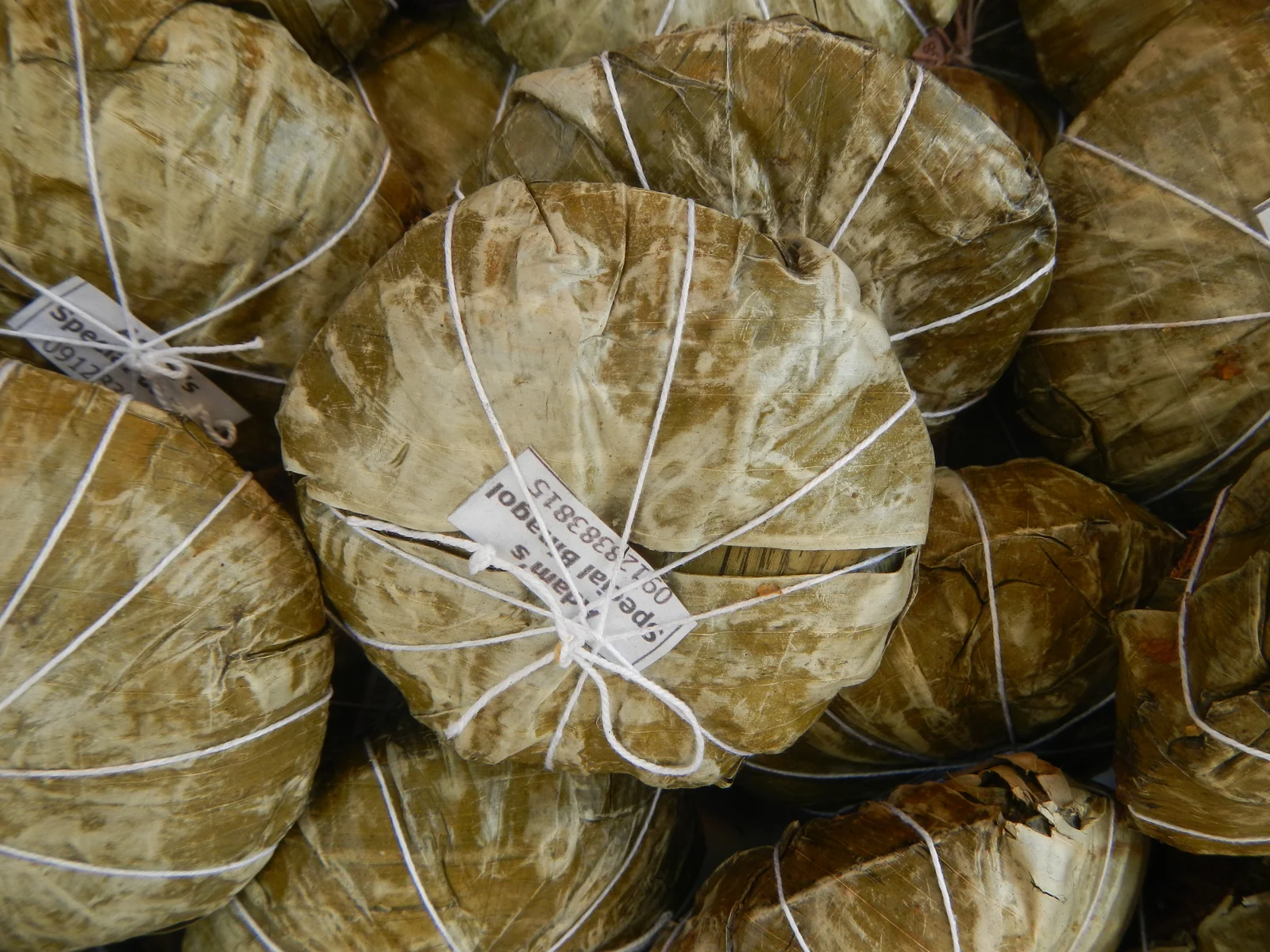
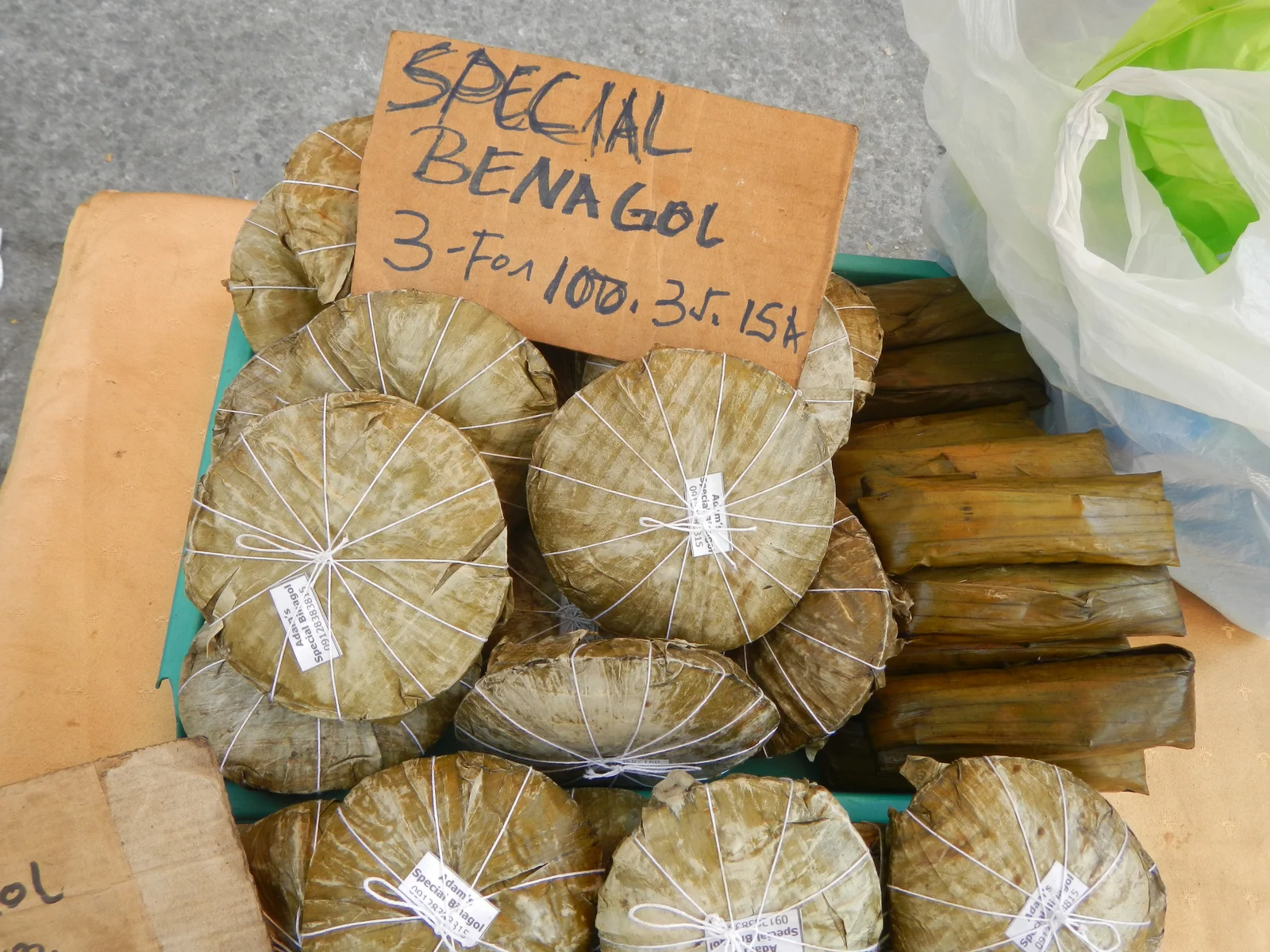
The string that secures the leaf before the shells go into the pot serves to keep the mouth of the shell covered during cooking. Mortel recorded that the shells were taken out of the water, dried, and the leaves retied with new string. JICA’s process chart also shows a step in which, after cooling, the leaf is removed once, tidied, and string and a label are attached. Whether the leaf is replaced after cooking or the same leaf is tidied cannot be determined uniformly from the sources. The string and price tag visible in photographs of a sales counter belong to this final tying stage. By holding the shell beneath the leaf, you can hand over each piece one at a time without touching the confection directly.
In Pastrana, Leaves Are Also Laid Inside the Shell
In the method of Virginia Orollo, who lives in Lourdes, Pastrana, Leyte, banana leaf is first laid inside the shell as well. According to Sulong, a Tagalog-language magazine covering local small businesses, the batter contains grated taro and cassava, condensed milk, margarine and egg yolks. Batter and syrup are layered as in the Ortega family’s Dagami version, but this means that, when the confection is opened, there are versions packed with the batter directly against the shell all the way to the bottom and versions packed with a leaf between the two.
The latik that Orollo places between the layers of batter is a syrup made by simmering pressed coconut milk while stirring, adding brown sugar, vanilla and margarine, and cooling it once it has thickened. Syrup and peanuts are placed on the batter already laid down, the root-crop mixture is added, and then the mouth of the shell is also covered with a leaf and wound with string. Because the coconut liquid is mixed into the batter, every spoonful tastes of it together with the root crop, while the syrup, placed in one spot, tastes strongly sweet when the spoon reaches it. The peanuts in this version are likewise encountered when you reach the layer where they were placed.
Orollo’s method puts water in the pot and cooks the shells for 8 hours from the time the water starts to boil. Setting this beside Terry’s 7 hours as mere numbers is not a comparison, because the two were not tested under the same conditions with a paste of two root crops and a talyan batter. Shell size is not given as a shared standard either. What the two share is the sequence: shells closed with leaf lids are cooked for a long time, then cooled before being served. For a mass of batter to be scooped together with the syrup portion, both the layering before the shells go into the pot and their state after cooling come into play.
Orollo’s family sold farm produce such as vegetables and cassava, along with handmade sweets. Orollo told Sulong that she honed her skills from the 1980s on the basis of methods she had learned from the family business. The confection also came to be sold at souvenir stalls in Carigara, outside Pastrana. The work learned at home (choosing the root crop and peanuts and finally closing the shell with leaves) becomes a package that can be carried home without coming undone, even from stalls outside the town.
From the Town Where It Is Made to the Hands of Those Who Take It Home
According to a 2009 interview in JICA’s case studies, the previous generation at Terry’s worked for another binagol maker in the 1960s and started the business in 1973. The daughter and her husband said that, after helping in the business, they took over in 2001. What can be traced here is the years in which one workshop in Dagami learned the work and passed it on. The place of production and the place of sale are also not the same. The family sold in central Tacloban as well, and later opened a shop on a street that souvenir shoppers pass. Together with the example of carrying binagol from Pastrana to Carigara, this shows that the shell, as an individual container for each piece, also helps when the confection is sent outside the town where it is made.
In the Philippines, items brought home for family and acquaintances when returning from a trip or outing are called pasalubong. A customer from Cebu who visited the sales outlet in Tacloban bought 12 binagol that he had sampled there and took them home packed in a cardboard box. The string tied around each shell by the artisan is useful not only for handing one piece to each person but also for keeping the batter covered when many packages are carried together. Before the binagol go into boxes, a Department of Trade and Industry counselor and the shop reviewed the labels, which had looked much alike, and enlarged the workshop name so that buyers could tell where each was made.
In the Terry’s interview, they said that in 2007 they were selected under the One Town, One Product program, which supports local specialties, and registered the business with the Department of Trade and Industry. Support staff visited the shop, checked conditions at the workshop and the sales area, and proposed improvements one by one, beginning with the labels. Later, making carrying bags and boxes from local materials was also considered. The work of identifying the maker of a single package with a small tag and the work of designing the outer box in which a person carries several are recorded separately.
Terry’s has records of making chocolate-filled and salted-egg-filled versions to order, separate from its regular products. On days when slightly more than the ordered quantity came out, the extras were also put on sale in the shop. Some products can be told apart from the regular talyan type only by reading the label and opening the package. Furthermore, in Baybay, Leyte, researchers made trial batches of a different binagol using makapuno, a coconut with soft flesh. The makapuno flesh was steamed and soaked in sugar syrup, heated in a pot with stirring, dried, packed into shells and finally heat-sterilized under pressure. The layers of root crop that appear when a Dagami confection is opened differ from the trial in which the flesh is processed first and then packed into the shell: even though the shells look alike, the ingredient that is heated and the order of the steps are different.
In the study, makapuno flesh obtained from a cultivation plot was tested with refined sugar, brown sugar and muscovado, each at concentrations of 30, 40 and 50 percent. In the sensory evaluation, what was related to overall liking in that test was the concentration rather than the type of sugar. This is a result from comparing prototypes made with the flesh. When you eat binagol from a workshop, the proportion of root crop and syrup also varies with where you scoop. Taken together, packing the root crop above and below, placing the sweet part in the center, and even the order of eating once the leaf is untied explain the Dagami and Pastrana versions.
Glossary
- talyan
- The root crop used by makers in Dagami. The sources describe it as a type of large taro.
- latik
- A name for a finishing touch or filling in confections made with coconut. In Orollo’s method described here, it is a syrup made by cooking down coconut milk with brown sugar and other ingredients.
- pasalubong
- A souvenir brought home for family and acquaintances on returning from a trip or outing. Confections for this purpose are sold at outlets in Tacloban and Carigara.
- makapuno
- A coconut with soft flesh on the inside. In this article, it is the material for the research trial on Leyte that uses the flesh.


